Archive for cosmological simulations

Weekly Update from the Open Journal of Astrophysics – 06/06/2026

Posted in OJAp Papers, Open Access, The Universe and Stuff with tags , , , , , , , , , , , , , , , , , , , , , , on June 6, 2026 by telescoper

Another Saturday, another update of activity at the Open Journal of Astrophysics. Since the last update we have published a further five papers, bringing the number in Volume 9 (2026) to 119 and the total so far published by OJAp up to 567.

I will continue to include the posts made on our Mastodon account (on Fediscience); these announcements also show the DOI for each paper.

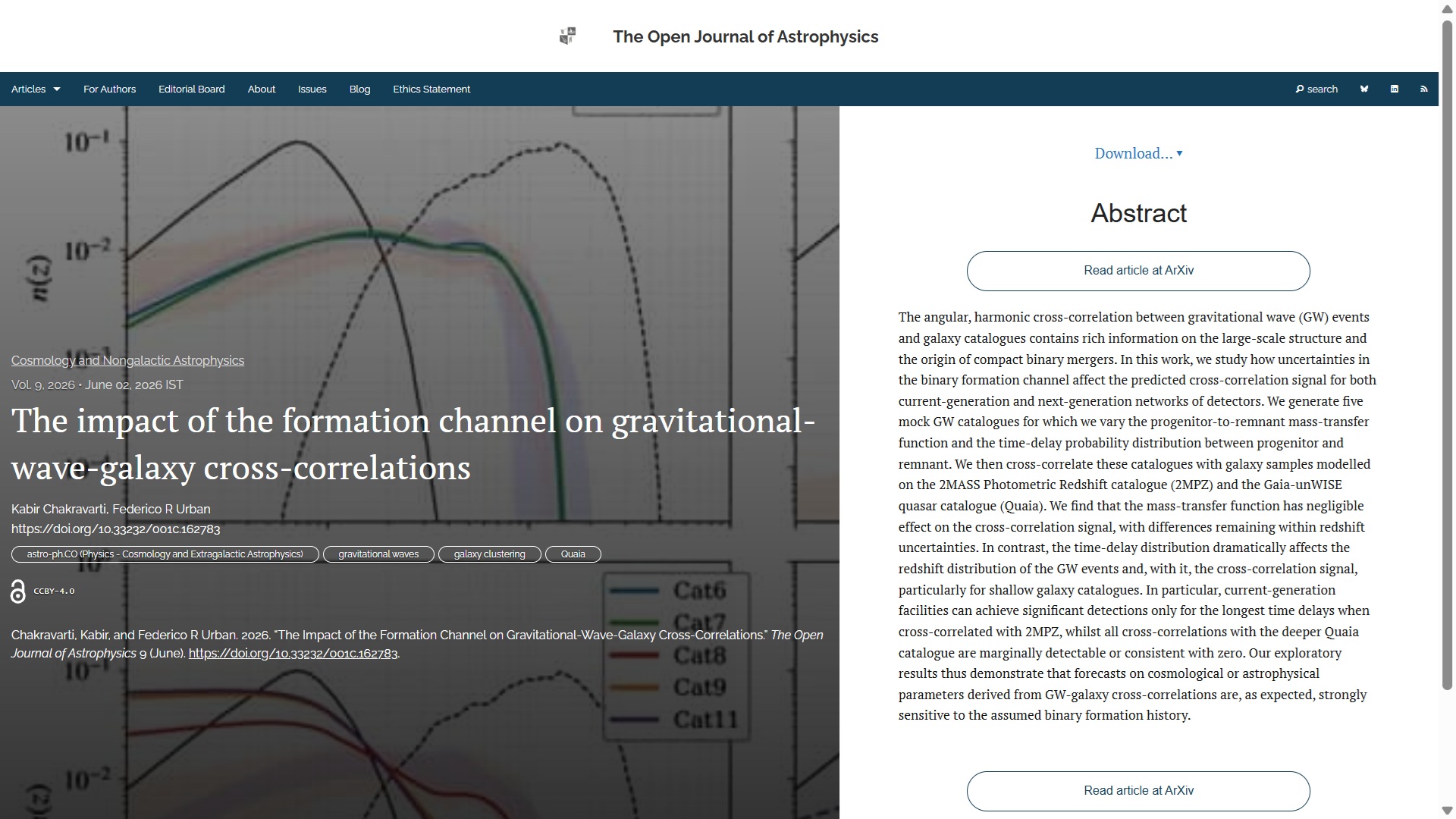
The first paper to report this week, published on Tuesday 2nd June, is “The impact of the formation channel on gravitational-wave-galaxy cross-correlations” by Kabir Chakravarti (Chennai Mathematical Institute, India) and Federico R Urban (CEICO-FZU, Czech Republic). This article, published in the folder Cosmology and Nongalactic Astrophysics, explores how uncertainties in binary formation affect the cross-correlation signal between gravitational wave events and galaxy catalogues, finding that time-delay distribution significantly impacts the signal.

The overlay for this paper is here

You can find the officially accepted version on arXiv here and the announcement on Fediverse here:

Open Journal of Astrophysics

New Publication at the Open Journal of Astrophysics: "The impact of the formation channel on gravitational-wave-galaxy cross-correlations" by Kabir Chakravarti (Chennai Mathematical Institute, India) and Federico R Urban (CEICO-FZU, Czech Republic)

doi.org/10.33232/001c.162783

June 2, 2026, 7:22 am 1 boosts 2 favorites

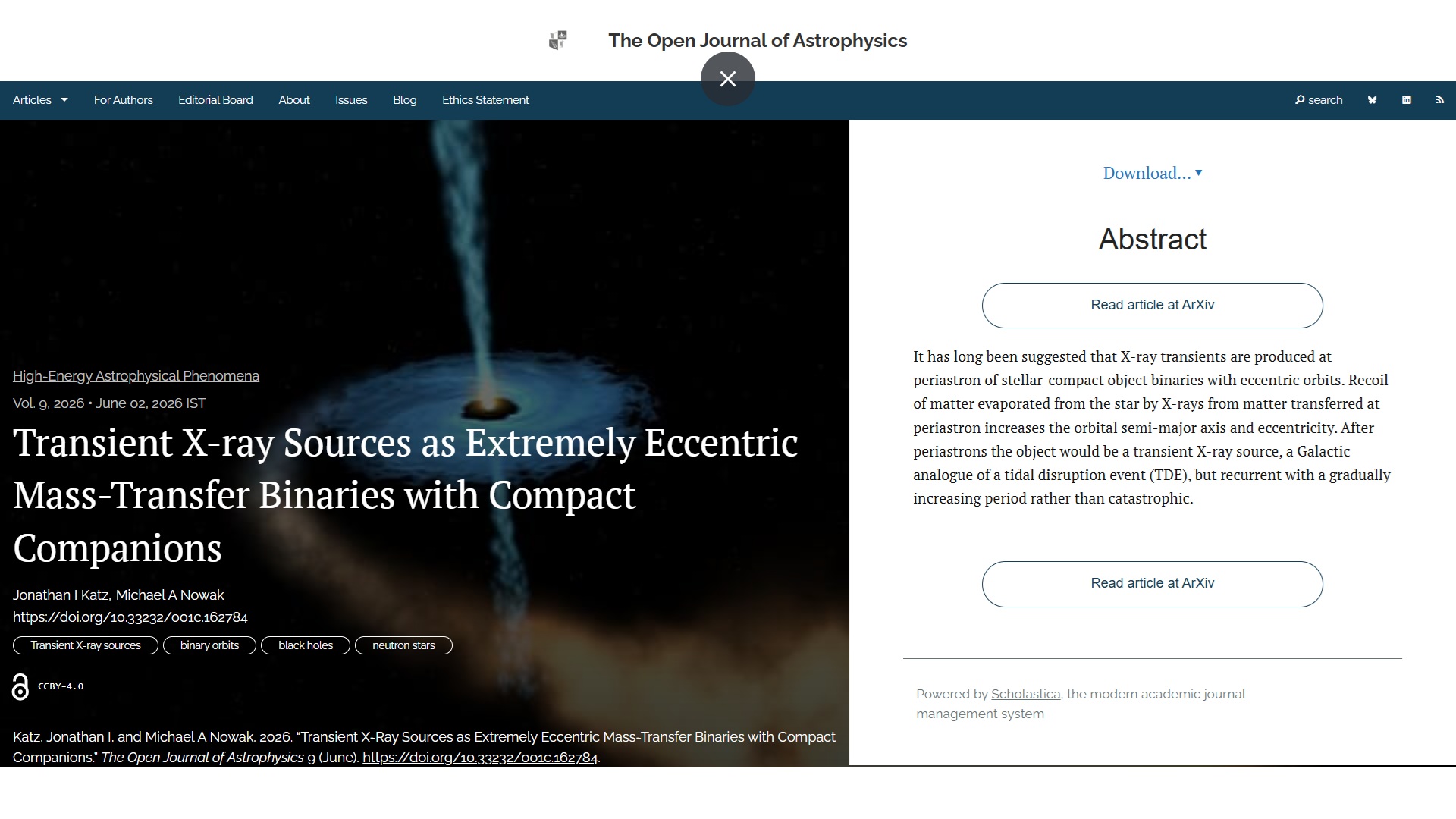
The second paper for this week, also published on Tuesday 2nd June but in the folder High-Energy Astrophysical Phenomena, is “Transient X-ray Sources as Extremely Eccentric Mass-Transfer Binaries with Compact Companions” by Jonathan I Katz and Michael A Nowak (Washington University, St Louis, USA). This article suggests that X-ray transients, similar to tidal disruption events, are produced in eccentric stellar-compact object binaries, with their frequency gradually increasing over time.

The overlay for this one looks like this:

The official version of the paper can be found on arXiv here and the Fediverse announcement here:

Open Journal of Astrophysics

New Publication at the Open Journal of Astrophysics: "Transient X-ray Sources as Extremely Eccentric Mass-Transfer Binaries with Compact Companions" by Jonathan I Katz and Michael A Nowak (Washington University, USA)

doi.org/10.33232/001c.162784

June 2, 2026, 7:44 am 1 boosts 1 favorites

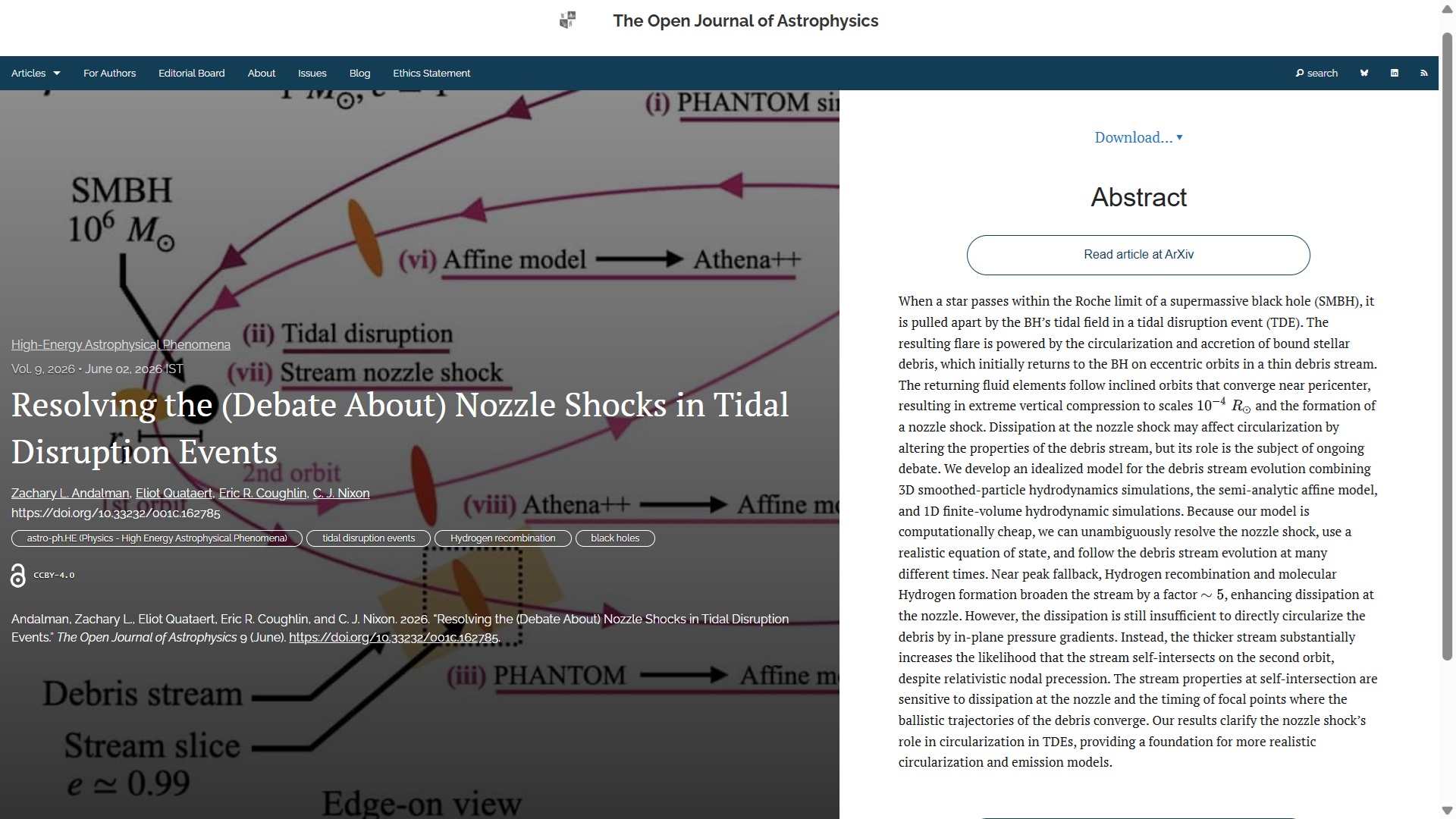
Next one up, the third paper of the week, also published on Tuesday 2nd June in the folder High-Energy Astrophysical Phenomena is “Resolving the (Debate About) Nozzle Shocks in Tidal Disruption Events” by Zachary L. Andalman & Eliot Quataert (Princeton U., USA), Eric R. Coughlin (Syracuse U. USA) and C. J. Nixon (U. Leeds, UK). This paper presents a model to understand the role of nozzle shocks in the circularization of stellar debris during a tidal disruption event when a star approaches a supermassive black hole (SMBH)

The overlay for this one is here:

The final, accepted version can be found on arXiv here and the Mastodon announcement is here:

Open Journal of Astrophysics

New Publication at the Open Journal of Astrophysics: "Resolving the (Debate About) Nozzle Shocks in Tidal Disruption Events" by Zachary L. Andalman & Eliot Quataert (Princeton U., USA), Eric R. Coughlin (Syracuse U. USA) and C. J. Nixon (U. Leeds, UK)

doi.org/10.33232/001c.162785

June 2, 2026, 7:52 am 1 boosts 1 favorites

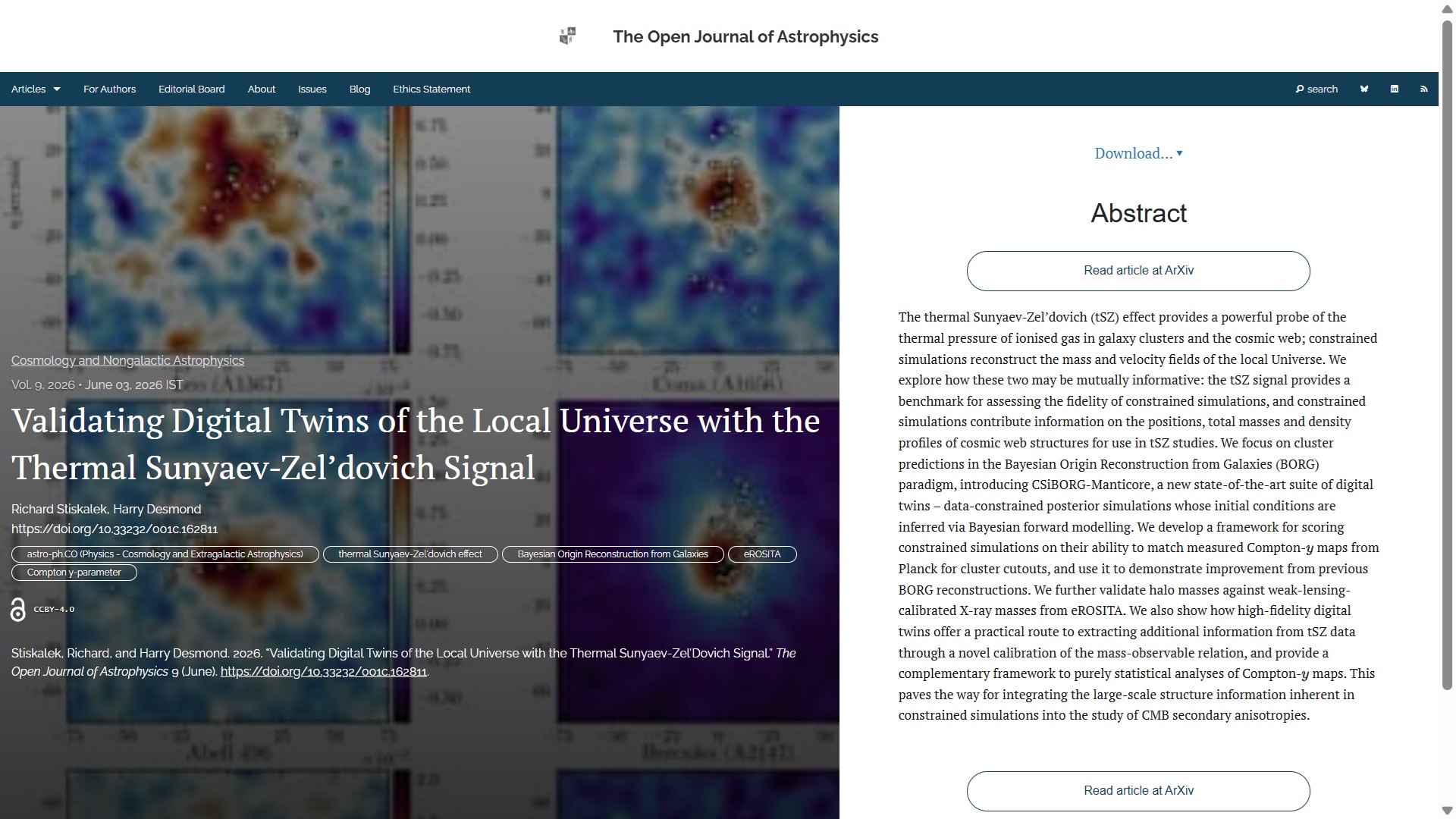
The fourth paper this week, published on Wednesday 3rd June in the folder Cosmology and Nongalactic Astrophysics, is “Validating Digital Twins of the Local Universe with the Thermal Sunyaev-Zel’dovich Signal” by Richard Stiskalek (University of Oxford, UK) and Harry Desmond (University of Portsmouth, UK). The thermal Sunyaev-Zel’dovich effect and constrained simulations are used to analyze the thermal pressure of ionized gas in galaxy clusters and produce a set of digital twins for cosmological study.

The overlay is here:

The officially accepted version can be found on arXiv here and here is the Mastodon announcement:

Open Journal of Astrophysics

New Publication at the Open Journal of Astrophysics: "Validating Digital Twins of the Local Universe with the Thermal Sunyaev-Zel’dovich Signal" by Richard Stiskalek (U. Oxford, UK) and Harry Desmond (U. Portsmouth, UK)

doi.org/10.33232/001c.162811

June 3, 2026, 5:15 am 1 boosts 1 favorites

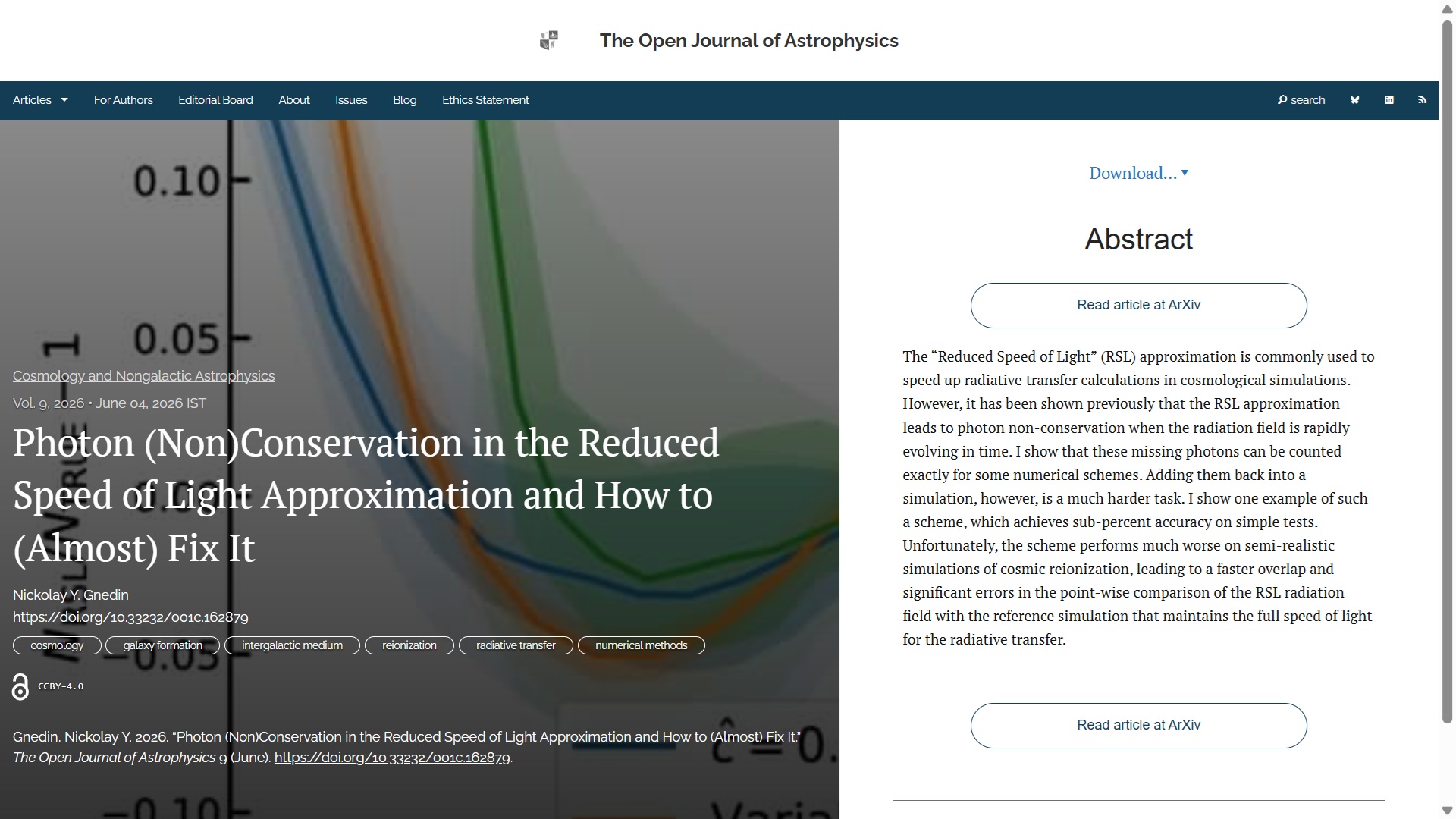
The fifth and final paper this week, published on Thursday 4th June in the folder Cosmology and Nongalactic Astrophysics is “Photon (Non)Conservation in the Reduced Speed of Light Approximation and How to (Almost) Fix It” by Nickolay Y. Gnedin (University of Chicago, USA). The “Reduced Speed of Light” approximation in cosmological simulations can lead to photon non-conservation, and while some missing photons can be counted, adding them back is challenging.

The overlay for this one is here:

The officially accepted version of this paper can be found on arXiv here and Mastodon announcement here

Open Journal of Astrophysics

New Publication at the Open Journal of Astrophysics: "Photon (Non)Conservation in the Reduced Speed of Light Approximation and How to (Almost) Fix It" by Nickolay Y. Gnedin (U. Chicago, USA)

doi.org/10.33232/001c.162879

June 4, 2026, 11:20 am 2 boosts 1 favorites

And that concludes this week’s update. I’ll do another one next Saturday.
Weekly Update from the Open Journal of Astrophysics – 30/05/2026

Posted in OJAp Papers, Open Access, The Universe and Stuff with tags , , , , , , , , , , , , , , , , , , on May 30, 2026 by telescoper

It’s Saturday once again, so it’s time for another update of activity at the Open Journal of Astrophysics. Since the last update we have published a further four papers, bringing the number in Volume 9 (2026) to 114 and the total so far published by OJAp up to 562.

I will continue to include the posts made on our Mastodon account (on Fediscience); these announcements also show the DOI for each paper.

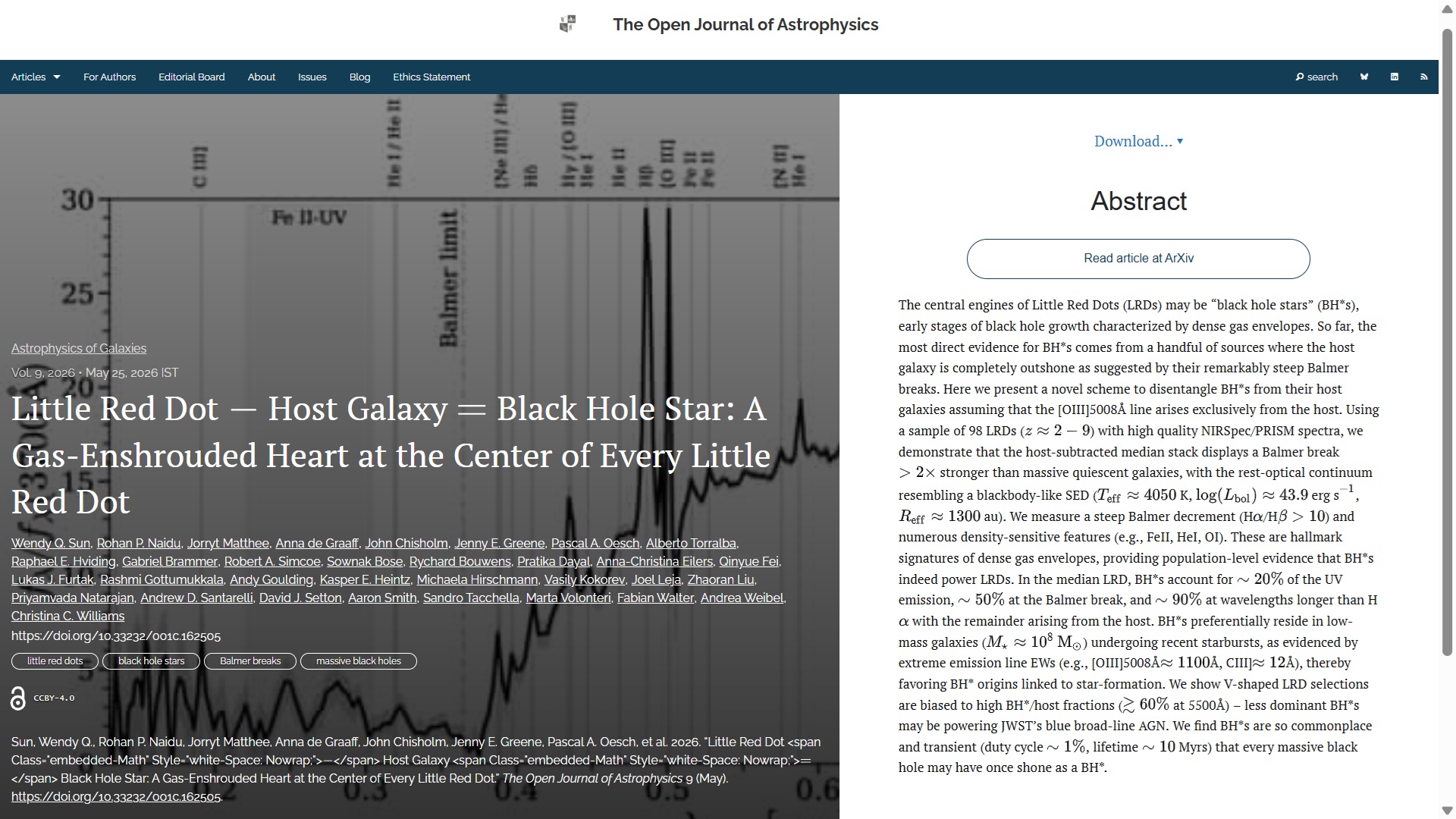
The first paper to report this week, published on Monday 25th May is “Little Red Dot – Host Galaxy = Black Hole Star: A Gas-Enshrouded Heart at the Center of Every Little Red Dot” by Wendy Q. Sun (MIT, USA) and 32 others from around the world. This study presents evidence that “black hole stars” (BH*), early stages of black hole growth, power Little Red Dots (LRDs) and every massive black hole may have been a BH*.

The overlay for this paper is here

You can find the officially accepted version on arXiv here and the announcement on Fediverse here:

Open Journal of Astrophysics

New Publication at the Open Journal of Astrophysics: "Little Red Dot – Host Galaxy = Black Hole Star: A Gas-Enshrouded Heart at the Center of Every Little Red Dot" by Wendy Q. Sun (MIT, USA) and 32 others from around the world.

doi.org/10.33232/001c.162505

May 25, 2026, 7:13 am 1 boosts 0 favorites

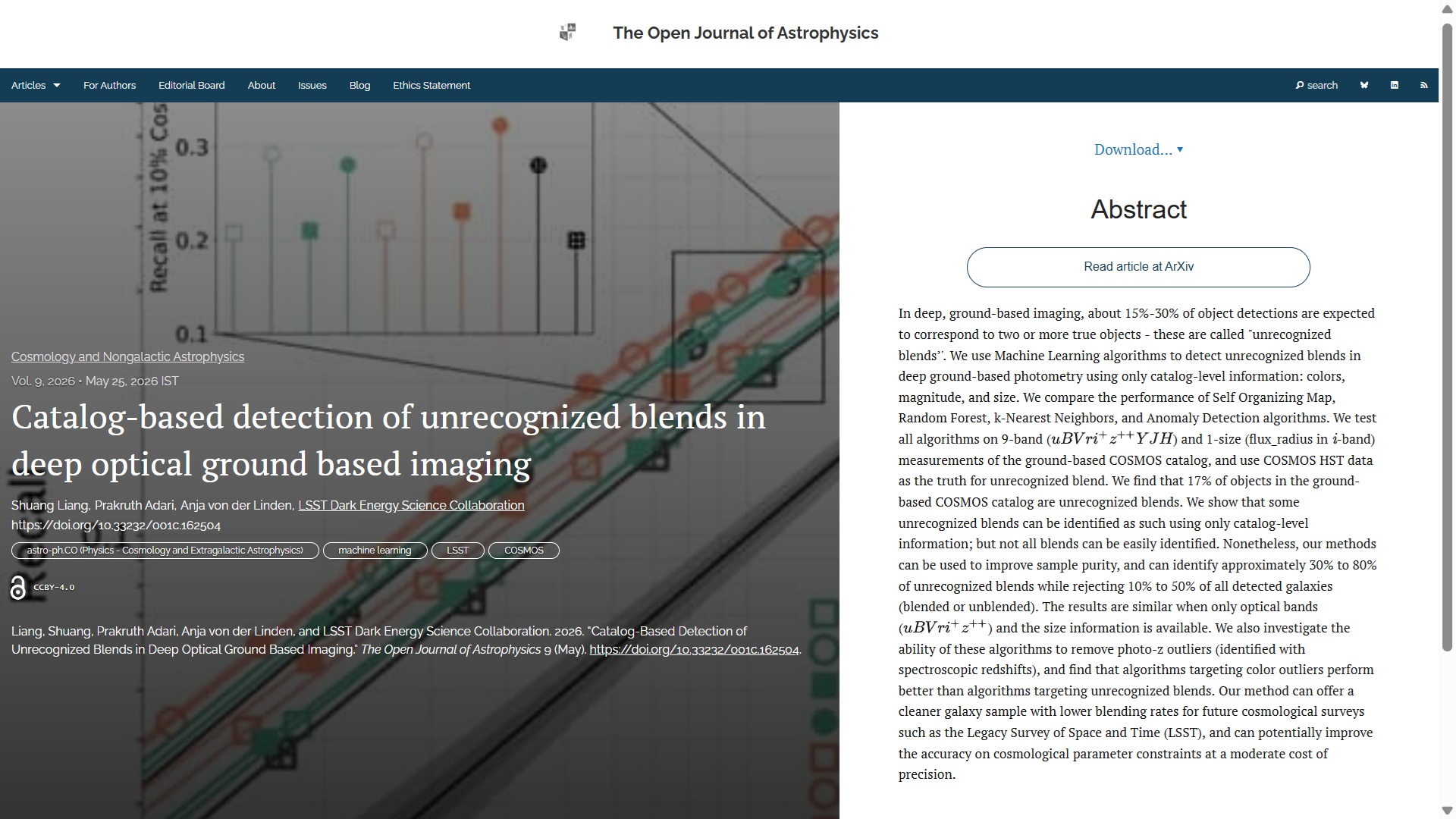
The second paper for this week, also published on Monday 25th May but in the folder Cosmology and Nongalactic Astrophysics, is “Catalog-based detection of unrecognized blends in deep optical ground based imaging” by Shuang Liang (Stanford U., USA) and Prakruth Adari & Anja von der Linden (Stony Brook U., USA) on behalf of the LSST Dark Energy Science Collaboration. The study uses machine learning to detect unrecognized blends in deep ground-based imaging, improving sample purity and potentially enhancing accuracy in future cosmological surveys.

The overlay for this one is here:

The official version of the paper can be found on arXiv here and the Fediverse announcement here:

Open Journal of Astrophysics

New Publication at the Open Journal of Astrophysics: "Catalog-based detection of unrecognized blends in deep optical ground based imaging" by Shuang Liang (Stanford U., USA) and Prakruth Adari & Anja von der Linden (Stony Brook U., USA) on behalf of the LSST Dark Energy Science Collaboration

doi.org/10.33232/001c.162504

May 25, 2026, 7:30 am 1 boosts 1 favorites

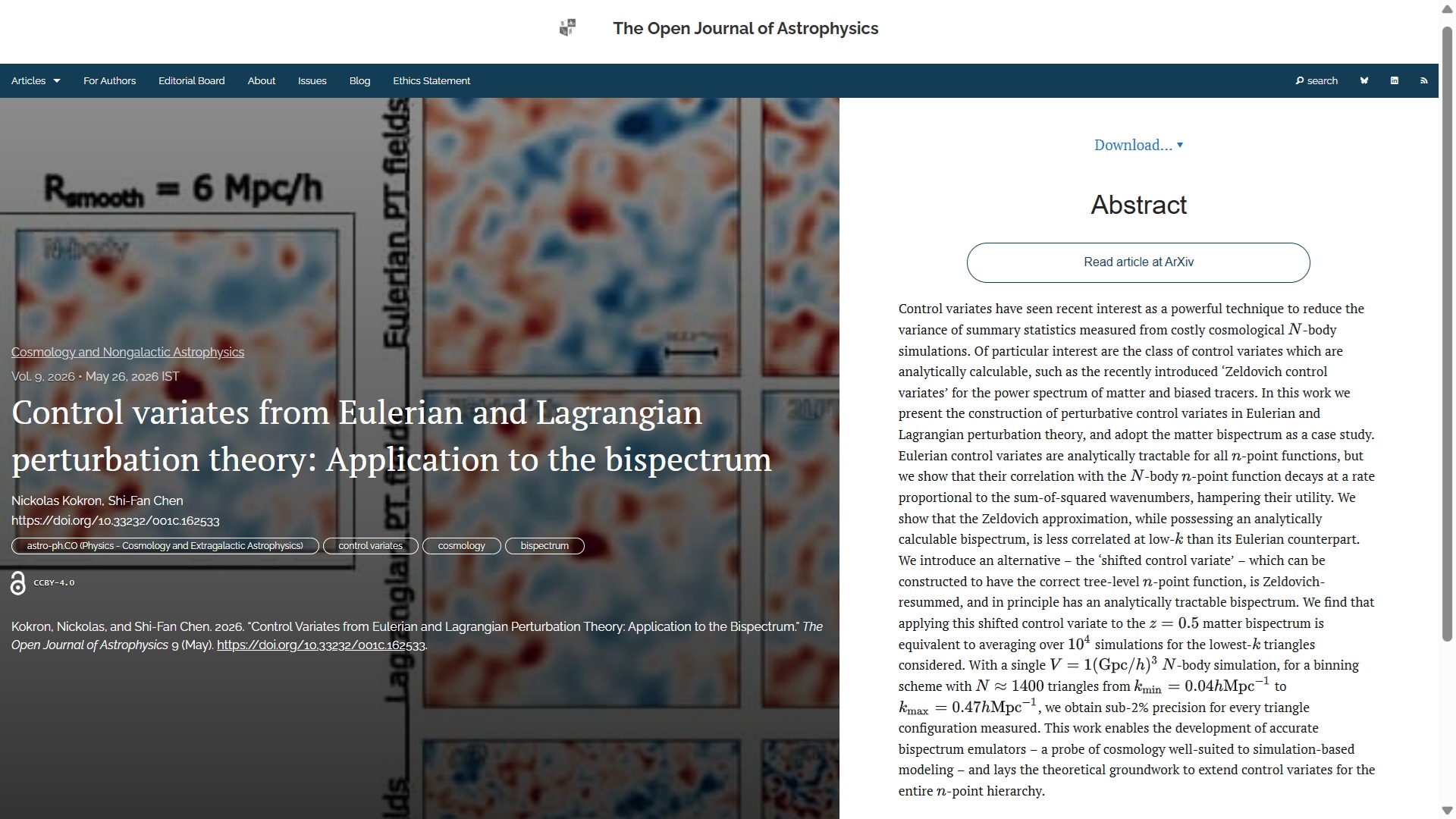
Next one up, the third paper of the week, published on Tuesday 26th May in the folder Cosmology and Nongalactic Astrophysics is “Control variates from Eulerian and Lagrangian perturbation theory: Application to the bispectrum” by Nickolas Kokron and Shi-Fan Chen (Institute for Advanced Study, Princeton, USA). This paper hexplores the use of control variates in cosmological simulations, introducing a new ‘shifted control variate’ that improves precision and enables accurate bispectrum emulators, aiding in cosmology modeling.

The overlay for this one is here:

The final, accepted version can be found on arXiv here and the Mastodon announcement is here:

Open Journal of Astrophysics

New Publication at the Open Journal of Astrophysics: "Probing Dark Energy Microphysics with kSZ Tomography" by Julius Adolff, Selim Hotinli and Neal Dalal (Perimeter Institute, Canada)

doi.org/10.33232/001c.162336

May 18, 2026, 7:04 am 1 boosts 0 favorites

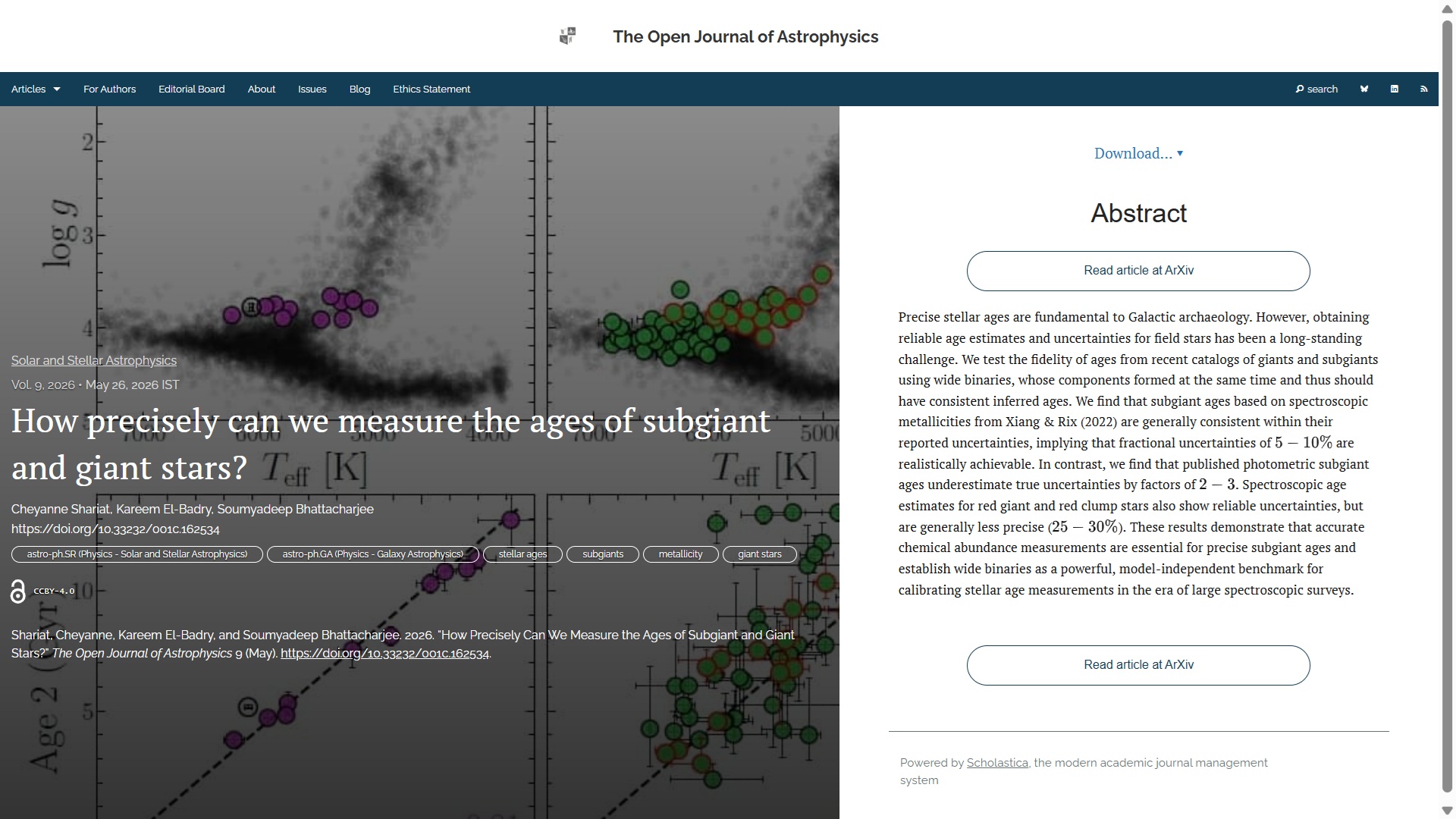
The fourth and final paper this week, also published on Tuesday 26th May is “How precisely can we measure the ages of subgiant and giant stars?” by Cheyanne Shariat, Kareem El-Badry and Soumyadeep Bhattacharjee (California Institute of Technology, USA). This article, published in the folder Solar and Stellar Astrophysics, is about testing the accuracy of stellar age estimates from recent catalogs, finding that spectroscopic metallicities provide reliable subgiant ages, while photometric ages underestimate uncertainties. Accurate chemical abundance measurements are essential.

The overlay is here:

The officially accepted version can be found on arXiv here and here is the Mastodon announcement:

Open Journal of Astrophysics

New Publication at the Open Journal of Astrophysics: "How precisely can we measure the ages of subgiant and giant stars?" by Cheyanne Shariat, Kareem El-Badry and Soumyadeep Bhattacharjee (California Institute of Technology, USA)

doi.org/10.33232/001c.162534

May 26, 2026, 7:05 am 1 boosts 0 favorites

And that concludes this week’s update. I’ll do another one next Saturday.
Weekly Update from the Open Journal of Astrophysics – 23/05/2026

Posted in OJAp Papers, Open Access, The Universe and Stuff with tags , , , , , , , , , , , , , , , , , , , , , , , , , , , , , , , , , , on May 23, 2026 by telescoper

It’s Saturday once again, so time for another update of activity at the Open Journal of Astrophysics. Since the last update we have published a further six papers, bringing the number in Volume 9 (2026) to 110 and the total so far published by OJAp up to 558.

I will continue to include the posts made on our Mastodon account (on Fediscience); these announcements also show the DOI for each paper.

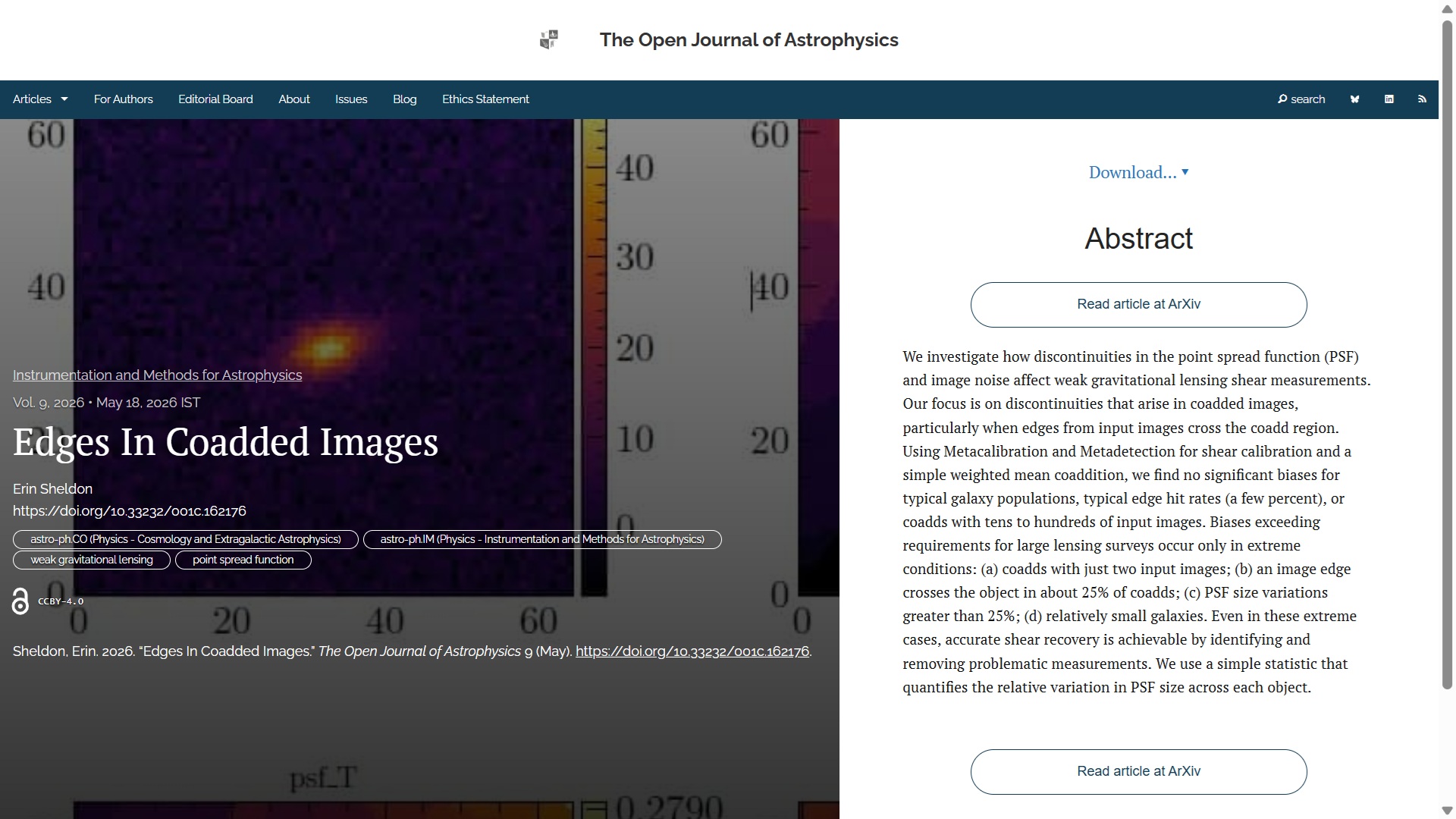
The first paper to report this week, published on Monday 18th May in the folder Instrumentation and Methods for Astrophysics is “Edges In Coadded Images” by Erin Sheldon (Brookhaven National Laboratory, USA). This paper describes a study exploring how image discontinuities and noise impact weak gravitational lensing measurements, finding no significant biases under typical conditions. Biases occur only in extreme cases, but can be mitigated.

The overlay for this paper is here

You can find the officially accepted version on arXiv here and the announcement on Fediverse here:

Open Journal of Astrophysics

New Publication at the Open Journal of Astrophysics: "Edges In Coadded Images" by Erin Sheldon (Brookhaven National Laboratory, USA)

doi.org/10.33232/001c.162176

May 18, 2026, 6:43 am 1 boosts 0 favorites

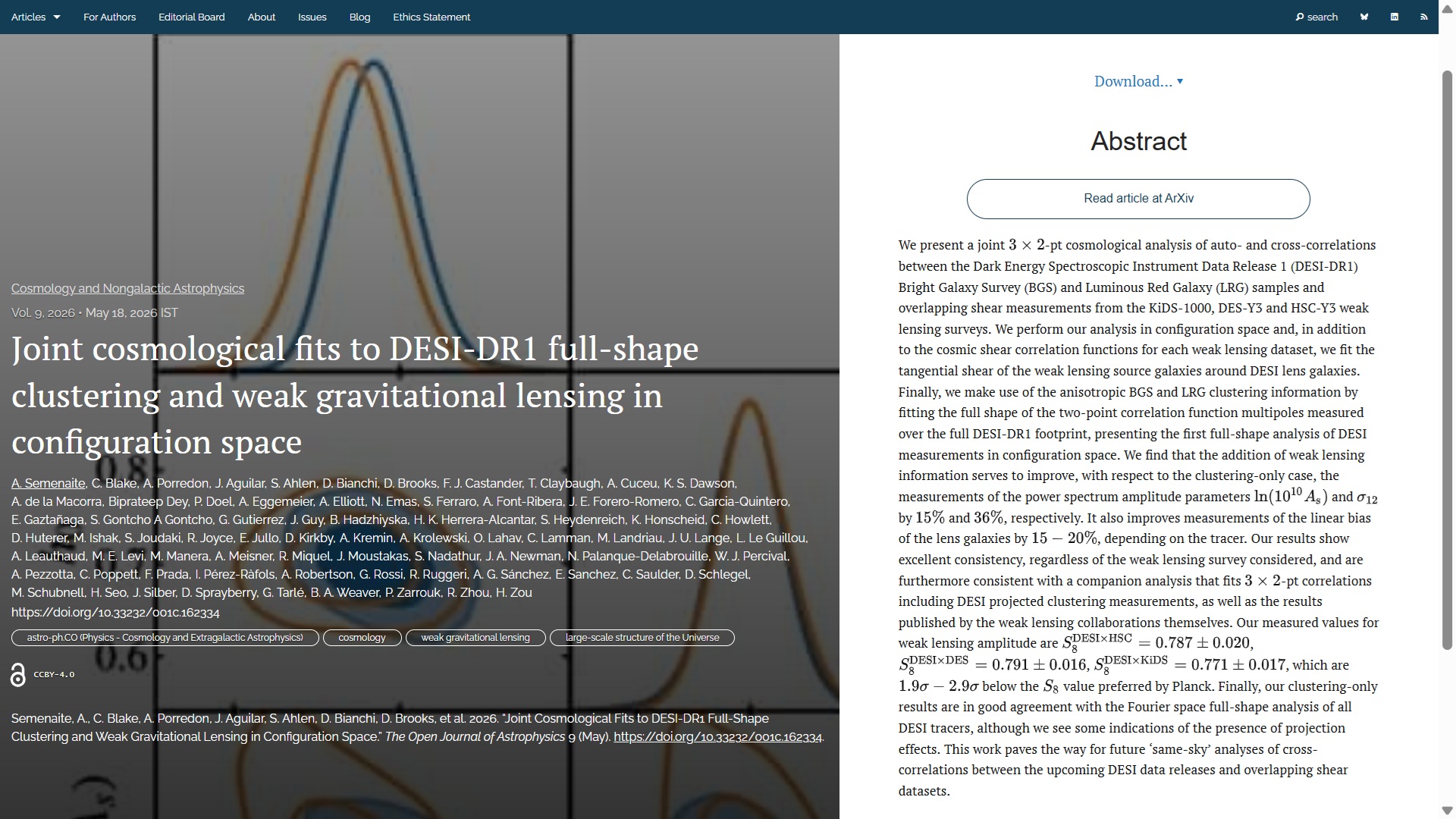
The second paper for this week, also published on Monday 18th May but in the folder Cosmology and Nongalactic Astrophysics, is “Joint cosmological fits to DESI-DR1 full-shape clustering and weak gravitational lensing in configuration space” by A. Semenaite (Swinburne Institute of Technology, Australia) and 72 other authors from all round the world. This paper presents a cosmological analysis of correlations between the DESI-DR1 Bright Galaxy Survey and Luminous Red Galaxy samples and overlapping shear measurements from various weak lensing surveys.

The overlay for this one is here:

The official version of the paper can be found on arXiv here and the Fediverse announcement here:

Open Journal of Astrophysics

New Publication at the Open Journal of Astrophysics: "Joint cosmological fits to DESI-DR1 full-shape clustering and weak gravitational lensing in configuration space " by A. Semenaite (Swinburne Institute of Technology, Australia) and 72 others from all round the world.

doi.org/10.33232/001c.162334

May 18, 2026, 6:52 am 1 boosts 1 favorites

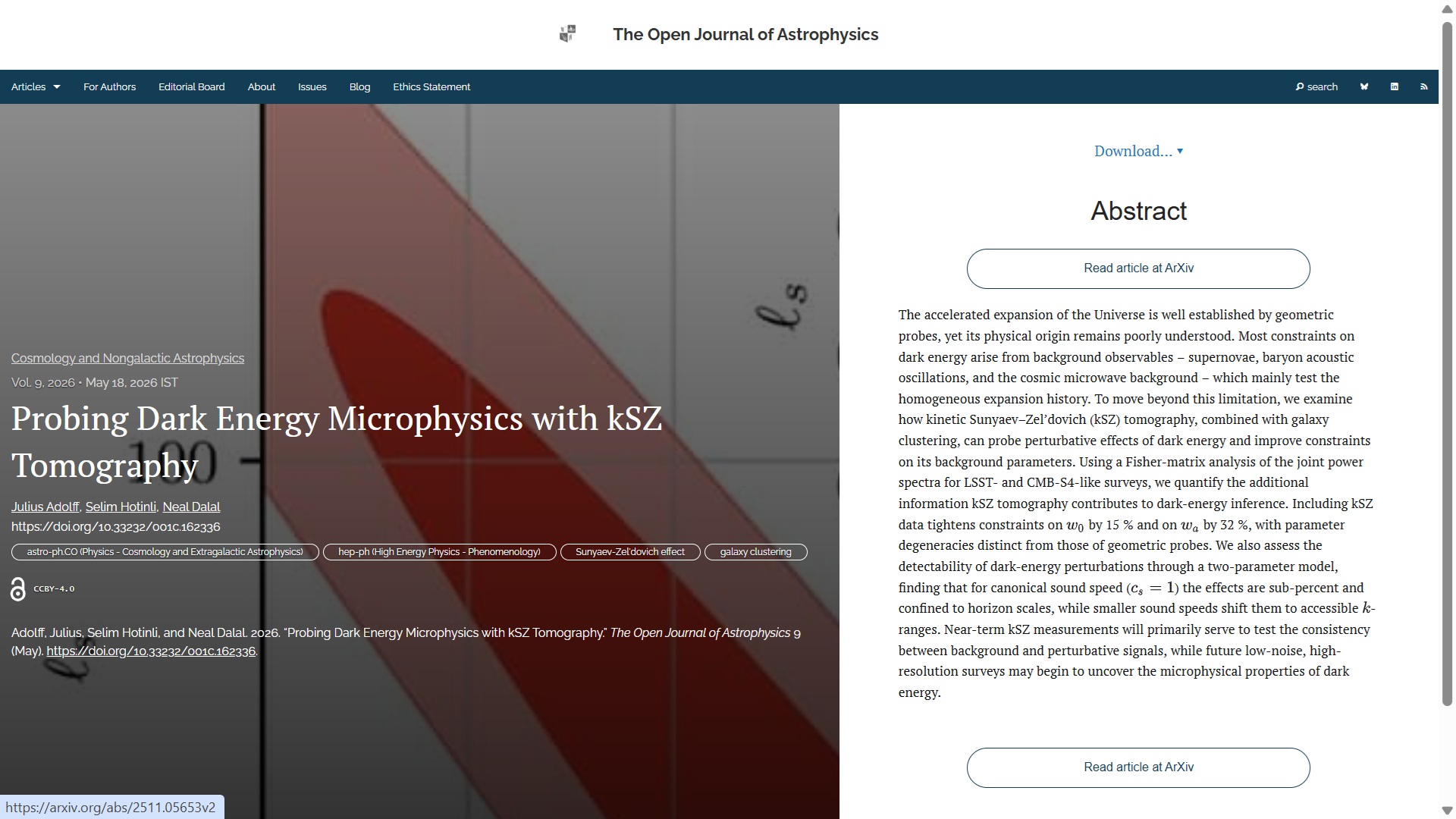
Next one up, the third paper of the week, and the third published on Monday 18th May, and in the folder Cosmology and Nongalactic Astrophysics is “Probing Dark Energy Microphysics with kSZ Tomography” by Julius Adolff, Selim Hotinli and Neal Dalal (all of the Perimeter Institute, Canada). This paper explores how kinetic Sunyaev-Zel’dovich tomography and galaxy clustering can enhance our understanding of dark energy and its effects, potentially revealing its microphysical properties in future surveys.

The overlay for this one is here:

The final, accepted version can be found on arXiv here and the Mastodon announcement is here:

Open Journal of Astrophysics

New Publication at the Open Journal of Astrophysics: "Probing Dark Energy Microphysics with kSZ Tomography" by Julius Adolff, Selim Hotinli and Neal Dalal (Perimeter Institute, Canada)

doi.org/10.33232/001c.162336

May 18, 2026, 7:04 am 1 boosts 0 favorites

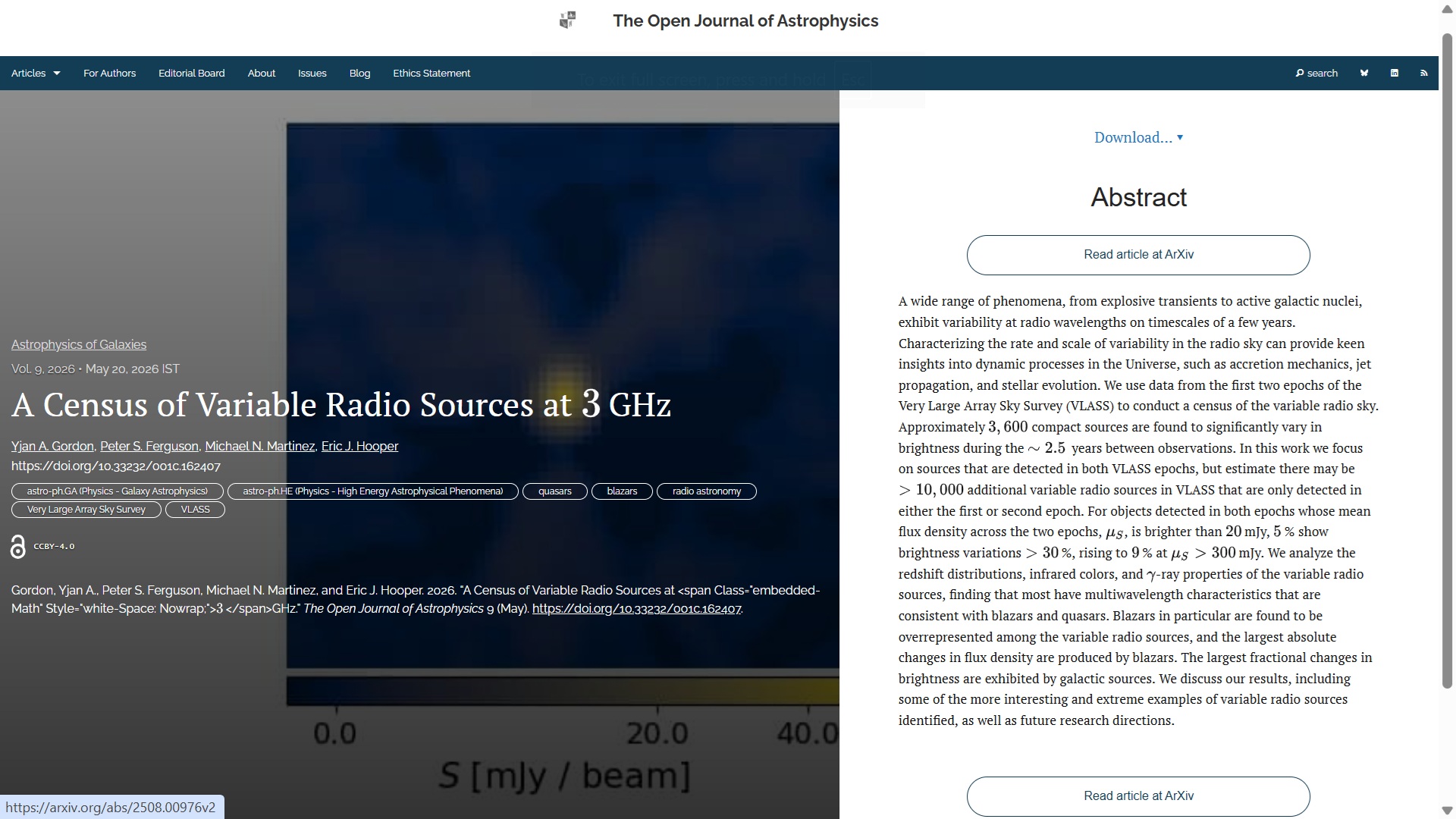
The fourth paper this week, published on Wednesday May 20th is “A Census of Variable Radio Sources at 3 GHz” by Yjan A. Gordon, Peter S. Ferguson, Michael N. Martinez and Eric J. Hooper (all of the University of Wisconsin, USA). This article, published in the folder Astrophysics of Galaxies, uses data from the Very Large Array Sky Survey to analyze variability in the radio sky, finding most changes consistent with blazars and quasars.

The overlay is here:

The officially accepted version can be found on arXiv here and here is the Mastodon announcement:

Open Journal of Astrophysics

New Publication at the Open Journal of Astrophysics: "A Census of Variable Radio Sources at 3 GHz" by Yjan A. Gordon, Peter S. Ferguson, Michael N. Martinez & Eric J. Hooper (U. Wisconsin, USA)

doi.org/10.33232/001c.162407

May 20, 2026, 2:52 pm 0 boosts 2 favorites

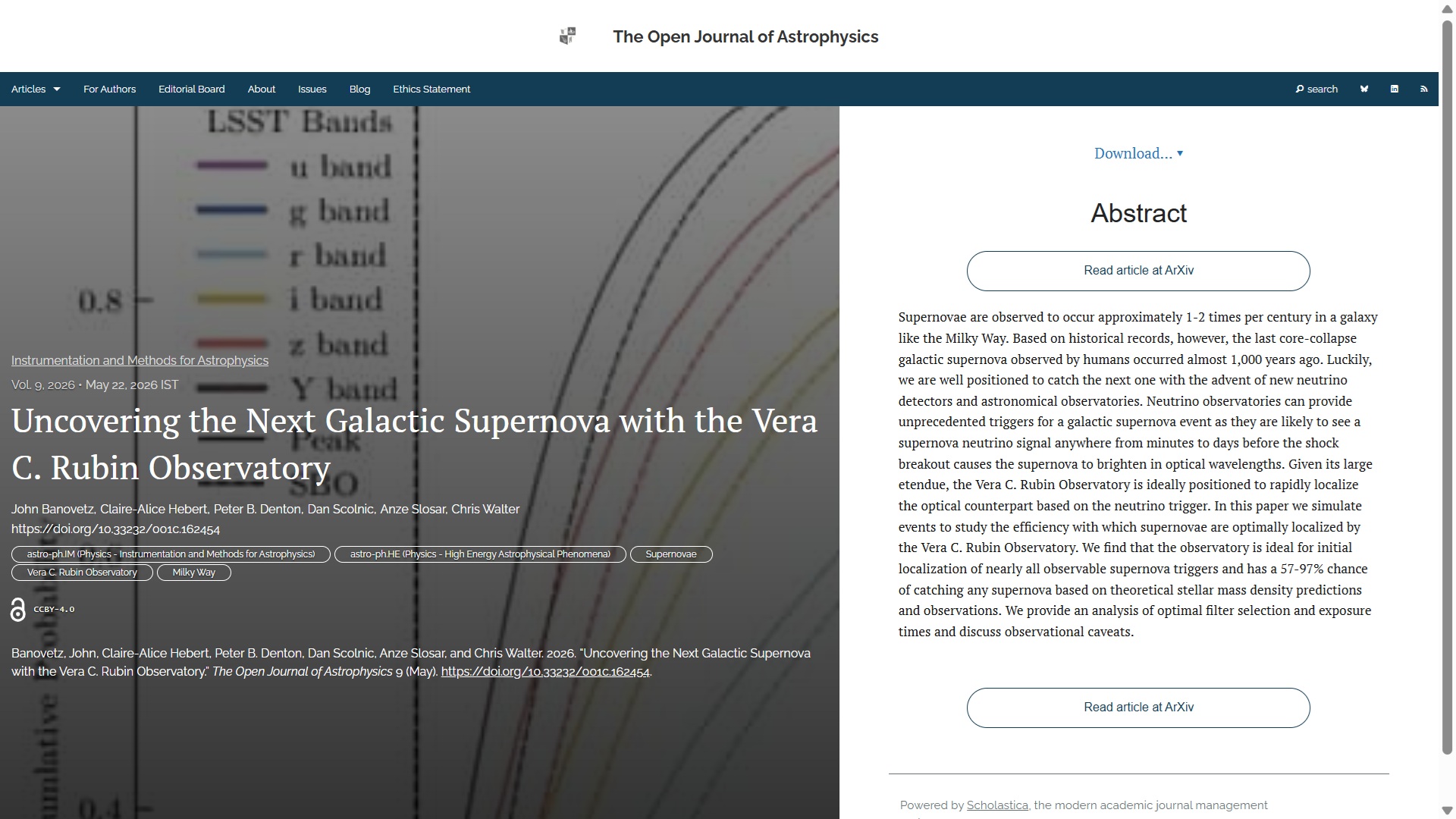
The fifth article of this week was published on Friday 22nd May in the folder Instrumentation and Methods for Astrophysics. The title is “Uncovering the Next Galactic Supernova with the Vera C. Rubin Observatory” by John Banovetz (Lawrence Berkeley Lab., USA), Claire-Alice Hebert & Peter B. Denton (Brookhaven National Lab., USA), Dan Scolnic (Duke University, USA), Anze Slosar (Brookhaven) and Chris Walter (Duke). The paper presents a study simulating how effectively the Vera C. Rubin Observatory can localize supernovae using neutrino triggers, finding a 57-97% success rate based on stellar mass density predictions.

The overlay is here:

You can find the authorized version of this paper on arXiv here and the Fediverse announcement is here:

Open Journal of Astrophysics

New Publlication at the Open Journal of Astrophysics: "Uncovering the Next Galactic Supernova with the Vera C. Rubin Observatory" by John Banovetz (Lawrence Berkeley Lab., USA), Claire-Alice Hebert & Peter B. Denton (Brookhaven National Lab., USA) , Dan Scolnic (Duke U., USA) , Anze Slosar (Brookhaven), and Chris Walter (Duke)

doi.org/10.33232/001c.162454

May 22, 2026, 8:31 am 0 boosts 1 favorites

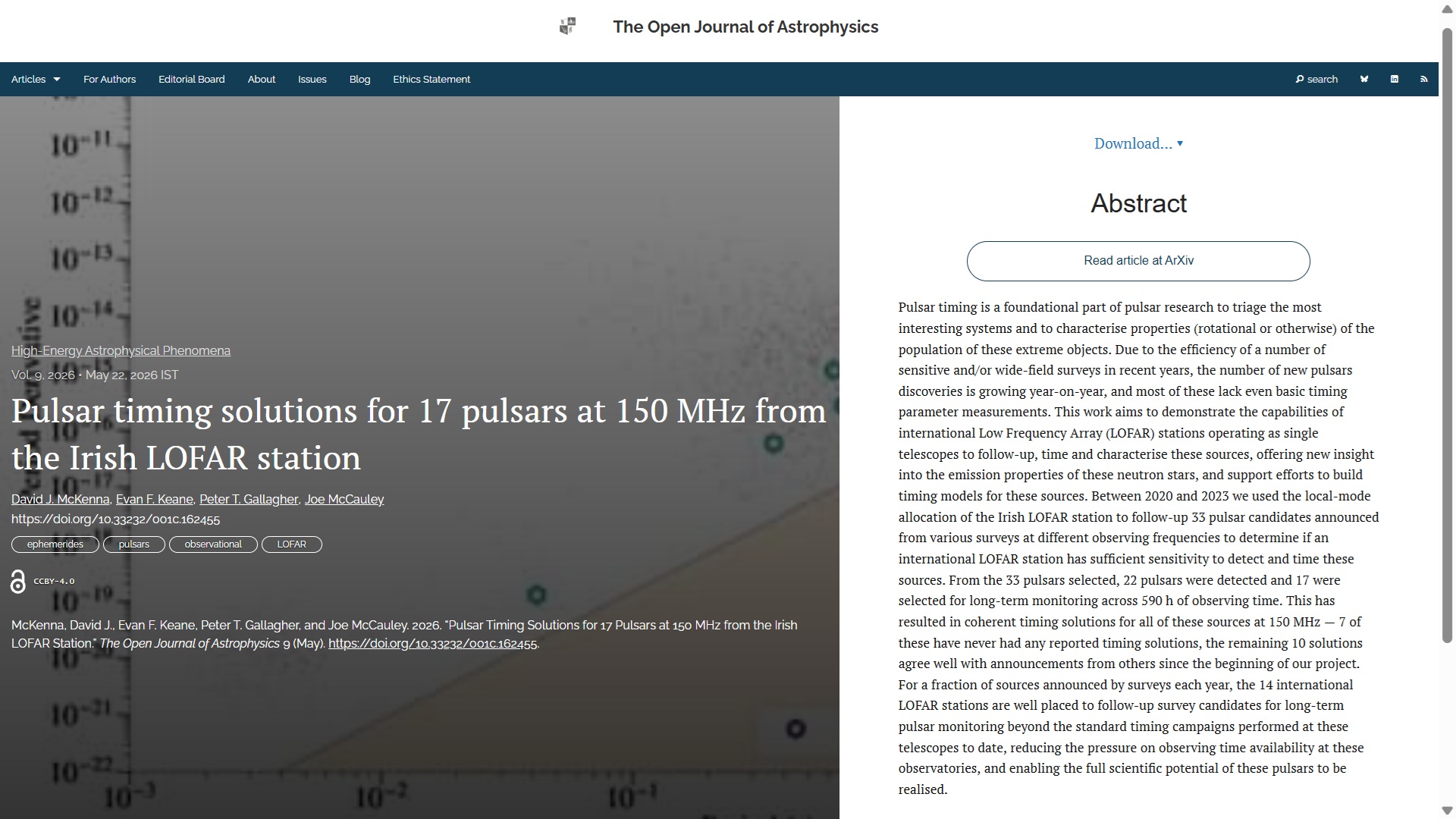
Last, but by no means least, this week we have “Pulsar timing solutions for 17 pulsars at 150 MHz from the Irish LOFAR station” by David J. McKenna (ASTRON, The Netherlands), Evan F. Keane (Trinity College Dublin, Ireland), Peter T. Gallagher (DIAS, Ireland) and Joe McCauley (Trinity). This was published on Friday 22nd May in the folder High-Energy Astrophysical Phenomena. It presents a demonstration of the use of international Low Frequency Array (LOFAR) stations in tracking and characterizing pulsars, providing new insights into these neutron stars’ emission properties.

The overlay for this one is here:

You can find the authorized version of this paper on arXiv here and the Fediverse announcement is here:

Open Journal of Astrophysics

New Publication at the Open Journal of Astrophysics: "Pulsar timing solutions for 17 pulsars at 150 MHz from the Irish LOFAR station" by David J. McKenna (ASTRON, The Netherlands), Evan F. Keane (Trinity College Dublin, Ireland), Peter T. Gallagher (DIAS, Ireland) and Joe McCauley (Trinity)

doi.org/10.33232/001c.162455

May 22, 2026, 8:59 am 0 boosts 0 favorites

And that concludes this week’s update. I’ll do another one next Saturday.
Weekly Update from the Open Journal of Astrophysics – 16/05/2026

Posted in OJAp Papers, Open Access, The Universe and Stuff with tags , , , , , , , , , , , , , , , , , , , , , , , , , , on May 16, 2026 by telescoper

It’s Saturday once again, so time for another update of activity at the Open Journal of Astrophysics. Since the last update we have published a further five papers, bringing the number in Volume 9 (2026) to 104 and the total so far published by OJAp up to 552. It took us until late July to pass 100 last year.

I will continue to include the posts made on our Mastodon account (on Fediscience) to encourage you to visit it. Mastodon is a really excellent service, and a more than adequate replacement for X/Twitter (which nobody should be using); these announcements also show the DOI for each paper.

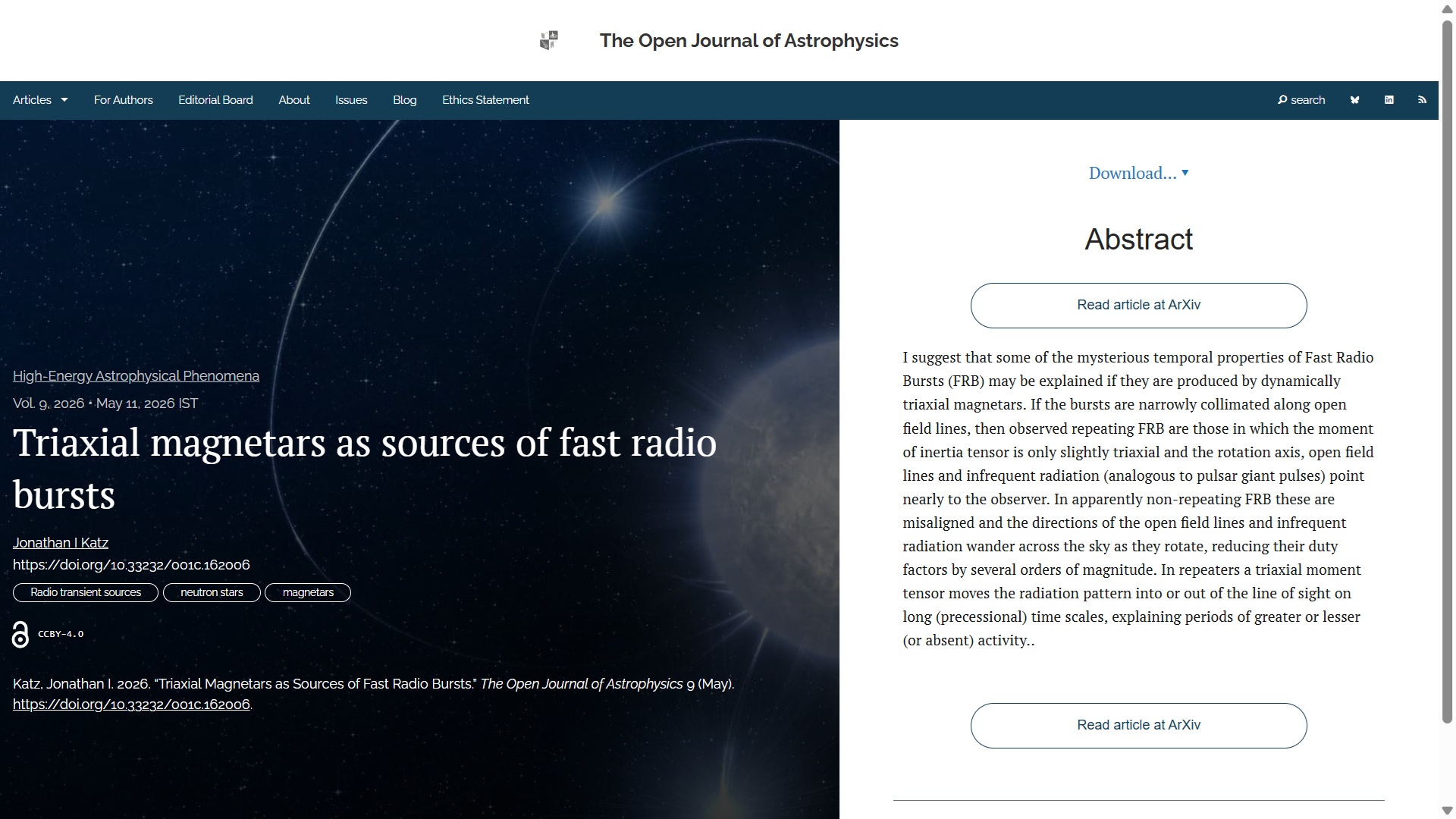
The first paper to report this week, published on Monday 11th May in the folder High-Energy Astrophysical Phenomena is “Triaxial magnetars as sources of fast radio bursts” by Jonathan I Katz (Washington University, USA). This paper suggests that the mysterious properties of Fast Radio Bursts (FRB) could be explained by triaxial magnetars, with their activity levels influenced by precessional time scales.

The overlay for this paper is here

You can find the officially accepted version on arXiv here and the announcement on Fediverse here:

Open Journal of Astrophysics

New Publication at the Open Journal of Astrophysics: "Triaxial magnetars as sources of fast radio bursts" by Jonathan I Katz (Washington University, USA)

doi.org/10.33232/001c.162006

May 11, 2026, 7:32 am 0 boosts 0 favorites

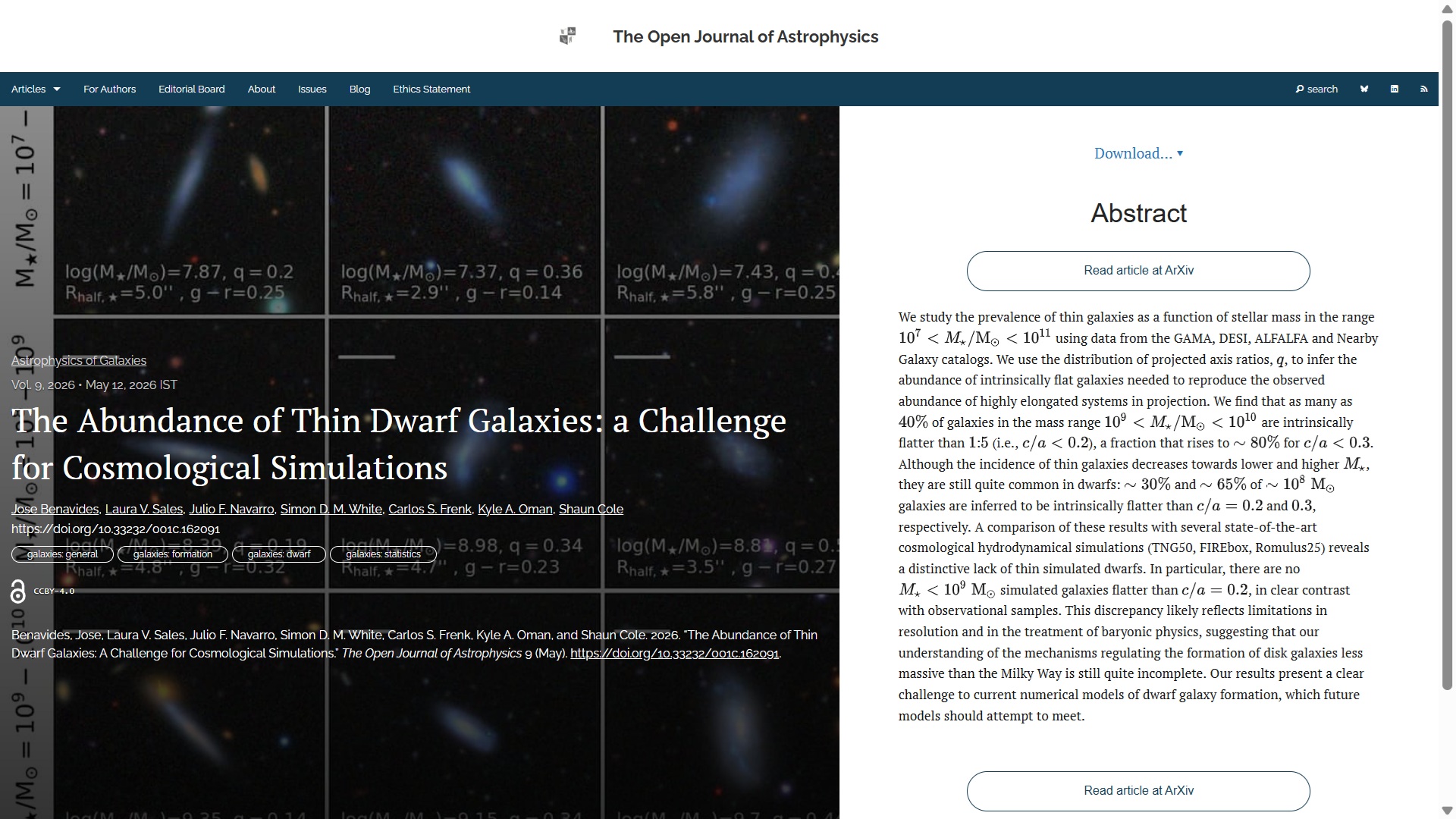
The second paper for this week, published on Tuesday 12th May in the folder Astrophysics of Galaxies, is “The Abundance of Thin Dwarf Galaxies: a Challenge for Cosmological Simulations” by Jose Benavides & Laura V. Sales (UC Riverside, USA), Julio F. Navarro (U. Victoria, Canada), Simon D. M. White (MPA Garching, Germany), and Carlos S. Frenk, Kyle A. Oman & Shaun Cole (U. Durham, UK). Depending on mass up to 40% of galaxies are intrinsically flat, a fraction that numerical models of galaxy formation struggle to reproduce suggesting the models are incomplete.

The overlay for this one is here:

The official version of the paper can be found on arXiv here and the Fediverse announcement here:

Open Journal of Astrophysics

New Publication at the Open Journal of Astrophysics: "The Abundance of Thin Dwarf Galaxies: a Challenge for Cosmological Simulations" by Jose Benavides & Laura V. Sales (UC Riverside, USA), Julio F. Navarro (U. Victoria, Canada), Simon D. M. White (MPA Garching, Germany), and Carlos S. Frenk, Kyle A. Oman & Shaun Cole (U. Durham, UK)

doi.org/10.33232/001c.162091

May 12, 2026, 6:07 am 1 boosts 3 favorites

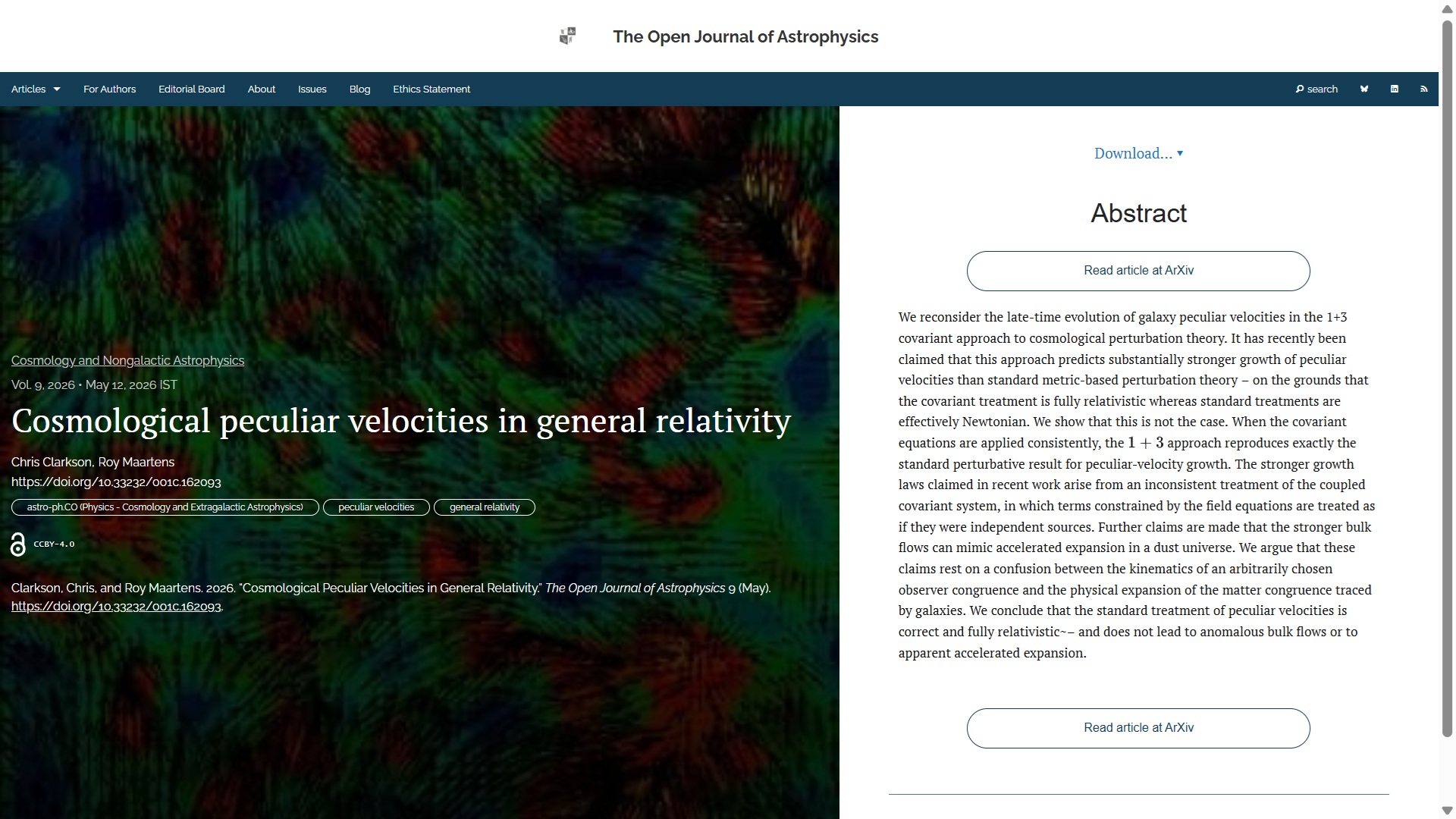
Next one up, the third paper of the week, also published on Tuesday 12th May but in the folder Cosmology and Nongalactic Astrophysics is “Cosmological peculiar velocities in general relativity” by Chris Clarkson (Queen Mary, University of London, UK) and Roy Maartens (U. Western Cape, South Africa). This paper refutes claims that the 1+3 covariant approach to cosmological perturbation theory predicts stronger growth of galaxy peculiar velocities, arguing that standard treatments are correct and fully relativistic.

The overlay for this one is here:

The final, accepted version can be found on arXiv here and the Mastodon announcement is here:

Open Journal of Astrophysics

New Publication at the Open Journal of Astrophysics: "Cosmological peculiar velocities in general relativity" by Chris Clarkson (QMUL, UK) and Roy Maartens (U. Western Cape, South Africa)

doi.org/10.33232/001c.162093

May 12, 2026, 6:37 am 1 boosts 1 favorites

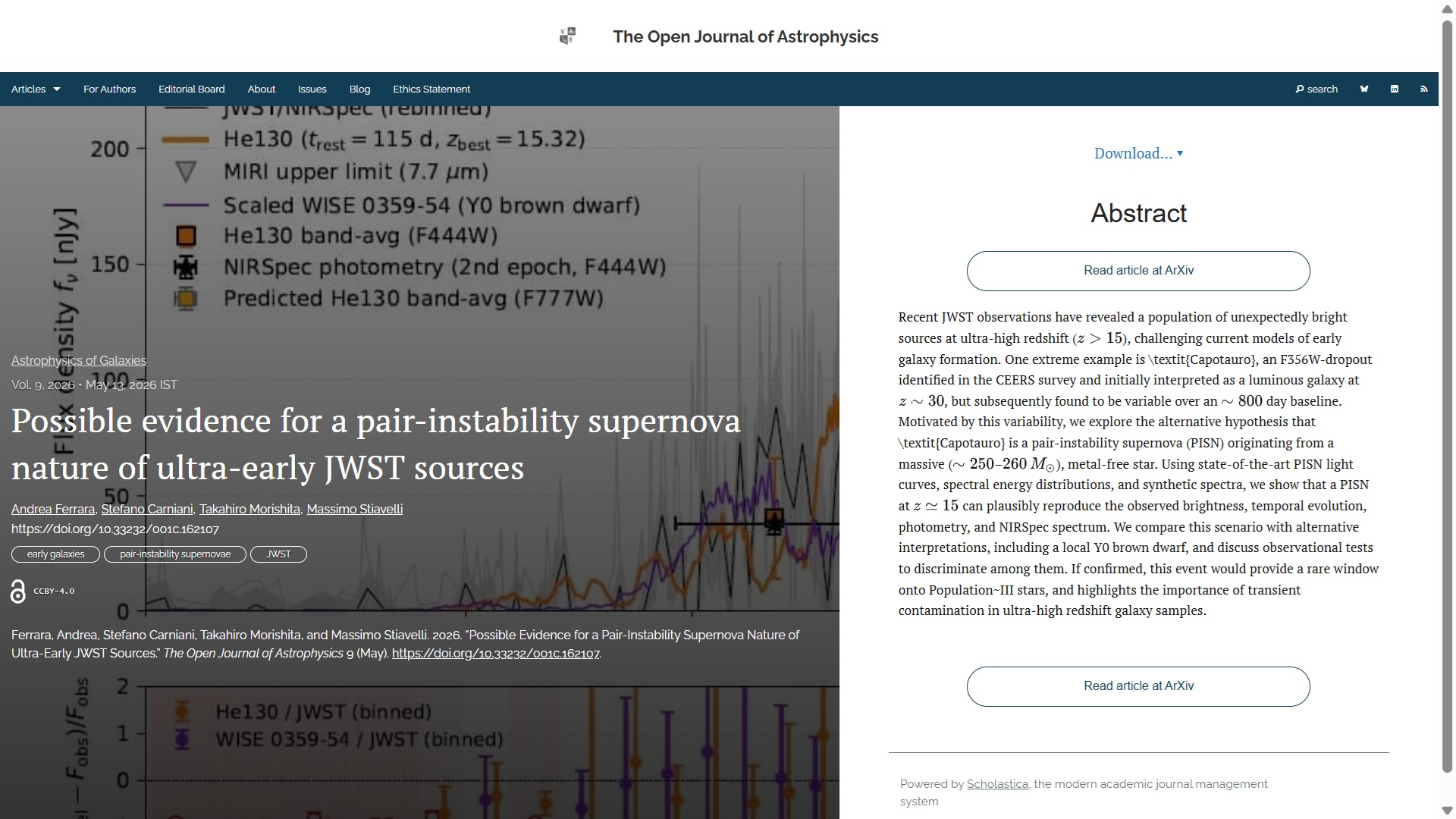
The fourth paper this week, published on Wednesday May 13th “Possible evidence for a pair-instability supernova nature of ultra-early JWST sources” by Andrea Ferrara & Stefano Carniani (Scuola Normale Superiore, Pisa, Italy), Takahiro Morishita (California Institute of Technology, USA), and Massimo Stiavelli (Space Telescope Science Institute, USA). Published in the section Astrophysics of Galaxies. This paper argues that recent observations challenge early galaxy formation models, suggesting that the bright source, Capotauro, could be a supernova from a massive, metal-free star, not a luminous galaxy as initially thought.

The overlay is here:

The officially accepted version can be found on arXiv here and here is the Mastodon announcement:

Open Journal of Astrophysics

New Publication at the Open Journal of Astrophysics: "Possible evidence for a pair-instability supernova nature of ultra-early JWST sources" by Andrea Ferrara & Stefano Carniani (Scuola Normale Superiore, Pisa, Italy), Takahiro Morishita (Caltech, USA) and Massimo Stiavelli (STScI, USA)

doi.org/10.33232/001c.162107

May 13, 2026, 7:44 am 1 boosts 1 favorites

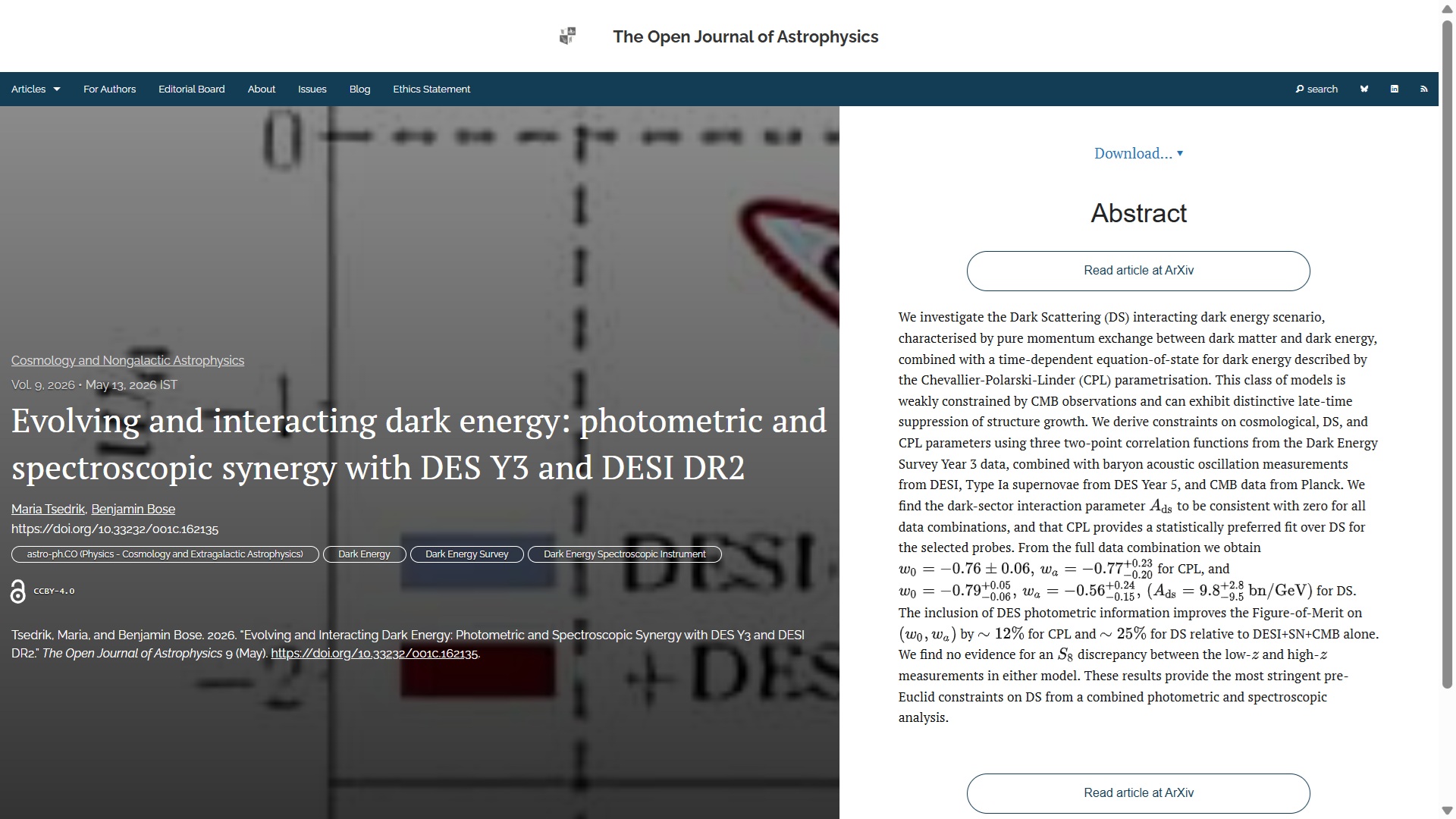
The fifth and final article of this week was also published on Wednesday 13th May but in the folder Cosmology and Nongalactic Astrophysics. The title is “Evolving and interacting dark energy: photometric and spectroscopic synergy with DES Y3 and DESI DR2” and it is by Maria Tsedrik and Benjamin Bose (University of Edinburgh, UK). The study investigates the Dark Scattering interacting dark energy scenario, using data from various sources. Results show no evidence of dark-sector interaction and a preference for the Chevallier-Polarski-Linder parametrisation.

The overlay is here:

You can find the authorized version of this paper on arXiv here and the Fediverse announcement is here:

Open Journal of Astrophysics

New Publication at the Open Journal of Astrophysics: "Evolving and interacting dark energy: photometric and spectroscopic synergy with DES Y3 and DESI DR2" by Maria Tsedrik and Benjamin Bose (University of Edinburgh, UK)

doi.org/10.33232/001c.162135

May 13, 2026, 7:48 am 1 boosts 0 favorites

And that concludes this week’s update. I’ll do another next Saturday.
Weekly Update from the Open Journal of Astrophysics – 11/10/2025

Posted in OJAp Papers, Open Access, The Universe and Stuff with tags , , , , , , , , , , , , , , , , , , , , , on October 11, 2025 by telescoper

It’s time once again for the usual Saturday update of the week’s new papers at the Open Journal of Astrophysics. Since the last update we have published six  more papers, which brings the number in Volume 8 (2025) up to 152, and the total so far published by OJAp up to 387. Not only have we passed the 150 mark for the year, but this week saw another record for the Journal, in that it was the first week in which we published at least one paper on every day.

Anyway, here are this week’s papers:

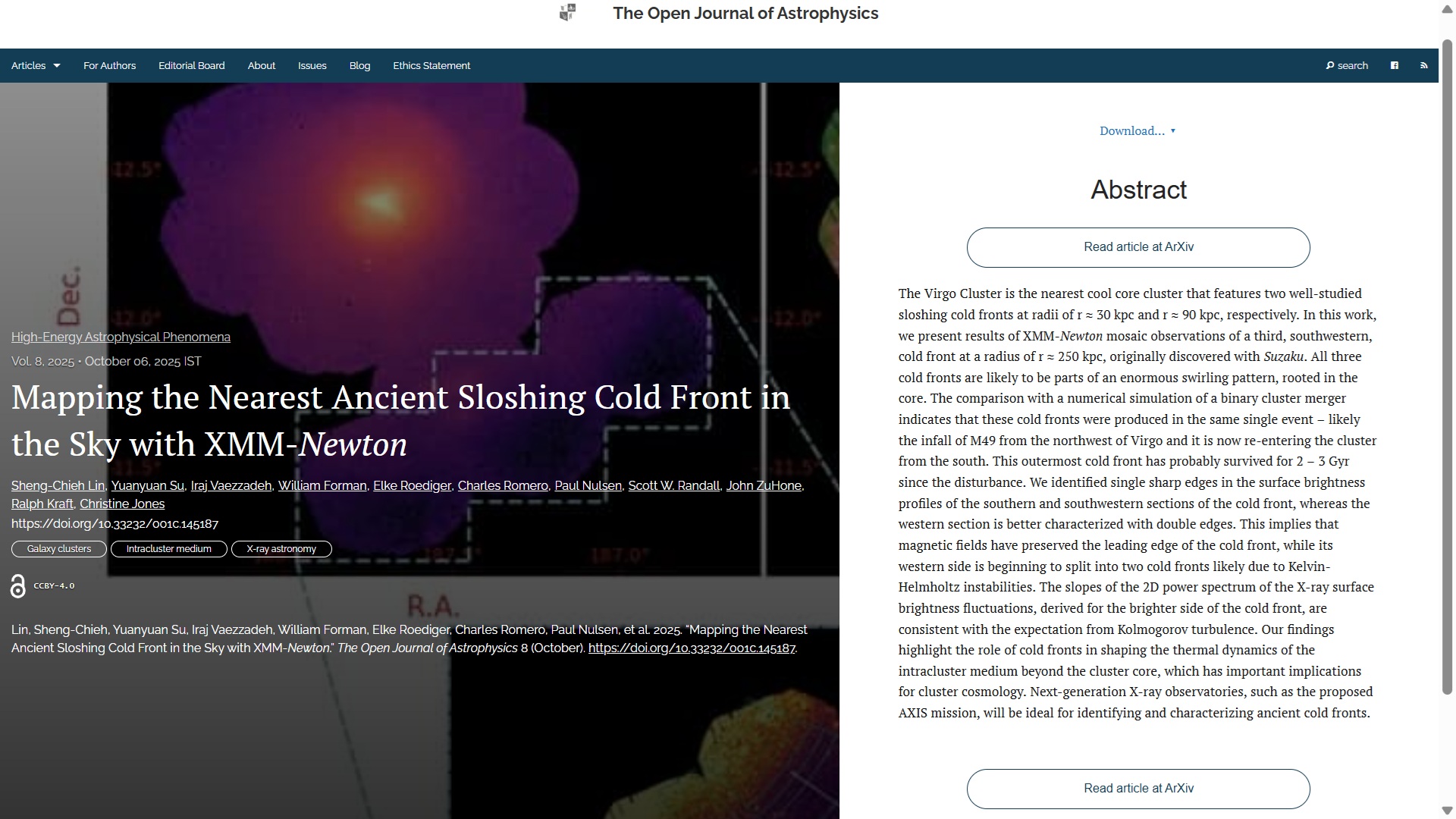
The first paper is “Mapping the Nearest Ancient Sloshing Cold Front in the Sky with XMM-Newton” by Sheng-Chieh Lin (University of Kentucky) and 10 others based in the USA, Spain and Germany. This article, published on Monday 6th October 2025, in the section High-Energy Astrophysical Phenomena discusses cold fronts in the Virgo Cluster, their importance in shaping the thermal dynamics of the intracluster medium beyond the cluster core, and their implications for cluster cosmology.

The overlay is here:


The officially accepted version of this paper can be found on the arXiv here.

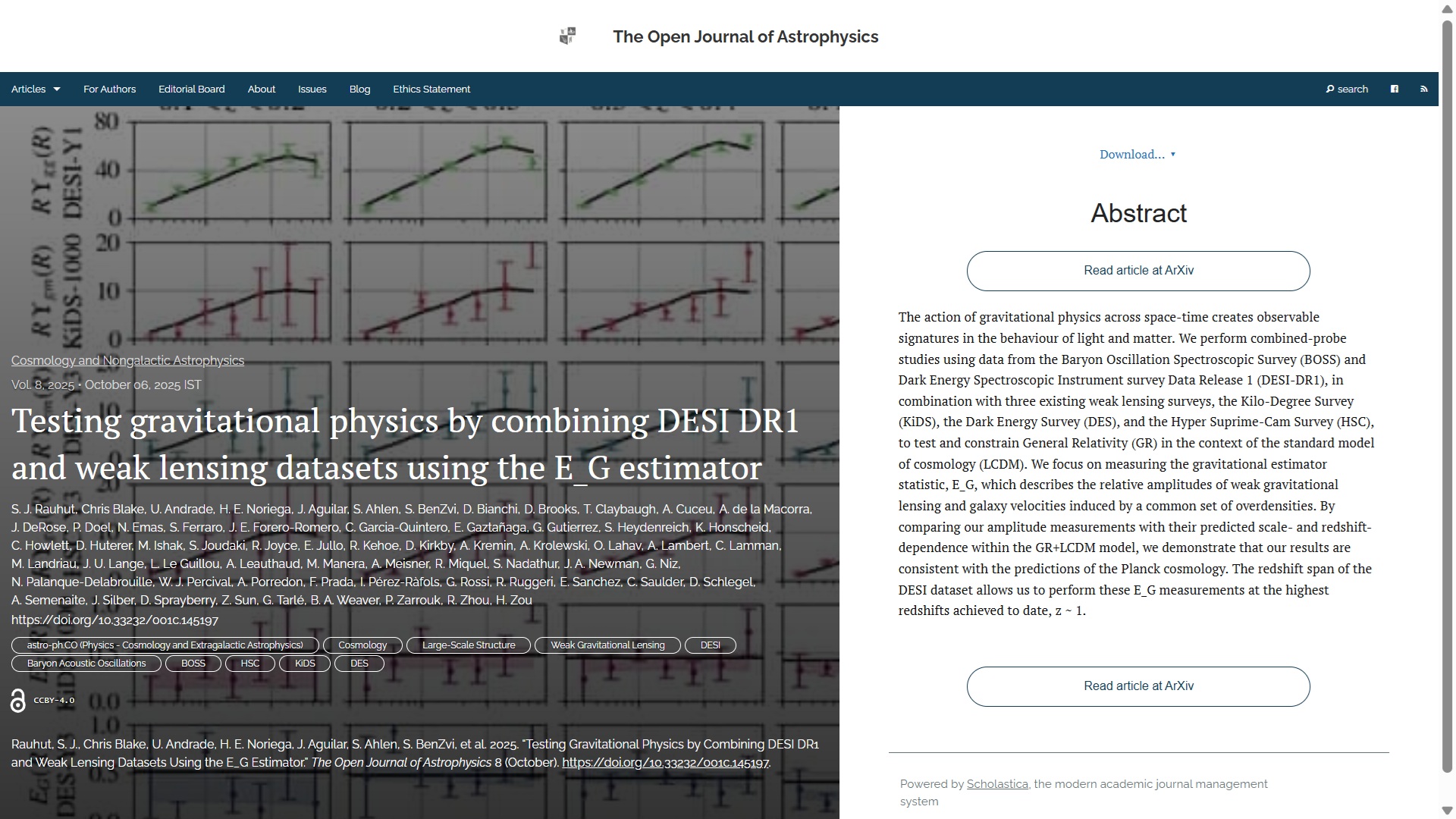
The second paper this week, also published on Monday 6th October, is “Testing gravitational physics by combining DESI DR1 and weak lensing datasets using the E_G estimator” by S.J. Rauhut (Swinburne University of Technology, Australia) and an international cast of 63 others. This one is in the folder Cosmology and NonGalactic Astrophysics, and it presents a comparison of  Baryon Acoustic Oscillation (BAO) measurements from BOSS, DESI with weak lensing from KiDS, DES and HSC showing that the results are altogether consistent with the standard cosmological model.

The overlay is here:

You can find the officially accepted version of this paper on arXiv here.

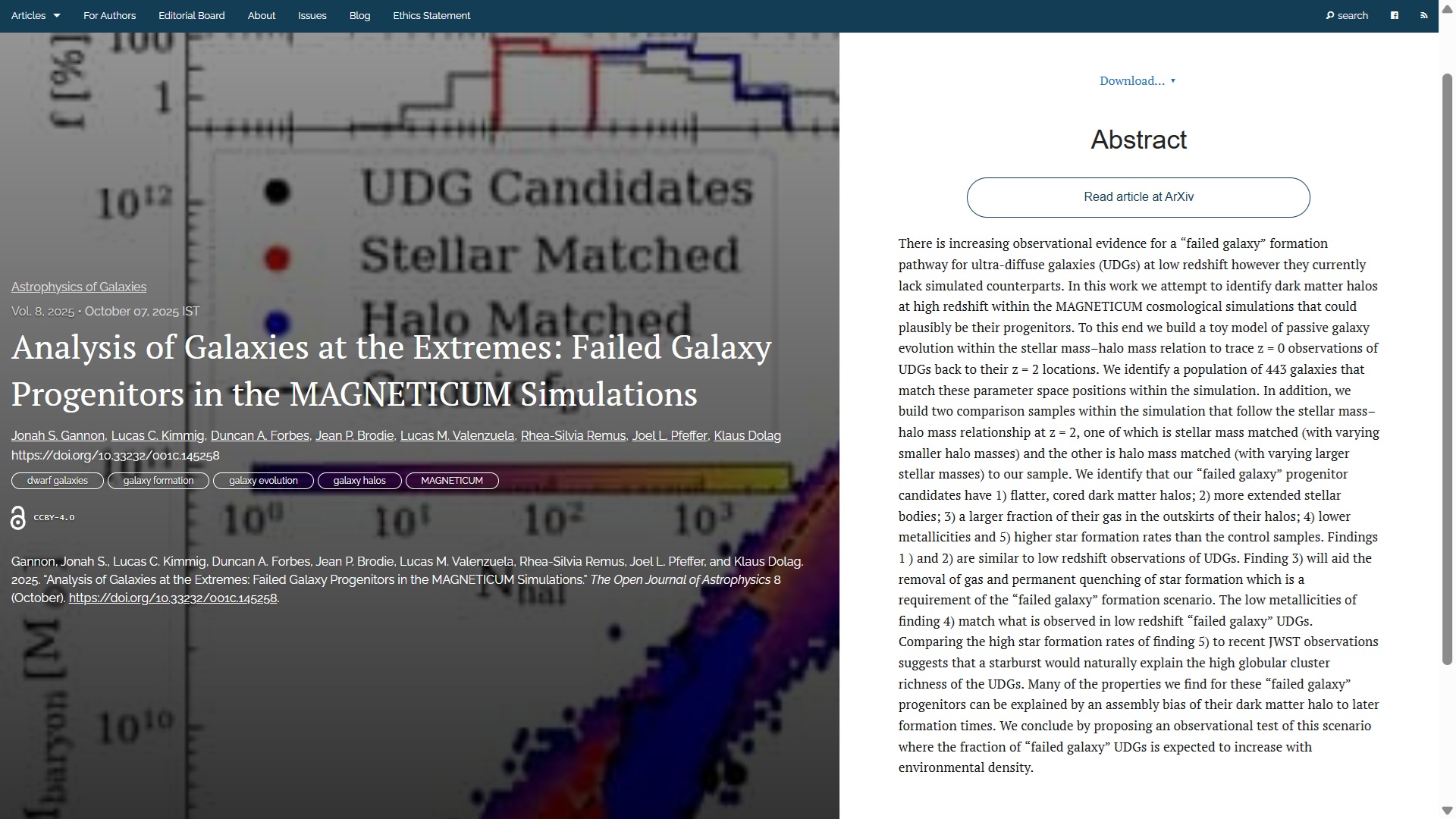
Next one up is “Analysis of Galaxies at the Extremes: Failed Galaxy Progenitors in the MAGNETICUM Simulations” by Jonah S. Gannon (Swinburne University, Australia), Lucas C. Kimmig (Ludwig-Maximilians-Universität, Germany; LMU), Duncan A. Forbes (Swinburne), Jean P. Brodie (Swinburne), Lucas M. Valenzuela (LMU), Rhea-Silvia Remus (LMU), Joel L. Pfeffer (Swinburne) and Klaus Dolag (LMU). This paper, published on Tuesday 7th October 2025, in the folder Astrophysics of Galaxies, discusses the business of identifying the possible high-redshift progenitors of low-redshift ultra-diffuse galaxies in cosmological simulations.

The corresponding overlay is here:

You can find the officially accepted version on arXiv here.

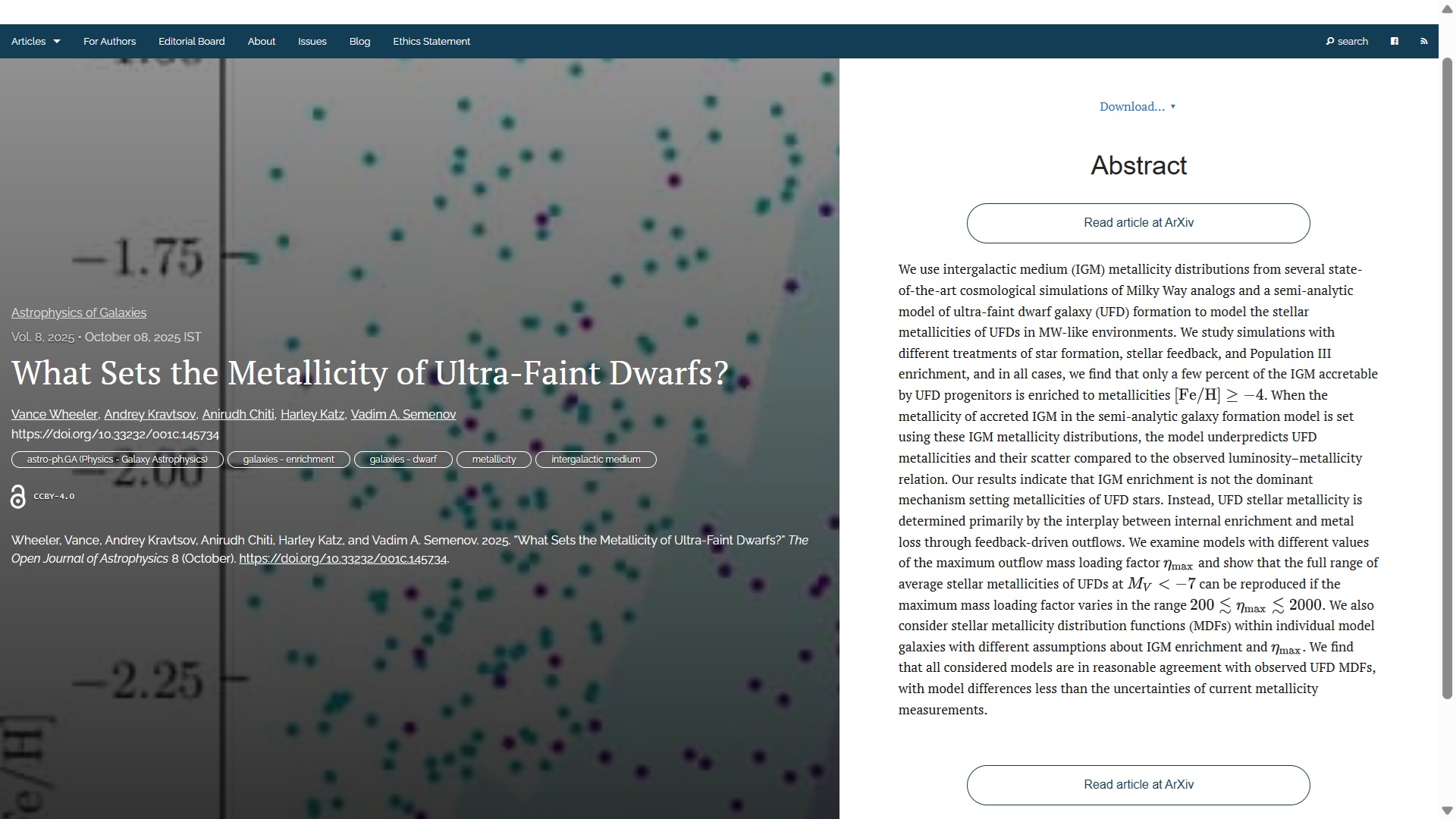
The fourth paper this week, published on Wednesday 8th October 2025 in the folder Astrophysics of Galaxies,  is
What Sets the Metallicity of Ultra-Faint Dwarfs?” by Vance Wheeler, Andrey Kravtsov, Anirudh Chiti & Harley Katz (U. Chicago) and Vadim A. Semenov (CfA Harvard), all based in the USA.

The overlay is here:

You can find the officially-accepted version on arXiv here.

Next, and fifth, we have our 150th publication of 2025, “Synthesizer: a Software Package for Synthetic Astronomical Observables” by Christopher C. Lovell (Cambridge, UK), William J. Roper, Aswin P. Vijayan & Stephen M. Wilkins (Sussex, UK), Sophie Newman (Portsmouth, UK) and Louise Seeyave (Sussex). This paper presents a suite of software tools for creating synthetic astrophysical observables for use in mock galaxy catalogues. It was published on Thursday 9th October 2025 in the folder Instrumentation and Methods for Astrophysics.

The overlay is here:

You can find the officially accepted version on arXiv here.

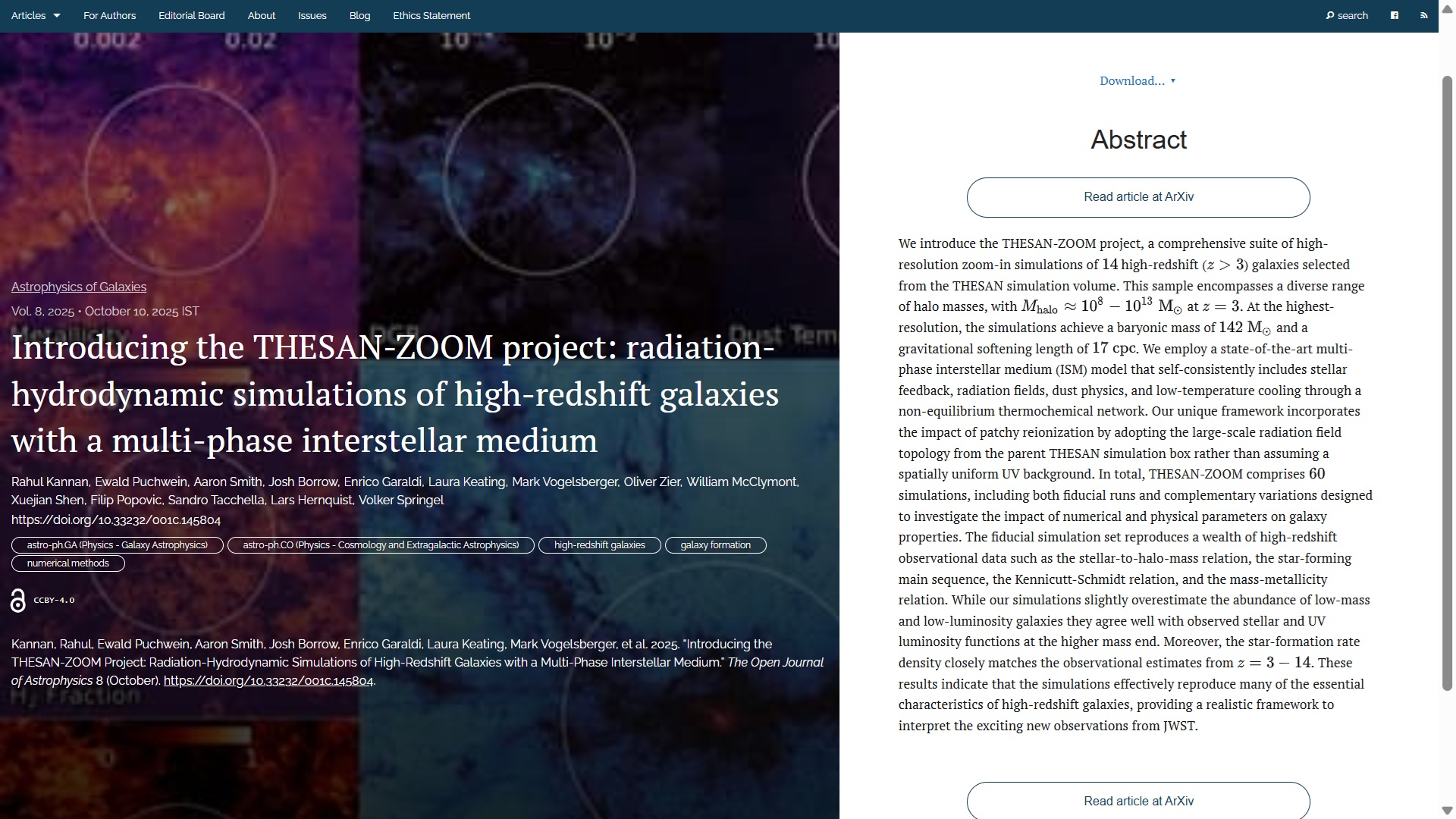
And finally for this week we have “Introducing the THESAN-ZOOM project: radiation-hydrodynamic simulations of high-redshift galaxies with a multi-phase interstellar medium” by Rahul Kannan (York University, Canada) and 13 others based in the USA, Germany, Japan, Italy and the UK. This one was published on Friday 10th October (i.e. yesterday) in the folder Astrophysics of Galaxies. It describes a comprehensive suite of high-resolution zoom-in simulations of high-redshift galaxies, encompassing a diverse range of halo masses, selected from the THESAN simulation volume.

The corresponding overlay is here:

You can find the officially accepted version of this one on arXiv here.

That concludes the papers for this week. I will, however, add a short postscript. This week saw the announcement of this year’s list of MacArthur Fellows. among them Kareem El-Badry who has published quite a few papers with the Open Journal of Astrophysics. His biography on the MacArthur Foundation page includes this:

He has published articles in Monthly Notices of the Royal Astronomical SocietyThe Astrophysical Journal, and The Open Journal of Astrophysics, among other leading scientific journals.

I’m pleased to see us listed with the established names. I mention this just in case there are still people out there who think it might damage their career if they publish with a non-mainstream journal. I guess we are mainstream now…