Archive for Physics

Reflections on the 2026 Leaving Certificate Results

Posted in Covid-19, Education, Maynooth with tags , , , , , on August 21, 2026 by telescoper

Yesterday I attended my last two Examination Boards for the year at Maynooth University. one for graduating MSc students and another for undergraduate repeat students in Engineering (which I attend because I’m teaching a mathematics course they do). That, more or less, is the end of the business (for me) for the 2025/6 academic year. No sooner is that done, however, than preparations for the start of the 2026/7 teaching session begins, as we wait to find out how many new students we will be admitting to our courses in September.

Today’s the day that over 70,000 school students across Ireland received their Leaving Certificate Results. As always there will be joy for some, and disappointment for others. The headline news relating to these results is that the proportion of students receiving the top grades in higher level examinations (i.e. H1) is down significantly from 11.7% last year to 10.1% this year. This fall is because various adjustments that were made during the Covid-19 pandemic are gradually being wound down. After next year they will disappear altogether.

I thought I would have a quick look at the results for subjects relevant to Physics:

SubjectNumber (2025)Number (2026)% Grade 1 (2025)% Grade 1 (2026)
Maths A235402515711.48.1
Maths G33364354446.14.2
Physics A6592685519.515.6
Physics G115413355.54.5
Applied Maths A1861195425.920.9
Applied Maths G34505.94

(A is higher level and G is ordinary level). Please note that this year’s numbers are provisional and may change as a result of appeals, etc. The full details can be found here.

You can see that the number of students taking these subjects has increased since last year, but in all cases the percentage getting top grades has fallen. Note the very low numbers in the last row, meaning that most students who take Applied Mathematics do the Higher level version. The numbers mean that exactly 2 people got the top grade in 2026 and 2025!

Comparison with earlier years is interesting. Here are the H1 percentages for Mathematics, Physics and Applied Mathematics since 2019:

MathematicsPhysicsApplied Mathematics
20196.410.916.5
20208.616.129.9
202115.121.140.9
202218.123.729.3
202311.221.231.0
202412.620.728.4
202511.419.525.9
20268.115.620.9

You can see that although these percentages have declined from their respective peaks they remain well above 2019 pre-pandemic levels.

It is also worth noting that the number of students taking Physics (A) nationally seems to be recovering from a sharp drop in 2022-4, the numbers being: 6583(2019); 7037(2020); 7210(2021); 6487(2022); 6143(2023); 6009 (2024); 6592 (2025); and 6855 (2026).

Anyway, now that the results are out there will be a busy time until next Wednesday (26th August) when the CAO first round offers go out. That is when those students wanting to go to university find out if they made the grades and university departments find out how many new students (if any) they will have to teach in September. Incidentally, colleagues in the UK might be interested to know that, here in Maynooth, departments have no say in admissions decisions: these are all made centrally.

P.S. When I was a little kid we used to call a “Certificate” a “Stiff Ticket”. I just thought you would like to know that.

Quantum Dry

Posted in The Universe and Stuff with tags , , , , on August 18, 2026 by telescoper

I was taken aback by the description “QUANTUM DRY” but then I remembered Chapter 40 of the Feynman Lectures on Physics on the topic of The Flow of Dry Water, by which is meant the flow of a fluid with zero viscosity (i.e. inviscid flow). I therefore infer that the material of which this product is composed is a quantum superfluid, i.e. a quantum fluid with zero viscosity. Can someone point me to the scientific literature on superfluid anti-perspirants?

Astronomy Envy

Posted in Biographical, Education, Science Politics with tags , , , on July 30, 2026 by telescoper

In 1998 the Department of Physics at the University of Nottingham was struggling in both research and undergraduate recruitment. To remedy the situation it decided to add a new group in Astronomy. The main idea was that having astronomy in its portfolio would attract more students and boost its standing in the Research Assessment Exercise (as it was then called). I was one of the people appointed to turn that decision into reality, and I’m glad to say the result was a success. Undergraduate numbers increased and in the next RAE Nottingham Physics scored a ‘5’, compared to the previous ‘4’. The Astronomy group quickly gained recognition across the UK and abroad, and another group was added, in Astroparticle Physics.

When the new Astronomy group was set up in 1999, the Department of Physics changed its name to the School of Physics & Astronomy. Despite the positive effect of this new activity, it was immediately clear that some members of staff resented it. A new letterhead was created, referring to the School of Physics & Astronomy, and one (very distinguished) senior member of the former Department always crossed off the “and Astronomy” whenever he used it. Others were surprised that the astronomers wanted to do research, when they felt that astronomy was just a bit of window-dressing for undergraduate recruitment. The astronomers were just there to do teaching, so that the “proper physicists” – mostly in semiconductor physics, nanoscience and other areas of condensed matter physics – could spend more time in their laboratories. I’m not saying that every physicist thought this – most were genuinely appreciative and supportive – but there were more than a few grumblers.

The undertone of all this is the envy that some physicists feel towards astronomy. Astronomers get invited to talk about their work to the general public and to amateur astronomy clubs, while there are no such calls for semiconductor physicists. Nobel prizes go to cosmology and astrophysics much more frequently than some would like. Above all there is the view that astronomy is all very well for bringing students in, but once at university the students must be converted to “proper physics”. Astronomers (including astrophysicists and cosmologists) should not get “notions” (as the Irish say). The short-sighted view that scientific research in universities should be aimed at short-term commercial gain amplifies this attitude, but does not entirely account for it.

These thoughts have been at the back of my mind for some time, but they came to the front again with the recent news about cuts to STFC funding. The callous attitude shown to the UK astronomy research community, implying that it should be grateful that it is not being cut by more than the disastrous level announced, indicates (to me) that there’s much more to what is going on than a mere budgetary issue. There is a deliberate plan to slap down a community that has grown too big for its boots.

The consequences for UK astronomy, and UK physics in general, are dire. Astronomy has kept many physics departments afloat for the last several decades. Without it, physics will fail in all but a handful of universities. That’s where envy takes you.

The 2026 Leaving Certificate Physics Papers

Posted in Education with tags , on June 19, 2026 by telescoper

While I remember I thought I’d follow up my post about the 2026 Leaving Certificate Mathematics papers, by uploading this year’s Physics papers. Here is the Higher level paper:

You can find some reaction to it here and here. I think it’s quite a nice paper, with plenty of choice. See what you think!

And here is the Ordinary level paper:

Jobs Under Threat at Nottingham University

Posted in Biographical, Education with tags , , on May 14, 2026 by telescoper

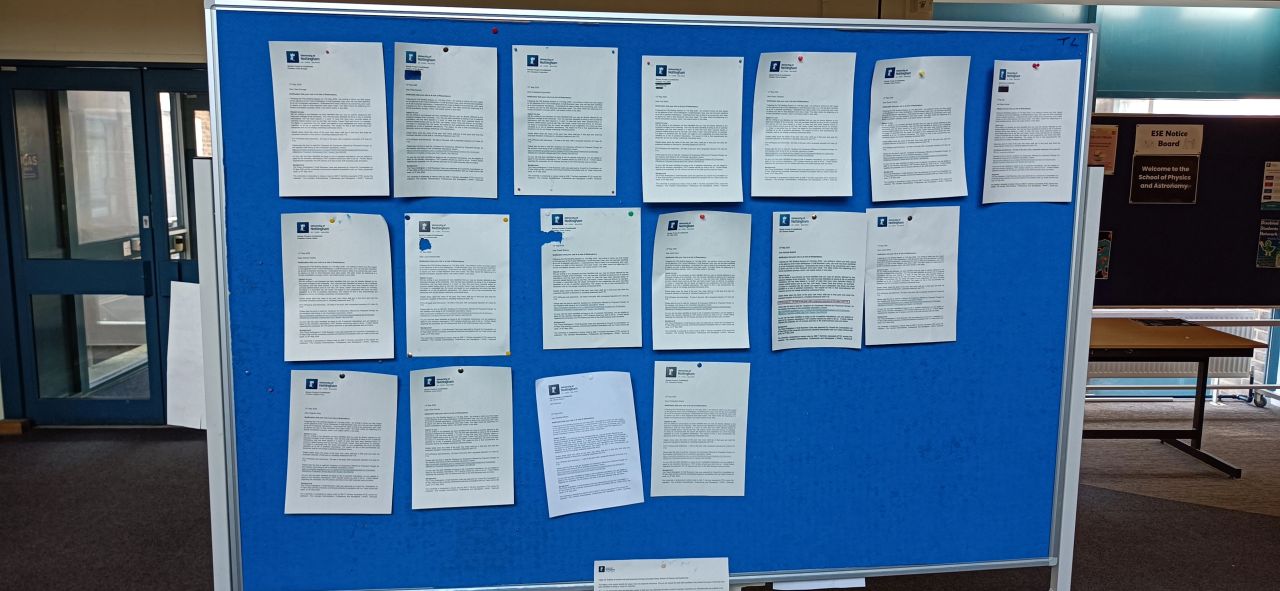
I saw this picture on a LinkedIn post from a former member of staff in Physics at Nottingham University:

It shows a notieboard in the foyer of the Physics Building, which houses the School of Physics & Astronomy. Earlier this week members of staff received letters informing them that their jobs are “at risk of redundancy”. As an act of solidarity the staff members concerned showed posted their letters publicly. I don’t know the names of the people who have received these letters – and if I did I wouldn’t share them here – but there are 17 letters.

UPDATE: I have since heard that 56 members of academic staff in the School – out of a total of 71 – have received these letters. The University wants to reduce the staff numbers in Physics & Astronomy by about a third.

I also know that the undergraduate course in Mathematical Physics, taught jointly with the School of Mathematics, has been suspended and will not admit any students. I taught on this course for many years when I was at Nottingham University (from 1999 to 2007).

The threat of redundancy is not specific to Physics. It seems almost 2,700 individuals across the University have received such notices and the University is attempting to cut 600 positions. Not all those in receipt of an “at risk” letter will actually be made redundant, but the intention is clearly to scare people into leaving in order to save on redundancy payments.

More details can be found here.

There is a petition against these job cuts here which I encourage you to sign.

The background to this disaster is explained here. In summary, the University’s current financial meltdown is caused by the actions of the former Vice-Chancellor of the University of Nottingham, Prof. Shearer West,, who presided over the hare-brained decision to purchase a large new campus. None of the “at risk” staff is at fault., but they will have to bear the burden of management ineptitude. You would think that the people responsible for this fiasco would be held to account and pay at least some of the price for their incompetence. But no. Prof. Shearer West left her post in 2024 to take up the position of Vice-Chancelor at the University of Leeds on a salary of more than £330K, leaving others to clean up the mess.

I fear more such news is coming. The UK Higher Education sector is shrinking rapidly. Nottingham University won’t be the last, and I doubt the contagion will be restricted to the UK either…

Lectures’ End

Posted in Biographical, Education, Maynooth, The Universe and Stuff with tags , , on May 8, 2026 by telescoper

At last we’ve made it to the end of term. This morning I delivered my last particle physics lecture. Given that it is the last day of the semester I was half-expecting no students would turn up, but in the end I had about 60% attendance. At the end of my lecture there was even a smattering of applause, which I interpreted as meaning that the students were happy that I’d finished.

I thought I would end this module with some topics that I didn’t have time to cover in any detail, but thought the students should know at least something about. These loose ends included:

  • Renormalization
  • Grand Unified Theories (GUTS)
  • Supersymmetry (SUSY)
  • Particle candidates for Dark Matter
  • Baryogenesis

I only had time for a superficial treatment of these topics, but felt the class should at least hear the words. There are some very good unanswered research questions under those headings, which I think is an appropriate way to end a final-year module, given that at least some of the class are intending to carry on to further study in physics.

This afternoon we had a colloquium by our PhD student John Ibrahim on the subject of the “Quark‑Gluon Vertex and Confinement of Quarks”. It was a nice talk but it struck me how big the gap was between what I’d been teaching at undergraduate level and the standard that a PhD student has to reach.

Today was also the deadline for Computational Physics projects. I’ll be grading them next week. Even then the term won’t quite be over – there is the small matter of exam marking to be done – but at least I’ve got no more formal teaching to do until September.

Last night on the way home I decided to buy a nice bottle of white wine and put it in the fridge so I could drink it in celebration of the end of term when I get home, with a nice fish supper.

Quantum & Answers

Posted in Maynooth, The Universe and Stuff with tags , , , on November 13, 2025 by telescoper

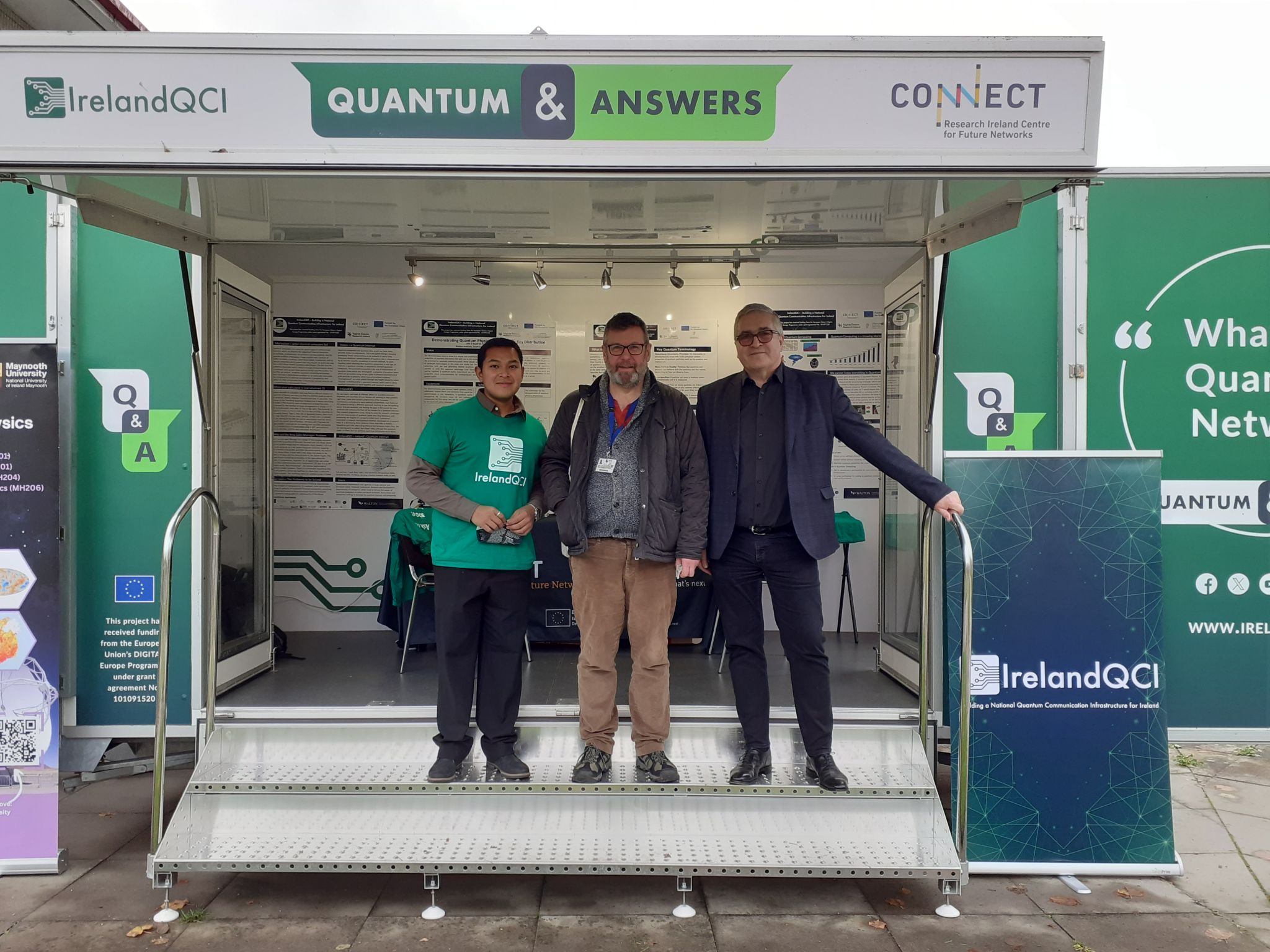
Returning to my office in the Science Building at Maynooth University I saw a new feature, which I initially thought was a mobile coffee shop, but which turned out to be the Quantum & Answers trailer, a mobile engagement unit, developed by IrelandQCI, and designed to bring quantum technologies to life for the general public in Ireland.

In case you weren’t aware, IrelandQCI, the ‘Building a National Quantum Communication Infrastructure for Ireland’ project incorporates integrating innovative and secure quantum devices and systems into conventional communication infrastructures. This will be done by enhancing the ESB Telecoms’ optical fibre network with an additional layer of security, all based on quantum physics, in particular quantum key distribution (QKD).

You can read more about this initiative here.

It’s on Maynooth University campus for the rest of the day so if you’re around please feel free to visit and talk about quantum encryption and the like.

Update: I popped in to get out of the rain…

Caveman Physics

Posted in The Universe and Stuff with tags , , on October 9, 2025 by telescoper

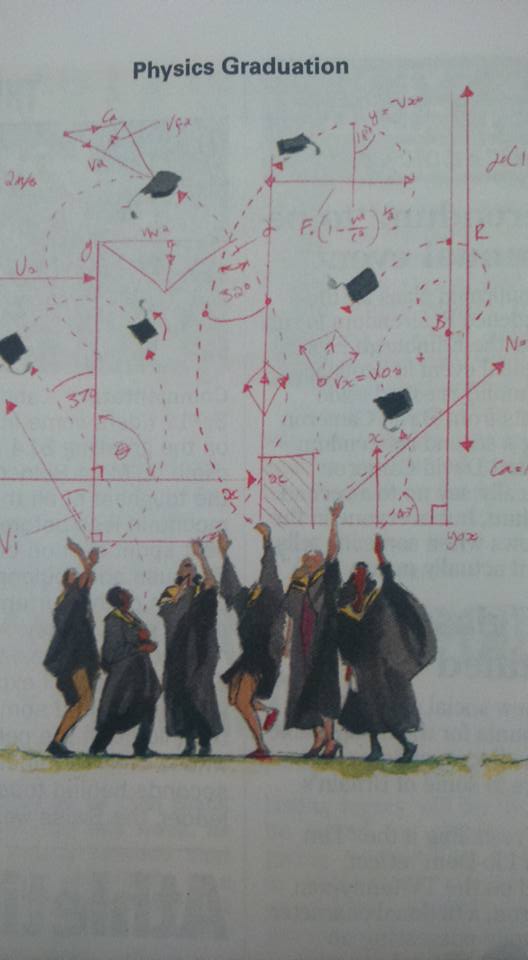
A colleague sent me this, so I thought I’d share it:

Of course we can’t be sure whether there’s a singularity or not because of the presence of a horizon…

The Week Ahead

Posted in Education, Maynooth with tags , , , , , on August 17, 2025 by telescoper

Another weekend is almost over so, after spending most of this afternoon in the garden, I’ve retreated indoors to look at my calendar for the forthcoming week. I find a plethora of Examination Board meetings, one (tomorrow) for our Masters students who did their presentations on Friday and two for undergraduates who took repeat examinations in August (one for Mathematical Physics and one for Engineering, as I happen to have been teaching Engineering Mathematics this year). The two undergraduate boards are both on Thursday. All three of these should be relatively brief, but you never know…

There is another meeting tomorrow, Monday, about organizing our computational physics teaching for the new academic year. The merger of theoretical and experimental physics has given us the chance to coordinate the different computational modules offered by the two previous departments, but we need to make sure the teaching rooms are big enough and the computers have the correct software, etc. Fortunately I’m not actually teaching Computational Physics again until Semester 2 but we have to get it sorted in time for other modules happening in Semester 1.

In between Monday and Thursday I have two whole days with no meetings and no grading to do. I might be able to get on with some research, or at least with writing up some research I’ve already done.

Friday is a big day for the Irish higher education system, in that it’s the day students get their Leaving Certificate results. This year the grade inflation introduced during the pandemic is supposed to begin to unwind, but none of us outside the examination system knows how this will be achieved or what the results will be. If I had to bet I’d say that the CAO points needed for most courses at Maynooth will go down substantially, partly because of the deflation mentioned previously but also because The Management has decided that the University has to recruit more and more students and will drop entry standards as low as it needs to in order to meet its targets.

I don’t know how many students we will end up with for Academic Year 2025/6 but I do know that I will have retired before most of them complete their course. I used to find it a bit scary thinking about retirement, but not any more.

Generative AI in Physics?

Posted in Artificial Intelligence, Education, mathematics, Maynooth with tags , , , , , , , , , on August 11, 2025 by telescoper

As a new academic year approaches we are thinking about updating our rules for the use of Generative AI by physics students. The use of GenAI for writing essays, etc, has been a preoccupation for many academic teachers. Of course in Physics we ask our students to write reports and dissertations, but my interest in what we should do about the more mathematical and/or computational types of work. A few years ago I looked at how well ChatGPT could do our coursework assignments, especially Computational Physics, and it was hopeless. Now it’s much better, though still by no means flawless, and now there are also many other variants on the table.

The basic issue here relates to something that I have mentioned many times on this blog, which is the fact that modern universities place too much emphasis on assessment and not enough on genuine learning. Students may use GenAI to pass assessments, but if they do so they don’t learn as much as they would had they done the working out for themselves. In the jargon, the assessments are meant to be formative rather than purely summative.

There is a school of thought that has the opinion that formative assessments should not gain credit at all in the era of GenAI since “cheating” is likely to be widespread. The only secure method of assessment is through invigilated written examinations. Students will be up in arms if we cancel all the continuous assessment (CA), but a system based on 100% written examinations is one with which those of us of a certain age are very familiar.

Currently, most of our modules in theoretical physics in Maynooth involve 20% coursework and 80% unseen written examination. That is enough credit to ensure most students actually do the assignments, but the real purpose is that the students learn how to solve the sort of problems that might come up in the examination. A student who gets ChatGPT to do their coursework for them might get 20%, but they won’t know enough to pass the examination. More importantly they won’t have learnt anything. The learning is in the doing. It is the same for mathematical work as it is in a writing task; the student is supposed to think about the subject not just produce an essay.

Another set of issues arises with computational and numerical work. I’m currently teaching Computational Physics, so am particularly interested in what rules we might adopt for that subject. A default position favoured by some is that students should not use GenAI at all. I think that would be silly. Graduates will definitely be using CoPilot or equivalent if they write code in the world outside university so we should teach them how to use it properly and effectively.

In particular, such methods usually produce a plausible answer, but how can a student be sure it is correct? It seems to me that we should place an emphasis on what steps a student has taken to check an answer, which of course they should do whether they used GenAI or did it themselves. If it’s a piece of code to do a numerical integration of a differential equation, for example, the student should test it using known analytic solutions to check it gets them right. If it’s the answer to a mathematical problem, one can check whether it does indeed solve the original equation (with the appropriate boundary conditions).

Anyway, my reason for writing this piece is to see if anyone out there reading this blog has any advice to share, or even a link to their own Department’s policy on the use of GenAI in physics for me to copy adapt for use in Maynooth! My backup plan is to ask ChatGPT to generate an appropriate policy…