Archive for Physics

The 2025 Leaving Certificate Physics papers

Posted in Education, Maynooth with tags , , , on June 18, 2025 by telescoper

As I have already mentioned on this blog, examinations for the 2025 school Leaving Certificate are under way. One of the interesting things about the Irish system is that the examination papers are put up online immediately after the examinations so it’s very easy to share the content. I have already posted the two Mathematics papers for 2025. This year’s Physics examinations (at Ordinary and Higher level) took place this morning, so I thought I’d share the papers here. In particular, readers in the UK might be interested to compare the standard of these papers with that of current A-levels in Physics.

One thing I should mention is that Leaving Certificate Physics is not a prerequisite for entry into any of our Physics programmes at Maynooth University. Some do have it, but many don’t. We teach the first-year material from scratch for all students. Anyway, here are this years papers, Ordinary and Higher respectively. As usual comments are welcome, through the box below:

I think the Ordinary level paper could have done with better proof-reading. As well as Jim’s comment below, there is

Explain how your calculations can be used to verify the principle of conversation of
momentum.

The Leaving

Posted in Biographical, Education, mathematics, Maynooth with tags , , , , , on June 4, 2025 by telescoper

Today is not only a significant date for me (in more ways than one), but it’s important for many young people in Ireland because the Junior Certificate and Leaving Certificate examinations both start today, so the first thing I need to do is wish everyone starting their examinations the very best of luck!

Among other things, the results of the leaving certificate examinations are important for September’s university admissions. This year the grade inflation that occurred during the pandemic years will be reduced, though it is not yet clear how. Whatever happens is likely to have a big impact on student recruitment to third-level institutions.

In the system operating in England and Wales the standard qualification for entry is the GCE A-level. Most students take A-levels in three subjects, which gives them a relatively narrow focus although the range of subjects to choose from is rather large. In Ireland the standard qualification is the Leaving Certificate, which comprises a minimum of six subjects, with many students taking more than this. This gives students a broader range of knowledge at the sacrifice (perhaps) of a certain amount of depth; it has been decreed for entry into this system that an Irish Leaving Certificate subject counts as about 2/3 of an A-level subject for admissions purposes, so Irish students do the equivalent of at least four A-levels, and many do more than this. It’s also worth noting that all students have to take Mathematics at Leaving Certificate level.

One can choose to do Leaving Certificate subjects at Ordinary or Higher level and there’s quite a big difference between the two, especially in Mathematics (of which more below).

Overall I prefer the Leaving Certificate over the UK system of A-levels, as the former gives the students a broader range of subjects than the latter (as does the International Baccalaureate). I would have liked to have been allowed to take at least one arts subject past O-level, for example.

For University admissions points are awarded for each paper according to the marks obtained and then aggregated into a total CAO points, CAO being the Central Applications Office, the equivalent of the UK’s UCAS. This means, for example, that our main Science pathway at Maynooth allows students to study Physics without having done it at Leaving Certificate level. This obviously means that the first year has to be taught at a fairly elementary level, but it has the enormous benefit of allowing us to recruit students whose schools do not offer Physics.

There is however a big problem with Mathematics. It was decided some years ago that students would get 25 extra CAO points if they got a mark of at least 40% in Higher Mathematics. This has led to more students taking the subject, which is good, but there are signs that this may have led to a decline in standards. If, for example, the marking is such that a fixed proportion of students get the top grade but more weaker students take the examination, that means that standards fall at the top end. For more discussion, see here.

Anyway, our Theoretical Physics & Mathematics course requires a good result in Higher Mathematics for entry. Will changes to the marking of Higher Mathematics this year make it harder for students to make the grade? We’ll just have to wait and see.

Moreover, since the pandemic struck, students have been able to choose to answer questions from a limited range of sections on the mathematics examination papers. That means that students can get very high grades despite knowing nothing about a big chunk of the syllabus. That matters most for subjects that require students to have certain skills and knowledge for entry into University, such as Physics. I taught part of our first year Mathematical Physics course in Maynooth for about 5 years. It was noticeable how the fraction that were comfortable with basic differentiation and integration was falling. Will this trend accelerate? Again, we’ll just have to wait and see…

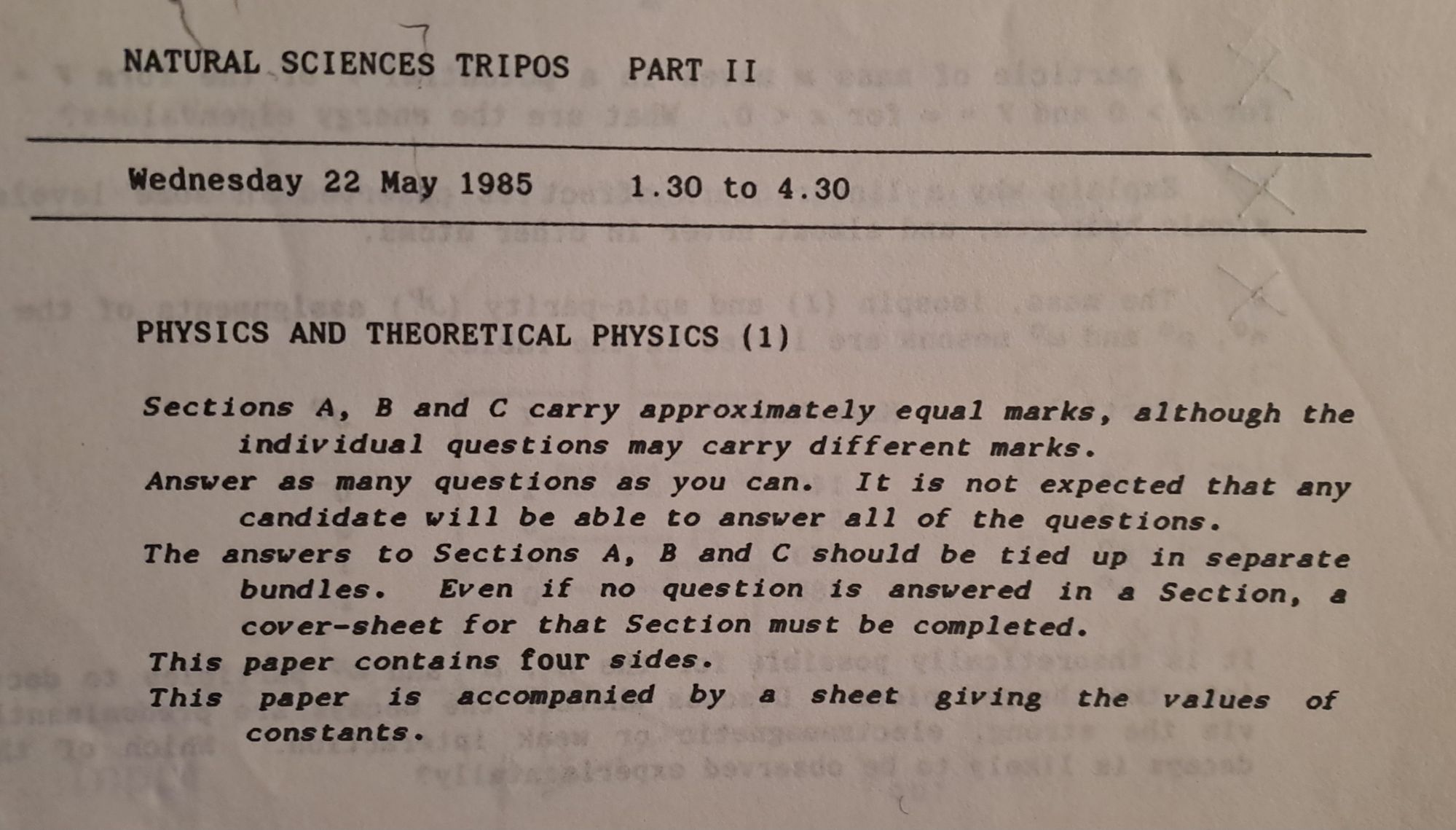
Physics & Theoretical Physics Undergraduate Final Examinations from 1985

Posted in Biographical, Education with tags , , on May 22, 2025 by telescoper

It is May 22nd 2025, so it’s 40 years to the day since started my final examinations in Physics and Theoretical Physics in the Natural Sciences Tripos at Cambridge University. These examinations concluded what was called Part II, the third and last year of a course which started out with four subjects (Part IA), then three (Part IB) I did double-physics and mathematics for IB.

The first paper of Part II was actually Paper Zero, an essay paper which I have already posted here. The five other papers are below; all six (including Paper Zero) were of three hours’ duration. You will see that Paper 4 is a very big one, because it contains questions pertaining to many options but each student did only a few. Unlike most of the theoretical physics students in my year I offered a theoretical project in lieu of part of Paper V, which means I was spared another three-hour paper. My project, incidentally, was on the computer simulation of a laser. My “prepared essay” was also on lasers Kilohertz and picoseconds in laser physics.

Looking at the papers I find a few things are different from what we do nowadays.

One is that Paper I was a general paper, with questions about random bits of physics. Most university physics courses these days do not have such papers (although I know of at least one that does…).

Another is that the course was not really modular. Each paper covered several different topics: Paper 2 for example covers Solid State Physics, Statistical and Thermal Physics and Electromagnetism; Paper 3 is Quantum Physics, Nuclear Physics and Particle Physics. In most modern university courses each of these would have a separate examination.

Other than that, some of the content (e.g. electromagnetism) is close to what you would find nowadays but in some areas (particle physics, for example) the 1985 paper is extremely dated.

As for the level difficulty, I can’t really comment. Take a look a the papers and decide for yourself!

(There is supposed to be a PDF preview, but it seems not to work on many web browsers, so You may hev to download the paper to view it.)

Comments are welcome through the box below.

The Universe Keeper

Posted in Maynooth, The Universe and Stuff with tags , , , , , , on February 28, 2025 by telescoper

Interested in learning a little bit about the ideas behind string theory? Here’s a short video that tries to explain the basics in a thought-provoking way. It features three main characters: The Universe Keeper Renata, inspired by Russian-American physicist Renata Kallosh, the quizzical Wolfie, inspired by the Austrian Nobel laureate Wolfgang Pauli, and the inquisitive Albie, inspired by Albert Einstein.

See what you make of it…

(One of the creators of this video is my PhD student Kay Lehnert, who has just given a departmental seminar in which he mentioned the video.)

The Dangers of AI in Science Education

Posted in Education with tags , , , , on January 17, 2025 by telescoper

I’m taking the liberty of reblogging this post from an experienced university teacher of chemistry and physics outlining some of the dangers posed by the encroachment of Artificial Intelligence into science education. It’s quite a long piece, but well worth reading in its entirety

Cosmology Talks: Recent DESI Power Spectrum Results

Posted in The Universe and Stuff with tags , , , , , on December 12, 2024 by telescoper

Some weeks ago I posted an item about recent results that have emerged from the DESI (Dark Energy Spectroscopic Instrument) Collaboration. I have been a bit busy since then but I just saw that there is one of those Cosmology Talks about these results which I thought I would pass on. The contributors are Arnaud de Mattia, Hector Gil-Marín and Pauline Zarrouk and they are talking about the analsysis they have done using the “full shape” of the galaxy power spectrum. It’s quite a long video, but very illuminating.

Introduction to Entropy: The Way of the World

Posted in The Universe and Stuff with tags , , , , on December 2, 2024 by telescoper

The publishers sent me a copy of this book Introduction to Entropy – The Way of the World by Jonathan Allday and Simon Hands. Here are some thoughts on it.

The conventional way of teaching physics at an introductory level is to develop the subject in thematic strands – classical mechanics, electromagnetism, quantum mechanics and so on – and reinforce the resulting structure with a cross-weave of methods – experimental, mathematical or computational – to show how the discipline as a whole is bound together by the interplay between these two. Some approaches emphasize the themes, others the methods but generally the layout is a criss-cross pattern of this sort, embedded within which are various concepts which we encounter on the way.

This book by schoolteacher Jonathan Allday and particle physicist Simon Hands is provides a valuable alternative approach in that it focusses on neither themes nor methods but on a particular concept, that of entropy. This is an interesting idea because it allows the reader to follow a direction more-or-less orthogonal to the conventional approaches. It is especially interesting to deal with entropy in this way because it is a concept that is familiar on one level – even Homer Simpson knows what about the Second Law of Thermodynamics! –  but very unfamiliar when it comes to its detailed application, for example in quantum mechanics.

Guided by the concept of entropy, the authors take us on a journey through physics that has three main stages. The first is fairly mainstream in undergraduate courses, from classical thermodynamics to statistical mechanics, with applications and basic ideas of probability and statistics introduced along the way. The second, more technical, leg takes us through the idea of entropy in quantum mechanics and quantum information theory. The final part of the excursion is much freer ramble through more speculative terrain, including the role of entropy in biology, cosmology and black holes. This final section on life, the universe, and (almost) everything, addresses a number of open research questions. The authors stop to point out common errors and misconceptions at various points too.

This is an interesting and engaging book to anyone with an undergraduate education in physics, or above, who wants to understand the concept of entropy in all its manifestations in modern physics. It covers a great deal of territory but the narrative is coherent and well thought-out, and the material is very well organized and presented.

Teaching Transforms

Posted in Education, History, Maynooth, The Universe and Stuff with tags , , , , , on November 21, 2024 by telescoper

We’re about two-thirds of the way into the Autumn Semester here at Maynooth and, by a miracle, I’m just about on schedule with both the modules I’m teaching. It’s always difficult to work out how long things are going to need for explanation when you’re teaching them for the first time.

One of the modules I’m doing is Differential Equations and Transform Methods for Engineering Students. I’ve been on the bit following the “and” for a couple of weeks already. The first transform method covered was the Laplace transform, which I remember doing as a physics undergraduate but have used only rarely. Now I’m doing Fourier Series, as a prelude to Fourier transforms.

As I have observed periodically, the differential equations and transform methods are not at all disconnected, but are linked via the heat equation, the solution of which led Joseph Fourier to devise his series in Mémoire sur la propagation de la chaleur dans les corps solides (1807), a truly remarkable work for its time that inspired so many subsequent developments.

In the module I’m teaching, the applications are rather different from when I taught Fourier series to Physics students. Engineering students at Maynooth primarily study electronic engineering and robotics, so there’s a much greater emphasis on using integral transforms for signal processing. The mathematics is the same, of course, but some of the terminology is different from that used by physicists.

Anyway I was looking for nice demonstrations of Fourier series to help my class get to grips with them when I remembered this little video recommended to me some time ago by esteemed Professor George Ellis. It’s a nice illustration of the principles of Fourier series, by which any periodic function can be decomposed into a series of sine and cosine functions.

This reminds me of a point I’ve made a few times in popular talks about astronomy. It’s a common view that Kepler’s laws of planetary motion according to which which the planets move in elliptical motion around the Sun, is a completely different formulation from the previous Ptolemaic system which involved epicycles and deferents and which is generally held to have been much more complicated.

The video demonstrates however that epicycles and deferents can be viewed as the elements used in the construction of a Fourier series. Since elliptical orbits are periodic, it is perfectly valid to present them in the form of a Fourier series. Therefore, in a sense, there’s nothing so very wrong with epicycles. I admit, however, that a closed-form expression for such an orbit is considerably more compact and elegant than a Fourier representation, and also encapsulates a deeper level of physical understanding. What makes for a good physical theory is, in my view, largely a matter of economy: if two theories have equal predictive power, the one that takes less chalk to write it on a blackboard is the better one!

Anyway, soon I’ll be moving onto the complex Fourier series and thence to Fourier transforms which is familiar territory, but I have to end the module with the Z-transform, which I have never studied and never used. That should be fun!

New Results from DESI

Posted in Barcelona, The Universe and Stuff with tags , , , , , , , on November 20, 2024 by telescoper
The Mayall Telescope at Kitt Peak, in which DESI is housed. This PR image was taken during a meteor shower, which is not ideal observing conditions. Picture Credit: KPNO/NOIRLab/NSF/AURA/R. Sparks

I’ve just got time between meetings to mention that a clutch of brand new papers has emerged from the DESI (Dark Energy Spectroscopic Instrument) Collaboration. There is a press release discussing the results from the Lawrence Berkeley Laboratory here and one from the ICCUB in Barcelona here; several members of the group I visited there during sabbatical are working on DESI. Congratulations to them.

I haven’t had time to read them yet, but a quick skim suggests that the results are consistent with the standard cosmological model.

The latest batch contains three Key Publications:

together with the companion supporting papers:

The links lead to the arXiv version of these papers. These articles can also be found, along with previously released publications by the DESI Collaboration, here.

Anyone who has read the latest papers is welcome to comment through the box below!

Dark Matter from Primordial Black Holes?

Posted in The Universe and Stuff with tags , , , , , , , , , on September 27, 2024 by telescoper

We live in a cyclic universe of a sort because every few years somebody tries to resurrect the idea that dark matter is somehow related to primordial black holes, i.e. black holes formed in the very early stages of the history of the Universe so that they have masses much smaller than black holes formed more recently by the collapse of stars or the merger of other black holes. If it forms very early the mass of a PBH could in principle be very small, much less than a star or a planet. The problem with very small black holes is that they evaporate very quickly via Hawking Radiation so would not survive the 14 billion years or so needed to still be in existence today and able to be dark matter.

An idea that was used in the past to circumvent this issue was that something might stop Hawking Radiation proceeding to reduce the mass of a PBH to zero, leaving a relic of finite mass usually taken to be the Planck mass. The suggestion has returned in different (but still speculative) guise recently, fueling a number of media articles of varying degrees of comprehensibility, e.g. here. The technical papers on which these articles are based can be found here and here.

Fortunately, there is now one of those excellent Cosmology Talks explaining the latest idea of how Hawking Radiation might break down and what the consequences are for Primordial Black Holes as a form of Dark Matter.