Archive for Galactic Centre

Euclid Stares at the Galactic Bulge

Posted in Euclid, The Universe and Stuff with tags , , , , , , on June 24, 2026 by telescoper

Time for another update from ESA’S Euclid Space Mission: today is Q2 Day!

The largest and most detailed photo ever made of the Galactic Centre in visible light was taken by the Euclid mission. For just one day (23rd March 2025), Euclid turned its gaze towards the extremely bright inner region of our Milky Way galaxy, known as the galactic bulge.  The extraordinary picture that resulted is not part of Euclid’s main cosmological survey, which is designed to look at objects far outside our own Galaxy, but was made in response to a special request from astronomers who were after what Euclid does best: capturing large areas of the sky in crisp detail. Packed with more than 60 million stars, this image opens the door for scientists to confirm the existence of any exoplanet found in this region and measure its mass using tiny changes in starlight over time.  The observational data obtained in this project were released today as Euclid’s Q2 data release; for details of Q1 please see here.

Designed to observe billions of faraway galaxies, the space telescope’s visible light camera is sensitive enough to tell apart individual stars in our super-crowded galactic bulge, without being blinded. This ability is crucial for what scientists want to use this image for: studying planets around other stars using a special technique called gravitational microlensing.

For comparison, Euclid’s sharpness and sensitivity in visible light is similar to the NASA/ESA Hubble Space Telescope’s wide field camera. But each pointing that Euclid captures in a few hours spans an area 270 times larger than Hubble’s field of view. To observe the same Euclid mosaic, the Keck Observatory would need around 2000 hours. Euclid is faster, and able to capture details from fainter stars that would be otherwise missed when observing from the ground. This single mosaic also encompasses the entire region that the upcoming Roman space telescope will monitor for planet hunting. 

You can learn more about this by visiting the official account of this on the ESA website and/or watching this video:
Our own Galactic Black Hole

Posted in The Universe and Stuff with tags , , , , on May 12, 2022 by telescoper

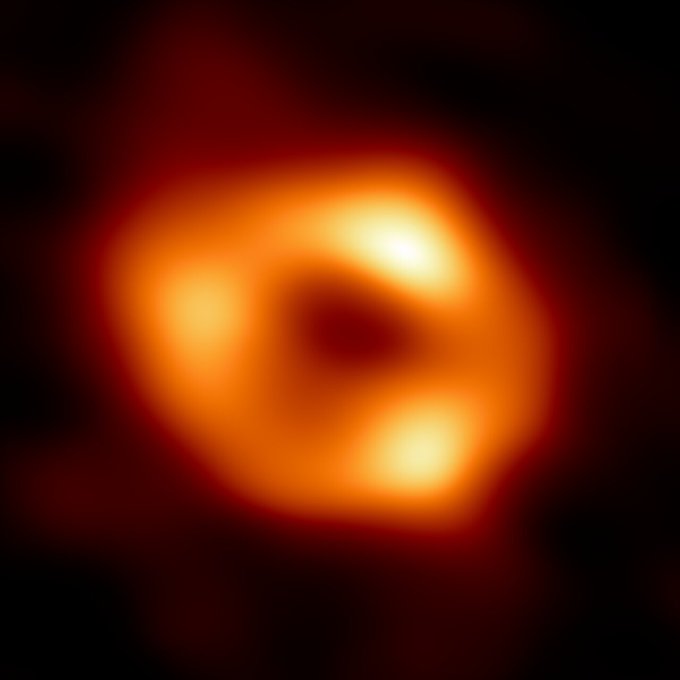
As I mentioned a while ago the Event Horizon Telescope team held a press conference this afternoon and to nobody’s surprise they used it announce an image of the (shadow of the event horizon around the) black hole at the centre of the Milky Way.

Here it is:

You can read the full press release here.

You may recall a great deal of excitement about three years ago concerning the imaging of the “shadow” of the event horizon of the black hole in the centre of the galaxy M87. The question I was asked most frequently back then is that there’s a much closer black hole in the centre of our own Galaxy, the Milky Way, so why wasn’t that imaged first?

It it true is that the black hole in the centre of M87 is ~103 times further away from us than the black hole in the centre of the Milky Way – known to its friends as Sagittarius A* or SgrA* for short – but is also ~103 times more massive, so its Schwarzschild radius is ~103 times larger. In terms of angular resolution, therefore, the observational challenge of imaging the event horizon is similar in the two cases. However, in the the case of the Milky Way’s black hole the timescales involved are much shorter than in M87 and there is a greater level of obscuration along the line of sight. That’s why it took longer to produce the image.

It’s a very difficult observation of course and I’m not sure of the significance of the “lumps” you can see, but the dark region in the centre is what the image is really about and that seems to be exactly the predicted size. The resolution is about 20 microarcseconds. Congratulations to the Event Horizon Telescope team!

If you’re interested in learning more about how this image was made I recommend this short video:

The Complex Heart of the Milky Way

Posted in Art, The Universe and Stuff with tags , , , on January 26, 2022 by telescoper

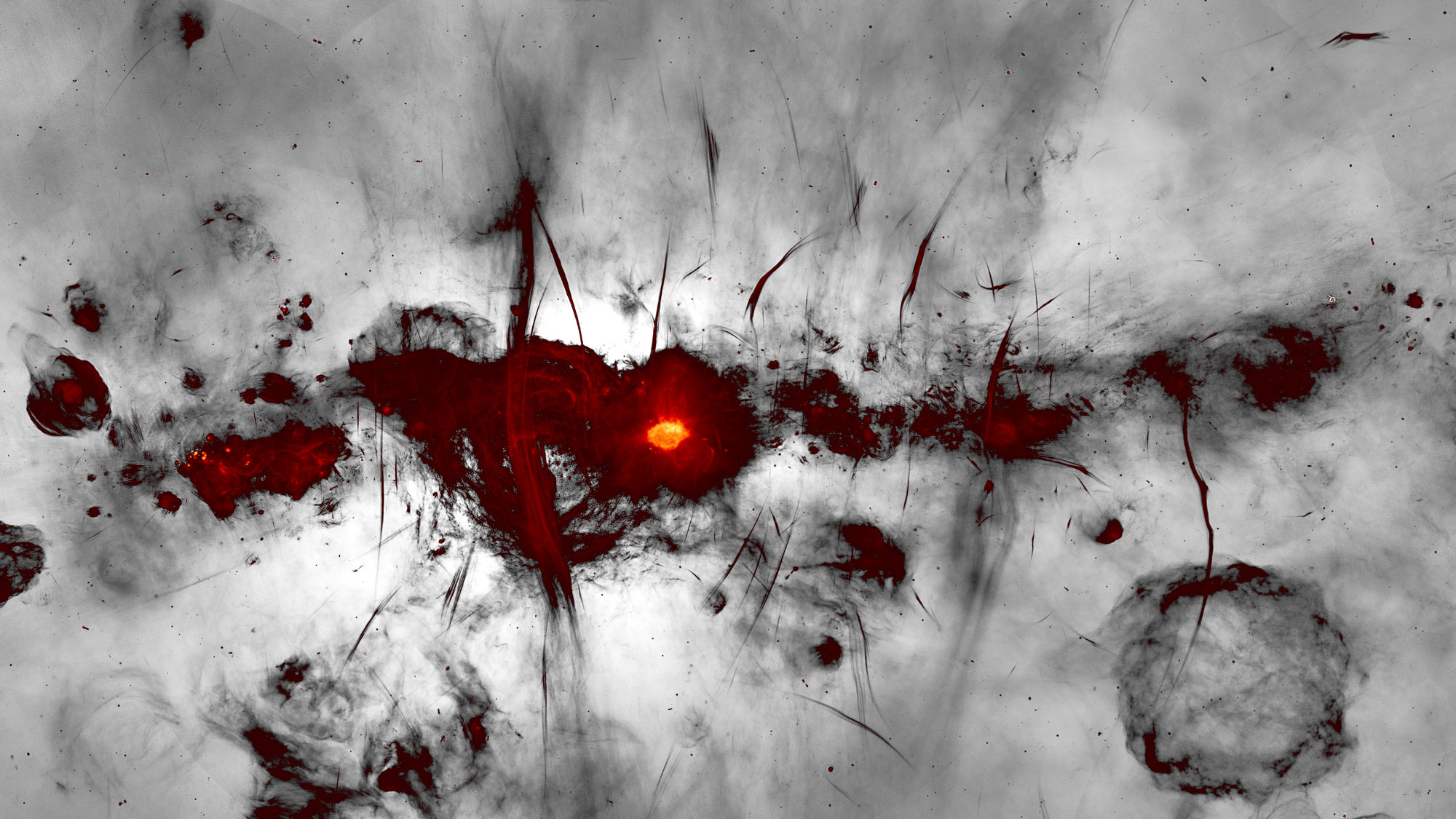
I couldn’t resist sharing this amazing radio image of the Galactic Centre made using the South African MeerKAT radio telescope:

Radio frequency electromagnetic radiation is able to penetrate the dust that permeates this region so can reveal what optical light can not. In particular you can see the very active region around the black hole at the centre of the Milky Way, bubbles caused by exploding stars and – most interesting of all – a number of magnetized filamentary structures.

It’s an extraordinarily beautiful picture made from a mosaic of 20 separate observations. In fact I like it so much I’ve cross-filed it in my “Art” folder. Those of us who work in astronomy or astrophysics are wont to say that there’s much more to it than pretty pictures, but when one like this comes along we’re all sure to geek out over it!

For more information about this image at the science behind it, see here.