I recently came across an article on PubMed Central called From symbiont to parasite: the evolution of for-profit science publishing, written by Peter Walter and Dyche Mullins of the University of Carlifornia at Santa Cruz. The abstract reads:
Two 17th century institutions—learned societies and scientific journals—transformed science in ways that still dominate our professional lives today. Learned societies like the American Society for Cell Biology remain relevant because they provide forums for sharing results, discussing the practice of science, and projecting our voices to the public and the policy makers. Scientific journals still disseminate our work, but in the Internet-connected world of the 21st century, this is no longer their critical function. Journals remain relevant almost entirely because they provide a playing field for scientific and professional competition: to claim credit for a discovery, we publish it in a peer-reviewed journal; to get a job in academia or money to run a lab, we present these published papers to universities and funding agencies. Publishing is so embedded in the practice of science that whoever controls the journals controls access to the entire profession. We must reform our methods for evaluating the contributions of younger scientists and deflate the power of a small number of “elite” journals. More generally, given the recent failure of research institutions around the world to strike satisfactory deals with publishing giant Elsevier, the time has come to examine the motives and methods of those to whom we have entrusted the keys to the kingdom of science.
This isn’t a new article – it was published in 2019 – and it says many things I have said already about the academic publishing racket – but I thought I’d share it here primarily because of the following picture:
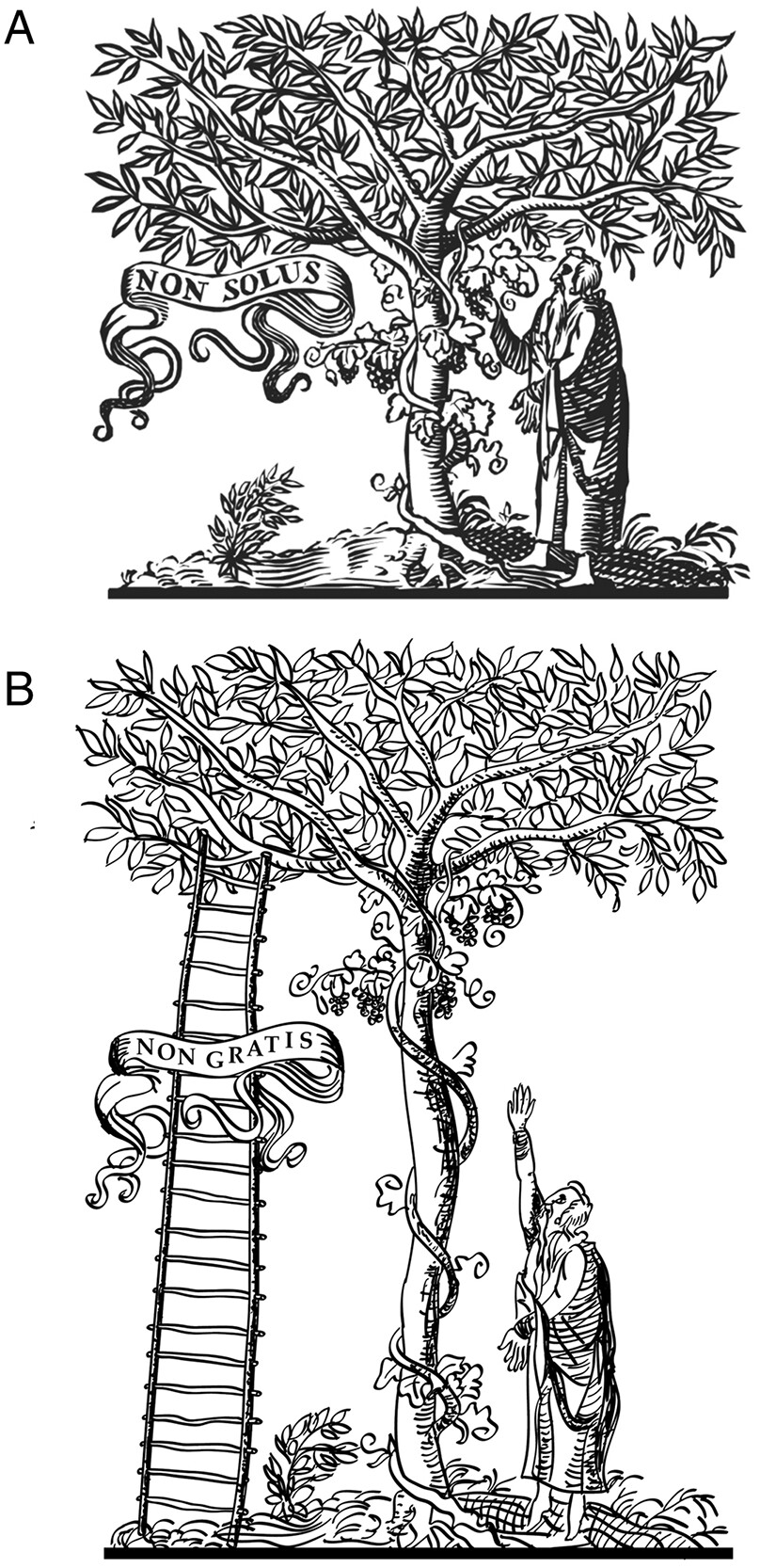
The text accompanying it reads:
Non Solus (Latin for “not alone”) reads the banner of a woodprint adopted as a logo in 1620 by the House of Elsevier, a family of Dutch booksellers. The print shows a sturdy elm tree that supports a growing vine, which wraps around the trunk and entangles the branches (Figure 1A). The vine bears fruit, which a solemn scholar harvests with ease. In 1880, an unrelated publishing company adopted the venerable Elsevier name and logo, which according to its website: “…represents, in classical symbolism, the symbiotic relationship between publisher and scholar. The addition of the Non Solus inscription reinforces the message that publishers, like the elm tree, are needed to provide sturdy support for scholars, just as surely as scholars, the vine, are needed to produce fruit. Publishers and scholars cannot do it alone….”
Today, this 400-year-old logo no longer reflects reality. As scholars, we now could take over the means of fruit production–in fact, we already do most of it. Like our intellectual ancestors hundreds of years ago, we still conceive and execute the research, and we write the manuscripts. But now, with the advent of electronic word and image processing, we also create our own graphics, proofread our own text, and in some cases typeset it. More significantly, the Internet enables us to instantly disseminate our work around the world. Publishers provide a measure of quality control by orchestrating the peer review process, but here again it is scholars who do the actual work of reviewing papers. It is thus surprising that despite the diminished (and arguably dispensable) role of the publishing industry, our community remains slavishly committed to centuries-old traditions that, we will argue, are illogical and in many cases exploitative and harmful to our community.
(The emphasis is mine.) I agree with these comments. I just wish more people would actually start taking over the means of production – as we’ve been doing at the Open Journal of Astrophysics – rather than just talking about it.


