After a very busy week, it’s time once more for another Saturday update of activity at the Open Journal of Astrophysics. Since the last update we have published a further twelve papers, bringing the number in Volume 9 (2026) to 189 and the total so far published by OJAp up to 637. As I pointed out on Wednesday this week is the first during which we have published at least one paper in each of the six categories on asrto-ph.
I continue to include the posts made on our Mastodon account (on Fediscience); these announcements also show the DOI for each paper. The Mastodon account has regular updates and announcements from OJAp too.
In the past on these posts I have included the article keywords as tags, but this is quite a lot of effort to do for little benefit so I’ve decided just to tag the arXiv category (i.e. folder) and arXiv ID for each paper as well as the lede from the journal platform.
The first one up this week was published on Monday 24th August 2026 in the folder Astrophysics of Galaxies. “Energy-Space Analysis of Tidal Stripping in Stellar-Dark Matter Systems“, by Bradley Arias (UC Berkeley, USA), Nicole E. Drakos (U. Hawaii, USA) and James E. Taylor (U. Waterloo, Canada), uses simulations to explore how tidal stripping shapes the stellar distribution of dwarf galaxies, also suggesting a pathway for the formation of galaxies deficient in dark matter
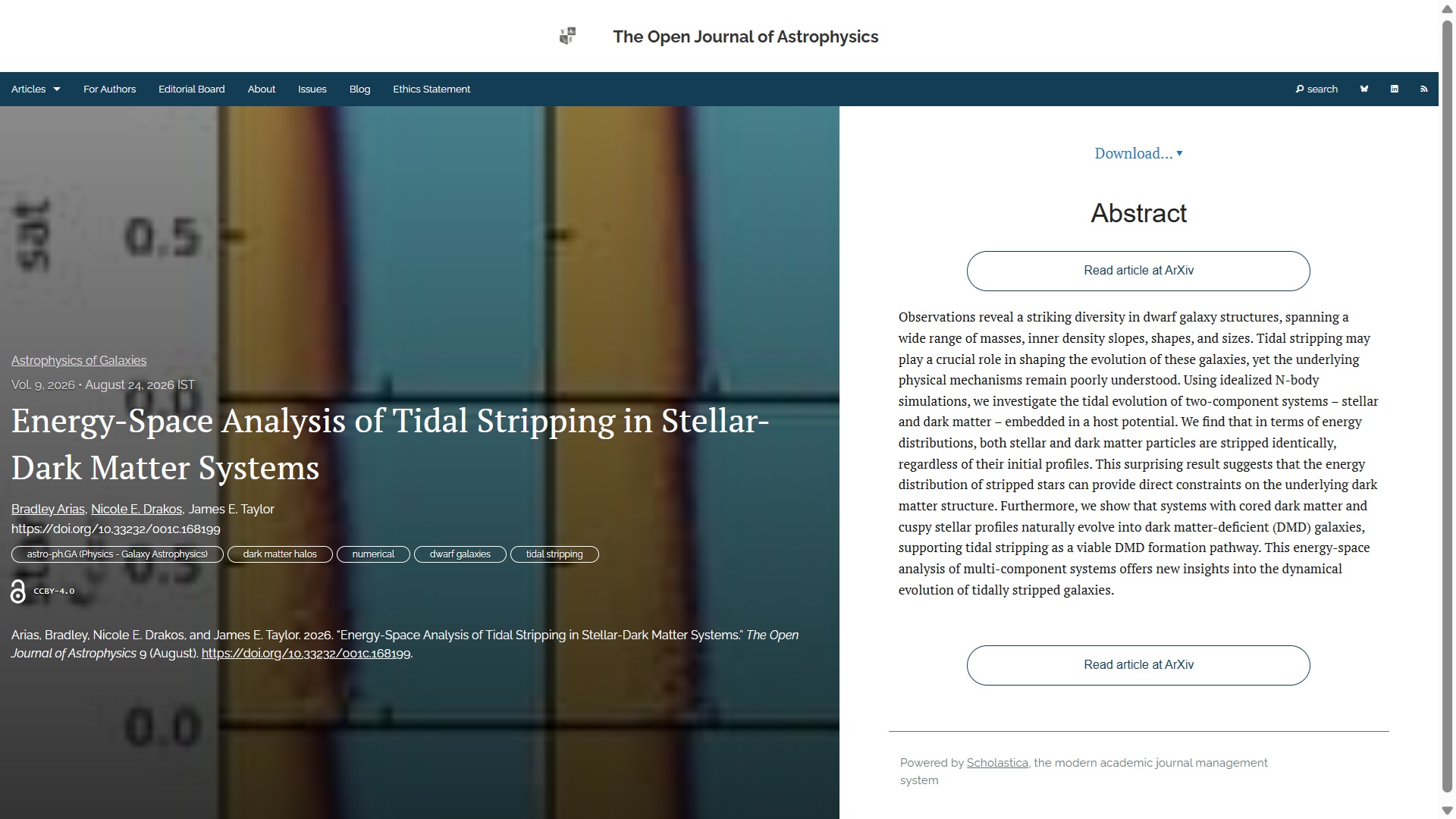
You can find the officially accepted version on arXiv here and the announcement on Fediverse here:

The second paper for this week, also published on Monday 24th August but in the folder Cosmology and Nongalactic Astrophysics is “Second Order Closures for the Radiative Transfer Equation: Some Are Unstable” by Nickolay Y. Gnedin and Harley Katz (U.Chicago, USA). This study explores higher-order closure relations in cosmic reionization simulations, finding that direct generalizations of M1 and OTVET are physically unstable, limiting second-order closure options.
The overlay looks like this:
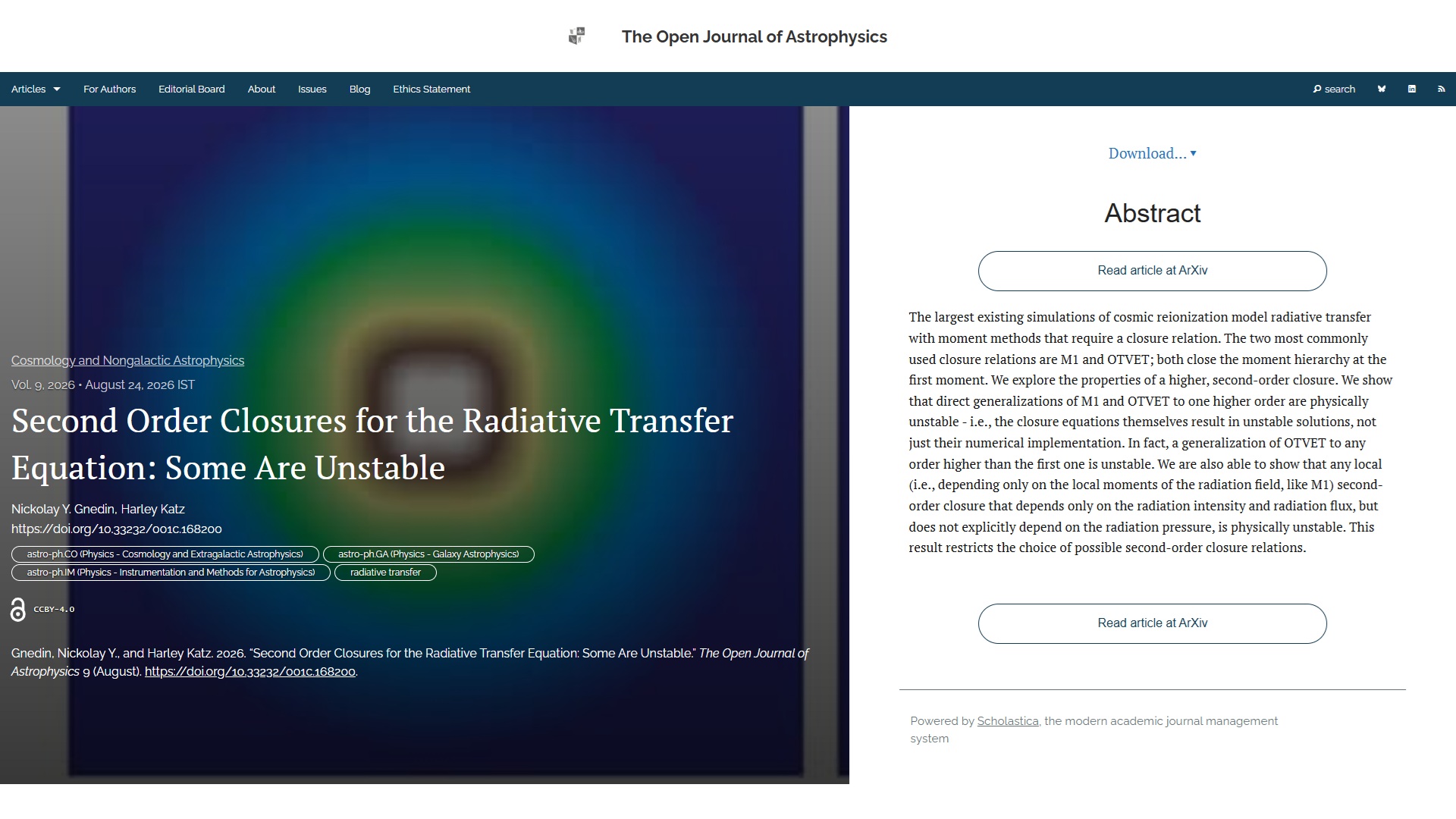
The official version of the paper can be found on arXiv here and the Fediverse announcement here:
The third paper of the week, yet another one published on Monday 24th August this time in the folder Instrumentation and Methods for Astrophysics is “Differentiable Forward Modeling for Efficient and Accurate Shear Inference” by Ismael Mendoza and 7 others on behalf of the LSST Dark Energy Science Collaboration. This study presents a modern implementation of the Bayesian shear inference framework for measuring cosmic shear signal in dark energy optical surveys, requiring no external calibration to handle noise bias.
The overlay is here:
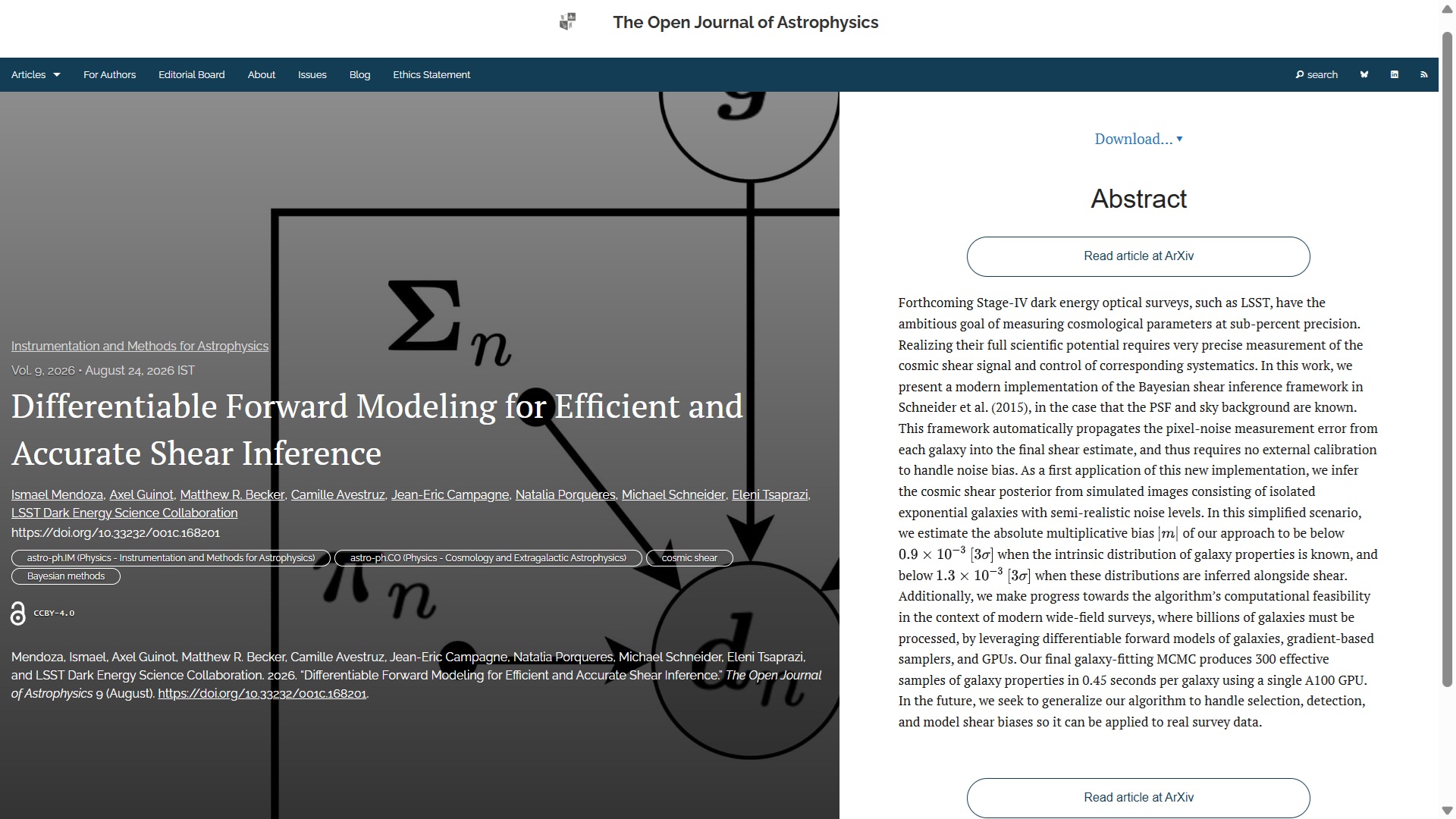
The official version of the paper can be found on arXiv here and the Fediverse announcement here:
The fourth paper of the week, published on Tuesday 25th August in the folder Solar and Stellar Astrophysics is “BLG723.31.34651 as an eclipsing Roche lobe-filling sdOB+WD binary” by Alekzander Kosakowski, Charles E. Derbyshire, Sydney Jetton and Brad N. Barlow (University of North Carolina, USA).
The overlay is here:
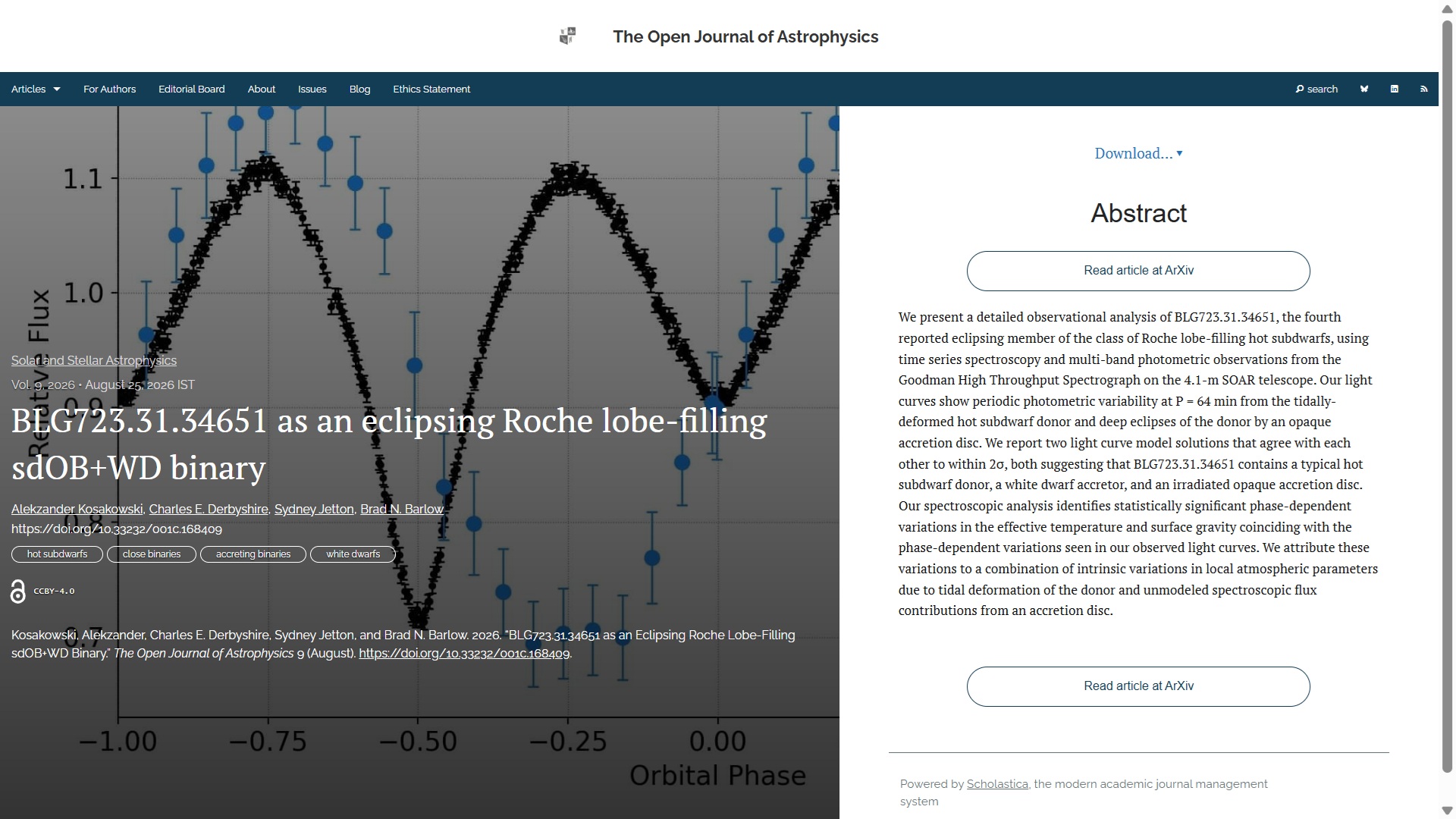
The officially-accepted version of the paper can be found on arXiv here and the Fediverse announcement here:
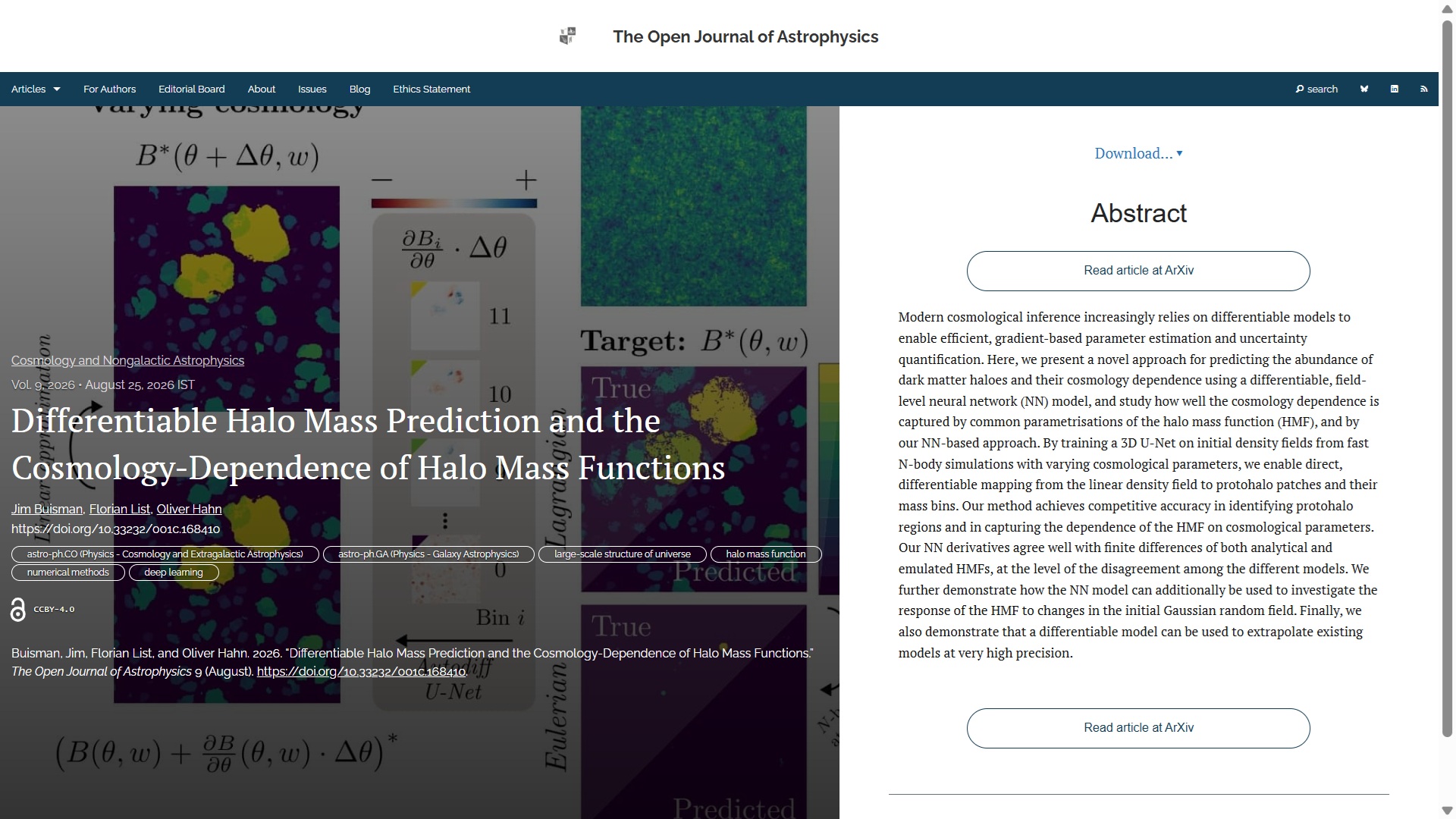
The fifth paper of the week is “Differentiable Halo Mass Prediction and the Cosmology-Dependence of Halo Mass Functions” by Jim Buisman, Florian List and Oliver Hahn (U. Vienna, Austria). This was published on Tuesday 25th August in the folder Cosmology and Nongalactic Astrophysics; it presents a novel approach using a differentiable neural network model for predicting dark matter haloes abundance and their cosmology dependence, achieving competitive accuracy in identifying protohalo regions.Abstractfor Differentiable Halo Mass Prediction and the Cosmology-Dependence of Halo Mass Functions.
The overlay is here:
The officially-accepted version of the paper can be found on arXiv here and the Fediverse announcement here:
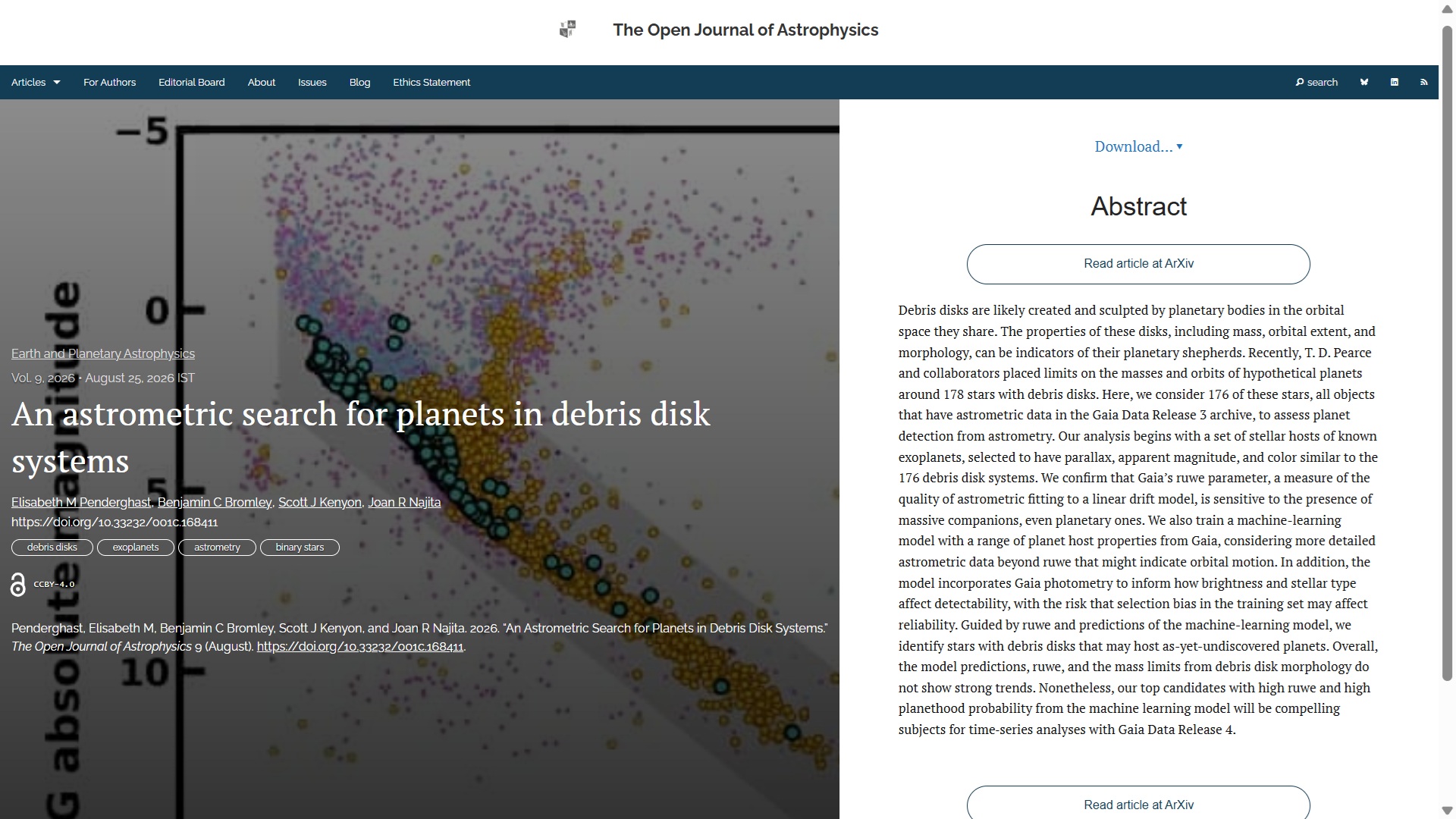
The sixth paper of the week is “An astrometric search for planets in debris disk systems” by Elisabeth M Penderghast & Benjamin C Bromley (U. Utah, USA), Scott J Kenyon (Smithsonian Astrophys. Obs., USA) and Joan R Najita (NSF NOIRLab, USA). This was published on Tuesday 25th August 2026 in the folder Earth and Planetary Astrophysics. This study uses Gaia astrometric data and machine learning to identify stars with debris disks that may host undiscovered planets, providing potential subjects for future analyses.
The overlay is here:
You can find the officially-accepted version of the paper on arXiv here and the Fediverse announcement here:
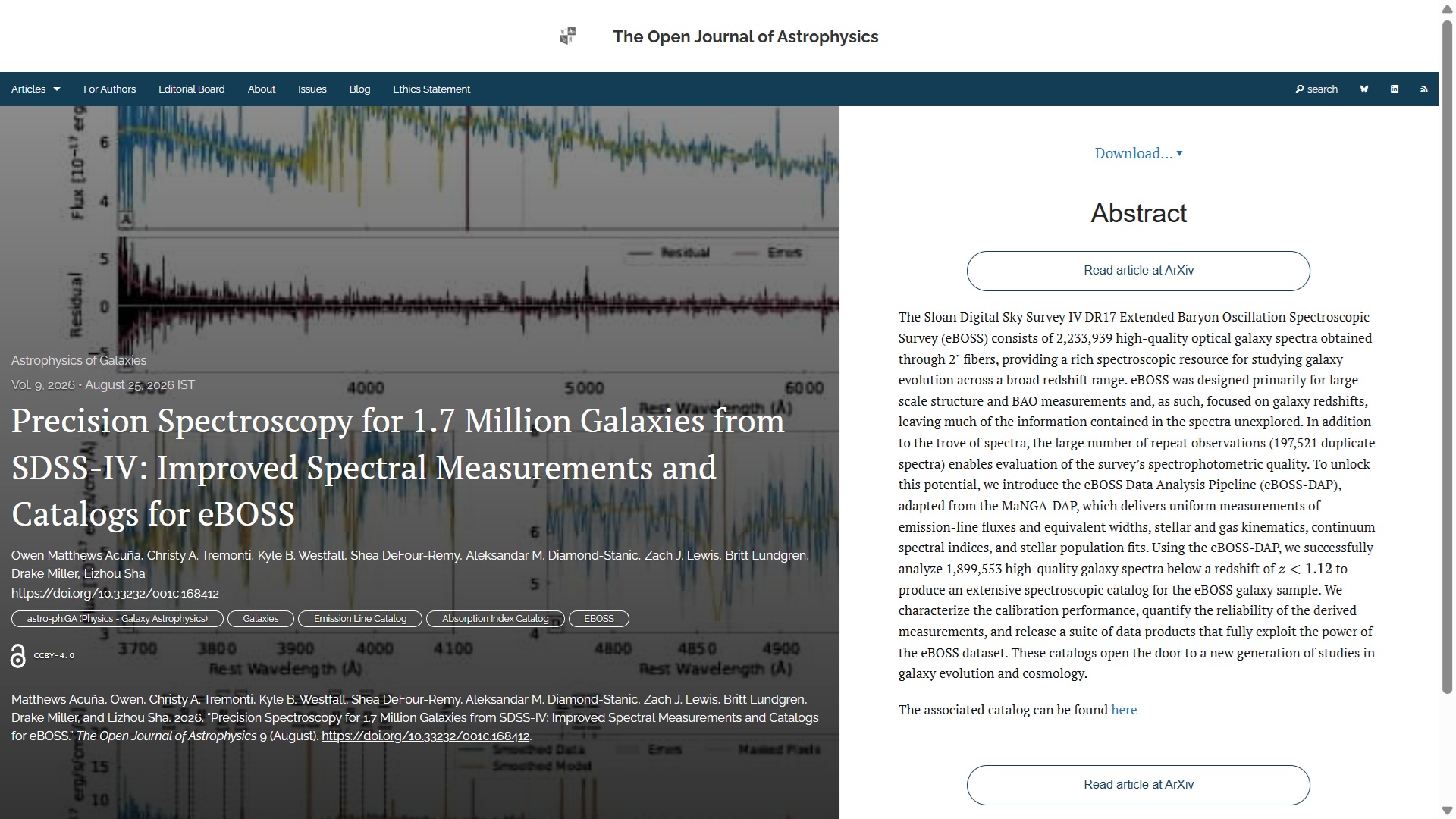
Paper number seven for the week is “Precision Spectroscopy for 1.7 Million Galaxies from SDSS-IV: Improved Spectral Measurements and Catalogs for eBOSS” by Owen Matthews Acuña (U. Wisconsin Madison, USA) and 8 others based at various instititions in the USA. This was published on Tuesday 25th August in the folder Astrophysics of Galaxies. The paper presents an extensive spectroscopic catalog and other data products for the EBOSS galaxy sample, opening the door to a new generation of studies in galaxy evolution and cosmology.
The overlay for this paper looks like this:
The officially-accepted paper can be found on arXiv here and the fediverse announcement follows
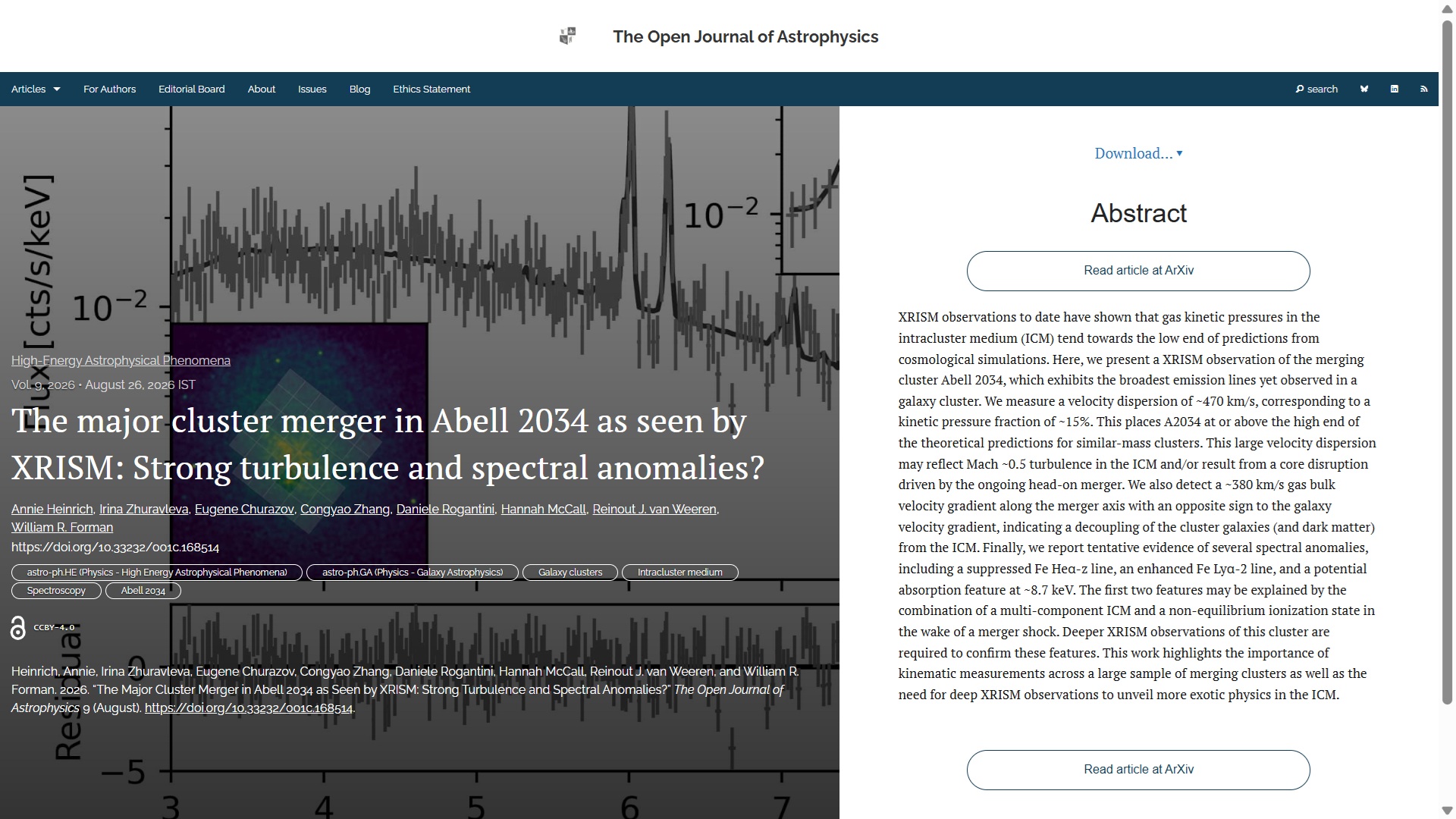
The eighth paper of the week, published on Wednesday 27th August in the folder High-Energy Astrophysical Phenomena is the one that completed our full house for the week. This study presents XRISM observations of the merging cluster Abell 2034, revealing the broadest emission lines yet seen in a galaxy cluster, indicating potential turbulence and core disruption.
The overlay is here:
You can find the official version on arXiv here and the Mastodon announcement is here
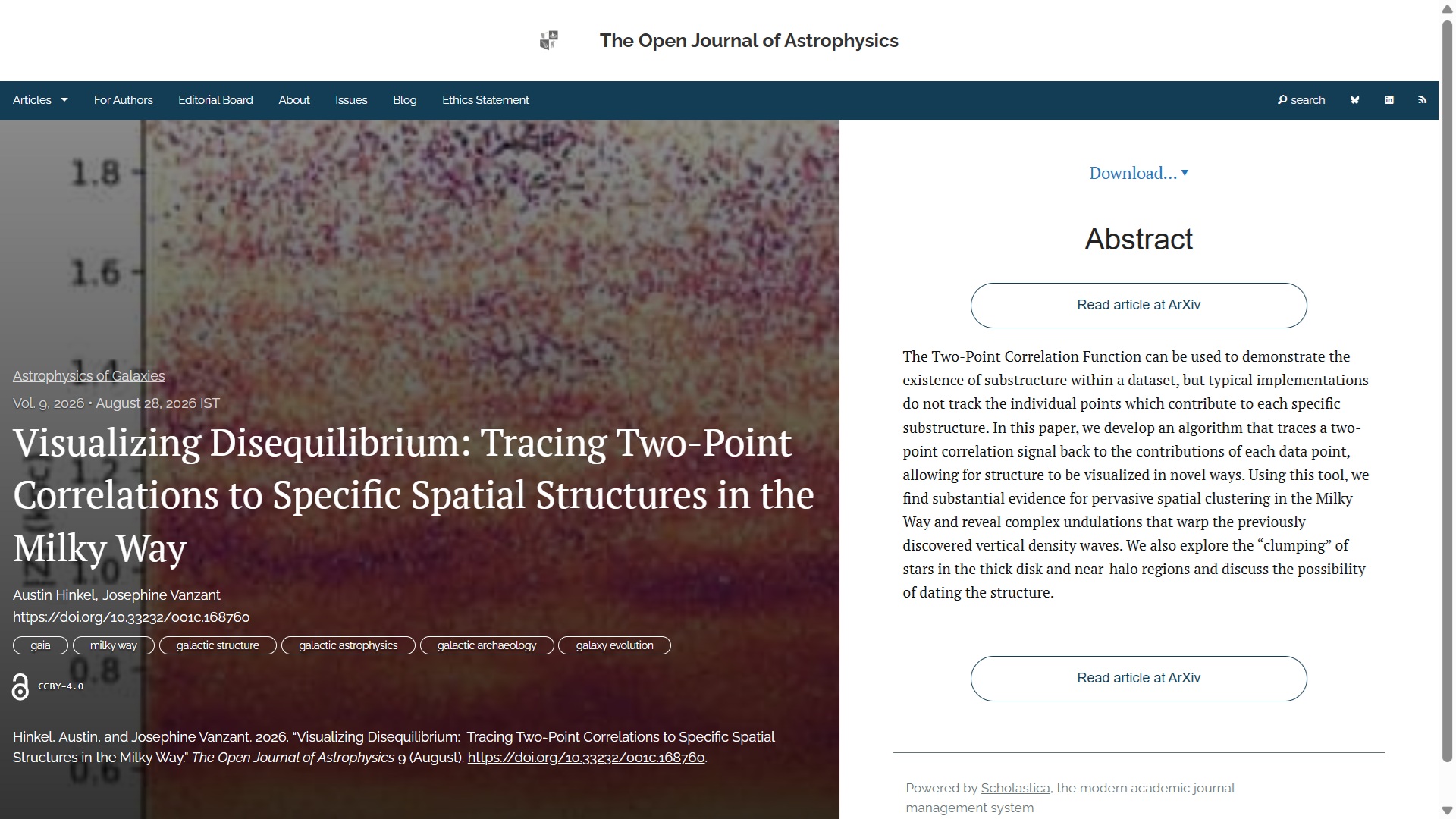
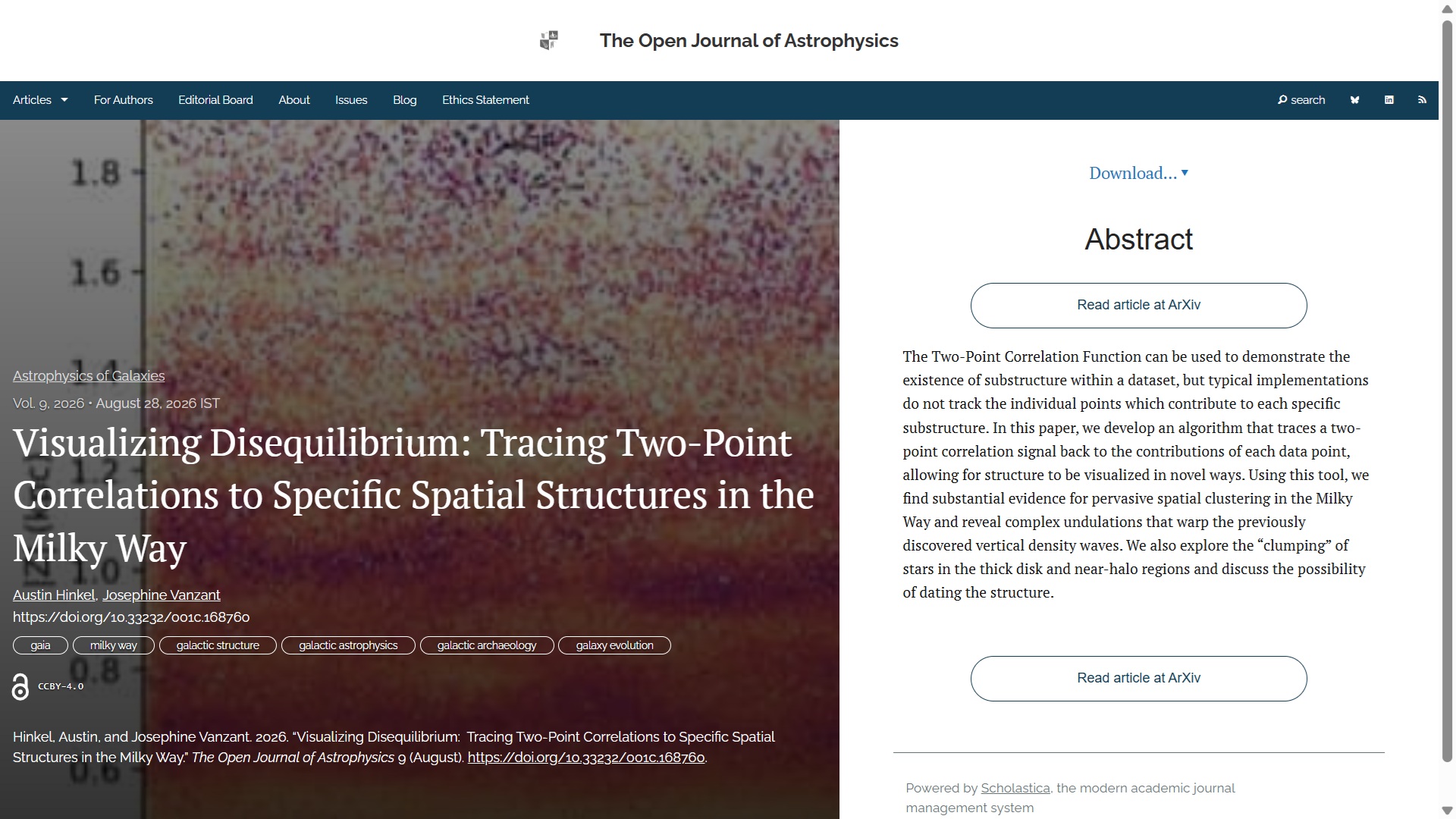
The ninth paper of the week is “Visualizing Disequilibrium: Tracing Two-Point Correlations to Specific Spatial Structures in the Milky Way” by Austin Hinkel and Josephine Vanzant (Thomas More U. USA). This paper, published on Friday 27th August in the folder Astrophysics of Galaxies, presents an algorithm that enhances the Two-Point Correlation Function, enabling detailed visualization of spatial clustering and complex structures in the Milky Way.
The overlay for this one looks like this:
You can find the officially-accepted version of the paper on arXiv here and the fediverse announcement is here:
The tenth paper of the week is “Assessing Self-Absorbed Molecular Lines as Tracers of Gravitational Collapse” by Lillian Y. Cai (Priinceton U., USA) and Felix D. Priestley & Sarah E. Ragan (Cardiff U., UK). This paper, reveals that traditional observational techniques probably underestimate true infall velocities and mass accretion rates in collapsing prestellar cores due to non-uniform radial velocity profiles.
The overlay for this one is here:
The officially accepted version can be found on arXiv here and here is the fediverse announcement:
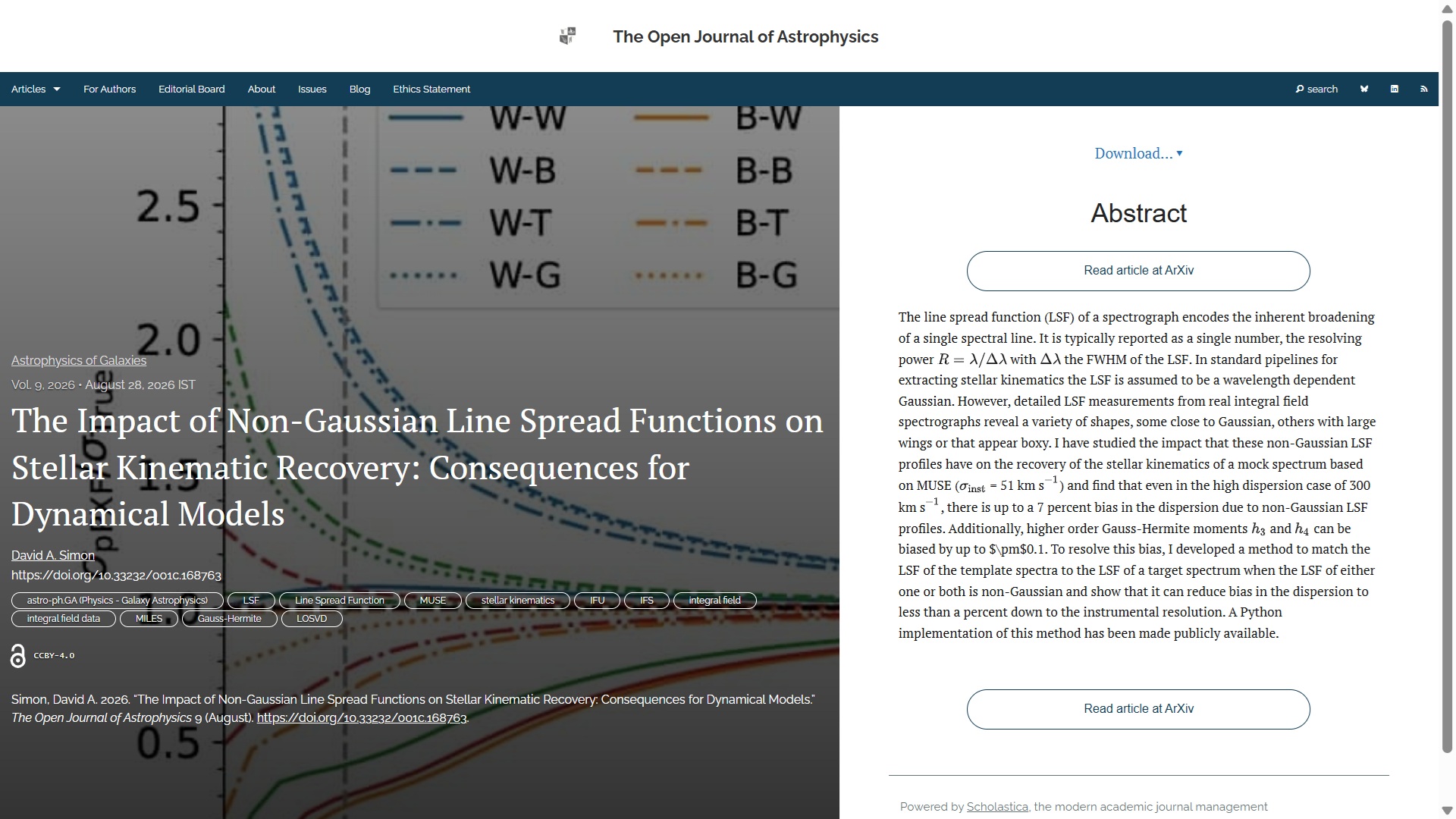
The penultimate paper of the week, the eleventh, is “The Impact of Non-Gaussian Line Spread Functions on Stellar Kinematic Recovery: Consequences for Dynamical Models” by David A. Simon (Oxford University, UK). This article was also published on 28th August 2026 in the folder Astrophysics of Galaxies. It explores the impact of non-Gaussian line spread function (LSF) profiles on stellar kinematics recovery. A method was developed to reduce bias in dispersion, with a Python implementation available.
A screenshot of the overlay for this one is here:
The final accepted version can be found on arXiv here and the fediverse announcement is here:
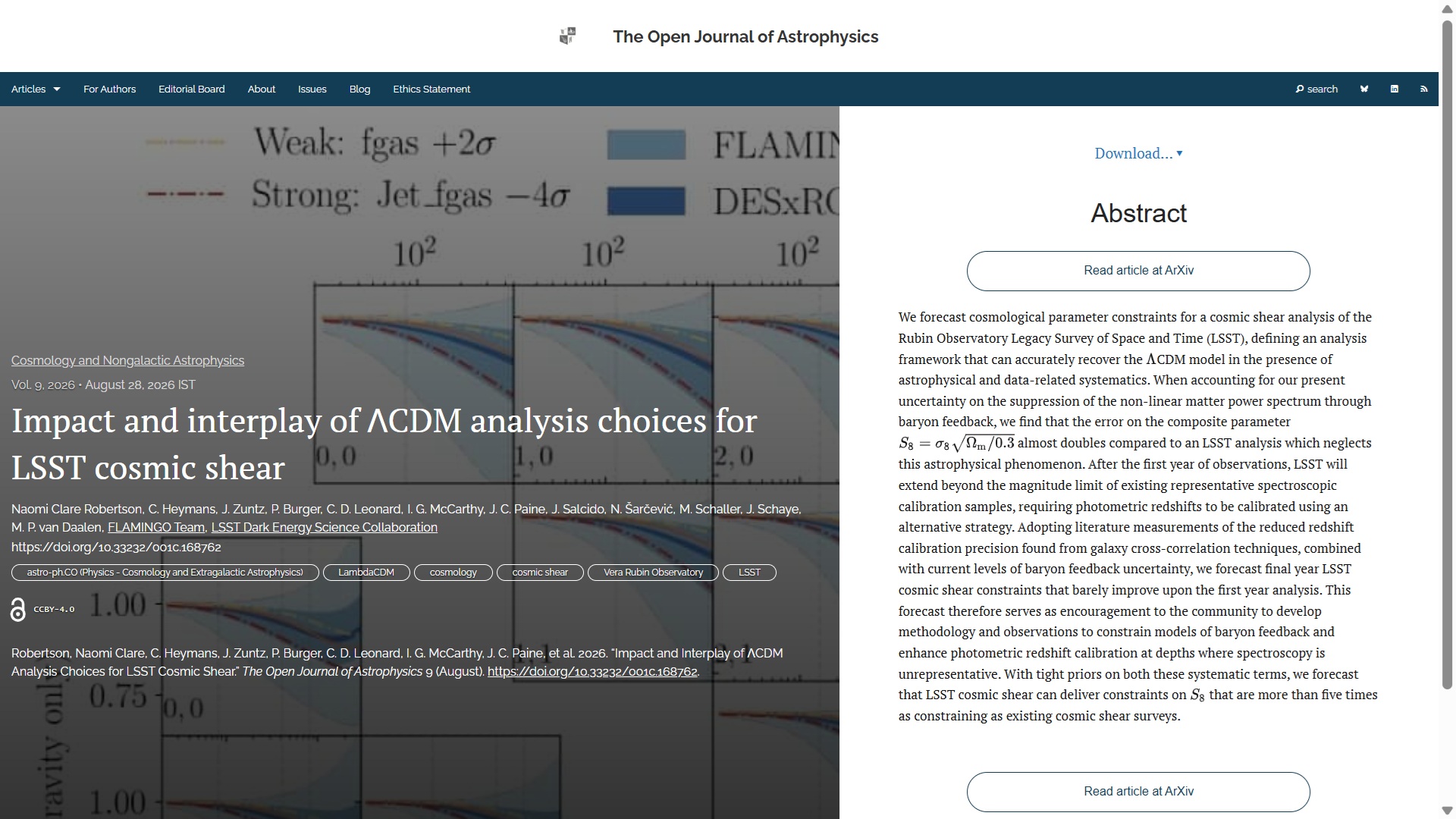
The last paper of the twelve to announce this week is “Impact and interplay of ΛCDM analysis choices for LSST cosmic shear” by Naomi Clare Robertson and 11 others for the FLAMINGO Team and the LSST Dark Energy Science Collaboration. This was also published on Friday 28th August 2026, but in the folder Cosmology and Nongalactic Astrophysics. The study forecasts cosmological parameter constraints for a cosmic shear analysis of the Rubin Observatory Legacy Survey of Space and Time (LSST), emphasizing the need for improved methods. This is what the overlay looks like:
The final accepted version can be found on arXiv here and the fediverse announcement is here:
And that concludes the papers for this week, which turned out to be a bumper one! I’ll do another update next weekend.

 In the Dark