Author Archive

Stardust – Ruby Braff

Posted in Jazz with tags , on October 28, 2023 by telescoper

Rueben “Ruby” Braff is probably better known as a cornet player than a trumpeter, but whenever he did play the trumpet he showed why Jack Teagarden dubbed him “the Ivy League Louis Armstrong”. Here’s a gorgeous performance by him of the Hoagy Carmichael classic Stardust in which he wears the influence of Louis Armstrong on his sleeve.

P.S. The pianist on this track is a young Dave McKenna.

Teaching in Base 60

Posted in Barcelona, Cardiff, History, mathematics, Maynooth with tags , , , , on October 27, 2023 by telescoper

Some time ago – was it really over a decade? – I wrote a piece about the optimum size of modules in physics teaching. I was still in the United Kingdom then so my ramblings were based on a framework in which undergraduate students would take 120 credits per year, usually divided into two semesters of 60 credits each. In Cardiff, for instance, most modules were (and still are) 10 credits but some core material was delivered in 20 credit modules. In the case of Sussex, to give a contrasting example, the standard “quantum” of teaching was the 15 credit module. I actually preferred the latter because that would allow the lecturer to go into greater depth, students would be only be studying four modules in a semester (instead of six if the curriculum consisted of 10 credit modules), and there would be fewer examinations. In short, the curriculum would be less “bitty”.

In Maynooth the size of modules is reckoned using the European Credit Transfer System (ECTS) which takes a full year of undergraduate teaching to be 60 credits rather than 120 in the UK, but the conversion between the two is a simple factor of two. In Maynooth the “standard” unit of teaching is 5 credits, with some 10 credit modules thrown in (usually extending over two semesters, e.g. projects). This is similar to the Cardiff system. The exception concerns first-year modules, which are 7.5 credits each because students take four modules in their first year so they have to be 30/4=7.5 credits each. The first year is therefore like the Sussex system. It changes to a five-credit quantum from Year 2 onwards because students do three subjects at that stage.

I find it interesting to compare this with the arrangements here in Barcelona (and elsewhere in Spain). Here the ECTS credit size is used, but the standard module is six credits, not five, and year-long projects here are 12 credits rather than 10. The effect of this is that students generally study five modules at a time (or four plus a project). To add to the fun there are also some 9 credit modules, so a semester could be made up of combinations of 6-credit and 9-credit chunks as long as the total adds up to 30.

Anyway, the main point of all this is to illustrate the joy of the sexagesimal system which derives from the fact that 60, being a superior composite number, has so many integer divisors: 2, 3, 4, 5, 6, 12, 15, 20, and 30. The Babylonians knew a thing or two!

The 21 Group – Guest Post by Wyn Evans

Posted in Harassment Bullying etc with tags , , , , , on October 26, 2023 by telescoper

Here’s an important piece by Professor Wyn Evans of Cambridge University relating to the theme of harassment and bullying which I’ve returned to several times on this blog. I strongly support the creation of the 21 Group and agree with the recommendations made in the post below. Indeed, I have myself made a similar suggestion in the context of sexual harassment that the people involved in investigations of such cases…

…should not be employees of the university in question, as they would come under pressure to hush things up – which clearly happens now. It seems to me that far too many institutions prioritize limiting reputational damage over doing the right thing for their staff and students.

https://telescoper.blog/2019/06/12/investigating-sexual-harassment-in-universities/

Now over to Wyn.

—o—

My article on Whistleblowing in the UK Universities is in The Times Higher Education Supplement this week:

https://www.timeshighereducation.com/opinion/investigating-serious-abuses-must-be-taken-out-universities-hands

Whistleblowing is ineffective in the UK Universities. There is no protection for whistleblowers. Any whistleblowing investigation is run by the university without properly independent scrutiny.

Self-directed investigations make no sense in an organisation in which poor behaviour has been tolerated for a long time. We have seen this in the scandals in the Post Office, in the NHS and in the Metropolitan Police.

The Universities are no exception. Organisations that investigate themselves exonerate themselves. They look for rugs enormous enough to sweep everything under.

Universities need an independent Ombudsman to look into serious complaints.

This already exists for complaints by undergraduates. It is the Office of the  Independent Adjudicator for Higher Education.

https://www.oiahe.org.uk

If a student or a former student is dissatisfied with the handling of a matter by a University, then they can appeal to the independent adjudicator.

Postgraduate students and university staff do not have any such rights. We are regarded as ‘service providers’ rather than ‘paying customers’ in the monetized world of higher education.

Vice chancellors and senior managers from Cambridge to Maynooth pontificate that world-class universities are about ‘the people’. That’s where it ends. Senior management are indifferent as to whether the people in universities do actually work in an environment that promotes respect, dignity, safety and equality.

Pressure groups are needed to drive organisational and cultural change in the UK Universities.

So, we have founded the 21 Group

Our name derives from the fact that in a staff survey, 21% of employees at the University of Cambridge reported that they had been subjected to bullying or harassment in the workplace.

https://www.theguardian.com/education/2020/jan/07/third-cambridge-university-staff-experienced-bullying

The 21 Group operates nationally and offers support for staff in UK universities who are experiencing bullying, victimisation and harassment in the workplace. Amongst other things, we are running a national survey of bullying in the UK Universities.

Sadly, we have nothing to be proud of in astronomy. The only systematic survey of UK astronomy was carried out by the Royal Astronomical Society in 2020-2021. They obtained responses from over 650 people.

44% of respondents had suffered bullying and harassment in the workplace within the last year.

https://ras.ac.uk/news-and-press/news/survey-finds-bullying-and-harassment-systemic-astronomy-and-geophysics

A figure of 44% is grotesque. It is almost a half of all respondents.

The Royal Astronomical Society deserves full credit for conducting the survey and publishing the results. What is sad is that the UK astronomical community has not made any discernible efforts to improve matters since its publication in 2021.

Another Country

Posted in Barcelona, Biographical, Maynooth with tags , , on October 25, 2023 by telescoper

It was only when I looked at my calendar this morning, and saw the reminder that my rent is due shortly, that I realized that I have now been in Barcelona for a whole month (plus one day). Lacking the usual cycle of lectures and other teaching sessions, I’ve still had regular telecons and other virtual discussions through which to reckon the passage of time, but these are different. When I’m teaching I always number my lectures consecutively so it’s easy for me to look at my notes and see that we’re, say, approaching half-term. That gives me a sense of progress which I must admit I don’t feel with scheduled telecons, which seem more cyclic – i.e. going around in circles most of the time.

Other than that, I’ve settled in here better than I expected. I’ve even managed to memorize the codes needed to get into my flat – no mean feat given my fading powers of recollection. Progress on the research has been a bit slower than expected, but I hope to finish the paper I’m working on by the weekend.

Next week is Study Week in Maynooth, including a public holiday on Monday 30th October to mark Samhain. Wednesday November 1st is a (national) public holiday in Spain too, Tots Sants (“All Saints” in Catalan). That would be the third public holiday since I arrived in Barcelona, but I won’t be here for it, as I have to make a flying visit to another country to give a talk, and do a few other things.

This reminds me that I should send an update on the affair of Maynooth University’s Governing Authority. As you may recall, the Powers That Be initially decided to scrap elections to the Governing Authority of the University in favour of selection. There was a protest at this authoritarian plan and a petition was raised. After initially proposing a mixture of election and selection, The Management finally backtracked and agreed to elections for all five internal representatives. Although the elections happened after I moved to Barcelona, they were held online so I was able to vote. The process is now complete, and I send congratulations to the five duly elected representatives!

One thing I hope the new members of Governing Authority will do concerns the outcomes of Maynooth University’s “Staff Climate and Culture Survey” which was carried out in 2022 with the promise made to participants that results would be published in early 2023. No such results have ever communicated to staff (or anyone else that I am aware of) and all mention of this survey has been wiped off the University’s web pages. Perhaps the new members of GA can push for the long overdue publication of this information?

The Metamorphosis of Narcissism

Posted in Art, Education, Maynooth with tags on October 24, 2023 by telescoper

My attention was drawn today to a paper in the journal Research Policy. It’s an Elsevier journal so the article is behind a paywall, and the methodology looks very dodgy, but the abstract is worth reading for amusement value (the emphasis is mine):

Universities hold a prominent role in knowledge creation through research and education. In this study, we examine the effects of VC narcissism on university performance. We measure VC narcissism based on the size of the signature, in line with a methodological approach which has been widely used in the recent literature and repeatedly validated in laboratory experiments. We exploit a quasi-natural experiment of VC changes and employ a Difference-in-Difference research design, which alleviates concerns related to endogeneity and identification bias. We show that the appointment of a highly narcissistic VC leads to an overall deterioration in research and teaching performance and concomitantly league table performance. We further identify excessive financial risk taking and empire-building as possible mechanisms explaining the main results and provide evidence on the moderating role of university governance. Our findings are consistent with the view that narcissism is one of the most prominent traits of destructive leadership; they also have practical implications for leadership recruitment and the monitoring of leadership practices in the higher education sector. The results of this study extend prior research in several ways. Extant literature on executive leadership and narcissism yields inconclusive findings; this literature has mainly focused on for-profit organisations and has not considered universities. In addition, prior research in higher education on the determinants of university performance has not yet examined the role of leadership personality traits.

https://doi.org/10.1016/j.respol.2023.104901

I chose the title of this post – an allusion to a famous painting by Salvador Dalí that plays with the themes of hallucination and delusion – reading a sentence in the introduction to the paper:

Over the past few years the complexity and challenges of running a higher education institution have changed beyond recognition.

In other news, I am dismayed that, because of my absence from campus on sabbatical, I am unable to attend today’s long-awaited launch event for the brand new Maynooth University Strategic Plan (which will be accompanied by a protest by postgraduate students at Maynooth about low stipends and poor working conditions). The latter seems to me to be of far greater importance to the future of the University than the former.

Open Access Week 2023

Posted in Open Access with tags , , on October 23, 2023 by telescoper

I’m reminded by multiple sources that this week is International Open Access Week 2023, with a theme of “Community over Commercialization”.

Of course, round my way, every week is Open Access Week.

The ongoing OA revolution should involve a radical reinvention/disruption of commercialized academic publishing instead of letting exploitative profit-making private publishing firms keep on fleecing the scholarly community. There is much still to do, and we’ll only succeed if more people turn words into actions.

P.S. You could always start by making a donation to arXiv.

New Publication at the Open Journal of Astrophysics

Posted in OJAp Papers, Open Access, The Universe and Stuff with tags , , , , , on October 22, 2023 by telescoper

It’s Sunday but I’ll be a bit busy next week so I’m taking the opportunity today to announce yet another new paper at the Open Journal of Astrophysics. This one was published on Friday 20th October.

The latest paper is the 41st  so far in Volume 6 (2023) and the 106th in all. It is a product of the Dark Energy Survey team and the Kilo-Degree Survey Collaboration, which amounts to about 160 authors altogether. The corresponding author for this article was the Astronomer Royal for Scotland Professor Catherine Heymans, no less.

The primary classification for this paper is Cosmology and NonGalactic Astrophysics and its title is “DES Y3 + KiDS-1000: Consistent cosmology combining cosmic shear surveys”. The article presents a joint analysis of the Dark Energy Survey Year 3 data and the Kilo-Degree Survey data, with a discussion of the implications for cosmological parameters. The key figure – a very important one – is this:

If you want to know more about the result and why it is so important you could read the paper. It is, however, rather long: 40 pages including 21 figures and 15 tables. Do not despair, though, because here is a video explaining the work in the series of Cosmology Talks presented by Shaun Hotchkiss:

Anyway, here is the overlay of the paper containing the abstract:

You can click on the image of the overlay to make it larger should you wish to do so. You can find the officially accepted version of the paper on the arXiv here.

Cursa Bombers!

Posted in Barcelona, Sport with tags , , on October 22, 2023 by telescoper

It’s all go outside my flat! This morning it’s the annual Cursa Bombers (Fireman’s Race), as I found out when I looked it up!

The event begins with teams of four firefighters in full gear running a relay race (4×2.5K) and is then followed by a standard 10K road race. I missed the first bit as I was still in bed.

Spanish Practices

Posted in Barcelona, Education, History, Maynooth with tags , , , , , on October 20, 2023 by telescoper

When I was a lad, during the 1970s, the term Spanish Practices was used pejoratively in a union-bashing sense to describe restrictive practices in the workplace. Until recently I thought it was a modern invention that relied on a stereotypical view of Spanish people as being lazy. In fact it seems the term dates back to Tudor times and is religious in origin, referring to Roman Catholic rites, in contrast to the simpler Protestant forms of worship. Anyway, none of that is what this post is about. I just used the title as clickbait.

I’ve been here in Barcelona, and working in the University of Barcelona, for four weeks now and I thought I’d share a few observations about differences in practice here and in the Ireland (and the UK).

The other night I went out for dinner with colleagues from the Department. The restaurant was much closer to the University than to my flat so instead of going home first I stayed in my office and walked straight there. My route out of the building takes me past a number of teaching rooms. During this warm weather, most of the rooms have the doors open so it’s easy to have a quick look at what’s going on inside. On my way out at about 7.30pm I was surprised to see a number of classes still going on, and they weren’t sparsely attended either.

In Maynooth the latest regular lectures finish at 6pm. Even during the 5pm to 6pm lectures, many students have to leave before the end to catch the one and only bus back to their place of residence. Here the public transport system is so good that isn’t really an issue even for those who don’t live near the campus. As far as I know lectures start at 9am, so students potentially have a very long day. They work hard.

I have to say that I wouldn’t like to have teach late in the evening. I used to do that on Fridays at Queen Mary for the MSc course and didn’t enjoy it. I don’t mind doing 9am lectures, though, but I don’t think students agree – partly because of the difficulty of getting to campus at that time.

In the Faculty of Physics, all the lecture halls, classrooms and laboratories are in one building rather than spread around the campus like they are in Maynooth (and many places in the UK). Fortunately, the building has been designed with students in mind and there is plenty of space for students to use socially or for private study between teaching sessions.

In this picture you can see the inner courtyard of the building occupied by the Faculties of Chemistry and Physics. It’s a big open space, with teaching rooms, etc, on either side. In the far right-hand corner there is a café/bar where one can buy lunch, a coffee, or even a beer, to be consumed either inside or in the seating area in the courtyard. Many students seem to prefer bring their own lunch and eat it in this space., although the food available is pretty good and cheap compared to back home.

As well as being able to eat and drink here, there is plenty of room for students simply to hang out or to study, either alone or in groups. If they don’t feel like that they can use the tram, bus or Metro to go home, and come back later if they have a long gap between classes. None of this is possible at Maynooth.

This particular kind of open space would not work so well in Ireland or the UK because of the weather, though you can probably see in the picture that there had been a bit of rain before I took the photograph, but I hope I’ve made the point that having social spaces makes a huge amount of difference to the student experience, not least because it feels that the University has thought about them. In the neoliberal system that dominates in the UK and Ireland, students are simply a commodity, a source of revenue, to be crammed into every available space and processed as cheaply as possible. In Maynooth students have been, and are being, forced to pay an extra levy for a notional student centre that will probably never be built.

The contrast is very disheartening.

Getting back to educational matters, another thing I’ve noticed walking past classrooms is that it’s not unusual to see a student standing at the blackboard in front of the class going through a problem. I’ve seen that a number of times with quite large classes. Sometimes we ask students to do that sort of thing in tutorials, but I’ve never done so in a full lecture. I think our students would be shocked if we asked, but it’s clearly not unexpected here. That’s a Spanish Practice I’d be quite happy to try.

Two New Publications at the Open Journal of Astrophysics

Posted in OJAp Papers, Open Access, The Universe and Stuff with tags , , , , , , , , on October 20, 2023 by telescoper

It’s Friday so it’s a good time to catch up with the week’s action at the Open Journal of Astrophysics, where there have been two new publications so far this week. These papers take us up to a total of 40  in Volume 6 (2023) and 105 in total since we started publishing.

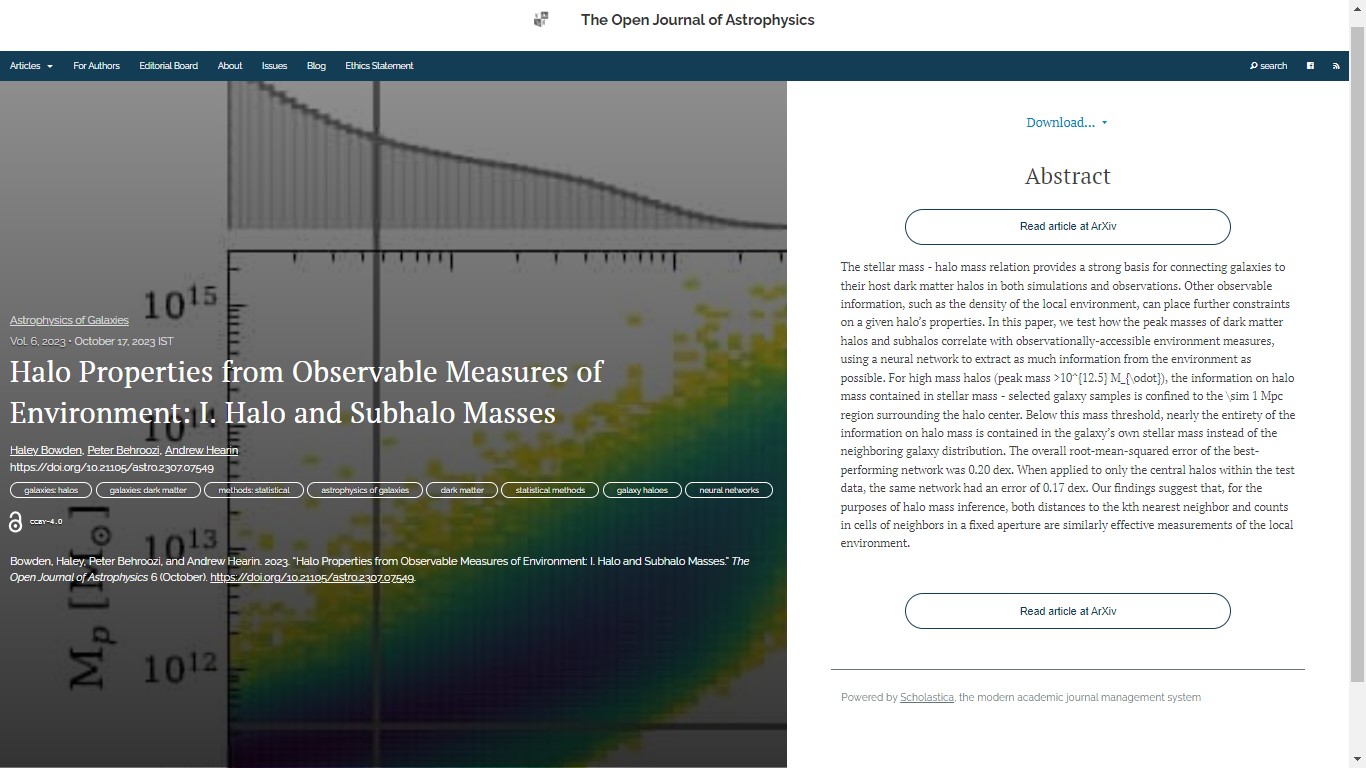
The title of the first paper is “Halo Properties from Observable Measures of Environment: I. Halo and Subhalo Masses” and its primary classification is Astrophysics of Galaxies. it is an exploration using neural networks of how the peak masses of dark matter halos and subhaloes correlate with observationally-accessible measures of their dependence on environment.

The authors based in the United States of America: Haley Bowden and Peter Behroozi of the University of Arizona, and Andrew Hearin of the Argonne National Laboratory

Here is a screen grab of the overlay which includes the abstract:


You can click on the image of the overlay to make it larger should you wish to do so. You can find the officially accepted version of the paper on the arXiv here.

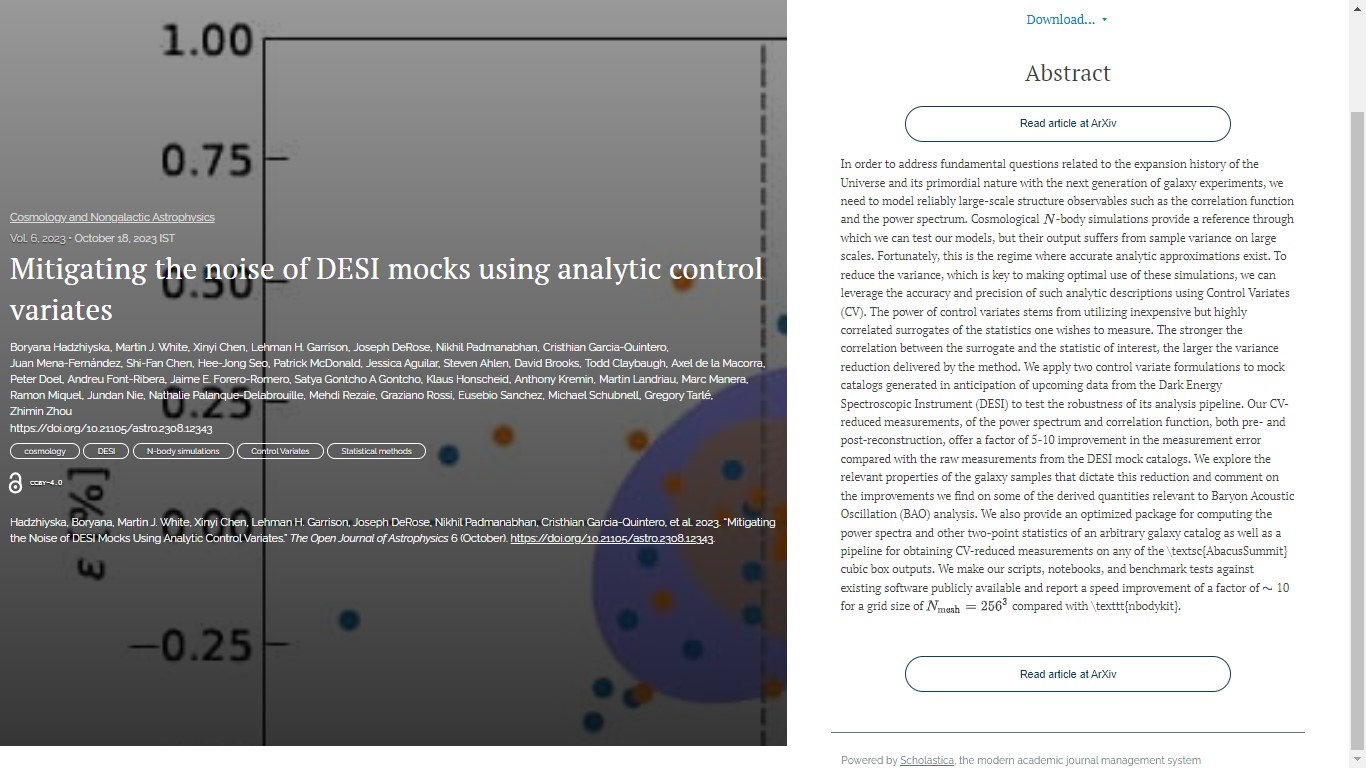
The second paper was published on 18th October 2023.  The primary classification for this one is Cosmology and Nongalactic Astrophysics and is “Mitigating the noise of DESI mocks using analytic control variates”. For those of you not up with the lingo, DESI stands for the Dark Energy Spectroscopic Instrument and you can read more about it here.

The lead author for this one is Boryana Hadzhiyska of the Lawrence Berkeley Laboratory and the University of California, Berkeley (USA) and there are 32 other authors. This paper presents a method for reducing the effects of sample variance on cosmological simulations using analytical approximations and tests it using DESI data.

Here is a screen grab of the overlay which includes the abstract:


You can click on the image of the overlay to make it larger should you wish to do so. You can find the officially accepted version of the paper on the arXiv here.