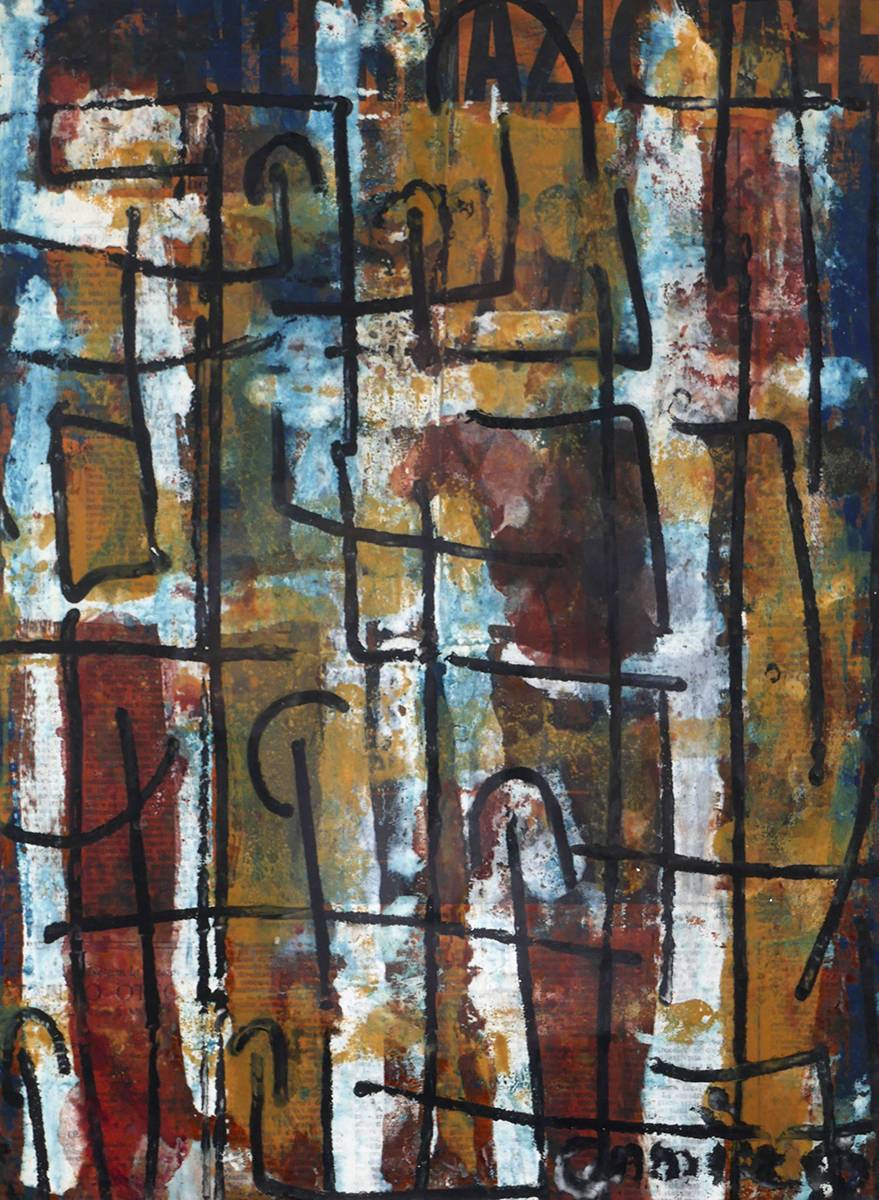
Internazionale by Camille Souter (1965, 76.2 x 63.5 cm, oil on newsprint, private collection).
Posted in tribute to the artist, who has passed away at the age of 93.
R.I.P. Camille Souter (1929-2023).
Internazionale by Camille Souter (1965, 76.2 x 63.5 cm, oil on newsprint, private collection).
Posted in tribute to the artist, who has passed away at the age of 93.
R.I.P. Camille Souter (1929-2023).

In yesterday’s post I asked the question whether anyone actually believes that it costs it costs £2310 to publish a scientific article online? I also posted the question on the Open Journal of Astrophysics Twitter account:
https://twitter.com/OJ_Astro/status/1631022314169987077?s=20
Only a few people responded to that question with a “yes”. Coincidentally all of them appear to be employed by the academic publishing industry. These people insist that the big publishers bring value to scientific papers. They don’t. Authors and referees do all the things that add value. What publishers do is take that value and turn it into its own profits. The fact that enormous profits are made out of this process in itself demonstrates that what the scientific community is being charged is nothing whatever to do with cost.
This reminds me of many discussions I had in my commie student days about surplus value, a concept explored in great detail by Karl Marx, in Das Kapital. According to the wikipedia page, the term “refers roughly to the new value created by workers that is in excess of their own labour-cost and which is therefore available to be appropriated by the capitalist, according to Marx; it allows then for profit and in so doing is the basis of capital accumulation.”
Engels is quoted there as follows:
Whence comes this surplus-value? It cannot come either from the buyer buying the commodities under their value, or from the seller selling them above their value. For in both cases the gains and the losses of each individual cancel each other, as each individual is in turn buyer and seller. Nor can it come from cheating, for though cheating can enrich one person at the expense of another, it cannot increase the total sum possessed by both, and therefore cannot augment the sum of the values in circulation. (…) This problem must be solved, and it must be solved in a purely economic way, excluding all cheating and the intervention of any force — the problem being: how is it possible constantly to sell dearer than one has bought, even on the hypothesis that equal values are always exchanged for equal values?
Marx’s solution of this economical conundrum was central to his theory of exploitation:
…living labour at an adequate level of productivity is able to create and conserve more value than it costs the employer to buy; which is exactly the economic reason why the employer buys it, i.e. to preserve and augment the value of the capital at his command. Thus, the surplus-labour is unpaid labour appropriated by employers in the form of work-time and outputs.
In the context of academic publishing, the workers are scientific researchers and the employers are the publishers. The workers not only produce the science in the first place, but also carry out virtually all of the actions that the employers claim add value. The latter are simply appropriating the labour of the former, which is exploitation. It needs to stop.
I got home this evening to find the sad news that legendary saxophonist Wayne Shorter has passed away at the age of 89. I only got to hear him live once, many moons ago, when he was part of a band led by drummer Jack de Johnette (I think that was in the early 1990s) but I have a big collection of CDs of him in various settings, including with Miles Davis, The Jazz Messengers, and, of course, Weather Report. As a tribute I feel it’s appropriate to post a great record he made as leader.
Speak No Evil was recorded in 1964 and released as a Blue Note LP in 1966. It features a superb band, including Freddie Hubbard (tpt), Herbie Hancock (p), Ron Carter (b) and Elvin Jones (d) alongside Shorter himself on tenor saxophone. It’s one of the must-have jazz albums, and it demonstrates Shorter’s flair for composition as well as improvisation. In both respects his approach to this album is very different from that he took just a few years earlier with Art Blakey’s Jazz Messengers. Standout tracks on this album include the suave yet unsettling Dance Cadaverous, the brooding Fee-fi-fo-fum, and the curiously agitated Witch Hunt.
Every piece on this album was composed by Shorter and as a player he revels in the ambiguous harmonies he created alongside the melodies. Although his style is clearly influenced by Sonny Rollins and John Coltrane, his tone is unlike either of these other giants, and Shorter expresses his individuality through varying emphasis producing asymmetric phrases. His playing is very quick-witted, full of abrupt changes of mood and dashes of fierce humour. A good example is Infant Eyes, a theme made up of three 9-bar phrases, played at a leisurely pace, on which Shorter’s lines impose a sense of determined exploration when many other soloists would have dawdled.
Anyway, don’t take my word for it. You can listen to the full album as a playlist on Youtube. The track order is: Witch Hunt, Fee-Fi-Fo-Fum, Dance Cadaverous, Speak No Evil, Infant Eyes and Wild Flower.
R.I.P. Wayne Shorter (1933-2023)

As it was foretold, the Royal Astronomical Society has now officially announced that all its journals will be moving to Gold Open Access. The only thing that surprised me about this is the speed that it will be done – from January 1st 2024. The announcement confirms that the “rumour” I reported in 2020 was true (as I knew it was, given the reliability of the source). I did, however, think the timescale would be “within a few years” and it turns out to be much shorter than that.
For the journal of most relevance to myself, Monthly Notices of the Royal Astronomical Society (MNRAS) this decision means that authors will have to pay an Article Processing Charge (APC) at the (suitably astronomical) level of £2310 for each paper (although there will be exemptions in certain situations). Does anyone genuinely believe that it costs that much to publish an article online? Really?
I did actually laugh out loud when I saw the spin the RAS are trying to put on this decision:
The RAS is excited to be a key contributor to the open science movement, helping to drive discoverability and change.
Au contraire. Gold Open Access a serious hindrance to the open science movement, as it involves hugely inflated costs to the authors in attempt to protect revenue in the face of declining subscription income. Switching from a ‘fleece-the-libraries’ model to a ‘fleece-the-authors’ alternative can in no way be regarded as a progressive move.
Other notable astronomy-related journals, such as the Astrophysical Journal (ApJ) and Astronomy & Astrophysics (A&A), have levied “page charges” (effectively APCs by another name) for as long as I can remember, though in the latter case there is a waiver for researchers in “member” countries. ApJ and other journals also have a waiver scheme for those who cannot afford to pay. For those who have to pay, the fee is usually about $100 per page. For a long time MNRAS was the exception and indeed the only feasible choice for people who don’t have access to funding to cover page charges, including many in the developing world. More recently, however, MNRAS introduced a charge for longer papers: £50 per page over 20 pages, so a paper of 21 pages costs £50 and one of 30 pages costs £500, etc. Now there will be a flat fee of £2310 per paper.
It is true that some institutions will pay the APC on behalf of their authors, but that is hardly the point. If institutions have cash to pay for astronomy publications to be open access then they would do far more good to the research community by giving it to the arXiv rather than to the publishing industry. When authors themselves see how much they have to pay to publish their work, many will realize that it is simply not worth the money. (I refuse to pay any APC on principle.)
The Twitter feed for the Open Journal of Astrophysics (OJAp) was buzzing all day yesterday with negative reactions to the RAS announcement. Obviously I am biased in this matter, but I do encourage those thinking of switching to give it a try. The RAS has played into the hands of OJAp, which publishes papers (online only) in all the areas of Astrophysics covered by MNRAS, and more, but is entirely free both for authors and readers. The annual running costs of OJAp are substantially less than one APC at the level proposed by MNRAS.
The comments I have seen brought this image to my mind:

(The allusion to sharks is not accidental.)
The question for the Royal Astronomical Society, and indeed the other learned societies that fund their activities in a similar way, is whether they can find a sustainable funding model that takes proper account of the digital publishing revolution. If their revenue from publishing does fall, can they replace it? And, if not, in what form can they survive? I’d like to think that future operating models for such organizations would involve serving their respective communities, rather than fleecing them.

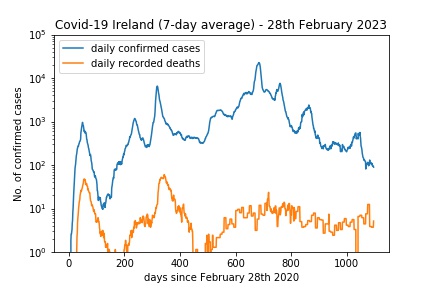
On February 29th 2020, Ireland identified its first case of the novel coronavirus, SARS CoV2, the virus that causes COVID-19. The World Health Organization declared the outbreak a pandemic on March 11th. On March 12th 2020 Schools and Colleges in Ireland were closed.
Since then, I have posted regular updates of the number of cases of COVID-19, initially daily and more recently weekly as the frequency of official announcements on the data hub decreased. The plotting the latest figures actually became a sort of ritual for me over this time and I even found mildly therapeutic.
Now, however, three full years have passed- can it really be three full years? – have since the (official) arrival of the pandemic in Ireland and, with the situation looking stable, I think it’s time to stop posting these updates. I made the decision to stop at the end of February 2023 unless something drastic happened to change my mind. Ironically, I just heard this morning that one of my colleagues has a new case of Covid-19 but that hasn’t changed my mind. I hope this makes it clear that I don’t think the pandemic is over: there are many people still suffering from new infections and the effects of “Long Covid”. I just don’t see the need to continue my updates here.
I will leave the data online here in case anyone is interested in the numbers, but I won’t be posting any further updates.
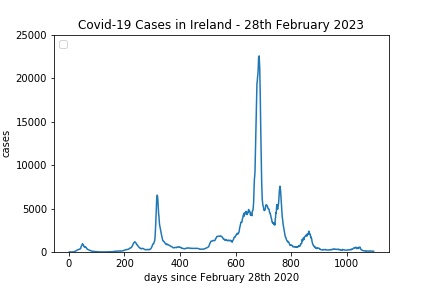
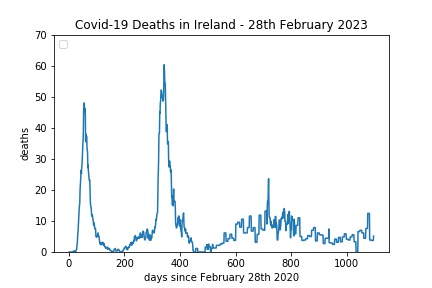
So here are the final graphs from me. The present 7-day moving average of new cases is just 89.6 per week, down from 103.0 last week and 36 deaths were recorded in the same period.
On a linear scale the cases look like this
The numbers for deaths on a linear scale look like this
Today is St David’s Day, and it seems apt to celebrate it with a poem by Dylan Thomas. I’ve loved this particular one since I first heard it when I was a student many years ago. I say “heard it” rather than “read it” because it was through buying a tape of the man himself reading his poems that got me hooked. I have posted this on St David’s Day before but that was many years ago and I hope you will forgive the repetition.
Fern Hill reflects about the passage of time, the loss of childhood happiness and the inevitability of death but its mood is defiant rather than gloomy. It’s full of vibrant imagery, but it’s also written with a wonderful feeling for the natural rhythms and cadences language. You can listen to Dylan Thomas reading this exactly as if it were music.
Now as I was young and easy under the apple boughs
About the lilting house and happy as the grass was green,
The night above the dingle starry,
Time let me hail and climb
Golden in the heydays of his eyes,
And honoured among wagons I was prince of the apple towns
And once below a time I lordly had the trees and leaves
Trail with daisies and barley
Down the rivers of the windfall light.
And as I was green and carefree, famous among the barns
About the happy yard and singing as the farm was home,
In the sun that is young once only,
Time let me play and be
Golden in the mercy of his means,
And green and golden I was huntsman and herdsman, the calves
Sang to my horn, the foxes on the hills barked clear and cold,
And the sabbath rang slowly
In the pebbles of the holy streams.
All the sun long it was running, it was lovely, the hay
Fields high as the house, the tunes from the chimneys, it was air
And playing, lovely and watery
And fire green as grass.
And nightly under the simple stars
As I rode to sleep the owls were bearing the farm away,
All the moon long I heard, blessed among stables, the nightjars
Flying with the ricks, and the horses
Flashing into the dark.
And then to awake, and the farm, like a wanderer white
With the dew, come back, the cock on his shoulder: it was all
Shining, it was Adam and maiden,
The sky gathered again
And the sun grew round that very day.
So it must have been after the birth of the simple light
In the first, spinning place, the spellbound horses walking warm
Out of the whinnying green stable
On to the fields of praise.
And honoured among foxes and pheasants by the gay house
Under the new made clouds and happy as the heart was long,
In the sun born over and over,
I ran my heedless ways,
My wishes raced through the house high hay
And nothing I cared, at my sky blue trades, that time allows
In all his tuneful turning so few and such morning songs
Before the children green and golden
Follow him out of grace.
Nothing I cared, in the lamb white days, that time would take me
Up to the swallow thronged loft by the shadow of my hand,
In the moon that is always rising,
Nor that riding to sleep
I should hear him fly with the high fields
And wake to the farm forever fled from the childless land.
Oh as I was young and easy in the mercy of his means,
Time held me green and dying
Though I sang in my chains like the sea.
Last night offered spectacular views of the Aurora Borealis (Northern Lights) all over Ireland. I took these amazing pictures, which are among the best I’ve seen, in Maynooth, County Kildare. I know that to the untrained eye they look like ordinary clouds, but an expert such as myself can clearly see dynamic patterns of brilliant green grey that appear as curtains, rays, spirals, and flickers covering the entire sky. It was a stunning, once-in-a-lifetime experience to witness this dramatic cosmic spectacle!

By sheer coincidence, the very same day that I posted a piece in which complained that the issue of PhD stipends for Irish postgraduates had apparently been “kicked into the long grass”, the consultation has at last opened.
You can contribute your submission or submit your contribution, whichever seems appropriate, here.
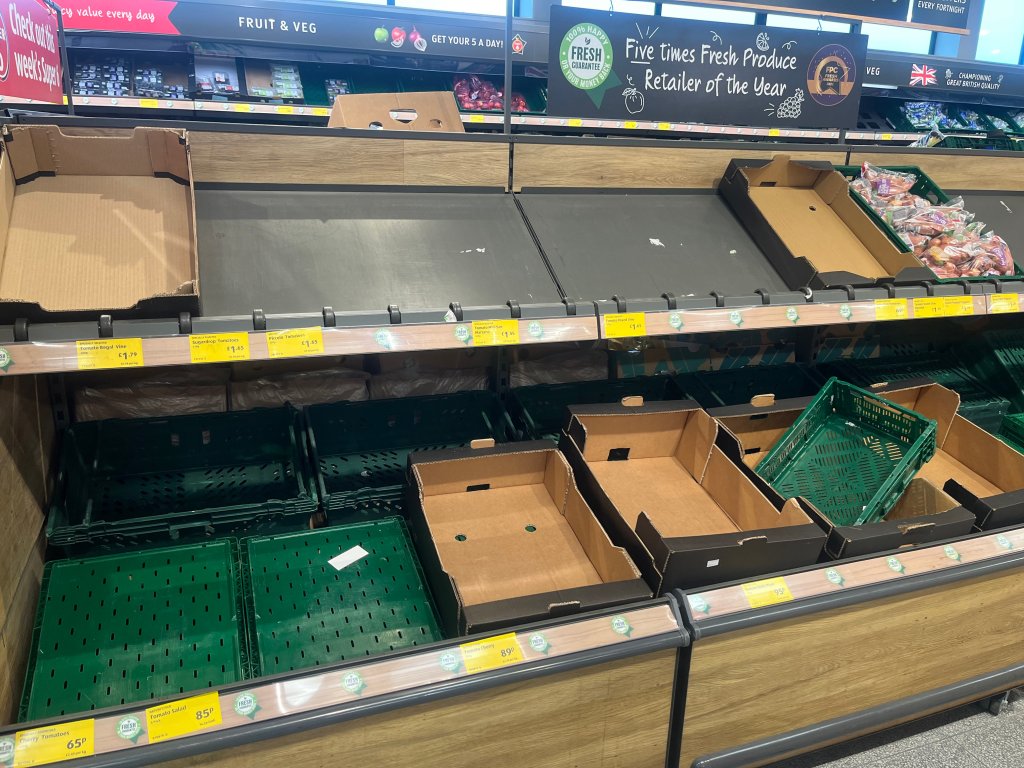
Q: What’s red and not there?
A: No tomatoes.
This week my social media timelines have been filled with pictures like this of British supermarket shelves bereft of salad vegetables, especially tomatoes. The UK Government has stated, through its mouthpiece the BBC, that this is due to unseasonably bad weather in Spain and Morocco, although I very much doubt this is the whole story.
There have been reports of similar shortages in Ireland but all I can do is report on my own experience. Because I live on my own in a small town with plenty of shops nearby I don’t do a big weekly trip to the supermarket but prefer to buy fresh things as and when I need them, usually on the way home from work. I therefore generally pop into Dunnes and/or Supervalu every day. On no occasion this week have I noticed any shortage of tomatoes or other salad ingredients in Maynooth, despite always going in the evening when you might expect the shelves to be depleted. I found plenty of nice tomatoes from both Spain and Morocco, though the ones I actually bought – of the cherry vine variety – are from Italy. People living elsewhere in Ireland may of course have experienced shortages, but I certainly haven’t.

A couple of papers were published recently that attracted quite a lot of media interest so I thought I’d mention the work here.
The researchers detail the theory in two papers, published in The Astrophysical Journal and The Astrophysical Journal Letters, with both laying out different aspects of the cosmological connection and providing the first “astrophysical explanation of dark energy”. The lead author of both papers is Duncan Farrah of the University of Hawaii. Both are available on the arXiv, where all papers worth reading in astrophysics can be found.
The first paper, available on the arXiv here, entitled Preferential Growth Channel for Supermassive Black Holes in Elliptical Galaxies at z<2, and makes the argument that observations imply that supermassive black holes grow preferentially in elliptical galaxies:
The assembly of stellar and supermassive black hole (SMBH) mass in elliptical galaxies since z∼1 can help to diagnose the origins of locally-observed correlations between SMBH mass and stellar mass. We therefore construct three samples of elliptical galaxies, one at z∼0 and two at 0.7≲z≲2.5, and quantify their relative positions in the MBH−M∗ plane. Using a Bayesian analysis framework, we find evidence for translational offsets in both stellar mass and SMBH mass between the local sample and both higher redshift samples. The offsets in stellar mass are small, and consistent with measurement bias, but the offsets in SMBH mass are much larger, reaching a factor of seven between z∼1 and z∼0. The magnitude of the SMBH offset may also depend on redshift, reaching a factor of ∼20 at z∼2. The result is robust against variation in the high and low redshift samples and changes in the analysis approach. The magnitude and redshift evolution of the offset are challenging to explain in terms of selection and measurement biases. We conclude that either there is a physical mechanism that preferentially grows SMBHs in elliptical galaxies at z≲2, or that selection and measurement biases are both underestimated, and depend on redshift.
arXiv: 2212.06854
Note the important caveats at the end. I gather from people who work on this topic that it’s a rather controversial claim.
The second paper, entitled Observational evidence for cosmological coupling of black holes and its implications for an astrophysical source of dark energy and available on the arXiv here, discusses a mechanism by which it is claimed that the formation of black holes actually creates dark energy:
Observations have found black holes spanning ten orders of magnitude in mass across most of cosmic history. The Kerr black hole solution is however provisional as its behavior at infinity is incompatible with an expanding universe. Black hole models with realistic behavior at infinity predict that the gravitating mass of a black hole can increase with the expansion of the universe independently of accretion or mergers, in a manner that depends on the black hole’s interior solution. We test this prediction by considering the growth of supermassive black holes in elliptical galaxies over 0<z≲2.5. We find evidence for cosmologically coupled mass growth among these black holes, with zero cosmological coupling excluded at 99.98% confidence. The redshift dependence of the mass growth implies that, at z≲7, black holes contribute an effectively constant cosmological energy density to Friedmann’s equations. The continuity equation then requires that black holes contribute cosmologically as vacuum energy. We further show that black hole production from the cosmic star formation history gives the value of ΩΛ measured by Planck while being consistent with constraints from massive compact halo objects. We thus propose that stellar remnant black holes are the astrophysical origin of dark energy, explaining the onset of accelerating expansion at z∼0.7.
arXiv:2302.07878
The first I saw of these papers was in a shockingly poor write-up in the Guardian which is so garbled that I dismissed the story out of hand. I recently saw it taken up in Physics World though so maybe there is something in it. Having scanned it quickly it doesn’t look trivially wrong as I had feared it would be.
I haven’t had much time to read papers over the last few weeks but I’ve decided to present the second paper – the more theoretical one – next time I do our cosmology journal club at Maynooth, which means I’ll have to read it! I’ll add my summary after I’ve done the Journal club on Monday afternoon.
In the meantime I was wondering what the general reaction in the cosmological community is to these papers, especially the second one. If anyone has strong views please feel free to put them in the comments box!
UPDATE: There is a counter-argument on the arXiv today.

 In the Dark