Author Archive

“The Whale”, by John Donne

Posted in Literature with tags , , , on August 2, 2022 by telescoper

A beached Sperm Whale (Dutch woodcut, 1598)

At every stroake his brazen finnes do take,
More circles in the broken sea they make
Than cannons’ voices; when the aire they teare:
His ribs are pillars, and his high arch’d roofe
Of barke that blunts best steele, is thunder-proofe:
Swimme in him swallow’d Dolphins, without feare,
And feele no sides, as if his vast wombe were
Some inland sea, and ever as he went
He spouted rivers up, as if he meant
To joyne our seas, with seas above the firmament.

He hunts not fish but as an officer,
Stayes in his court, at his own net, and there
All suitors of all sorts themselves enthrall;
So on his backe lies this whale wantoning,
And in his gulfe-like throat, sucks every thing
That passeth neare. Fish chaseth fish, and all,
Flyer and follower, in this whirlpool fall;
O might not states of more equality
Consist? and is it of necessity
That thousand guiltlesse smals, to make one great, must die?


These are Stanzas XXXII and XXXIII from “Metempsycosis” by John Donne (1572-1631); posted because they feature in the programme I watched yesterday.


The Dead Zoo

Posted in Architecture, History, Television with tags , , on August 1, 2022 by telescoper

I don’t often post about television but I couldn’t resist a quickie about a fascinating programme I just watched called The Dead Zoo, about Dublin’s splendid Natural History Museum, which opened in 1857. I visited this place way back in 2019 on which occasion I took this picture of the interior:

I thought the museum was wonderful if a bit creepy. I remember thinking while I wandered around that I wouldn’t like to be stuck there overnight, surrounded by over 10,000 dead animals in Victorian glass cabinets. It would make a grand setting for a ghost story!

The building had been somewhat neglected and the splendid roof was prone to leaking, so the Museum was closed for renovation in 2020 and all the specimens on the upper floors – including the huge skeleton of a Fin Whale that you can see in the photo hanging from the ceiling – were removed to a storage facility.

This operation -carried out against the backdrop of the Covid-19 pandemic – is the subject of Paul Duane’s excellent documentary, the trailer of which you can watch here:

If you didn’t get the chance to watch it you can catch it on the RTÉ Player here.

The work on the roof and other renovations will take some time to complete but the ground floor will re-open to visitors tomorrow (2nd August 2022). I imagine it will be pretty busy and you have to book in advance, though as with all Ireland’s National Museums, admission is free.

Lá Saoire i mí Lúnasa

Posted in Biographical, Cardiff, Maynooth, Mental Health with tags , on August 1, 2022 by telescoper

Today, Monday 1st August 2022, being the first Monday in August, is a Bank Holiday in Ireland. This holiday was created by the Bank Holiday Act of 1871 when Ireland was under British rule. While the holiday was subsequently moved to the end of August in England and Wales it has remained at the start of August in Ireland. Today is also a Bank Holiday in Scotland, though the Scots have the best of both worlds and have a holiday at the end of August too.

I’ve mentioned before that 1st August marks the old Celtic festival of Lughnasadh, named after the God Lugh, on which is celebrated the beginning of the harvest season. It is also one of the cross-quarter days, lying roughly half-way between the Summer Solstice and the Autumnal Equinox (in the Northern Hemisphere).

Anyway, the University is closed today and I made the use of the long weekend to take a few days of annual leave last week, from Wednesday. I’ll be off tomorrow too. Those four days will be about it for my summer holidays, though, as our repeat examinations commence on Wednesday 3rd August and I’ll be busy doing corrections from then on. Incidentally, these examinations are called the Autumn Repeats consistent with the general interpretation here in Ireland of 1st August being the start of autumn. The weather today is certainly somewhat autumnal!

For various reasons we have a larger-than-average number of students taking repeat examinations this year. Moreover, one of our temporary lecturers left at the end of his contract at the end of June so is unavailable to mark his examinations. As Head of Department, and with several staff unavailable, it’s my responsibility to make sure that they get graded so it looks like I’ll have to mark the majority of his scripts as well as my own. And a few projects too.

At least my term as Head of Department is due to end soon. I was appointed to this position in 2019, initially for three years starting on 1st September so August 31st 2022 is my last day in office. That reminds me that I stepped down as Head of School of Mathematical and Physical Sciences at Sussex on 31st July 2016, i.e. six years ago yesterday. How can it be so long?

I moved back to Cardiff in 2016 to a three-year, part-time position which would have come to an end in 2019. I supposed at the time that I would then take early retirement and that would be that. I certainly didn’t imagine then that I would move once more, this time to Ireland nor did I think I would be Head of Department anywhere.

Reflecting on my decision to leave Sussex and return to Cardiff I wrote this:

I’m not going to go into all the reasons for stepping down, but one of them is I wanted to establish a better work-life balance…. I was therefore more than happy to accept the offer of a position here on a 50% salary. In other words, I am officially a part-time member of staff. I’m planning to use the other 50% to pursue some other interests, such as writing a couple of books and running the Open Journal of Astrophysics, but generally just taking more time off the treadmill of academic life.

It didn’t quite turn out like that, but at least I did what I was appointed to do at Cardiff. It was just chance that led to the change of plan, with the opportunity of moving to Ireland coming out of the blue. Instead of taking 50% of my time off, from December 1st 2017 until July 2018 I worked 50% of the time at Maynooth, commuting to and fro across the Irish Sea: thereafter I worked here full-time.

When I was appointed Head of Department of Theoretical Physics in Maynooth in 2019 I received some (sarcastic) comments about that bit above about the “treadmill of academic life”. In truth I didn’t imagine that it would be as hard as it turned out. I wrote in 2019:

It’s about three years now since I stepped down as Head of School at the University of Sussex at which point I didn’t imagine I would be stepping up to be Head of Anything again, but to be honest this position has a smaller and much better defined set of responsibilities than the one I used to hold so I’m actually quite looking forward to it.

Of course I didn’t know then that the Covid-19 pandemic would strike in 2020, exacerbated by staff shortages and lack of support at University level, creating a huge increase in workload and stress. The job has been far harder than I imagined it would be, not least because there is no proper job description for a Head of Department at Maynooth. The “smaller and much better defined set of responsibilities” I anticipated turned out not to be the case at all. Indeed, the workload associated with being HoD has grown substantially over the last three years, with fewer resources and lower levels of support.

In short, I can’t wait for this month, and my term as Head of Department, to be over. I am not going to leave Maynooth and will continue doing teaching and research (including supervising graduate students), both of which I enjoy. But after this month time I will have served my time as Head of Department and it will be someone else’s turn to climb up on the treadmill…

The Soundtrack of Summer

Posted in Biographical, Music, Television on July 31, 2022 by telescoper

I just heard of the death on 4th July at the age of 82 of Austrian actor Robert Hoffmann who I remember very well for his role as Robinson Crusoe in the TV series The Adventures of Robinson Crusoe. That series was first broadcast in 1964 and was repeated frequently over the years, especially during the long summer holidays. I loved the theme music when I was a child and it is now redolent with nostalgia, forever associated with memories of childhood summers before life got complicated. I’m sure that is also the case for many others, so perhaps you won’t mind wandering off down memory lane with this:

New Away Kit for Newcastle United!

Posted in Football on July 30, 2022 by telescoper

With the start of the new English Premiership football season less than a week away, I notice that Newcastle United’s new away strip accurately reflects the values and traditions of the club’s owners, the Saudi Royal Family:

Perhaps it’s a warning to the players not to lose their heads under pressure?

PhD Stipends in Ireland

Posted in Education, Maynooth with tags , on July 29, 2022 by telescoper

Some time ago I posted an item about the planned introduction of a higher PhD stipend (€28K) for a small number of research students in Ireland. It being obvious that he current level of PhD stipends (e.g. €18.5K per annum for IRC-funded studentships) being far too low, my main comment on that was that if that level is a fair level for a PhD then all PhD students should get it.

Now there’s an open letter going around signed by over 400 PhD students arguing for an uplift in their stipends. I support this wholeheartedly. I’m surprised there aren’t even more signatories than that, actually, but I think they have now opened it up again and let others sign it who didn’t know about it. I encourage all PhD students reading this to sign it

With inflation rampant at over 9%, even the IRC level of stipend is difficult for a student to live on (especially in the Greater Dublin area) yet many receive even less than that. Maynooth University, for example, funds many of its PhD students at the paltry level of €10K per annum. This is completely impossible to live on and it forces recipients to undertake large amounts of tutoring or other work (including bar work and retail) in order to get by financially. In my opinion stipends paid at this level are simply exploitative. I have argued repeatedly, but without success, for these to be scrapped.

The deliberate impoverishment of PhD students exists in order to force them to undertake extensive and poorly paid teaching duties because there aren’t enough teaching faculty to cover what is required. That situation is a direct result of the chronic underfunding of higher education in Ireland. Universities will argue that they don’t have any choice, but that doesn’t make the situation is acceptable.

Third level institutions don’t care. If they did they’d do something about it. Maynooth University ran up a surplus of €13.2M during the first year of the pandemic largely by exploiting unpaid overtime by lecturers and tutors, the latter predominantly PhD students. It could be used to provide emergency relief for PhD students but I bet it won’t be. In fact has anyone working at Maynooth received anything at all in return for generating this surplus?

It is of course good for a research student to get some teaching experience during their PhD but this should be on a voluntary basis. A PhD student who chooses to teach will probably do a better job than one who is forced to do it in order to pay the rent. My basic point, though, is that a full-time research student should be funded to do research full time, and it is grossly unfair to pay them too little for this to be possible.

The Kindness of Faces

Posted in Biographical, Cardiff, Film, Television with tags , on July 28, 2022 by telescoper
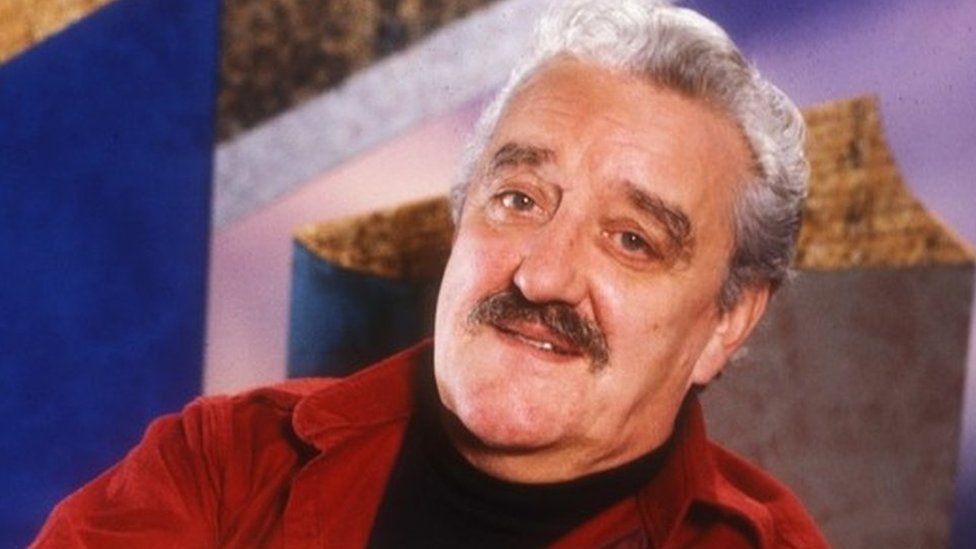
Bernard Cribbins

Another bit of sad news arrived today. The much-loved character actor, singer and comedian Bernard Cribbins has passed away at the age of 93. He was a remarkably versatile performer who appeared in scores of films and TV programmes over the years, including numerous stints on Jackanory, on which he revealed himself to be a superb reader of children’s stories, and providing all the voices for the TV series of The Wombles. Rest in peace, Bernard Cribbins (1928-2022).

Reading about his death and looking at pictures of him taken during his long and varied career got me thinking about something I’ve wondered about many times over the years, namely what is it about certain faces that makes them appear kind?

I know it’s a subjective judgment whether or not someone has a kind face but it does seem that many people do agree on it. I certainly think Bernard Cribbins had a kind face and it stayed with him all through his long career. Among actors, Tom Hanks is another prominent example. His face has clearly influenced the roles he has been cast in. No doubt you can think of others.

This is not just about showbusiness of course. I have met many people in the course of my life who have what I’d describe as kind faces, but what exactly is it about their faces that makes them so? It seems to involve a certain shape – softer features perhaps, not too angular – with rounder eyes and an easy smile. Other than those vague considerations I really don’t know. I have looked back through the personal library of kind faces in my memory and they don’t really have much in common at all. Whatever it is, it’s not the same thing that makes a face handsome or beautiful or sexy, though those are also of course subjective. For me there has to be a hint of danger for someone to be very sexy; a kind face is perhaps too bland.

Anyway, I remember many years ago talking with a (female) graduate student in a pub in Cardiff about this subject. In fact we started talking about which men in the Department we thought were the most handsome – I’d better keep quiet about that bit – but got onto a more general discussion. She had – and presumably still has – what I’d call a kind face, and I told her so when the subject came up. She was very aware that people thought that too and wasn’t entirely pleased about it. She said her face made people assume she was extremely emphatic and proceed to burden her with their personal problems even if she didn’t know them very well. I’d never thought of that downside before then.

In Macbeth, Duncan says “There’s no art / to find the mind’s construction in the face”, and there’s no necessary connection between a kindly disposition and a kind face. No doubt there are successful criminals, con-artists and the like, who trade on their apparently kind faces to manipulate their victims. On the other hand, in a world that can be incomprehensibly cruel, it can be nice to see a kind face even if it’s just a superficial relief.

Any theories on what makes a kind face and/or other examples of people who have such please use through the box below.

R.I.P. James Lovelock (1919-2022)

Posted in Literature, The Universe and Stuff with tags , , on July 28, 2022 by telescoper

I heard this week of the death, on his 103rd birthday, of scientist and writer James Lovelock. He started out as a chemist but became what is now called an “independent scientist” and “futurist”. These terms are often applied to people who are simply cranks, but he wasn’t just that. Unorthodox he was, certainly, but there was depth to his thinking that mere cranks never reach.

James Lovelock was best known to me – and I suspect to many others – for his work on the Gaia Hypothesis, which is roughly speaking the idea that the system of life on Earth functions as a single organism that defines and maintains the conditions necessary for its own survival.

I’ve just had a rummage around my bookshelves and found my copy of his famous book on this topic, which I bought and read back in the 80s. The first edition was published in 1979, but the one I bought was the version published in 1987 after the topic had been featured on the BBC TV programme, Horizon:

The Gaia hypothesis has been widely criticized by biologists and ecologists but I remember finding it a very thought-provoking book, though I interpreted more as a metaphor than a mechanism. At any rate it seems to me to be a useful counter to the extreme reductionism of many prominent life scientists. It’s also very well written and definitely worth reading over 40 years after it was written. James Lovelock was as inventive and ingenious a thinker as he was unorthodox.

Rest in peace, James Ephraim Lovelock (1919-2022).

A pretty simple thing…

Posted in History, The Universe and Stuff with tags , , , on July 27, 2022 by telescoper

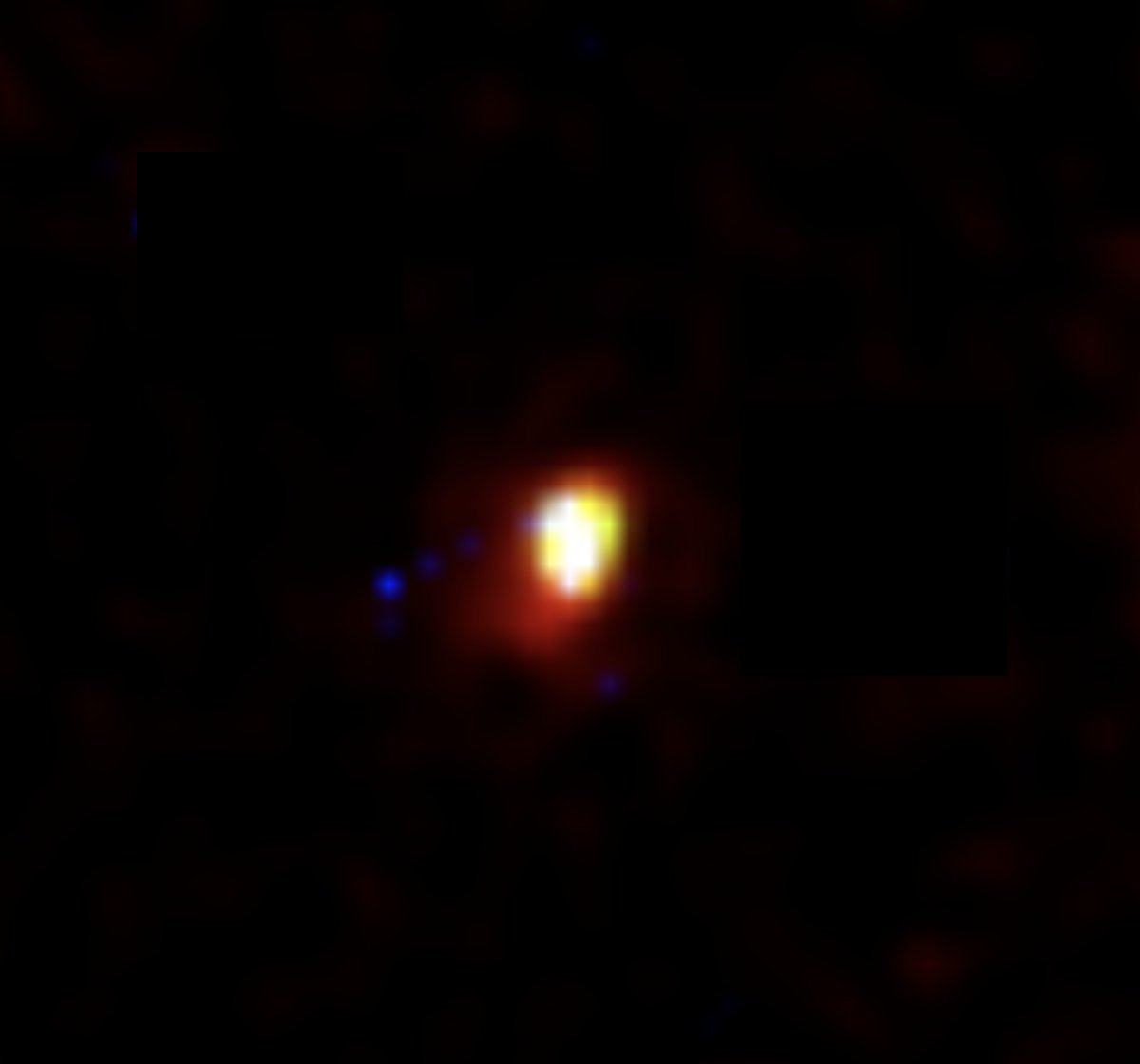
In a state of not inconsiderable excitement, I showed the above picture (which appears in yesterday’s post) to a friend who shrugged and said “It doesn’t look like much..”. My response was “Well, you wouldn’t look like much at z=16.7…”

That reply was of course inspired by a famous exchange between Fred Hoyle and R.O. Redman recounted here:

Fred once started a talk by saying, ‘Oh, Ooh, basically a star is a pretty simple thing.’ And from the back of the room was heard the voice of R. O. Redman, saying, ‘Well, Fred, you’d look pretty simple too, from ten parsecs!

I’ve heard this story told by many people in different versions involving different characters, including Eddington, but I think it is generally accepted to have been between Hoyle and Redman, though this may well not have been the first comment of its type. If anyone knows any more please let me know!

Now a Galaxy at z>16?

Posted in The Universe and Stuff with tags , , , , , , on July 26, 2022 by telescoper

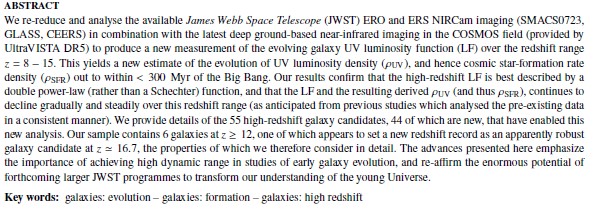
It’s less than a week since I posted an item about an object which is possibly the highest redshift galaxy ever observed (with z ~13) and now along comes a paper describing an object that may be of even higher redshift (with z~16.7). The abstract of the new paper – lead author of which is Callum Donnan of the University of Edinburgh – is here:

As with the previous object the redshift of this one is not obtained via spectroscopy (which usually involves the identification of spectral lines) but via fitting a spectral profile to photometric imaging data seen in different bands. The process for this galaxy is illustrated by this diagram from the paper:

There are 7 images along the top showing the source through various broad band filters. Suitably calibrated these can be converted to the flux measurements shown on the graph. Notice the first three images are significantly fainter than the others, so the first three points on the left of the graph are lower.

If this is a galaxy its spectrum is expected to possess a Lyman Break resulting from the fact that radiation of shorter wavelength than the Lyman Limit (912 Å) is absorbed by neutral gas surrounding the regions where stars are formed in the galaxy. In the rest frame of a galaxy this break is the ultraviolet region of the spectrum but because of the cosmological redshift it is observed in the infrared part of the spectrum for very distant galaxies. In this case the best fit is obtained if the break is positioned as shown, with the first three fainter points to the left of the break and the rest to the right. The break itself is straddled by two observational bands. Employing a number of different estimates the authors conclude that the redshift of this galaxy is z=16.7 or thereabouts.

There is no direct evidence for the sharp edge associated with the Lyman Break – and no spectral lines are observed either – so this all depends on the object being correctly identified as a high-redshift galaxy and not some other object at lower redshift. You have to assume this to get a redshift, but then all inferences are based on assumed models so there’s nothing unusual about this approach. The authors discuss other possibilities and conclude that there is no plausible alternative source. Take away the green template spectrum and you just see a spectrum that rises to a peak and falls again. The authors claim that there is no plausible low-redshift source with such a spectrum.

Anyway, here is a composite colour image of the source:

So is this now the earliest galaxy ever observed? And what object will I be asking this question about next week? One thing I can predict is that there are going to be many more such objects in the very near future!