Today has been (and indeed continues to be) the June Bank Holiday (Lá Saoire i mí Mheitheamh) in Ireland. It is the equivalent of the usual May Bank Holiday in the UK in that both have their origin in the old festival of Whitsuntide (or Pentecost) which falls on the 7th Sunday after Easter. Because the date of Easter moves around in the calendar so does Whit Sunday, but it is usually in late May or early June. Here in Ireland the Bank Holiday is always on the first Monday in June whereas on the other side of the Irish Sea it is on the last Monday in May (except for this year when it was moved at the behest of some old Queen).
Although I’m only at beginners’ level in Irish, the phrase Lá Saoire i mí Mheitheamh gives me a chance to bore you about it. It’s actually quite a straightforward phrase until you reach the last word: “Lá” means “day” and “Saoire” means “leave” or “vacation” so “Lá Saoire” means “holiday”; “i” is a prepositional pronoun meaning “in” and “mí” means “month”. So far so good.
The word for June however is Meitheamh (at least when it is in the nominative singular case). As an Indo-European language, Irish is distantly related to Latin which has six grammatical cases for nouns (actually seven if you count the rarely used locative case). Irish has only four cases – there’s no ablative and, curiously, no real distinction between nominative and accusative (though there is for some pronouns). That leaves nominative, dative, genitive, and vocative. The dative case– used after simple prepositions – is only rarely distinct from the nominative so basically the ones you have to learn are the genitive and the vocative.
Whereas in Latin cases are indicated by changes to the end of noun, in Irish they involve initial mutations. In the example of “mí Mheitheamh” meaning “month of June”, requiring the genitive form of “June”, the initial consonant “M” undergoes lenition (softening) to sound more like a “v”. In old Irish texts this would be indicated by a dot over the M but in modern orthography it is indicated by writing an “h” after the consonant. This is called a séimhiú (pronounced “shay-voo” ). Note the softened m in the middle of that word too but it’s not a mutation – it’s just part of the regular spelling of the word, as is the -mh at the end of Meitheamh. There’s also a softened “t” in the middle of Meitheamh which makes it vrtually disappear in pronunciation. Meitheamh is thus pronounced something like “Meh-hiv” whereas “Mheitheamh” is something like “Veh-hiv”.
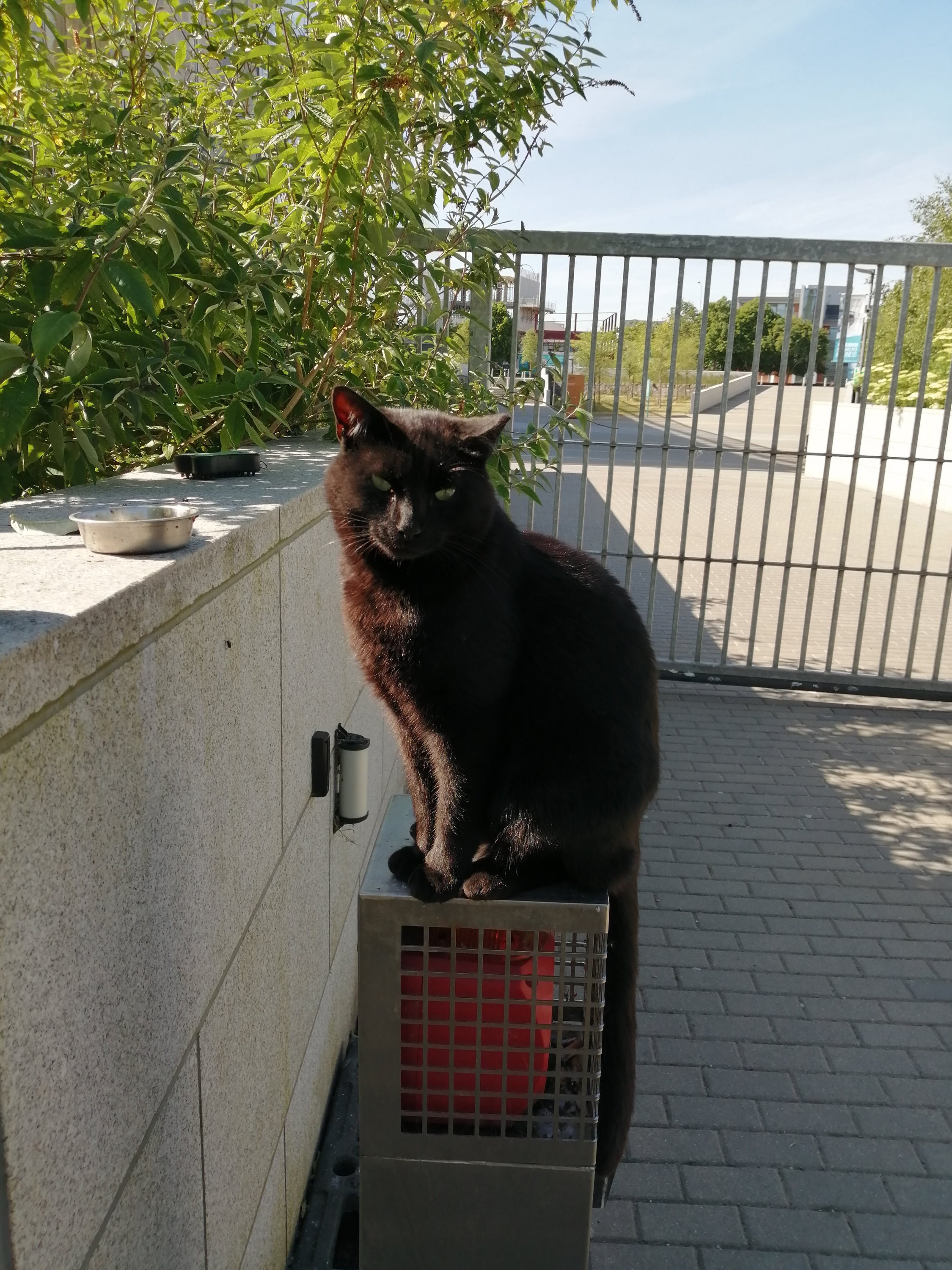
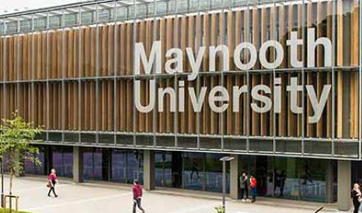
Anyway, here’s a picture of Maynooth University Library Cat.
Last week I was chatting to one of my colleagues about old films, particularly those made in the immediate post-war years by Ealing Studios. Nowadays this film production company is most strongly associated with superb comedy films, including such classics as Passport to Pimlico, Whisky Galore, The Ladykillers and The Lavender Hill Mob among many more. But there was more to Ealing Studios than the Ealing Comedies. During the war the company was involved in making propaganda films to help with the war effort, most of which are now forgettable but at least one, Went the Day Well, about people in an English village attempting to resist ruthless German paratroopers, is genuine shocking to this day because of its unusually frank depiction (for the time) of brutality and violence in a normally tranquil and familiar setting. The image of Thora Hird taking on the invaders with a Lee Enfield rifle is one that stays in my mind.
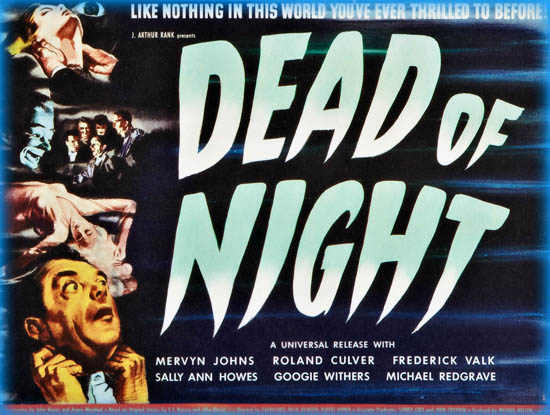
Horror films were banned during the War but in 1945 Ealing Studios released one which was to become enormous influential in the genre and which holds up extremely well to this day. As a matter of fact, I watched it again, for the umpteenth time, last night.
I’ve actually blogged about a bit of this film before. There is a sequence (to me by far the scariest in the film) about a ventriloquist (played by Michael Redgrave) who is gradually possessed by his evil dummy which came up in a post I did about Automatonophobia many moons ago.
Anyway, you only have to watch Dead of Night to watch it to appreciate why it its held in such high regard by critics to this day. Indeed you can see ideas in it which have been repeated in a host of subsequent (and usually inferior) horror flicks. I’m not going to spoil it by saying too much about the plot. I would say though that it’s basically a portmanteau film, i.e. a series of essentially separate stories (to the extent of having a different director for each such segment) embedded within an overall narrative. It also involves an intriguing plot device similar to those situations in which you are dreaming, but in the dream you wake up and don’t know whether you’re actually awake or still dreaming.
In this film the architect Walter Craig arrives at a country cottage, is greeted by his host Elliot Foley who has invited him to discuss possible renovations of the property. He is shown into a room with several other guests. Despite apparently never having been to the property before it seems strangely familiar and despite never having met the guests before he says he has seen them all in a recurring dream. One by one the guests recount strange stories. When they’ve all had their turn the film reaches a suitably nightmarish ending but Craig then wakes up in bed at home and realizes it was all a dream. Then the phone rings and it’s Elliot Foley inviting him to his country cottage to discuss possible renovations. The film ends with Craig arriving at the cottage just as he did at the start of the film.
Here is the trailer:
It’s the “dream-within-a-dream” structure (presumably repeated forever) – what physicists would call a self-similar hierarchy – of the overall framework of this movie that gives it its particular interest from the point of view of this blog, because it played an important role in the evolution of theoretical cosmology. One evening in 1946 the mathematicians and astrophysicts Fred Hoyle, Hermann Bondi and Tommy Gold went to see Dead of Night in Cambridge. Discussing the film afterwards they came up with the idea of the steady state cosmology, the first scientific papers about which were published in 1948. For the best part of two decades this theory was a rival to the now-favoured “Big Bang” (a term coined by Fred Hoyle which was intended to be a derogatory description of the opposing theory).
In the Big Bang theory there is a single “creation event”, so this particular picture of the Universe has a definite beginning, and from that point the arrow of time endows it with a linear narrative. In the steady state theory, matter is created continuously in small bits (via a hypothetical field called the C-field) so the Universe has no beginning and its time evolution not unlike that of the film.
Modern cosmologists sometimes dismiss the steady state cosmology as a bit of an aberration, a distraction from the One True Big Bang but it was undeniably a beautiful theory. The problem was that so many of its proponents refused to accept the evidence that they were wrong. Supporters of disfavoured theories rarely change their minds, in fact. The better theory wins out because younger folk tend to support it, while the recalcitrant old guard defending theirs in spite of the odds eventually die out.
And another thing. If Fred Hoyle had thought of it he might have called the field responsible for creating matter a scalar field, rather than the C-field, and it would now be much more widely recognized that he (unwittingly) invented many elements of modern inflationary cosmology. In fact, in some versions of inflation the Universe as a whole is very similar to the steady state model, only the continuous creation is not of individual particles or atoms, but of entire Big-Bang “bubbles” that can grow to the size of our observable Universe. So maybe the whole idea was actually right after all..
As my only contribution to the ongoing Platinum Jubilee celebrations, here’s a classic record that’s almost as old as Queen Elizabeth II and is by a prominent member of the Jazz nobility, the Duke of Ellington.
As far as I know this is the first recording of Jubilee Stomp, made in early 1928, though the band made several other versions. At the time this one was made, Duke Ellington’s Orchestra had just started as the house band at the famous Cotton Club in Harlem which soon established the venue as the hottest nightspot in New York. That almost didn’t happen: the residency was initially offered to King Oliver, but he wanted too much money and so it passed to the second choice, Duke Ellington. The rest, as they say, his history.
Anyway, this is a digitally remastered version of the original Okeh recording, which brings out the best of the Ellington Band of that time, especially the great Wellman Braud who introduced the style of walking bass that quickly established itself as a mainstay of every rhythm section.
This version of Ellington’s Orchestra was actually only a ten-piece band, but it was packed with great soloists and you’ll hear superb growl trumpet from James “Bubber” Miley, clarinet from Barney Bigard, and trombone from Joe “Tricky Sam” Nanton, among others. There’s also a nice example of the piano style of the young Duke Ellington himself. Enjoy!
Posted in Biographical on June 4, 2022 by telescoper
Time passes.
Today, as I find myself another year older, I was thinking back over what things of a personal nature have happened in the last ten years. In that time I moved from Cardiff to Sussex and back to Cardiff and then here to Maynooth.
When I was chatting to John Ellis over lunch at the ITP meeting last week he said to me “You move around quite a lot, don’t you?”. I replied “Yes, that has been remarked upon”. He seemed to think that was funny.
I don’t think I’ll be moving jobs again. Sometime in the next ten years I’ll be retiring, hopefully sooner rather than later. At any rate in less than three months I’ll be stepping down as Head of Department, hopefully spending more time on teaching and research and less on pointless bullshit.
Another notable thing that happened in the last decade was that I had a nervous breakdown. I spent a few weeks in a psychiatric institution but recovered well enough to return to work quite quickly. Fortunately, and contrary to my pessimistic expectations, and despite the stresses caused by the pandemic, I have suffered no significant recurrences and am now not even taking any medication (unless you count wine). So that’s all good.
The last ten years also saw my Mam cruelly taken by dementia; she passed away in 2019. Now all my grandparents and both my parents have gone.
The other thing I realised today is that I am now older than my late collaborator and colleague Francesco Lucchin, with whom I wrote a cosmology text book, was when he passed away twenty years ago, in 2002.
Time passes.
Anyway, I’ve done very little today except relax, read and listen to music and to complete the self-indulgence I’m now going to cook dinner and drink some wine while I watch some football on the telly.
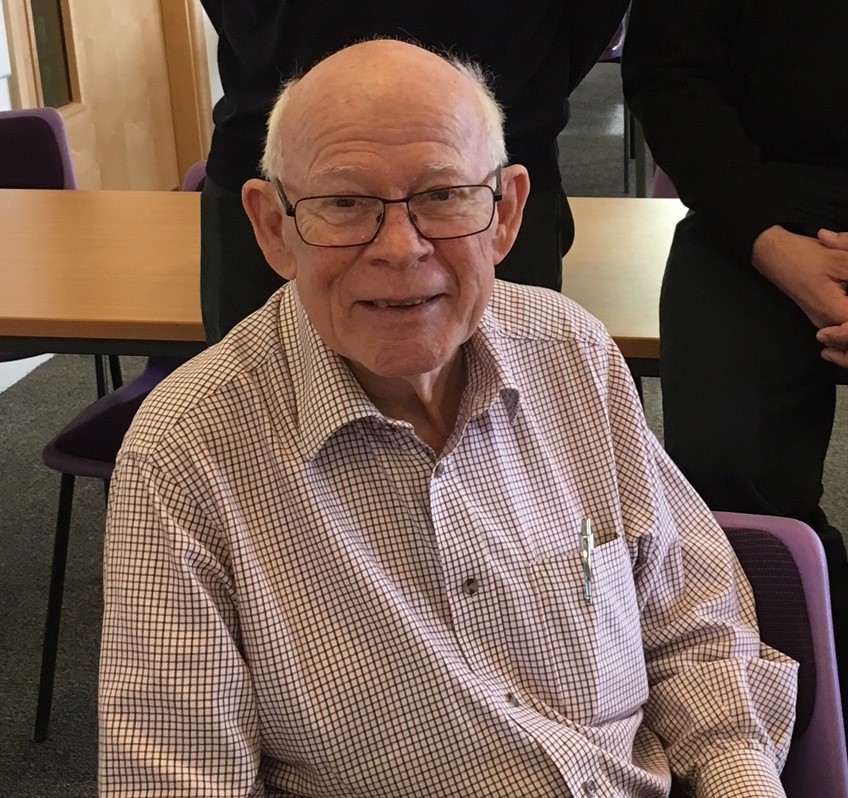
David Matravers, pictured on his 80th birthday in December 2017 (Picture Credit: ICG)
I was very sad this morning to hear via George Ellis of the death at the age of 84 of David Matravers. A South African by borth, David moved to (then) Portsmouth Polytechnic in 1990, just before it became the University of Portsmouth, where he set up a group in cosmology and relativity with the Mathematics Department. Though initially small, that group grew steadily branching out into other areas, including observational cosmology, and became, in 2002, the Institute of Cosmology and Gravitation which is recognized throughout the world as a centre of excellence in research. I see it did particularly well in the recent Research Excellence Framework, for example.
NOTE: I am grateful to David Wands for pointing out that David Matravers wasn’t the first Director of the ICG as I said in an earlier version of this post: that was Roy Maartens. David Matravers actually retired just as the ICG was being set upbut played a huge role in its creation.
David Matravers is rightly regarded as its founding father of research in cosmology and gravitation at Portsmouth. He therefore leaves a wonderful legacy not only in the ICG itself but in the many alumni who have passed through it at various stages of their careers and are now carrying on their work all around the globe.
During the 1990s I saw David Matravers quite regularly as he visited Queen Mary & Westfield College where I was working at the time to attend our relativity seminars and talk to the relativity group. He was a very cheerful and engaging chap who was always keen to encourage early career researchers. I was in that category at the time and, although I never worked directly with David, he was always very kind and supportive to me. What struck me in particular about him were his enthusiasm and determination, which is no doubt why he was so successful at building up the ICG from scratch. He will be greatly missed.
My condolences to his friends, colleagues and family.
We’ve at last managed to finish marking and collating examination scripts, coursework and project reports of various types and the provisional results are all uploaded to the system. I have to say that marking examinations on paper is much less of a chore than doing digital submissions online, though it is still not exactly a simple task and I’m glad it’s over for another year.
Tomorrow morning we’ll have a relatively informal “Pre-Board” meeting to go double-check the results and discuss any isues arising before the full Departmental Examination Board which takes place next week. That’s just for the Department of Theoretical Physics but we also do teaching for the Department of Engineering and there are Pre-Boards and Full Boards for those too.
In between now and the Full Boards we have a Bank Holiday weekend. Not the extravaganza going on over the Irish Sea concerning the Queen’s Platinum Jubilee, just the regular Lá Saoire i mí Mheitheamh we have every year. In any case, there’s more than one old Queen having a celebration this weekend. A nice thing about living in Ireland is that my birthday is always in close proximity to a national holiday.
But I digress.
The Departmental Examination Boards do not quite mark the end of the examinations business for the academic year, as we have the Final Final Examination Board after all the Departmental ones. That is when marks from all Departments come together to determine the final results for students who are taking degrees in combinations of subjects. The Department of Theoretical Physics has quite a number of students doing Joint Honours with Mathematics, for example, and we don’t won’t know their final results until we see how their Mathematics has gone. It does add an extra level to the process, but I think that’s a price worth paying for the flexibility we offer to students through joint programmes.
This final Examination Board takes place on 22nd June and students will get their marks a couple of days later on 24th June. We have an official Consultation Day (28th June) the following week during which students can get feedback on their examinations as well as discussing options for choices to be made ahead of next year. Even that won’t be the end, because some students will be taking repeat examinations in August, but at least it signals a gap in the assessment cycle during which we can hopefully think of other things for a while.
This year has been challenging, to say the least. There was a piece in the Irish Times recently discussing concerns about lack of student engagement, poor lecture attendance and high dropout rates for students in Irish universities. I discussed some of the reasons for this here. Obviously, until our results are finalized I can’t say anything specific about the impact of all these difficulties on our students, but the post-Covid turmoil undoubtedly has had a significant impact on many students and a severe impact on some. It remains to be seen precisely what the scale of the problem is and what we can do to mitigate it.
The general turbulence in the wake of the pandemic, which is unavoidable, has been exacerbated in my Department by serious staffing issues resulting from deliberate management decisions. This combination has created a perfect storm which in my view could easily have been avoided. I shall refrain from commenting further, except to say that it will take some time to sort out and we’ll probably have similar – though hopefully less severe – issues next year.
One of the difficulties faced by students this summer is that they would not have done traditional written examinations for two years before this May’s set. The online timed assessments we deployed during the pandemic were of “open-book” style but the unseen written papers on campus are not. The challenge posed by these two types of examination are different, and it remains to be seen how well the students – especially those in Years 1 and 2 – have coped with the abrupt switch. Those who get disappointing results will have the opportunity to take repeat examinations (on campus) and those who disengaged entirely will have the chance to repeat the year in full if they so desire, so all is not lost!
Another sign of our gradual emergence from the pandemic is that our Examination Board meeting next week will be attended in person by the External Examiner. She wasn’t able to get here last year owing to illness so it will be nice to have her present at the Exam Boards and, hopefully, at dinner afterwards.
It’s 1st June 2022, which means that it’s the first day of Pride Month 2022. This year there’s actually going to be an in-person Pride Festival with a March and Parade in Dublin of which I’m planning to attend at least part, even if I am obviously too old for that sort of thing.
Anyway, I thought I’d flag this occasion with a selection of banners. Here is the traditional rainbow flag:
Here is the banner from Dublin Pride’s website, more accurately emphasizing the full spectrum of diversity covered by the term LGBTQIA+ than the original rainbow flag.
And here is the Pride Progress flag, hoisted today outside the John Hume Building on Maynooth University campus where it will remain for the rest of the month.
With its origins as a commemoration of the Stonewall Riots of 1969, Pride remains both a celebration and protest. It’s more necessary than ever now because of the sustained abuse being aimed at trans people from all quarters, including those in political power and those sad losers who have nothing better to do that spend all day tweeting their bigotry on social media. Bigots will always be bigots, but the lowest of the low are those that masquerade as some sort of progressive while spouting their hate and prejudice.
Anyway, as well as a celebration and a protest, Pride is an opportunity for us all to show solidarity against those who seek to divide us.
Though many LGBTQIA+ people in many countries – even those that claim to be more liberal – still face discrimination, hostility and violence, Pride Month always reminds me of how far we’ve come in the past 50 years ago. Recently my own celebration of Pride is very subdued as it tends to makes me feel old and irrelevant as well as worried that we might be headed back to the bigotry and intolerance of the past; the rights we have won could so easily be taken away.
As I get older, I find I have become more and more protective towards younger LGBT+ people. I don’t want them to have to put up with the crap that I did when I was their age.
I would like to wish all LGBTQIA+ people around the world, but especially staff and students at Maynooth University, a very enjoyable and inspiring Pride 2022!
At last week’s Irish Theoretical Physics meeting I had the opportunity to have lunch with particle physicist Professor John Ellis (of King’s College London). Among other things we discussed whether or not it was likely that Ireland might join CERN. Currently Ireland has no official relationship with CERN, not even associate membership, which makes it anomalous among European countries. In November 2019 I blogged about the issue here.
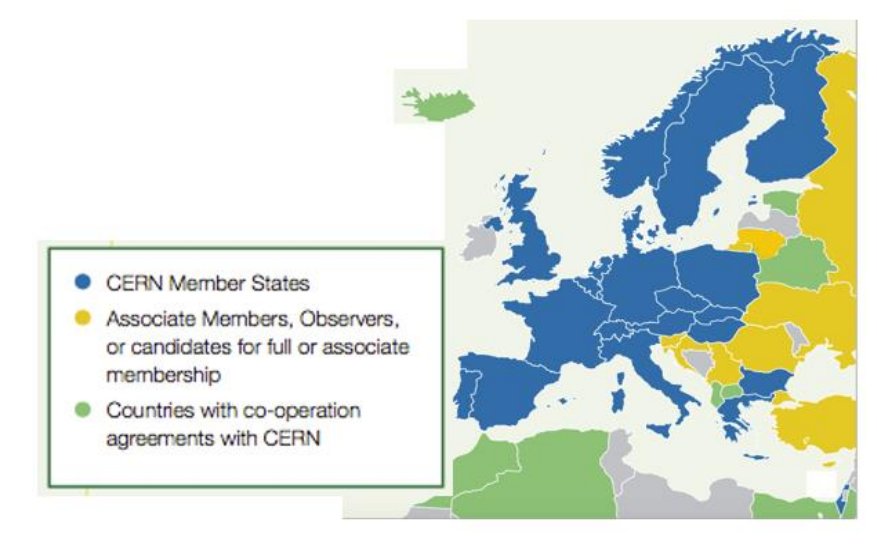
There was a move reported in the news here in Ireland of a report from a Committee of the Houses of the Oireachtas making the case for Ireland to join CERN. You can download the report here (PDF) and you’ll find this rather striking graphic therein:
You will see that there are only three European countries other than Ireland that don’t have any form of membership or other agreement with CERN: Latvia, Bosnia-Herzegovina, Moldova. The fact that almost everyone else is in is not in itself necessarily a good argument for Ireland to join, but it does make one wonder why so many other countries have found it to join or have an agreement with CERN while Ireland has not.
As the document explains, if the Irish government were to decide to take Ireland into CERN then it would first have to become an Associate Member, which would cost around €1.2 million per year. That’s small potatoes really, and the financial returns to Irish industry and universities are likely to far exceed that, so the report strongly recommends this step be taken. This Associate member stage would last up to 5 years, and then to acquire full membership a joining fee of around €15.6 million would have to be paid, which is obviously a much greater commitment but in my view still worthwhile.
There were some positive noises when the document came out, but that was near the end of 2019. Not far into 2020 the pandemic struck and the idea sank without trace. Perhaps now is a good time to raise the issue again?
While I strongly support the idea of Ireland joining CERN I do have a couple of concerns about the case as presented in the Oireachtas report.
One is that I’m very sad that the actual science done at CERN is downplayed in the report. Most of it is about the cash return to industry, training opportunities, etc. These are important, of course, but it must not be forgotten that big science projects like those carried out at CERN are above all else science projects. The quest for knowledge does have collateral benefits, but it a worthy activity in its own right and we shouldn’t lose sight of that.
My other (related) concern is that joining CERN is one thing, but in order to reap the scientific reward the government has to invest in the resources needed to exploit the access to facilities membership would provide. Without a related increase in research grant funding for basic science the opportunity to raise the level of scientific activity in Ireland would be lost.
Ireland recently joined the European Southern Observatory (ESO), a decision which gave Irish astronomers access to some amazing telescopes. However, there is no sign at all of Irish funding agencies responding to this opportunity by increasing funding for academic time, postdocs and graduate students needed to do the actual science. In one respect ESO is very like CERN: the facilities do not themselves do the science; we need people to do that. The jam is already spread very thinly in Ireland so having an extra thing to spread it on will not necessarily be a good thing for science in general.
With about a month to go to the deadline, I thought I would take the opportunity to remind readers that Maynooth University has a Chair (i.e. Full Professor) position in Astrophysics or Cosmology under the Strategic Academic Leadership Initiative (SALI). I blogged about this scheme here and announced this Chair position originally here.
You can find the full announcement of the competition for all the SALI positions here; you can apply for the position at Maynooth here. The position is now also advertised on the AAS Jobs Register here.
The deadline for applications is in July 2022, and the provisional start date is January 2023 (although this is flexible). As well as a good salary (starting at €124,683 at current rates, rising by annual increments to €157,611) the position comes with membership of the Irish public service pension scheme, a defined benefit scheme (comparable to the older version of the UK’s USS which has now been scrapped).
The key rationale for these SALI positions is clear from the statement from Simon Harris, the Minister responsible for Third Level education in Ireland:
“Championing equality and diversity is one of the key goals of my department. The Senior Academic Leadership Initiative (SALI) is an important initiative aimed at advancing gender equality and the representation of women at the highest levels in our higher education institutions.
We have a particular problem with gender balance among the staff in Physics in Maynooth, especially in Theoretical Physics where all the permanent staff are male, and the lack of role models has a clear effect on our ability to encourage more female students to study with us.
The wider strategic case for this Chair revolves around broader developments in the area of astrophysics and cosmology at Maynooth. Currently there are two groups active in research in these areas, one in the Department of Experimental Physics (which is largely focussed on astronomical instrumentation) and the other, in the Department of Theoretical Physics, which is theoretical and computational. We want to promote closer collaboration between these research strands. The idea with the new position is that the holder will nucleate and lead a new research programme in the area between these existing groups as well as getting involved in outreach and public engagement.
It is intended that the position to appeal not only to people undertaking observational programmes using ground-based facilities (e.g. those provided by ESO, which Ireland recently joined), or those exploiting data from space-based experiments, as well as people working on multi-messenger astrophysics, gravitational waves, and so on.
Exciting as this position is in itself, it is part of wider developments and we are expecting to advertise further job opportunities in physics and astronomy very soon! I’d be happy to be contacted by any eligible person wishing to discuss this position (or indeed the general situation in Maynooth) on an informal basis.
Last week was rather busy. Amongst other things I managed to complete the publication process for two more papers in the Open Journal of Astrophysics (one on Tuesday and one on Thursday) although there was a small delay in registering the metadata so I didn’t fully announce them until yesterday. I’ve only just managed to find time today to advertise them here. These two are the sixth and seventh papers in Volume 5 (2022) and the 54th and 55th in all respectively. Both the new papers are in the folder marked Cosmology and Nongalactic Astrophysics.
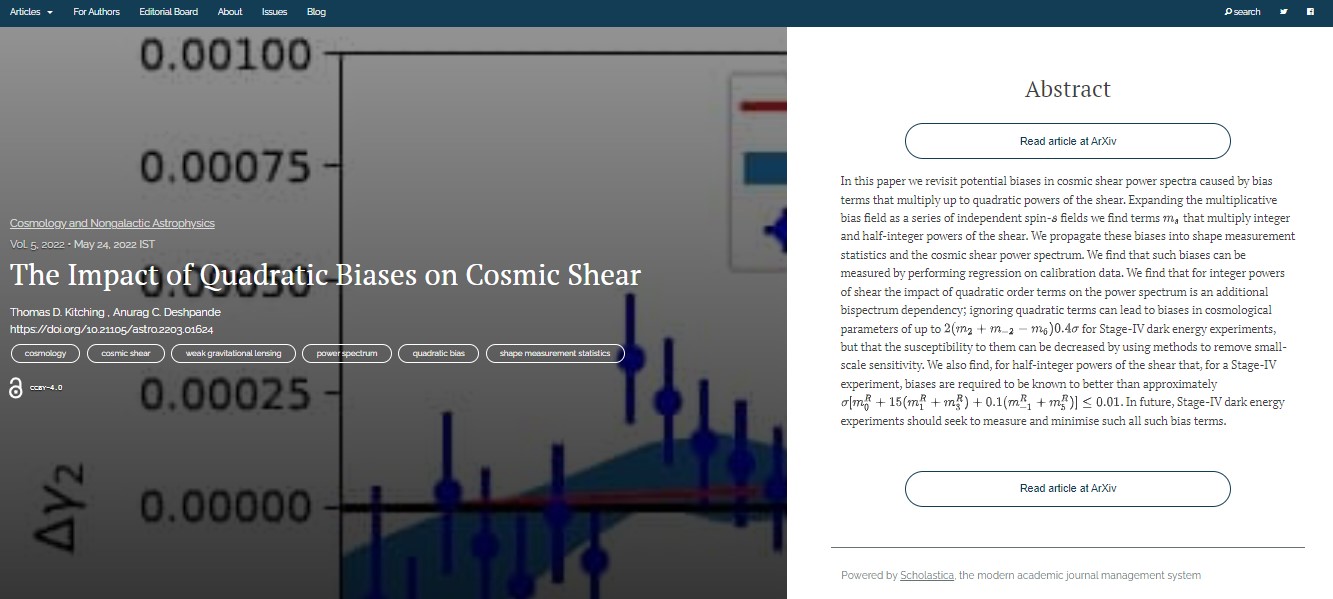
The first of these two new publications is entitled “The Impact of Quadratic Biases on Cosmic Shear”and is written by Tom Kitching and Anurag Deshpande of the Mullard Space Science Laboratory in Surrey (UK).
Here is a screen grab of the overlay which includes the abstract:
You can click on the image to make it larger should you wish to do so. You can find the arXiv version of this paper directly here.
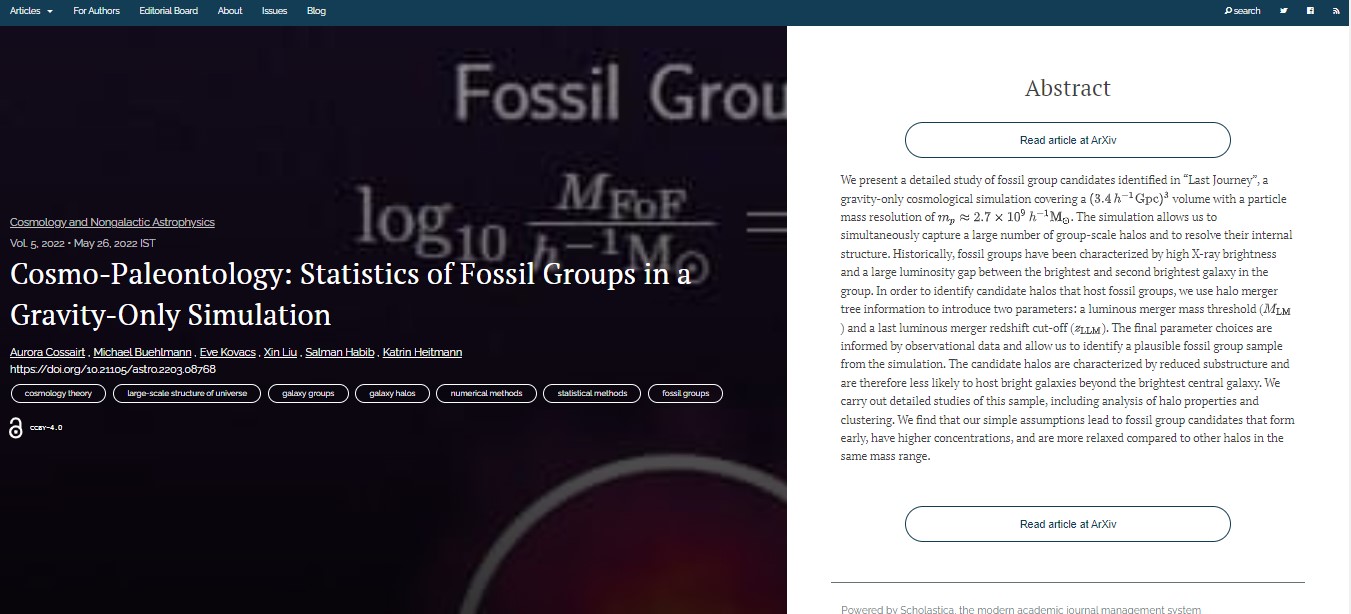
The second new publication is entitled “Cosmo-Paleontology: Statistics of Fossil Groups in a Gravity-Only Simulation”and is written by Aurora Coissairt, Michael Buehlmann, Eve Kovacs, Xin Liu, Salman Habib and Katrin Heitmann all from the Argonne National Laboratory which is just outside Chicago in the USA.
Here is the overlay of that paper which includes the abstract:
Once again You can click on the image to make it larger should you wish to do so. You can find the arXiv version of the paper here.
We have quite a few more papers in the pipeline so expect to be announcing more quite soon, probably early next month.
The views presented here are personal and not necessarily those of my employer (or anyone else for that matter).
Feel free to comment on any of the posts on this blog but comments may be moderated; anonymous comments and any considered by me to be vexatious and/or abusive and/or defamatory will not be accepted. I do not necessarily endorse, support, sanction, encourage, verify or agree with the opinions or statements of any information or other content in the comments on this site and do not in any way guarantee their accuracy or reliability.






 In the Dark