Author Archive

ERC Starting (and Finishing) Grants

Posted in Politics, Science Politics with tags , , , , on September 3, 2019 by telescoper

Just time for a quick note to announce that the European Research Council has announced the winners of the latest round of `Starting Grants’ (which are intended to further the research plans of early career researchers). Full details are here. Congratulations to all the winners, and especially  Erminia Calabrese in the School of Physics & Astronomy at Cardiff University!

In all, 408 applicants were selected for funding, hosted in 24 different countries. The split by nationality and discipline is as follows:

I’ll make two comments on the numbers.

First, the United Kingdom is host to a total of 64 awards. It is however very unclear what will happen in the case of a `No Deal’ Brexit in which the British Government refuses to honour its existing financial commitments. Hopefully even in this case these grants will go ahead in some form (perhaps funded directly by the UK).

Second, note that there is only one award for Ireland and nothing in either Physical Sciences or Life Sciences. This is very disappointing, but is probably a fair reflection of the Irish governments ongoing failure to invest in basic science.

It’s not that the Irish aren’t good at research. Here is another graphic that shows that 7 Irish researchers were actually awarded grants under this scheme, but none of them chose to hold their awards in Ireland:


That tells you something about the environment for early career researchers in this country.

The imminent departure of the United Kingdom from the European Union makes its future participation in such schemes unlikely. Brexit could be a great opportunity for the research community in Ireland, if only the Irish Government would seize it, but it would first need to recognize the benefits of increasing investment in research. Sadly I don’t think it will.


The Road to Galway

Posted in Maynooth, Talks and Reviews with tags , on September 2, 2019 by telescoper

Well, today is my first working day in the office of Head of the Department of Theoretical Physics at Maynooth University so I’m going to start as I mean to continue… er … by leaving around lunchtime.

Actually, no. I’m leaving after lunch for a very special reason: I’m getting the bus to Galway to give a talk at Galway Astronomy Club which is in the Harbour Hotel in Galway this evening.

It’s a three-hour trip on the bus (each way), so I’m leaving in time hopefully to have a look around Galway, which I’ve never visited before. Hopefully I’ll get time to upload a few pictures later on. Although I have plenty of work to do on the journey, I’m looking forward to travelling through such exotic locations as Enfield, Kilbeggan, and Athlone on the way.

Oh, and the talk is open to the public so if you’re in or around Galway this evening do come along!

Update: 14.15 I’m on the bus, en route and it’s raining.

Update: I made it to Galway a little bit late but still in time for a quick look around.

A bit of a rainbow..

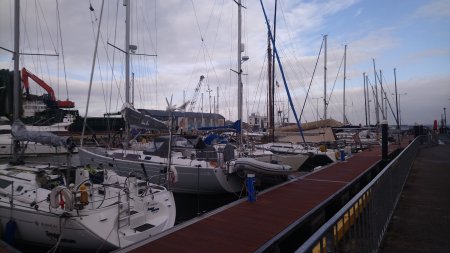
The Harbour

The Venue.

Update: I’m back in the B&B on Nun’s Island. The talk seems to have gone down quite well. Thanks to Galway Astronomy Club for the invitation, for the very warm reception, and for the very interesting questions afterwards!

September 1st, 1939

Posted in Uncategorized with tags , , on September 1, 2019 by telescoper

Today, September 1st 2019, is the 80th anniversary of the Nazi invasion of Poland that led to the outbreak of World War 2. Although I have posted it before, this poem by W.H. Auden seems a good wsy to mark the event.

I sit in one of the dives
On Fifty-second Street
Uncertain and afraid
As the clever hopes expire
Of a low dishonest decade:
Waves of anger and fear
Circulate over the bright
And darkened lands of the earth,
Obsessing our private lives;
The unmentionable odour of death
Offends the September night.

Accurate scholarship can
Unearth the whole offence
From Luther until now
That has driven a culture mad,
Find what occurred at Linz,
What huge imago made
A psychopathic god:
I and the public know
What all schoolchildren learn,
Those to whom evil is done
Do evil in return.

Exiled Thucydides knew
All that a speech can say
About Democracy,
And what dictators do,
The elderly rubbish they talk
To an apathetic grave;
Analysed all in his book,
The enlightenment driven away,
The habit-forming pain,
Mismanagement and grief:
We must suffer them all again.

Into this neutral air
Where blind skyscrapers use
Their full height to proclaim
The strength of Collective Man,
Each language pours its vain
Competitive excuse:
But who can live for long
In an euphoric dream;
Out of the mirror they stare,
Imperialism’s face
And the international wrong.

Faces along the bar
Cling to their average day:
The lights must never go out,
The music must always play,
All the conventions conspire
To make this fort assume
The furniture of home;
Lest we should see where we are,
Lost in a haunted wood,
Children afraid of the night
Who have never been happy or good.

The windiest militant trash
Important Persons shout
Is not so crude as our wish:
What mad Nijinsky wrote
About Diaghilev
Is true of the normal heart;
For the error bred in the bone
Of each woman and each man
Craves what it cannot have,
Not universal love
But to be loved alone.

From the conservative dark
Into the ethical life
The dense commuters come,
Repeating their morning vow;
‘I will be true to the wife,
I’ll concentrate more on my work,’
And helpless governors wake
To resume their compulsory game:
Who can release them now,
Who can reach the dead,
Who can speak for the dumb?

All I have is a voice
To undo the folded lie,
The romantic lie in the brain
Of the sensual man-in-the-street
And the lie of Authority
Whose buildings grope the sky:
There is no such thing as the State
And no one exists alone;
Hunger allows no choice
To the citizen or the police;
We must love one another or die.

Defenseless under the night
Our world in stupor lies;
Yet, dotted everywhere,
Ironic points of light
Flash out wherever the Just
Exchange their messages:
May I, composed like them
Of Eros and of dust,
Beleaguered by the same
Negation and despair,
Show an affirming flame.

Phase Correlations and the LIGO Data Analysis Paper

Posted in Bad Statistics, The Universe and Stuff with tags , , , on September 1, 2019 by telescoper

I have to admit I haven’t really kept up with developments in the world of gravitational waves this summer, though there have been a number of candidate events reported in the third observing run (O3) of Advanced LIGO  which began in April 2019 to which I refer you if you’re interested.

I did notice, however, that late last week a new paper from the LIGO Scientific Collaboration and Virgo Collaboration appeared on the arXiv. This is entitled A guide to LIGO-Virgo detector noise and extraction of transient gravitational-wave signals and has the following abstract:

The LIGO Scientific Collaboration and the Virgo Collaboration have cataloged eleven confidently detected gravitational-wave events during the first two observing runs of the advanced detector era. All eleven events were consistent with being from well-modeled mergers between compact stellar-mass objects: black holes or neutron stars. The data around the time of each of these events have been made publicly available through the Gravitational-Wave Open Science Center. The entirety of the gravitational-wave strain data from the first and second observing runs have also now been made publicly available. There is considerable interest among the broad scientific community in understanding the data and methods used in the analyses. In this paper, we provide an overview of the detector noise properties and the data analysis techniques used to detect gravitational-wave signals and infer the source properties. We describe some of the checks that are performed to validate the analyses and results from the observations of gravitational-wave events. We also address concerns that have been raised about various properties of LIGO-Virgo detector noise and the correctness of our analyses as applied to the resulting data.

It’s an interesting paper that gives quite a lot of detail, especially about signal extraction and parameter-fitting, so it’s very well worth reading.

Two particular things caught my eye about this. One is that there’s no list of authors anywhere in the paper, which seems a little strange. This policy may not be new, of course. I did say I haven’t really been keeping up.

The other point I’ll mention relates to this Figure, the caption of which refers to paper [41], the famous `Danish paper‘:

The Fourier phase is plotted vertically (between 0 and 2π) and the frequency horizontally. A random-phase distribution should have the phases uniformly distributed at each frequency. I think we can agree, without further statistical analysis,  that the blue points don’t have that property!  Of course nobody denies that the strongly correlated phases  in the un-windowed data are at least partly an artifact of the application of a Fourier transform to a non-stationary time series.

I suppose by showing that using a window function to apodize the data removes phase correlations is meant to represent some form of rebuttal of the claims made in the Danish paper. If so, it’s not very convincing.

For a start the caption just says that after windowing resulting `phases appear randomly distributed‘. Could they not provide some more meaningful statistical statement than a simple eyeball impression? The text says little more:

In addition to causing spectral leakage, improper windowing of the data can result in spurious phase correlations in the Fourier transform. Figure 4 shows a scatter plot of the Fourier phase as a function of frequency … both with and without the application of a window function. The un-windowed data shows a strong phase correlation, while the windowed data does not.

(I added the link to the explanation of `spectral leakage’.)

As I have mentioned before on this blog, the human eye is very poor at distinguishing pattern from randomness. There are some subtleties involved in testing for correlated phases (e.g. because they are periodic) but there are various techniques available: I’ve worked on this myself (see, e.g., here and here.). The phases shown may well be consistent with a uniform random distribution, but I’m surprised the LIGO authors didn’t present a proper statistical analysis of the windowed phases to prove beyond doubt the point they seem to be trying to make.

Then again, later on in the caption, there is a statement that `the phases show some clustering around the 60 Hz power line’. So, on the one hand the phases `appear random’, but on the other hand they’re not. There are other plausible clusters elsewhere too. What about them?

I’m afraid the absence of quantitative detail means I don’t find this a very edifying discussion!


Brexit and the British Border in Ireland

Posted in Politics with tags , , , , on August 31, 2019 by telescoper

The events of the past week have given me even more reason than usual to rant about Brexit, and the damage it is causing even to those who voted for it. So let me take as the subject for this one the absolute claptrap that brexiters are talking about the so-called `Backstop’ which is part of the Withdrawal Agreement (WA) negotiated between the United Kingdom and the European Union but voted down three times by the House of Commons. This part of the agreement is designed to allow the free flow of goods and people across the British* Border in Ireland by keeping the United Kingdom in the Customs Union and some parts of the Single Market if no free trade agreement is negotiated between the UK and EU that comes up with alternative ways of achieving this during the transition period allowed for in the WA (which extends at least until December 2020, but could in principle be extended further).

*Note: I consider the term `Irish Border’ to be misleading, so I use the more accurate `British Border in Ireland’.

The first thing to say – and this is blindingly obvious if you have actually read the WA – is that the backstop does not come into play at all if an alternative solution to the Border issue can be found. The fact that leading Brexiters are so exercised by the backstop therefore betrays their belief that no such alternative arrangements exist or can be put in place in the foreseeable future. If such arrangements existed the Brexiters would not be in the slightest bit bothered by the Backstop as it would be irrelevant. The fact that they are opposed to the backstop is an obvious signal that they know there is no technological or other solution consistent with the position into which the UK Government has trapped itself.

So why the constant demand from the ERG et al for the backstop to be removed? And why all the lying about its purpose?

To answer that I think you have to consider the true motivation of the Leave campaign. The purpose of Brexit was not just about the UK leaving the European Union. That was merely intended to be a step along the path to destroying the EU and so destabilizing Europe. The original theory was that Brexit would lead to a parade of other EU nations wanting to leave. That didn’t happen. Indeed the solidarity of the EU in the face of the attacks on it has been quite remarkable.

So now it is Plan B, which is based on the premise that the Achilles Heel of the EU is Ireland. By creating economic and political chaos – and possibly a return to violence, sparked by Britain’s intentional violation of the Good Friday Agreement – in Ireland they will force the EU to offer the UK favourable terms on access to the Single Market. To do so, however, would open the floodgates to other governments who might want to reap the benefits of EU membership without the responsibility that goes with it (as Britain does).

And even if this doesn’t work, Leave supporters will still have to find someone to blame when the cake-and-eat-it Brexit they promised – the `easiest trade deal in history’, `no downside only a considerable upside’, `because we hold all the cards’ Brexit – will never actually materialize. The alternative would be for the whole gang of them to admit they were lying (which we know they were). No prizes for guessing who the scapegoat will be…

The strategy of setting up Ireland as a target for economic aggression may well cause a great deal of pain in the short-term, but I hope and believe that it won’t succeed. For one thing, I don’t think the Irish economy is as vulnerable as the UK government thinks. for another, it may quickly lead to a United Ireland. That, at any rate, is far more likely than Ireland becoming a British colony again, which is what some Brexiters want.

More importantly, however, although Ireland and Britain differ substantially in size, the former will a great advantage over the latter in the world after Brexit: Ireland will still have friends, and Britain won’t.

Some Good News For Maynooth!

Posted in Education, Maynooth with tags on August 30, 2019 by telescoper

These days more than ever it’s a relief when there’s some good news to share, so I was very happy this morning to hear that the Irish Government has awarded Maynooth University a capital grant of €25 million for a major new building project. This is a big slice of a total of  almost €100 million capital investment for projects across the sector. The other recipients were: IT Sligo (€6.6M); NUI Galway (€15M); University College Cork (€25M); and University College Dublin (€25M). The official press release can be found here.

This investment reflects the fact that Maynooth is Ireland’s fastest-growing university, at least partly because of the rapidly increasing demographic demand for higher education in the area to the west of the Dublin metropolitan area.

As I write, building work has already started on the North Campus of Maynooth University near the Science Building. This new building is due to open in late 2020. For further details see here.

Maynooth University Library Cat was unavailable for comment.


Back to School!

Posted in Uncategorized on August 29, 2019 by telescoper

My calendar informs me that today, 29th August 2019, is the start of the school year in Maynooth. The local supermarkets are preparing in an appropriate manner:

A Very British Coup

Posted in History, Politics with tags , , , on August 28, 2019 by telescoper

Known liar, charlatan and tinpot dictator Boris Johnson.

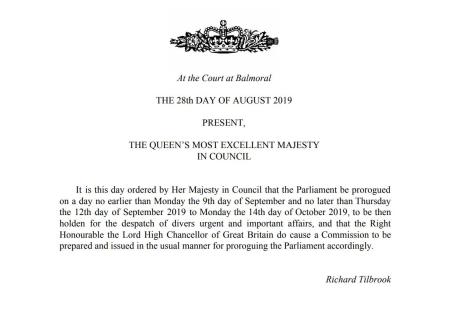
Got back to Ireland this morning to find that the UK Government has decided to suspend Parliament. The deed is already done:

Prorogue

Remind me, what was all that stuff about the European Union being undemocratic?

Any lingering doubts anyone might have had about the direction in which the United Kingdom might go after known liar Boris Johnson became Prime Minister will have been dispelled this morning by the decision (by a small group within the Cabinet) to prorogue Parliament. There can be no doubt that this is a coup d’état. The parallels with 1930s Germany are chilling. If you ever wondered what you would have done in then, as the Nazis took over, that’s what you’re doing now.

This may allow the populist charlatans behind this manoeuvre to force through their chaotic `no deal’ Brexit, but they cannot be allowed to get away with this. I live in hope that one day they will be brought to book for this scandalous act. When that happens the retribution will be a joy to watch.

This disgraceful episode has made much easier a decision I have been putting off for almost two years. I’m putting my house in Wales up for sale and cutting the last of my ties with the United Kingdom. Enough is enough.

Cat Burglar – Updated

Posted in Biographical on August 27, 2019 by telescoper

I’ve been sleeping with the bedroom windows open during this spell of hot weather – not the main windows, just the small transom windows at the top.

I woke up in the early hours of this morning to the sound of something moving around in the spare bedroom. I thought at first it might be a burglar but when I investigated I couldn’t see anyone. Puzzled, I went back to bed.

A few minutes later there was more noise so I got up again and this time spotted the intruder: a small black cat. It was as surprised to see me as I was to see it and it ran off through the open door of the spare room and down the stairs. Not wishing to cause the creature (which was clearly frightened) any unnecessary distress, I just opened the back door and sat quietly waiting for it to leave, which in due course it did. I locked the door behind it and went back to bed.

The mystery is how my visitor managed to climb up the outside of the house and in through the top of the window. I can’t think of any other way it could have got in. It must be a nimble little moggy.

I wonder if it has any plans for a return visit?

Update: The cat’s name is Lula. She did indeed return to the house and managed to hide so I didn’t know she was there. Her human came down the street looking for her while I was out and saw her sitting in the front window. He left a note that the cat was trapped in my house, though the window she had come in by was open..

When I got back I looked for her but couldn’t find her. She was obviously hiding. At about 2am, while I was in bed, she surfaced and made for the spare bedroom. I just saw her impressive leap out of the window and onto the bathroom roof – and in one bound she was free..

This morning, getting ready to go to the airport, I discovered Lula had left a little present on the sitting room floor but it didn’t take long to clear up. Hopefully she’s home safe and sound now.

I made sure that all the windows were closed before I left.

A Pointless Imprimatur?

Posted in Open Access with tags , , on August 26, 2019 by telescoper

In numerous rants about Open Access on this blog I’ve made the point that because of the arXiv the field I work in is way ahead of the game. Most researchers in astronomy astrophysics and cosmology post their papers on the arXiv, and many do that before the work has been accepted for publication. Even before the arXiv we used to circulate preprints ahead of publication.

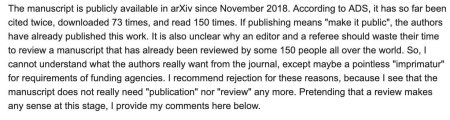
But it seems there are some astronomers who aren’t aware of the culture of openness. Here is an excerpt from a referee report on a paper submitted to Astronomy & Astrophysics which has been circulated on Twitter:

In summary the referee thinks the paper should be rejected because it has already appeared on the arXiv. That’s a pretty extraordinary recommendation when the authors were following standard practice for the field!

In a sense, though, the referee is right. Journals are no longer needed in order to publish papers. We can all do that ourselves on the arXiv for free. What we do need is to have some quality control via peer review. The imprimatur of a journal is not pointless because it indicates the paper has met a quality threshold. Indeed, in my opinion, it’s the only thing a journal does that’s not pointless..

The Open Journal Of Astrophysics provides peer review for papers on the arXiv, dispensing with the rest of the cumbersome paraphernalia of journals that digital publishing has made redundant.

So if your paper is rejected by a journal because you have put in on the arXiv then why not just submit it to OJA instead?