At the risk of giving the impression that I’m obsessed with the issue of the Hubble constant, I thought I’d do a quick post about something vaguely related to that which I happened to be thinking about the other night.
It has been remarked that the two allegedly discrepant sets of measures of the cosmological distance scale seen, for example, in the diagram below differ in that the low values are global measures (based on observations at high redshift) while the high values of are local (based on direct determinations using local sources, specifically stars of various types).
The above Figure is taken from the paper I blogged about a few days ago here.
That is basically true. There is, however, another difference in the two types of determination: the high values of the Hubble constant are generally related to interpretations of the measured brightness of observed sources (i.e. they are luminosity distances) while the lower values are generally based on trigonometry (specifically they are angular diameter distances). Observations of the cosmic microwave background temperature pattern, baryon acoustic oscillations in the matter power-spectum, and gravitational lensing studies all involve angular-diameter distances rather than luminosity distances.
Before going on let me point out that the global (cosmological) determinations of the Hubble constant are indirect in that they involve the simultaneous determination of a set of parameters based on a detailed model. The Hubble constant is not one of the basic parameters inferred from cosmological observations, it is derived from the others. One does not therefore derive the global estimates in the same way as the local ones, so I’m simplifying things a lot in the following discussion which I am not therefore claiming to be a resolution of the alleged discrepancy. I’m just thinking out loud, so to speak.
With that caveat in mind, and setting aside the possibility (or indeed probability) of observational systematics in some or all of the measurements, let us suppose that we did find that there was a real discrepancy between distances inferred using angular diameters and distances using luminosities in the framework of the standard cosmological model. What could we infer?
Well, if the Universe is described by a space-time with the Robertson-Walker Metric (which is the case if the Cosmological Principle applies in the framework of General Relativity) then angular diameter distances and luminosity distances differ only by a factor of (1+z)2 where z is the redshift: DL=DA(1+z)2.
I’ve included here some slides from undergraduate course notes to add more detail to this if you’re interested:
The result DL=DA(1+z)2 is an example of Etherington’s Reciprocity Theorem. If we did find that somehow this theorem were violated, how could we modify our cosmological theory to explain it?
Well, one thing we couldn’t do is change the evolutionary history of the scale factor a(t) within a Friedman model. The redshift just depends on the scale factor when light is emitted and the scale factor when it is received, not how it evolves in between. And because the evolution of the scale factor is determined by the Friedman equation that relates it to the energy contents of the Universe, changing the latter won’t help either no matter how exotic the stuff you introduce (as long as it only interacts with light rays via gravity).
In the light of the caveat I introduced above, I should say that changing the energy contents of the Universe might well shift the allowed parameter region which may reconcile the cosmological determination of the Hubble constant from cosmology with local values. I am just talking about a hypothetical simpler case.
In order to violate the reciprocity theorem one would have to tinker with something else. An obvious possibility is to abandon the Robertson-Walker metric. We know that the Universe is not exactly homogeneous and isotropic, so one could appeal to the gravitational lensing effect of lumpiness as the origin of the discrepancy. This must happen to some extent, but understanding it fully is very hard because we have far from perfect understanding of globally inhomogeneous cosmological models.
Etherington’s theorem requires light rays to be described by null geodesics which would not be the case if photons had mass, so introducing massive photons that’s another way out. It also requires photon numbers to be conserved, so some mysterious way of making photons disappear might do the trick, so adding some exotic field that interacts with light in a peculiar way is another possibility.
Anyway, my main point here is that if one could pin down the Hubble constant tension as a discrepancy between angular-diameter and luminosity based distances then the most obvious place to look for a resolution is in departures of the metric from the Robertson-Walker form.
Addendum: just to clarify one point, the reciprocity theorem applies to any GR-based metric theory, i.e. just about anything without torsion in the metric, so it applies to inhomogeneous cosmologies based on GR too. However, in such theories there is no way of defining a global scale factor a(t) so the reciprocity relation applies only locally, in a different form for each source and observer.
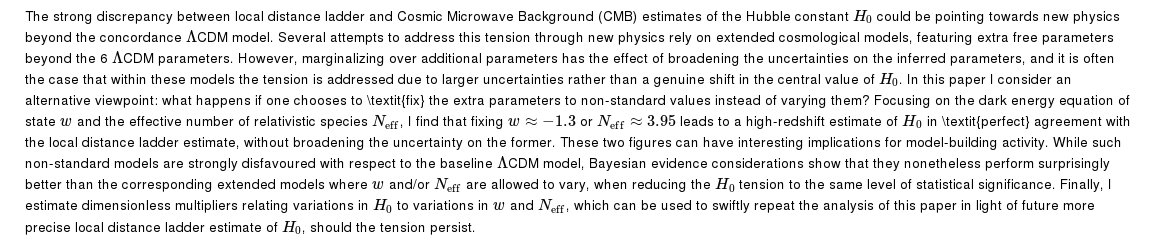
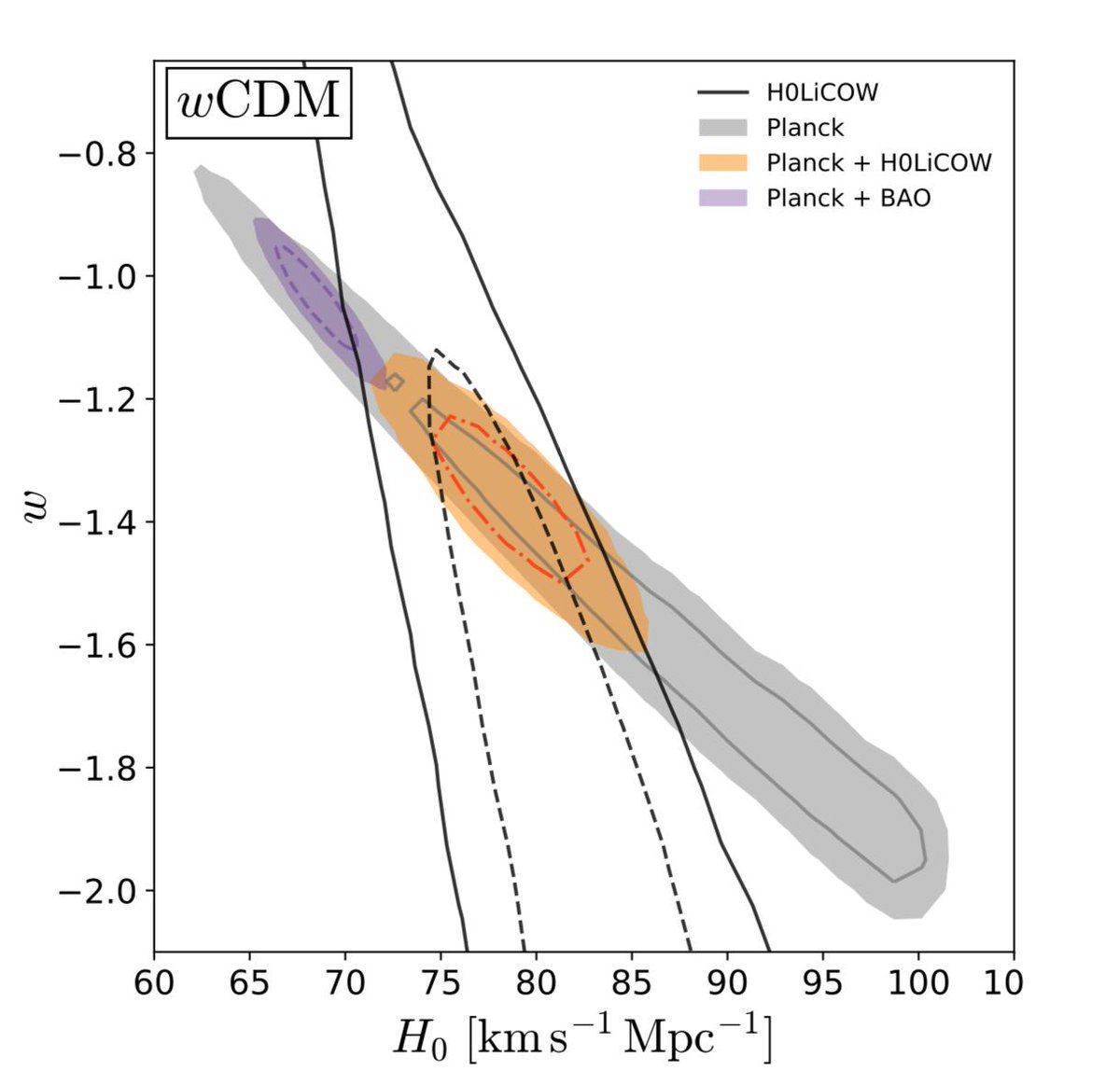 The point is that if you allow the equation of state parameter w to vary from the value of w=-1 that it has in the standard cosmology then you get a better fit. However, it is one of the features of Bayesian inference that if you introduce a new free parameter then you have to assign a prior probability over the space of values that parameter could hold. That prior penalty is carried through to the posterior probability. Unless the new model fits observational data significantly better than the old one, this prior penalty will lead to the new model being disfavoured. This is the Bayesian statement of Ockham’s Razor.



 In the Dark
A Comment on Comments
Posted in Biographical with tags abuse, Anonymity, comments, trolls on July 24, 2019 by telescoperGiven some recent activity on this blog, I think it’s time to do another post stating my policy on comments.
This is what it says on the front page of this blog:
That statement has been there since 2009. I don’t mind people posting contrary views as long as they’re not abusive, but if you use a fake email address and/or a fake name then your comment will be blocked. If you’ve got something to say then at least have the courage to identify yourself! I do block comments for other reasons, including if they’re silly or demented or just plain tedious.
When I first started blogging, over a decade ago, I decided to have an open comment policy so that anyone and everyone could comment without any form of intervention. That turned out to be a disaster because of the number of automatically generated SPAM comments that clogged up the boxes. I therefore switched on a SPAM filter so it could veto obvious garbage, but otherwise kept an open policy. The alternatives offered by WordPress include one that requires all comments to be from people registered at the site (which I thought would probably be a deterrent to people only wanting to comment on the odd post). Another option is to maintain a blacklist which treats all messages from persons on the list as Spam. It’s also possible to block all comments entirely, of course, but I enjoy reading most of them so I think it would be a shame to do that just because of a few breaches of netiquette.
All went fairly well and I only had to ban a couple of individuals for abuse. I did for a time receive a stream of crudely abusive comments (of a personal nature) from various anonymous sources. These were mostly depressingly puerile and they didn’t affect me much but I did find it very disconcerting to think that there are people sitting out there with nothing better to do than write such stuff.
Take Mr Hine, for example – no, go on, take him! -:
This chap attempts to post comments usually saying the same thing several times every day (weekends included). In fact on Monday 22nd July there were no fewer than 17 messages from him. Occasionally I can’t resist showing bits I’ve found in the spam folder for comedy value but I have no intention of allowing him free rein to fill up every thread.I know I should probably stop winding him up so that he stops trying, but alas I am weak.
Since WordPress notifies me every time a comment is posted (or an attempt is made to post a comment) it is quite easy to remove this junk, but I found it very tiresome (when there were several per day) and eventually decided to change my policy and automatically block comments from all anonymous sources. Since this requires a manual check into whether the identity information given with the comment is bona fide, comments from people who haven’t commented on this blog before may take a little while to get approved.
There are still comments on here which may appear to a reader anonymous (or with a pseudonym), but these are from people who have identified themselves to me with a proper email address or who the software has identified through their IP address or information revealed by their web browser (which is probably more than you think…). I’m happy for people to comment without requiring they release their name to the world, and will do my best to ensure their confidentiality, but I’m not happy to publish comments from people whose identity I don’t know.
To give you an idea of the scale of the problem, as of today, 32,689 comments have been published on this blog. The number rejected as SPAM or abuse is 2,399,850. That means that fewer than 1 in 70 are accepted. I simply don’t have time to go through all the flagged comments individually, so I usually just delete them all.
Am I denying freedom of speech by rejecting anonymous comments? I don’t think so. If you want freedom of speech that much, you can write your own blog (anonymous or otherwise). And if every sight of this blog makes you want to write abusive comments, perhaps you should exercise your freedom not to read it.
I’d be interested to know from any fellow bloggers if they have the same problems with abusive comments. If not, perhaps I should start taking it personally!
More generally, I will not accept anonymous comments on the subject of the anonymity of comments, but any other contributions are welcome via the box.
Unless, of course, you’re banned.
Follow @telescoper8 Comments »