Schattenbilder (Silhouettes) of Gustav Mahler conducting, by Otto Böhler (1847–1913), published posthumously in 1914.
Follow @telescoper
Schattenbilder (Silhouettes) of Gustav Mahler conducting, by Otto Böhler (1847–1913), published posthumously in 1914.
Follow @telescoper
A very busy day today so I thought I’d just do a quick post to give you a chance to test your brains with some more order-of-magnitude physics problems. I like using these in classes because they get people thinking about the physics behind problems without getting too bogged down in or turned off by complicated mathematics. If there’s any information missing that you need to solve the problem, make an order-of-magnitude estimate!
Give order of magnitude answers to the following questions:
There’s no prize involved, but feel free to post answers through the comments box. It would be helpful if you explained a bit about how you arrived at your answer!
Follow @telescoperI read an interesting piece in Sunday’s Observer which is mainly about the challenges facing the modern sports betting industry but which also included some interesting historical snippets about the history of gambling.
One thing that I didn’t know before reading this article was that it is generally accepted that the first ever bookmaker was a chap called Harry Ogden who started business in the late 18th century on Newmarket Heath. Organized horse-racing had been going on for over a century by then, and gambling had co-existed with it, not always legally. Before Harry Ogden, however, the types of wager were very different from what we have nowadays. For one thing bets would generally be offered on one particular horse (the Favourite), against the field. There being only two outcomes these were generally even-money bets, and the wagers were made between individuals rather than being administered by a `turf accountant’.
Then up stepped Harry Ogden, who introduced the innovation of laying odds on every horse in a race. He set the odds based on his knowledge of the form of the different horses (i.e. on their results in previous races), using this data to estimate probabilities of success for each one. This kind of `book’, listing odds for all the runners in a race, rapidly became very popular and is still with us today. The way of specifying odds as fractions (e.g. 6/1 against, 7/1 on) derives from this period.
Ogden wasn’t interested in merely facilitating other people’s wagers: he wanted to make a profit out of this process and the system he put in place to achieve this survives to this day. In particular he introduced a version of the overround, which works as follows. I’ll use a simple example from football rather than horse-racing because I was thinking about it the other day while I was looking at the bookies odds on relegation from the Premiership.
Suppose there is a football match, which can result either in a HOME win, an AWAY win or a DRAW. Suppose the bookmaker’s expert analysts – modern bookmakers employ huge teams of these – judge the odds of these three outcomes to be: 1-1 (evens) on a HOME win, 2-1 against the DRAW and 5-1 against the AWAY win. The corresponding probabilities are: 1/2 for the HOME win, 1/3 for the DRAW and 1/6 for the AWAY win. Note that these add up to 100%, as they are meant to be probabilities and these are the only three possible outcomes. These are `true odds’.
Offering these probabilities as odds to punters would not guarantee a return for the bookie, who would instead change the odds so they add up to more than 100%. In the case above the bookie’s odds might be: 4-6 for the HOME win; 6-4 for the DRAW and 4-1 against the AWAY win. The implied probabilities here are 3/5, 2/5 and 1/5 respectively, which adds up to 120%, not 100%. The excess is the overround or `bookmaker’s margin’ – in this case 20%.
This is quite the opposite to the Dutch Book case I discussed here.
Harry Ogden applied his method to horse races with many more possible outcomes, but the principle is the same: work out your best estimate of the true odds then apply your margin to calculate the odds offered to the punter.
One thing this means is that you have to be careful f you want to estimate the probability of an event from a bookie’s odds. If they offer you even money then that does not mean they you have a 50-50 chance!
Follow @telescoperI completely forgot to upload the slides from my talk at the Open Meeting of the Royal Astronomical Society on April 12 2019 so here they are now!
Just a reminder that the centenary of the famous 1919 Eclipse Expeditions is on 29 May 2019.
Follow @telescoper
Here’s another interesting image that for some people creates an optical illusion in that the circular patterns seem to rotate. I have to admit, though, that I don’t see the effect. Actually, correct that. I don’t see anything when I view it on my phone, but do see swirling motion when I have it on my computer screen.
Do you see movement?
Follow @telescoper
Well here I am, back in Maynooth, after a week’s restful leave in Cardiff. The weather here is just as nice as it was in Wales when I left yesterday: sunny and about 20 degrees. I’m enjoying the warm weather very much indeed, as my arthritis seems to have eased off considerably.
I was planning to return to Ireland today (Monday) but the flights were far cheaper yesterday. The plane I took yesterday (Sunday) less than half full. Incidentally, after their recent rescue and restructuring FlyBe have announced that after this summer they will no longer operate jets from Cardiff. Flights to Dublin will therefore be by their smaller Bombardier turboprops rather than the Embraer aircraft that I took yesterday.
Today is a Bank holiday in Ireland, as it is in the UK, but after that the Easter break is over; I’m officially back to work tomorrow. This semester will have been divided into three pieces, firstly by the half-term study week (around St Patrick’s Day) and now by a one-week Easter break. Last year these two breaks were contiguous, but Easter is quite late this year so they are separate this time.
Anyway, we now have three weeks of teaching left followed by the May examination period and, of course, the inevitable Marking of the Scripts.
The three remaining weeks include two Bank Holiday Mondays including today, Easter Monday, and the May Day Holiday on 6th May). I have lectures on Mondays I will miss two sessions, leaving only seven lectures remaining for Engineering Mathematics. I’d better make sure that in the short time remaining I cover everything that is in the examination!
Anyway, although it’s a holiday I’ve got to get my lecture together for tomorrow morning so I’d better get to work. It’s a shame not to be out and about in the sunshine but there you go. That is the price you pay for having a week off. No doubt there is a ton of emails to reply to as well; I’ve tried not to look at my inbox while I’ve been off. I’ve made that a rule for holidays now: put the out of office message on and leave the email alone!
Follow @telescoperAt this time of year it seems appropriate to do a post, as the thoughts of good folk around the world turn to the important issue of the season … ie who will get relegated from the Premiership.
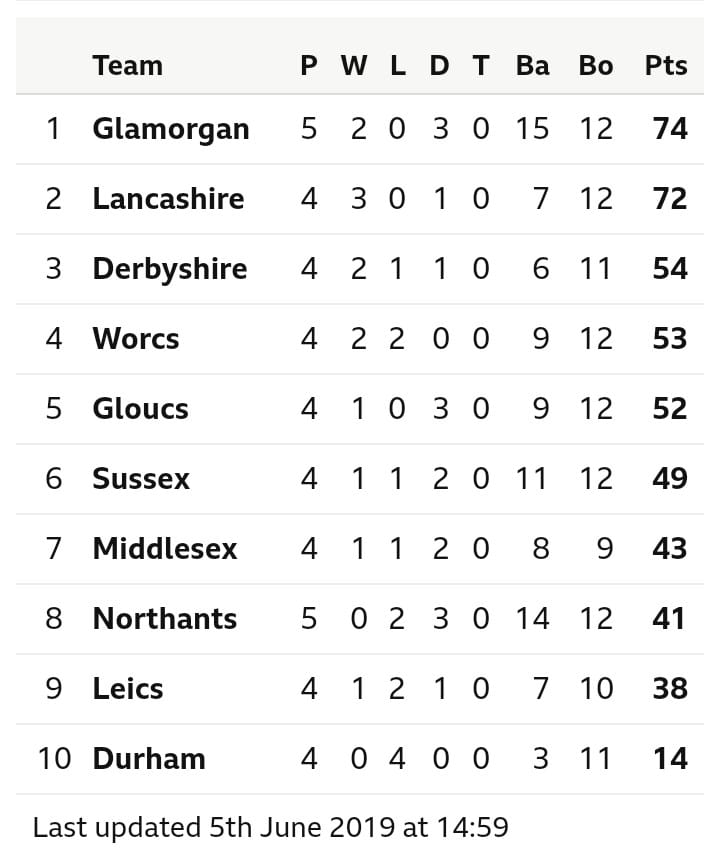
Yesterday evening’s win by Newcastle United over Southampton left the lower reaches of the table looking like this:

Huddersfield and Fulham having already been doomed, the only question is who will join them.
The bookies clearly think Cardiff City are odds-on to take the third relegation spot: the best odds I could get are 1/6 on them going down, implying only a probability of 14% or so survival. Brighton and Hove Albion are 9/2. Southampton are 150/1, Burnley 250/1 and Newcastle 750/1.
I’m not so sure the odds on Cardiff City are fair: they do play Liverpool later today but after that seem to have two winnable games (against Fulham and Crystal Palace). Brighton are three points ahead of Cardiff, but that’s away against Spurs and they’ll do well to get anything out of that fixture, and after that they have games against Newcastle United, Arsenal and Manchester City. Despite yesterday’s 0-0 draw against Wolves they don’t look like a team strong on form and confidence.In short I think that 9/2 is worth a bet.
Let me say that I don’t want to see either Brighton or Cardiff go down. I’ve got ties to both places. I’m just talking about what seems probable not what I think is desirable.
Southampton seem to have extremely long odds too, but they do seem to have a much easier run in than Brighton.
We’ll see. I’d expect these odds to change quite a bit if Cardiff beat Liverpool this afternoon. If they lose, however, then Newcastle are mathematically safe from relegation…
UPDATE: Cardiff City lost 2-0 at home to Liverpool this afternoon. The odds on them get relegated have shortened a bit (around 1/8 is as good as you can get) but there’s no great change in the odds, presumably because bookies did not really expect Cardiff to get any points from that game. Brighton have now moved to 13/2 against.
Cardiff City are now on 31 points with three games left. That means the maximum total they can reach is 40, so Newcastle United are safe from relegation.
Follow @telescoperTurning and turning in the widening gyre
The falcon cannot hear the falconer;
Things fall apart; the centre cannot hold;
Mere anarchy is loosed upon the world,
The blood-dimmed tide is loosed, and everywhere
The ceremony of innocence is drowned;
The best lack all conviction, while the worst
Are full of passionate intensity.
Surely some revelation is at hand;
Surely the Second Coming is at hand.
The Second Coming! Hardly are those words out
When a vast image out of Spiritus Mundi
Troubles my sight: somewhere in sands of the desert
A shape with lion body and the head of a man,
A gaze blank and pitiless as the sun,
Is moving its slow thighs, while all about it
Reel shadows of the indignant desert birds.
The darkness drops again; but now I know
That twenty centuries of stony sleep
Were vexed to nightmare by a rocking cradle,
And what rough beast, its hour come round at last,
Slouches towards Bethlehem to be born?
by William Butler Yeats (1865-1939): this poem was written in 1919.
Follow @telescoperAmong the new Fellows of the Royal Society announced this week, I was astonished to see the name of Roy Kerr, the man who gave his name to the Kerr Metric an exact solution of Einstein’s equations of general relativity which describes the geometry of space-time around a rotating black hole.

When I say “astonished” I don’t mean that Kerr does not deserve this recognition. Far from it. I’m astonished because it has taken so long:the Kerr solution was published way back in 1963.
Anyway, better late than never, and heartiest congratulations to him!
While I’m on about Roy Kerr I’ll also say that I now think there is a very strong case for him to be awarded a Nobel Prize. The reasons are twofold.
One is that all the black hole binary systems whose coalescences produced gravitational waves detected by LIGO have involved Kerr black holes. Without Kerr’s work it would not have been possible to construct the template waveforms needed to extract signals from the LIGO data.

Second, and even more topically, the black hole in M87 recently imaged (above) by the Event Horizon Telescope is also described by the Kerr geometry. Without Kerr’s work the modelling of light paths around this object would not have been possible either.
Follow @telescoper
The Multiverse is Andrew Wynn Owen‘s first book of poems. It was published last year by Carcanet Press, but I only found out about it a week or two ago, from a review in a recent edition of the Times Literary Supplement. I had £10 in book tokens left over from a crossword prize so decided to spend them on this exuberant and diverse collection (which cost £9.99).
There are two particularly interesting things about this book. One is its thematic range, which is centred on science and philosophy but spreads out very widely across many fields. It’s actually not unusual for poets to be interested in science, though perhaps it is rather rarer for scientists to be interested in poetry…
The other particularly interesting aspect of these poems is their stylistic range. All of them are written in very precise forms, including the various types of sonnet, each with a strict metre but differing radically in structure from one to the other. As you might expect there are clear echoes of poetry from other eras, including nods in the direction of the metaphysical poets such as George Herbert.
You might infer from what I’ve said that these poems are merely imitative of other works, but that’s not the case. Although they are often very witty, these poems are not just parodies. I think the poet’s intention was to demonstrate how much can still be said that’s relevant to the modern world using established forms. I think he succeeds brilliantly, and he shows such mastery of so many different styles that it’s hard to believe this is a debut collection.
The title The Multiverse plays both on the aspects I described above, the scientific and philosophical themes, and the plurality of verse forms contained in this collection. As a physicist, though I’m not a proponent of the ‘scientific’ Multiverse, I recommend the poetic version very highly!
Follow @telescoper