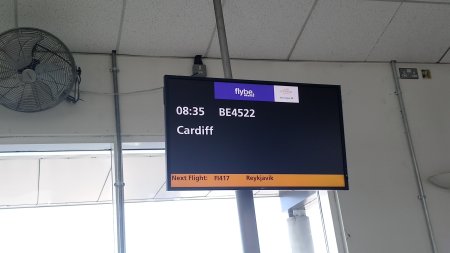
So here I am again, back in sunny Cardiff (if a bit later than planned). My flight from Dublin was supposed to depart at 8.35, but didn’t go until over an hour later. The delay was allegedly caused by a lightning strike last night that required the plane to be checked before take-off. Although they must have known about this mishap for some time, FlyBe didn’t bother to tell us anything about the reason for the delay or how long it would be. This was the scene at the (unstaffed) departure gate at about 9.15am. The lack of communication or any form of customer service compounds the irritation caused by such delays.
Anyway, once airborne, it was a pleasant flight. Here are two pictures just after taking off from Dublin Airport, with a view up to Malahide in the North.
And here are a few more flying over Wales about 10 minutes before landing.
We landed about 85 minutes late in Cardiff, but it’s lovely weather here so I’m not as grumpy as I might have been. Now, to work.
The last link to an arXiv paper I posted here seems to have proved rather popular so here’s another that I think is well worth reading, this time by Ed Witten:
This article consists of a very short introduction to classical and quantum information theory. Basic properties of the classical Shannon entropy and the quantum von Neumann entropy are described, along with related concepts such as classical and quantum relative entropy, conditional entropy, and mutual information. A few more detailed topics are considered in the quantum case.
It’s not really `very short’ as it is nearly 40 pages long, but it does tackle a very big topic so I won’t quibble about that. You can download a PDF of the full paper here.
As always, comments are welcome through the comments box.
So here I am, in Maynooth, on my birthday. I’ve made such an impression here in Ireland since I arrived that they’ve declared this day a national holiday so I’ve got the day off.
The June Bank Holiday (Lá Saoire i mí Mheitheamh) in Ireland is actually the equivalent of last week’s late May Bank Holiday in the UK, in that both have their origin in the old festival of Whitsuntide (or Pentecost) which falls on the 7th Sunday after Easter. Because the date of Easter moves around in the calendar so does Whit Sunday, but it is usually in late May or early June. When the authorities decided to fix a statutory holiday at this time of year, presumably to reduce administrative difficulties, the UK went for late May and Ireland for early June. Whit Sunday was actually on 20th May this year.
Incidentally, when I was a lad, ‘Whit Week’ was always referred to as ‘Race Week’. Geordie Ridley’s famous music hall song The Blaydon Races begins “I went to Blaydon Races, ’twas on the 9th of June, Eighteen Hundred and Sixty Two on a summer’s afternoon…”. Easter Sunday fell on 20th April in 1862, so Whit Sunday was on 8th June. After raucous scenes at the Blaydon Races, they were scrapped and replaced with a Temperance Festival on the Town Moor in Newcastle which evolved into one of the largest open-air funfairs in Europe, The Hoppings.
Anyway, with this birthday, I have now reached the minimum retirement age in the UK university pension scheme, so I could start drawing my pension when I leave Cardiff University next month. For a time I was planning to do that, but Ireland has given me a new lease of life, so to speak, so thoughts of retirement have receded.
Today also represents a short hiatus before our formal Exam Board meeting tomorrow, then I’ll be back in Cardiff for exam business there. And next week I’ll be in neither Cardiff nor Maynooth…
One of the deep cultural differences I have discovered between Ireland and the United Kingdom lies in the arena of potato crisps.
Here the crisp of choice for the discerning consumer is the Tayto, a brand I have not seen elsewhere (though apparently it is also made under licence in Northern Ireland). So familiar is the name Tayto over here that people use it to refer to any kind of crisp, in much the same way that in the UK you might use ‘Hoover’ to refer to any kind of vacuum cleaner.
If you don’t believe that a humble potato crisp can be a cultural phenomenon then note that there is even a Tayto Park which is only 30 minutes from Dublin but which, regrettably, I have not yet visited.
Tayto’s crisps have been around since 1954 and the manufacturer is credited with inventing the method of production of flavoured potato crisps. Tayto has the right, therefore, to call itself the original potato crisp.
Naturally, while in Ireland I try to buy locally produced items whenever possible, so I have sampled Tayto crisps on a number of occasions. They come in a relatively narrow range of flavours, but the Cheese & Onion variety is definitely nicer than, e. g. Walkers.
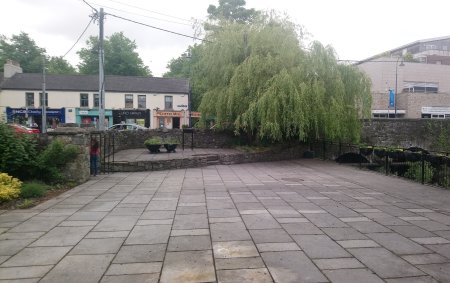
Taking a stroll around Maynooth this afternoon I came across a little bit of local history that I thought I would share. On the appropriately name Pound Lane, right next to the stream that used to run past an ancient mill where there is now a shopping centre, there is a small enclosure called the Maynooth Pound, marked with this sign:
If you can’t read the sign it explains that this is the only surviving example of a type of pound which used to be common all over Ireland. Stray animals were brought here to be fed and watered before being reunited with their owners (for a small fee).
The walls are of interesting dry stone construction and have survived the passage of time rather well; they were built in 1822, although the Pound itself is a bit older.
The interior of the Pound was virtually derelict until quite recently but has been tidied up and is now a pleasant place to sit down and perhaps feed the birds. The old mill was famous for its crows, of which there are still a great many in Maynooth although they tend now to congregate on the playing fields near the Royal Canal.
In the picture, the mill stream is to the right of the shot and you can see the roof of the Manor Mill shopping centre to the upper right.
Contrary to claims about the irrelevance of philosophy for science, I argue that philosophy has had, and still has, far more influence on physics than is commonly assumed. I maintain that the current anti-philosophical ideology has had damaging effects on the fertility of science. I also suggest that recent important empirical results, such as the detection of the Higgs particle and gravitational waves, and the failure to detect supersymmetry where many expected to find it, question the validity of certain philosophical assumptions common among theoretical physicists, inviting us to engage in a clearer philosophical reflection on scientific method.
I don’t know why this track just came into my head but while it’s there I thought I’d share it. It’s from a rightly renowned album by Chick Corea and Gary Burton recorded at a live concert in Zurich in 1979, but this number just features Gary Burton on the vibes. I bought this album on vinyl when it first came out and was completely gobsmacked by the miraculous nature of Gary Burton’s four-mallet vibraphone playing, especially on this track. In a subsequent interview on the radio I heard Burton dismiss his extraordinary technical accomplishment, explaining that the mallets are really just like fingers and it is no harder than playing the piano. I think his modesty is misplaced, as fingers bend but mallets don’t. Or do they?
Well, it’s another lovely day here in Maynooth and it feels even nicer that now that I’ve finished the stack of examination and project marking I had to do relating to the Computational Physics module I’ve been teaching for the past term.
I was feeling a bit guilty that I only just got the marks ready before today’s deadline, but it turns out that mine is far from being the last set to go into the database.
Tomorrow we have an internal meeting to discuss all the examination results and then on Tuesday next week we have the full formal meeting of the Exam Board complete with visiting External Examiner. It’s always a busy period preparing for these meetings as not only does everything have to be marked, but also all the marks need to be checked and double-checked, and various statistics produced ready for the forthcoming meetings. We take all these things very seriously because they’re so important.
I’m not sure students appreciate how much goes on behind the scenes at this time of year, but in this period they are finished with their academic work and probably out and about enjoying the sunshine. They were cooped up indoors sitting their examinations just a few days ago while we staff were in a state of comparative relaxation, and now it’s our turn to suffer.
Anyway, it’s at busy times of the year that we rely heavily on the efforts not only of administrative staff, without whom the whole business of examinations would grind to a halt. We rely on them all round the year, in fact, but their contribution is particularly obvious during exam season.
As it happens the Department of Theoretical Physics at Maynooth University will soon be losing an invaluable member of administrative staff who is retiring in a month or so. We have an advertisement already out for a (full-time) Executive Assistant with a deadline of 17th June to provide us with a replacement as soon as possible.
Anyway, Monday 4th June is a Bank Holiday in Ireland. It’s the equivalent holiday to the Late Spring Holiday in the UK (which is always on the last Monday of May), but here in the Emerald Isle it is always the first Monday in June. This year it happens to be on my birthday! So after the ordeal of tomorrow’s pre-Board meeting I have a long weekend to relax before the official meeting on Tuesday. I’m not sure if the fine weather will last, but I intend to do a bit of sightseeing if it does.
A few days ago I came across the following video, and I thought I’d share it here for two reasons. The first reason is that you might find it surprising, possibly amusing and possibly also bit scary. Keep your eye on the cross in the centre of the screen and observe what happens to the faces either side:
Most people who I’ve shown this to report peculiar distortions of the (familiar) faces either side. This phenomenon is clearly related to the limitations of peripheral vision.
The second reason for posting this is much more personal and relates to my struggles over the years with a form of panic disorder (which I’ve blogged about before, e.g., here). The term `panic disorder’ has a very broad definition, so that different individuals experience different forms of panic attacks and they can also take very different forms for the same individual. For me, a “typical” panic episode begins with a generalised feeling of apprehension or dread. Sometimes that’s as far as it goes. However, more often, there follows a period of increasingly heightened awareness of things moving in my peripheral vision that I can’t keep track of, accompanied by auditory and visual hallucinations. I’ve tried to explain the latter in conversations with friends and colleagues and usually when I do so I describe how the faces of people around me become distorted in a grotesque and terrifying way. When that happens I usually run as fast as I can in whatever direction I can to get away.
On top of the effect of these attacks themselves, there is also the frustration, when they are over, of not really understanding what had happened. What is happening in my brain when a panic episode begins? What is going on with my peripheral vision when it goes awry like it does? Why do some particular places or circumstances trigger an attack but other, apparently similar, ones don’t?
When I first saw the above video it struck me immediately that it might contain a big clue about these episodes, as the facial distortions that appear there are very similar to what I experience. Perhaps what goes wrong is that peripheral vision takes over from central vision, i.e. a kind of opposite of tunnel vision, as a result of some malfunction in the way my brain deals with peripheral data.
Most of the time we just discard data from outside our line-of-sight unless it’s something extremely dramatic and disturbing (whether good or bad); presumably we can’t process everything across our entire field of view so we usually filter out observations coming from the edges. What seems to happen with me is that something interferes with this filtering process so that almost everything gets flagged with a danger signal. My response to these is to look about manically trying to establish whether the threat is real before, usually, just getting out of there as quickly as I can when it becomes overwhelming.
Obviously, this isn’t a complete answer to any of the many questions I’ve asked myself about this but somehow seeing the effect in the video makes me feel more comfortable with what happens because at least I can see that others can experience a similar phenomenon, even if in very different circumstances.
P.S. I should say that although about two years ago I quit the medication I was taking to control them, I haven’t had any of these psychotic episodes since then. Reducing stress by leaving my job at Sussex was almost certainly a contributing factor.
The views presented here are personal and not necessarily those of my employer (or anyone else for that matter).
Feel free to comment on any of the posts on this blog but comments may be moderated; anonymous comments and any considered by me to be vexatious and/or abusive and/or defamatory will not be accepted. I do not necessarily endorse, support, sanction, encourage, verify or agree with the opinions or statements of any information or other content in the comments on this site and do not in any way guarantee their accuracy or reliability.









 In the Dark