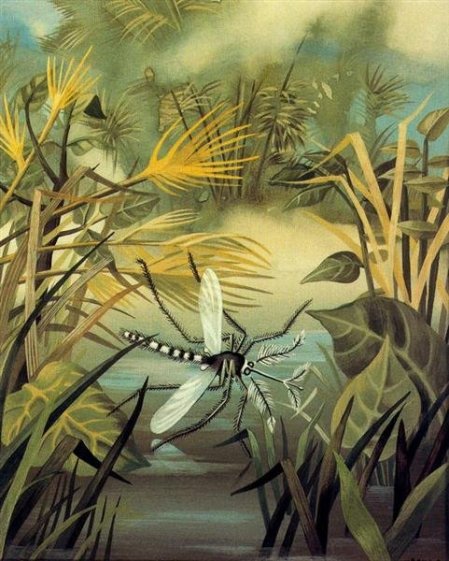
by Remedios Varo Uranga (1908-63), painted in 1947, 25.5× 21cm, gouache on cardboard.
Follow @telescoper
by Remedios Varo Uranga (1908-63), painted in 1947, 25.5× 21cm, gouache on cardboard.
Follow @telescoper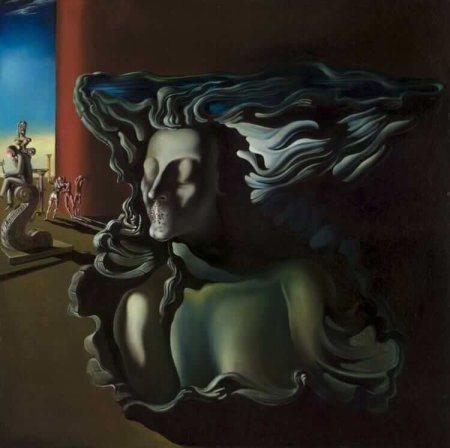
The Dream (Salvador Dali, 1931)
I know I’m not alone during this strange and unsettling Coronavirus period in having extraordinarily vivid dreams almost every night.
I’m grateful for two things related to this. One is that I’m sleeping much better than usual, with not a trace of the insomnia I’ve experienced in the past during times of stress. The other is that these dreams are very far from being nightmares. Most of them are benign, and some are laugh-out-loud hilarious.
The other day, for example, I had a dream in which Nigel Farage returned from his recent trip to Dover in search of migrants publicity to find his house filled with asylum seekers singing the theme from The Dambusters. There was also a cameo appearance by Nigella Lawson in that dream but I forget the context.
I’ve written about dreams a few times before (e.g. here) and don’t intend to repeat myself here. It does seem to me however that dreams are probably a byproduct of the unconscious brain’s processing of notable recent events and this activity is heightened because the current times are filled with unfamiliar experiences.
I know some people are having far worse nocturnal experiences than me, and I don’t really understand why I’m having a relatively easy ride when my past history suggests I’d be prime candidate for cracking up. Perhaps I’ve had enough practice at dealing with anxiety in the past (not always very satisfactorily)? Perhaps the sense of detachment I’ve experienced over the past few weeks is part of some sort of defence mechanism I’ve acquired?
Anyway, don’t have nightmares!
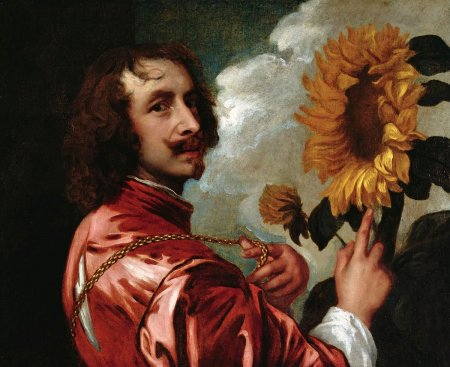
Follow @telescoperThe 17th-century Flemish painter Anthony van Dyck (1599–1641) is famous not only as an artist but also for a particular style of facial hair, the goatee/moustache combo now known as a “Van Dyke”, as demonstrated by the man himself in this self-portrait:
What I didn’t realise until recently however that van Dyck painted a very large number of studies of men with all kinds of beards. Here is a particularly fine example (Study of a Bearded Man with Hands Raised, 1616).
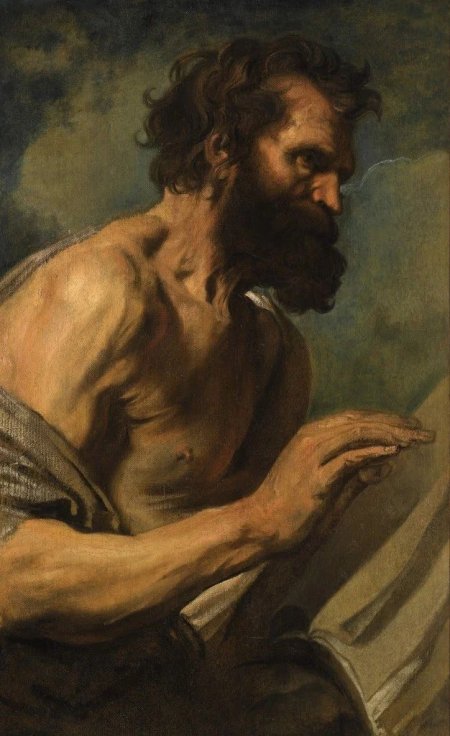
I’m not an expert but based on the poses I suspect these studies were done in preparation for paintings with biblical themes. Indeed the model looks rather similar to the figure in Jude The Apostle completed about three years later:

Yesterday there was a celebration in London to mark the bicentenary of the foundation of the Royal Astronomical Society. I wasn’t there as I was finishing my examination marking, but I did notice that the RAS used the opportunity to unveil its new “branding” :

It’s perfectly reasonable to use the 200th anniversary to update the Society’s logo etc and the previous one was a bit old-fashioned:
I am however very confused by the new design, shown here in negative:
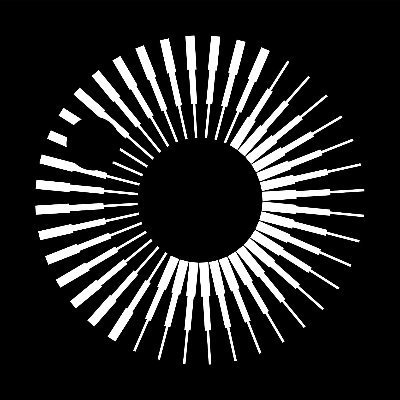
What does it represent? Are those screwdrivers or hypodermic needles?
It reminds me a bit of that symbol that appears when Windows is doing one of its interminable updates.
Apparently there was an email to RAS Fellows describing (and perhaps even explaining) the new design but I haven’t got it so perhaps someone who did could enlighten me?
Follow @telescoperCircumstances require me to travel back to Dublin via London today, so I took the opportunity to spend an hour or so at the wonderful Bridget Riley retrospective at the Hayward Gallery. The exhibition is on until January 26th and I recommend it very enthusiastically.
I took a few pictures, but none of them give an adequate impression of the experience of seeing them in the flesh.
These three deceptively simple compositions made from coloured stripes play with the eye’s colour perception, seeming to change in texture and hue as the observer changes position or viewing angle.


The “rhomboid” pictures like this one November use changes in colour to disrupt the brain’s interpretation of the two-dimensional nature of the painting. The rhombi seem to rise and fall, the surface buckling as a result.

From the black and white collection this is Movement in Squares which uses simple changes in shape to imply depth, but also creates a visual instalibity to the perception is not of a static image.

This (Drift 2) generates a twisting effect on that makes you feel quite dizzy!

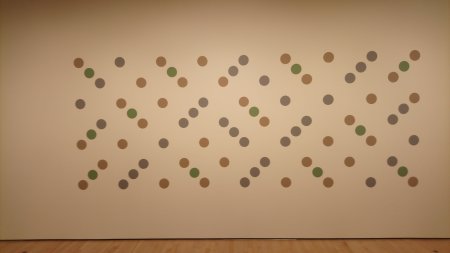
This one from 2017 is untitled and is simultaneously the least successful to be photographed and one of the most successful to view in person. It is very large – about 4 metres by 2 metres – and the circles filled with colour seem to jump about in your field of vision with every slight change of eyeline!
There are many more treats to experience in this exhibition which is highly recommended.
One of the nice things about the location of premises of the Royal Astronomical Society in Burlington House is that it’s right next to the Royal Academy. I took advantage of this proximity yesterday to have a look at the exhibition of work by Antony Gormley. The Main Gallery was very busy as I did my tour but I spent a very enjoyable time wandering around the various rooms and, in some cases, inside the installations therein.
The Royal Academy is a very traditional gallery space and it was the ingenious use of that space within the formal confines of the gallery that I found most impressive. In some of the rooms thin steel bars run through and out from the doors like beam of laser light. Two such beams arrive in one room where they are joined by a vertical bar of the same type, setting up coordinate axes for the whole show.
Here are some snaps I took on the way around:

Clearing
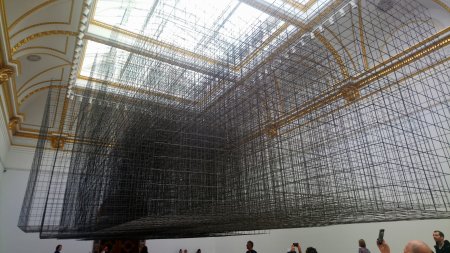
Matrix

Lost Horizon
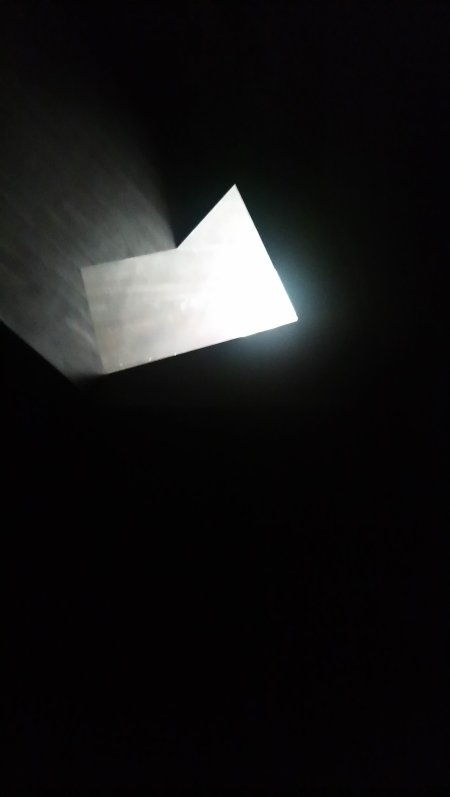
Cave
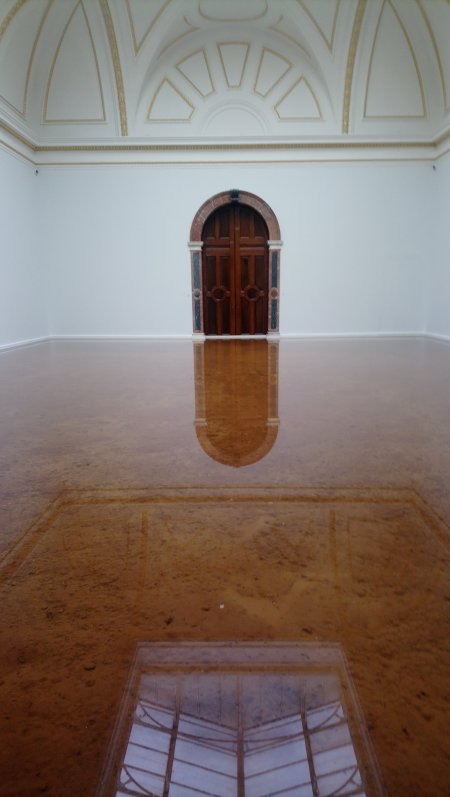
Host
`Cave’ is a large sculpture in rolled steel that you can go into. Parts of it are very dark; the photograph I took was from inside looking out. `Lost Horizons’ has typical Gormleyesque human figures standing upright, upside-down and horizontally on the floor ceiling and walls, an idea that resonates with the coordinate axes mentioned above, which you encounter just before entering this room.
But one of the most fascinating parts of the exhibition is the large collection of Gormley’s workbooks, which show how he develops his ideas, always with reference both to the form and materials of his sculpture and the space into which they are to be placed.
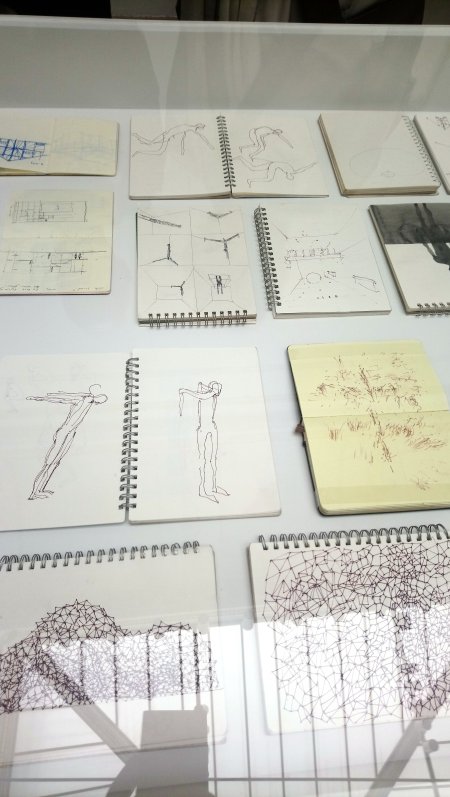
The exhibition is open until 3rd December 2019. Do catch it if you can!
Follow @telescoper
I thought I’d do a quick round-up of my little trip around cultural and historic Dublin yesterday after being stood down from duty at the Higher Options fair at the Royal Dublin Society (RDS). I have to say it was wonderful to see so many people out and about in the City’s beautiful parks and public spaces enjoying the September sunshine as I walked around.
The RDS is in the Ballsbridge area in of Dublin, to the East of the City. My route into town from there took me along Northumberland Road, where I took this picture outside Number 25:

A little further along I went across Mount Street Bridge, passing this memorial.

If you want to know more about the significance of these memorials to the events of the Easter Rising in 1916, see my post here.
My main intention during my afternoon off was to visit the National Gallery of Ireland which is situated on one side of Merrion Square. I have to say that this was even better than I’d expected, and I’m sure to visit again many times in the future. The ground floor is dominated by the work of Irish artists from about 1660 to 1965, together with European Art from 1835 to 1965. You will find works by Monet and Picasso in this section, which has much to savour. Among the Irish artists represented in this show is Jack B. Yeats (brother of poet W.B. Yeats), an extremely interesting artist in his own right.
The highlights for me, however, were found on the 3rd floor which displays examples of European Art from the early Renaissance (c. 1300) to the Enlightenment. One of the interesting things about this collection is that it is arranged thematically rather than by artist (or nationality thereof). There is, for example, an entire room of paintings inspired and influenced by Caravaggio, all of them with an intensely dramatic use of light and shadow. The gallery is worth it just for that room, but there are also fascinating juxtapositions of religious paintings from the renaissance with icons and altarpieces from the Byzantine and Russian orthodox traditions from the same period.
Elsewhere in the collection there are notable works by Vermeer, Rembrandt and Perugino as well as a number of British works by, for example, Gainsborough and Reynolds.
The work that really stopped me in my tracks, however, was this:
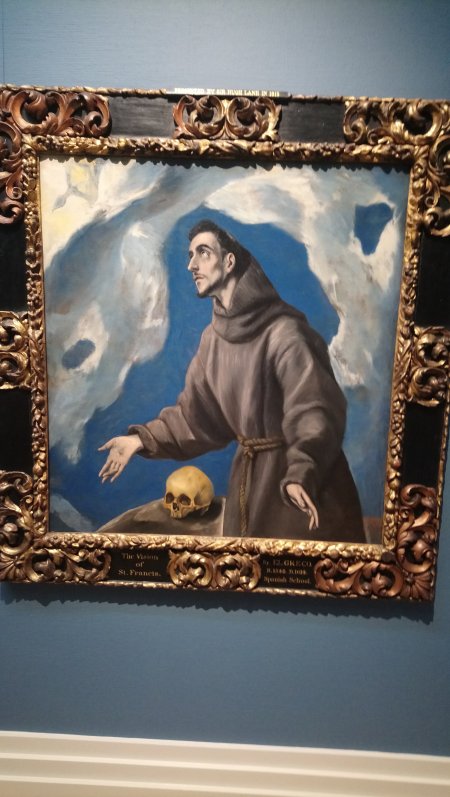
This is St Francis Receiving The Stigmata by El Greco. I knew about this painting but had no idea it was in Dublin. Seeing it close up is a revelation: the swirling brushstrokes give it an extraordinary texture that makes it hard to bring the image completely into focus. The hypnotic feel that results is a brilliant depiction of a man undergoing a kind of ecstatic vision. This work has an unbelievably powerful effect on the viewer (or at least on this one).
After a break for a sit down and a cup of coffee I visited the Natural History Museum (which is practically next door to the National Gallery). This is a surprisingly old-fashioned affair, with hundreds of stuffed animals and birds crammed into two large rooms:
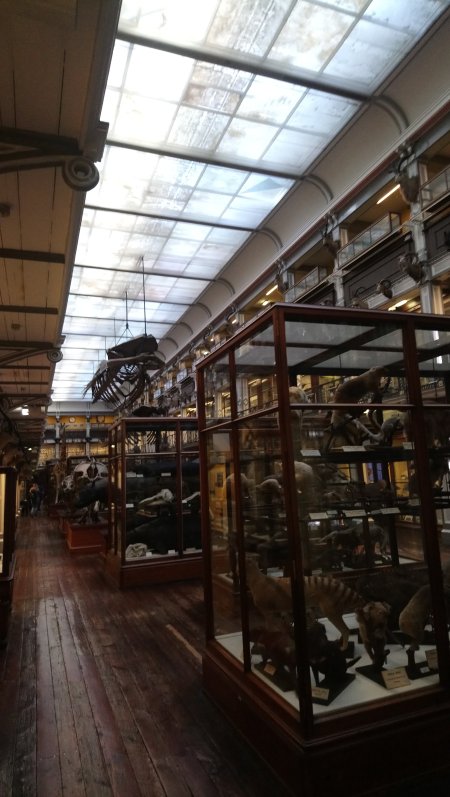
It reminded me a lot of visits to the Hancock Museum in Newcastle when I was a kid. It’s interesting, but more than a little creepy and would make an excellent setting for a horror story!
After adjourning to a pub for a pint of Guinness the final stop of the day was the National Concert Hall for yesterday’s Culture Night concert. On the way there I saw a big queue of people trying to get into one of the many free events around Dublin. It turns out this Culture Night was the grand opening of the Museum of Literature Ireland, which is situated in Newman House on the South Side of St Stephen’s Green. There’s another one to put on my list of places to visit.

The Culture Night concert was by the RTÉ National Symphony Orchestra conducted by Leonard Slatkin. The opening piece, Kinah, was a composition by the conductor himself and is a sort of memorial to his parents, both of whom were classical musicians, one a violinist and the other a cellist, and together they formed half of the famous Hollywood String Quartet. It was a new piece for me, and I found it very moving indeed. After that there was a bit of reorganization on stage to make way for the Steinway on which the brilliant Xiayin Wang played the Piano Concerto by Samuel Barber, which consists of two fast and furious movements either side of a beautifully lyrical slower movement. This must be a ferociously difficult piece to play – especially the last movement which is at a breakneck pace in 5/8 time – requiring not only dexterity but physical strength. It was a wonderful performance by Xiayin Wang, who rounded off the first half with an encore in the form of a transcription of George Gershwin’s song The Man I Love.
After the wine break interval came the main course in the form of the Symphony No. 4 in E Minor by Johannes Brahms. This is of course a much more familiar work than the previous two, but I really like concerts that mix unfamiliar material with the standard concert repertoire. It also gave me the chance to persevere with Brahms as my friends keep telling me to. It’s not that I don’t like Brahms, it’s just that I don’t find that he moves me as much as many other composers and so many people rave about him that I think I must be missing something. The 4th Symphony is a very fine work, and was performed beautifully last night under the direction of Leonard Slatkin (conducting, incidentally, without a score), but I couldn’t stop myself thinking how much like Beethoven it sounds. That’s not meant to be derogatory, by the way.
But you don’t need to take my word for it. You can listen to (and watch) the whole concert here:
Anyway, after the applause had died down I headed out towards Pearse Station for the train back to Maynooth. I was a bit tired after a very full day and wanted to get the 10.08 train so I didn’t stop to watch any of the numerous musical and artistic events I passed on the way, including an intriguing installation involving images projected onto one of the buildings to the side of St Stephen’s Green. I made it to the station with 5 minutes to spare and discovered that, because it was Culture Night, the train home was free!
Follow @telescoper
Radiante by Olga Albizu (1924-2005), painted in 1967, 68 x 62 in (172.7 x 157.5 cm), oil on canvas. Smithsonian American Art Museum.
Follow @telescoper
This image, created by David Novick, is the most impressive colour illusion I have ever seen: all the balls are actually the same colour, brown.
If you don’t believe me, zoom in on any one of them…
I don’t really know why this fascinating image causes the effect that it does, but think it is a combination of hardware and software issues! The hardware issues include the fact that colour receptors are not distributed uniformly at the back of the human eye, so colour perception is different when peripheral cues are present, and also that their spectal response is rather broad with considerable overlap between the three types of cell. The software issue is something to do with how the brain resolves a colour when there are other colour nearby:nNotice how the balls take on the colour of the lines passing across them..
Follow @telescoper

 In the Dark