Archive for the Astrohype Category

Top Ten Gaia Facts

Posted in Astrohype, The Universe and Stuff with tags , , , on December 20, 2013 by telescoper
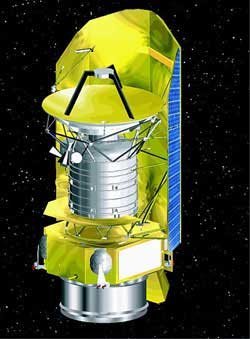
Gaia looks nothing like the Herschel Space Observatory shown here.

Gaia looks nothing like the Herschel Space Observatory shown here.

Since yesterday’s successful launch of the European Space Agency’s Gaia mission I have been inundated with requests for more information about this impressive satellite and the science behind it. As a service to the community, and for the edification of the public at large, I therefore thought I’d share my list of top ten Gaia facts via the medium of this blog:

  1. The correct pronunciation of GAIA is as in “gayer”. Please bear this in mind when reading any press articles about the mission.
  2. The GAIA spacecraft will orbit the Sun at the Second Lagrange Point, the only place in the Solar System where the  effects of cuts in the UK science budget can not be felt.
  3. The data processing challenges posed by GAIA are immense; the billions of astrometric measurements resulting from the mission will be analysed using the world’s biggest Excel Spreadsheet.
  4. To provide secure backup storage of the complete GAIA data set, the European Space Agency has commandeered the world’s entire stock of 3½ inch floppy disks.
  5. As well as measuring billions of star positions and velocities, GAIA is expected to discover thousands of new asteroids and the hiding place of Lord Lucan.
  6. GAIA can measure star positions to an accuracy of a few microarcseconds. That’s the angle subtended by a single pubic hair at a distance of 1000km.
  7. The precursor to GAIA was a satellite called Hipparcos, which is not how you spell Hipparchus.
  8. The BBC will be shortly be broadcasting a new 26-part TV series about GAIA. Entitled WOW! Gaia! That’s Soo Amaazing… it will be presented by Britain’s leading expert on astrometry, Professor Brian Cox.
  9. Er…
  10. That’s it.

Tension in Cosmology?

Posted in Astrohype, Bad Statistics, The Universe and Stuff with tags , , , on October 24, 2013 by telescoper

I noticed this abstract (of a paper by Rest et al.) on the arXiv the other day:

We present griz light curves of 146 spectroscopically confirmed Type Ia Supernovae (0.03<z<0.65) discovered during the first 1.5 years of the Pan-STARRS1 Medium Deep Survey. The Pan-STARRS1 natural photometric system is determined by a combination of on-site measurements of the instrument response function and observations of spectrophotometric standard stars. We have investigated spatial and time variations in the photometry, and we find that the systematic uncertainties in the photometric system are currently 1.2% without accounting for the uncertainty in the HST Calspec definition of the AB system. We discuss our efforts to minimize the systematic uncertainties in the photometry. A Hubble diagram is constructed with a subset of 112 SNe Ia (out of the 146) that pass our light curve quality cuts. The cosmological fit to 313 SNe Ia (112 PS1 SNe Ia + 201 low-z SNe Ia), using only SNe and assuming a constant dark energy equation of state and flatness, yields w = -1.015^{+0.319}_{-0.201}(Stat)+{0.164}_{-0.122}(Sys). When combined with BAO+CMB(Planck)+H0, the analysis yields \Omega_M = 0.277^{+0.010}_{-0.012} and w = -1.186^{+0.076}_{-0.065} including all identified systematics, as spelled out in the companion paper by Scolnic et al. (2013a). The value of w is inconsistent with the cosmological constant value of -1 at the 2.4 sigma level. This tension has been seen in other high-z SN surveys and endures after removing either the BAO or the H0 constraint. If we include WMAP9 CMB constraints instead of those from Planck, we find w = -1.142^{+0.076}_{-0.087}, which diminishes the discord to <2 sigma. We cannot conclude whether the tension with flat CDM is a feature of dark energy, new physics, or a combination of chance and systematic errors. The full Pan-STARRS1 supernova sample will be 3 times as large as this initial sample, which should provide more conclusive results.

The mysterious Pan-STARRS stands for the Panoramic Survey Telescope and Rapid Response System, a set of telescopes cameras and related computing hardware that monitors the sky from its base in Hawaii. One of the many things this system can do is detect and measure distant supernovae, hence the particular application to cosmology described in the paper. The abstract mentions a preliminary measurement of the parameter w, which for those of you who are not experts in cosmology is usually called the “equation of state” parameter for the dark energy component involved in the standard model. What it describes is the relationship between the pressure P and the energy density ρc2 of this mysterious stuff, via the relation P=wρc2. The particularly interesting case is w=-1 which corresponds to a cosmological constant term; see here for a technical discussion. However, we don’t know how to explain this dark energy from first principles so really w is a parameter that describes our ignorance of what is actually going on. In other words, the cosmological constant provides the simplest model of dark energy but even in that case we don’t know where it comes from so it might well be something different; estimating w from surveys can therefore tell us whether we’re on the right track or not.

The abstract explains that, within the errors, the Pan-STARRS data on their own are consistent with w=-1. More interestingly, though, combining the supernovae observations with others, the best-fit value of w shifts towards a value a bit less than -1 (although still with quite a large uncertainty). Incidentally  value of w less than -1 is generally described as a “phantom” dark energy component. I’ve never really understood why…

So far estimates of cosmological parameters from different data sets have broadly agreed with each other, hence the application of the word “concordance” to the standard cosmological model.  However, it does seem to be the case that supernova measurements do generally seem to push cosmological parameter estimates away from the comfort zone established by other types of observation. Could this apparent discordance be signalling that our ideas are wrong?

That’s the line pursued by a Scientific American article on this paper entitled “Leading Dark Energy Theory Incompatible with New Measurement”. This could be true, but I think it’s a bit early to be taking this line when there are still questions to be answered about the photometric accuracy of the Pan-Starrs survey. The headline I would have picked would be more like “New Measurement (Possibly) Incompatible With Other Measurements of Dark Energy”.

But that would have been boring…

Just a minute! Is space really expanding?

Posted in Astrohype, The Universe and Stuff with tags , , , on August 2, 2013 by telescoper

Now then. I’m sure this little video will get a few cosmologists’ hackles rising:

The video was produced by minutephysics, so presumably the expansion of time accounts for the fact that lasts more than two minutes. More importantly, though, is the content. Here’s an old  discussion of mine on this question. Let me know what you think via the comments box!

Universality in Space Plasmas?

Posted in Astrohype, The Universe and Stuff with tags , , , , , , , , on June 16, 2013 by telescoper

It’s been a while since I posted anything reasonably technical, largely because I’ve been too busy, so I thought I’d spend a bit of time today on a paper (by Livadiotis & McComas in the journal Entropy) that provoked a Nature News item a couple of weeks ago and caused a mild flutter around the internet.

Here’s the abstract of the paper:

In plasmas, Debye screening structures the possible correlations between particles. We identify a phase space minimum h* in non-equilibrium space plasmas that connects the energy of particles in a Debye sphere to an equivalent wave frequency. In particular, while there is no a priori reason to expect a single value of h* across plasmas, we find a very similar value of h* ≈ (7.5 ± 2.4)×10−22 J·s using four independent methods: (1) Ulysses solar wind measurements, (2) space plasmas that typically reside in stationary states out of thermal equilibrium and spanning a broad range of physical properties, (3) an entropic limit emerging from statistical mechanics, (4) waiting-time distributions of explosive events in space plasmas. Finding a quasi-constant value for the phase space minimum in a variety of different plasmas, similar to the classical Planck constant but 12 orders of magnitude larger may be revealing a new type of quantization in many plasmas and correlated systems more generally.

It looks an interesting claim, so I thought I’d have a look at the paper in a little more detail to see whether it holds up, and perhaps to explain a little to others who haven’t got time to wade through it themselves. I will assume a basic background knowledge of plasma physics, though, so turn away now if that puts you off!

For a start it’s probably a good idea to explain what this mysterious h* is. The authors define it via ½h*ctc, where εc is defined to be “the smallest particle energy that can transfer information” and tc is “the correlation lifetime of Debye Sphere (i.e. volumes of radius the Debye Length for the plasma in question). The second of these can be straightforwardly defined in terms of the ratio between the Debye Length and the thermal sound speed; the authors argue that the first is given by εc=½(mi+me)u2, involving the electron and ion masses in the plasma and the information speed u which is taken to be the speed of a magnetosonic wave.

You might wonder why the authors decided to call their baby h*. Perhaps it’s because the definition looks a bit like the energy-time version of Heisenberg’s Uncertainty Principle, but I can’t be sure of that. In any case the resulting quantity has the same dimensions as Planck’s constant and is therefore measured in the same units (Js in the SI system).

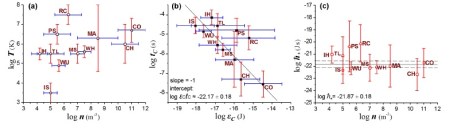
Anyway, the claim is that h* is constant across a wide range of astrophysical plasmas. I’ve taken the liberty of copying the relevant Figure here:
constant_h

I have to say at this point I had the distinct sense of damp squib going off. The panel on the right purports to show the constancy of h* (y-axis) for plasmas of a wide range of number-densities (x-axis). However, but are shown on logarithmic scales and have enormously large error bars. To be sure, the behaviour looks roughly constant but to use this as a basis for claims of universality is, in my opinion, rather unjustified, especially since there may also be some sort of selection effect arising from the specific observational data used.

One of the authors is quoted in the Nature piece:

“We went into this thinking we’d find one value in one plasma, and another value in another plasma,” says McComas. “We were shocked and slightly horrified to find the same value across all of them. This is really a major deal.”

Perhaps it will turn out to be a major deal. But I’d like to see a lot more evidence first.

Plasma (astro)physics is a fascinating but very difficult subject, not because the underlying requations governing plasmas are especially complicated, but because the resulting behaviour is so sensitively dependent on small details; plasma therefore provide an excellent exemplar of what we mean by a complex physical system. As is the case in other situations where we lack the ability to do detailed calculations at the microscopic level, we do have to rely on more coarse=grained descriptions, so looking for patterns like this is a good thing to do, but I think the Jury is out.

Finally, I have to say I don’t approve of the authors talking about this in terms of “quantization”. Plasma physics is confusing enough as classical physics without confusing it with quantum theory. Opening the door to that is a big mistake, in my view. Who knows what sort of new age crankery might result?
Das Letzte Gericht

Posted in Art, Astrohype, The Universe and Stuff with tags , , , on December 20, 2012 by telescoper

Apparently the world is due to end tomorrow, so I’ve saved quite a lot of money by not having done my Christmas shopping yet. Anyway, the forthcoming Apocalypse reminded me of the painting that I often use to introduce cosmology talks. I usually use this piece of Hieronymus Bosch Das letzte Gericht (The Last Judgement) to illustrate my feelings about the standard cosmological model:

das_letzte_gericht

The top part represents the concordance cosmology. It clearly features an eminent cosmologist surrounded by postdoctoral researchers. Everything appears to be in heavenly harmony, surrounded by a radiant glow of self-satisfaction. The trumpets represent various forms of exaggerated press coverage.

But if you step back from it, and get the whole thing in a proper perspective, you realise that there’s an awful lot going on underneath that’s not so pleasant or easy to interptet. I don’t know what’s going down below there, although the unfortunate figures slaving away in miserable conditions and suffering unimaginable torments, are obviously supposed to represent graduate students. The large knife visible in the bottom right corner clearly symbolises budget cuts looming in the next Comprehensive Spending Review.

The main point is that the concordance model is based on rather strange foundations: nobody understands what the dark matter and dark energy are, for example. Even more fundamentally, the whole thing is based on a shotgun marriage between general relativity and quantum field theory which is doomed to fail somewhere along the line.

Far from being a final theory of the Universe I think we should treat our standard model as a working hypothesis and actively look for departures from it. I’m not at all against the model. As models go, it’s very successful. It’s a good one, but it’s still just a model.

What’s with the Wang Particle?

Posted in Astrohype, The Universe and Stuff with tags , , , , , , on September 11, 2012 by telescoper

Not long ago a colleague ran into my office all of a flutter and asked me about this new discovery called the “Wang particle” that had been in the media. I’m the one around here who’s supposed to know about particle astrophysics stuff, so I was quite embarrassed that I’d never heard of the Wang particle, although I’ll be delighted if it becomes famous as the name has a great deal of comedy potential.

Anyway, I vowed to find out a little bit about it and finally got around this lunchtime to doing so. It turns out that the story was sparked by press release from the British Science Association which, out of the goodness of my heart, I reproduce below (link added by me).

 A new particle, similar to the Higgs Boson, could provide a clue to one of the greatest mysteries of the Universe.

Dr Charles Wang from the University of Aberdeen believes that a new scalar particle is behind the intense supernova explosions that occur when a star implodes. He presented his work to the British Science Association on Tuesday.

Supernova explosions are the most powerful forces in the universe, second only to the Big Bang.

Once frequent, the energy produced in these explosions is responsible for combining particles to produce all the recognisable elements on earth, providing all the known building blocks of life on earth.

There are still many gaps in our understanding of physics and one of the major blanks is how the implosion of a star subsequently produces an intense explosion.

It is known that as elements are created at the centre of a star, a huge amount of energy is released.  However, it is believed that the conversion of known elements would never produce enough energy to result in an explosion.

Dr Wang’s theory states that “a scalar particle – one of the most elementary types of particles in the universe and similar to the Higgs Boson – is at work within these stars and responsible for the additional energy which causes the explosion to take place.”

The scalar particle would effectively enable the high transfer of energy during a supernova, allowing shockwaves from the implosion of a star to become re-energised and cause an explosion.

A new collaboration between Dr Wang and CERN could provide the equipment to make this theory a reality and demonstrate the existence of the ‘Wang particle’ – or as Dr Wang himself refers to it the ‘scalar gravitational particle’. It is hoped that using the ISOLDE facility at CERN it may be possible assimilate a nuclear reaction that would determine the process of a starburst.

If demonstrated, the existence of the ‘Wang particle’, like the Higgs Boson, would hold major implications for physics, shedding new light on the theory of everything and affecting our understanding of how different physical phenomena interact.

There’s no link to an academic paper with it, which is a bit disappointing, but an older piece in the CERN Courier does provide a reference to the paper, which is

C H-T Wang et al. 2011 Parametric instability induced scalar gravitational waves from a model pulsating neutron star, Phys. Letts. B 705 148

If you’re prepared to shake hands with the Devil that is Elsevier you can find the paper here.

I have to confess that this is a new one on me. I haven’t gone through the paper in detail yet but, at a quick skim, it seems to be based on a variation of the  Brans-Dicke scalar-tensor theory of gravity. It’s probably an interesting paper, and I look forward to reading it in detail on a long flight I’m about to take, but I am a bit mystified as to why it created such a stir in the media. Looks more a result of hype than real significance to me. It certainly isn’t the “new Higgs boson” anyway. Nor is it likely to be relevant in explaining Climate Change. Or am I missing something? Perhaps hot air generated by press releases is responsible for global warming?

Anyone out there an expert on Wang’s work? Care to comment?

A Grand Design Challenge

Posted in Astrohype, The Universe and Stuff with tags , , , , , on July 20, 2012 by telescoper

While I’m incarcerated at home I thought I might as well make myself useful by passing on an interesting news item I found on the BBC website. This relates to a paper in the latest edition of Nature that reports the discovery of what appears to be a classic “Grand Design” spiral galaxy at a redshift of 2.18. According to the standard big bang cosmology this means that the light we are seeing set out from this object over 10 billion years ago, so the object formed about 3 billion years after the big bang.

I found this image of the object – known to its friends as BX442 – and was blown away by it..

..until I saw the dreaded words “artist’s rendering”. The actual image is somewhat less impressive.

But what’s really interesting about the study reported in Nature are the questions it asks about how this object first into our understanding of spiral galaxy formation. According to the prevailing paradigm, galaxies form hierarchically by progressively merging smaller clumps into bigger ones. The general expectation is that at high redshift – corresponding to earlier stages of the formation process – galaxies are rather clumpy and disturbed; the spiral structure we see in nearby galaxies is rather flimsy and easily disturbed, so it’s quite surprising to see this one. Does BX442 live in an especially quiet environment? Have we seen few high-redshift spirals because they are rare, or because they are hard to find? Answers to these and other questions will only be found by doing systematic surveys to establish the frequency and distribution of objects like this, as well as the details of their internal kinematics.

Quite Interesting.

A Ghost of a Jet?

Posted in Astrohype, The Universe and Stuff with tags , , on June 4, 2012 by telescoper

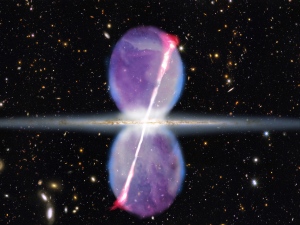
Last week an article in Nature News caught my eye. Ghostly jets seen streaming from Milky Way’s core was the headline. It’s based on a paper by Su & Finkbeiner recently submitted to the arXiv. There’s even a picture showing the jets in glorious technicolour:

Wow! Impressive stuff. If the jets look like that it’s amazing nobody ever saw them before!

Oh, hang on. The picture is an “artist’s conception”. In other words, it’s what the jets might look like if they actually existed, as imagined by a bloke with a box of crayons.

And how strong is the evidence that they do exist? Here’s the last paragraph of the Nature article (my emphasis):

Although the emissions are dim and the observations don’t have the statistical significance that astronomers require for proof, Baganoff says that several properties make them compelling evidence of jets. They are brighter at higher γ-ray energies and also brighter than the surrounding interstellar medium. They also seem to be long and thin, as would be expected of jets. “Taking all of the evidence together, it appears highly plausible that the features are jets emanating from the Galactic Centre,“ he says.

If they “don’t have the statistical significance that astronomers require for proof” then one wonders why they’re being given so much publicity. In any case the “ghostly jets seen streaming from the Milky Way’s core” can’t be said to have really been “seen” for certain. But they are “highly plausible”. In other words, the authors would like them to be there.

All I can say is that it must have been a slow news day at Nature.

Still, nice drawing.

Dark Matter: Dearth Evaded

Posted in Astrohype, The Universe and Stuff with tags , , , , , , on May 23, 2012 by telescoper

While I’m catching up on developments over the last week or so I thought I’d post an update on a story I blogged about a few weeks ago. This concerns the the topic of dark matter in the Solar Neighbourhood and in particular a paper on the arXiv by Moni Bidin et al. with the following abstract:

We measured the surface mass density of the Galactic disk at the solar position, up to 4 kpc from the plane, by means of the kinematics of ~400 thick disk stars. The results match the expectations for the visible mass only, and no dark matter is detected in the volume under analysis. The current models of dark matter halo are excluded with a significance higher than 5sigma, unless a highly prolate halo is assumed, very atypical in cold dark matter simulations. The resulting lack of dark matter at the solar position challenges the current models.

In my earlier post I remarked that this  study   makes a number of questionable assumptions about the shape of the Milky Way halo – they take it to be smooth and spherical – and the distribution of velocities within it is taken to have a very simple form.

Well, only last week a rebuttal paper by Bovy & Tremaine appeared on the arXiv. Here is its abstract:

An analysis of the kinematics of 412 stars at 1-4 kpc from the Galactic mid-plane by Moni Bidin et al. (2012) has claimed to derive a local density of dark matter that is an order of magnitude below standard expectations. We show that this result is incorrect and that it arises from the invalid assumption that the mean azimuthal velocity of the stellar tracers is independent of Galactocentric radius at all heights; the correct assumption—that is, the one supported by data—is that the circular speed is independent of radius in the mid-plane. We demonstrate that the assumption of constant mean azimuthal velocity is physically implausible by showing that it requires the circular velocity to drop more steeply than allowed by any plausible mass model, with or without dark matter, at large heights above the mid-plane. Using the correct approximation that the circular velocity curve is flat in the mid-plane, we find that the data imply a local dark-matter density of 0.008 +/- 0.002 Msun/pc^3= 0.3 +/- 0.1 Gev/cm^3, fully consistent with standard estimates of this quantity. This is the most robust direct measurement of the local dark-matter density to date.

So it seems reports of the dearth were greatly exaggerated..

Having read the paper I think this is a pretty solid refutation, and if you don’t want to take my word for it I’ll also add that Scott Tremaine is one of the undisputed world experts in the field of Galactic Dynamics. It will be interesting to see how Moni Bidin et al. respond.

This little episode raises the question that, if there was a problem with the assumed velocity distribution in the original paper (as many of us suspected), why wasn’t this spotted by the referee?

Of course to a scientist there’s nothing unusual about scientific results being subjected to independent scrutiny and analysis. That’s how science advances. There is a danger in all this, however, with regard to the public perception of science. The original claim – which will probably turn out to be wrong – was accompanied by a fanfare of publicity. The later analysis arrives at a much less spectacular conclusion,  so will probably attract much less attention. In the long run, though, it probably isn’t important if this is regarded as a disappointingly boring outcome. I hope what really matters for scientific progress is people doing things properly. Even if it  don’t make the headlines, good science will win out in the end. Maybe.

Milky Way Satellites and Dark Matter

Posted in Astrohype, Bad Statistics, The Universe and Stuff with tags , , , , on May 4, 2012 by telescoper

I found a strange paper on the ArXiv last week, and was interested to see that it had been deemed to merit a press release from the Royal Astronomical Society that had been picked up by various sites across the interwebs.

The paper, to appear in due course in Monthly Notices of the Royal Astronomical Society, describes a study of the positions and velocities of small satellite galaxies and other object around the Milky Way, which suggest the existence of a flattened structure orientated at right angles to the Galactic plane. They call this the “Vast Polar Structure”. There’s even a nifty video showing this arrangement:

They argue that this is is evidence that these structures have a tidal origin, having been thrown out   in the collision between two smaller galaxies during the formation of the Milky Way. One would naively expect a much more isotropic distribution of material around our Galaxy if matter had fallen into it in the relatively quiescent way envisaged by more standard theoretical models.

Definitely Quite Interesting.

However, I was rather taken aback by this quotation by one of the authors, Pavel Kroupa, which ends the press release.

Our model appears to rule out the presence of dark matter in the universe, threatening a central pillar of current cosmological theory. We see this as the beginning of a paradigm shift, one that will ultimately lead us to a new understanding of the universe we inhabit.

Hang on a minute!

One would infer from this rather bold statement that the paper concerned contained a systematic comparison between the observations – allowing for selection effects, such as incomplete sky coverage – and detailed theoretical calculations of what is predicted in the standard theory of galaxy formation involving dark matter.

But it doesn’t.

What it does contain is a simple statistical calculation of the probability that the observed distribution of satellite galaxies would have arisen in an exactly isotropic distribution function, which they conclude to be around 0.2 per cent.

However, we already know that galaxies like the Milky Way are not exactly isotropic, so this isn’t really a test of the dark matter hypothesis. It’s a test of an idealised unrealistic model. And even if it were a more general test of the dark matter hypothesis, the probability of this hypothesis being correct is not what has been calculated. The probability of a model given the data is not the same as the probability of the data given the model. To get that you need Bayes’ theorem.

What needs to be done is to calculate the degree of anisotropy expected in the dark matter theory and in the tidal theory and then do a proper (i.e. Bayesian) comparison with the observations to see which model gives the better account of the data. This is not any easy thing to do because it necessitates doing detailed dynamical calculations at very high resolution of what galaxy like the Milky Way should look like according to both theories.

Until that’s done, these observations by no means “rule out” the dark matter theory.