I’ve come down with some sort of lurgy and had to cancel a tutorial that was due to take place today, which I am sorry about. I did, however, manage to rise from my sick bed earlier this morning to publish a paper at the Open Journal of Astrophysics. When I checked the publishing dashboard I saw that this one is paper No. 425. This is a significant figure if you reckon by the cost of an Article Processing Charge (APC) at Monthly Notices of the Royal Astronomical Society. The current APC is £2356 per paper. If you multiply this by 425 the result is just over a million pounds (£1,001,300 to be exact). The Open Journal of Astrophysics, being a Diamond Open Access journal, is totally free for authors.
I mentioned a couple of weeks ago, that this is a small fraction of the money being wasted by the astronomical community worldwide on publication charges but if even a small operation like ours can save a million pounds, just think of what could happen if we all published this way! For one thing, there would certainly be more money available for actual research. That doesn’t only go for astronomy, of course: almost every scientific discipline is being ripped off by publishers who have hijacked the Open Access movement to generate income from APCs.
I’ll repeat the quotation I posted yesterday about a scandal relating to corporate publishing giant Elsevier
The scandal exposes the windfall profits of scientific publishers, who in recent years have amassed billions of dollars in earnings from public funds earmarked for science.
It’s a shocking idea, I know, but what if we spent public funds on what they are supposed to be spent on rather than handing millions to greedy publishers?
Today, 1st December, is World Aids Day, which is dedicated to raising awareness of the AIDS pandemic caused by the spread of HIV infection, mourning those who have died of the disease, and showing solidarity with those living with HIV. In my case it’s also a day for remembering how lucky I have been.
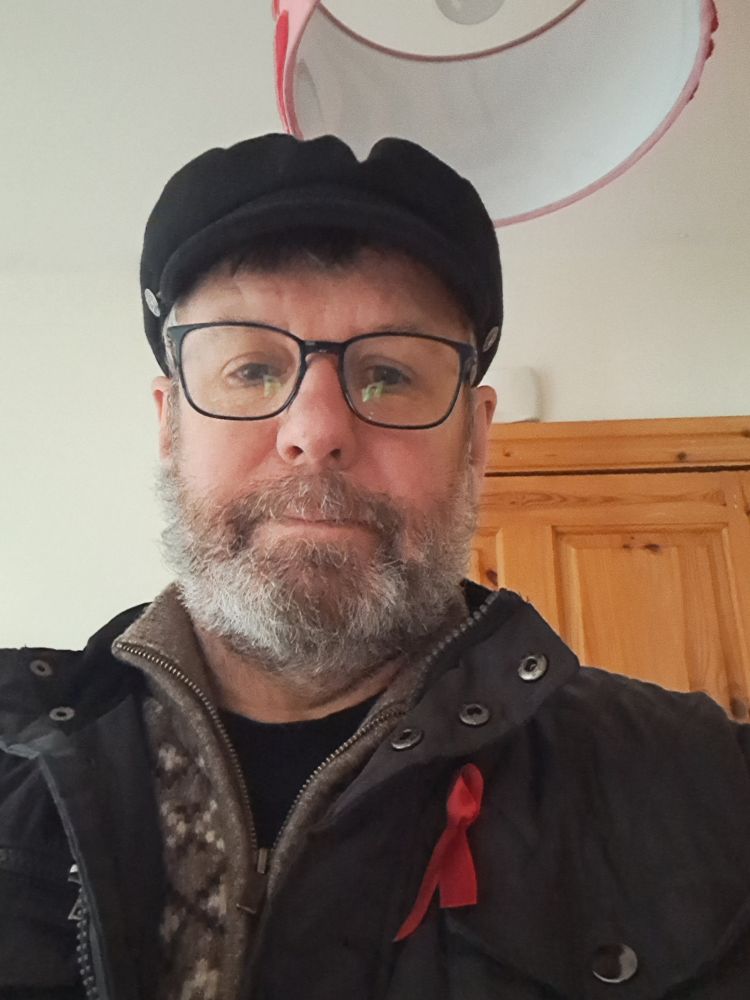
Here’s me just about to leave the house this morning with my red ribbon.
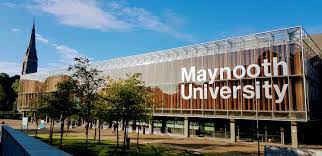
Maynooth University Library, home of the famous cat
Today is 1st December 2025, which means that it’s eight years to the day since I started work at Maynooth University. Despite the frustrations, I’m still very happy I made the move all that time ago.
We’ve now had more than a year since the merger of the former Departments of Theoretical and Experimental Physics. This has gone pretty well, actually, with significant improvements in terms of some steps forward in rationalising teaching. It does, however, feel less like a merger and more like an acquisition, with the theoretical activity effectively subsumed into the old Experimental Physics department. I suppose that was inevitable given the relative sizes of the two former Departments, but it has led to a loss of identity and the loss of the group spirit we use to have in Theoretical Physics. To add to this a number of familiar faces have left – two of my own PhD students, Aonghus Hunter-McCabe and Aoibhinn Gallagher have graduated and left, as have others with different supervisors. I am delighted for their success, of course, but will miss having them around.
I continue to enjoy teaching, and was pleasantly surprised to continue doing the same modules this academic year as last. The big change in that regard has been the adoption of different assessment methods to deal with the possibility of students using AI to do their coursework. That seems to be going reasonably well, though I’ll have to wait until the January examinations to see the outcomes.
The thing I’m probably most proud of over the past eight years is, with the huge help of staff at Maynooth University Library, getting the Open Journal of Astrophysics off the ground and attracting some excellent papers. This year has seen yet more significant growth, publications this year set to reach 200, after 120 in 2024 and just 50 the year before that (2024). We’re still smaller than many of the mainstream astrophysics journals, but we’re still growing…
Anyway, eight years of service mean that only two remain until I can claim the full state pension. I’ll be retiring as soon as I can afford to. There were Open Days at Maynooth on Friday and Saturday (28th and 29th November, respectively). These were for prospective students to enter in September 2026. Since I don’t teach any first or second year Physics modules now, and that is likely to continue, it looks like I’ll never see any of that intake in class.
Every now and then I get talking over lunch to a distinguished Emeritus Professor at Maynooth University, Tony O’Farrell, about various things. A topic that came up recently was crossword puzzles, which reminded me that I haven’t posted much on that subject for a while. Regular readers of this blog will know that in the past I used to do a lot of crosswords, including the Guardian puzzles almost every day and Azed and Everyman in the Observer on Sundays. Since I moving to Ireland I have weaned myself off the UK newspapers so my regular crossword-solving is nowadays limited to the Times Literary Supplement and Cyclops in Private Eye. Since my TLS subscription has now lapsed, the only one I do regularly is Cyclops.
When I first arrived here almost eight years ago I had a look at the crosswords in the Irish Times. I had a go at the cryptic puzzle – called Crosaire – but didn’t find it particularly challenging (and there’s no prize competition) so never got into the habit of doing it. It’s about the same level of difficulty as Everyman, in my opinion, which I used to do mainly to limber up for Azed. I buy the Weekend Edition on paper and have an online subscription, but rarely look at the crossword.
After chatting with Tony, however, I decided to look at Crosaire again. I had a class test to supervise today so thought I would look at the puzzle that appeared in Saturday’s Weekend Edition as I still had the paper copy. The solution has already been published so I won’t be spoiling anyone’s fun!
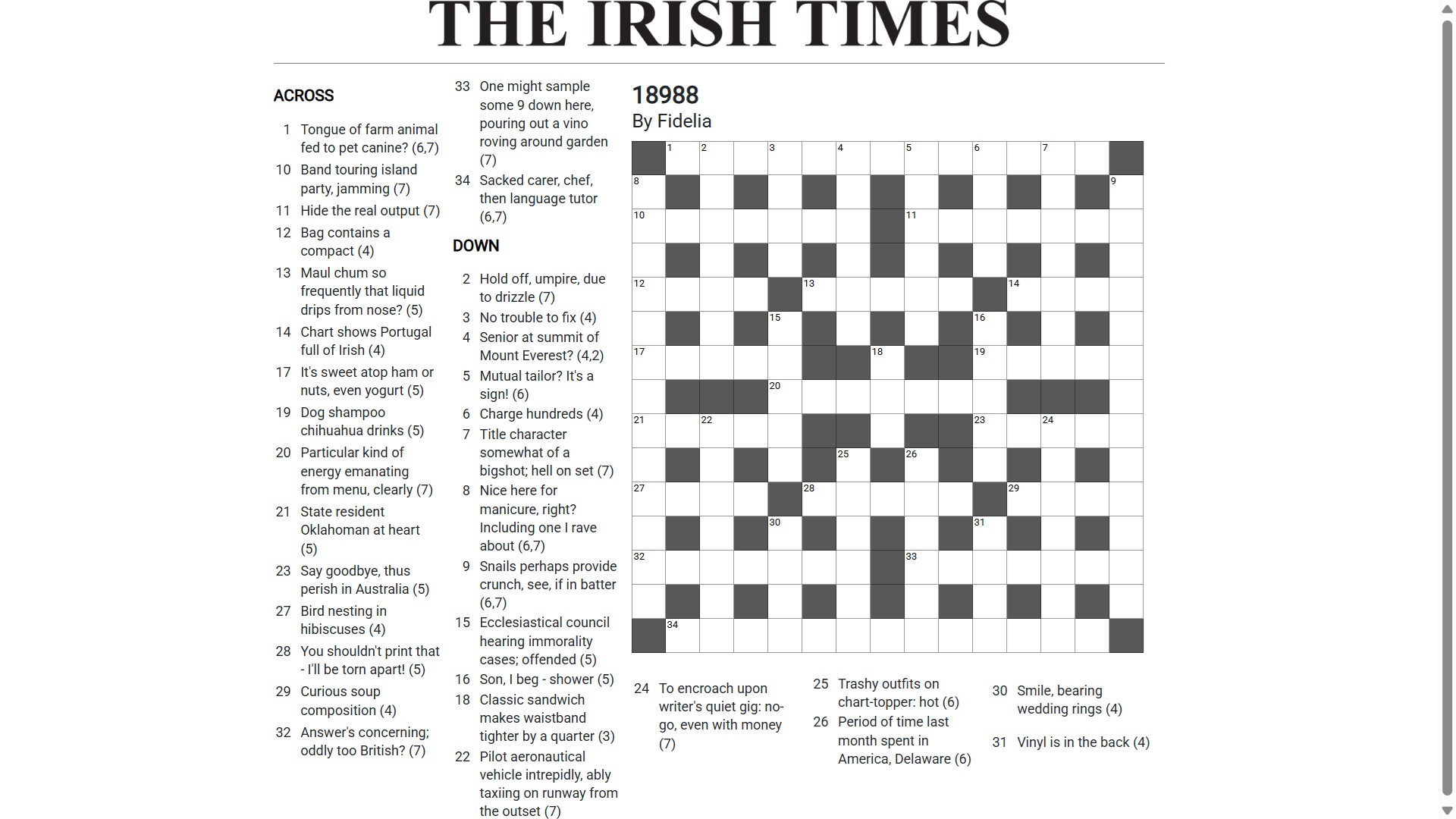
Anyway, here is Saturday’s puzzle (obtained from the Irish Times website)
I see that the screen grab misses the clue for 23 across, which is “Say goodbye, thus perish in Australia (5)”. That’s one of the easy clues; the solution is ADIEU. Other easy ones are 18 down (BLT) and 20 across (NUCLEAR)
Overall, it’s a fairly straightforward cryptic puzzle, with conventional wordplay, but there are one or two points of interest.
The first – and this seems to be a trademark – is that the four clues around the perimeter (1 across, 8 down, 9 down and 34 across) are thematically linked. The theme is also sometimes referenced elsewhere. Obviously getting these solutions is an enormous help in completing the grid. When I looked at 1 across I immediately suspected that “Tongue” might mean a language. I then saw an anagram for RIVIERA on 8 down and the starting word “Nice” gave the game away entirely. The four perimeter clues are thus: FRENCH BULLDOG, FRENCH RIVIERA, FRENCH CUISINE and FRENCH TEACHER; 33 down also refers to the French theme.
Other than that I see that there are more ‘hidden word’ type clues than one would normally see in a UK cryptic, such as the clue for NUCLEAR mentioned above. Another one is “Dog shampoo chihuaua drinks (5)” which is “pooch”, although I am not convinced by “drinks” as the indicator!
I also had to think about 14 across “Chart shows Portugal full of Irish (4)”; I thought it had to be PLAN but couldn’t parse the rest until I found out that lán is “full” in the Irish language, hence “full of Irish” with “P” for “Portugal”. I don’t think there are many references to Irish words in Crosaire, generally.
I’m no speed merchant when it comes to crosswords, but this one took me 10 minutes to solve. If you’re interested, the full solution with notes can be found here. Maybe I’ll try to get into the habit of solving this more frequently. That might provide a little compensation for the generally woeful Opinion pieces cluttering up the newspaper. Also, with retirement on my mind, I wonder if the Irish Times – or any other newspaper – is looking for any more setters?
P.S. Crosaire was the pseudonym taken by the original setter John Derek Crozier, as a play on his own name and on the Irish word for “crossroad”. The Irish word for “crossword” is crosfhocal.
Yesterday I came across the old cartoon shown above and shared it on Bluesky. It seemed to cause some amusement so I thought I’d share it here too.
The in-tray reminds me of when I (briefly) worked in industry during the 80s. There was a guy in our large open-plan office who had two trays on his desk, one with a sign marked “IN” and the other with a sign marked “OUT”. Things were delivered on Mondays to the in-trays and collected from out-trays at the end of the day on Fridays. This guy never touched the stuff in his in-tray but just before he left work on Fridays he would swap the signs on the two trays…
I’ve been a bit preoccupied these recent weeks so it was with a shock that I realised that we’re into Week 9, which means just four weeks (including this one) until the end of term and just a month before Christmas. Teaching finishes here in Maynooth on Friday 19th December, but I don’t have any lectures on Fridays so in my case it will finish the day before (with a tutorial). I don’t know how many students will be there, but the module concerned is my 4th year Mathematical Physics module and the students are very hard-working, so I think most will attend. After such a busy term I’m sure that they will need a break as much as I will.
I had to rejig the schedule for both modules I am teaching this semester to accommodate the introduction of in-class tests to replace take-home assignments (for reasons I outlined here). I’ve also been handing out voluntary exercises for practice, not counting towards the module mark but for formative reasons. Both modules are mathematical in nature, and I think the best way to learn mathematics is by doing it…
Despite the changes with respect to last year, I am still roughly on track. In my Engineering Mathematics module I’ve just finished Laplace transforms, and will start Fourier methods tomorrow. With the mathematical physicists, I am in the middle of complex analysis, having done complex differentiation and conformal mappings and starting complex integration next week.
I still have a couple more class tests to get through. On the positive side, the students are turning up for them and have expressed approval for the fact that they don’t have compulsory homework to do off-campus. This form of assessment is undoubtedly harder work for the students, it’s also better preparation for the examination that take-home assignments.
We’ve just received the draft examination timetable for January, and I’m pleased that both of the examinations for which I am responsible will take place quite early in the examination period (on 12th and 15th January, respectively) so I should be able to get them corrected in time to have a break for some research before teaching resumes at the start of February.
The weather here in Maynooth was very mild until a couple of weeks ago and with the arrival of inclement conditions I started putting out the bird feeders in my garden. I can see the level of the seed from my kitchen window so know when they need filling up. I had one out for a couple of days before the arrival of Storm Claudia with associated torrential rain, but when it passed I was surprised to see the feeders were still half full so I left them.
Last weekend it started to become very cold so I was surprised there were no birds at the feeder. When I went out to look I realized that owing the heavy rainfall some water had got into the seed container, with the result that some of the seeds had started to germinate. This formed a tangled mass of shoots that blocked the gap through which seed is dispensed. The reason the feeders were not empty was not that the birds weren’t hungry, but that no seed was coming out.
I took the feeders inside and cleaned out all the matted seedlings. Then I took them back to the shed to fill up, at which point I knocked over the jar in which I stored the birdseed, scattering the supply all over the floor. There wasn’t much left anyway, but my clumsiness reduced the stock to zero so I was unable to feed the birds despite having functioning feeders.
Yesterday I finally had time to buy some more birdseed. I filled up the feeders as soon as I got home. It was quite interesting to watch the sequence of events. The first to arrive were sparrows who, being small and agile, were quite happy taking terms perching at the feeders. Not long after, however, starlings arrived, squabbling and squawking as they usually do. Starlings are much larger then sparrows and are extremely messy and noisy eaters, their attempts to perch at a feeder causing it to swing and scatter seed all over the ground.
(Incidentally, the term for a large group of starlings is a murmuration, a congregation, a cloud, or a constellation, but there are alternatives for a smaller group like the dozen or so that arrived in my garden. These include a clutter, a scourge, a vulgarity and, my favourite, a filth…)
Some starlings and sparrows started to feed on the ground, as did a very bonny collared dove, walking around calmly amid the flurry of other birds and paying them no attention at all .
At this point the feeder was almost empty.
The last cohort to arrive were the rooks and jackdaws. These are too big to even attempt to perch so their modus operandi is to crash into the feeders to try to break them or knock them down to the ground where they are easier to attack. They didn’t succeed, so they left.
Now the feeders are empty, the birds have gone, and all is quiet. I think I’ll put more food out tomorrow before I go to work. I imagine they’ll be empty by the time I get back home.
I couldn’t resist passing on an unsettling news item about Astronomy Ireland, an Irish Astronomy Club described on its website in the following terms:
Astronomy Ireland is a non profit organisation and the largest national astronomy club in the world relative to population.
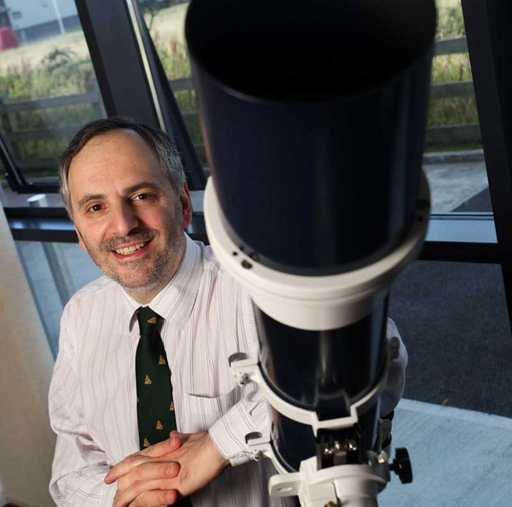
The news item concerned revolves around founder and chairperson David Moore (left), who has been held personally liable for multiple employment rights breaches against a former manager, Sonya Martin, at Astronomy Ireland who said she was forced to quit due to a “toxic” work environment and alleged “serious financial irregularities”.
The astronomy club and four members of its management committee, including David Moore, have been ordered to pay nearly €11,000 to the ex-employee, Sonya Martin, after she complained of constructive dismissal to the Workplace Relations Commission (WRC).
Among the allegations reported were that Mr Moore was keeping funds meant for Astronomy Ireland:
David was taking the money and pocketing it as his own income, as opposed to it going back into the society,” Ms Martin said. “The attitude changed towards myself and Ms Doyle after that,” Ms Martin said.
No doubt the money was just “resting in his account”. I mentioned this story to colleagues in the Department and none was surprised, and many (unlike myself) had known about this case for some time. I’ll keep some of the comments to myself, but one said that they gave a lecture (for free, as we academics usually do) to Astronomy Ireland which was filmed without consent. David Moore then sold DVDs of the talk. Where the profits from this went, I have no idea.
These financial shenanigans are dodgy enough but there are some truly bizarre sections of the news report. Here is one:
As the hearings continued into 2025, Mr Moore made repeated objections to being attached personally to the claim, and told Mr Dolan he had not received hearing notifications.
“Emails are unreliable,” he said. When Ms Martin’s solicitor, Mr O’Connell said the notification was sent by post too, Mr Moore said: “The post is unreliable.”
Even stranger, if not directly relevant to the case of Mr Moore, is this:
During the June 2024 hearing, Ms Martin gave evidence that Astronomy Ireland’s office landlord approached her complaining about having to clean up after the junior administrator, Mr G, who was later dismissed.
“The final straw for the landlord was that he had to clean ejaculate from the bathroom after Mr G was in there,” Ms Martin added.
Ewww…
In the interest of full disclosure, I gave a talk to Astronomy Ireland in December 2019. I don’t remember if it was filmed nor whether DVDs were sold, but given what I know now I don’t think I’ll be accepting any more speaking invitations from that organisation.
Update: it seems DVDs of my talk were made and were on sale but are no longer available. They must have sold out.
So we have arrived at October 31st, Hallowe’en or, in pagan terms, Samhain. This, a cross-quarter day – roughly halfway between the Autumnal Equinox and the Winter Solstice – represents the start of winter (“the dark half of the year“) in the Celtic calendar. Technically, Samhain is tomorrow, 1st November, but the Celtic practice of reckoning days from sunset to sunset makes this a moot point.
Samhain is pronounced something like “sowin”, with the “sow” as in a female pig. The h after the m denotes lenition of the consonant (which in older forms of Irish would have been denoted by a dot on top of the m) so, when followed by a broad vowel the m is pronounced like the English “w”; when followed by a slender vowel or none “mh” is pronounced “v” or in other words like the German “w” (which makes it easier to remember). The phrase Oíche Shamhna (the Eve of Samhain) is used for Hallowe’en; it contains the genitive form of Samhain.
Unfortunately I’m still struggling a bit with the after-effects of yesterday’s jab so have neither the time nor the energy for a long post today so instead, before I go for another nap, I’ll just share a a replica (from the National Museum) of an authentically carved turnip as was traditional in old times. I think it’s infinitely scarier than any of those namby-pamby pumpkins.
Just for the record, today I had my 5th Covid-19 vaccination booster. As an Old, I get prompted by the HSE to get free Covid-19 boosters and winter ‘flu jabs so I booked an appointment at a local pharmacist as I did last year. In fact I went into work this morning to say farewell to newly-doctored Aoibhinn Gallagher, and walked to the pharmacy afterwards. I didn’t have to wait long and the vaccination itself only took a matter of minutes.
That makes seven Covid-19 jabs altogether for me: the initial vaccination was in two stages, and I have since had five boosters. All but one of these have been Pfizer; the other was Moderna.
On previous occasions of this type I’ve usually managed to arrange an afternoon free afterwards in case of any adverse reactions. That was easy this time because it is Study Week at Maynooth University so there are no lectures. I did feel a bit tired after the jab, and had a short nap this afternoon. I also seem to have developed a runny nose, which may or may not be a reaction to the injection, but I don’t think it’s very serious.
Update: 24 hours on, I’m still feeling the after-effects. Hopefully, I’ll be better by the weekend.
The views presented here are personal and not necessarily those of my employer (or anyone else for that matter).
Feel free to comment on any of the posts on this blog but comments may be moderated; anonymous comments and any considered by me to be vexatious and/or abusive and/or defamatory will not be accepted. I do not necessarily endorse, support, sanction, encourage, verify or agree with the opinions or statements of any information or other content in the comments on this site and do not in any way guarantee their accuracy or reliability.




 In the Dark