So, three weeks to the day since I completed the online formalities, I received delivery today, by courier, of my new UK passport. Fair play to the Passport Office for their extremely efficient service. The only thing I don’t have is my previous (expired) passport which I am assured will arrive under separate cover. It being less valuable than a new one, presumably it will be sent by a cheaper and slower method.
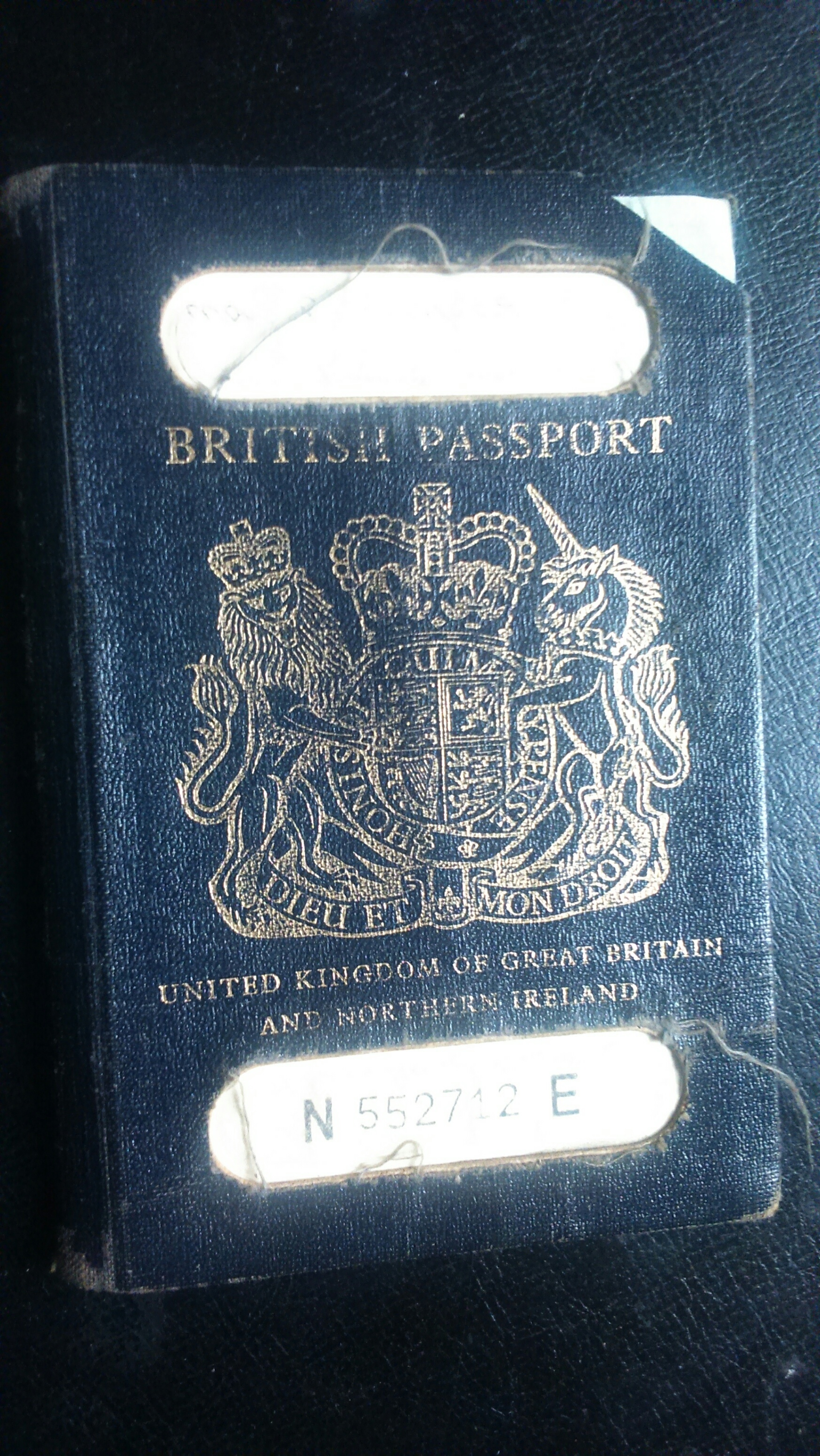
I thought I would compare the new one (right) with my oldest old one (left; the first passport I ever had, issued in 1986, with the corner now cut off to show it is defunct):
The new one is black (or perhaps a very dark blue) but the old one is more of a navy blue. The new one is a bit smaller. The size of the old one was not consistent with international ID standards and was changed in 1992, at which point the colour was changed to burgundy red. The 1986 vintage is not a biometric passport either. The biggest difference however is that the old one is a bit battered from extensive use but this is unlikely to happen to the new one. I’ve already put it away for safe keeping. I don’t think I’ll be using it much so it will probably remain in a pristine state until it expires (or I do).
UPDATE: 07/08/2026. Just two days after the new one arrived, I got the old one (minus corner).
Today, Monday 3rd August 2026, being the first Monday in August, is a Bank Holiday in Ireland. This holiday was created by the Bank Holiday Act of 1871 when Ireland was under British rule. While the August Bank Holiday was subsequently moved to the end of August in England and Wales, it has remained at the start of August in Ireland. It has been a nice morning weather-wise, but in true Bank Holiday fashion we’re promised heavy rain later on, with a chance of thunderstorms.
As I mentioned on Saturday, the first day of August marks the old pagan festival of Lughnasadh, named after the God Lugh, on which is celebrated the beginning of the harvest season. This coincides with the English Lammas Day, one of many Christian festivals with pagan origins. Traditionally this is the start of the harvest season and is celebrated accordingly, with rites involving the first fruit and bread baked from flour obtained from the first corn. It is also one of the cross-quarter days, lying roughly half-way between the Summer Solstice and the Autumnal Equinox (in the Northern Hemisphere).
Two years ago at this time I was still on sabbatical. That seems like ages ago! When I resumed teaching, in September 2024, I had to teach two modules I’d never taught before: a fourth-year Mathematical physics course on Differential Equations and Complex Analysis and a second-year Engineering Mathematics course. I am doing both of these again so resumption of teaching in September won’t be as challenging, although I will be changing a few things in the light of last year’s experience. Lectures start on Monday 22nd September.
After I return to work tomorrow the next big item on the agenda is the repeat examination period, which starts on Wednesday August 5th. The first paper for which I have responsibility is on Friday 7th, but I won’t be able to get the scripts until Monday 10th so I have a bit of time to do other stuff before I start marking. I am not expecting many scripts, actually, so it shouldn’t be too onerous a task to get them done promptly.
Next week also sees the deadline for the dissertations for our MSc course. I have been supervising a student this year and will probably be asked to give comments on the final draft of his report. Then the MSc students have their presentations on Friday 14th August. They have all completed the taught component of the course so the only thing left to assess are these projects. Students will get their final results later this month, along with the resitting undergraduate students.
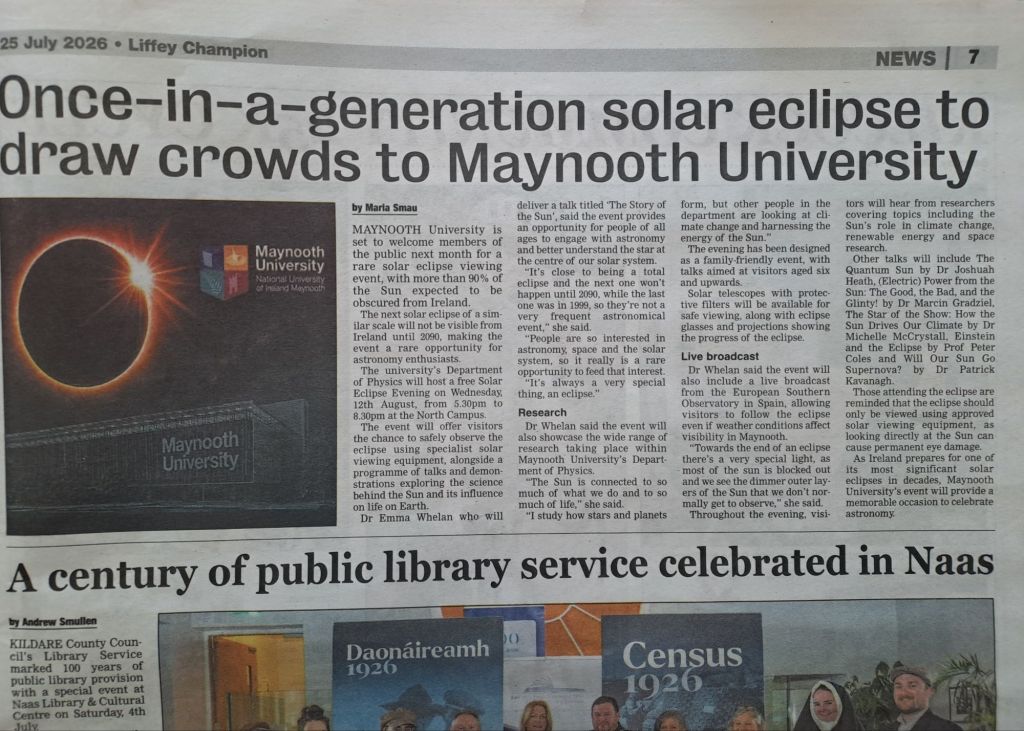
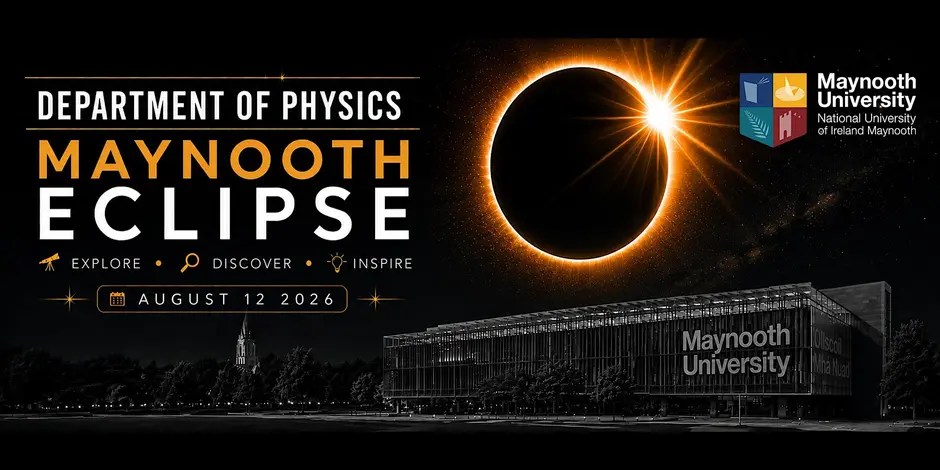
In between all this we have our Eclipse Event on August 12th. This sold out very quickly so we expect a good turnout. The event was advertised quite a bit in the local media, e.g. here and here:
The viewing of the eclipse will of course depend on the weather, but we have talks lined up indoors and a pop-up planetarium so I hope people will turn up even if the weather isn’t great. Although it is officially full, there may be a few returns, so it is worth checking on the day to see if we can fit you in.
Anyway, after the repeat examinations and project assessments are done, the marks uploaded, and the Undergraduate and Postgraduate Examination Boards have done their work, the next job will be to prepare for the new intake of students. This year’s Leaving Certificate results will be announced on Friday 21st August, at which point we’ll see how many students (if any) we have studying Physics next academic year (which, if all goes to plan, will be my penultimate…)
Today is 1st August, which is marked by the old Celtic festival of Lughnasadh, named after the God Lugh. This coincides with the English Lammas Day, one of many Christian festivals with pagan origins. The word for August in modern Irish is Lúnasa, a name derived from the old Celtic word.
Traditionally 1st August marks the start of the harvest season and is celebrated accordingly, with rites involving the first fruit and bread baked from flour obtained from the first corn. It is also one of the cross-quarter days, lying roughly half-way between the Summer Solstice and the Autumnal Equinox (in the Northern Hemisphere).
In the Northern hemisphere, from an astronomical point of view, the solar year is defined by the two solstices (summer, around June 21st and winter, around December 21st) and the equinoxes (Spring, around March 21st, and Autumn, around September 21st). These four events divide the year into four roughly equal parts of about 13 weeks each. If you divide each of these intervals in two you divide the year into eight pieces of six and a bit weeks each. The dates midway between the astronomical events mentioned above are (roughly) :
1st February: Imbolc (Candlemas)
1st May: Beltane (Mayday)
1st August: Lughnasadh (Lammas)
1st November: Samhain (All Saints Day)
The names I’ve added are taken from the Celtic/neo-Pagan (and Christian terms) for these cross-quarter days. These timings are rough because the dates of the equinoxes and solstices vary from year to year. Imbolc is often taken to be the 2nd of February (Groundhog Day) and Samhain is sometimes taken to be October 31st, Halloween. But hopefully you get the point. All four of thes days have a Bank Holiday associated with them (on the first Monday after the respective date); this Monday (3rd August) is a Bank Holiday in Ireland.
Some folk in Ireland regard August 1st as the first day of Autumn, just as 1st February is regarded as the first day of Spring and 1st May is the start of Summer. Indeed, our annual cycle of repeat examinations at Maynooth always happens in early to mid-August and these examinations are officially called the Autumn repeats. I rest my case. In my time here I have also noticed that May, June and July do tend to have significantly better weather than August, although I’m pleased to say that the weather isn’t particularly autumnal today.
In 1998 the Department of Physics at the University of Nottingham was struggling in both research and undergraduate recruitment. To remedy the situation it decided to add a new group in Astronomy. The main idea was that having astronomy in its portfolio would attract more students and boost its standing in the Research Assessment Exercise (as it was then called). I was one of the people appointed to turn that decision into reality, and I’m glad to say the result was a success. Undergraduate numbers increased and in the next RAE Nottingham Physics scored a ‘5’, compared to the previous ‘4’. The Astronomy group quickly gained recognition across the UK and abroad, and another group was added, in Astroparticle Physics.
When the new Astronomy group was set up in 1999, the Department of Physics changed its name to the School of Physics & Astronomy. Despite the positive effect of this new activity, it was immediately clear that some members of staff resented it. A new letterhead was created, referring to the School of Physics & Astronomy, and one (very distinguished) senior member of the former Department always crossed off the “and Astronomy” whenever he used it. Others were surprised that the astronomers wanted to do research, when they felt that astronomy was just a bit of window-dressing for undergraduate recruitment. The astronomers were just there to do teaching, so that the “proper physicists” – mostly in semiconductor physics, nanoscience and other areas of condensed matter physics – could spend more time in their laboratories. I’m not saying that every physicist thought this – most were genuinely appreciative and supportive – but there were more than a few grumblers.
The undertone of all this is the envy that some physicists feel towards astronomy. Astronomers get invited to talk about their work to the general public and to amateur astronomy clubs, while there are no such calls for semiconductor physicists. Nobel prizes go to cosmology and astrophysics much more frequently than some would like. Above all there is the view that astronomy is all very well for bringing students in, but once at university the students must be converted to “proper physics”. Astronomers (including astrophysicists and cosmologists) should not get “notions” (as the Irish say). The short-sighted view that scientific research in universities should be aimed at short-term commercial gain amplifies this attitude, but does not entirely account for it.
These thoughts have been at the back of my mind for some time, but they came to the front again with the recent news about cuts to STFC funding. The callous attitude shown to the UK astronomy research community, implying that it should be grateful that it is not being cut by more than the disastrous level announced, indicates (to me) that there’s much more to what is going on than a mere budgetary issue. There is a deliberate plan to slap down a community that has grown too big for its boots.
The consequences for UK astronomy, and UK physics in general, are dire. Astronomy has kept many physics departments afloat for the last several decades. Without it, physics will fail in all but a handful of universities. That’s where envy takes you.
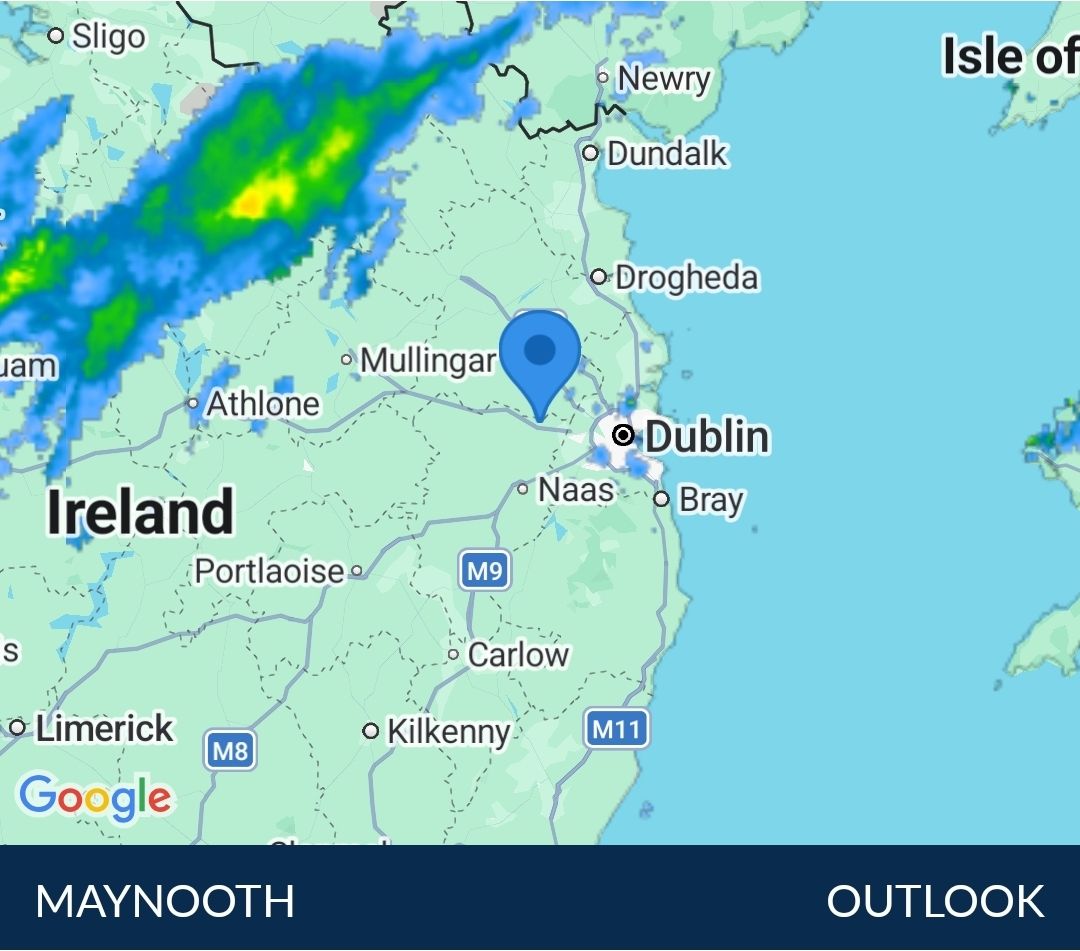
We got some rain at last. On Friday evening I checked the trusty Met Éireann app and saw this:
With a west/northwesterly wind I thought there was a good chance we would get a bit of rain, and so it turned out although to be honest there wasn’t that much. I think the greeny-yellowy blobs missed us. There was enough rain to give the garden a little light refreshment but not to make up for the ongoing hosepipe ban. We’ve had several weeks with next to no rain, which is highly unusual.
I look at the weather outlook quite regularly and have learned one thing in my time in Ireland. The forecast is usually fairly accurate up to about three days in the future but you shouldn’t rely on it beyond that. This week provided a good illustration. Last weekend the forecast predicted rain on Saturday (i.e. yesterday). As the week progressed the forecast changed and rain wasn’t forecast until next Wednesday. Then it rained on Friday evening. Saturday, by the way, was extremely humid: well over 90%.
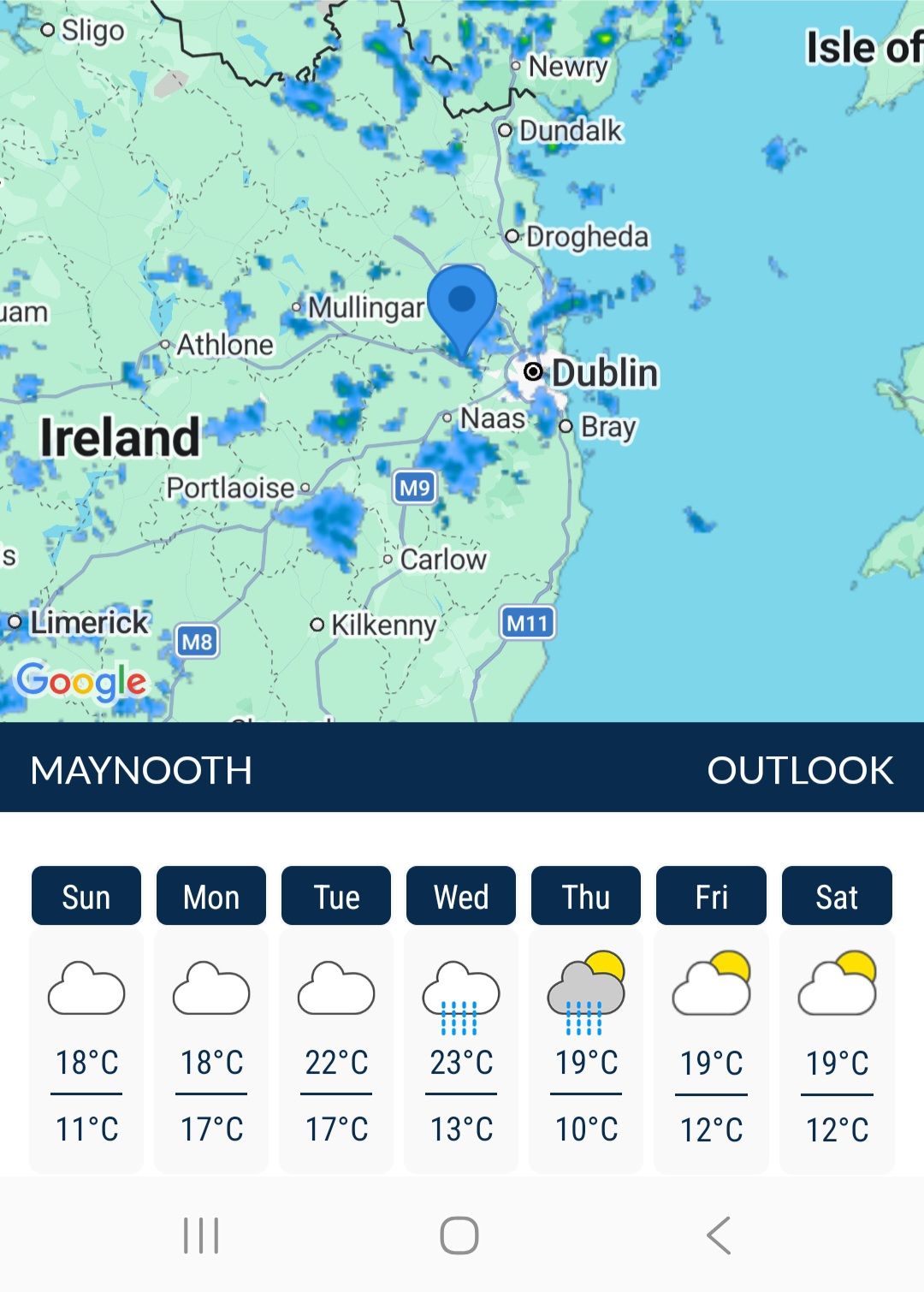
Here’s the outlook from today:
You can see that rain is forecast for Wednesday and Thursday, but the rainfall radar map shows why it is so difficult to predict whether rain will fall at a specific location. The rain clouds are rather small and moving rather quickly; the winds are around 25km/h (westerly). At the time of taking that screen grab there had been some light rain, but will the other blobs hit us? The Met Éireann model says “no” but others may well say “yes”. It’s a tough problem to predict this level of detail.
One thing that I think could be improved is a more reasonable representation of the uncertainty. The outlook for today confidently asserts that the Chance of Preciptation for the rest of today is “0%”. To me that means that it is absolutely impossible that it will rain, and that seems unreasonable to me. Surely there is some chance of rain later today? It doesn’t do much for the credibility of a forecast to claim such certainty. A week or two ago there were no clouds anywhere and “0%” was reasonable, but not today. If it were up to me I’d probably put “<1%” or “<5%” to hedge my bets.
And then there is the question of what amount of rain we’re talking about. I was on campus on Thursday and a few spots of rain fell then. I only noticed because I was outside, coming back from lunch. That was too little to count as real rainfall, but I wonder what the threshold is?
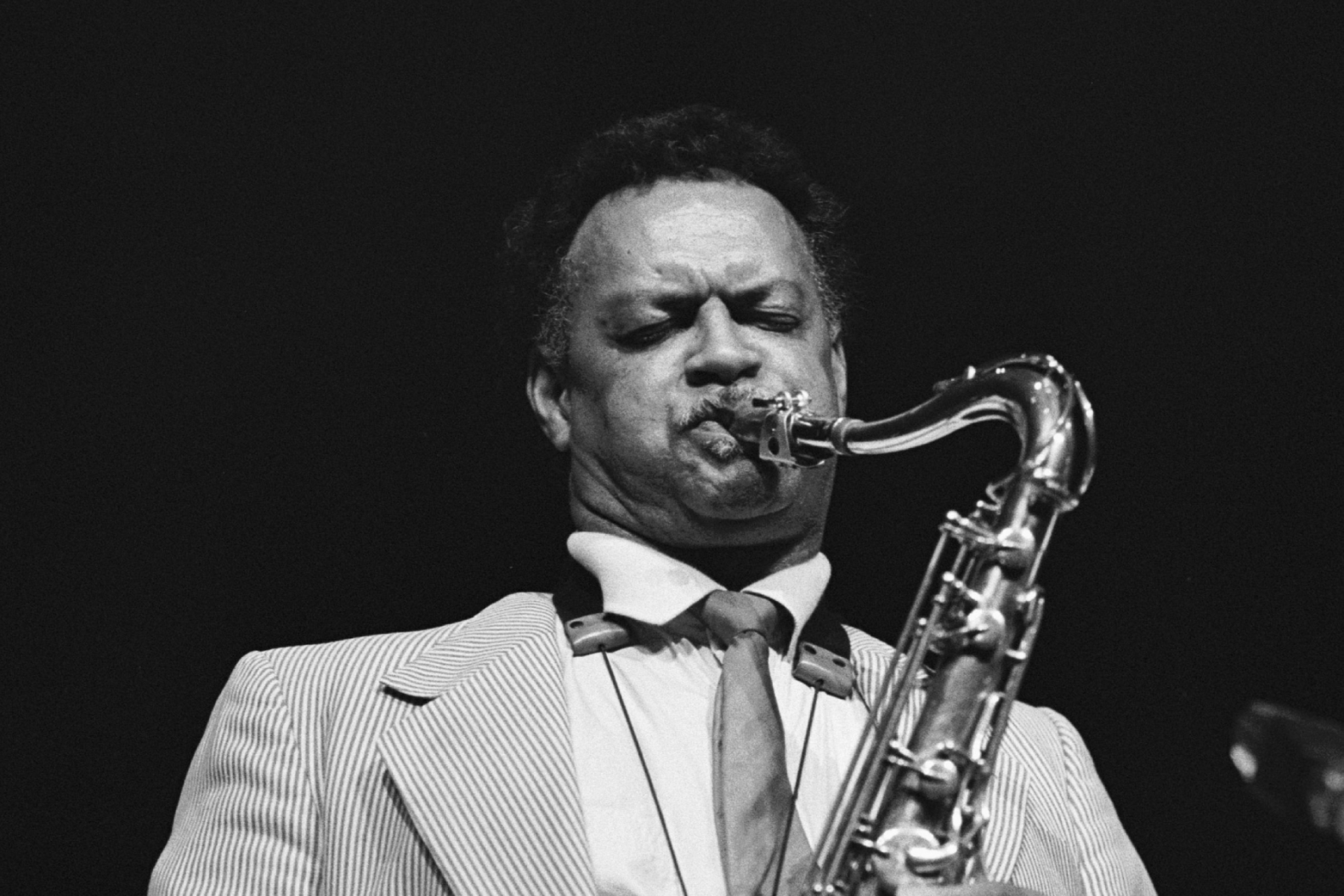
I first heard news of the death of tenor saxophonist Plas Johnson (left) a couple of days ago, and since then there have been numerous tributes including this one in the Irish Times. Almost without fail the obituaries introduce him as the man who played the saxophone part of the Pink Panther theme written by Henry Mancini. In fact, years ago, I won a tiebreak for my team in a pub quiz by knowing the name of the person who played that tune.
Even very good musicians struggled to make a decent living from jazz after the arrival of rock-and-roll as a popular musical phenomenon in the 1950s. Like many jazz performers, Johnson addressed this issue by moving to Los Angeles, where he found work as a session musician working to support such artists as Frank Sinatra and Marvin Gaye, or on film and TV music. Henry Mancini noticed Plas Johnson’s quality and it inspired him to write the Pink Panther film specifically for him. Most of these performances went uncredited, which is why his name isn’t more widely known despite him being a very fine saxophonist. Nonetheless, having the financial security of being much sought after session musician, Plas Johnson was able to continue to pursue his love of jazz. He made some fine albums as leader (I have Positively on vinyl). He also moonlighted as Johnny Beecher to evade contractual issues.
The reason I knew of Plas Johnson as a jazz musician before I found out he was the Pink Panther guy. That’s because I used to listen to Humphrey Lyttelton’s radio programme The Best of Jazz on Radio 2 on Monday evenings from 9pm when I was at school and Plas Johnson came up a few times, including on the track I’ve included below from one of the famous Hanna-Fontana sessions at the Concord Jazz Festival. The recording was made in 1975 but the record wasn’t available in the UK until a couple of years later. I used to tape Humph’s radio shows but no longer have any of the cassettes so I had to spend much of my spare time the last couple of days trying to find the track Humph played. This is it! It features Plas Johnson (ts), clearly enjoying himself in the company of Bill Berry (tpt), Carl Fontana (tb), Herb Ellis (g), Dave McKenna (p), Herb Mickman (b) and Jake Hanna (d). Not a bad line-up!
R.I.P. Plas Johnson (1931-2026), so much more than the Pink Panther guy!
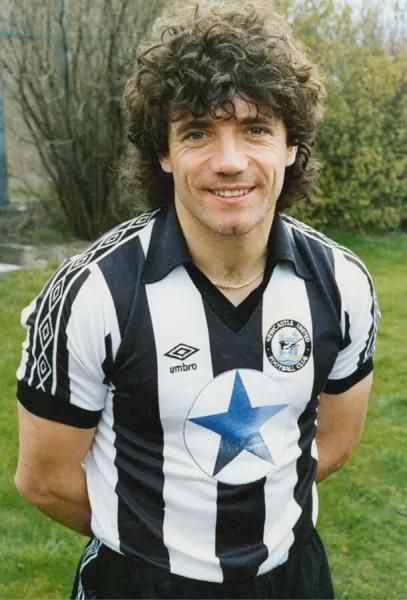
More very sad news. Kevin Keegan (left) has passed away from cancer at the age of 75. He made his reputation at Liverpool, and in Germany, but I remember him best as a player and captain of the Newcastle United team that got promotion to the (then) First Division in 1984. At that time I was a student at Cambridge and member of the local branch of the NUFC Supporters’ Club so I got to see him play quite a few times. Keegan retired from playing at the end of that season and bid an emotional farewell from St James’s Park after the final game against Brighton.
Kevin Keegan was an attacking midfielder who usually operated in the inside-right position. Very good on the ball and an excellent finisher, he was also surprisingly effective in the air. I say “surprisingly” because he wasn’t a very big man, around 5 foot 8 inches tall. After moving to Hamburg he was named European Footballer of Year for two successive years (1978 and 1979). It was quite unusual in those days for English footballers to play on the continent, but Keegan seems to have thrived there.
Later on, in 1992, he rejoined Newcastle United as manager and brought them to promotion to the Premier League. They team led for most of the 1995/6 season but ended up in second place. He had assembled a wonderful group of attacking players but the team’s defensive frailties cost them the title. Keegan had a rather fragile character, and the strain obviously got to him and thence to the players. He was never a great tactical manager – my Dad said Keegan was more of a mascot than a manager – but that team played some great football. Was that really 30 years ago?
On a more personal note, in the 1990s, my Mum was working at a school for physically handicapped children in Newcastle. One day they were visited by Kevin Keegan and some of the Newcastle players. Such PR trips were not uncommon and the staff didn’t think much of them. She didn’t care for footballers in general, but told me that Keegan was very different from most of the other visitors they got. He ignored the photographers aand the formal itinerary and just went to sit on the floor chatting with the kids around him. I never met him in person but it seems he was a genuinely nice man in private life.
P.S. Though he was born in Doncaster, “Keegan” is an Irish name. His paternal grandfather was born in Ireland and moved to Newcastle to work as a miner. He could therefore have played for Ireland rather than England.
I’ve been thinking for some time whether to renew my (expired) British passport, and finally decided to do so. No longer being resident in the UK I thought this would require a trip to the Embassy in Dublin, but that isn’t the case these days. One has to apply online, including supplying a digital photograph, send the old passport off by courier, then wait for the new one to arrive (by courier).
One problem with doing this is that the format of digital picture required for a British passport is not the same as for an Irish one, so most of the automatic machines (“Photo-Me”, etc) in Ireland are no use. I was able to take advantage of a recent trip to London, however, by using such a machine in Paddington station. I had plenty of time for that given the train delays. I got a few printed photos at the same time, in case I need them, but all you need for the passport is a photo code. The images are stored until used in the passport application.
And so it came to pass that today I completed the online application, paid the fees, and went to the local Post Office to send the old one to HM Passport Office. Now I have to wait and see how long it takes for my new passport to arrive. About a month, they say. We’ll see.
The new one will be dark-blue or black, like the very first one I ever had (left). That one was issued in 1986 and expired in 1996. I leave it as an exercise the reader to calculate how many I have had since then!
Whatever its design it will not allow me the right to live, work and retire freely within the European Union, so it will be of considerable less value than my Irish one.
I was for a time under the impression that having a British passport would make it easier should I ever want to enter the UK from somewhere other than Ireland, but I don’t think this is true. Unlike other EU citizens, according to the provisions of the Common Travel Area (CTA), Irish citizens do not require an ETA to enter the UK. They just need a valid Irish passport. Still, I think it will be useful to have a spare and I’m now used to having multiple identities!
I recently travelled to the UK and back by ferry. That journey being within the CTA a passport is not strictly required – other forms of photo-ID are acceptable – but I took mine anyway, as I don’t have a driver’s licence and we don’t have official government-issued ID cards in Ireland so I wasn’t sure whether they would accept any of the cards I have with my picture on it (e.g. my Maynooth staff card). As it happened the ID checks were very cursory. When I checked in at Dublin Ferry Port, the assitant there only wanted my ticket number and didn’t ask to see my ID at all. It was the same coming back from Holyhead. On arrival at Holyhead, there was a border post staffed by several officers, but they waved most passengers through (including me). On returning to Dublin the check was even more perfunctory: there was just one guy and he seemed more interested in welcoming everyone to Dublin than looking at any documents.
The CTA means that if you fly from Dublin to the UK you generally arrive at a place in the airport dedicated to such passengers. This is particularly convenient flying to Heathrow Terminal 2: on arrival you just walk through the Baggage Reclaim and out into the airport without passing any checks. You still need a passport, though, as airlines require this form of identification and it is scrutinized when you check in and when you board the plane. The only airport I know of that doesn’t have a simplified arrival system for CTA passengers is Dublin. They have no separate facilities, so you have to go through passport control with all the other passengers. That can be a bit inconvenient if lots of flights have arrived at the same time. I suppose the people who run Dublin Airport do not think it’s worth having a CTA arrivals facility.
I was very sad this morning to read the news that Sam Neill has passed away at the age of 78. He was a very fine and exceptionally versatile actor. Among many other roles I remember him well as the sadistic and corrupt Chief Inspector Chester Campbell in Peaky Blinders. I was impressed by his convincing Ulster accent but then found out he was actually born in Omagh, County Tyrone.
About 25 years ago (!) I made a very brief appearance in a BBC documentary series called Space for which Sam Neill (left) was the narrator. Apparently he only agreed to do the job on condition that they would film his segments at his home in New Zealand. I remember talking to the production team about Sam Neill and they all said he was not only very professional in his work but also a very nice man. These things don’t always go together…
After the episode I was in – the last of six – was broadcast, my Mam rang me. She didn’t mention my part at all, but asked “That Sam Neill, is he nice?”. I had to explain that I never met him, as they filmed his segments after all the other location sequences. “Oh well,” she said. “At least he knows your name”.
The following clip shows the item I took part in. Originally we were going to demonstrate wormholes using a snooker table, clever editing and reversed video. The producer, Jeremy Turner, decided that wouldn’t look spectacular enough so instead we went to St Anton in Austria: I was flown over the Alps in a helicopter and then driven through the Arlberg tunnel in an impressively fast car. Well worth the cost to license fee payers, I’m sure, even if the three-day trip to Austria by me and a crew of six as well as the hire of the helicopter ended up as a mere three minutes of screen time.
The item is daft, I know, and I don’t really believe any of that stuff about wormholes. It was great fun doing it, but hard work. I remember after the shoot we had a few drinks to wrap it up then left on a very early flight the next morning to the UK. I got back to Nottingham University just in time for a 10am lecture.
Anyway, the episode I was in was called To Boldly Go. I remember suggesting to the producer that the only way to travel faster than light in the manner required was with a split infinitive drive, but they didn’t use that in the final script.
Notice how, in the helicopter sequence, I give the appearance of being completely terrified. A fine piece of acting by me, I thought. *Cough*
I took another ferry back from Holyhead to Dublin last night. The outbound journey was via Irish Ferries but I returned on the Stena Line. I left Holyhead at 22.15 and arrived at the Ferry Terminal at Dublin Port at 1.45am. I was a bit unsure what it would be like on such a late-night trip but the trip was uneventful. I’d had a very tiring day getting to Holyhead so I toyed with the idea of sitting in the bar and having a few drinks, but I thought better of that. Instead I found a quiet corner in one of the lounges where there was a bench seat, and managed to stretch out enough to get about an hour’s sleep.
I think quite a few passengers had booked cabins for the crossing. I didn’t think it was worth doing that for less than four hours aboard, but I will consider that next time I take a late-night ferry. There’s not much to see out of the window in the dark!
The disadvantage of being a foot passenger on these ferries is that you have to wait until all the people with vehicles have disembarked before getting a bus back to the terminal building, which adds about 30 minutes to the time. Anticipating the probability that I would be knackered topo fed up to try getting home by public transport with all my luggage in the early hours of the morning, I had booked a taxi to meet me at 1.45, the scheduled arrival time, but I didn’t actually meet the driver until after 2am. Sitll, I got home to Maynooth quickly and was tucked up in bed by 3am. I had to open all the windows as the house was very stuffy, but other than that all was well.
While I was staying in London I took a few trips by train here and there, most of them very shambolic. All the direct trains from London Paddington to Oxford were cancelled, so passengers had to get on very overcrowded trains that went through Oxford to other destinations. To get back to London I used a train to Marylebone which I didn’t know existed. It was slow, but got me back.
With these problems in mind I took an earlier train from Euston to Holyhead than I originally intended. I’m glad I decided that because even the earlier train was delayed by > 45 minutes leaving Euston. Worse, some other trains goint to Manchester and beyond were cancelled so passengers were advised to get on the train I was on and change at Crewe or Chester. The seat reservations weren’t working so the result was a very sweaty overcrowded train with standing room only, at least until Chester where many people got off. The uncomfortable journey made me break a 195-day blogging streak as I just couldn’t be bothered even when I got a seat. Instead I just relaxed and looked out of the window as we travelled along the coast of North Waves.
My train from Holyhead to London was delayed by over an hour as was the train back yesterday. The upshot of all that is that I get a 100% refund of the fare for the entire journey so it was effectively free (if you don’t count the cost of the stress and discomfort).
Anyway, this trip was my first experience of ferry+train to the UK and back. My summary of the experience is “Ferry Good, Train Bad”.
The views presented here are personal and not necessarily those of my employer (or anyone else for that matter).
Feel free to comment on any of the posts on this blog but comments may be moderated; anonymous comments and any considered by me to be vexatious and/or abusive and/or defamatory will not be accepted. I do not necessarily endorse, support, sanction, encourage, verify or agree with the opinions or statements of any information or other content in the comments on this site and do not in any way guarantee their accuracy or reliability.