Archive for the Books, Talks and Reviews Category

Hawking and the Mind of God

Posted in Books, Talks and Reviews, Science Politics, The Universe and Stuff with tags , , , , , on September 2, 2010 by telescoper

I woke up this morning to the news that, according to Stephen Hawking, God did not create the Universe but it was instead an “inevitable consequence of the Law of Physics”. By sheer coincidence this daft pronouncement has come out at the same time as the publication of Professor Hawking’s new book, an extract of which appears in todays Times.

It’s interesting that such a fatuous statement managed to become a lead item on the radio news and a headline in all the national newspapers despite being so obviously devoid of any meaning whatsoever. How can the Universe be  “a consequence” of the theories that we invented to describe it? To me that’s just like saying that the Lake District is a consequence of an Ordnance Survey map. And where did the Laws of Physics come from, if not from God?

Stephen Hawking is undoubtedly a very brilliant theoretical physicist. However, something I’ve noticed about theoretical physicists over the years is that if you get them talking on subjects outside physics they are generally likely to say things just as daft as some drunk bloke  down the pub. I’m afraid this is a case in point.

Part of me just wants to laugh this story off, but another part is alarmed at what must appear to many to be an example of an arrogant scientist presuming to pass judgement on subjects that are really none of his business. When scientists complain about the lack of enthusiasm shown by sections of the public towards their subject, perhaps they should take seriously the alienating effect that such statements can have. This kind of thing isn’t what I’d call public engagement. Quite the opposite, in fact.

In case anyone is interested, I am not religious but I do think that there are many things that science does not – and probably will never –  explain, such as why there is  something rather than nothing. I also believe that science and religious belief are not in principle incompatible – although whether there is a conflict in practice does depend of course on the form of religious belief and how it is observed. God and physics are in my view pretty much orthogonal. To put it another way,  if I were religious, there’s nothing in theoretical physics that would change make me want to change my mind. However, I’ll leave it to those many physicists who are learned in matters of theology to take up the (metaphorical) cudgels with Professor Hawking.

No doubt this bit of publicity will increase the sales of the new book, so I’ve decided  to point out that I have  written a book myself on precisely this question, which is available from all good airports bookshops. I’m sure you’ll understand that there isn’t a hint of opportunism in the way I’m drawing this to your attention. If you think this is a cynical attempt to cash in then all I can say is

BUY MY BOOK!

I also noticed that today’s Grauniad is offering a poll on the existence or non-existence of God. I noticed some time ago that there’s a poll facility on WordPress, so this gives me an excuse to try repeating it here. Anything dumb the Guardian can do, I can do dumber. However, owing to funding cuts I’ve decided to do a single poll encompassing several topical news stories at the same time.


Share/Bookmark

Paperback Writer

Posted in Books, Talks and Reviews with tags , on August 19, 2010 by telescoper

I’ve had a bit too much on my plate over the last couple of days to be able to find the time to post anything, but I thought break silence and get into the swing of things with a bit of gratuitous self-promotion.

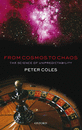
My little book From Cosmos to Chaos is today officially published in paperback. I’m glad the new edition has come out because it gave me a chance to correct quite a large number of typographical errors in the original edition – some of them very embarrassing!  I had spotted many of them before publication, but unfortunately there was a breakdown in the proof correcting process and the changes I’d requested were not made to the version that got printed. Fortunately the publishers, Oxford University Press, gave me the chance to do proper corrections to the text for the paperback version so hopefully it has many fewer bugs in it than the original hardcover version.

Anyway, I would like to take this opportunity to thank those people who contacted me to point out some of the egregious errors. Of course I  really put them there deliberately to check that the readers were paying attention..

Science as a Religion

Posted in Books, Talks and Reviews, Science Politics, The Universe and Stuff with tags , , , , , , , on July 6, 2010 by telescoper

With the reaction to Simon Jenkins’ rant about science being just a kind of religion gradually abating, I suddenly remembered that I ended a book I wrote in 1998 with a discussion of the image of science as a kind of priesthood. The book was about the famous eclipse expedition of 1919 that provided some degree of experimental confirmation of Einstein’s general theory of relativity and which I blogged about at some length last year, on its 90th anniversary.

I decided to post the last few paragraphs here to show that I do think there is a valuable point that Simon Jenkins could have made out of the scientist-as-priest idea. It’s to do with the responsibility scientists have to be honest about the limitations of their research and the uncertainties that surround any new discovery. Science has done great things for humanity, but it is fallible. Too many scientists are too certain about things that are far from proven. This can be damaging to science itself, as well as to the public perception of it. Bandwagons proliferate, stifling original ideas and leading to the construction of self-serving cartels. This is a fertile environment for conspiracy theories to flourish.

To my mind the thing  that really separates science from religion is that science is an investigative process, not a collection of truths. Each answer simply opens up more questions.  The public tends to see science as a collection of “facts” rather than a process of investigation. The scientific method has taught us a great deal about the way our Universe works, not through the exercise of blind faith but through the painstaking interplay of theory, experiment and observation.

This is what I wrote in 1998:

Science does not deal with ‘rights’ and ‘wrongs’. It deals instead with descriptions of reality that are either ‘useful’ or ‘not useful’. Newton’s theory of gravity was not shown to be ‘wrong’ by the eclipse expedition. It was merely shown that there were some phenomena it could not describe, and for which a more sophisticated theory was required. But Newton’s theory still yields perfectly reliable predictions in many situations, including, for example, the timing of total solar eclipses. When a theory is shown to be useful in a wide range of situations, it becomes part of our standard model of the world. But this doesn’t make it true, because we will never know whether future experiments may supersede it. It may well be the case that physical situations will be found where general relativity is supplanted by another theory of gravity. Indeed, physicists already know that Einstein’s theory breaks down when matter is so dense that quantum effects become important. Einstein himself realised that this would probably happen to his theory.

Putting together the material for this book, I was struck by the many parallels between the events of 1919 and coverage of similar topics in the newspapers of 1999. One of the hot topics for the media in January 1999, for example, has been the discovery by an international team of astronomers that distant exploding stars called supernovae are much fainter than had been predicted. To cut a long story short, this means that these objects are thought to be much further away than expected. The inference then is that not only is the Universe expanding, but it is doing so at a faster and faster rate as time passes. In other words, the Universe is accelerating. The only way that modern theories can account for this acceleration is to suggest that there is an additional source of energy pervading the very vacuum of space. These observations therefore hold profound implications for fundamental physics.

As always seems to be the case, the press present these observations as bald facts. As an astrophysicist, I know very well that they are far from unchallenged by the astronomical community. Lively debates about these results occur regularly at scientific meetings, and their status is far from established. In fact, only a year or two ago, precisely the same team was arguing for exactly the opposite conclusion based on their earlier data. But the media don’t seem to like representing science the way it actually is, as an arena in which ideas are vigorously debated and each result is presented with caveats and careful analysis of possible error. They prefer instead to portray scientists as priests, laying down the law without equivocation. The more esoteric the theory, the further it is beyond the grasp of the non-specialist, the more exalted is the priest. It is not that the public want to know – they want not to know but to believe.

Things seem to have been the same in 1919. Although the results from Sobral and Principe had then not received independent confirmation from other experiments, just as the new supernova experiments have not, they were still presented to the public at large as being definitive proof of something very profound. That the eclipse measurements later received confirmation is not the point. This kind of reporting can elevate scientists, at least temporarily, to the priesthood, but does nothing to bridge the ever-widening gap between what scientists do and what the public think they do.

As we enter a new Millennium, science continues to expand into areas still further beyond the comprehension of the general public. Particle physicists want to understand the structure of matter on tinier and tinier scales of length and time. Astronomers want to know how stars, galaxies  and life itself came into being. But not only is the theoretical ambition of science getting bigger. Experimental tests of modern particle theories require methods capable of probing objects a tiny fraction of the size of the nucleus of an atom. With devices such as the Hubble Space Telescope, astronomers can gather light that comes from sources so distant that it has taken most of the age of the Universe to reach us from them. But extending these experimental methods still further will require yet more money to be spent. At the same time that science reaches further and further beyond the general public, the more it relies on their taxes.

Many modern scientists themselves play a dangerous game with the truth, pushing their results one-sidedly into the media as part of the cut-throat battle for a share of scarce research funding. There may be short-term rewards, in grants and TV appearances, but in the long run the impact on the relationship between science and society can only be bad. The public responded to Einstein with unqualified admiration, but Big Science later gave the world nuclear weapons. The distorted image of scientist-as-priest is likely to lead only to alienation and further loss of public respect. Science is not a religion, and should not pretend to be one.

PS. You will note that I was voicing doubts about the interpretation of the early results from supernovae  in 1998 that suggested the universe might be accelerating and that dark energy might be the reason for its behaviour. Although more evidence supporting this interpretation has since emerged from WMAP and other sources, I remain skeptical that we cosmologists are on the right track about this. Don’t get me wrong – I think the standard cosmological model is the best working hypothesis we have _ I just think we’re probably missing some important pieces of the puzzle. I don’t apologise for that. I think skeptical is what a scientist should be.

Talk, Nosh and Gridlock

Posted in Biographical, Books, Talks and Reviews, Cute Problems with tags , on February 18, 2010 by telescoper

I paid a flying visit yesterday to the beautiful city of Edinburgh in order to give a seminar at the Institute for Astronomy, which is situated with the historic Royal Observatory. I was there not long ago, in fact, to do a PhD examination but on this occasion all I had to was stand up in a lecture room and rabbit on for an hour or so. That part of it seemed to go reasonably well, in that no more than half the audience fell asleep while I wittered away.

The morning flight from Cardiff to Edinburgh was uneventful and got me there in time to chat with various people and have lunch before the talk. I elected not to rush straight from the seminar to the airport in order to return the same day, but stayed overnight giving some of  the locals the dubious pleasure of paying for my dinner and enduring my company during it, which they did with great patience. I’d like to thank Alan, John, Alina, Stefano and Brendan for rounding off such a nice day with such a pleasant evening.

In the restaurant we ended up setting each other little geometry problems drawn on napkins, to the palpable disdain of our waiter who clearly wanted us to leave.  However, since I had to get up at 5am the following morning (i.e. this morning) to get the flight back to Cardiff, we didn’t stay out too late. I got back to the B&B where I was billeted in good time to check last night’s football results  before retiring to grab some shut-eye. Newcastle United 4 Coventry City 1 was the result, so it was good news to end the day…

I had to get up at the ungodly hour of 5am in order to catch the flight at Edinburgh airport, but the return flight was right on time. This was fortunate because, not long after the plane landed, a blizzard descended on Cardiff. Snow has fallen intermittently all day. Although I’m a bit tired after getting up so early – hence the brevity of this post –  I’m relieved I managed to get back to work without any major travel hitches.

Anyway, my contribution to the little problem-setting session that took place between the plates and wine glasses was this one, which I was asked during the interview I had to undergo to get a place to study at Cambridge:

Consider an infinite square grid made as shown above from 1Ω resistors. What is the resistance between any two adjacent nodes of this network?

If you’re really interested, a general solution for the resistance between any two (not necessarily adjacent) nodes is given here but you should be able to get the answer for adjacent nodes by a much simpler line of reasoning!

Talked Out

Posted in Books, Talks and Reviews, Cosmic Anomalies with tags , , , on November 20, 2009 by telescoper

My trip to Bath yesterday turned out to be very enjoyable and entirely free of aqueous complications. The train ran on time from Cardiff to Bath Spa, although it was hideously overcrowded. About an hour later I was met at the station by Gary Mathlin and taken to the University campus  in his car. I didn’t get to see much of the city because it was already dark, but parts of it are very beautiful in a very Jane-Austen type of way. The University of Bath campus is a very different kettle of fish, a 1960s modernist construction in which I would have got completely lost had I not had a guide. Quite smart though. Better than most of its ilk.

The talk itself was in quite a large and swish lecture theatre. I’m not sure how many turned up but it might have been close to a hundred or so. Very mixed too, with quite a few students and some much older types.

I thought it went down quite well, but you’ll really have to ask the audience about that! I answered a few questions at the end and then there was  a very generous vote of thanks and I was given a gift of a very interesting book published by Bath Royal Literary and Scientific Institution. Thereafter I was whisked off to dinner, which I hadn’t realised was going to happen. I had the chance to chat to various people, including students and members  of the William Herschel Society, all of whom were very friendly and convivial after a few glasses of wine. Fortunately, Gary Mathlin lives in Cardiff so he gave me a lift home afterwards so I didn’t get back too late.

This morning I had to head straight to London without going into work in order to get to Imperial College to give a lunchtime seminar at the Theoretical Physics group, which is based in the Huxley building. I think it is named after T.H. rather than Aldous, because I wasn’t offered any Mescalin. Of course seminars like this have a much smaller audience and are much more technical than public lectures, but I still found myself having flashbacks to the previous evening’s lecture. I talked about various bits and pieces arising from work I’ve been doing with various people about the cosmic anomalies I’ve blogged about from time to time.

After this we went to a local pizzeria for a late lunch (and a couple of glasses of wine). I would have liked to stay longer to chat with the folks there, but I wanted to get back to Cardiff at a reasonable hour so I left in time for the 4.15 train.

Walking back home from Cardiff station along the side of the River Taff I was struck by its rather sinister appearance. Still high after the recent rains, and lit only by the lights of the city, it glistened like thick black oil as it flowed very quickly down towards the Bay.  I felt more than a hint of menace in the sheer volume of water streaming past in the darkness.

So far we’ve escaped the worst of the season’s bad weather. The fells of Cumbria, in the far north-west of England, have had 14 inches of rain in 2 days, which is a record. If that happened in South Wales I’m not sure even Cardiff’s formidable flood defences would cope! The  forecast for this weekend is terrible so I don’t think I’ll be doing anything very much outdoors. That suits me, in fact, as all this travelling about has left me well and truly knackered. Time for an early night, I think!

Aquae Sulis

Posted in Books, Talks and Reviews, The Universe and Stuff with tags , , , , , on November 19, 2009 by telescoper

Just time for a quick post this lunchtime, in between a whole day of meetings with students about projects and other things. This afternoon I have to whizz off to the fine city of Bath where this evening I am giving a public lecture jointly organized  by the University of Bath and the William Herschel Society (which is based in Bath).

The title of my talk is The Cosmic Web, and a brief outline is as follows.

The lecture will focus on the large scale structure of the Universe and the ideas that physicists are weaving together to explain how it came to be the way it is.

Over the last few decades astronomers have revealed that our cosmos is not only vast in scale – at least 14 billion light years in radius – but also exceedingly complex in texture, with galaxies and clusters of galaxies linked together in immense chains and sheets tracing out an immense network of structures we call the Cosmic Web.

Cosmologists have developed theoretical explanations for its origin that involve such exotic concepts as ‘dark matter’ and ‘cosmic inflation’, producing a cosmic web of ideas that is in many ways as rich and fascinating as the Universe itself.

The University of Bath website has more details of the talk, and I think they are going to do a podcast too. I’ll actually be doing a recap in a couple of weeks’ time in Bristol at an event for the Institute of Physics, of which more anon.

Bath is only about an hour from Cardiff by train and I’m very much looking forward to this trip as I have never been to the University of Bath before.I remember from my schooldays that the Romans named the place Aquae Sulis (or, as my Latin teacher Mr Keating who couldn’t pronounce his esses would say, Aquae Thulith).  The local waters were famous for their healing powers even before the Romans got to England, and the Celtic inhabitants attributed this to a deity they called  Sulis. The Romans kept the name, although they decided that Sulis was actually their goddess Minerva in disguise. The Romans were good at appropriating local traditions like that.

The only potential fly in the ointment is the British weather, which has been terrible over the last week or so and further deluges are forecast this afternoon and evening. As I write, though, it’s actually fine and sunny and the weather map suggests the worst of the current band of rain has passed to the north of here. I hope I’m not tempting providence, and that there won’t be too much of the aquae heading in my direction!

Cranks Anonymous

Posted in Biographical, Books, Talks and Reviews, The Universe and Stuff with tags , , , , on September 22, 2009 by telescoper

Sean Carroll, blogger-in-chief at Cosmic Variance, has ventured abroad from his palatial Californian residence and is currently slumming it in a little town called Oxford where he is attending a small conference in celebration of the 70th birthday of George Ellis. In fact he’s been posting regular live commentaries on the proceedings which I’ve been following with great interest. It looks an interesting and unusual meeting because it involves both physicists and philosophers and it is based around a series of debates on topics of current interest. See Sean’s posts here, here and here for expert summaries of the three days of the meeting.

Today’s dispatches included an account of George’s own talk which appears to have involved delivering a polemic against the multiverse, something he has been known to do from time to time. I posted something on it myself, in fact. I don’t think I’m as fundamentally opposed as Geroge to the idea that we might live in a bit of space-time that may belong to some sort of larger collection in which other bits have different properties, but it does bother me how many physicists talk about the multiverse as if it were an established fact. There certainly isn’t any observational evidence that this is true and the theoretical arguments usually advanced are far from rigorous.The multiverse certainly is  a fun thing to think about, I just don’t think it’s really needed.

There is one red herring that regularly floats into arguments about the multiverse, and that concerns testability. Different bits of the multiverse can’t be observed directly by an observer in a particular place, so it is often said that the idea isn’t testable. I don’t think that’s the right way to look at it. If there is a compelling physical theory that can account convincingly for a realised multiverse then that theory really should have other necessary consequences that are testable, otherwise there’s no point. Test the theory in some other way and you test whether the  multiverse emanating from it is sound too.

However, that fairly obvious statement isn’t really the point of this piece. As I was reading Sean’s blog post for today you could have knocked me down with a feather when I saw my name crop up:

Orthodoxy is based on the beliefs held by elites. Consider the story of Peter Coles, who tried to claim back in the 1990’s that the matter density was only 30% of the critical density. He was threatened by a cosmological bigwig, who told him he’d be regarded as a crank if he kept it up. On a related note, we have to admit that even scientists base beliefs on philosophical agendas and rationalize after the fact. That’s often what’s going on when scientists invoke “beauty” as a criterion.

George was actually talking about a paper we co-wrote for Nature in which we went through the different arguments that had been used to estimate the average density of matter in the Universe, tried to weigh up which were the more reliable, and came to the conclusion that the answer was in the range 20 to 40 percent of the critical density. There was a considerable theoretical prejudice at the time, especially from adherents of  inflation, that the density should be very close to the critical value, so we were running against the crowd to some extent. I remember we got quite a lot of press coverage at the time and I was invited to go on Radio 4 to talk about it, so it was an interesting period for me. Working with George was a tremendous experience too.

I won’t name the “bigwig” George referred to, although I will say it was a theorist; it’s more fun for those working in the field to guess for themselves! Opinions among other astronomers and physicists were divided. One prominent observational cosmologist was furious that we had criticized his work (which had yielded a high value of the density). On the other hand, Martin Rees (now “Lord” but then just plain “Sir”) said that he thought we were pushing at an open door and was surprised at the fuss.

Later on, in 1996, we expanded the article into a book in which we covered the ground more deeply but came to the same conclusion as before.  The book and the article it was based on are now both very dated because of the huge advances in observational cosmology over the last decade. However, the intervening years have shown that we were right in our assessment: the standard cosmology has about 30% of the critical density.

Of course there was one major thing we didn’t anticipate which was the discovery in the late 1990s of dark energy which, to be fair, had been suggested by others more prescient than us as early as 1990. You can’t win ’em all.

So that’s the story of my emergence as a crank, a title to which I’ve tried my utmost to do justice since then. Actually, I would have liked to have had the chance to go to George’s meeting in Oxford, primarily to greet my ertswhile collaborator whom I haven’t seen for ages. But it was invitation-only. I can’t work out whether these days I’m too cranky or not cranky enough to get to go to such things. Looking at the reports of the talks, I rather think it could be the latter.

Now, anyone care to risk the libel laws and guess who Professor BigWig was?

Game Theory

Posted in Bad Statistics, Books, Talks and Reviews, The Universe and Stuff with tags , , , on September 5, 2009 by telescoper

Nowadays gambling is generally looked down on as something shady and disreputable, not to be discussed in polite company, or even to be banned altogether. However, the  formulation of the basic laws of probability was almost exclusively inspired by their potential application to games of chance. Once established, these laws found a much wide range of applications in scientific contexts, including my own field of astronomy. I thought I’d illustrate this connection with a couple of examples. You may think that I’m just trying to make excuses for the fact that I also enjoy the odd bet every now and then!

Gambling in various forms has been around for millennia. Sumerian and Assyrian archaeological sites are littered with examples of a certain type of bone, called the astragalus (or talus bone). This is found just above the heel and its shape (in sheep and deer at any rate) is such that when it is tossed in the air it can land in any one of four possible orientations. It can therefore be used to generate “random” outcomes and is in many ways the forerunner of modern six-sided dice. The astragalus is known to have been used for gambling games as early as 3600 BC.
images

Unlike modern dice, which appeared around 2000BC, the astragalus is not symmetrical, giving a different probability of it landing in each orientation. It is not thought that there was a mathematical understanding of how to calculate odds in games involving this object or its more symmetrical successors.

Games of chance also appear to have been commonplace in the time of Christ – Roman soldiers are supposed to have drawn lots at the crucifixion, for example – but there is no evidence of any really formalised understanding of the laws of probability at this time.

Playing cards emerged in China sometime during the tenth century BC and were available in western europe by the 14th Century. This is an interesting development because playing cards can be used for games such as contract Bridge which involve a great deal of pure skill as well as an element of randomness. Perhaps it is this aspect that finally got serious intellectuals (i.e. physicists) excited about probability theory.

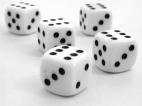
The first book on probability that I am aware of was by Gerolamo Cardano. His Liber de Ludo Aleae ( Book on Games of Chance) was published in 1663, but it was written more than a century earlier than this date.  Probability theory really got going in 1654 with a famous correspondence between the two famous mathematicians Blaise Pascal and Pierre de Fermat, sparked off by a gambling addict by the name of Antoine Gombaud, who went by the name of the “Chevalier de Méré” (although he wasn’t actually a nobleman of any sort). The Chevalier de Méré had played a lot of dice games in his time and, although he didn’t have a rigorous mathematical theory of how they worked, he nevertheless felt he had an intuitive  “feel” for what was a good bet and what wasn’t. In particular, he had done very well financially by betting at even money that he would roll at least one six in four rolls of a standard die.

It’s quite an easy matter to use the rules of probability to see why he was successful with this game. The odds  that a single roll of a fair die yields a six is 1/6. The probability that it does not yield a six is therefore 5/6. The probability that four independent rolls produce no sixes at all is (the probability that the first roll is not a six) times (the probability that the second roll is not a six) times (the probability that the third roll is not a six) times (the probability that the fourth roll is not a six). Each of the probabilities involved in this multiplication is 5/6, so the result is (5/6)4 which is 625/1296. But this is the probability of losing. The probability of winning is 1-625/1296 = 671/1296=0.5177, significantly higher than 50%. Sinceyou’re more likely to win than lose, it’s a good bet.

So successful had this game been for de Méré that nobody would bet against him any more, and he had to think of another bet to offer. Using his “feel” for the dice, he reckoned that betting on one or more double-six in twenty-four rolls of a pair of dice at even money should also be a winner. Unfortunately for him, he started to lose heavily on this game and in desperation wrote to his friend Pascal to ask why. This set Pascal wondering, and he in turn started a correspondence about it with Fermat.

This strange turn of events led not only to the beginnings of a general formulation of probability theory, but also to the binomial distribution and the beautiful mathematical construction now known as Pascal’s Triangle.

The full story of this is recounted in the fascinating book shown above, but the immediate upshot for de Méré was that he abandoned this particular game.

To see why, just consider each throw of a pair of dice as a single “event”. There are 36 possible events corresponding to six possible outcomes on each of the dice (6×6=36). The probability of getting a double six in such an event is 1/36 because only one of the 36 events corresponds to two sixes. The probability of not getting a double six is therefore 35/36. The probability that a set of 24 independent fair throws of a pair of dice produces no double-sixes at all is therefore 35/36 multiplied by itself 24 times, or (35/36)24. This is 0.5086, which is slightly higher than 50%. The probability that at least one double-six occurs is therefore 1-0.5086, or 0.4914. Our Chevalier has a less than 50% chance of winning, so an even money bet is not a good idea, unless he plans to use this scheme as a tax dodge.

Both Fermat and Pascal had made important contributions to many diverse aspects of scientific thought in addition to pure mathematics, including physics, the first real astronomer to contribute to the development of probability in the context of gambling was Christiaan Huygens, the man who discovered the rings of Saturn in 1655. Two years after his famous astronomical discovery, he published a book called Calculating in Games of Chance, which introduced the concept of expectation. However, the development of the statistical theory underlying  games and gambling came  with the publication in 1713 of Jakob Bernouilli’s wonderful treatise entitled Ars Conjectandi which did a great deal to establish the general mathematical theory of probability and statistics.

Beginning Again

Posted in Books, Talks and Reviews, The Universe and Stuff with tags , on August 19, 2009 by telescoper

I keep finding old forgotten bits and pieces – especially book reviews – on my computer. This one is about five years old but I thought I might as well put it on here to save having to think of anything else for today. It’s also a little bit topical because the author, Simon Singh, has recently been the subject of much discussion on this blog (here and here).

This piece was eventually published in an edited form as as Nature 432, 953-954 (23 December 2004) | doi:10.1038/432953b; Published online 22 December 2004.

BOOK REVIEWEDBig Bang: The Most Important Scientific Discovery of All Time and Why You Need to Know About It

by Simon Singh
Fourth Estate: 2004. 544 pp. £20, $27.95

When the British astrophysicist Fred Hoyle coined the phrase ‘Big Bang’ to describe the rival to his beloved ‘steady state’ theory of the Universe, he meant it to be disparaging. It was bad enough for Hoyle that his pet theory turned out to disagree with astronomical observations, but it must have been especially galling that his cosmological adversaries embraced his derisive name. The tag has since spread into the wider cultural domain — nowadays even politicians have heard of the Big Bang.

But what is the Big Bang? In a nutshell, it is the idea that our Universe — space, time and all its matter content — was born in a primordial fireball, from which the whole caboodle has been expanding and cooling ever since. Pioneering theorists such as Aleksander Friedmann and Georges Lemaître derived mathematical solutions of Einstein’s field equations that could be used to describe the evolution of a Big Bang Universe. These models involve a creation event, in which space-time and matter-energy sprang into existence to form our Universe. We are still in the dark about how this happened, but we think it took place about 14 billion years ago.

Edwin Hubble’s discovery of the recession of distant galaxies gave support to the idea that the Universe was expanding, but the notion that it might be evolving from a hot beginning was rejected by many theorists, including Hoyle. He favoured a model in which the origin of matter was not a single event but a continuous process in which atoms were created to fill in the gaps created by cosmic expansion. The battle between these competing views of creation raged until the accidental discovery in 1965 of the cosmic microwave background radiation, which marked the beginning of the end for the steady-state theory.

This conflict between the two theories plays a central role in Simon Singh’s book Big Bang. His previous books, Fermat’s Last Theorem and The Code Book, succeeded admirably in bringing difficult mathematical subjects to a popular readership, using a combination of accessible prose, a liberal sprinkling of jokes and a strong flavouring of biographical anecdotes. The recipe for his new book is similar.

In Big Bang, Singh uses the historical development of modern cosmological theory as a case study for how scientific theories are conceived, and how they win or lose acceptance. He rightly points out that science rarely proceeds in an objective, linear fashion. Correct theories are often favoured for the wrong reasons; observations and experiments are frequently misinterpreted; and sometimes force of personality holds sway over analytic reason. Because cosmology has such ambitious goals — to find a coherent explanation for the entire system of things and how it has evolved — these peculiarities are often exaggerated. In particular, cosmology has more than its fair share of eccentric characters, providing ample illustration of the role of personal creativity in scientific progress.

This very well written book conveys the ideas underpinning cosmological theory with great clarity. Taking nothing for granted of his readership, Singh delves into the background of every key scientific idea he discusses. This involves going into the history of astronomical observation, as well as explaining in non-technical language the principles of basic nuclear physics and relativity. The numerous snippets of biographical information are illuminating as well as amusing, and the narrative is driven along by the author’s own engaging personality.

However, even as a fan of Singh’s previous books, I have to admit that, although this one has many strengths, I found it ultimately rather disappointing. For one thing, there isn’t anything in this book that could be described as new. The book follows a roughly historical thread from pre-classical mythology to the middle of the twentieth century. This is a well-worn path for popular cosmology, and the whole thing is rather formulaic. Each chapter I read gave me the impression that I had read most of it somewhere before. It certainly lacks the ground-breaking character of Fermat’s Last Theorem.

The past ten years in cosmology have witnessed a revolution in observation that has, among many other things, convinced us of the existence of dark energy in the Universe. Theory has also changed radically over this period, largely through the introduction of ideas from high-energy physics, such as superstring theory. Indeed, some contemporary Big Bang models bear a remarkable resemblance to the steady-state universe, involving the continuous creation not of mere atoms, but of entire universes.

Frustratingly, virtually all the exciting recent developments are missing from this book, which leaves off just when things started to get interesting, with the COBE satellite in 1992. Readers who want to know what is going on now in this field should definitely look elsewhere. The processes of cosmic discovery and controversy are ongoing, not just relics of the past.