Archive for the Crosswords Category

When random doesn’t seem random..

Posted in Crosswords, The Universe and Stuff with tags , , , , , on February 21, 2015 by telescoper

A few months have passed since I last won a dictionary as a prize in the Independent Crossword competition. That’s nothing remarkable in itself, but since my average rate of dictionary accumulation has been about one a month over the last few years, it seems a bit of a lull.  Have I forgotten how to do crosswords and keep sending in wrong solutions? Is the Royal Mail intercepting my post? Has the number of correct entries per week suddenly increased, reducing my odds of winning? Have the competition organizers turned against me?

In fact, statistically speaking, there’s nothing significant in this gap. Even if my grids are all correct, the number of correct grids has remained constant, and the winner is pulled at random  from those submitted (i.e. in such a way that all correct entries are equally likely to be drawn) , then a relatively long unsuccessful period such as I am experiencing at the moment is not at all improbable. The point is that such runs are far more likely in a truly random process than most people imagine, as indeed are runs of successes. Chance coincidences happen more often than you think.

I try this out in lectures sometimes, by asking a member of the audience to generate a random sequence of noughts and ones in their head. It seems people are very conscious that the number of ones should be roughly equal to the number of noughts that they impose that as they go along. Almost universally, the supposedly random sequences people produce only have very short runs of 1s or 0s because, say, a run like ‘00000’ just seems too unlikely. Well, it is unlikely, but that doesn’t mean it won’t happen. In a truly random binary sequence like this (i.e. one in which 1 and 0 both have a probability of 0.5 and each selection is independent of the others), coincidental runs of consecutive 0s and 1s happen with surprising frequency. Try it yourself, with a coin.

Coincidentally, the subject of randomness was suggested to me independently yesterday by an anonymous email correspondent by the name of John Peacock as I have blogged about it before; one particular post on this topic is actually one of this blog’s most popular articles).  What triggered this was a piece about music players such as Spotify (whatever that is) which have a “random play” feature. Apparently people don’t accept that it is “really random” because of the number of times the same track comes up. To deal with this “problem”, experts are working at algorithms that don’t actually play things randomly but in such a way that accords with what people think randomness means.

I think this fiddling is a very bad idea. People understand probability so poorly anyway that attempting to redefine the word’s meaning is just going to add confusion. You wouldn’t accept a casino that used loaded dice, so why allow cheating in another context? Far better for all concerned for the general public to understand what randomness is and, perhaps more importantly, what it looks like.

I have to confess that I don’t really like the word “randomness”, but I haven’t got time right now for a rant about it. There are, however, useful mathematical definitions of randomness and it is also (sometimes) useful to make mathematical models that display random behaviour in a well-defined sense, especially in situations where one has to take into account the effects of noise.

I thought it would be fun to illustrate one such model. In a point process, the random element is a “dot” that occurs at some location in time or space. Such processes can be defined in one or more dimensions and relate to a wide range of situations: arrivals of buses at a bus stop, photons in a detector, darts on a dartboard, and so on.

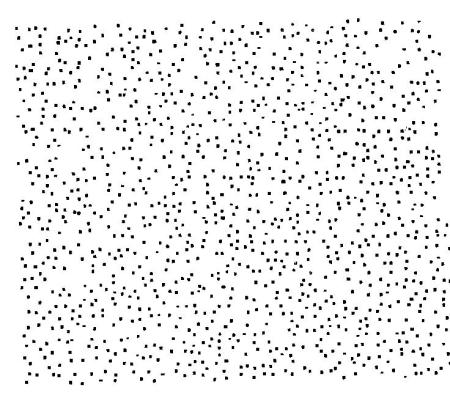
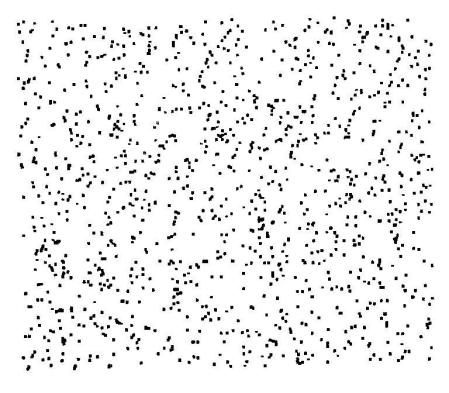
The statistical description of clustered point patterns is a fascinating subject, because it makes contact with the way in which our eyes and brain perceive pattern. I’ve spent a large part of my research career trying to figure out efficient ways of quantifying pattern in an objective way and I can tell you it’s not easy, especially when the data are prone to systematic errors and glitches. I can only touch on the subject here, but to see what I am talking about look at the two patterns below:
pointbpointa

You will have to take my word for it that one of these is a realization of a two-dimensional Poisson point process and the other contains correlations between the points. One therefore has a real pattern to it, and one is a realization of a completely unstructured random process.

I show this example in popular talks and get the audience to vote on which one is the random one. In fact, I did this just a few weeks ago during a lecture in our module Quarks to Cosmos, which attempts to explain scientific concepts to non-science students. As usual when I do this, I found that the vast majority thought  that the top one is random and the bottom one is the one with structure to it. It is not hard to see why. The top pattern is very smooth (what one would naively expect for a constant probability of finding a point at any position in the two-dimensional space) , whereas the bottom one seems to offer a profusion of linear, filamentary features and densely concentrated clusters.

In fact, it’s the bottom  picture that was generated by a Poisson process using a  Monte Carlo random number generator. All the structure that is visually apparent in the second example is imposed by our own sensory apparatus, which has evolved to be so good at discerning patterns that it finds them when they’re not even there!

The top  process is also generated by a Monte Carlo technique, but the algorithm is more complicated. In this case the presence of a point at some location suppresses the probability of having other points in the vicinity. Each event has a zone of avoidance around it; the points are therefore anticorrelated. The result of this is that the pattern is much smoother than a truly random process should be. In fact, this simulation has nothing to do with galaxy clustering really. The algorithm used to generate it was meant to mimic the behaviour of glow-worms which tend to eat each other if they get  too close. That’s why they spread themselves out in space more uniformly than in the “really” random pattern.

I assume that Spotify’s non-random play algorithm will have the effect of producing a one-dimensional version of the top pattern, i.e. one with far too few coincidences to be genuinely random.

Incidentally, I got both pictures from Stephen Jay Gould’s collection of essays Bully for Brontosaurus and used them, with appropriate credit and copyright permission, in my own book From Cosmos to Chaos.

The tendency to find things that are not there is quite well known to astronomers. The constellations which we all recognize so easily are not physical associations of stars, but are just chance alignments on the sky of things at vastly different distances in space. That is not to say that they are random, but the pattern they form is not caused by direct correlations between the stars. Galaxies form real three-dimensional physical associations through their direct gravitational effect on one another.

People are actually pretty hopeless at understanding what “really” random processes look like, probably because the word random is used so often in very imprecise ways and they don’t know what it means in a specific context like this.  The point about random processes, even simpler ones like repeated tossing of a coin, is that coincidences happen much more frequently than one might suppose.

I suppose there is an evolutionary reason why our brains like to impose order on things in a general way. More specifically scientists often use perceived patterns in order to construct hypotheses. However these hypotheses must be tested objectively and often the initial impressions turn out to be figments of the imagination, like the canals on Mars.

Perhaps I should complain to WordPress about the widget that links pages to a “random blog post”. I’m sure it’s not really random….

In Praise Of The Oldie

Posted in Biographical, Crosswords with tags on December 9, 2014 by telescoper

Feeling the effects of advancing years, and ahead of another weekend out of circulation, I purchased a copy of the December edition of The Oldie last week to help pass the time. I heartily recommend this magazine to readers of a certain age for its eclectic mixture of articles, cartoons and, best of all from my point of view, a splendid crossword (set by Antico). In fact there are two crosswords, a tricky thematic cryptic puzzle called Genius, and a straightforward definition puzzle, namely, a little harshly, Moron. For the December edition there was a bumper-sized Genius puzzle which took me a good hour to solve, a distraction that I found most welcome. I’ve posted off my solution already in the hope that I can win another dictionary to add to my collection.

The Christmas OLdie also included a calendar which is already hanging on my office wall. Here is a cartoon from the calendar, which tickled me because of its topicality and operatic connection:


oldie

I’ve decided to take out a year’s subscription, so I hope they’ll forgive any copyright infringement involved in including that cartoon!

Life, Work and Postgraduate Research

Posted in Biographical, Crosswords, Education with tags , , , , on September 21, 2014 by telescoper

A very busy Freshers’ Week at the University of Sussex is now behind us and lectures proper start tomorrow morning. As far as I was concerned all the Freshers’ events were superimposed on a week that was already filled with other things, some good (of which more anon), and some not so good (of which I will say nothing further).

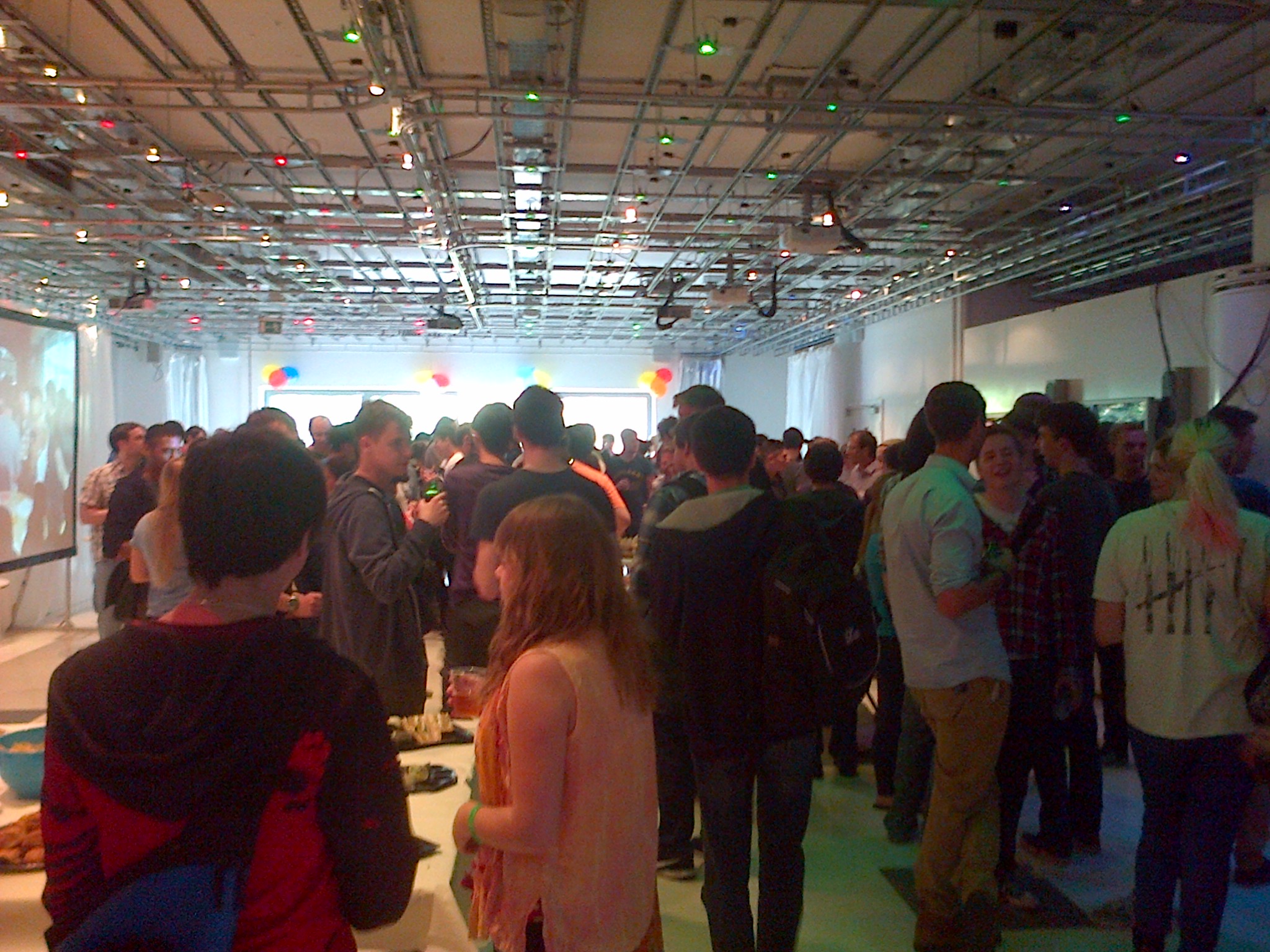
After welcome receptions at the weekend, Freshers’ Week for me began with an induction lecture with all the new students in the School of Mathematical and Physical Sciences (MPS) or at least as many as could rouse themselves for a 10am start the day after a big welcome party. In the event, the turnout was good. I then gave another little speech at a much less formal event in the Creativity Zone (which is situated in the building occupied by MPS. I then had to dash off to a couple of meetings but when I returned a couple of hours later the party was still going, so I helped myself to a beer and rejoined the socializing.

IMG-20140915-00402

Welcome to the new students in MPS!

And so it was for the rest of the week, dominated by meetings of one sort or another including one in London, until Friday and my last formal induction task in the form of a session for new postgraduate students in MPS. Since this happened at the end of Induction Week there wasn’t much of a practical nature say to the students that they hadn’t already heard during the School-based induction sessions that preceded it, so I decided to scrap the Powerpoint I had planned to use and just give a general pep talk. Doing so was quite an interesting experience because it reminded me of the time I started my own postgraduate education, here at Sussex.

As a matter of fact it was on the corresponding day in 1985 (Sunday 22nd September) that I moved down to Brighton in advance of starting my DPhil (as Sussex doctorates were called in those days). It’s hard to believe that was 29 years ago. As it turned out, I finished my thesis within three years and stayed on here at Sussex as a postdoctoral research fellow in the Astronomy Centre until 1990, whereupon I left to take up a teaching and research position at what is now Queen Mary, University of London. That was the start of a mini-tour of UK universities that ended up with me returning to Sussex last year as Head of the same school in which I started my research career.

This morning I noticed a story in the Times Higher about the loneliness and sense of isolation often faced by postgraduate research students which often leads to a crisis of confidence. I can certainly attest to that, for reasons I will try to explain below, so tried to reassure the students about it in the induction session on Friday.

The point is that a postgraduate research degree is very different from a programme of undergraduate study. For one thing, as a research student you are expected to work on your own a great deal of the time. That’s because nobody else will be doing precisely the same project so, although other students will help you out with some things, you’re not trying to solve the same problems as your peers as is the case with an undergraduate. Your supervisor will help you of course and make suggestions (of varying degrees of helpfulness), but a PhD is still a challenge that you have to meet on your own. I don’t think it is good supervisory practice to look over a research student’s shoulder all the time. It’s part of the purpose of a PhD that the student learns to go it alone. There is a balance of course, but my own supervisor was rather “hands off” and I regard that as the right way to supervise. I’ve always encouraged my own students to do things their own way rather than try to direct them too much.

That loneliness is tough in itself, but there’s also the scary fact that you do not usually know whether your problem has a solution, let alone whether you yourself can find it. There is no answer at the back of the book; if there were you would not be doing research. A good supervisor will suggest a project that he or she thinks is both interesting and feasible, but the expectation is that you will very quickly be in a position where you know more about that topic than your supervisor.

I think almost every research student goes through a phase in which they feel out of their depth. There are times when you get thoroughly stuck and you begin to think you will never crack it. Self-doubt, crisis of confidence, call it what you will, I think everyone who has done a postgraduate degree has experienced it. I certainly did. A year into my PhD I felt I was getting nowhere with the first problem I had been given to solve. All the other research students seemed much cleverer and more confident than me. Had I made a big mistake thinking I could this? I started to panic and began to think about what kind of job I should go into if I abandoned the idea of pursuing a career in research.

So why didn’t I quit? There were a number of factors, including the support and encouragement of my supervisor, staff and fellow students in the Astronomy Centre, and the fact that I loved living in Brighton, but above all it was because I knew that I would feel frustrated for the rest of my life if I didn’t see it through. I’m a bit obsessive about things like that. I can never leave a crossword unfinished either.

What happened was that after some discussion with my supervisor I shelved that first troublesome problem and tried another, much easier one. I cracked that fairly quickly and it became my first proper publication. Moreover, thinking about that other problem revealed that there was a way to finesse the difficulty I had failed to overcome in the first project. I returned to the first project and this time saw it through to completion. With my supervisor’s help that became my second paper, published in 1987.

I know it’s wrong to draw inferences about other people from one’s own particular experiences, but I do feel that there are general lessons. One is that if you are going to complete a research degree you have to have a sense of determination that borders on obsession. I was talking to a well-known physicist at a meeting not long ago and he told me that when he interviews prospective physics students he asks them “Can you live without physics?”. If the answer is “yes” then he tells them not to do a PhD. It’s not just a take-it-or-leave-it kind of job being a scientist. You have to immerse yourself in it and be prepared to put long hours in. When things are going well you will be so excited that you will find it as hard to stop as it is when you’re struggling. I’d imagine it is the just same for other disciplines.

The other, equally important, lesson to be learned is that it is essential to do other things as well. Being “stuck” on a problem is part-and-parcel of mathematics or physics research, but sometimes battering your head against the same thing for days on end just makes it less and less likely you will crack it. The human brain is a wonderful thing, but it can get stuck in a rut. One way to avoid this happening is to have more than one thing to think about.

I’ve lost count of the number of times I’ve been stuck on the last clue in a crossword. What I always do in that situation is put it down and do something else for a bit. It could even be something as trivial as making a cup of tea, just as long as I don’t think about the clue at all while I’m doing it. Nearly always when I come back to it and look at it afresh I can solve it. I have a large stack of prize dictionaries to prove that this works!

It can be difficult to force yourself to pause in this way. I’m sure that I’m not the only physicist who has been unable to sleep for thinking about their research. I do think however that it is essential to learn how to effect your own mental reboot. In the context of my PhD research this involved simply turning to a different research problem, but I think the same purpose can be served in many other ways: taking a break, going for a walk, playing sport, listening to or playing music, reading poetry, doing a crossword, or even just taking time out to socialize with your friends. Time spent sitting at your desk isn’t guaranteed to be productive.

So, for what it’s worth here is my advice to new postgraduate students. Work hard. Enjoy the challenge. Listen to advice from your supervisor, but remember that the PhD is your opportunity to establish your own identity as a researcher. Above all, in the words of the Desiderata:

Beyond a wholesome discipline,
be gentle with yourself.

Never feel guilty about establishing a proper work-life balance. Having more than one dimension to your life is will not only improve your well-being but also make you a better researcher.

Farewell to Araucaria

Posted in Crosswords with tags , on December 1, 2013 by telescoper

I was just thinking this morning that it’s been a while since I posted about crosswords, and then an email arrived from Prof. Monica Grady pointing out the sad news of the passing (on Tuesday, 26th November, at the age of 92) of Johh Galbraith Graham, better known to crossword fans as Araucaria of the Guardian. I had missed the announcement of his death because I’ve just been too busy recently to look at the papers except at weekends.

For those of you not aware, the pseudonym Araucaria is the “Monkey Puzzle ” tree. Those of you who were aware already of that, I’ll add that another name for this tree is “Chile Pine” whence John Graham formed the anagram CINEPHILE, under which pseudonym he also set puzzles in the Financial Times for many years. Not a lot of people know that.

John Graham was an undoubted genius as a crossword setter, one of the few whose clues have made me laugh out loud when working out the solution not only because of their cleverness but also because of the wonderful sense of humour with which they were composed. His clues didn’t always abide by the strict conventions laid down by the father of the crossword puzzle, Derrick Somerset MacNutt (aka Ximenes) but he was a compiler whose transgressions in this regard were easy to forgive when so many of his clues were so brilliant.

Here’s a nice video made about a year ago featuring the man himself talking about the art of crossword setting:

I switched from the Guardian to the Independent some time ago so haven’t done any of Araucaria‘s recent puzzles – my only regret for having switched allegiances, as it happens. I’ve actually won prizes from the weekend Independent competition over twenty times subsequently, which has given me a steady supply of dictionaries. More importantly I do find their crosswords generally more challenging and more entertaining than the Guardian‘s. But the irreplaceable Araucaria was in a class on his own. Having given so much pleasure to so many people for such a long time, he has certainly earned his status as national treasure.

Rest in peace John Galbraith Graham (1921-2013).

Goodbye to Azed

Posted in Crosswords with tags , , , , on November 3, 2013 by telescoper

Having a bit of a tidy up on the blog earlier today, I noticed today that it’s been quite a while since I’ve posted anything in the category marked “crosswords”.

The reason for this is that the responsibilities I acquired with my current position have made it quite difficult to find the time to indulge my passion for cruciverbalism if I’m also going to keep this blog going. In fact, I’ve recently made a decision to ditch a puzzle that has been a favourite for some time, Azed in the Observer.

Some time ago I stopped getting the Guardian on Saturday and switched to the Independent. That has been quite rewarding because I’ve taken to the Indy crossword and have won the prize a number of times. I’ve lost count how many, actually, but it’s probably about twenty. The prize on each occasion was a dictionary, the same dictionary, and I’ve given most of them away.

I persevered with the Observer, chiefly because of Azed, but I’m afraid the quality of the paper has deteriorated as quickly as its price has increased. I therefore decided, with some regret, to switch to the Independent on Sunday. I find this is a much more compact and better written newspaper with, as a friend of mine accurately summed it up, “much less shite in it” than the Observer.

The Independent on Sunday has a normal prize cryptic (similar to the Saturday one) in the paper and another one, Beelzebub, in the magazine, which is similar in style of both grid and clues to Azed, nicely done but perhaps a little less challenging. There isn’t a monthly clue-writing competition either; since I always struggled to find the time and inspiration to offer decent clues I think it’s just as well that I admit defeat and withdraw from that competition. Perhaps I’ll return to it when I’ve got more spare time, which is only likely to happen when I’m retired..

P.S. Incidentally you can find the circulation figures of UK newspapers here. The Observer and the Independent on Sunday have both fallen precipitously since ~ 2007.

Combined Cake and Crossword!

Posted in Biographical, Crosswords on February 8, 2013 by telescoper

On Wednesday there was a little gathering in the School of Mathematical and Physical Sciences to welcome me as the new Head. I had been told there would be tea and cakes, but had no idea that the cake would be in the form of a personalised crossword! It was a lovely touch, so thank you to everyone in MPS (especially Dorothy) for planning such a wonderful surprise.

The cake went down well – it vanished in no time!

Crossed Words

Posted in Crosswords with tags , , , on October 28, 2012 by telescoper

I’m still a bit fragile after a sudden bout of illness. Judging by my symptoms – and the fact that the worst of it seems to have passed in about 24 hours – I think it must have been this (i.e. the dreaded “Winter Vomiting Bug”). You’ll be relieved that I don’t intend to go into the details on here.

Anyway, being out of action all day yesterday has put me behind on a number of important things, including the weekend’s crosswords which also reminded me that it’s been a while since I posted anything in that particular file on here.  I did manage to get out to buy yesterday’s Independent, but haven’t started the puzzle yet. Incidentally, I should mention that I recently won the Independent Crossword Prize for the NINTH time. That means I’ve accumulated nine copies of the Oxford Dictionary and Thesaurus in little over a year. I keep getting envious comments from people who’ve been entering this competition for years and have never won, but I seem to win it regularly every few weeks.  I have one copy of the Oxford Dictionary and Thesaurus at home, one in my office at work. I gave one to my mum and the rest I’ve distributed to colleagues at work. I’ve even started a waiting list, although I may move on from Cardiff before I can fulfil all the requests…

Anyway, I was cheered this morning when I discovered that I’d won a VHC (“Very Highly Commended”) in the Observer’s Azed Crossword Puzzle No. 2105. This puzzle was a “special” with the theme “Collisions”, introduced with the following rubric:

Down clues are normal. Each across entry consists of two answers which ‘collide’,  i.e. they overlap by one or more letters, the overlapping letters always appearing in  their correct order. Across clues consist of definitions of each of the full overlapping  answers and subsidiary indications of each minus the overlapping letters. Definition and subsidiary indication for one answer precede those for the other, but either  may come first. Numbers in brackets indicate the lengths of complete entries. One  across answer consists of two words. Competitors should submit with their entries  a clue in the style of the other acrosses to the unclued ‘collision’ at 1 Across, which  must be deduced.

I’m always very wary of unclued lights, but in this case it was quite easy to deduce TITANIC/ICEBERG was the combination that went with the overall theme as well as fitting with the other clues. I didn’t think that, for a “special”, the puzzle was all that difficult to solve but I did find it a mighty struggle to come up with a clue in which the join between the two separate parts was reasonably well disguised and which had a reasonable surface reading. My attempt was

Showing sex appeal in leather, very large bird knocked back cold fish

I’ll leave it to the reader to parse the clue and see how it fits with the instructions.

Anyway, with that I’m up to 10th place in the Annual Honours Table, but with only 3 out of 13 puzzles completed there’s plenty of time to fall back to my usual position!

Now, time to see if I can eat something without unwanted special effects….

Crosswords and Prizes

Posted in Crosswords with tags , , , , on June 24, 2012 by telescoper

It has been a while since I last posted anything in the box marked Crosswords, so I thought I’d while away a bit of this dreary Sunday morning with a few thoughts on that topic.

Less than a year ago, I switched my Saturday newspaper from the Guardian to the Independent (see here for the reason). I’ve been doing the Independent Prize Cryptic every week since then, except when I’ve been away. I find it significantly more satisfying than the Guardian puzzle. I’m not sure the Independent‘s crossword is harder – although some of my friends think so –  but there seems to be better quality control there than at the Guardian.

I still occasionally do the Guardian puzzle at weekends by downloading it from the web. Yesterday’s celebrated a centenary – not difficult to guess whose! – but it wasn’t a particularly interesting puzzle, and I thought some of the clues were very clumsy.

Anyway, somewhat amazingly, I’ve actually won the Independent crossword prize no less than six times in the nine months or so since I starting doing it. An immediate inference from this is that there must be many fewer entrants than for the Guardian weekly puzzle, which I only won once every few years. The other side of this is that I’m accumulating dictionaries at an alarming rate. The prize for the Indy cryptic competition is The Oxford Dictionary and Thesaurus, a substantial tome that retails for about £20. I now have one in my study at home, one in the sitting room, and one in my office at work. I gave one to my mum a while ago, and the other two I’ve given to colleagues at work. I’ll probably be disposing of a few more copies like that if things carry on the way they have in past months. I’ve even started taking advance orders…

I haven’t been doing so well this year in my favourite crossword competition, the Azed puzzle in the Observer. I started well enough, but then drew a blank on a number of occasions and slipped back down the table. However, this week I got another score with a VHC (“Very Highly Commended”) in Azed 2087, and am currently in equal 24th place. There’s only one competition puzzle left, and I’m a long way off the pace set by the leaders, so I’m not going to finish much higher than that even if I do well in the last competition.

Anyway, my clue for the word ROCKET was:

Dicky ticker – love might make this one race!

I’ll leave it as an exercise for the reader to parse, although it involves a “comp. anag.” It goes without saying that the prize-winning clues are much better than my effort!

Incidentally, I noticed yesterday that my post about the Azed 2000 lunch a couple of years ago was getting a bit of traffic. I don’t really know why, but in the course of looking around I saw that there’s a nice collection of photographs of the event here. I couldn’t embed any of them here as they’re protected.

The general reaction of people I work with to all this cruciverbalism is that it’s a waste of time. I actually don’t agree, except insofar as everything is a waste of time when you think about it. Crosswords for me are a form of mental jogging. They exercise a brain in a way that’s different from the usual things it is faced with. In my case, a lot of my work involves puzzles of various kinds. Some are mathematical, connected with my research, but the most difficult ones are bureaucratical: trying to work out what all the paperwork is for and how to fill it in without losing my rag. Despite a complete lack of empirical evidence to support this assertion, I think doing crosswords keeps my brain from ossifying and enables it to think more flexibly. Or maybe I protest too much. Perhaps I just enjoy them.

Crossword Look-alikes

Posted in Crosswords with tags , , , on May 13, 2012 by telescoper

I wonder if anyone else has noticed the remarkable similarity between this clue, by Paul, in yesterdays Guardian Prize Crossword (No. 25634)

Foolishly cash lost in ’em? (4,8)

and this one in Everyman No. 3423 which appeared in today’s Observer:

One-armed bandits – lost cash in ’em, stupidly (4,8)

I wonder if, by any chance, they might be related?

More interestingly, the clue by Paul is a nice example of an “&lit” clue whereas the Everyman one has the traditional definition + cryptic parts. In an &lit clue two different readings of the clue give the definition and cryptic allusion. In this one the word “foolishly” is an anagram indicator (acting on the subsequent  letters); the surface reading (“literally what it says”) defines something you might lose money in foolishly. This kind of clue often ends with a “?” or even a “!” to suggest something a bit sneaky is going on so a bit more lateral thinking than usual may be required.  The second clue has the same anagram (indicated by “stupidly”) but this is preceded by a straightforward definition of the answer so has no “?” at the end.

I’m not going to give the answer, but it’s quite an easy one so I assume the penny has dropped.

Setters and Solvers

Posted in Crosswords with tags , , , , , , on February 26, 2012 by telescoper

I realise that yesterday I said I only had time for a quick post, and then proceeded to write >1000 words on the subject of Masters degrees. Today I really only have time for a quick post, as I have to finish writing my examination paper (amongst other things).

Anyway, I haven’t blogged about crosswords for a while so I just thought mention a few things. Some time ago I switched from the Guardian to the Independent on Saturdays. The Guardian is a sad case. As its circulation falls, the price continues to rise. It is now getting more expensive virtually by the week. It comes with stacks of tedious supplements which go straight into the recycling bin anyway. There’s much less of the Independent and it’s both higher quality and cheaper. There’s a lesson there for the Grauniad, I think.

More importantly (for me) the Guardian’s crosswords have gone rapidly downhill and I much prefer the Independent’s setters nowadays. I do occasionally do the Grauniad prize one by downloading it from the net, especially if it’s Araucaria, but most of the other setters are nowhere near as good. Since I started doing the Indy crossword last year I’ve won the prize, a rather splendid dictionary, three times. I’ve got one in my study at home and one in my office. The other I gave to my mum. If I win any more I’m not sure how I’ll dispose of them. Perhaps I could open a shop?

The magazine bit of the Independent has a more difficult crossword called Inquisitor. I’m not sure about these at all. Sometimes they’re really good, but too often they require so many modifications to be made to each solution before entry into the grid that they become completely tedious, and the completed puzzle just looks like a random jumble of letters. Call me old-fashioned, but I like my crosswords to have words in them. Last week’s (Inquisitor 1217) was an extreme example, with “thematic modifications” all over the place and some parts of the puzzle completely unclued. It turned out that you had to remove every third letter of each solution before entering it into the grid, the theme being an obscure and entirely unclued reference to the Rime of the Ancient Mariner “And he stoppeth one of three”. I got there in the end – I find I can’t leave a puzzle incomplete once I’ve started – but I didn’t post it off in protest at how unsatisfying it was.  I don’t mind difficult puzzles, but they have to be fair: leaving huge parts of the puzzle unclued means that it’s just guesswork rather than logic.

My favourite crossword is still Azed in the Observer. I got off to a good start in this year’s clue setting competition with a run of VHCs (“Very Highly Commended”). However, I didn’t have time to do the Christmas Azed and have therefore slipped down the league table a bit.

I got an HC in the last competition, No. 2070, in which the word to be clued was MISTREATMENT. My clue was

Kinky “Master” welcoming one into pain or wanting abuse

i.e. anagram of MASTER including I running into TORMENT with OR missing (wanting); abuse is the definition. It’s OK I suppose but admittedly not as good as the prize-winning entries.

This word is tailor-made for an &lit type of clue, which Azed seems to like. The winning entry for this one was of this type

Abuse T. Emin’s art met?

So you can read this as “abuse” (an anagram indicator) of the subsequent letters to make MISTREATMENT or the whole clue itself as a definition. Azed seems to allow a lot of slack in the definition part of such clues, but I’m not at all convinced that “T. Emin’s art” has ever been actually mistreated so I don’t like this as much as some of the other clues. It’s not my decision, however, and I have to say some of the clues in the list are really superb, much better than my mundane effort.

I love solving crossword puzzles, but I find setting the clues extremely difficult. I think I’m the same way with physics too. I like solving – or trying to solve – problems of various kinds, but I find setting them very hard work. That’s why it takes me so long to write examination papers, and why I consequently have to go into the office on a lovely spring sunday. It would be much easier to set exactly the same paper as last year, but of course no self-respecting university teacher would ever even dream of doing that….