Archive for the Education Category

The Next Semester

Posted in Artificial Intelligence, Education, mathematics, Maynooth with tags , , , , , , , on January 26, 2026 by telescoper

There’s just a week to go before the next Semester at Maynooth University so I’ve been looking at my calendar for the weeks ahead. Actually, I won’t start teaching again until Tuesday 3rd February, because Monday 2nd February is a national holiday. As it turns out, however, I don’t have any lectures, labs or tutorials on Mondays anyway so I won’t be missing a session either on February 2nd or on May 4th, another holiday. I will have to miss one on Friday 3rd April (Good Friday), though.

The Timetable has given me two 9 o’clock lectures a week for the forthcoming Semester, one on Tuesdays and the other on Thursdays. I don’t think the students like 9am lectures very much, but I don’t mind them at all. I find it quite agreeable to have accomplished something concrete by 10am, which I don’t always do. This schedule might mean that I defer publishing papers at the Open Journal of Astrophysics on those days. I usually do this before breakfast, but I might not have time if I have to be on campus and ready to teach for 9am.

As usual, Semester 2 is a stop-start affair. We have six weeks until the Study Break, which includes the St Patrick’s Day holiday, then we’re back for two weeks (minus Good Friday) before another week off for Easter. We return on Monday April 13th to complete the Semester; the last lectures are on Friday 8th May and exams start a week later. This arrangement creates no problems for lecture-based teaching, but it takes some planning to organize labs and project deadlines around the breaks. I’ll have to think about that for my Computational Physics module.

A more serious issue for Computational Physics is how to deal with the use of Generative AI. I’ve written about this before, in general terms, but now it’s time to write down some specific rules for a specific module. A default position favoured by some in the Department is that students should not use GenAI at all. I think that would be silly. Graduates will definitely be using CoPilot or equivalent if they write code in the world outside university so we should teach them how to use it properly and effectively.

In particular, such methods usually produce a plausible answer, but how can a student be sure it is correct? It seems to me that we should place an emphasis on what steps a student has taken to check an answer, which of course they should do whether they used GenAI or did it themselves. If it’s a piece of code to do a numerical integration of a differential equation, for example, the student should test it using known analytic solutions to check it gets them right. If it’s the answer to a mathematical problem, one can check whether it does indeed solve the original equation (with the appropriate boundary conditions).

If anyone out there reading this blog has any advice to share, or even a link to their own Department’s policy on the use of GenAI in computational physics for me to copy adapt for use in Maynooth, I’d be very grateful!

(My backup plan is to ask ChatGPT to generate an appropriate policy…)

Marking Time Once More

Posted in Biographical, Education, Maynooth with tags , , , , on January 13, 2026 by telescoper

Lecturers at Maynooth University are supposed to be available on the telephone to deal with queries from students concerning their examinations. And so it came to pass that yesterday I was “on call”. Since I live in Maynooth, I decided to come into campus in case of a query so I could go to the examination venue l to deal with it if required. In the event, however, the examination passed off without incident and nobody called.

I wasn’t twiddling my thumbs all morning though. It seemed a good opportunity to go through the accumulated coursework for this module, applying various exemptions for medical or other reasons, so that when I’ve marked the scripts I can immediately combine the results with the CA component.

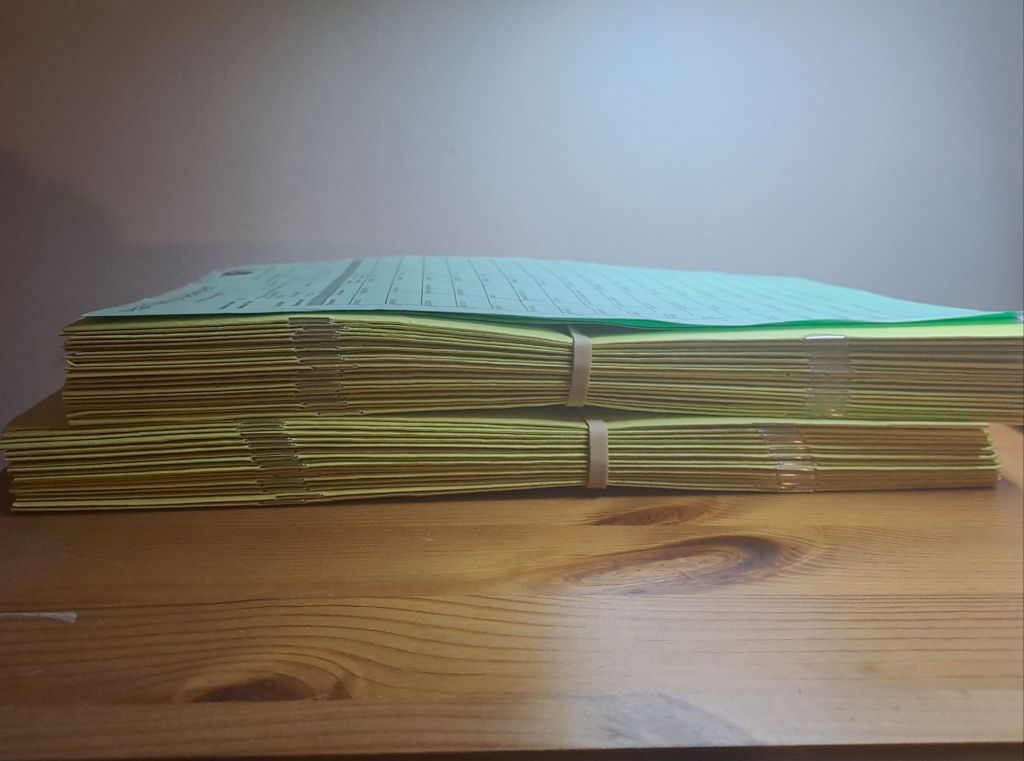
The examination venue, incidentally, was not on campus but in the Glenroyal Hotel in Maynooth. The Sports Hall on campus is usually one of the places for examinations to be sat, but it is not available this year due to refurbishment. The other day I was in one of the shops in the shopping centre next to the hotel and there were some complaints about the lack of available car parking spaces owing to so many students parking there for their exams. Anyway, the exam scripts found their way to my office this morning and here I am again, back home with a stack of an examination scripts to mark. The picture shows about 40 papers from my module on Differential Equations and Transform Methods. I want to get them out of the way as quickly as possible as I have another paper coming up on Thursday and have a lot of other things to do before term starts at the beginning of February. All the usual displacement activities having been exahusted, I’ve already made a start. With a bit of luck I’ll complete this task by Thursday.

I’ve often discussed the process of marking examinations with my colleagues and they all have different techniques. What I do is mark one question at a time rather than one script at a time. What I mean by that is that I go through every script marking all the attempts at Question 1, then I start again and do Question 2, etc. I find that this is much quicker and more efficient than marking all the questions in each script then moving onto the next script. The reason for this is that I can upload into my mind the model answer for Question 1 so that it stays there while I mark dozens of attempts at it so I don’t have to keep referring to the marking scheme. Other advantages are that it’s easier to be consistent in giving partial credit when you’re doing the same question over and over again, and that also you spot what the common mistakes are more easily.

Anyway, I’ve decided to take a break for today. I’ll start again tomorrow.

Exam Time Yet Again

Posted in Education, Maynooth with tags , , , on January 8, 2026 by telescoper

The January examination period at Maynooth starts tomorrow (Friday 9th January), so I thought I’d do a quick post on the topic of examinations. First of all let me wish the very best of luck to everyone at Maynooth or elsewhere taking examinations in the next few weeks. I hope at least that the exam halls are nice and warm! Actually, owing to the Sport Hall being unavailable for this examination period owing to building work, some exams will be off campus; my first exam paper is actually being sat in the GlenRoyal hotel.

Here’s a video produced by Maynooth University to remind those taking exams of some general points about preparation and, most importantly, to look after themselves before during the examination period. It’s directed at Maynooth students but students from elsewhere may find useful tips in it.

I completed the last of my revision sessions today but, as the first examination for which I have responsibility is not until Monday 12th, I’ll have to wait to find out how any of my own students have done but let me take this opportunity to pass on a few of my own tips more aimed at students in Physics:

  1. Try to get a good night’s sleep before the examination and arrive in plenty of time before the start. This is especially important when there’s bad weather that may disrupt travel. It is your responsibility to get to the examination on time!
  2. Read the entire paper before starting to answer any questions. In particular, make sure you are aware of any supplementary information, formulae, etc, given in the rubric or at the end.
  3. Start off by tackling the question you are most confident about answering, even if it’s not Question 1. This will help settle any nerves.
  4. Don’t rush! Students often lose marks by making careless errors. Check all your numerical results on your calculator at least twice and – PLEASE – remember to put the units!
  5. Don’t panic! You’re not expected to answer everything perfectly. A first-class mark is anything over 70%, so don’t worry if there are bits you can’t do. If you get stuck on a part of a question, don’t waste too much time on it (especially if it’s just a few marks). Just leave it and move on. You can always come back to it later.

Readers of this blog are welcome to add other tips through the comments box below!

Eight Years in Maynooth…

Posted in Artificial Intelligence, Biographical, Education, Maynooth with tags , , on December 1, 2025 by telescoper
Maynooth University Library, home of the famous cat

Today is 1st December 2025, which means that it’s eight years to the day since I started work at Maynooth University. Despite the frustrations, I’m still very happy I made the move all that time ago.

We’ve now had more than a year since the merger of the former Departments of Theoretical and Experimental Physics. This has gone pretty well, actually, with significant improvements in terms of some steps forward in rationalising teaching. It does, however, feel less like a merger and more like an acquisition, with the theoretical activity effectively subsumed into the old Experimental Physics department. I suppose that was inevitable given the relative sizes of the two former Departments, but it has led to a loss of identity and the loss of the group spirit we use to have in Theoretical Physics. To add to this a number of familiar faces have left – two of my own PhD students, Aonghus Hunter-McCabe and Aoibhinn Gallagher have graduated and left, as have others with different supervisors. I am delighted for their success, of course, but will miss having them around.

I continue to enjoy teaching, and was pleasantly surprised to continue doing the same modules this academic year as last. The big change in that regard has been the adoption of different assessment methods to deal with the possibility of students using AI to do their coursework. That seems to be going reasonably well, though I’ll have to wait until the January examinations to see the outcomes.

The thing I’m probably most proud of over the past eight years is, with the huge help of staff at Maynooth University Library, getting the Open Journal of Astrophysics off the ground and attracting some excellent papers. This year has seen yet more significant growth, publications this year set to reach 200, after 120 in 2024 and just 50 the year before that (2024). We’re still smaller than many of the mainstream astrophysics journals, but we’re still growing…

Anyway, eight years of service mean that only two remain until I can claim the full state pension. I’ll be retiring as soon as I can afford to. There were Open Days at Maynooth on Friday and Saturday (28th and 29th November, respectively). These were for prospective students to enter in September 2026. Since I don’t teach any first or second year Physics modules now, and that is likely to continue, it looks like I’ll never see any of that intake in class.

A month to go

Posted in Artificial Intelligence, Biographical, Education, mathematics, Maynooth with tags , , , , , on November 25, 2025 by telescoper

I’ve been a bit preoccupied these recent weeks so it was with a shock that I realised that we’re into Week 9, which means just four weeks (including this one) until the end of term and just a month before Christmas. Teaching finishes here in Maynooth on Friday 19th December, but I don’t have any lectures on Fridays so in my case it will finish the day before (with a tutorial). I don’t know how many students will be there, but the module concerned is my 4th year Mathematical Physics module and the students are very hard-working, so I think most will attend. After such a busy term I’m sure that they will need a break as much as I will.

I had to rejig the schedule for both modules I am teaching this semester to accommodate the introduction of in-class tests to replace take-home assignments (for reasons I outlined here). I’ve also been handing out voluntary exercises for practice, not counting towards the module mark but for formative reasons. Both modules are mathematical in nature, and I think the best way to learn mathematics is by doing it…

Despite the changes with respect to last year, I am still roughly on track. In my Engineering Mathematics module I’ve just finished Laplace transforms, and will start Fourier methods tomorrow. With the mathematical physicists, I am in the middle of complex analysis, having done complex differentiation and conformal mappings and starting complex integration next week.

I still have a couple more class tests to get through. On the positive side, the students are turning up for them and have expressed approval for the fact that they don’t have compulsory homework to do off-campus. This form of assessment is undoubtedly harder work for the students, it’s also better preparation for the examination that take-home assignments.

We’ve just received the draft examination timetable for January, and I’m pleased that both of the examinations for which I am responsible will take place quite early in the examination period (on 12th and 15th January, respectively) so I should be able to get them corrected in time to have a break for some research before teaching resumes at the start of February.

Queen’s University Belfast and Dundalk IT (not Maynooth?)

Posted in Education, Maynooth with tags , , , on November 19, 2025 by telescoper

A couple of years ago I posted an item about the news of a proposed merger of Maynooth University and Dundalk Institute of Technology. That piece began with the following:

Life is full of surprises, especially if you’re a member of academic staff at Maynooth University.

Today it was revealed that the institution that employs me is planning to merge with Dundalk Institute of Technology. It was revealed not in a direct message to staff, but through an article in the national media, in this case the Sunday Independent. The article there is paywalled but there is another piece here.

This is astonishing news, not least because of the way it has come out. Yet again, the only way that staff at Maynooth can find out what’s going on is through the newspapers. Senior Management don’t deign to inform us of anything…

Not surprisingly I hadn’t heard anything about how the proposed merger was progressing except for a couple of items in the national media. For example, in May this year, there was an announcement of the formation of a Regional Graduate Academy linking postgraduate education in Dundalk and Maynooth.

Today, however, I saw another news item announcing that Dundalk IT has now decided to become a College of Queen’s University Belfast. It explains:

The new partnership between Queens University Belfast and Dundalk Institute of Technology is not a “parent child relationship,” and represents the first “all-Ireland university”, the Minister for Further and Higher Education has said.

DkIT is set to become a University College following the agreement with QUB, which will see it change from an IT to a University College of Queen’s University Belfast.

What does this new new relationship between DkIT and QUB mean for the old new relationship between DkIT and Maynooth University? Have they called the Maynooth-Dundalk merger off? Or will the three institutions form a ménage à trois?

Don’t ask me. I only work here. Perhaps I’ll be able to find out by reading the newspapers.

P.S. Coincidentally, the next “President’s Update” for staff at Maynooth, scheduled for December, has been postponed until the New Year.

P.P.S. It is about 80km from Belfast to Dundalk and about 100km from Dundalk to Maynooth.

The Passage of Time

Posted in Biographical, Education with tags , , , , , on October 20, 2025 by telescoper

The start of this term has been so busy that I forgot that October 1st was the 40th anniversary of the day I officially started as a research student at the University of Sussex (1st October 1985). Reflecting on that event I realized with something approaching horror that 1985 is halfway between 1945 and 2025, so I started my PhD DPhil closer in time to the end of World War 2 than to today. Yikes!

Before travelling to the Sussex to embark on my research degree, I spent a couple of weeks at a summer school for all the new Astronomy PhD students. These are still held annually, although they are now just a week long instead of a fortnight. They are now sponsored by the Science and Technology Facilities Council (STFC) but the one I attended was before that came into being, and even before its predecessor, the Particle Physics and Astronomy Research PPARC. The Science and Engineering Research Council (SERC)  summer school I went to was held at Durham University; we all stayed in St Mary’s College, just over the road from the Physics Department. I remember it well and indeed still have the notes I took during the lectures there.

Another difference in those days was that we got our stipends paid by cheque – every three months, if I remember correctly – directly from the Research Council. Nowadays STFC gives block grants to universities and other research institutions, who then pay the students.

Anyway, here is the summer school conference picture:

Unfortunately (for such a rare and valuable document) it is slightly damaged on the left -hand side. I leave it up to my readers to identify the people in this group who are still in the business 40 years later. I can see quite a few – Moira Jardine, Alan Fitzsimmons, Melvyn Hoare, Jon Loveday and Alastair Edge, among others! A more complete list can be found here.

I don’t think I’m the only member of this group who is thinking of retiring fairly soon. This post was occasioned by the 40th anniversary of the start of my DPhil; my plan is to retire 40 years after the date of the completion of my thesis. That’s less than three years from now…

"What we call the beginning is often the end
And to make an end is to make a beginning.
The end is where we start from. "

from Little Gidding V, Four Quartets by T.S. Eliot

Testing Times

Posted in Artificial Intelligence, Education, mathematics, Maynooth with tags , , , , on October 17, 2025 by telescoper

As it was foretold, I conducted my first set of my new-style in-class tests this week. These tests, as I mentioned a while ago,  were introduced because of concerns about the integrity of the coursework element of my modules in the light of improvements in Generative AI.

The main events – one for each of my modules – were both yesterday, but one student couldn’t make it at the scheduled time (for good reasons) so I set a special test this morning, which is now over. Because access to the internet is not allowed these tests are invigilated.

It’s been quite a while since I was last required to invigilate a full examination. I think it was back in Nottingham days, actually. I never enjoyed this task even though I took work to do it wasn’t really possible to do much as one had to keep one’s eyes on the students. Crosswords could be done; these are good in this situation because you can solve a few clues at a time. It was disappointing if I happened to take one that was easy enough to do quickly, as there was little to stave off the boredom after completing it. Other things I used to do included counting the number of right-handed and left-handed students, though I never did any detailed statistical analysis of the results.

Anyway, my recent class tests were a bit different. Designed to fit in a lecture slot of 50 minutes duration, they were much shorter than traditional end-of-year exams. They were also “open-book” style, so students could bring anything on paper that they wanted. Phones and laptops were, however, forbidden. During these tests I just sat quietly with my laptop getting some work done, with an occasional glance at the students. It was actually nice to be locked away like this with no disturbance. Time passed very quickly, actually, though perhaps not as quickly as it did for the students taking the tests.

When I first told the students that the tests would be “open-book”, I think they all assumed that would make them easy. I don’t think that was the case, however, as the questions are designed so that the answers can’t be obtained immediately by looking them up in a textbook. Also, having things on paper rather than in your head does slow you down. I’ve never seen much point in examinations as speed tests. I designed this week’s tests so that the questions could be done in about 30 minutes, but the formal duration was 50 minutes. I encouraged students who finished early to use the remaining time to check their work, but some did leave early.

This new regime also meant I had number of teaching sessions without the exertion of having to do any actual teaching, which was nice. The downside is, of course, that I now have stacks of class tests to correct. That will be payback time.

I won’t know how well the students have coped until I have got their grades, but informal feedback was that they seemed reasonably content with the new method of assessment. I’ll be doing the next ones in about three weeks.

Quarter-Term – Testing Time

Posted in Education, mathematics, Maynooth with tags , , , on October 13, 2025 by telescoper

I’ve just noticed that three teaching weeks have passed and we’re already into the fourth. Tempus fugit. Both the modules I am lecturing this semester are divided into four chunks of approximately equal size. For example, MP469 Differential Equations and Complex Analysis splits into: Ordinary Differential Equations; Partial Differential Equations; Complex Functions and Derivatives; and Complex Integration. Though technically not on the syllabus, I also do couple of lectures on Conformal Mappings because I think they’re cool.

As I mentioned a while ago,  I am concerned about the integrity of the coursework element of these modules in the light of improvements in Generative AI. Only a couple of years ago GenAI could not solve the sort of problems I set for homework, but now it generally can. I don’t altogether object to people applying artificial intelligence to solve mathematical problems, but the main issue is that it does make mistakes. Moreover, instead of saying “sorry I can’t solve that problem” it will generally present a superficially plausible but incorrect solution. Although students will probably use GenAI for problem-solving, I think it is important that they learn to do such problems themselves, otherwise they won’t know whether the solution coughed up by the algorithm is correct or not.

The only way to learn mathematics is by doing it. If students get GenAI to do the mathematics for them, then they won’t learn it. In the past we have given marks for coursework (usually 20% of the module mark) mainly to encourage students to do them. Students who don’t bother to do these exercises generally do badly in the final exam (80%).

For these reasons I am moving the assessment from weekly homework sheets – which could be tackled with AI – to supervised in-class tests for which students can use notes on paper, but not laptops or phones. I will of course give examples for the students to have a go at themselves, and I will give feedback on their attempts, but they will not contribute to the module score. Another advantage of this approach is that students won’t have to do so much work against deadlines outside of class.

What I’ve decided to do is have one class test for each of the four sections of each module. Given that we’re about a quarter of the way through the term, it’s time for the first ones. This week there will be a class test on Ordinary Differential Equations. I’ve never been enthusiastic about examinations being speed tests, so I’ve decided to set problems to be done in a 50-minute session which would be expected to take about 30 minutes in a formal end-of-term examination.

I have to make a short work-related trip that will keep me away on Wednesday, but I’ve already written the test questions, and will make arrangements for someone to supervise the tests if for some reason I don’t make it back to Maynooth on time…

Anyway, although we’ve been teaching for three weeks I still have to check my calendar to remember which room I’m supposed to go to before every lecture. Perhaps by Christmas I will have learned them off by heart…

A Meme for Modern University Management

Posted in Education, Maynooth with tags , , on October 1, 2025 by telescoper

This variation on an old meme seems relevant to the state of the modern university system:

I posted a more detailed version on BlueSky here.

To pre-empt accusations that this is a misleading representation of the true state of affairs, I admit this is so. In a more accurate version there would be many more members of the Senior Management Team. Moreover, the President and Senior Management Team appear in the photo to be aware of, and some are even showing some interesting in, the activity of the lecturer.