Archive for the Education Category

Planning Research

Posted in Education, Maynooth on June 15, 2022 by telescoper

This summer I have two undergraduate students doing research projects with me funded under Maynooth University’s Summer Programme for Undergraduate Research (SPUR). They’re actually making Monte Carlo simulations of galaxy clustering and using them to test various statistical analysis tools. The Department of Theoretical Physics actually has five students on three different projects, which is quite a lot for a small Department. The University as a whole has 57 SPUR students so we have almost ten percent of the total!

The SPUR students are paid for the projects, which last for (usually) six weeks but can be extended. I wish we could offer these projects to every student who wanted one, actually, but we just can’t afford to do that. I don’t agree with unpaid internships as these can only be taken up by students who have access to enough income to cover living expenses over the summer, so are discriminatory. We select students based on an application and their academic performance.

Anyway, at the start of the SPUR programme students attend a briefing session (which was last Wednesday) and they have to do various tasks along the way and, at the end, construct a poster. At the beginning they have to complete an agreement and “work plan”.

I was very amused to see the following template for a research plan in the pack given to students:
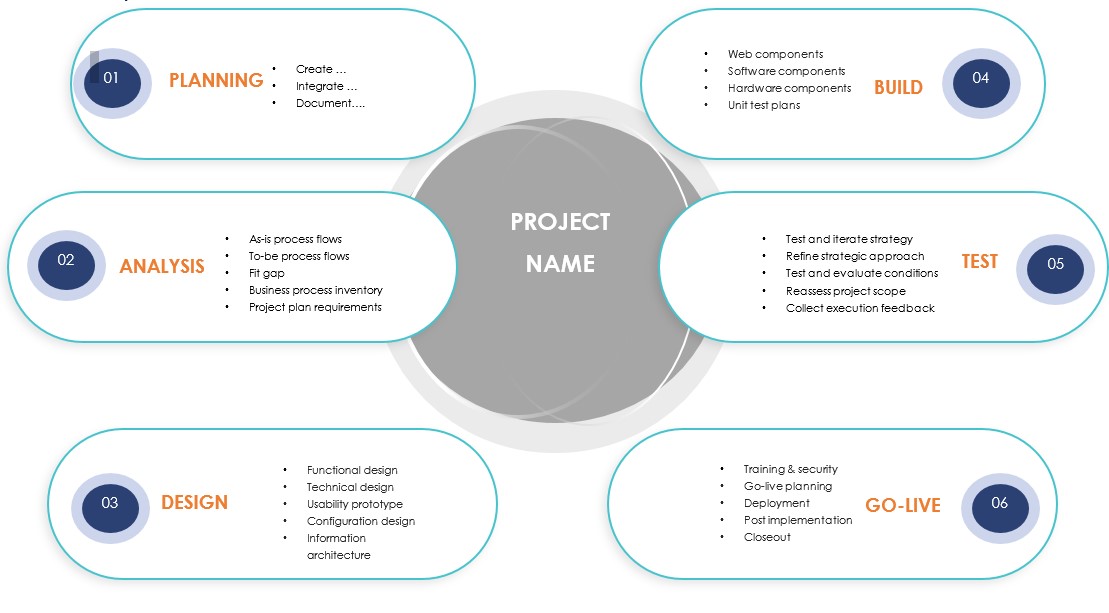
I’m at a loss to understand how any of this relates to how research is actually done in theoretical physics. The many amused reactions from colleagues when I posted this on Twitter yesterday suggest I’m not the only one. As a matter of fact, I don’t understand what many of the buzzphrases even mean. What for example are “As-is process flows”?

Obviously this template is intended for students doing business management courses in which they presumably learn to speak this language. Fortunately this is Template 3 and Template 1 just consists of a list of tasks to be done with key “deliverables” of the sort you need to complete when applying for a research grant, so my students used that.

I find it uncomfortable making detailed plans because to me the whole point of doing research is that you find things out that you didn’t expect and alter your strategy accordingly. If everything were predictable it would be a very dull project. Indeed I would say that if the outcomes were entirely predictable it wouldn’t even deserve the name “research”. Much theoretical research is accordingly rather open-ended, unlike say engineering or product design. On the other hand “give me the money and I hope to discover something interesting” is unlikely to go down well with funding panels. So you have to find a middle ground between convincing the panel that you know what you’re doing and allowing yourself space to adapt in the light of new developments. I think grant bodies in science largely understand that. Or at least I hope they do.

I had better end there as it is time for me to GO-LIVE (sic).

A Leaving Certificate Applied Maths Problem

Posted in Cute Problems, Education, mathematics with tags , on June 11, 2022 by telescoper

The 2022 cycle of Leaving Certificate examinations is under way and the first Mathematics (Ordinary and Higher) were yesterday there’s been the usual discussion about whether they are easier or harder than in the past. I won’t get involved in this except to point you to this interesting discussion based on an archive of mathematics questions, that this year the papers have more choice for students and that, apparently, the first Higher Mathematics paper had very little calculus on it.

Anyway, I was looking through some old Applied Mathematics Leaving Certificate papers, as these cover some similar ground to our first year Mathematical Physics at Maynooth, and my eye was drawn to this question from 2010 about two balls jammed in a cylinder…

I’d add another: does it matter whether or not the cylinder is smooth (as this is not specified in the question)?

Your answers are welcome through the comments box!

Exploitation and Surplus Value in Academia

Posted in Education, Maynooth with tags , , on June 7, 2022 by telescoper

After two years of Covid-19 pandemic requiring academic staff to undertake countless hours of unpaid overtime, I’m sure all my colleagues at Maynooth University, especially those whose workloads went through the roof during this time, will be as delighted as I am to learn that the University made a surplus of €13.2 million last year.

I’m reminded of a post I did a while ago about why academic publishing is so profitable. The argument I presented based on Marx’s theory of exploitation which holds not only for capitalist societies but for all class-based societies (including, e.g., feudal societies). In Das Kapital Marx argued that

…living labour at an adequate level of productivity is able to create and conserve more value than it costs the employer to buy; which is exactly the economic reason why the employer buys it, i.e. to preserve and augment the value of the capital at his command. Thus, the surplus-labour is unpaid labour appropriated by employers in the form of work-time and outputs.

The current situation certainly seems like exploitation to me, though it’s not only the staff but also the students who are being taken for a ride.

In a couple of weeks I am supposed to spend yet another Saturday (unpaid) delivering an open-day talk at which I attempt to persuade students to come to Maynooth to study Theoretical Physics. I probably won’t mention that we haven’t got enough staff to teach them effectively, we haven’t had sufficient investment to offer decent levels of teaching infrastructure (e.g. no lecture capture facilities), and they probably won’t be able to find anywhere to live near campus so won’t be able to attend lectures without lengthy commutes. I don’t suppose prospective students care about those things anyway. But I’m sure they’ll be delighted to hear about the size of the University’s surplus….

…I bet that will make them feel really good about coming to Maynooth!

On Board for Examinations

Posted in Covid-19, Education, Maynooth on June 2, 2022 by telescoper

We’ve at last managed to finish marking and collating examination scripts, coursework and project reports of various types and the provisional results are all uploaded to the system. I have to say that marking examinations on paper is much less of a chore than doing digital submissions online, though it is still not exactly a simple task and I’m glad it’s over for another year.

Tomorrow morning we’ll have a relatively informal “Pre-Board” meeting to go double-check the results and discuss any isues arising before the full Departmental Examination Board which takes place next week. That’s just for the Department of Theoretical Physics but we also do teaching for the Department of Engineering and there are Pre-Boards and Full Boards for those too.

In between now and the Full Boards we have a Bank Holiday weekend. Not the extravaganza going on over the Irish Sea concerning the Queen’s Platinum Jubilee, just the regular Lá Saoire i mí Mheitheamh we have every year. In any case, there’s more than one old Queen having a celebration this weekend. A nice thing about living in Ireland is that my birthday is always in close proximity to a national holiday.

But I digress.

The Departmental Examination Boards do not quite mark the end of the examinations business for the academic year, as we have the Final Final Examination Board after all the Departmental ones.  That is when marks from all Departments come together to determine the final results for students who are taking degrees in combinations of subjects. The Department of Theoretical Physics has quite a number of students doing Joint Honours with Mathematics, for example, and we don’t won’t know their final results until we see how their Mathematics has gone. It does add an extra level to the process, but I think that’s a price worth paying for the flexibility we offer to students through joint programmes.

This final Examination Board takes place on 22nd June and students will get their marks a couple of days later on 24th June. We have an official Consultation Day (28th June) the following week during which students can get feedback on their examinations as well as discussing options for choices to be made ahead of next year. Even that won’t be the end, because some students will be taking repeat examinations in August, but at least it signals a gap in the assessment cycle during which we can hopefully think of other things for a while.

This year has been challenging, to say the least. There was a piece in the Irish Times recently discussing concerns about lack of student engagement, poor lecture attendance and high dropout rates for students in Irish universities. I discussed some of the reasons for this here. Obviously, until our results are finalized I can’t say anything specific about the impact of all these difficulties on our students, but the post-Covid turmoil undoubtedly has had a significant impact on many students and a severe impact on some. It remains to be seen precisely what the scale of the problem is and what we can do to mitigate it.

The general turbulence in the wake of the pandemic, which is unavoidable, has been exacerbated in my Department by serious staffing issues resulting from deliberate management decisions. This combination has created a perfect storm which in my view could easily have been avoided. I shall refrain from commenting further, except to say that it will take some time to sort out and we’ll probably have similar – though hopefully less severe – issues next year.

One of the difficulties faced by students this summer is that they would not have done traditional written examinations for two years before this May’s set. The online timed assessments we deployed during the pandemic were of “open-book” style but the unseen written papers on campus are not. The challenge posed by these two types of examination are different, and it remains to be seen how well the students – especially those in Years 1 and 2 – have coped with the abrupt switch. Those who get disappointing results will have the opportunity to take repeat examinations (on campus) and those who disengaged entirely will have the chance to repeat the year in full if they so desire, so all is not lost!

Another sign of our gradual emergence from the pandemic is that our Examination Board meeting next week will be attended in person by the External Examiner. She wasn’t able to get here last year owing to  illness so it will be nice to have her present at the Exam Boards and, hopefully, at dinner afterwards.


Premiership Final Marks

Posted in Education, Football with tags , on May 22, 2022 by telescoper

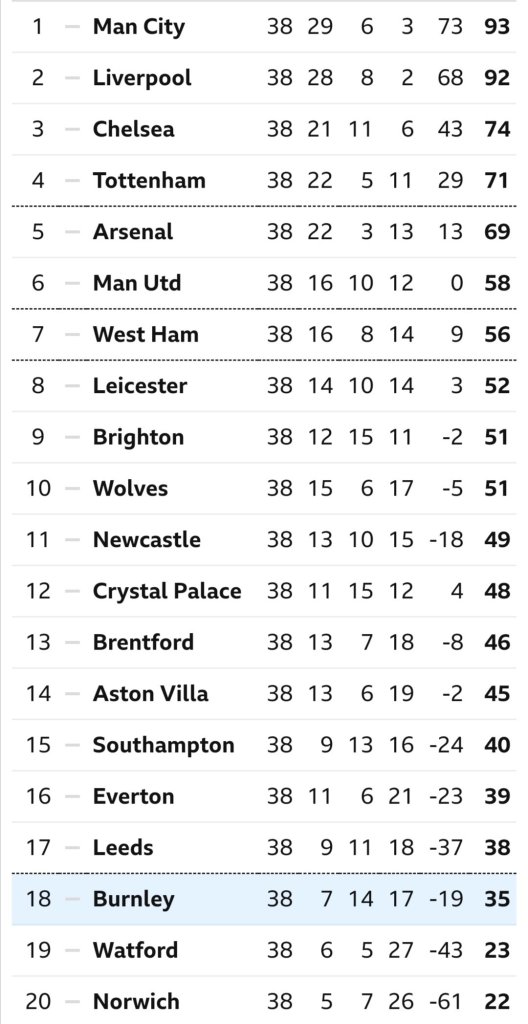
Time for a quick reaction to an exciting final day of the Premiership season.

There were 20 candidates, no absences, and no extenuating circumstances recorded. The final marks are all in and we can now proceed to the classification of honours:

Looking at the last column we can see that the top four all get first-class honours, with Man City (top of the class) and Liverpool in line for prizes. Arsenal may also end up with a 1st, possibly depending on the result of a viva and consultation with the external examiner.

Among the others, Man Utd will be disappointed with their 2.2. By contrast Brighton will be delighted to have scraped theirs.

Newcastle in 11th only get a 3rd but they did at one point look like failing so will be relieved; they might also be bumped up to a 2.2 after a viva or if there are extenuating circumstances. There is a long tail of poor marks near the bottom: Norwich, Watford and Burnley all drop out but may return to resit at some stage.

(I think may have been spending too long recently marking examinations…)

Science vs Marketing

Posted in Astrohype, Education, Science Politics, The Universe and Stuff with tags , , , on May 20, 2022 by telescoper

I saw a paper some months ago by former Sussex colleague Xavier Calmet and collaborators that attracted quite a lot of press coverage largely based on a press release from the University of Sussex that claimed:

Stephen Hawking’s famous black hole paradox solved after hair-raising discovery

(If you want to learn more about the black hole information paradox you could start here.)

The press release is pure unadulterated hype. The paper in Physical Review Letters is actually rather good in my opinion but it says next to nothing about the black hole information paradox. Unfortunately the Sussex press release was picked up by the BBC’s science editor Pallab Ghosh who turned it into a very garbled article. Unfortunately Ghosh has quite a lot of form when it comes to producing nonsensical takes on science results. See, for example, this piece claiming that recent results from the Dark Energy Survey cast doubt on Einstein’s general theory of relativity when they do nothing of the sort.

Fortunately in the case of the black hole paper David Whitehouse has done a good job at demolishing the “BBC’s black hole baloney” here so I don’t need to repeat the arguments.

What I will mention however is that there is an increasing tendency for university press offices to see themselves entirely as marketing agencies instead of informing and/or educating the public. Press releases about scientific research nowadays rarely make any attempt at accuracy – they are just designed to get the institution concerned into the headlines. In other words, research is just a marketing tool.

This isn’t the only aspect of the marketisation of universities. If an academic tries to organize a public engagement event or do some schools outreach activity, the chances are their institution will hijack it and turn it into a marketing exercise, aimed exclusively at student recruitment. Universities are increasingly unconcerned with education and research and obsessed with income.

Forget the phony controversies about woke politics and free speech manufactured by right-wing press. The real culture war in modern universities is between those who believe in the intrinsic value of higher education and those who see it simply as a means of generating profit by whatever means possible. As in any war, truth is the first casualty.

Research Excellence in Physics

Posted in Bad Statistics, Education, Science Politics on May 16, 2022 by telescoper

For no other reason that I was a bit bored watching the FA Cup Final on Saturday I decided to construct an alternative to the Research Excellence Framework rankings for Physics produced by the Times Higher last week.

The table below shows for each Unit of Assessment (UoA):  the Times Higher rank;  the number of Full-Time Equivalent staff submitted;  the overall percentage of the submission rated  4*;  and the number of FTE’s worth of 4* stuff (final column), by which the institutions are sorted. The logic for this – insofar as there is any – is that the amount of money allocated is probably going to be more strongly weighted to 4* (though not perhaps the 100% I am effectively assuming) than the GPA used in the Times Higher.

1. University of Oxford 9= 171.3 57 97.6
2. University of Cambridge 3 148.2 64 94.8
3. Imperial College 18= 130.1 49 63.7
4. University of Edinburgh 13= 118.0 51 60.2
5. University of Manchester 2 87 66 57.4
6. University College London 24= 112.5 42 47.3
7. University of Durham 23 84.2 45 37.9
8. University of Nottingham 7 63.9 59 37.7
9. University of Warwick 20 79.2 47 37.2
10. University of Birmingham 4 55.2 66 36.4
11. University of Bristol 5 54.1 61 33.0
12. University of Glasgow 12 58.2 53 30.8
13. University of York 13= 59.9 51 30.5
14. University of Lancaster 21 56.1 46 25.8
15. University of Strathclyde 13= 46.7 52 24.3
16. Cardiff University 18= 52.2 46 24.0
17. University of Exeter 22 49.4 48 23.7
18. University of Sheffield 1 34.7 65 22.5
19. University of St Andrews 8 40.8 55 22.4
20. University of Liverpool 16 44.4 49 21.7
21. University of Leeds 9= 34 53 18.0
22. University of Sussex 26 42.7 42 17.9
23. The University of Bath 24= 38.8 42 16.3
24. Queen’s University of Belfast 31 49.7 32 15.9
25. Queen Mary University of London 28= 48 33 15.8
26, University of Southampton 27 41.7 38 15.8
27. The Open University 32= 41.8 36 15.0
28. University of Hertfordshire 38 42 32 13.4
29. Liverpool John Moores University 17 25.8 50 12.9
30. Heriot-Watt University 9= 21 55 11.6
31. King’s College London 28= 33.9 34 11.5
32. University of Portsmouth 6 19.8 58 11.5
33. University of Leicester 35= 34.3 28 9.6
34. University of Surrey 35= 30.6 31 9.5
35. Swansea University 32= 25.2 32 8.0
36. Royal Holloway and Bedford New College 35= 19.1 36 6.9
37. University of Central Lancashire 39 19.3 25 4.8
38. Loughborough University 40 19.8 22 4.4
39. University of Keele 32= 9 38 3.4
40. The University of Hull 30 11 28 3.1
41. University of Lincoln 43 15.2 16 2.4
42.The University of Kent 41 19 12 2.3
43. Aberystwyth University 44 18.2 7 1.3
44. University of the West of Scotland 42 8 11 0.9

Using this method to order institutions produces a list which clearly correlates with the Times Higher ordering – the Spearman rank correlation coefficient is + 0.75 – but there are also some big differences. For example, Oxford (=9th in the Times Higher) and Cambridge (3rd) come out 1st and 2nd with Imperial (=18th in the Times Higher) moving up to 3rd place. Edinburgh moves up from =13th to 4th. The top ranked UoA in the Times Higher table is Sheffield, which drops to 18th in this table. Portsmouth (6th in the Times Higher) drops to 32nd in this version. And so on.

Of course you shouldn’t take this seriously at all. The lesson -if there is one – is that the use of the Research Excellence Framework results to produce rankings is a bit arbitrary, to say the least…

Mental Health and the Reasons for Burnout

Posted in Biographical, Education, Maynooth, Mental Health with tags , , , on May 10, 2022 by telescoper

It is now European Health Week as well as “Employee Wellbeing Month” here at Maynooth University. I’m reminded that ten years ago that I was heading for a breakdown and a subsequent spell in a psychiatric institution so I always try to use this opportunity to encourage friends colleagues and students to do what I didn’t back then, and ask for help sooner rather than later.

Today my colleague from, and former Head of, the Psychology Department at Maynooth shared a piece on twitter that provided me with a new theme, burnout, which is usually described in these terms:

Burnout is a state of emotional, physical, and mental exhaustion caused by excessive and prolonged stress. It occurs when you feel overwhelmed, emotionally drained, and unable to meet constant demands. As the stress continues, you begin to lose the interest and motivation that led you to take on a certain role in the first place.

Burnout reduces productivity and saps your energy, leaving you feeling increasingly helpless, hopeless, cynical, and resentful. Eventually, you may feel like you have nothing more to give.

I’d be surprised if any of my friends and colleagues in the University have not felt at least some of the signs of burnout at some point over the last two years during the which the pandemic drastically exacerbated existing conditions of overwork. I know there’s a tendency among staff to blame themselves for struggling and I know that there’s a even stronger tendency for Management to want staff to blame themselves: “you need to be more resilient” is the catchphrase.

As a counter to this attitude I suggest you read this piece which explains that burnout is not the fault of employees but of the environment created by management. In particular, here are the five main causes of burnout:

  1. Unfair treatment at work
  2. Unmanageable workload
  3. Lack of role clarity
  4. Lack of communication and support from their manager
  5. Unreasonable time pressure

Do any of these look familiar to you? They certainly do to me! I would add a sixth: “6. management determination to make 1-5 even worse in future”. Academic staff on proper contracts are much more expensive than low-paid temporary lecturers on insecure contracts. If you care more about making a profit than providing a quality third level education, why not let the former burn out and replace them with the latter?

My biggest fear is that having seen the lengths to which staff have been prepared to go voluntarily to keep things going during the pandemic, all that has been achieved is to establish in the minds of Management an expectation that this is the way things will be for the indefinite future.

It’s not so bad for me. I’ll be 60 next year and I can see the prospect of retirement on the horizon, but I do worry about what this means for the careers of younger staff.

How to do Physics Exam Questions

Posted in Education on May 9, 2022 by telescoper


It’s now Study Week in Maynooth, with the summer examination period starting on Friday. For many of our students this will be the first exam they have ever taken on campus and for others there will have been a gap of two years since their last one.

Bearing this in mind I thought I would share again this video from my YouTube channel (which has several subscribers) which related to a post I did a few years ago about how to solve Physics problems.

These are intended for the type of problems students might encounter at high school or undergraduate level in examinations. I’ve tried to keep the advice as general as possible though so hopefully students in other fields might find this useful too.


Last Day of Term!

Posted in Biographical, Education, Maynooth on May 6, 2022 by telescoper

So at last we’ve arrived at the last day of teaching for Semester 2 at Maynooth University. My final session – a revision lecture – was actually yesterday. Today I’m on tenterhooks as the students are submitting their Computational Physics project reports ahead of the deadline of 4pm this afternoon and I’m on hand to help with last minute problems. Some have already appeared on Moodle, bucking the fine academic tradition of only submitting things at the very last minute. Students on this module have to do the project in order to pass the module, so I hope they all manage to submit something by the deadline. I saw a few in the lab yesterday afternoon and they seemed to have good results. I just hope they left enough time to write everything up! No prizes for guessing what I’ll be doing next week: marking project reports (and coursework I didn’t have time to correct earlier).

Next week is a study week for the students, so the powers be must think academic staff are going to be sitting around twiddling their thumbs until the exam period begins (on Friday 13th). That’s the only explanation I can think of for the proliferation of meetings in my calendar for next week.

After that of course my colleagues and I will be marking examinations. I have papers on Tuesday 17th May and Friday 20th May. I may be able to get the first set of scripts marked before the second set arrives, but maybe not. At any rate we have to get all the marks up on the system well before the Exam Boards take place in early June. That should be easy for me, but not so much for those staff who have exams much later in the cycle.

This term has been marked by low attendances at lectures and tutorials, for a number of Covid-related reasons. We’ve done our lectures in person on campus, but only around a third of the students have been attending. Neither I nor anyone else knows what that will mean for the results of the forthcoming examinations. We’ll just have to wait and see…

At least our Exam Board will take place in person this time as the Covid-19 situation here in Ireland looks reasonably positive which will make it a bit easier to discuss any important matters that may arise.

This has been a tough year, with half our lecturing staff being temporary replacements after one departure, one retirement and one on sabbatical. One member of staff will be returning from sabbatical in September, and we have one permanent position under advertisement (application deadline: 22nd May) but we’re going to be forced employ temporary lecturers again next academic year as it seems unlikely the permanent replacement will be in post by September and in any case we will be a post down even if that post is filled. I don’t like this at all, but I have no choice.