Archive for the Education Category

How to be a better PhD supervisor

Posted in Education with tags , , , on July 24, 2022 by telescoper

The text for this Sunday’s sermon is provided by a piece by a Danish PhD student called Rikke Plougmann in the latest Physics World entitled How to become a better supervisor. The article is quite interesting, though I was a bit alarmed by the first of the two paragraphs here:
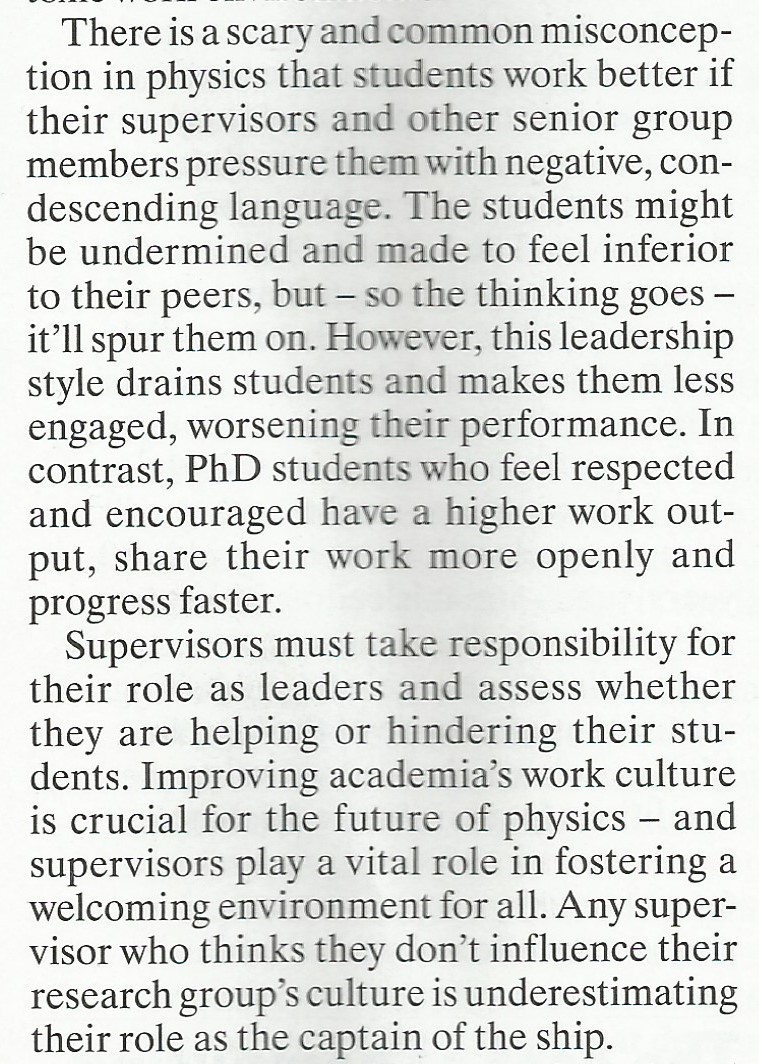
While it certainly is “scary” I don’t think the “misconception” described in the first paragraph is “widespread”, or at least I sincerely hope it isn’t. I think any supervisor who behaves in such a way towards their research students shouldn’t be allowed to have any! Does your supervisor use “negative, condescending language”? If so I think you should get a new one!

Whether or not the first paragraph is accurate, the second definitely is. It is important for a supervisor (and the rest of a research group and the rest of a department and indeed the whole institution) to try their best to create a welcoming environment for all.

I have written several times on here about my own experiences as a PhD student, most recently here. I have written much less about my experiences as a supervisor. That’s partly because I don’t feel comfortable writing about what I think should really be confidential matters relating to PhD students and partly because each student-supervisor relationship is different.

I certainly don’t think I’m any sort of role model as a PhD supervisor. Among many other failings, I have let my students down at various times when I’ve been mentally unwell and/or when struggling with workload. But I’ve always tried to be friendly and supportive, and encouraged students to look after their work-life balance.

Other than that, it has always seemed to me that it is important for a supervisor to create a healthy working relationship. It’s not simply about training an early-career researcher. The fact of the matter is that when you take on a research student it’s because there is a project you think should be done but you’re not able to do it on your own. The student should realize that their work is not some sort of prolonged test but is highly valued as an essential contribution to a project. In other words, you need the student. I have known some supervisors to act as if they are doing students a favour by taking them on, when the reality is the other way round.

Another thing that I think a supervisor should do is make it clear that they do not have a monopoly on wisdom. Students should be encouraged to question what the supervisor suggests. I always feel I’m succeeding as a supervisor when a PhD student has the confidence to say something like “I thought about what you suggested and decided it wouldn’t work so I did this instead….”

Certainly, by the end of a PhD, the student should know more about the topic than their supervisor. At the beginning, though, the supervisor will know more and it is more of a teacher/pupil relationship then. Managing the transition from that to the equal partnership it should become is tricky as it depends on individual personalities, and it doesn’t always work out. That’s not always the fault of the supervisor. On the other hand, recognizing that’s where you should be headed is at least a start.

Above all, a supervisor should try the best they can to enable the student to enjoy their PhD. I certainly enjoyed mine and I am immensely grateful to my supervisor, who is alas no longer with us, for being so kind and supportive to me during the difficult times as well as giving me such interesting projects to do.

I’m aware this is all rather vague so I’d welcome any comments either from students about how they feel their supervisor might be better or from supervisors with advice to others. The box below is at your disposal.
Last Open Day

Posted in Education, Maynooth with tags , , on June 25, 2022 by telescoper
Ready to go

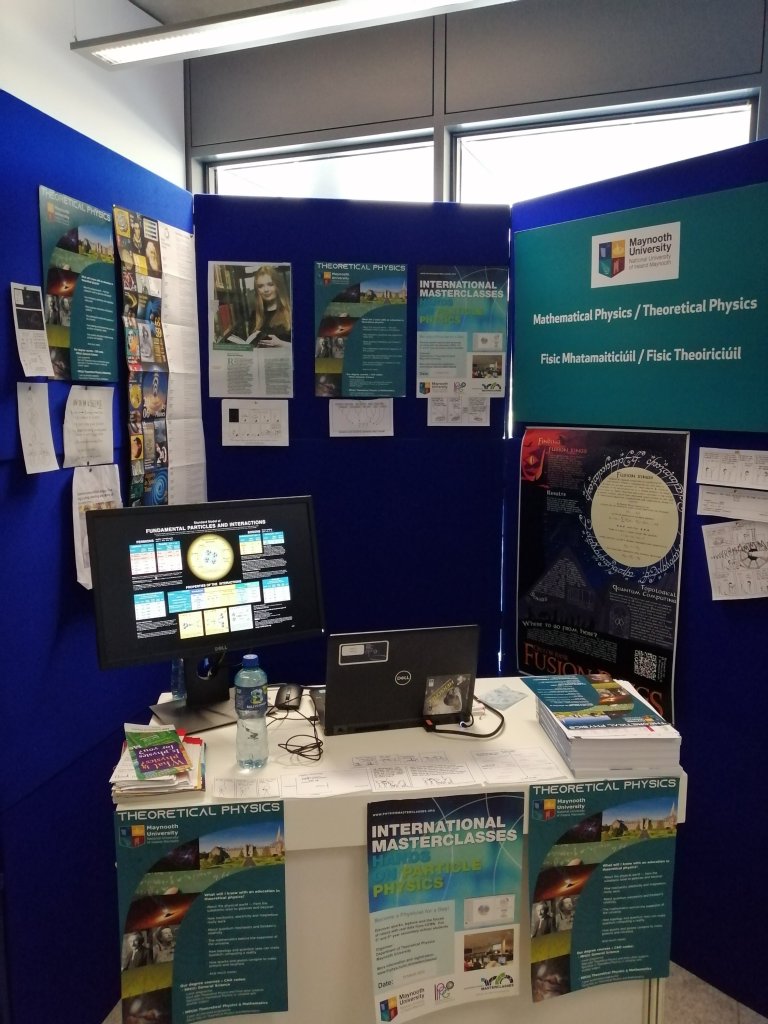
So here I am, then, back at home. I’m not at Dublin Pride because I had to attend an Open Day at Maynooth University. It was a lot quieter than the last one I did, in April, but a reasonable number attended. The weather forecast was rather dire but it turned out to be not bad at all, if a bit breezy. Hopefully that means there was good weather for Pride too.

I’m told there were 1000 registrations as opposed to the 5000 a couple of months ago. This one is usually a bit quieter because students have basically finished making their choices by now. A show of hands in the audience in my talk suggested the vast majority were actually 5th year students, so not planning to go to University this September.

Anyway, that completes the cycle of open days for this academic year. Since I’m stepping down as Head of Department when my term ends at the end of August, this will be the last of these I shall be responsible for. I hope.

Big thanks to Dale who helped out a lot today, setting up and dismantling the stand, and to him and the others who have helped over the year.

Another Late Start to the Academic Year

Posted in Education, Maynooth with tags , on June 24, 2022 by telescoper

Following on from Monday’s post about uncertainty relating to the start of next academic year, it has now been announced that this summer’s Leaving Certificate results will not be released to students until Friday 2nd September and CAO offers will be made on 8th September.

The timeline for admissions at Ireland’s third level institutions will therefore be roughly the same as last year. Although nothing has been officially announced from Maynooth yet, it seems likely that lectures for first-year students will have to commence a week later than returners just as happened last year.

This is not ideal but at least we have some basis on which to start planning. The start of the current academic year was a bit chaotic to say the least but if this year is a repeat of last at least we have some experience on what worked and what didn’t to guide us. And at least I have something reasonably concrete to say at tomorrow’s Open Day.

From the point of teaching, therefore, things are probably going to be a bit less bad than last year, at least in Maynooth. Some universities were due to start teaching on 5th September so they face a delay of 2-3 weeks.

That doesn’t mean however that things will be better for the students. They will have to wait until September until they know which course they will be on, which will cause considerable stress. On a more practical level it means that that new students will have very little time to find accommodation which is in any case in very short supply.

Now that we know the dates we will make the best plans we can for teaching, but for accommodation there doesn’t seem to be any plan at all. A crisis is looming.

The Pagan University Year

Posted in Education, Maynooth with tags , , on June 22, 2022 by telescoper

This morning we had the usual end-of-year meeting of the University Examination Board. It’s been a difficult year so it was a longer meeting than usual but it went reasonably smoothly. Marks will be released to students either tomorrow or Friday. That basically concludes the formal business for the academic year.

The proximity of this important event to yesterday’s Summer Solstice got me thinking again about the academic year and how it relates to the old pagan calendar.

In the Northern hemisphere, from an astronomical point of view, the solar year is defined by the two solstices (summer, around June 21st, and winter, around December 21st) and the equinoxes (spring, around March 21st, and Autumn, around September 21st). These four events divide the year into four roughly equal parts each of about 13 weeks.

Now, if you divide each of these intervals in two you divide the year into eight pieces of six and a bit weeks each. The dates midway between the astronomical events mentioned above are (roughly) :

  • 1st February: Imbolc (Candlemas)
  • 1st May: Beltane (Mayday)
  • 1st August: Lughnasadh (Lammas)
  • 1st November: Samhain (All Saints Day)

The names I’ve added are taken from the Celtic/neo-Pagan (and Christian terms) for these cross-quarter days. These timings are rough because the dates of the equinoxes and solstices vary from year to year. Imbolc is often taken to be the 2nd of February (Groundhog Day) and Samhain is sometimes taken to be October 31st, Halloween. But hopefully you get the point.

Incidentally, the last three of these also coincide closely with traditional Bank Holidays in Ireland, though these are always on Mondays so often happen a few days away. The first has not been a holiday but from next year there will be a new Bank Holiday that occurs on or near 1st February, which completes the set of cross-quarter-day holidays.

Anyway, it is interesting (to me) to note the extent that the academic year here in Ireland is defined by these dates.

Usually the first semester of the academic year starts on or around September 21st (Autumnal Equinox) and finishes on or Around December 21st (Winter Solstice). Half term (study week) thus includes the Halloween Bank Holiday (Samhain).

After a break for Christmas and a three-week mid-year exam period Semester Two starts on or around 1st February (Imbolc). Half-term is then around March 21st (Vernal Equinox, which roughly coincides with St Patrick’s Day March 17th) and teaching ends around May 1st (Imbolc). More exams and end of year business take us to the Summer Solstice and the (hypothetical) vacation. Most of us get to take the 1st August holiday (Lughnasadh) off at least!

So we’re basically operating on a pagan calendar.

Schrödinger’s Theatre

Posted in Education, History, The Universe and Stuff with tags , , on June 21, 2022 by telescoper

Although it’s relatively old news in Ireland, a colleague recently sent me a story from Physics World about Trinity College Dublin’s decision to change the name of its Schrödinger Lecture Theatre (to the Physics Lecture Theatre). The Provost, Fellows, Foundation Scholars and the other members of Board, of the College of the Holy and Undivided Trinity of Queen Elizabeth near Dublin (to give it its proper title) took this decision in the light of revelations about Erwin Schrödinger‘s predatory sexual conduct towards very young girls.

According to my careful research carried out by reading his Wikipedia page, Schrödinger never actually worked at Trinity College Dublin; the Theatre in question was named in his honour after he delivered his famous lectures on What is Life there in 1943.

Reactions to the decision to rename the Theatre have generated a wide range of reactions from physicists and non-physicists alike. For my part I think it is the right decision. As the Physics World article states:

As an educational institute, we cannot condone or glorify someone who abused the trust between teacher and student.

Jonathan Coleman, Head of School Physics TCD

To me this is quite different from attaching Schrödinger’s name to his equation or even his cat. His unsavoury conduct should not mean that his scientific achievements should be “cancelled” . These are and should continue to be recognized through terms like Schrödinger’s Equation. As far as I am aware, however, Schrödinger did not build any lecture theatres.

It’s up to Trinity to decide what to call its rooms, of course, but that doesn’t mean we’re not allowed to have opinions about the decision. I’d therefore invite you to express yours through the following poll:

Of course if you wish to expand on your opinion you may do so through the box below.

Timeline for Admissions

Posted in Education, Maynooth with tags , , , on June 20, 2022 by telescoper

As the current academic year comes to a close – this week sees the final Exam Board at Maynooth University – thoughts turn with some apprehension to the start of the next.

The Leaving Certificate Examinations are taking place now and will finish on 28th June, more-or-less in line with pre-pandemic times, but the results will come out later. Normally these would be released in mid-August, so the university admissions process run by CAO would start then, giving a whole month before the start of teaching term at third-level institutions.

Last year, however, the results were not released until 3rd September 2021, which made it impossible for new students to start their courses at the scheduled time. At Maynooth, for example, first-years started a week later than returning students and missed the usual orientation week. More importantly for the students, there was a last-minute scramble for accommodation that made it impossible for many students to live anywhere near campus.

Until recently I was assuming that this year would be at least as bad as last. Although the examinations have returned to the traditional format this year, the Leaving Certificate results will be delayed again, for two (connected) reasons. One is that the Minister for Education decided that this year’s results would not be lower than last year so some scaling may be necessary and the other is that it is anticipated that more students will make use of the later alternative sittings provided for those unable to take the regular sitting owing to, e.g. ill health. These are connected because if a large number of students avail of the second setting then the scaling business will have to wait until their marks have been processed.

We know that the results will be late, but we don’t know how late they will be which is a major headache. Autumn Term in Maynooth is scheduled to start on 19th September, for returning students, but at the moment we don’t know when first years will start.

Today however there is an indication that results will probably be released in ‘late August’. If that turns out to be the case then the start of next academic year will probably turn out to be no less chaotic than this year was from at least from the point of view of teaching. I’d be relieved at any outcome that is not worse than last year. It’s even possible that teaching in Maynooth can start on 19th September for all students, though I don’t think I would bet on it. Things will be even be trickier at other institutions whose teaching term starts earlier in September.

That still leaves the problem of student accommodation, though. Here I don’t think the timeline for admissions will help much in averting an entirely predictable crisis. Once we know the dates we will make the best plans we can for teaching, but for accommodation there doesn’t seem to be any plan at all.

Planning Research

Posted in Education, Maynooth on June 15, 2022 by telescoper

This summer I have two undergraduate students doing research projects with me funded under Maynooth University’s Summer Programme for Undergraduate Research (SPUR). They’re actually making Monte Carlo simulations of galaxy clustering and using them to test various statistical analysis tools. The Department of Theoretical Physics actually has five students on three different projects, which is quite a lot for a small Department. The University as a whole has 57 SPUR students so we have almost ten percent of the total!

The SPUR students are paid for the projects, which last for (usually) six weeks but can be extended. I wish we could offer these projects to every student who wanted one, actually, but we just can’t afford to do that. I don’t agree with unpaid internships as these can only be taken up by students who have access to enough income to cover living expenses over the summer, so are discriminatory. We select students based on an application and their academic performance.

Anyway, at the start of the SPUR programme students attend a briefing session (which was last Wednesday) and they have to do various tasks along the way and, at the end, construct a poster. At the beginning they have to complete an agreement and “work plan”.

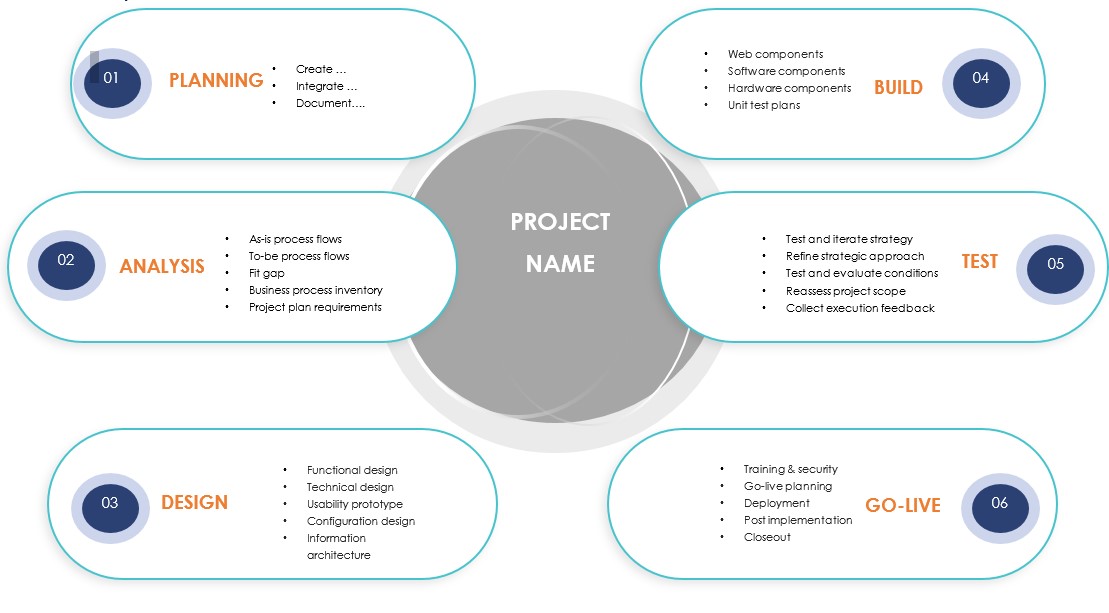
I was very amused to see the following template for a research plan in the pack given to students:

I’m at a loss to understand how any of this relates to how research is actually done in theoretical physics. The many amused reactions from colleagues when I posted this on Twitter yesterday suggest I’m not the only one. As a matter of fact, I don’t understand what many of the buzzphrases even mean. What for example are “As-is process flows”?

Obviously this template is intended for students doing business management courses in which they presumably learn to speak this language. Fortunately this is Template 3 and Template 1 just consists of a list of tasks to be done with key “deliverables” of the sort you need to complete when applying for a research grant, so my students used that.

I find it uncomfortable making detailed plans because to me the whole point of doing research is that you find things out that you didn’t expect and alter your strategy accordingly. If everything were predictable it would be a very dull project. Indeed I would say that if the outcomes were entirely predictable it wouldn’t even deserve the name “research”. Much theoretical research is accordingly rather open-ended, unlike say engineering or product design. On the other hand “give me the money and I hope to discover something interesting” is unlikely to go down well with funding panels. So you have to find a middle ground between convincing the panel that you know what you’re doing and allowing yourself space to adapt in the light of new developments. I think grant bodies in science largely understand that. Or at least I hope they do.

I had better end there as it is time for me to GO-LIVE (sic).

A Leaving Certificate Applied Maths Problem

Posted in Cute Problems, Education, mathematics with tags , on June 11, 2022 by telescoper

The 2022 cycle of Leaving Certificate examinations is under way and the first Mathematics (Ordinary and Higher) were yesterday there’s been the usual discussion about whether they are easier or harder than in the past. I won’t get involved in this except to point you to this interesting discussion based on an archive of mathematics questions, that this year the papers have more choice for students and that, apparently, the first Higher Mathematics paper had very little calculus on it.

Anyway, I was looking through some old Applied Mathematics Leaving Certificate papers, as these cover some similar ground to our first year Mathematical Physics at Maynooth, and my eye was drawn to this question from 2010 about two balls jammed in a cylinder…

I’d add another: does it matter whether or not the cylinder is smooth (as this is not specified in the question)?

Your answers are welcome through the comments box!

Exploitation and Surplus Value in Academia

Posted in Education, Maynooth with tags , , on June 7, 2022 by telescoper

After two years of Covid-19 pandemic requiring academic staff to undertake countless hours of unpaid overtime, I’m sure all my colleagues at Maynooth University, especially those whose workloads went through the roof during this time, will be as delighted as I am to learn that the University made a surplus of €13.2 million last year.

I’m reminded of a post I did a while ago about why academic publishing is so profitable. The argument I presented based on Marx’s theory of exploitation which holds not only for capitalist societies but for all class-based societies (including, e.g., feudal societies). In Das Kapital Marx argued that

…living labour at an adequate level of productivity is able to create and conserve more value than it costs the employer to buy; which is exactly the economic reason why the employer buys it, i.e. to preserve and augment the value of the capital at his command. Thus, the surplus-labour is unpaid labour appropriated by employers in the form of work-time and outputs.

The current situation certainly seems like exploitation to me, though it’s not only the staff but also the students who are being taken for a ride.

In a couple of weeks I am supposed to spend yet another Saturday (unpaid) delivering an open-day talk at which I attempt to persuade students to come to Maynooth to study Theoretical Physics. I probably won’t mention that we haven’t got enough staff to teach them effectively, we haven’t had sufficient investment to offer decent levels of teaching infrastructure (e.g. no lecture capture facilities), and they probably won’t be able to find anywhere to live near campus so won’t be able to attend lectures without lengthy commutes. I don’t suppose prospective students care about those things anyway. But I’m sure they’ll be delighted to hear about the size of the University’s surplus….

…I bet that will make them feel really good about coming to Maynooth!

On Board for Examinations

Posted in Covid-19, Education, Maynooth on June 2, 2022 by telescoper

We’ve at last managed to finish marking and collating examination scripts, coursework and project reports of various types and the provisional results are all uploaded to the system. I have to say that marking examinations on paper is much less of a chore than doing digital submissions online, though it is still not exactly a simple task and I’m glad it’s over for another year.

Tomorrow morning we’ll have a relatively informal “Pre-Board” meeting to go double-check the results and discuss any isues arising before the full Departmental Examination Board which takes place next week. That’s just for the Department of Theoretical Physics but we also do teaching for the Department of Engineering and there are Pre-Boards and Full Boards for those too.

In between now and the Full Boards we have a Bank Holiday weekend. Not the extravaganza going on over the Irish Sea concerning the Queen’s Platinum Jubilee, just the regular Lá Saoire i mí Mheitheamh we have every year. In any case, there’s more than one old Queen having a celebration this weekend. A nice thing about living in Ireland is that my birthday is always in close proximity to a national holiday.

But I digress.

The Departmental Examination Boards do not quite mark the end of the examinations business for the academic year, as we have the Final Final Examination Board after all the Departmental ones.  That is when marks from all Departments come together to determine the final results for students who are taking degrees in combinations of subjects. The Department of Theoretical Physics has quite a number of students doing Joint Honours with Mathematics, for example, and we don’t won’t know their final results until we see how their Mathematics has gone. It does add an extra level to the process, but I think that’s a price worth paying for the flexibility we offer to students through joint programmes.

This final Examination Board takes place on 22nd June and students will get their marks a couple of days later on 24th June. We have an official Consultation Day (28th June) the following week during which students can get feedback on their examinations as well as discussing options for choices to be made ahead of next year. Even that won’t be the end, because some students will be taking repeat examinations in August, but at least it signals a gap in the assessment cycle during which we can hopefully think of other things for a while.

This year has been challenging, to say the least. There was a piece in the Irish Times recently discussing concerns about lack of student engagement, poor lecture attendance and high dropout rates for students in Irish universities. I discussed some of the reasons for this here. Obviously, until our results are finalized I can’t say anything specific about the impact of all these difficulties on our students, but the post-Covid turmoil undoubtedly has had a significant impact on many students and a severe impact on some. It remains to be seen precisely what the scale of the problem is and what we can do to mitigate it.

The general turbulence in the wake of the pandemic, which is unavoidable, has been exacerbated in my Department by serious staffing issues resulting from deliberate management decisions. This combination has created a perfect storm which in my view could easily have been avoided. I shall refrain from commenting further, except to say that it will take some time to sort out and we’ll probably have similar – though hopefully less severe – issues next year.

One of the difficulties faced by students this summer is that they would not have done traditional written examinations for two years before this May’s set. The online timed assessments we deployed during the pandemic were of “open-book” style but the unseen written papers on campus are not. The challenge posed by these two types of examination are different, and it remains to be seen how well the students – especially those in Years 1 and 2 – have coped with the abrupt switch. Those who get disappointing results will have the opportunity to take repeat examinations (on campus) and those who disengaged entirely will have the chance to repeat the year in full if they so desire, so all is not lost!

Another sign of our gradual emergence from the pandemic is that our Examination Board meeting next week will be attended in person by the External Examiner. She wasn’t able to get here last year owing to  illness so it will be nice to have her present at the Exam Boards and, hopefully, at dinner afterwards.