Archive for the Education Category

Loose Ends of the Academic Year…

Posted in Biographical, Education, Maynooth with tags , , , , , , , , , on August 13, 2025 by telescoper

I know most people outside academia thing university staff are on a long holiday between June and September, but that’s not the case. This week we have been trying to sort out some of the loose ends of Academic Year 2024/5 before we start on planning for 2025/6. The matters to be dealt with include undergraduate, taught postgraduate, and research posgraduate.

To start with I’ve had to mark my undergraduate repeat (resit) examinations. The grades need to be checked and uploaded before the appropriate examination board meeting next week. That will resolve a number of progression issues, as well as hopefully allowing some students to retrieve credit from their final year and thus be allowed to graduate.

Another set of tasks related to our taught MSc students. They submitted their dissertations on Monday which now need to be read and graded before another examination board (next Monday). They also have to do their presentations, which take place this Friday (15th August).

The following week, the School leaving certificate results come out, at which point we’ll start to get some idea of how many students we will have entering the first year in September.

Today I heard that my PhD student Aoibhinn, who passed her viva voce examination way back in May, has had her thesis corrections formally approved. She now has to submit a bound copy of the thesis along with an electronic version thereof by September 6th at the latest. Then her degree has to be approved by the Faculty of Science & Engineering (on September 16th) followed by Academic Council on (29th September). Assuming those formalities are observed, she can receive her doctorate at one of the conferring ceremonies at the end of October.

Another thing I heard today is that Aoibhinn has been awarded a prestigious research fellowship from the Alexander von Humboldt Foundation but she needs her degree certificate before she can start. That’s a stricter policy than elsewhere, but it is Germany. It’s a bit frustrating, but that particular loose end will definitely be tied soon enough, after which Aoibhinn will be off to Germany for two years. Fortunately the start date of the fellowship is flexible. Congratulations to Aoibhinn!

Generative AI in Physics?

Posted in Artificial Intelligence, Education, mathematics, Maynooth with tags , , , , , , , , , on August 11, 2025 by telescoper

As a new academic year approaches we are thinking about updating our rules for the use of Generative AI by physics students. The use of GenAI for writing essays, etc, has been a preoccupation for many academic teachers. Of course in Physics we ask our students to write reports and dissertations, but my interest in what we should do about the more mathematical and/or computational types of work. A few years ago I looked at how well ChatGPT could do our coursework assignments, especially Computational Physics, and it was hopeless. Now it’s much better, though still by no means flawless, and now there are also many other variants on the table.

The basic issue here relates to something that I have mentioned many times on this blog, which is the fact that modern universities place too much emphasis on assessment and not enough on genuine learning. Students may use GenAI to pass assessments, but if they do so they don’t learn as much as they would had they done the working out for themselves. In the jargon, the assessments are meant to be formative rather than purely summative.

There is a school of thought that has the opinion that formative assessments should not gain credit at all in the era of GenAI since “cheating” is likely to be widespread. The only secure method of assessment is through invigilated written examinations. Students will be up in arms if we cancel all the continuous assessment (CA), but a system based on 100% written examinations is one with which those of us of a certain age are very familiar.

Currently, most of our modules in theoretical physics in Maynooth involve 20% coursework and 80% unseen written examination. That is enough credit to ensure most students actually do the assignments, but the real purpose is that the students learn how to solve the sort of problems that might come up in the examination. A student who gets ChatGPT to do their coursework for them might get 20%, but they won’t know enough to pass the examination. More importantly they won’t have learnt anything. The learning is in the doing. It is the same for mathematical work as it is in a writing task; the student is supposed to think about the subject not just produce an essay.

Another set of issues arises with computational and numerical work. I’m currently teaching Computational Physics, so am particularly interested in what rules we might adopt for that subject. A default position favoured by some is that students should not use GenAI at all. I think that would be silly. Graduates will definitely be using CoPilot or equivalent if they write code in the world outside university so we should teach them how to use it properly and effectively.

In particular, such methods usually produce a plausible answer, but how can a student be sure it is correct? It seems to me that we should place an emphasis on what steps a student has taken to check an answer, which of course they should do whether they used GenAI or did it themselves. If it’s a piece of code to do a numerical integration of a differential equation, for example, the student should test it using known analytic solutions to check it gets them right. If it’s the answer to a mathematical problem, one can check whether it does indeed solve the original equation (with the appropriate boundary conditions).

Anyway, my reason for writing this piece is to see if anyone out there reading this blog has any advice to share, or even a link to their own Department’s policy on the use of GenAI in physics for me to copy adapt for use in Maynooth! My backup plan is to ask ChatGPT to generate an appropriate policy…

Good Luck in Your Repeat Exams!

Posted in Education, Maynooth with tags , , , on August 6, 2025 by telescoper

Since the repeat examination period at Maynooth University starts today, Wednesday 6th August, I thought’d I’d send a quick message for students taking one or more exams…

Autumn Repeats

Posted in Education, History, Maynooth with tags , , , , , on August 5, 2025 by telescoper

As I mentioned yesterday, it is almost time for the repeat examination period to begin once again. In fact the first papers are due tomorrow (6th August). A couple of years ago, Maynooth University produced this nice good luck message for those resitting so I’ll repeat it here:

I was a bit surprised when I first arrived here in Ireland that the August repeat examinations are called the Autumn Repeats. After all, they happen in August which is generally regarded as summer rather than Autumn. The term is, I think, a relic of the old Celtic calendar in which the start of Autumn coincides with the start of harvesting, the old festival of Lúnasa being when people celebrated the Celtic deity Lugh, who would bring a good harvest or who, if not satisfied, could bring his wrath to bear in storms that would mess everything up. Lúnasa is the name for August in modern Irish; Lá Lúnasa is 1st August, and the first Monday in August (Lá Saoire i mí Lúnasa) (yesterday) is a Bank Holiday.

Anyway, the repeat examinations start tomorrow and go on for ten days or so, I will have four different papers to grade, though I’m expecting only one candidate each for three of them.

Every year at this time I mention the difference between the system of repeats in Maynooth compared to other institutions with which I am familiar, especially in the UK. Elsewhere, students generally take resits when, because they have failed one or more examinations the previous May, they have not accumulated sufficient credits to proceed to the next year of their course. Passing the resit allows them to retrieve lost credit, but their mark is generally capped at a bare pass (usually 40%). That means the student gets the credit they need for their degree but their average (which determines whether they get 1st, 2nd or 3rd class Honours) is affected. This is the case unless a student has extenuating circumstances affecting the earlier examination, such as bad health or family emergency, in which case they take the resit as a `sit’, i.e. for the first time with an uncapped mark.

Here in Maynooth, however, the mark obtained in a repeat examination is usually not capped. Indeed, some students – though not many – elect to take the repeat examination even if they passed earlier in the summer, in order to increase their average mark.

Some people don’t like the idea of uncapped repeats because they feel that it would lead to many students playing games, i.e. deliberately not taking exams in May with the intention of spreading some of their examination  load into August. The Institute of Physics has decided to impose capped resits as part of its accreditation requirements. Some people here seem to think IOP accreditation is worth having so we’re being pushed into that requirement. I find it heavy-handed and unhelpful. It is also unimportant unless you want to do postgraduate study in physics in the UK. It doesn’t matter at all anywhere else.

If you think students have an unfair advantage if they don’t take a full diet of examinations in May, then the logical conclusion is that part-time students have an unfair advantage as do students taking micro-credentials consisting of just one or two modules. It’s the essence of the modular system that each module result should be considered on its own merit, not in relation to other modules a student may or may not have taken at the same time. One can of course argue whether the modular system is good or not, but if you have it then you should act consistently in accordance with it. You wouldn’t penalize students who have to work to support their study relative to those who don’t, would you?

And there’s no real evidence of students actually playing the system in the way the IOP thinks they do anyway. For one thing the results from the repeat examination period are not confirmed until early September so that students that deploy this strategy do not know whether they are going to be able to start their course until just a couple of weeks before term. That could cause lots of problems securing accommodation, etc, so it doesn’t seem to me to be a good ploy. Finallists adopting this strategy will not be able to graduate with the rest of their cohort and may miss several months of potential employment. I think most of our students are smart enough to realize that it’s a risky strategy.

Anyway, I’d welcome comments for or against whether resits/repeats should be capped/uncapped and on what practice is adopted in your institution.

Lá Saoire i mí Lúnasa

Posted in Biographical, Education, mathematics, Maynooth with tags , , , , on August 4, 2025 by telescoper

Today, Monday 4th August 2024, being the first Monday in August, is a Bank Holiday in Ireland. This holiday was created by the Bank Holiday Act of 1871 when Ireland was under British rule. While the August Bank holiday was subsequently moved to the end of August in England and Wales, it has remained at the start of August in Ireland.

We have had some proper Bank Holiday weather, in the form of Storm Floris. Although the worst of this passed to the West of Maynooth, the winds were powerful enough to blow one of my wheelie bins over.

As I mentioned last week, the first day of August marks the old pagan festival of Lughnasadh, named after the God Lugh, on which is celebrated the beginning of the harvest season. This coincides with the English Lammas Day, one of many Christian festivals with pagan origins. Traditionally this is the start of the harvest season and is celebrated accordingly, with rites involving the first fruit and bread baked from flour obtained from the first corn. It is also one of the cross-quarter days, lying roughly half-way between the Summer Solstice and the Autumnal Equinox (in the Northern Hemisphere).

I’m reminded that this time last year I was still on sabbatical. That seems like ages ago. When I resumed teaching last September I had to teach two modules I’d never taught before: a fourth-year Mathematical physics course on Differential Equations and Complex Analysis and a second-year Engineering Mathematics course. This time should be a bit easier as I get to do both of these again. Over the year I also had a final-year undergraduate project student and an MSc student. Both have been a pleasure to work with. The Masters course lasts a calendar year so that one isn’t quite finished, but the deadline for handing in their dissertation is close, next Monday (11th) in fact.

After I return to work tomorrow the next big item on the agenda is the repeat examination period, which starts on Wednesday August 6th. The fates have conspired to require me to be “on call” for four papers next Saturday (two of my own and two covering for a colleague): three of these are scheduled at 12.30 and the other one at 15.30 so I’l have to be by the phone all afternoon in case any matters arise. I also have three others scattered through the approximately ten days of the examination period.

After the repeat examinations are done, the marks uploaded, and the Examination Board has done its work, the next job will be to prepare for the new intake of students. This year’s Leaving Certificate results will be announced on Friday 22nd August, at which point we’ll see how many students (if any) we have studying Physics next academic year which, if all goes to plan, will be my antepenultimate…

Masters from Cambridge

Posted in Biographical, Education with tags , , , on July 23, 2025 by telescoper

A few weeks ago, after I posted an item about it being 40 years since I graduated from the University of Cambridge, I was talking to some students. The main subject was that the primary route for becoming a research student is to do an undergraduate degree (Bachelors) followed by a taught postgraduate programme (Masters) before starting a PhD or equivalent. In the course of that discussion I mentioned that I skipped the middle step and went straight from my (three-year) BA at Cambridge to my DPhil at Sussex. Nevertheless, I have got a Masters degree: MA (Cantab), to be precise.

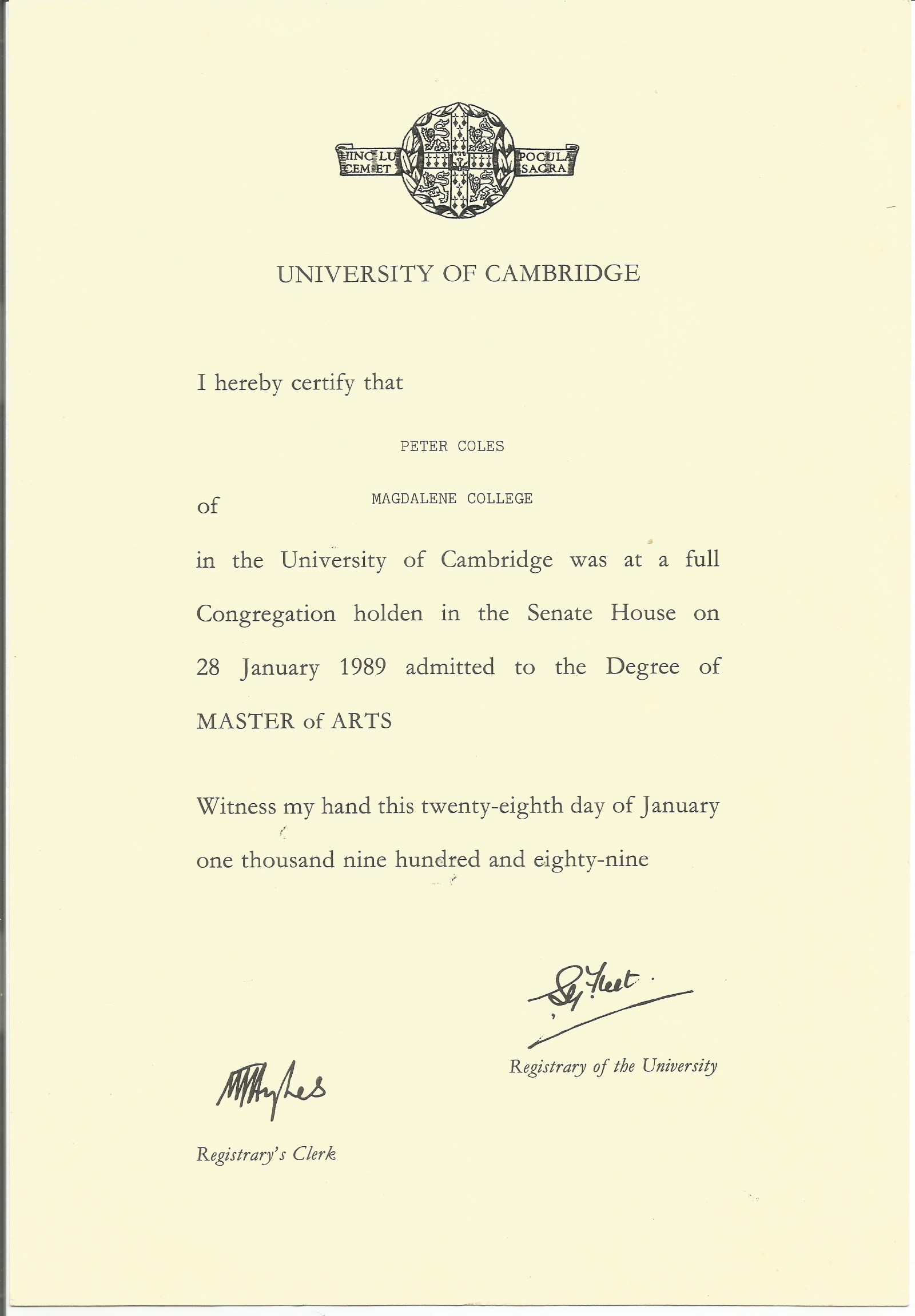
I had to explain that if you graduate from the University of Cambridge then all you have to do is wait a few years and then your B.A. automatically becomes an M.A. In my memory I received news of this just a year or two after graduation but this evening I found the correspondence and it was later than that:

By December 1988 I’d already finished my DPhil thesis, though I wasn’t formally awarded the degree until the following July. I didn’t turn up to the graduation ceremony, of course. I had done at least some work for my B.A. but did nothing at all for my M.A. except survive for three and a half years. Neverthless, I still have the stiff ticket (right) which I show here alongside my B.A. certificate (left) to demonstrate that it looks just like a proper degree certificate even though it is, frankly, a bit of a fraud.

I bet our MSc students currently hard at work on their dissertations wish that theirs were so easy!

By the way, having an MA also gives you (limited) dining rights in College. I’ve never once availed myself of this privilege.

A Reminder to Vote for Wyn Evans as Chancellor of Cambridge University

Posted in Education, Harassment Bullying etc with tags , , , on July 17, 2025 by telescoper

Here’s a message for Alumni of Cambridge University!

Tomorrow (18th July) is the last day registered electors can vote online for Prof. Wyn Evans as Chancellor of the University. If you’ve registered then please don’t forget to vote! You have until 5pm tomorrow.

Here’s a post outlining the reasons why you should vote for Wyn.

In-person voting in Cambridge has already closed.

The word on the street in Cambridge is that the election will be won by Lord Browne. The Masters of many of the richest Colleges (Trinity, St Johns) have come out in his favour despite his tarnished reputation. The likelihood that the post of Chancellor of the University of Cambridge will be filled by someone so eminently unsuitable has prompted an open letter by academics (any academic can sign, not just Cambridge).

Why anyone would think that Lord Browne is an appropriate choice is completely beyond me. The letter clearly identifies the main reason why he would be a terrible choice; he is one of the key individuals associated with ushering in the present funding regime, which has led to students graduating with huge debts and many UK universities currently facing financial ruin.

Update: Unfortunately, Wyn didn’t win. Lord Browne didn’t either. The new Chancellor of Cambridge University is Chris Smith (currently Master of Pembroke College, Cambridge). It seems the electorate went with the tradition of electing a political has-been.

Heatwave

Posted in Biographical, Education with tags , , , on July 12, 2025 by telescoper

So here I am, back from a sweltering London to an almost-as-sweltering Maynooth. It was 33 degrees where I was in London yesterday and 30 degrees here in Maynooth earlier today, though it is now cooling slightly. Such a temperature is very unusual for this part of the world.

I was visiting South Kensington Technical College Imperial College for the last couple of days, working there. The surrounding area is of course looked very posh and looked resplendent in the summer sun. The area around the Museums was very busy with tourists, but it was nice to see people out and about, enjoying themselves in the sunshine.

I had hoped to publish a few OJAp papers on Wednesday morning before leaving for the airport. Unfortunately, as explained here, Crossref was offline all day Wednesday so I couldn’t do that. I caught up on Thursday morning by getting up before 6am and publishing 4 papers before heading down for a very nice hotel breakfast at 7am.

The journey to London on Wednesday didn’t get off to a very good start. My Aer Lingus flight from Dublin was delayed for an hour waiting the arrival of the aircraft from, of all places, Barcelona. Worse was to follow. I had decided to take the tried-and-trusted route from Heathrow Terminal 2 to South Kensington via the Piccadilly line. All went well until we approached Acton Town when the driver explain that there was a signal failure ahead at Covent Garden which meant the line in front was congested. Thereafter we inched along waiting for a succession of red lights to clear. The Piccadilly line has rather old trains without air conditioning, so it was like sitting in a slowly-moving sauna. Then we reached Turnham Green (where the train was not supposed to stop), and the driver opened the doors to give us a bit of fresh air. I spotted a District Line train to Upminster on the other side of the platform. That line does not go through Covent Garden so I dashed across and took it for the rest of the journey. I got to my hotel about 90 minutes later than planned, but not late enough to miss the welcome dinner at Ognisko, a very nice Polish restaurant.

Fortunately the hotel the Imperial staff had booked for me was very nice, and had good airconditioning. The rest of my stay was very pleasant, if intense. I even got back to Dublin on schedule yesterday evening and had time to go to the shops to get something for dinner last night and breakfast this morning.

Now that I’m back I have a report to write, but that can wait until tomorrow. Today I have to attend to a thirsty garden.

40 Years a Graduate

Posted in Biographical, Education, Maynooth with tags , on July 4, 2025 by telescoper

The summer examinations at Maynooth being over and the finalists having received their degree results I was reminded that I’d missed the anniversary of my own graduation. The main reason for that is that I couldn’t remember the date. I thought it was in July, actually, but rummaging through my files reminded me that it was on Saturday 22nd June 1985. Maynooth graduands will have to wait until September at the earliest for their conferring ceremony.

The degree certificate, incidentally, is not at all fancy. The only thing that surprised me about it was that it’s not in Latin!

The Stiff Ticket for my Degree

The one I got when I collected my DPhil from Sussex University is far more elaborate. It’s also worth mentioning that although I did Natural Sciences (specialising in Theoretical Physics), the degree I got was Bachelor of Arts.

I don’t remember much about the Cambridge graduation, perhaps because the previous evening (Friday 21st June) we were plied with alcohol at the MacFarlarne-Grieve Dinner (a special event for graduands), then finished up in The Pickerel, the closest pub to the College. Our ceremony started at 9.15am and I wasn’t the only person graduating with a hangover.

The whole ceremony was dpme in Latin (or was when I graduated) and involved each graduand holding a finger held out by their College’s Praelector and then kneeling down in front of the presiding dignitary, i.e. either the Vice-Chancellor or Deputy Vice-Chancellor. I can’t remember which.  The magic formula that turns a graduand into a graduate is:

Auctoritate mihi commissa admitto te ad gradum Baccalaurei in Artibus, in nomine Patris et Filii at Spiritus Sanctii

Other than that, and the fact that the graduands had to walk to the Senate House from their College through the streets of Cambridge,  I don’t remember much about the actual ceremony.

After the ceremony we returned to Magdalene College for a garden party. I found this quite stressful, because my parents had divorced some years before and my Mum had re-married. My Dad wouldn’t speak to her or her second husband. At the garden party, the two parts of my family occupied positions at opposite corners of the lawn and I scuttled between them trying to keep everyone happy. It was like that for the rest of the day and I was glad when it was all over.

Anyway, the following October I started as a research student at the University of Sussex doing a Doctorate in Philosophy. I finished my thesis in 1988. Those three years were hard work but, on the whole, very enjoyable. I have a similar length of time in front of me before I retire. By the end I’ll have had 40 years in higher education (29 in the UK and 11 in Ireland). Hopefully, by then I’ll have figured out what to do when I leave University.

MSc in Theoretical Physics & Mathematics at Maynooth

Posted in Education, Maynooth, The Universe and Stuff with tags , , on July 1, 2025 by telescoper

Today is Consultation Day here at Maynooth University and, in the course of being consulted, I was reminded that this period, being immediately after undergraduate final results are released to students, is a potentially a good time to advertise our local postgraduate course to prospective applicants.

I therefore decided o use the medium of this blog to advertise the fact that the MSc in Theoretical Physics & Mathematics at Maynooth University is open to applications for entry in September 2025.

This postgraduate course is run jointly between the Departments of Physics and Mathematics & Statistics, with each contributing about half the material. The duration is one calendar year (full-time) or two years (part-time) and consists of 90 credits in the European Credit Transfer System (ECTS). This is split into 60 credits of taught material (split roughly 50-50 between Theoretical Physics and Mathematics) and a research project of 30 credits, supervised by a member of staff in a relevant area from either Department.

This course is a kind of follow-up to the existing undergraduate BSc Theoretical Physics & Mathematics at Maynooth, also run jointly. We think the postgraduate course will appeal to many of the students on that programme who wish to continue their education to postgraduate level, though applications are very welcome from suitably qualified candidates who did their first degree elsewhere.

You can register your interest by scanning the QR code above or, if you prefer, simply following the link here. You can apply directly to the postgraduate application portal here.