Archive for the Education Category

Pointless Postscript

Posted in Biographical, Education with tags , , on August 5, 2021 by telescoper

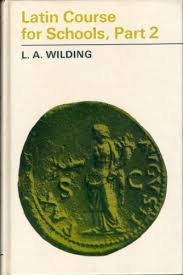
Since my recent post about Latin I’ve been wracking my brain trying the remember the textbook we used at school to learn Latin grammar. Now, with the aid of an old school friend, I know the answer:

Part 2 took us up to O-level, but I think we used Part 1 in earlier years alongside the Cambridge Latin Course featuring the famous character Caecilius:

Caecilius was a resident of Pompeii and he snuffed it during the eruption of Vesuvius at the end of the first set of (orange) books, but the course continued with different characters in different coloured books including one set based in Britain.

The books by Wilding are very traditional grammar school texts. They weren’t easy going for us kids, and were quite formal and with some difficult exercises. They’re probably too old-fashioned to be in use now, but I’m tempted to acquire copies to see how much I remember!

Thoughts of Return

Posted in Biographical, Covid-19, Education, Maynooth on August 4, 2021 by telescoper

So here I am sitting at home supervising my first online repeat examination supplemental assessment. I’ve only had a couple of minor queries so I’ve been able to get on with other things, among which I noticed that according to the news Universities and Colleges in Ireland have announced that

The rapid progress in the Covid vaccination programme has injected a new level of confidence about maximising the return to higher education, and preparations are at an advanced stage.

That’s great. Presumably at some point the University authorities will communicate these preparations which are at an advanced stage to the staff who will have to implement them. I would have thought we might get to hear about them before they are presented to the media, but perhaps the details for Maynooth haven’t been worked out yet. In which case they’re not really advanced. Or perhaps the plan will be what it has been throughout the pandemic: leave everything to Heads of Department to sort out.

The press release is here by the way. What it contains is rather vague but it does contain some specific things about staggered start and end times for lectures and contraflow into and out of buildings, so if we’re going to do that we’ll have to know what it involves. I am mindful however of the debacle last year when we made elaborate plans that then had to be ditched when the Covid-19 situation deteriorated. After getting my fingers burned that way last year I’m going to wait until the last possible moment before making concrete plans.

While I’m very happy about the prospect of returning to campus I’ve suddenly realized my positive feelings are tempered with a strange and unfamiliar sense of anxiety. The first teaching sessions of next academic year are in the week beginning September 20th. At that point it will have been 18 months since I last stood up in front of a full lecture theatre. It will be a strange experience after such a long period during which I’ve been doing my teaching by talking into a camera. Will I be able to remember how to do it? I think I’ll be quite nervous, actually. I don’t normally get nervous when giving lectures but already feel it. Perhaps it will pass.

Another thing that occurred to me is that as well as the brand new intake I will have students in my second year whose faces I’ve never seen!

Anyway, all that’s for next month. For the time being it’s back to the repeat examinations. While I’ve been typing this, two have been submitted….

Repeat Message..

Posted in Education, Maynooth with tags , , , on August 3, 2021 by telescoper

Back to work after yesterday’s Bank Holiday and almost immediately it’s the repeat examination period at Maynooth University, which starts tomorrow. Technically these examinations are called supplemental assesssments, but we generally call them repeats.

My first supplemental assessment is tomorrow afternoon, actually. I have another on Thursday and three next week. All these papers are to be held online as has been the case for the past year and a bit. Perhaps the next set of examinations in January 2022 will be back to normal, but we have to wait and see about that.

The main purpose of writing this post was to wish all students taking exams this month the very best of luck!

I also thought it was worth mentioning for any university teachers out there reading this that although they are held at roughly the same time of year in the two countries there’s a difference in the way resits are handled in the institutions I’ve worked at in the United Kingdom and the way repeats work here in Maynooth which is implied by the slightly different name.

In UK institutions with which I am familiar students generally take resits when, because they have failed one or more examinations during the year,  they have not accumulated sufficient credits to proceed to the next year of their course. Passing the resit allows them to retrieve lost credit, but their mark is generally capped at a bare pass (usually 40%). That means the student gets the credit they need for their degree but their average (which determines whether they get 1st, 2nd or 3rd class Honours) is negatively affected.

This is the case unless a student has extenuating circumstances affecting the earlier examination, such as bad health or family emergency, in which case they take the resit as a `sit’, i.e. for the first time with an uncapped mark.

Here in Maynooth, repeat examinations are generally taken for the same reasons as in the UK but the mark obtained is not capped. Indeed, some students – though not many – elect to take the repeat examination even if they passed earlier in the summer, in order to increase their average mark. Because of the difficult circumstances this year the usual fees for a repeat examination are waived for Maynooth students this time, but I haven’t seen a noticeable increase in the number of students taking repeat papers.

When I’ve told former UK colleagues that our repeat examinations are not capped they generally  don’t  like the idea because they feel that it might lead to many students playing games, i.e. deliberately not taking exams in May with the intention of spreading some of their examination load into August. There’s not much sign of students actually doing that here, to be honest, for the reason that the results from the repeat examination period are not confirmed until early September so that students that deploy this strategy do not know whether they are going to be able to start their course until a couple of weeks before term. That could cause lots of problems securing accommodation, etc, so it doesn’t seem to me to be a good strategy.

I’d welcome comments for or against whether resits/repeats should be capped/uncapped and on what practice is adopted in your institution(s).

On Lúnasa

Posted in Biographical, Education, History, Irish Language, Maynooth on August 1, 2021 by telescoper

It’s the first of August which means it is the ancient Celtic festival of Lughnasadh (which, in modern Irish, is Lúnasa). This coincides with the English Lammas Day one of many Christian festivals which have pagan origins. Traditionally 1st August marks the start of the harvest season and is celebrated accordingly, with rites involving the first fruit and bread baked from flour obtained from the first corn.

Tomorrow being the first Monday in August it is a Bank Holiday in Ireland called Lá Saoire i mí Lúnasa. This holiday was created by the Bank Holiday Act of 1871 when Ireland was under British rule. While the holiday was subsequently moved to the end of August in England and Wales it has remained at the start of August in Ireland, which is a far better place for it in my opinion.

In the Northern hemisphere, from an astronomical point of view, the solar year is defined by the two solstices (summer, around June 21st and winter, around December 21st) and the equinoxes (spring, around March 21st, and Autumn, around September 21st). These four events divide the year into four roughly equal parts of about 13 weeks each.

Now, if you divide each of these intervals in two you divide the year into eight pieces of six and a bit weeks each. The dates midway between the astronomical events mentioned above are (roughly) :

  • 1st February: Imbolc (Candlemas)
  • 1st May: Beltane (Mayday)
  • 1st August: Lughnasadh (Lammas)
  • 1st November: Samhain (All Saints Day)

The names I’ve added are taken from the Celtic/neo-Pagan (and Christian terms) for these cross-quarter days. These timings are rough because the dates of the equinoxes and solstices vary from year to year. Imbolc is often taken to be the 2nd of February (Groundhog Day) and Samhain is sometimes taken to be October 31st, Halloween. But hopefully you get the point.

Incidentally, the last three of these also coincide closely with Bank Holidays in Ireland, though these are always on Mondays so often happen a few days away. I find it intriguing that the academic year for universities here in Ireland is largely defined by the above dates dates.

The first semester of the academic year 2021/22 starts on September 20th 2021 (the Autumnal Equinox is on September 22nd) and finishes on 17th December (the Winter Solstice is on December 21st ).  Halloween (31st October) is actually a Sunday this year so the related bank holiday is on Monday 25th October; half term (study week) always includes the Halloween Bank Holiday. The term is pushed forward a bit because it finishes on a Friday and it would not be acceptable to end it on Christmas Eve!

After a break for Christmas and a three-week mid-year exam period Semester Two starts 31st January 2022. Half-term is then from 14th to 18th March (the Vernal Equinox; is on March 20th) and teaching ends on May 6th.  More exams and end of year business take us to the Summer Solstice and the (hypothetical) vacation.

So we’re basically operating on a pagan calendar.

Another tradition seems to be that examinations come straight after bank holidays, both in May and August. The repeat examination period begins on August 4th this year. You can interpret that in two ways: one is that students have a guaranteed day off to do revision; the other is that the bank holidays in May and August are ruined by the need to prepare for exams…

The Joy of Latin

Posted in Biographical, Education, Politics with tags , , , on July 31, 2021 by telescoper

This morning I noticed a story in the Guardian that Latin is to be taught in 40 UK state secondary schools had provoked some rather extreme reactions on social media. I hesitated to comment on this lest it appear that I have any respect or confidence in Gavin Williamson (who is undoubtedly one of the stupidest politicians in living memory) or that I don’t think there may be better things on which to spend £4m, but I have to say that I don’t think this is as stupid an idea as many people seem to think.

For what it’s worth I think that learning Latin (which I did from age 11 to O-level at aged 16, where which it was my best subject. If you’re interested here is the examination paper I took way back in 1979:

I not only enjoyed it enormously but also found it useful for learning other languages as well as helping to understand English grammar. There are many aspects of the English language that I only understood when I learned about them in Latin, and that also helped me with French and German where things like the subjunctive are much more obvious than they are in English and also much more precise, which makes them easier to identify and understand.

Latin has important elements in common with a great many Indo-European languages besides the obvious Italian, Spanish and French, including the Germanic languages (which include English). I did French to O-level too, by the way, but only did one year of German because I wasn’t allowed to do three languages to O-level alongside the full complement of science and mathematics. I have managed to get by during my frequent visits to Italy pretty well without having formally studied any Italian, though I find it easier to read and listen to Italian than to speak it. I have to say, though, that Latin hasn’t helped me much at all in my struggles to learn Irish…

Above all, though, learning Latin taught me that as well as being a tool for communication, language is fascinating in itself. There are strong connections between linguistics and genetics, for example – ideas in genetics on how you can work backwards from common elements in current diverse populations to the “last common ancestor” came from historical linguistics.. Languages evolve through mutation and intermingling in much the same way that populations do.

The relationships between different languages are deep and mysterious but studying their common structures helps bring them to light. That’s how the physical sciences work too…

It has long been an intention of mine to try to re-learn Latin when I retire and have a go at translating some old texts into English. It’s much easier to learn new languages when you are young but hopefully having done it when I was young it might come back reasonably easy. I remember quite a lot actually, but need more practice. Perhaps I’ll get the time before too long.

P. S. I’ve heard it said that, instead of teaching the Latin language in schools, students would be better off learning Latin dance, e.g the tango. My response to that is that “tango” is the first person singular in the present indicative of the Latin verb “tangere” (to touch)…

New Term Ahead!

Posted in Biographical, Covid-19, Education, Maynooth with tags , , on July 28, 2021 by telescoper

I know that there are quite a few people out there who think the summer is one long holiday for academic staff. Well, it may still be July but after my 10 days away that’s the holidays over as far as I’m concerned. Still, ten days’ summer holiday is ten days more holiday than I got last summer.

Next week the Repeat Examination period begins; it lasts from 4th August to 14th August. Once again these examinations are online and once again they have to be supervised by a member of academic staff. I have five paper scheduled and have to be at the screen for all of them. Then there’s the marking, checking, collation and uploading of the marks which must be done by 18th August. After that there’s an Examination Board before the final submission of all the repeat exams by August 23rd.

Incidentally, I was just checking over my Semester 1 repeat examinations and it seems like decades since I taught those modules last Autumn! The pandemic has played havoc with the perception of time!

After the Repeat Examinations are done, I have the unenviable task of preparing teaching for the next academic year. Although I’m stepping down as Head of Department of Theoretical Physics at the end of September I am still in that position until then so that task falls to me. Quite apart from the continuing uncertainty about what the Covid-19 situation will be like at the start of term (20th September), I have to deal with the fact that three out of our six full-time permanent lecturers are not available for next year. One is retiring this summer, one is departing for a position in Germany and another is on sabbatical.

The appointment of a temporary lecturer to provide sabbatical cover is normal, but the two other departures have not been replaced with permanent staff but by two one-year temporary lecturers. None of these new staff will be in post until 1st September but will have to teach a full complement of modules from 20th September onwards. Half our modules will therefore have to be reassigned, which means that the organization of teaching for the new academic year is not just the usual slight rearrangement of the previous year’s assignments but a major overhaul.

Losing two of our permanent staff to be replaced by temporary staff will of course have a negative impact on our research but that doesn’t seem to be important.

On top of al this the University is pressing ahead with a complete reorganization in the form of a merger of the Departments of Theoretical Physics and Experimental Physics which it intends to force through by 1st October 2021…

While glad that we may at last be emerging from the pandemic I’m dreading the next two months, not only because of the huge amount that has to be done by the end of September, but also because I think that period is going to set the scene for the longer-term future. I know I’m not the only academic who fears the massively increased workload dumped on us during the pandemic is going to become, to use a hackneyed phrase, “the new normal”.

Interaction in Lectures

Posted in Biographical, Education on July 6, 2021 by telescoper

There’s been dismay among many students at the University of Manchester at the news that said institution is planning to keep lectures online next year. If the reason for that decision were that campuses are likely to be closed again by September then I would consider it wise, but it seems this is to be a permanent thing; see the following excerpt.

The clear assumption here is that large lectures never involve interaction. I can think of many colleagues besides myself who would object to that most strongly. Even in a big lecture hall interaction is key to the learning experience. The thing the above statement misses entirely is the extent to which the presence of an audience actually helps the lecturer to improve the learning experience for the students. It’s astonishing to me that the person quoted above seems to think interaction only happens in one direction! On the contrary, a lecture is – or should be – a shared experience between lecturer and students.

If you think about it is a very strange situation when someone stands up in front of a bunch of students and lectures at them for an hour or more. I frequently have the best part of a 100 people watching, and occasionally listening to, me drone on about something or other. What’s strange is that all those people see basically the same thing, whereas the lecturer gets to see all their different facial expressions, at least the lecturer can when the lecture is in person not online with everyone’s video muted.

I’m one of those people who finds it very difficult to give a lecture without looking at the audience, which is why I’ve found the transition to online teaching so difficult. It’s partly to try to establish some kind of rapport with them, notably in order to encourage them to answer when I ask a question or to offer questions of their own, but also to try to figure out whether anyone at all is following what I’m saying. Not all students are helpful in this regard, but some have very responsive mannerisms, nodding when they understand and frowning when they don’t. When I’m teaching a class for the first time I usually look around a lot in an attempt to identify those students who are likely to help me gauge how well things are going. Usually,  there are only a few barometers like this but I would be lost without them. Fortunately most students seem to sit in the same place in the theatre for each lecture so you can usually locate the useful ones fairly easily, with a discreet look around before you  start.

Most other students seem to have a default lecture face.  The expressions range from a perpetual scowl to a vacant smile (each of which is in its own way a bit scary). There’s the “wish I wasn’t here” face of pure boredom,  not to mention those who are fast asleep; I don’t mind them as long as they don’t snore. There’s the Bookface of someone who’s not listening but messing around on Facebook, and the inscrutable ones whose faces are masks, even when not literally wearing a mask, yielding no clues as to what, if anything, is going on behind. The brightest students often seem to belong to the last group, although I haven’t done a statistical study of this so that must be taken as purely anecdotal.

Anyway, by way of a bit of audience participation if you can be bothered, here’s a poll. If you don’t know what your own lecture face is, then you could always ask, that is if you’re one of the lucky folks who’s actually been in a lecture at all as opposed to sitting in your room watching a recording.

Reasons for Optimism

Posted in Biographical, Covid-19, Education with tags , , , , , , on July 6, 2021 by telescoper

After an interruption of almost two months because of a Cyberattack on the Health Service Executive’s computer system, daily updates of Ireland’s vaccination statistics have at last resumed, including via the Covid-19 app (which has been moribund since 11th May).

You might think it strange but I find the restoration of daily updates reassuring. I suppose it’s because I work in a quantitative discipline but I like having things expressed in figures, though I am of course aware of their uncertainties and other problems involved in interpreting them.

The latest figures above show that about 70% of the adult population has received at least one dose while about 50% have had two doses; the latter are regarded as “fully” vaccinated as are the smaller number who have received the one-shot Janssen vaccine produced by Johnson & Johnson. Although the Government missed by some margin its target of giving one dose to 82% of the adult population by the end of June, I find myself much more optimistic than in past few weeks about how things are going.

Two developments in particular have helped.

First the Government is set to purchase about a million doses of Pfizer/BioNTech from Romania. That would be enough to fully vaccinated about 10% of the population. These doses have become available because take-up in Romania is very poor and the shots would go to waste if not disposed of elsewhere. What’s bad news for Romania is, however, good news for Ireland.

The second change is that the Government has decided to allow the AstraZeneca and Janssen vaccines to be used on adults in the age range 18-34 and that vaccinations of this group are now being carried out by pharmacists. Previously these vaccines were only to be given to persons aged 50 and over. Indications are that there is some reluctance among the younger cohort, which is hardly surprising since it was only a few weeks ago that they were being told these vaccines were too risky, but I suspect this change will go a long way towards fully vaccinating the adult population, which may be possible by the end of August.

I regard the immunization of students next year’s intake to third level education institutions as a necessary condition for opening up campuses to something like “normal” teaching. Just a couple of months ago I didn’t think this would be possible, but now it might be. It’s still possible that there will be disruptions in supply but it’s looking reasonably good at the moment based on the arithmetic of how many doses are available.

The fly in the ointment is of course the so-called Delta Variant, which has already gained a foothold in Ireland and is set to cause case numbers to rise substantially. We will soon see whether this causes an increase in hospitalizations and deaths. The most vulnerable should be protected so the probability of a case turning into serious illness or death should be much lower, but we don’t know by how much. Unfortunately the statistics of Covid-19 are still not being reported publicly. Some people seem to think this means they’re not happening. It doesn’t. It just means the system for reporting them is not working. I expect the forthcoming announcement of the backlog will cause some alarm.

The Irish Government recently decided to pause the gradual reopening of the economy to allow vaccinations to proceed further. There is still a race between the Delta variant and the vaccination programme. The number of people vaccinated increases approximately linearly with time, while the number of Covid-19 cases grows exponentially in the growth phase of the pandemic. I think the pause was sensible.

Across the Irish Sea there is a different situation. The English Government has decided to abandon all attempts to control the spread of Covid-19 at precisely the point when the pandemic is in another exponential phase. The number of cases is now likely to increase dramatically. The number of resulting deaths may be fewer than in previous waves but won’t be zero. Perhaps more importantly, allowing a huge pool of virus to develop increases the chance of yet another variant evolving, perhaps one that can evade the defences afforded by vaccination even more effectively than the Delta variant. I shudder to think of the consequences if that does happen. Perhaps it already has.

Stepping Down

Posted in Biographical, Education, Maynooth on July 3, 2021 by telescoper

I was planning to be on leave now; I intended to make up for the fact that I didn’t get a summer holiday last year by taking most of July off. Unfortunately that was not to be and I have to stay at work for at least another week to participate in an interview panel. I may still get a couple of weeks after that but if I do it will be taken up with organizing the move of the rest of my belongings from Cardiff to Maynooth, rather than being an actual holiday.

Over the last few days, in an exhausted and demoralized state, I have been looking back over the best part of two years I have been Head of the Department of Theoretical Physics at Maynooth University – most of which has coincided with the Covid-19 pandemic. Frankly, I have found the burden of administration on top of the heavy teaching load required of me to be unmanageable. Because we are a very small Department teaching a full degree course, all of us have to teach many more modules than is reasonable for for staff who are expected to do research as well. I had to teach five modules* last academic year; that would have been bad enough even without having to do everything online and without the additional and frequently onerous duties associated with the Head of Department. There is no prospect of that burden decreasing for the foreseeable future.

I was appointed as Head of Department for three years, but last week I asked the University to let me step down from my role as Head of Department of Theoretical Physics from the end of September 2021, a year early. I’ll carry on as a Professor, hopefully with some time to do research, although my teaching duties will undoubtedly remain heavy.

At least now, if I do get some holiday this summer I’ll be spared some of the dread of what I’ll have to return to afterwards…

*For those who are wondering, two of those modules are 36 lectures (3 per week for a 12-week semester), two are 24 lectures (two per week for a semester) and one is computer-based (1 lecture + a 2hr lab session per week for a semester). That load is about average for full-time staff in the Department; if I did less someone else would have to do more.

UPDATE: 6th July. The University has agreed to my request. “Freedom Day” for me is October 1st 2021.

Thank-You Notes

Posted in Biographical, Education, Maynooth on June 26, 2021 by telescoper

I’ve just finished my presentation about Theoretical Physics at today’s Open Day in Maynooth and now have a short break before the online Question-and-Answer session so I thought I’d use the time to do a quick post.

Yesterday our students got their marks and as a consequence I had quite a few emails from students about their results. Happily the vast majority were absolutely lovely. Here are two excerpts of emails from graduating students (I’ve removed bits to ensure anonymity):

Thanks a million for all your support throughout the 3 years. I enjoyed every minute of this course, largely due to yourself and the other lecturers..

Thank you and everyone in the TP department for everything, I am indebted to you all and am incredibly gratefully for all your support, help and advice.

And another:

I want to express my gratitude to yourself and the rest of the department. I had a great experience in Maynooth and having personable and helpful professors helped a lot.

Such nice comments mean a very great deal, especially since these students – and others too numerous to mention – have been taught remotely for the last three semesters. They’re not just about me, of course; they refer to all the staff in the Department. I’m sure the gratitude expressed goes both ways too. I’d like to take this opportunity to thank all our students for putting up with everything that’s been thrown at them over the last year and a half and for being so determined and cooperative.

I really do hope it will be possible to offer congratulations in person to our graduating class at a formal Conferring Ceremony due to take place in September, but that I suppose is dependent on the progress of the Covid-19 pandemic, vaccination, and so on. It’s out of my hands.

I’ve said before on this blog that I always feel a curious sense of loss at the end of an academic year. After three or four years in the Department you’re only just starting to get to know students and then suddenly they’re finished. This year in particular it would be very sad if they just disappeared without a proper goodbye. As one of my correspondents said:

I am really looking forward to attending the conferring ceremony. As you said, it’s been far too long since we’ve talked to anyone in the department in person.

Of course this little tinge of sadness is more than made up by the success of these students which is hard won and thoroughly well deserved. I’m very pleased for them all. They now have the opportunity to follow a career of their choice. It must be very exciting for them, as a degree in Theoretical Physics opens a great many doors!