Archive for the Education Category

Break Points

Posted in Biographical, Covid-19, Education, Maynooth with tags , on March 11, 2020 by telescoper

It is now Week 6 of the Spring Semester at Maynooth University.  My lectures on Engineering Mathematics take th place on Monday, Tuesday and Wednesday so today I gave the 18th of the semester, which means I am halfway through the module. Next week is a scheduled Study Week so there are no lectures planned after this Friday until 23rd March. Just two days to go before the breaking

It remains to be seen whether teaching does indeed resume on that day. If the coronavirus situation in Ireland gets much worse we may stay closed for a longer period.

There is a subdued mood around campus, and the number of students in my class this afternoon was significantly lower than usual. I don’t know whether that is because of coronavirus or because some students have headed home early for the break or because they didn’t fancy learning about curves and tangent vectors!

Last night the University issued updated guidance. The main thing is that we stay open but the Conferring Ceremonies for postgraduate degrees scheduled for Thursday and Friday next week have been postponed indefinitely.  The students will formally receive their degrees in absentia although they will (hopefully) be able to attend a ceremony to get their certificates in person at some point in the not-too-distant future.

I blogged on Monday about contingency planning and I’ve been spending quite a lot of time this week making the best arrangements possible for students in case we don’t reopen on 23rd March. That includes getting all the notes and examples sheets ready for Engineering Mathematics, which is now done.

My other module is Computational Physics. For that one there’s a small project that the students do (usually) in pairs. I published the list of projects for the students to pick from earlier than originally planned and will hopefully be able to allocate them before the end of this week. That way, if there’s a campus closure they can at least get on with their projects. Fortunately Python is free so they can run code on their laptops. All the other resources for that module will be available online too so disruption shouldn’t be too bad: even if we have to cancel the laboratory sessions the students can still work through the scripts on their own.

What will happen with examinations is not yet clear, but those don’t take place until May so they’re not the immediate priority!

I asked the students in my Engineering Mathematics at the end of this afternoon’s lecture please to keep an eye on their email and social media for announcements about changes in the situation. The positive message for students is that they are actually at very low risk of serious illness themselves (although they should of course take precautions to ensure they don’t infect others).

I feel a bit guilty for thinking about the positive message for staff, but I do have quite a bit of writing-up to do and a nice long campus closure would seem to provide an ideal opportunity to `self-isolate’ and get on with it. For the time being, though, it’s business as usual…

Coronavirus Contingency

Posted in Covid-19, Education, Maynooth with tags , , , , on March 9, 2020 by telescoper

Today we heard that the annual St Patrick’s Day Parades due to take place around Ireland next week on 17th March have been cancelled. Although it seems the Government was reluctant to take this decision, it seems to me an entirely sensible precaution.

I also noticed an article this weekend that academic staff at a St Mary Immaculate College in Limerick have been asked to draw up “…contingency plans for delivering module content in the event of there being on-campus restrictions due to the coronavirus.”

I’d be very surprised if there is an educational institute that has not asked staff to undertake contingency planning of this sort. It would indeed be irresponsible to fail to plan for such an eventuality. The fact that such processes are going on is no reason at all for students or staff to feel anxious.

All Heads of Department here at Maynooth (including myself) have been briefed about the University’s contingency planning and have in turn briefed their staff. In general this planning, which is led by the official advice from the Health and Safety Executive (HSE), seems sensible and proportionate. It also seems very similar to what is going on in Limerick.

For the time being here in Maynooth teaching carries on as normal, but if the situation deteriorates and the advice from HSE changes then contingency arrangements will be adopted. That may include restricting student access to campus and delivering some teaching online instead of in person. That won’t be ideal but it could be managed and we’ll do it circumstances require it.

We have a Study Week break for the week including St Patrick’s Day so after this Friday students won’t be on campus in large numbers anyway. That gives us a bit of time to assess developments.

In the meantime I’ll just share the official poster again.

Building Up Maynooth

Posted in Education, Maynooth with tags , , , on March 6, 2020 by telescoper

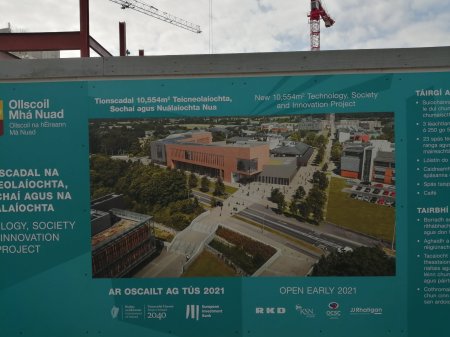
I thought I’d share the above picture as part of an occasional series of updates about the new building going up on the North Campus at Maynooth University.

This artist’s impression of what the new building will look like has appeared on the fence surrounding the construction site; you can see cranes and part of the skeleton of the new structure behind the board.

It looks like the Science Building in which I am currently based will be almost completely hidden from the road: it is the building immediately behind the grey rectangular block to the right of the larger brick-coloured edifice which is the main part of the new structure. The road across the middle of the image that divides the North Campus from the South is called Kilcock Road.

Apparently the new building will be opened early in 2021. I look forward to seeing the new development completed!

When is an External Examiner not an External Examiner?

Posted in Education with tags , , , , on February 21, 2020 by telescoper

The other day I was at a training session about Finance and Governance for new Heads of Department at Maynooth University. During the course of that there was a briefing about payroll arrangements, tax rules and so on. Among the pieces of information I learned is that all external examiners at the University have to receive their payment through the payroll system, which means that, as well as other bureaucracy, they will have to get a PPS number (the equivalent of a National Insurance number) before they start work. This goes for undergraduate and postgraduate programmes, including individual PhD examinations.

The payment for an external examiner is really just a token honorarium – nobody becomes an external examiner for the money! – so this imposes quite a big administrative overheard but the Revenue people are adamant that it has to be done so we’ll have to cope.

There is another difficulty here. Technically any payment you get to compensate for travel to your `normal place of work’ is not tax-free. If you’re employed even for just one day as an external examiner at University X then University X is your employer and its campus is your normal place of work for that employment. Your travel expenses should therefore be taxed. I understand that in Ireland an exemption has been negotiated for this so in practice this issue won’t arise, unless (as is possible) the authorities change their mind about the exemption.

Aside from the additional paperwork and muddle there’s an important conceptual issue here. The new arrangements mean that an external examiner (who is meant to be independent) will now be an employee of the University. In effect, the external examiner is no longer external. This makes me very uncomfortable.

I was already a bit uncomfortable about the system of external examiners anyway, as they are usually appointed on the recommendation of a department based on personal knowledge. In principle a department could recommend someone they know would be a soft touch or who owes them a favour in some way. I think such abuses of the system are probably rather rare, and most externals do the job as objectively and as diligently as they can.  I have  always tried to be fair when called upon to do such tasks, although it’s not for me to say whether I have always succeeded.

The point I want to make, however, is that It is important not only that the system is fair and rigorous but that it be seen to be fair and I don’t think that is the case the way things are currently run either in Ireland or in the United Kingdom. For the reasons described above the present arrangements certainly do not look incorruptible.

I’ve always felt that a better system could be created by setting up an agency of some sort, completely independent of the universities that would maintain a panel of external examiners who would be paid by the agency rather than by higher education institutes themselves . The agency will also pay travel expenses. When a university needs an external examiner, it would make a request and be allocated one with the necessary expertise in such a way that no personal conflicts of interest could arise.

This would be quite a simple thing to set up in the United Kingdom, as UK universities usually have externals from other UK universities. It would be more difficult in Ireland, however, because the university sector is quite small and many of our external examiners are overseas (especially from the UK). I don’t see this as an insuperable problem, however, as the body overseeing the appointments should be set up in such a way as to deal with the administration.

I think the system I advocate would solve the issues I have raised, principally by assuring that external examiners are actually external.

Comments are, of course, welcome through the box below.


Solidarity with the UCU Strike!

Posted in Education, Politics with tags , , on February 20, 2020 by telescoper

So the latest round of strikes by members of the University and College Union (UCU) began today. There will be fourteen days of strikes spread over four weeks between now and 13th March. The cause of the long-running dispute is twofold: (1) the long-running saga of the Universities pension scheme (about which there were strikes in 2018); and (2) over pay, equality, workloads and the ever-increasing casualization of lecturing and other work.

Among the UK institutions to be involved in the industrial action are Cardiff, Sussex and Nottingham where I have worked at various times in the past. Nobody likes going on strike but the UK higher education system is a very poor state right now, and many of my former colleagues feel that they have no alternative. It will be tough out there on the picket lines in the cold weather, and losing 14 days’ pay is no fun either, but that’s what it means to go on strike.

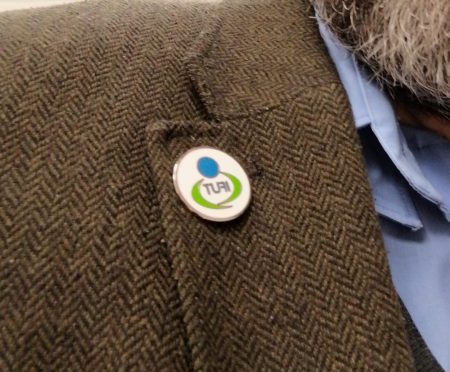
I’m no longer involved in the UK university system so can’t do much directly to support those taking industrial action but thought the least I could do is wear my union badge* for the duration of the strike. The Irish Federation of University Teachers (IFUT) will no doubt be expressing their support for comrades on strike. It’s not as if higher education in Ireland is immune from casualisation and workload issues.

*On reflection, I should have taken the picture a different way…

Spring Semester Starts

Posted in Biographical, Education, Maynooth with tags , , , , , , on February 3, 2020 by telescoper

It’s February 3rd 2020, which means that today is two days after Imbolc, a Gaelic festival marking the point halfway between the winter solstice and vernal equinox. The 1st Day of February is also the Feast day of St Brigid of Kildare (c. 451-525), one of Ireland’s patron saints along with Saints Patrick and Colm Cille. One of her miraculous powers was the ability to change water into ale, which perhaps explains her enduring popularity among the Irish.

In Ireland this day is sometimes regarded as the first day of spring, as it is roughly the time when the first spring lambs are born. It corresponds to the Welsh Gŵyl Fair y Canhwyllau and is also known as the `Cross Quarter Day’ or (my favourite) `The Quickening of the Year’.

Today is, appropriately enough in the light of all this, the start of the Spring Semester of teaching at Maynooth University, the third Spring Semester I will have experienced here. The weather has even played along; it has definitely been spring-like. The Campus, whicgh has beenhas been very quiet for the last week or so since the examinations finished, is full of students again.

This Semester, as was the case last year, I am teaching Engineering Mathematics II and Computational Physics I. The former, what you would probably call a `service course’, covers a mixture of things, mainly Linear Algebra but with some other bits thrown in for fun, such as Laplace transforms. Interestingly I find the Mathematical Physics students do not encounter Laplace Transforms in the first year, but perhaps engineers use them more often than physicists do? I think I’ve written only one paper that made use of a Laplace transform. Anyway, I have to start with this topic as the students need some knowledge of it for some other module they’re taking this semester. I reckon six lectures will be enough to give them what they need. That’s two weeks of lectures, there being three lectures a week for this module.

Once again my teaching timetable for this module is quite nice. I have lectures on Monday, Tuesday and Wednesday and then the students have a choice of tutorial (on either Thursday or Friday). That means I can get through a decent amount of material each week before each tutorial. I don’t do the tutorials, by the way: that’s left to one of our PhD students, who gets paid for doing that and correcting the weekly coursework. There are about 50 students on this module, divided into two courses: Electronic Engineering and Robotics and Intelligent Devices. We don’t have Civil or Mechanical or Chemical Engineering, etc at Maynooth, in case you were wondering.

Anyway, my first lecture was this afternoon at 2pm and had a good turnout. It was so sunny outside that we had to close all the blinds. That’s quite an unusual event for a February lecture!

My first Computational Physics lecture is on Thursday, after which it will be back to the Department for some frantic behind-the-scenes activity ahead of the afternoon lab session, which is in a computer room near my office. Students attend one two-hour lab session in addition to the lecture, on either Thursday or Tuesday. The first lecture being on Thursday the first lab session will be Thursday afternoon, with the same material being covered the following Tuesday.

While my teaching duties are the same this year as they were in the corresponding semester last year, there is a significant difference this year in that I am now also Head of Department. Either side of my first lecture I had to attend a meeting of the Faculty Executive for Science & Engineering, a meeting on `Project LEGO’ (which, sadly, did not involve any actual Lego but was instead about the proposed redesign of the University’s website) and a meeting of Academic Council. I have also been trying to sort out tutors and tutorials for the forthcoming Semester: these don’t start until next week so there’s time, but it’s quite a challenge to get everyone sorted out. A few timetable clashes have also come to light. So, in summary, I’m a bit worn out after today and will shortly go home to vegetate.

At least I didn’t have to find time for the regular Monday afternoon Euclid telecon in which I usually participate. There wasn’t one today because the working group of which I am part is actually meeting in person for a few days… in Paris! I couldn’t go because of all the above!

Exam Time

Posted in Education, Maynooth with tags , , , on January 12, 2020 by telescoper

Back in Maynooth into the January examination period, I await the arrival tomorrow of the first batch of examination scripts I have to mark, so I thought I’d do a quick post on the topic of examinations.

First, for readers elsewhere, full-time undergraduate students at Maynooth what is called 60 “credits” in a year, usually split into two semesters of thirty credits each. This is usually split into 5-credit modules with an examination in each module at the end of each semester. Projects, and other continuously-assessed work do not involve a written examination, but the system means that a typical student will have at least 5 written examination papers in January and at least another 5 in May. Each examination is usually of two hours’ duration.

This is very similar to the system in most UK universities that I am aware of except that a full year’s work over there is 120 credits so there’s a conversion factor of 2:1. A 5-credit module in Ireland would be a 10-credit module in the United Kingdom, for example, but otherwise the system is similar.

One big difference between our examinations in Theoretical Physics in Maynooth and those at other institutions I’ve taught at in the UK is that the papers here – at least at a reasonably advanced level, say Years 3 and 4 – offer no choice of questions to be answered.  A typical format for a two-hour paper is that there are two long questions, each of which counts for 50 marks. Elsewhere  one normally finds students have a choice of two or three questions from four or five on the paper.

One  advantage of our system is that it makes it much harder for students to question-spot in the hope that they can get a good grade by only revising a fraction of the syllabus. If they’re well designed, two long questions can cover quite a lot of the syllabus for a module, which they have to in order to test all the learning outcomes. To accomplish this, questions can be split into parts that may be linked to each other to a greater or lesser extent to explore the connections between different ideas, but also sufficiently separate that a student who can’t do one part can still have a go at others. With such a paper, however, it is a  dangerous strategy for a student to focus only on selected parts of the material in order to pass.

As an examiner, the Maynooth style of examination also has the advantage that you don’t have to worry too much if one question turns out to be harder than the others. That can matter if different students attempt different questions, but not if everyone has to do everything.

But it’s not just the number of questions that’s important, it’s the duration. I’ve never felt that it was even remotely sensible for undergraduate physics examinations to be a speed test, which was often the case when I was a student. Why the need for time pressure? It’s better to be correct than to be fast, I think. I always try to set examination questions that could be done inside two hours by a student who knew the material, including plenty of time for checking so that even a student who made a mistake would have time to correct it and get the right answer. If a student does poorly in this style of examination it will be because they haven’t prepared well enough rather than because they weren’t fast enough.

The structure of the Maynooth examinations at more introductory level is rather different, with some choice. In my first year module on Mechanics & Special Relativity, for example, there is a compulsory first question worth 50 marks (split into several pieces) and then the students can pick two out of three shorter questions worth 25 marks each. This is a somewhat gentler approach than with the more advanced papers, partly adopted because we have quite a few students doing the General Science degree who taking Mathematical Physics as one of their 4 first-year subjects but will not be taking it further.

As their examination is not until Wednesday, I’ll have to wait until later this week to find out how my first-years have done. This will be the examination taken at University level for most of my class, so let me take this opportunity to pass on a few quick tips.

  1. Try to get a good night’s sleep before the examination and arrive in plenty of time before the start.
  2. Read the entire paper before starting to answer any questions. In particular, make sure you are aware of any supplementary information, formulae, etc, given in the rubric or at the end.
  3. Start off by tackling the question you are most confident about answering, even if it’s not Question 1. This will help settle any nerves.
  4. Don’t rush! Students often lose marks by making careless errors. Check all your numerical results on your calculator at least twice and – PLEASE – remember to put the units!
  5. Don’t panic! You’re not expected to answer everything perfectly. A first-class mark is anything over 70%, so don’t worry if there are bits you can’t do. If you get stuck on a part of a question, don’t waste too much time on it (especially if it’s just a few marks). Just leave it and move on. You can always come back to it later.

Readers of this blog are welcome to add other tips through the comments box below!

Oh, and good luck to anyone at Maynooth or elsewhere taking examinations in the next few weeks!


Exams and Anniversaries

Posted in Biographical, Education, Maynooth with tags , , , on January 9, 2020 by telescoper

Tomorrow (10th January)  is the start of our mid-year examination period here at Maynooth University. It’s therefore a good opportunity to send a hearty “good luck” message to all students about to take examinations, especially those who are further on in their courses for whom these papers have greater importance. In particular I’d like to send my best wishes to students on my fourth-year module on Astrology Astrophysics and Cosmetics Cosmology, whose paper is tomorrow.

On the equivalent day last year I reflected on examinations and in particularly on the fact that the system of education both here in Ireland and in the United Kingdom places such a great emphasis on examination and assessment compared to learning and understanding.

Also on the equivalent day yesterday I was about to travel to London to attend my first LGBT+STEMinar at the Institute of Physics in London. Tomorrow I’ll be doing a similar thing, getting up at stupid o’clock
to travel to Birmingham for the 2020 event. The main difference this year (apart from the change of venue) is that I’m not giving a talk this time. This is good news for me (because it means I can relax a bit more) and for the attendees (because they don’t have to listen to me rambling on like they did last year).

I won’t be able to stay to the end of the LGBT+STEMinar, however, as I have to get to London. As I have mentioned previously here, 2020 marks the bicentenary of the Royal Astronomical Society:

According to the brief history published on the RAS website:

The ‘Astronomical Society of London’ was conceived on 12 January 1820 when 14 gentlemen sat down to dinner at the Freemason’s Tavern, in Lincoln’s Inn Fields, London. After an unusually short gestation the new Society was born on 10 March 1820 with the first meeting of the Council and the Society as a whole. An early setback, when Sir Joseph Banks induced the Duke of Somerset to withdraw his agreement to be the first President, was overcome when Sir William Herschel agreed to be the titular first President, though he never actually took the Chair at a meeting.

To be precise, the Society only became the `Royal Astronomical Society’ in 1831 when it was granted a Royal Charter by William IV, but its roots go back to 1820.

It’s not only the Royal Astronomical Society that has survived and prospered for two hundred years. The group of `gentlemen’ who met for dinner in January 1820 has also carried on in the form of the RAS Club which is, of course, older than the RAS itself. The Dining Club always meet on the second Friday of the month, which means that tomorrow is the closest date to that very first meeting. There will therefore be a special club dinner tomorrow night, with more guests than usual. I’m looking forward to it a lot, actually, although I’m slightly apprehensive about the fact that I’ll be relying on the train to get me there in time!

The Strategic Academic Leadership Initiative Begins

Posted in Education, Maynooth with tags , , , , , on January 3, 2020 by telescoper

I was caught on the hop this morning by the formal announcement that twenty new professorships for women have been created in Ireland. I hadn’t expected this announcement to come so quickly since the idea was only floated in November 2018. There is a piece in the Irish Times about today’s announcement here.

I blogged about this scheme here when it was announced, a little over a year ago. The appointments are to be in areas where there is “clear evidence” of significant under-representation of women, such as physics, computer science and engineering.

I’m delighted that two of these new positions will be at Maynooth University, one in Computer Science and one in Physical Geography (in the area of Climate Science). These areas were selected as being of particularly high strategic priority.

The 20 new Chairs represent the first tranche of positions out of 45 planned under the Strategic Academic Leadership Initiative. I understand there will be two further rounds. I do hope that we might get a position in physics at Maynooth in a subsequent round. I note however that there will be a Professorship in Theoretical Physics at Dublin Institute for Advanced Studies. I’ll be sure to pass on the advertisement here when it appears.

Reactions to this scheme among people I know have been very varied, so it seems a good topic on which to have a simplistically binary poll:

For the record, I should state that although I had reservations when about this scheme when it was first announced, largely due to lack of detail about how it was to be implemented, I am now very enthusiastic about it and hope it is successful in its aims.

I will however also repeat that this initiative should not distract attention away from the need for Irish higher education institutions to have much better promotion procedures; see, e.g. here. There are plenty of female academics at lecturer level in Irish universities, but they seem to face serious difficulties getting promoted to Professorships.

End of Teaching for 2019

Posted in Biographical, Education, Maynooth on December 18, 2019 by telescoper

So it’s 6pm on Wednesday 18th December and I’ve just given my 24th and last Astrophysics & Cosmology lecture for the term at Maynooth University. Earlier this afternoon I gave my 36th and last first-year Mechanics & Special Relativity module so that’s over for the year too. That makes 60 lectures for the semester.

I find these twelve week semesters very tiring (even with a week-long break in the middle). I assume the students do too. Numbers in class certainly dropped off this week, but overall I’ve been very happy with the level of engagement of the students, especially the first years. Although it’s a lot of work putting on a big course for the first time, I do enjoy teaching very much indeed. I have found few things in life more rewarding than teaching students who want to learn and physics students here in Maynooth do seem to be highly motivated. The exams for both modules are in January so I’ll find out in the New Year if anyone actually learnt anything!

This morning somebody suggested that would be my last teaching for the decade. Of course that is incorrect. The current decade ends on 31st December 2020, not 31st December 2019, just as the millennium started on 1st January 2001 not 1st January 2000. I’m glad a fellow blogger has taken the trouble to point the reason: there is no Year Zero.

Earlier today we had presentations from our final-year project students, which were very good. As usual on such occasions I find myself thinking how much better current generations of students are at that than mine was!

I don’t mind admitting that I’m not inconsiderably knackered at this moment and will be heading home for a bite to eat and a glass or several of wine. Tomorrow I have a few things to do before heading off for the Christmas break, after which regular blogging will be suspended for a time.