Archive for the Education Category

Project Work

Posted in Biographical, Education, mathematics with tags , , , , , on April 23, 2018 by telescoper

I’m progressively clearing out stuff from my office prior to the big move to Ireland. This lunchtime I opened one old box file and found my undergraduate project. This was quite an unusual thing at the time as I did Theoretical Physics in Part II (my final year) of Natural Sciences at Cambridge, which normally meant no project but an extra examination paper called Paper 5. As a member of a small minority of Theoretical Physics students who wanted to do theory projects, I was allowed to submit this in place of half of Paper 5…

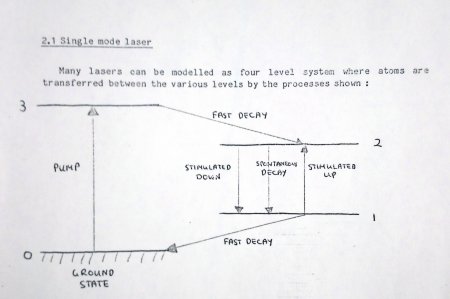
The problem was to write a computer program that could solve the equations describing the action of a laser, starting with the case of a single-mode laser as shown in the diagram below that I constructed using a sophisticated computer graphics package:

The above system is described by a set of six simultaneous first-order ordinary differential equations, which are of relatively simple form to look at but not so easy to solve numerically because the equations are stiff (i.e. they involve exponential decays or growths with very different time constants). I got around this by using a technique called Gear’s method. There wasn’t an internet in those days so I had to find out about the numerical approach by trawling through books in the library.

The code I wrote – in Fortran 77 – was run on a mainframe, and the terminal had no graphics capability so I had to check the results as a list of numbers before sending the results to a printer and wait for the output to be delivered some time later. Anyway, I got the code to work and ended up with a good mark that helped me get a place to do a PhD.

The sobering thought, though, is that I reckon a decent undergraduate physics student nowadays could probably do all the work I did for my project in a few hours using Python….

An O-Level History Examination from 1979

Posted in Biographical, Education, History with tags , , , , on April 18, 2018 by telescoper

I have in the past posted a few examples of the O- and A-level examinations I took when I was at school. These have been mainly science and mathematics papers as those are relevant to the area of higher education in which I work, and I thought they might be of interest to students past and present.

A few people have emailed me recently to ask if I could share any other examinations, so here are the two History papers I took for O-level in June/July 1979. Can that really have been almost 40 years ago?

These were Papers 5 and 12 out of an unknown number of possible papers chosen by schools. My school taught us exclusively about British and European history from the mid-19th to early 20th centuries; you will observe that in both cases `history’ was deemed to have ended in 1914. It’s possible that some of the other papers paid more attention to the wider world.

I have no idea what modern GCSE history examinations look like, but I’d be interested in any comments from people who do about the style and content!

Fun with the Airy Equation

Posted in Education, mathematics with tags , , , , , , on April 12, 2018 by telescoper

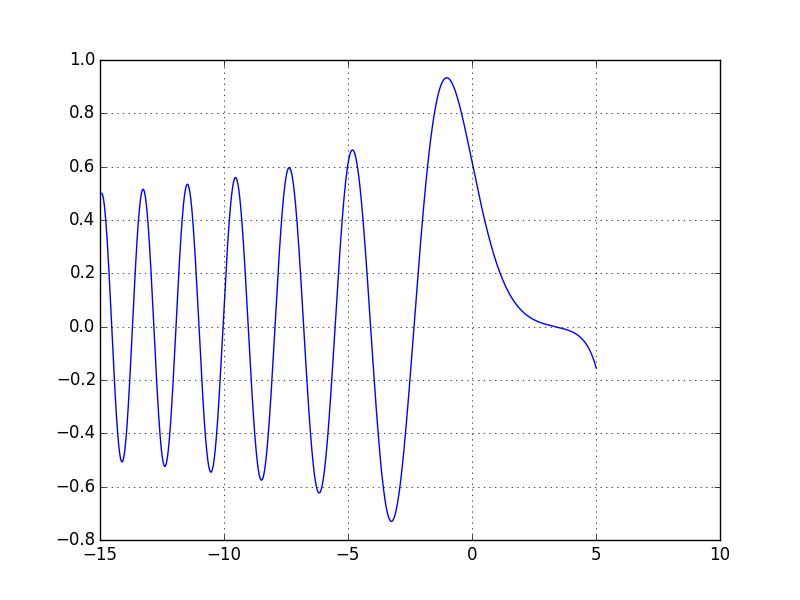
Today being a Maynooth Thursday, it has, as usual, has been dominated by computational physics teaching. We’re currently doing methods for solving ordinary differential equations. At the last minute before this afternoon’s lab session I decided to include an exercise that involved solving the following harmless-looking equation: y'' = xy.

This is usually known as Airy’s equation and it comes up quite frequently in problems connected with optics. It was first investigated by a former Astronomer Royal George Airy, after whom the function is named; incidentally, he was born in Alnwick (Northumberland, i.e. not the Midlands).

Despite its apparent simplicity, the Airy equation describes some very interesting phenomena. Indeed it is the simplest ODE (that I know of) that has the property that there’s a point at which the behaviour of the solution turns from oscillatory to exponential. Here’s a result of a numerical integration of the equation: obtained using a simple Python script:

(I stopped the integration at x=5 as the magnitude of the solution grows very quickly beyond that value for the particular initial conditions chosen).

One of the reasons for including this example (apart from the fact that Airy was a Geordie) is that the students were so surprised by the behaviour of the solution and most of them assumed that there was some problem with the numerical stability of their results. Some integration methods do struggle with such simple equations as the simple harmonic oscillator, but just sometimes weird numerical results are not mere numerical artifacts!

Anyway, my point is not about this particular equation or even about computational physics, but a general pedagogical one: finding interesting results for yourself is much more likely to motivate you to think about what they mean than if they’re just described to you by someone else. I think that goes for numerical experiments in a computer lab just as much as it does for any other kind of practical experiment in a science laboratory.

Public House Outreach

Posted in Education, The Universe and Stuff with tags , , , , on April 10, 2018 by telescoper

I’m told that there are pubs in which people don’t sit around discussing antimatter and time reversal by sketching Feynman diagrams on seasickness bags, but who would want to drink in one those?

Back to work in Cardiff..

Posted in Biographical, Education with tags , on March 19, 2018 by telescoper

So here I am, then. Back in the offices of the Data Innovation Research Institute in Cardiff for the first time in almost a fortnight. The four-week batch of strikes over pensions has come to an end so I have returned to work. No agreement has been reached so it seems likely there will be further industrial action, but for the time being normal services are being resumed. In fact it’s not exactly back to normal because there’s a large backlog of things to be done (including marking coursework and setting examinations), but I mean at least that lectures resume and will be delivered on the normal timetable. In my Physics of the Early Universe module I have only given four (two-hour) lectures and have missed three. I return to the fray tomorrow morning to give Lecture 8. Frustratingly, that’s the only lecture I have before the Easter break which starts on Friday and lasts for three weeks. Assuming there are no further strikes I’ll be giving lectures 9-12 (the last a revision lecture) after the holiday.

I now have to figure out how to cope with the six hours of lectures missed because of industrial action. That will be tricky, but I’ll do my level best to ensure that I cover everything needed for the examination. I spent most of this morning trying to figure out how to reorganise the remaining material, and I think I can do it as long as we don’t lose any more teaching time. At any rate I have made the decision not to give additional lectures to cover what I’ve missed. Owing to the timing of the strikes (and the fact that only work half the time here in Cardiff) I have been on strike for all the days I would have been working for three weeks. That means I will lose three full weeks pay. Even if it were logistically possible to fit in 6 hours of extra lectures after Easter, I don’t think it’s reasonable for me to do that for free.

While I was on strike a group of my students emailed the Vice-Chancellor of Cardiff University (copying me in) to point out how much teaching they were missing and request some form of compensation. I have a lot of sympathy for their situation and in no way do I want to damage their education. I will do what I can to mitigate the effect of the strike but won’t take any action that reduces the effectiveness of the industrial action. It remains to be seen if any compensation will be offered by the University management, but I think their best policy would be pressure Universities UK to stop pratting about and find a speedy settlement of the dispute.

Anyway, today is a bank holiday in Maynooth – St Patrick’s Day fell on a Saturday this year – and the rest of the week is `Study Week’, so there are no lectures or laboratory sessions. I’ll therefore be staying in Cardiff all week, which gives me the chance to go to a concert on Friday at St David’s Hall – the first for quite a while.

Now, time to get back to writing tomorrow’s lecture…

Other People’s Code

Posted in Education, mathematics with tags , , , on March 16, 2018 by telescoper

I don’t know if this is just me being useless, but one of the things I’ve always found difficult is debugging or rewriting computer programs written by other people. This is not a complaint about people who fail to document their code sufficiently to see what’s going on, it’s that even when the code is documented it seems much more difficult to spot errors in code written by other people than it is when you’ve written the program yourself.

I’ve been thinking a lot since I’ve been teaching Computational Physics here in Maynooth University. One of the standard elements of the assessment for this module is a task wherein the students are given a Python script intended to perform a given task (e.g. a numerical integral) but which contains a number of errors and asked to identify and correct the errors. This is actually a pretty tough challenge, though it is likely to be one that a graduate might have to meet if they get a job in any environment that involves programming.

Another context in which this arises is our twice-weekly computing laboratory sessions. Twice in the last couple of weeks I’ve been asked for a bit of help by students with code that wasn’t working, only to stare at the offending script for ages and fiddling with a number of things that made no difference, without seeing what turned out to be an obvious mistake. Last week it was an incorrect indent in Python (always a hazard if you’ve been brought up on Fortran). This week it was even simpler, a sign error in a line that was just supposed to calculate the mid-point of an interval. I should have been able to spot these very quickly, but I couldn’t.

What makes this so difficult? When given a mathematical calculation to mark I can usually spot errors reasonably easily (unless the working is illegible), but with code it’s different (at least for me). If I’d been given it on a piece of paper as part of a formula, I reckon I would have spotted that minus sign almost immediately.

One possibility is just that I’m getting old. While that may well be true, it doesn’t explain why I found debugging other people’s code difficult even when I was working on software at British Gas when I was 18. In that context I quite often gave up trying to edit and correct software, and instead just deleted it all and wrote my own version from scratch. That’s fine if the task is quite small, but not practicable for large suites written by teams of programmers.

I think one problem is that other people rarely approach a programming task exactly the same way as one would oneself. I have written programs myself to do the tasks given to students in the computing lab, and I’m always conscious of the method I’ve used. That may make it harder to follow what others have tried to do. Perhaps I’d be better off not prejudicing my mind doing the exercises myself?

Anyway, I’d be interested to know if anyone else has the same with other people’s code and if they have any tips that might improve my ability to deal with it. The comments box is at your disposal…

USS Pension Proposal: Poll

Posted in Education, Politics with tags , , , , , on March 13, 2018 by telescoper

Last night I saw the news on Twitter that negotiators on behalf of the Universities and Colleges Union (UCU) and the employers’ organisation Universities UK (UUK) under the auspices of the Advisory Conciliation and Arbitration Service (ACAS) agreed a proposal to end the strike over pensions that has been going on since the end of February.

The text of the agreement can be found here (PDF). This proposal will have to be discussed and ratified formally, but the negotiators hope this can be do today and that the strike will be suspended from tomorrow.

The proposal suggests a transitional period of three years from April 2019 during which a much reduced Defined Benefit scheme will operate, but it still affirms the much disputed November 2017 valuation of the scheme which means that it is overwhelmingly likely that after three years the dispute will be back on.

I shall be leaving the USS scheme in July 2018 as I’m moving full-time to Ireland where I will be joining a Defined Benefit scheme so the changes outlined in the document will not affect me. Moreover, though I have supported the strike I am not a member of UCU. If I were I would not be in favour of accepting this deal because it seems to me that it amounts to an abject surrender on all the main issues. But given my personal situation I don’t think my opinion should carry much weight. The few friends I have discussed this with feel the same as I do, but I’m interested to know what the general opinion is. If you feel like filling in the poll below please feel free to do so. I’ve divided the responses between UCU members and non-UCU members to see if there’s a difference.

On one matter however I am less equivocal. The document calls on staff to `prioritise the rescheduling of teaching’ (lost during the strike). I have a one-word response to that: NO. Not only will it be logistically impossible to reschedule so many teaching sessions, but I am also not going to do extra teaching for free when my pay is being deducted for days on strike.

As usual, I invite your comments through the box below.

UPDATE: Here is a Google Document showing how UCU branches are responding to the proposal: at the time of posting, it is solidly `reject’..

UPDATE: Following on from the above, the UCU has now formally rejected the proposal. The strikes continue.

Why I’m taking part in the UCU Strike Action

Posted in Education, Politics with tags , , , , , , on February 21, 2018 by telescoper

In case you weren’t aware, from tomorrow (22nd February) the University and College Union (UCU) is taking industrial action over proposed drastic cuts to staff pensions funded by the Universities Superannuation Scheme (USS). You can find some background to the pensions dispute here (and in related articles). A clear explanation of why the employers’ justification for these cuts is little more than fraudulent is given here and here you can find an example of the effect of the proposed changes on a real person’s pension (ie a cut of almost 50%). I also blogged about this a few weeks ago. There’s no doubt whose side the Financial Times is on, either.

I am not a member of UCU – I left its forerunner organisation the Association of University Teachers (AUT) as a result of its behaviour when I was at the University of Nottingham – but I will be participating in the industrial action, which takes place over four weeks as follows:

  • Week one – Thursday 22 and Friday 23 February (two days)
  • Week two – Monday 26, Tuesday 27 and Wednesday 28 February (three days)
  • Week three – Monday 5, Tuesday 6, Wednesday 7 and Thursday 8 March (four days)
  • Week four – Monday 12, Tuesday 13, Wednesday 14, Thursday 15 and Friday 16 March (five days)

This is a bit complicated for me because I only work half-time at Cardiff University (usually Mondays, Tuesdays and half of Wednesdays) and at Maynooth University the rest of the time. The USS only covers UK universities, and the dispute does not apply in the Republic of Ireland (though it does affect higher education institutions in Northern Ireland) so I won’t be on strike when I’m working for Maynooth University, which includes the first two strike days (tomorrow and Friday). I will be participating in industrial action next week, however, and have today sent an announcement to my students they hear from me that the strike has been called off there will be no lectures on 27th February, 6th March or 13th March.

All staff will be docked pay for days not worked owing to strike action, of course, but that will be far less than the amount to be lost in these pension cuts. In my case I will be docked the equivalent of three weeks’ pay as 2.5 days a week I work are all strike days in Weeks 2-4. Moreover, I shall be leaving the UK for Ireland this summer and the pension cuts will not affect my pension anyway – any changes will not be made until after I’ve left the USS scheme. Nevertheless, this is an important issue and I feel it is right to take a stand.

One final comment. Last week Cardiff University sent an email to staff including a link to a website that stated:

If staff refuse to cross a picket line and they are not a member of UCU they will be in breach of their contract of employment with the University.

In fact, any strike action (even by a union member) is a breach of contract. The law however prevents employers dismissing staff who participate in industrial action, provided that it is lawful (i.e. following a ballot, and with due notice given to the employer, etc). The government website makes it clear that non-union members have exactly the same protection as union members in this regard. The Cardiff website has now been changed, but I’m very unhappy that this extremely misleading communication was sent out in the first place.

I sincerely hope that there is a negotiated settlement to this issue. Nobody wants to go on strike, especially when it has the potential to damage students’ learning. But there comes a point where you have to draw a line in the sand, and we have reached that point. I hope I’m proved wrong, but I think this could be a very prolonged and very unpleasant dispute.

Learning Technology

Posted in Biographical, Cardiff, Education, Maynooth with tags , , , , , , , , on February 20, 2018 by telescoper

I’m just taking a tea break in the Data Innovation Research Institute. Today has been a very day as I have to finish off a lot of things by tomorrow, for reasons that I’ll make clear in my next post…

It struck me when I was putting on the brew how much more technology we use for teaching now than when I was a student. I think many of my colleagues make far more effective use of the available technology than I do, but I do my best to overcome my Luddite tendencies. Reflecting on today’s teaching makes me feel just a little less like a dinosaur.

This morning I gave a two-hour lecture on my Cardiff module Physics of the Early Universe which, as usual, I recorded using our Panopto system. Although there was a problem with some of the University’s central file storage this morning, which made me a bit nervous about whether the lecture recording would work, it did. Predictably I couldn’t access the network drives from the PC in the lecture theatre, but I had anticipated that and took everything I needed on a memory stick.

After a short break for lunch I checked the lecture recording and made it available for registered students via the Virtual Learning Environment (VLE), known to its friends as Learning Central. I use this as a sort of repository of stuff connected with the module: notes, list of textbooks, problem sets, model answers, instructions and, of course, recorded lectures. The students also submit their coursework assignment (an essay) through this system, through the plagiarism detection software Turnitin.

This afternoon the students on my Computational Physics course in Maynooth University had a lab test, the first of four such tests, this one consisting of a short coding exercise. There are two lab sessions per week for this class, one on Thursdays (when I am normally in Maynooth to help supervise) and another on Tuesdays (when I am normally in Cardiff). I have a number of exercises, which are similar in scope but different in detail (to prevent copying) and the Tuesday lab has a completely different set of exercises from the Thursday one. In each exercise the students have to write a simple Python script to plot graphs of a function and its derivative (computed numerically) using matplotlib. The students upload their script and pictures of the plot to the VLE used in Maynooth, which is called Moodle.

In the manner of a TV chef announcing `here’s one I did earlier’, this a sample output produced by my `model’ code:

I wonder if you can guess of what function this is the derivative? By the way in this context `model’ does not mean `a standard of excellence’ but `an imitation of something’ (me being an imitation of a computational physicist). Anyway, students will get marks for producing plots that look right, but also for presenting a nice (commented!) bit of code

This afternoon I’m on Cardiff time but I was able to keep an eye on the submissions coming in to Moodle in case something went wrong. It seemed to work out OK, but the main problem now is that I’ve got 20-odd bits of code to mark! That will have to wait until I’m properly on Maynooth time!

Now, back to the grind…

`Pass-the-Harasser’ … to Turku

Posted in Education, Harassment Bullying etc with tags , , , on February 2, 2018 by telescoper

I noticed yesterday evening that there has recently been a substantial increase in the number of people viewing my posts about Christian Ott, the former Caltech Professor who eventually left his job there after harassing and committing ‘gender-based discrimination’ against two female students there.

It wasn’t difficult to find out why there had been an upsurge in interest: Christian Ott has got a new job, at the University of Turku, in Finland. As far as I understand the situation – and please correct me if I’m wrong – he was `head-hunted’ for this position, so his appointment was not the result of an open competition and it seems the position was specifically created just for him.

UPDATE: the post was advertised here, but the gap between the deadline for applications – 10th December 2017 – and the appointment being announced is too short to be consistent with the usual processes of academic appointments. Moreover, the advertised job descriptions includes teaching duties; see below for why this is relevant.

Not surprisingly both the appointment itself and the circumstances by which it was brought about have provoked considerable reaction. A group of Finnish astronomers and astrophysicists has written a Statement on Harassment, which you can sign in support (here if you’re Finnish and/or based in Finland) and here for other concerned academics. I have signed the second one.

I have two personal comments to make. The first is that I’ve seen people say that Ott should get a `second chance’, and it would be unfair for his past transgressions to force him out of academia.

This is what I wrote in an earlier piece about this:

It remains to be seen what Christian Ott does. I am not familiar with his work but he is, by all accounts, a talented scientist so he may well find a position at another institution. If he does, I hope, for his and for his future colleagues’ sake, that he has learned his lesson.

I think that makes it clear that I have no desire to see Christian Ott ruined, but I don’t think that means that I think due process should be subverted to help him, as appears to be the case here. In fact I’m bound to say that if I were a Head of Department I wouldn’t under any circumstances have offered this man a position, after what he did.

Had Ott committed a different disciplinary offence (such as plagiarism or other research misconduct) he would not have found it so easy to get another job than because it was `just’ harassment. Why should these offences be treated so differently?

Once again, research esteem seems to trump everything else. That attitude is one of the most poisonous elements in modern academia. The `Great Man of Science’ is indeed a dangerous myth.

The second thing is that, as far as I understand it (and again please correct me if I’m wrong), Ott’s new position is as an `independent researcher’ and he will have no teaching duties and minimal contact with students. I suppose that is supposed to make everything alright. It doesn’t. Indeed, there are many academics who would regard a cushy research-only contract as a reward rather than a cost. It’s a slap in the face for teaching staff at Turku that funds have been found to create a bespoke position in the way that has been done here.

As always, comments clarifications and corrections are welcome through the comments box.

UPDATE: 7/2/2018. The appointment of Dr Ott has been cancelled.