Archive for the Education Category

The Quickening of the Year

Posted in Education, Maynooth, Music, The Universe and Stuff with tags , , , , on February 1, 2018 by telescoper

It’s 1st February 2018, which means that today is Imbolc, a Gaelic festival marking the point halfway between the winter solstice and vernal equinox. This either happens 1st or 2nd February, and this year it is the former. In this part of the world – I’m in Ireland as I write- this day is sometimes regarded as the first day of spring, as it is roughly the time when the first spring lambs are born. It corresponds to the Welsh Gŵyl Fair y Canhwyllau and is also known as the `Cross Quarter Day’ or (my favourite) `The Quickening of the Year’.

So, talking of quickening, the pace of things is increasing for me now too. This morning at 9am I gave my first ever lecture in Maynooth University in a lecture theatre called Physics Hall, which is in the old (South) part of campus as opposed to the newer North Campus where the Science Building that contains my office is situated.

After that it was back to the Department for some frantic behind-the-scenes activity setting up accounts for the students for the afternoon lab session, which is in a computer room near to my office. Students attend one two-hour lab session in addition to the lecture, on either Thursday or Tuesday. The first lecture being this morning (Thursday) the first lab session was this afternoon, with the same material being covered next Tuesday.

I was far more nervous about this afternoon’s lab session than I was about this morning’s lecture as there seemed to be many things that could go wrong in getting the students up and running on our Linux cluster and getting them started on Python. Quite a few things did go wrong, in fact, but they were fewer in number and less drastic in outcome that I had feared.

So there we are, my first full day teaching in Maynooth. I think it went reasonably well and it was certainly nice to meet my first group of Maynooth students who, being physics students, are definitely la crème de la crème. I’ve got another 6 weeks like this (teaching on Tuesday in Cardiff and on Thursday in Maynooth) before the Easter break so it’s going to be a hectic period. Just for tonight, however, I’ve got time to relax with a glass or several of wine.

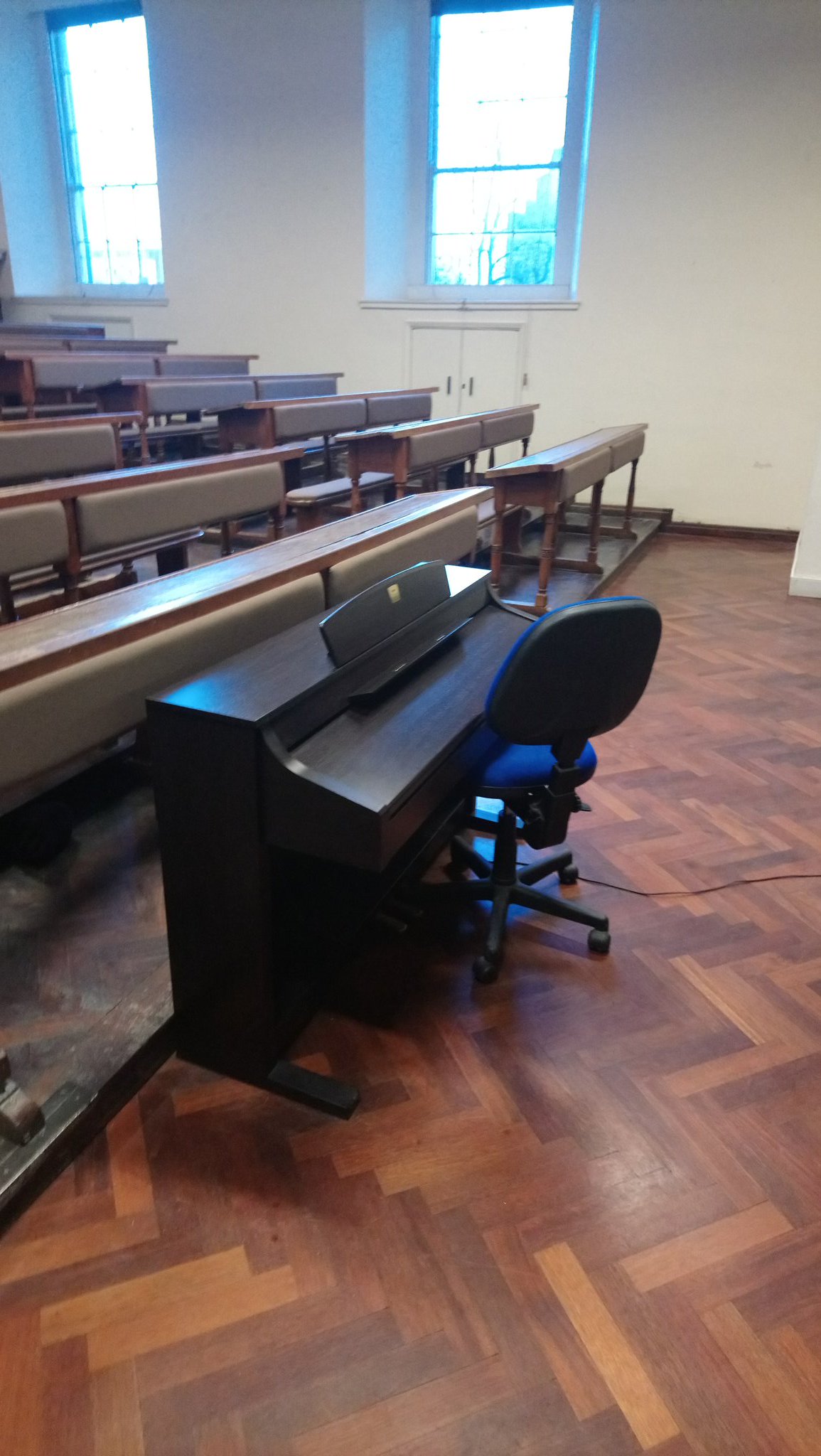
Incidentally, I was impressed that Physics Hall (where I did this morning’s lecture) is equipped with an electric piano:

I wonder if anyone can suggest appropriate musical numbers to perform for a class of computational physicists? Suggestions are hereby invited via the Comments Box!

Transitional Arrangements

Posted in Biographical, Education with tags , on January 27, 2018 by telescoper

So I’m here in Dublin airport again, waiting for a flight back to Cardiff. I woke up early this morning so decided to get the 6am Hopper Bus from Maynooth instead of the usual 7am one. There was no traffic and it took only 40 minutes so I’ve had time to have a coffee and a bacon sandwich, as well as finishing the FT prize crossword.

Anyway, teaching term starts next week in both Cardiff and Maynooth so it promises to be quite a hectic period. I’ll be teaching Physics of the Early Universe in Cardiff on Tuesdays and Computational Physics in Maynooth on Thursdays. I volunteered for the latter course primarily to brush up my Python skills, which are distinctly rusty.

At least I won’t have the problem that I had in Nottingham when I was teaching two modules in the same Semester, Cosmology and Theoretical Elementary Particle Physics, both for 3rd year students (so mostly the same students) and both timetabled in the same room. I remember one day turning up and starting a lecture on weak nuclear interactions only to realise I was meant to be doing something about the propagation of photons in an expanding universe.

The midweek to and fro between Wales and Ireland will continue until March where there is a divergence of arrangements for the Easter break. My calculations indicate that happens after 7 lectures  and therefore 7 midweek flights. Should be fun. At least I’m racking up the Avios…


University Pension Differences

Posted in Education, Finance, Maynooth with tags , , , , , , , , on January 26, 2018 by telescoper

Following a ballot of members of the University and College Union (UCU), the UK university sector is gearing up for strike action over proposed changes to the USS pension scheme. Unless the dispute is resolved in the meantime (which I think is highly unlikely) the first strike lasting two days will place on 22nd and 23rd February. Thereafter strikes will escalate to cover three days, four days and five days in subsequent weeks.  I’ll actually be in Maynooth for the first 48 hour block so won’t have to worry about crossing a picket line initially, but will have to later if it drags on. It looks set to be a bitter dispute which will not be easily resolved.

When I joined USS (in 1988) it was a simple `Final Salary Scheme’. Both employer and employee contributed and the benefits accrued were an index-linked pension of 1/80 of the final salary for each year of contributions and a (tax-free) lump sum of 3/80 for each year of contributions. I joined at age 25 so I expected to accrue 40 years of pension if I retired at 65, namely a pension of half my final year’s salary and a lump sum of three-halves. It looked a good deal and was a significant factor mitigating the relatively low starting salary for academics in those days.

Over the years it became apparent that this scheme is actuarially unsound because (a) people are living longer, increasing the scheme’s liability and (b) investment growth achieved by the USS fund managers has decreased, with a negative impact on asset growth. Moreover, the USS fund is not underwritten by the government, so if it collapses completely members could be left with no benefits at all.

The USS Final Salary scheme was closed to new entrants some years ago and replaced by a less generous defined benefit scheme. A couple of years ago it was closed to existing members too, though the benefits accrued are retained; I will now only be able to get 28/80 of my final salary from that scheme when I actually retire. The scheme was replaced by a hybrid of an even less generous defined benefit scheme and a defined contribution scheme (where the pension benefit is dependent on the fund valuation at retirement, as most private pensions). Now the proposal is to remove the defined benefit component entirely. The loss of pension benefits will be substantial.

I don’t see any easy settlement of this dispute so I’m glad that it won’t affect me very much. I’ll be leaving the UK Higher Education system this summer and relocating to Ireland. Quite a few people have asked me how the pension scheme works here so I thought I’d point out the differences.

The first thing to say is as a professor in the National University of Ireland at Maynooth I am treated as a public servant so my future pension benefits here are covered by the Single Public Service Pension scheme. This resembles the final salary scheme that USS used to be, but with the important difference is that it is integrated with the State Pension to which everyone is entitled if they pay social insurance contributions. This – called the SPC – is similar to the old State Earnings-Related Pension Scheme (SERPS). Since public employees benefit from this as well as the public service pension scheme, the accrual rate in the latter is lower than the old USS scheme – just 0.58% per year – on salaries up to €45,000. For salaries above this figure the amount above the  limit generates an accrual rate 0f 1/80, just as the USS version. There is also a lump sum which accrues at 3.75% per annum, the same as the USS scheme.

In summary, then, the big difference is that in Ireland the public service pension is integrated with the state pension, whereas in the UK the latter is entirely separate. It’s also the case that in Ireland the pension is guaranteed by the government (which, of course, can change the rules…)

In my opinion the pension scheme for University staff in Ireland is significantly better value than the diminishing returns provided by the USS scheme, yet another reason why I made the decision to move here.


Cosmology: The Professor’s Old Clothes

Posted in Education, The Universe and Stuff with tags , , , , , , , on January 19, 2018 by telescoper

After spending  a big chunk of yesterday afternoon chatting the cosmic microwave background, yesterday evening I remembered a time when I was trying to explain some of the related concepts to an audience of undergraduate students. As a lecturer you find from time to time that various analogies come to mind that you think will help students understand the physical concepts underpinning what’s going on, and that you hope will complement the way they are developed in a more mathematical language. Sometimes these seem to work well during the lecture, but only afterwards do you find out they didn’t really serve their intended purpose. Sadly it also  sometimes turns out that they can also confuse rather than enlighten…

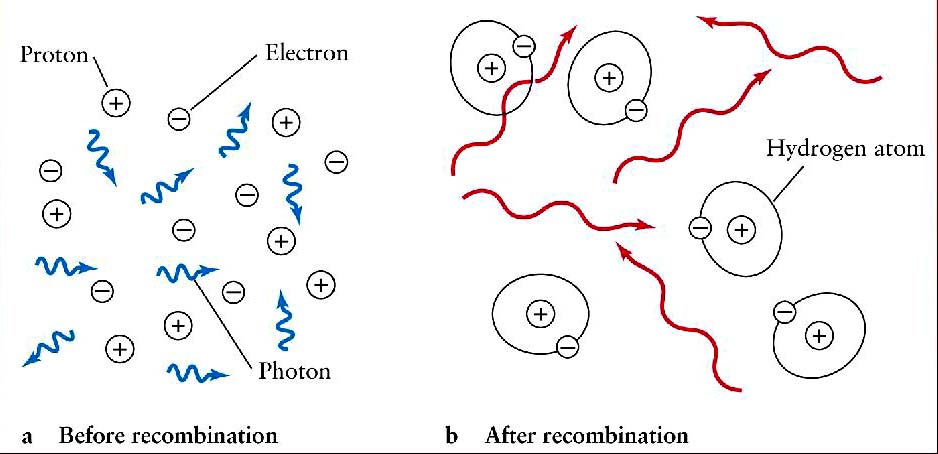
For instance, the two key ideas behind the production of the cosmic microwave background are recombination and the consequent decoupling of matter and radiation. In the early stages of the Big Bang there was a hot plasma consisting mainly of protons and electrons in an intense radiation field. Since it  was extremely hot back then  the plasma was more-or-less  fully ionized, which is to say that the equilibrium for the formation of neutral hydrogen atoms via

p+e^{-} \rightarrow H+ \gamma

lay firmly to the left hand side. The free electrons scatter radiation very efficiently via Compton  scattering

\gamma +e^{-} \rightarrow \gamma + e^{-}

thus establishing thermal equilibrium between the matter and the radiation field. In effect, the plasma is opaque so that the radiation field acquires an accurate black-body spectrum (as observed). As long as the rate of collisions between electrons and photons remains large the radiation temperature adjusts to that of the matter and equilibrium is preserved because matter and radiation are in good thermal contact.


Image credit: James N. Imamura of University of Oregon.

Eventually, however, the temperature falls to a point at which electrons begin to bind with protons to form hydrogen atoms. When this happens the efficiency of scattering falls dramatically and as a consequence the matter and radiation temperatures are no longer coupled together, i.e. decoupling occurs; collisions can longer keep everything in thermal equilibrium. The matter in the Universe then becomes transparent, and the radiation field propagates freely as a kind of relic of the time that it was last in thermal equilibrium. We see that radiation now, heavily redshifted, as the cosmic microwave background.

So far, so good, but I’ve always thought that everyday analogies are useful to explain physics like this so I thought of the following.

When people are young and energetic, they interact very extensively with everyone around them and that process allows them to keep in touch with all the latest trends in clothing, music, books, and so on. As you get older you don’t get about so much , and may even get married (which is just like recombination, not only that it involves the joining together of previously independent entities, but also in the sense that it dramatically  reduces their cross-section for interaction with the outside world).  As time goes on changing trends begin to pass you buy and eventually you become a relic, surrounded by records and books you acquired in the past when you were less introverted, and wearing clothes that went out of fashion years ago.

I’ve used this analogy in the past and students generally find it quite amusing even if it has modest explanatory value. I wasn’t best pleased, however, when a few years ago I set an examination question which asked the students to explain the processes of recombination and decoupling. One answer said

Decoupling explains the state of Prof. Coles’s clothes.

Anyhow, I’m sure there’s more than one reader out there who has had a similar experience with an analogy that wasn’t perhaps as instructive as hoped or which came back to bite you. Feel free to share through the comments box…

Why I’m moving to Ireland

Posted in Biographical, Education with tags , , , , , , , , , on December 20, 2017 by telescoper

Over the past few weeks quite a number of people have asked me why I decided to move to Ireland, so thought I’d write a post about it in case anyone out there is interested.

The simple answer that I was offered a full-time permanent and rather well paid job at Maynooth University. I’m currently on a part-time fixed term contract at Cardiff University.  The salary wasn’t the main factor, but the low value of the £ relative to the € means that I will do quite well financially out of the move. On top of that I will be joining a final salary pension scheme which has far more favourable terms that the scheme that applies to UK academic staff. Oh, and there’s neither a Research Excellence Framework nor a Teaching Excellence Framework nor a Knowledge Exchange Framework nor punitive levels of student tuition fees nor any of the many other  idiocies that have been inflicted on UK universities in recent years. It will be a relief to be able to teach and do research in environment which, at least for the time being, regards these as things of value in themselves rather than as means of serving the empty cycle of production and consumption that defines the modern neoliberal state. Above all, it’s a good old-fashioned professorship. You know, teaching and research?

That’s the simple answer, but there’s a bit more to it than that. I left Sussex in 2016 with the intention of taking early retirement as soon as I could do so. My short exposure to  a role in senior management, as Head of the School of Mathematical and Physical Sciences at the University of Sussex, convinced me that I didn’t want to spend the rest of my life  in a system that I felt had lost all sight of what universities are and what they are for. I was (and still am) deeply grateful to Cardiff University for throwing me a lifeline that enabled me to escape from what I increasingly saw as a dead-end job, and giving me an interesting job to do to tide me over until next year, when I am 55 and therefore eligible for early retirement.

I think I have done everything that was asked of me in my current position at Cardiff, on a half-time salary but often up against very short timescales. The two MSc courses I was brought in to set up are both now running and looking to expand. On top of that we also managed to secure funding for a Centre for Doctoral Training. I only played a small part in doing that, but I think it has put the Data Innovation Research Institute on the map.  When both of these successes had been secured earlier this year, I felt that there was no way that leaving now would have a negative effect either on the Data Innovation Institute or the School of Physics & Astronomy. By about April this year I had firmly decided to retire completely from academia in mid-2018.

The problem with this plan had been apparent since 2016: Brexit.  I think it’s still quite possible that the Brexit project will fail under the weight of its own contradictions, but that no longer matters. The damage has already been done. The referendum campaign, followed by the callous and contemptuous attitude of the current UK Government towards EU nationals living in Britain, unleashed a sickening level of xenophobia that has made me feel like a stranger in my own country. Not everyone who voted `Leave’ is a bigot, of course, but every bigot voted for Brexit and the bigots are now calling all the shots. There are many on the far right of UK politics who won’t be satisfied until we have ethnic cleansing. Even if Brexit is stopped the genie of intolerance is out of the bottle and I don’t think it well ever be put back. Brexit will also doom the National Health Service and the UK university system, and clear the way for the destruction of workers’ rights and environmental protection. The poor and the sick will suffer, while only the rich swindlers who bought the referendum result will prosper. The country in which I was born, and in which I have lived for the best part of 54 years, is no longer something of which I want to be a part.

So, having spent most of my working life in the UK higher education system and decided that my heart was no longer in that, I then had to face that my heart was no longer in this country at all. Could I face years of retirement in mean-spirited down-market Brexit Britain? What was I to do?

I’ve mentioned many times on this blog how lucky I have been that opportunities have come along at exactly the right time. In May, a friend pointed out the advertisement for a job in Maynooth with an application deadline just a few days away. Cosmology was specifically mentioned as one of the possible areas. I felt that they would probably be looking for someone younger, and my research output over the last few years has been patchy given my other commitments, but at the last minute I sent off an application.

Ireland has a particularly strong attraction for me because I have Irish ancestry through which I am eligible for citizenship without having to go through the naturalisation process (which takes 5 years, still less than many EU countries). Together with an Irish EU passport comes a continuation of the rights – especially freedom of movement – that UK citizens will shortly lose.

It seemed like outrageously good luck that the position in Maynooth came up just at the right time, but the end of July came and went without any news. I assumed I hadn’t been shortlisted, so forgot about the idea.

Then, in September I received a letter inviting me for interview just a couple of weeks later. I’m not sure why the process was  so delayed, but was overjoyed to find out there was still a chance. The date clashed with a prior commitment, so I had to do the interview via Skype (over a flaky internet connection from a hotel room) rather than in person.  I thought it went very badly, but I ended up being offered the job. I visited Maynooth University shortly after being informed of this, to discuss terms.

The people at Maynooth were keen to have me start there as soon as possible, but given the lateness of the interview date I had already committed to teaching in Cardiff this forthcoming Semester and I wasn’t going to leave my current colleagues and students in the lurch. There was an obvious solution, however. I am employed here at 50% FTE so I could start in Maynooth at up to 50% without having to resign. We quickly agreed this transitional arrangement was workable, and I started there on 1st December.  The period from February to April will be very busy, as I will be working either side of the Irish Sea, but it’s only for a relatively short time. Next summer I plan to relocate completely to Ireland.

You probably think I’m a bit old to be starting a new life in another country, even one that’s relatively nearby, but I reckon I have time for this one last adventure before I retire. In the words of Tennyson’s Ulysses, `It is not too late to seek a newer world’.  I have worked in British universities since 1988. That’s almost 30 years. I reckon I can still contribute something in the last 10 I have before I pull down the shutters for good. Who knows, maybe I’ll even experience the joy of living in a United Ireland before long?

The press have covered a number of stories of EU nationals who have been living in Britain and who have decided to leave because of Brexit. Surprisingly little attention has been paid to those, like myself, who are also EU nationals but who happen have been born in Britain. I know more than a few academics who are weighing up their options, as well as those born abroad I know who have already departed.  The Brexodus has already begun and its pace seems likely to accelerate very quickly indeed. Others have personal situations that are more complicated than mine, especially those who have partners and children, so not everyone will find it easy to follow a similar path to the one I’ve chosen, but I those that can get out will do so.

Because I’ve lived here all my life I thought I would find it difficult to leave Britain. I was quite traumatised by the Brexit referendum, as one would be by the death of a close relative, but it made me reexamine my life. There is a time when you have to move on, and that’s what I’m doing. I’m done here.
The Taste and Tincture of Another Education

Posted in Education, Literature, The Universe and Stuff with tags , on December 17, 2017 by telescoper

This is what a University education meant to the poet and theologian Thomas Traherne (1636-1674), according to his Centuries of Meditations. In this astonishing book describing his own voyage of spiritual discovery, Traherne celebrates, among many other things, the beauty and complexity of creation as a manifestation of the power of God. Even  a non-religious person like myself can find much to appreciate in his words about the wonder of the natural world and the joy of learning for learning’s sake:

Having been at the University, and received there the taste and tincture of another education, I saw that there were things in this world of which I never dreamed; glorious secrets, and glorious persons past imagination. 

There I saw that Logic, Ethics, Physics, Metaphysics, Geometry, Astronomy, Poesy, Medicine, Grammar, Music, Rhetoric all kinds of Arts, Trades, and Mechanisms that adorned the world pertained to felicity; at least there I saw those things, which afterwards I knew to pertain unto it: and was delighted in it. 

There I saw into the nature of the Sea, the Heavens, the Sun, the Moon and Stars, the Elements, Minerals, and Vegetables. All which appeared like the King’s Daughter, all glorious within; and those things which my nurses, and parents, should have talked of there were taught unto me.

Problems with two-year degrees

Posted in Education with tags , , , , , on December 13, 2017 by telescoper

I see that the Minister responsible for UK universities, Jo Johnson, has decided that universities should offer two-year degrees, claiming that this will somehow attract more students into higher education.

The idea seems to be that students will get the same `amount’ of teaching, but concentrated in two full calendar years rather than spread over three academic years. This fast-track degree will be offered at a lower level of fee than a normal three-year Bachelors programme.

I can just about accept that this will work in some disciplines and at some universities. The (private) University of Buckingham, for example, already offers such programmes. On the other hand, the University of Buckingham did not participate in the latest Research Excellence Framework, no doubt for the reason that teaching all-year round leaves its academic staff no time to do research or even attend conferences, which (I find) these days is only possible during the summer recess.

Call me old-fashioned, but I think an institution that does not combine teaching and research – and indeed one in which the teaching is not led by research – does not merit the name of `University’. The old polytechnics offered a range of valuable opportunities that complemented the traditional honours degree, but that capacity was basically eliminated in 1992 when all such institutions became universities.

Though my main objection to two-year degrees is their impact on research, there are problems from the teaching side too. One is that keeping up the intensity of full-time study throughout a whole year will, in my opinion, exacerbate the difficulty many students have managing their workload without stress or other mental health difficulties. Moreover, many students currently use the long summer vacation either to work, either to earn money to help offset the cost of study, or to participate in placements, internships or other activities to help make them more employable after graduation.

It would be particularly difficult to manage two-year degrees in STEM disciplines, as the teaching laboratories need maintenance and installation of new equipment, for which the proposed system allows no time. And how would project work fit into the fast-track system? On top of all that there’s the fact that the current fee level does not cover the cost of teaching in STEM disciplines, so having to do it faster and for less money is not going to be possible. Incidentally, many STEM students currently pursue undergraduate programmes that last four years, not three…

These points have no doubt been made before, but there is another point that is less widely understood. The fact is that a two-year Bachelors degree may not be a recognised qualification outside the UK. This is, in fact, already a problem with the four-year undergraduate programmes we call, e.g., MPhys, and regard as Masters level in this country: these are not regarded as Masters qualifications in many European countries. Perhaps this is part of some cunning plan to stop graduates leaving the UK after Brexit?

In the light of these difficulties it is no surprise to me that not a single undergraduate I’ve spoken to thinks that a two-year degree is a sensible option. If the government wants to make studying cheaper, said one Physics student I was chatting to, why don’t they just cut the fees for normal degree programmes?

The impression one gets from all this `thinking’ is that the Government increasingly regards universities as businesses that trade in a commodity called `education’, where the word ‘education’ is narrowly construed as `training’ in the skills needed for future employment. I believe a University education is (or should be) far more about developing critical thinking, problem-solving ability, intellectual curiosity than it is about teaching them, e.g., programming skills. Skills are important, of course, but we also need to educate students in what to use them for.

Thinking of Applying for a PhD Place in Physics or Astronomy?

Posted in Education with tags , , on December 11, 2017 by telescoper

Back in Cardiff at the start of Week 11, the last week of teaching before Christmas, I realise that some final-year undergraduate and Masters students will be using the forthcoming vacation to think about applying for PhD places. As I have done for a few years now, I thought I’d use this opportunity  to pass on some, hopefully useful,  information about how to go about applying for PhDs  in Physics  and Astronomy. I’m aiming this primarily at UK students applying for places in the UK; special considerations apply for students wanting to do graduate research abroad, including the Irish Republic…

What is a PhD? The answer to that is relatively easy; it’s a postgraduate research degree. In order to obtain a PhD you have to present a thesis like that shown on the left (which happens to be mine, vintage 1988), typically in the range 100-250  pages long. A thesis has to satisfy two conditions for the award of the degree: it should contain original research, which is publishable in an academic journal; and it should present a coherent discussion of that original work within the context of ongoing work in the area of study. In Physics & Astronomy, the PhD is pretty much a prerequisite for any career in academic research, and it usually takes between 3 and 4 years to complete. After submission of the thesis you will have to undergo a viva voce examination conducted by two examiners, one internal and one external. This is quite a tough test, which  can last anywhere between about 2 and about 6 hours, during which you can be asked  detailed questions about your research and wide-ranging questions about the general area.

The Money Side. In the UK most PhDs are supported financially by the research councils, either EPSRC (most physics) or STFC (nuclear & particle physics, astronomy). These generally award quotas of studentships to departments who distribute them to students they admit. A studentship will cover your fees and pay a stipend, currently £14553 pa. That doesn’t sound like a lot, but you should at least remember that it is a stipend rather than a wage; it is therefore not taxed and there is no national insurance payable. There is a fee (currently £4284) payable for a PhD course, but that only comes into play if you are planning to fund yourself. If you receive a studentship it will normally cover the fee as an additional component. What I mean by that is you don’t need to pay it out of the stipend, it is separate. In top of that, research council funding also supplies a Research Training Grant which covers, e.g., travel and small items of equipment, so you don’t need to pay for those out of your stipend either.

How do I choose a PhD? During the course of a postgraduate degree you are expected to become an expert in the area in which you specialize. In particular you should reach the point where you know more about that specific topic than your supervisor does. You will therefore have to work quite a lot on your own, which means you need determination, stamina and enthusiasm. In my view the most important criterion in your choice of PhD is not the institution where you might study but the project. You need to be genuinely excited by the topic in order to drive yourself to keep through the frustrations (of which there will be many). So, find an area that interests you and find the departments that do active research in that area by looking on the web. Check out the recent publications by staff in each department, to ensure that they are active and to have something to talk about at interview!

Qualifications. Most universities have a formal requirement that candidates for admission to the PhD should have a “good honours degree”, which basically means at least an Upper Second Class Honours degree. Some areas are more competitive than others, however, and in many disciplines you will find you are competing with a great many applicants with First Class degrees.

How to apply successfully. The application procedure at most universities is quite simple and can be done online. You will need to say something about the area in which you wish to do research (e.g. experiment/theory, and particular field, e.g. cosmology or star formation). You’ll also need a CV and a couple of references. Given the competition, it’s essential that you prepare. Give your curriculum vitae some attention, and get other people (e.g. your personal tutor) to help you improve it. It’s worth emphasizing particular skills (e.g. computing). If you get the chance, make use of your summer vacations by taking on an internship or other opportunity to get a taste of research; things like that will undoubtedly give your CV an edge.

The Interview. Good applicants will be invited for an interview, which is primarily to assess whether you have the necessary skills and determination, but also to match applicants to projects and supervisors. Prepare for your interview! You will almost certainly be asked to talk about your final-year project, so it will come across very badly if you’re not ready when they ask you. Most importantly, mug up about your chosen field. You will look really silly if you haven’t the vaguest idea of what’s going on in the area you claimed to be interested in when you wrote your  application!

Don’t be shy! There’s nothing at all wrong with being pro-active about this process. Contact academic staff at other universities by email and ask them about research, PhD opportunities. That will make a good impression. Also, don’t be afraid to ask for advice. Although we’re all keen to recruit good PhD students for our own departments, we academics are  conscious that it is also our job to give impartial advice. Ask your tutor’s opinion.

How many places should I apply for? Some research areas are more fashionable than others so the level of competition varies with field. As a general rule I would advise applying for about half-a-dozen places, chosen because they offer research in the right area. Apply to fewer than that and you might lose out to the competition. Apply to many more and you might not have time to attend the interviews.

What’s the timetable?  Most applications come in early in the new year for entry to the PhD in the following September/October. The Christmas break is therefore a pretty good time to get your applications sorted out. Interviews are normally held in February or March, and decisions made by late March. STFC runs a deadline system whereby departments can not force students to accept or decline offers before the end of March, so there should be ample time to visit all your prospective departments before having to make any decisions.

That’s all I can think of for now. I hope at least some of these comments are useful to undergraduates anywhere in the UK thinking of applying for a PhD. If there are any further questions, please feel free to ask through the comments box. Likewise if I’ve missed anything important, please feel free to suggest additions in the same manner…

How much cross-subsidy? Research funding and the British university*

Posted in Education on November 23, 2017 by telescoper

This post makes some very important points about how research is so underfunded in UK universities that it can only be sustained by cross-subsidy from teaching income mainly generated by other subjects, especially from overseas students who are charged extremely high fees. This is particularly true for experimental science subjects, for which the cost of research activity far exceeds the funds available from government agencies. I don’t think it will be long until this leads to a crisis. In fact, I think it’s happening already.

amcrae2014's avatar[ex-] HEAD OF DEPARTMENT’S BLOG

A recent HEPI report exposes the confidence trick that sustains British higher education. Research excellence leads to high international status; this in turn leads to high numbers of international students; and these students underwrite the research. Simple, but maybe not sustainable, especially in the current climate. Indeed an examination of this creaky merry-go-round exposes the risks that face UK universities.

How much is too much?

The report, How much is too much? Cross-subsidies from teaching to research in British universities, by University of Oxford MPhil student Vicky Olive, grabbed headlines for its calculation that international students contribute, on average, £8,000 per year to research funding. The author used Transparent Approach to Costing (TRAC) data (imperfect, yes, but the best information we have) to track income and expenditure, working largely at institutional level. Unsurprisingly, she found that teaching subsidises research. However, it’s almost entirely the surplus value from international students…

View original post 826 more words

This is not normal: universities in the news

Posted in Education, Politics on October 30, 2017 by telescoper

A reaction to recent news coverage of UK universities, among other things.

I particularly liked “the degraded language of TEF, REF and KEF, which confuses bureaucracy with vision”. Well said.

amcrae2014's avatar[ex-] HEAD OF DEPARTMENT’S BLOG

It is not normal for universities to occupy the front pages of national newspapers. Granted, at any time there is a vital, occasionally tense, dialogue between universities and the nations in which they are situated. The line between ideals of academic freedom on the one hand, and the realities of finances and state oversight on the other hand, is notoriously fuzzy. The extent to which universities reflect or represent their nations is always a potential point of controversy.

But these are not normal times. Over the past few months, debate has swirled frenetically around questions including university funding, whether we have too many universities, what our top managers are paid, free speech on campus, how we select our students, and what we teach. We appear now to be at the point where even what academics think might be a point for national outrage.

It seems to me that much of…

View original post 767 more words