Archive for the Education Category

Day Trip to Harwell

Posted in Education, Science Politics with tags , , , on April 1, 2014 by telescoper

Only time for a quick post as I’ve just got back from a visit to the Rutherford Appleton Laboratory which is located at Harwell (in the heart of the Midlands).

I was there to find out about the Science and Technology Facilities Council‘s Apprenticeship scheme, as we are planning to introduce a similar scheme at the University of Sussex and needed some advice about how to set it up. I hope to write more about that in due course.

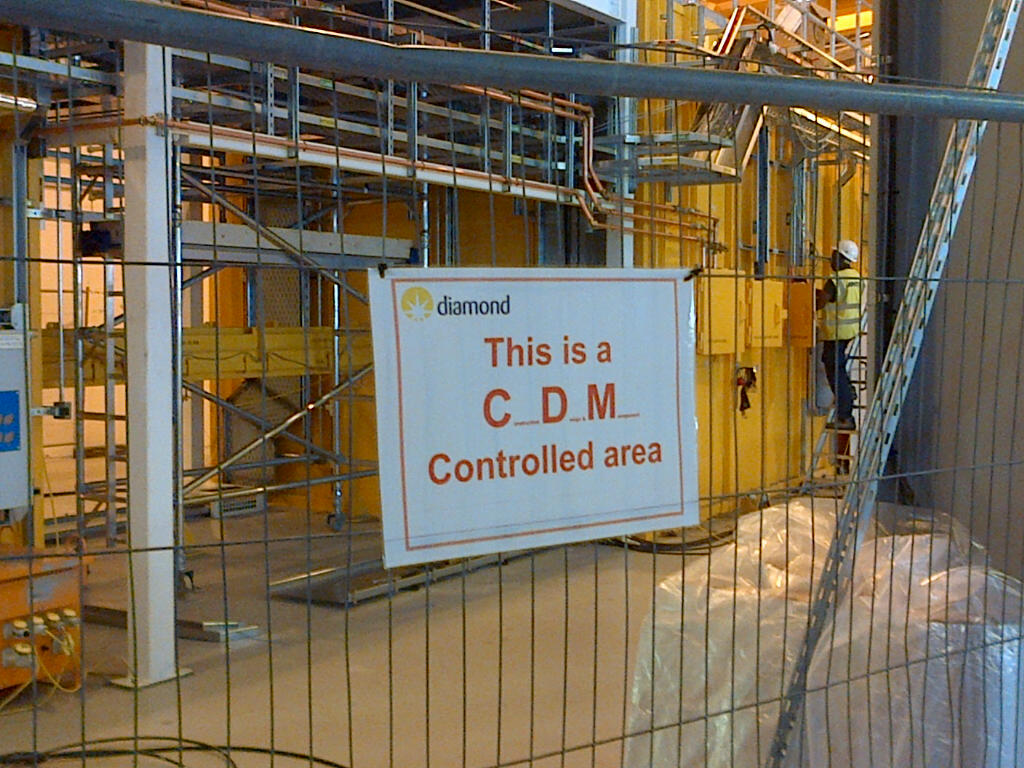
Anyway, it was a very informative and useful visit with the added bonus that we also got an impromptu guided tour of the Diamond Light Source (and its associated workshops where some of the current STFC apprentices are employed). The Diamond Light Source is actually shut down at the moment so various upgrades can be performed, and we were therefore allowed up close to where the beam lines are. That was very interesting indeed, especially when I saw that special devices are apparently deployed to counteract the effects of Cold Dark Matter..

Tuition Fees, Ponzi Schemes and University Funding

Posted in Education, Finance, Politics with tags , , on March 30, 2014 by telescoper

Last week the Higher Education Funding Council for England (HEFCE) finally released information on allocations for 2014/15. As expected, there are large cuts in recurrent grants pretty much across the board (a full table can be found here).  These cuts reflect the fact that government funding for teaching in many subjects is being progressively replaced by tuition fee income in most disciplines, the prominent exception being STEM subjects, which continue to attract a (small) element of grant support in addition to the £9K fees.  Grants for research are largely unchanged for the time being; the big upheaval there will happen when the outcome of the Research Excellence Framework is applied, from 2015/16 onwards.

If you look at the table you will see that some big research universities have relatively small cuts, especially if they focus on STEM disciplines; the obviously example is Imperial College which has a cut of only 3%. Typical Russell Group universities seem to be getting cuts of around 15%. My own institution, the University of Sussex, has been handed a cut of 24%, which reflects the fact that a large majority (greater than 75%) of students here are doing non-science subjects. Universities with less research income and a higher concentration on Arts & Humanities subjects are having to bear cuts of up to 60%.  These reductions are larger than anticipated as a result of the government’s decision to increase the total number of places by about 30,000 this year.

These numbers look alarming, but in most cases, including Sussex, the net income (FEES+GRANT) will actually go up next year, as long as the institution manages to recruit a sufficient number of students. The ability of a university to generate sufficient income to cover its costs has always depended on its ability to attract students, but this has previously been managed using a student number control, effectively applying a cap on recruitment to institutions that might otherwise corner the market.   This year some institutions who failed to recruit strongly have had their cap lowered, but worse is in store from 2015/16 as the cap will be lifted entirely, so that there will effectively be a free market in student recruitment. I sure I’m not the only person who thinks the likely outcome of this change will be a period of chaos during which a relatively small number of institutions will experience a bonanza while many others will struggle to survive.

As if this weren’t bad enough, there is also the growing consensus that the current fee regime is unsustainable. Revised estimates now suggest that about 45% of graduates will never pay back their tuition fees anyway. If this percentage grows to about 50% – and I am very confident that it will – then the new tuition fee system will end up costing the Treasury (i.e. the taxpayer) even more than the old regime, while also saddling generations of graduates with huge debts and also effectively removing the sector from public control.

Apparently, the response of the government to the level of default on repayments is to consider increasing fees to a level even higher than the current £9K per annum. It seems to me that the likely consequence of this would simply be to increase the default rate still further, largely by driving UK graduates abroad to avoid liability for paying back their loans, and thus drive the system into runaway instability.

The more one looks at the fees and loans debacle the more it resembles  a Ponzi scheme that’s destined to unravel with potentially catastrophic consequences for England’s universities; note that Wales, Northern Ireland and Scotland are not covered by HEFCE arrangements.

So what can be done?

I’ll assume at the outset that the only really sensible plan – taking the entire system back under public control – is, by the very nature of the British political system, unthinkable.

My first suggestion reflects the fact that I am a scientist and that I think  science education and research properly should be a very high priority for any system of university funding. Whatever is done therefore must address the point I made a post about the threat to STEM subjects presented by HEFCE’s policies the essence of which is that the £9K flat-rate fee across all disciplines does not reflect the true difference in cost of teaching between, say, English and Physics. Differential fees would have a disastrous effect on recruitment into science subjects while the current system underfunds STEM disciplines so severely that it offers a perverse incentive for universities to focus on non-science areas. Under the current system, fees from Arts disciplines are effectively subsidizing science subjects rather than providing education to those paying the fees; in other words, Arts students are being ripped off.

Second, if the taxpayer is going to foot a significant part of the bill for higher education then HEFCE (or whatever organization replaces it in future) must have sufficient clout to manage the sector for the public interest, rather than allow it to be pulled apart by the unfettered application of market forces.

Third, any new system must be designed to reduce the level of graduate debt which, as I’ve mentioned already, simply encourages our brightest graduates to emigrate once they’ve obtained their degree.

I’ve actually never really been opposed to the principle that students who can afford to should contribute at some level to the cost of their education; I have, on the other hand, always been opposed to fees being set at the level of £9K per year. The Labour Party’s suggestion that fees should be cut to £6K would go some of the way to satisfying the third requirement, but would be disastrous unless the cut were offset by increased state funding through recurrent grants. I think a better suggestion would be to cut fees by a greater amount than that if possible, but to have a much bigger differentiation in the unit of resource paid to different subjects. I’d say that the net income per student should be about £15K per annum in STEM subjects, whereas for Arts and Social Sciences £6K probably covers the full cost of tuition.  So if the fee is set at £X across the board, STEM disciplines should receive £(15-X) from HEFCE while Arts subjects get a subsidy of £(6-X).


Lincoln – Green Shoots for Maths and Physics?

Posted in Education with tags , , , , on March 3, 2014 by telescoper

I noticed over the weekend that there’s a job being advertised at the University of Lincoln designated Founding Head of the School of Mathematics and Physics. It seems the powers that be at Lincoln University (which is in the Midlands) have decided to set up an entire new activity in Mathematics and Physics. I’m pointing this out not because of any personal connection with the position, but because it’s refreshing to see a new(ish) Higher Education Institute apparently willing to take the plunge and invest in a new venture, particularly because it includes Physics. It wasn’t at all long ago that UK Physics departments were being closed down – the University of Reading being a prominent example, in 2006. I think Reading is thinking of starting up Physics again, in fact. Perhaps these are the green shoots that presage a new spring for Physics in this country? I do hope so.

It won’t be an easy task to start up a new department from scratch in Lincoln: grant funding is tight and the competition for students among established institutions is already so intense that it will be very difficult for a brand new outfit to break through. Nevertheless, I think it’s a praiseworthy initiative and I wish it well.

Athena Swan Cake Day

Posted in Biographical, Education with tags on March 2, 2014 by telescoper

I had such a busy day on Friday (28th February) that I didn’t get time to post about our monthly MPS afternoon cake event. This month’s extravaganza was in honour of Athena Swan, the Bronze Award of which the Department of Physics and Astronomy hopes to earn later this year.

The eleven “special” cakes shown in the picture, each of which is in the shape of a swan, represent the eleven female members of academic staff in the School of Mathematical and Physical Sciences (out of about 60 total), and were consumed by them too! There were plenty of other cakes for the rest of us, but since they all involved chocolate I didn’t eat any…


Sussex University – the Place for Undergraduate Physics Research!

Posted in Education, The Universe and Stuff with tags , , , , , , , on February 27, 2014 by telescoper

One of the courses we offer in the School of Physics & Astronomy here at the University of Sussex is the integrated Masters in Physics with a Research Placement. Aimed at high-flying students with ambitions to become research physicists, this programme includes a paid research placement as a Junior Research Associate each summer vacation for the duration of the course; that means between Years 1 & 2, Years 2 & 3 and Years 3 & 4 . This course has proved extremely attractive to a large number of very talented students and it exemplifies the way the Department of Physics & Astronomy integrates world-class research with its teaching in a uniquely successful and imaginative way.

Here’s a little video made by the University that features Sophie Williamson, who is currently in her second year (and who also in the class to whom I’m currently teaching a module on Theoretical Physics:

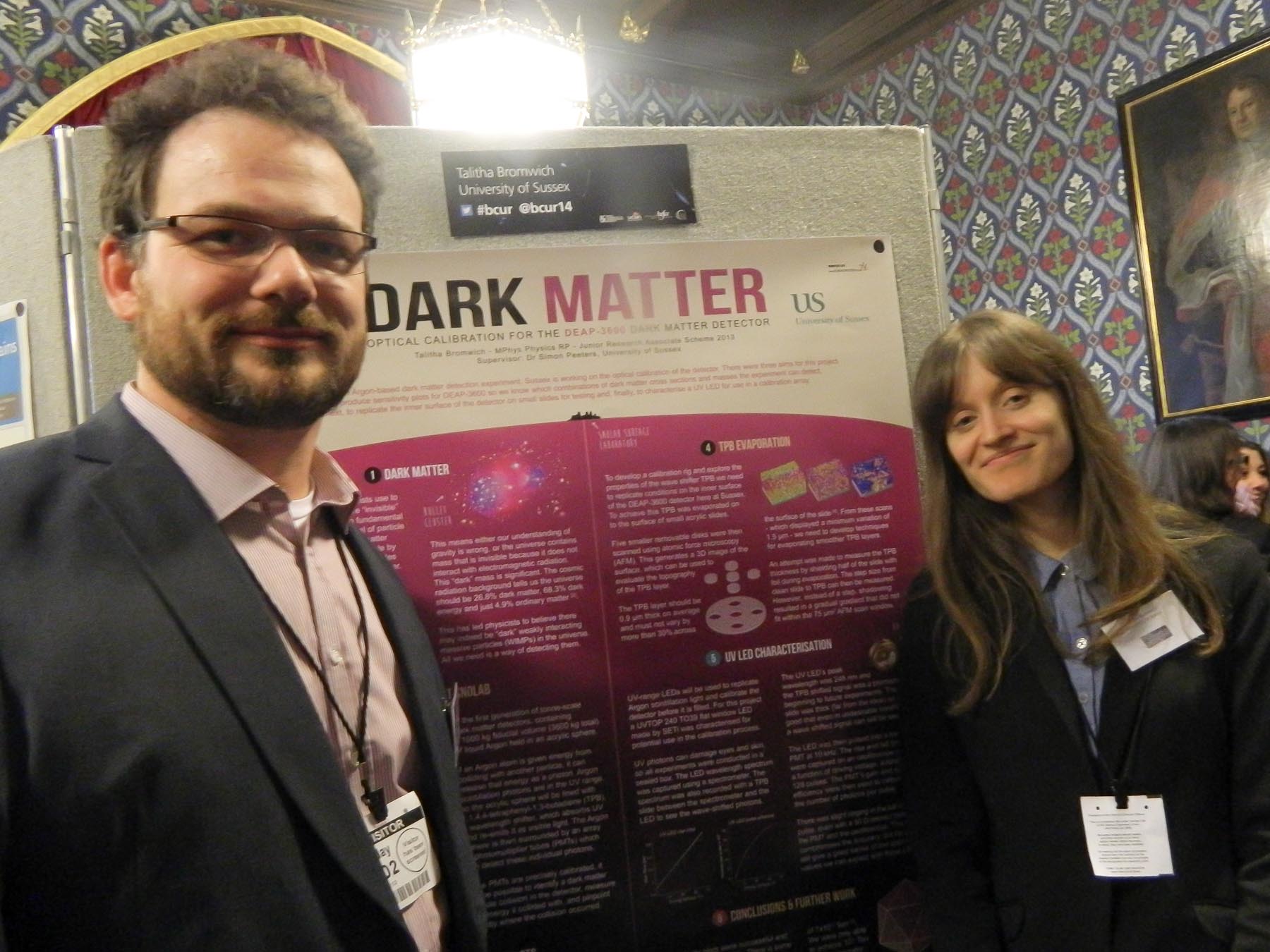
This week we had some very good news about another of our undergraduate researchers, Talitha Bromwich, who is now in the final year of her MPhys degree, and is pictured below with her supervisor Dr Simon Peeters:

Talitha Bromwich with her JRA supervisor Dr Simon Peeters at 'Posters in Parliament' event 25 Feb 14

Talitha spent last summer working on the DEAP3600 dark-matter detector after being selected for the University’s Junior Research Associate scheme. Her project won first prize at the University’s JRA poster exhibition last October, and she was then chosen to present her findings – alongside undergraduate researchers from 22 other universities – in Westminster yesterday as part of the annual Posters in Parliament exhibition, organized under the auspices of the British Conference of Undergraduate Research (BCUR).

A judging panel – consisting of Ben Wallace MP, Conservative MP for Wyre and Preston North; Sean Coughlan, Education Correspondent for the BBC; and Professor Julio Rivera, President of the US Council of Undergraduate Research; and Katherine Harrington of the Higher Education Academy – decided to award Talitha’s project First Prize in this extremely prestigious competition.

Congratulations to Talitha for her prizewinning project! I’m sure her outstanding success will inspire future generations of Sussex undergraduates too!

How should mathematics be taught to non-mathematicians?

Posted in Education with tags , , , , on February 25, 2014 by telescoper

This post from the estimable “Gowers’s Weblog” passed me by when it was originally published in 2012, but I saw the link on Twitter and decided to repost it here because it’s still topical..

gowers's avatarGowers's Weblog

Michael Gove, the UK’s Secretary of State for Education, has expressed a wish to see almost all school pupils studying mathematics in one form or another up to the age of 18. An obvious question follows. At the moment, there are large numbers of people who give up mathematics after GCSE (the exam that is usually taken at the age of 16) with great relief and go through the rest of their lives saying, without any obvious regret, how bad they were at it. What should such people study if mathematics becomes virtually compulsory for two more years?

A couple of years ago there was an attempt to create a new mathematics A-level called Use of Mathematics. I criticized it heavily in a blog post, and stand by those criticisms, though interestingly it isn’t so much the syllabus that bothers me as the awful exam questions. One might…

View original post 9,949 more words

From Real Time to Imaginary Time

Posted in Brighton, Education, The Universe and Stuff with tags , , , , , , , , , , , on February 24, 2014 by telescoper

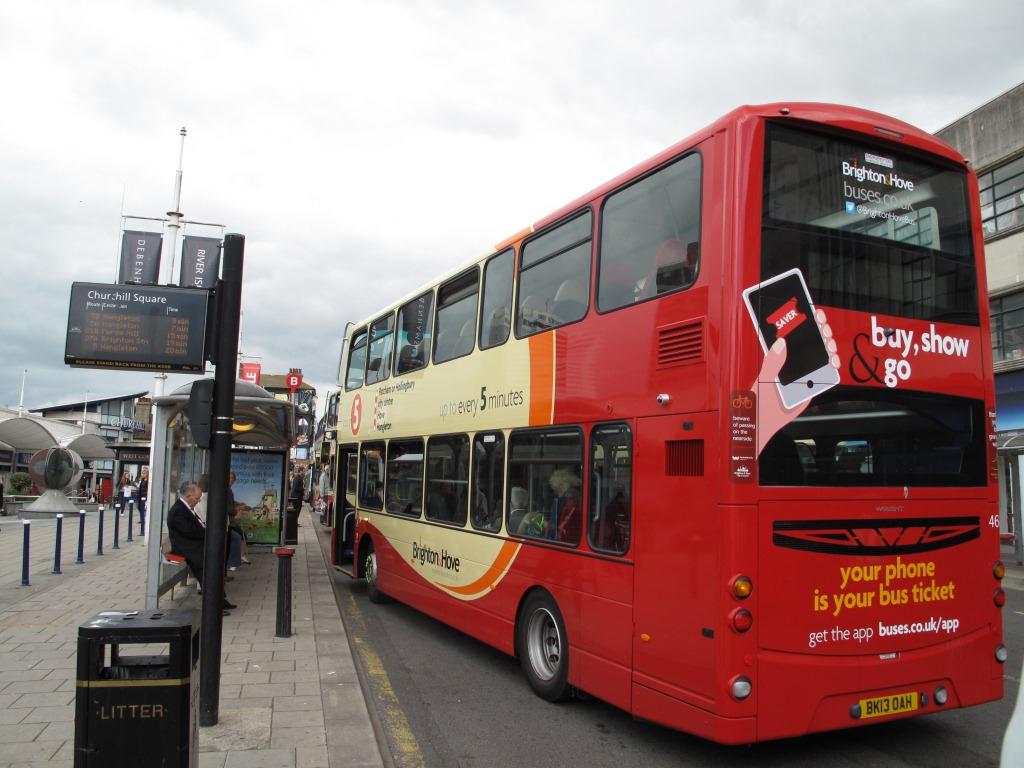
Yesterday, after yet another Sunday afternoon in my office on the University of Sussex campus, I once again encountered the baffling nature of the “real time boards” at the bus-stop at Falmer Station (just over the road from the University). These boards are meant to show the expected arrival times of buses; an example can be seen on the left of the picture below, taken at Churchill Square (in the City Centre).

???????????????????????????????

The real-time board system works pretty well in central Brighton, but it’s a very different story at Falmer, especially for the Number 23 which is my preferred bus home. Yesterday provided a typical illustration of the problem: the time of the first bus on the list, a No. 23, was shown as “1 min” when I arrived at the stop. It then quickly moved to “due” (a word which I’ll comment about later). It then moved back to “2 mins” for about 5 minutes and then back to “due” again. It stayed like that for over 10 minutes at which point the bus that was second on the list (a No. 28 from Lewes) appeared. Rather than risk waiting any longer for the 23 I got on the 28 and had a slightly longer walk home from the stop at the other end. Just as well I did because the 23 vanished entirely from the screen as soon as I boarded the other bus. This apparent time-travel isn’t unusual at Falmer, although I’ve never really understood why.

By sheer coincidence when I got to the bus stop to catch a bus to campus this morning there was a chap from Brighton and Hove buses there. He was explaining what sometimes goes wrong with the real time boards to a lady, so I joined in the conversation and asked him if he knew why Falmer is so unreliable. He was happy to oblige. It turns out that the way the real-time boards work depends on each bus having a GPS system that communicates to a central computer via a radio link. If the radio link drops out for some reason – as it apparently does quite often up at Falmer (mobile phone connectivity is poor here also) – the system looks up the expected time of the bus after the one that it has lost contact with. Thus it is that a bus can apparently be “due” and then apparently go back in time. Also, if a bus has to divert from the route programmed into the GPS tracker then it is also removed from the real-time boards.

However, there is another system in operation alongside the GPS tracker. When a bus actually stops at a stop and opens its doors the onboard computer communicates this to the central system at the same time as the location signs inside the bus are updated. At this point the real-time boards are reset.

The unreliability I’ve observed at Falmer is in fact caused by two problems: (i) the patchy radio coverage as the bus wanders around the hilly environs of Falmer campus; and (ii) the No. 23 is on a new route around the back of campus which means that it vanishes from the system entirely when it wanders off the old route, as would happen if the bus were to break down.

Mystery solved then, in a sense, but it means there’s a systematic problem that isn’t going to be fixed in the short-term. Would it be better to switch off the boards than have them show inaccurate information? Perhaps, but only if it were always wrong. In fact the boards seem to work OK for the more frequent bus, the No. 25. My strategy is therefore never to rely on the information provided concerning the No. 23 and just get the first bus that comes. It’s not a problem anyway during the week because there’s a bus every few minutes, but on a Sunday evening it is quite irksome to see apparently random times on the screens.

All this talk about real-time boards reminds me of a question I was asked in a lecture last week. I was starting a new section of my Theoretical Physics module for 2nd Year students on Complex Analysis: the Cauchy-Riemann equations, Conformal Transformations, Contour Integrals and all that Jazz. To start the section I went on a bit of a ramble about the ubiquity of complex numbers in physics and whether this means that imaginary numbers are, in some sense, real. You can find an enjoyable polemic on this subject, given the answer “no” to the question here.

Anyway, I got the class to suggest examples of the use of complex numbers in physics. The things you’d expect came up such as circuit theory, wave propagation etc. Then somebody mentioned that somewhere they had heard of imaginary time. The context had probably been provided Stephen Hawking who mentioned this in his book A Brief History of Time. In fact the trick of introducing imaginary time is called a Wick Rotation and the basic idea is simple. In special relativity we deal with four-dimensional space-time intervals of the form

ds^2 = -c^2dt^2 + dx^2 + dy^2 +dz^2,

i.e. the metric describing Minkowski space. The minus sign in front of the time bit is essential to the causal structure of space-time but it causes quite a few mathematical difficulties. However if we make the substitution

\tau \rightarrow i c t

then the metric becomes

ds^2 = d\tau^2 + dx^2 + dy^2 +dz^2,

which corresponds to a four-dimensional Euclidean space which is in many situations much easier to handle mathematically.

Complex variables and complex functions provide the theoretical physicist with a host of extremely elegant techniques for solving tricky problems. But does that mean they are somehow “built in” to nature? I don’t think so. I don’t think the Brighton & Hove Bus company uses imaginary time on its display boards either, although it does sometimes seem that way.


POSTSCRIPT. I forgot to include my planned rant about the use of the word “due”. The boards displaying train times at railway stations usually give the destination and planned departure time of the train, e.g. “Brighton 11.15”. If things are running to schedule this information is supplemented by the phrase “On Time”. If not, which is sadly a more likely contingency in the UK, this changes to “due 11.37” or some such. This really annoys me.: the train is due at 11.15. If it doesn’t come until after then, it’s overdue or, in other words, late.
Graduation and Pronunciation

Posted in Biographical, Brighton, Education with tags , , on February 22, 2014 by telescoper

Here’s a chance to relive (if you were there) or experience for the first time (if you weren’t)  the hilarity of my attempts to pronounce the names of all the graduands from the School of Mathematical and Physical Sciences at the Winter Graduation Ceremony for the University of Sussex at the Dome, in Brighton, last month.  I blogged about this here and there are also some pictures here. My stint commences at about 1:35:30 and finishes about 1:48:00 so there’s not too much of me to put up with, and if you get bored with my voice there’s always the irrepressible Chancellor, Sanjeev Baskar, to keep you entertained…

The National Student Survey: Feedback and Response

Posted in Education with tags , , , on February 21, 2014 by telescoper

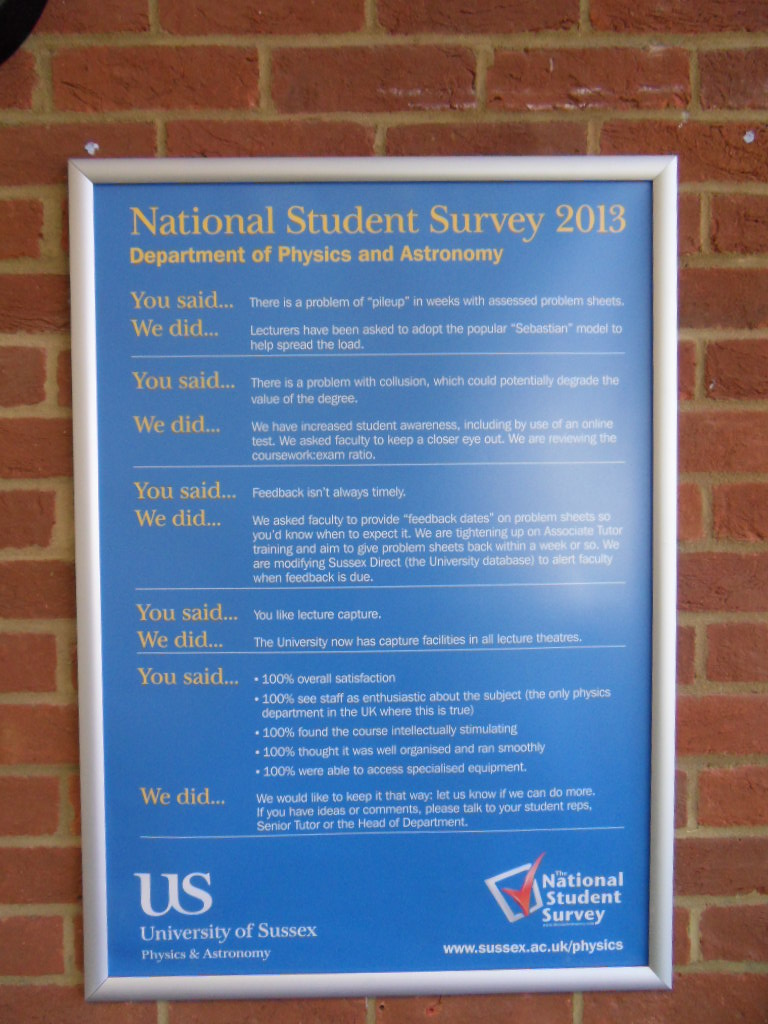
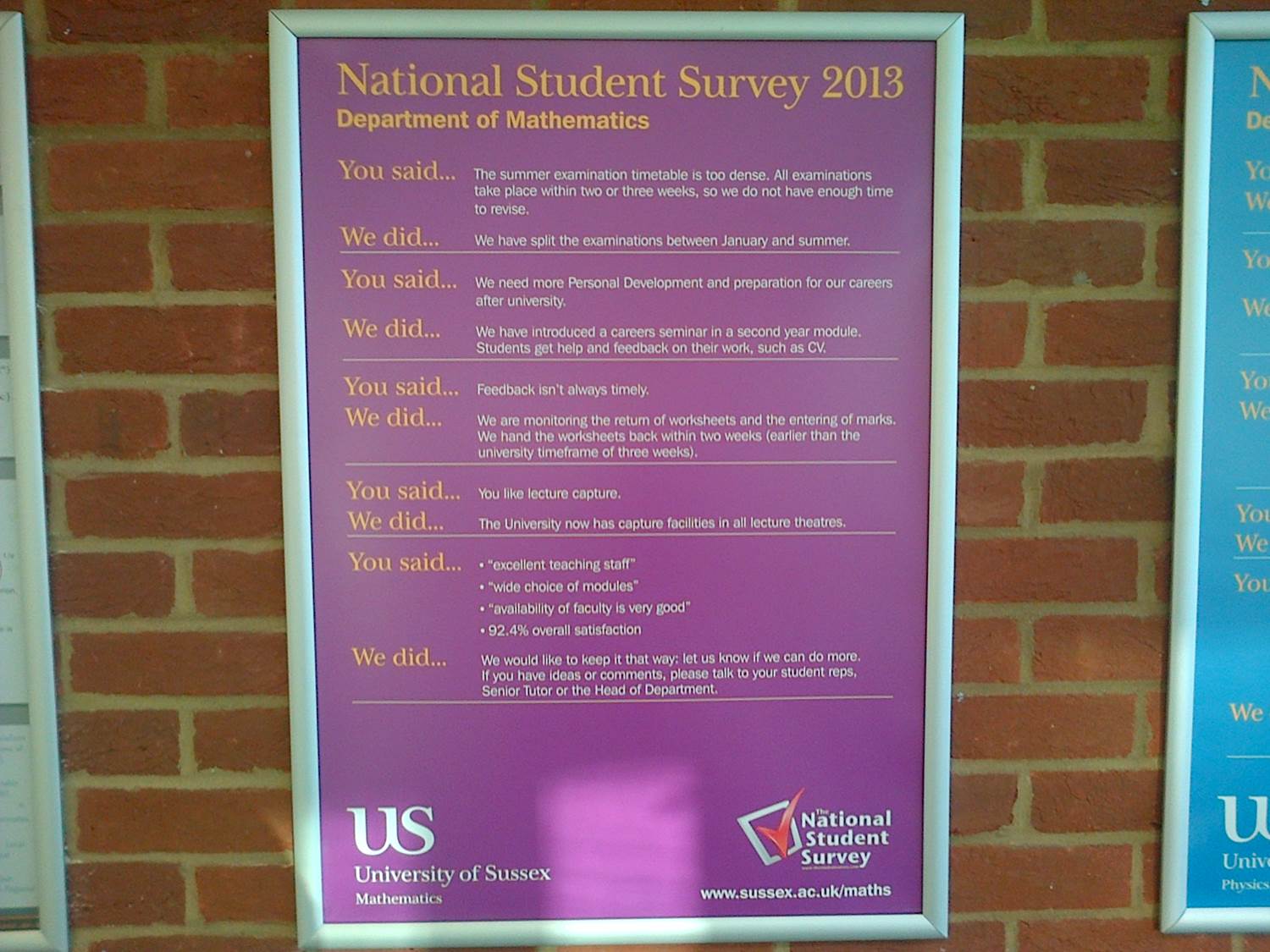
So the 2014 National Student Survey is under way. The NSS is much maligned, largely because it seems to be regarded by the powers that be solely for the purpose of constructing meaningless league tables. In reality I think the NSS survey is actually rather valuable because it allows us to gather systematic feedback on things that we do well and things we do not so well so we can look to improve our teaching for future generations of students. This isn’t just a PR exercise, at least not here in the School of Mathematical and Physical Sciences at the University of Sussex. We really do listen. Here are our responses to last year’s survey in the Department of Physics & Astronomy:

SAMSUNG DIGITAL CAMERA

and for the Department of Mathematics:

Picture1

I hope the fact that we have responded to the feedback we’ve got will encourage more students to participate in this year’s National Student Survey, regardless of what they have to say; that way we can try to improve still further.

Coming out as a scientist

Posted in Education, LGBTQ+, The Universe and Stuff with tags , on February 14, 2014 by telescoper

So here I am sitting in the library at Burlington House, the Royal Astronomical Society Council meeting I was attending having just finished slightly ahead of schedule.

I only have time for a brief post, so I’ll take the opportunity to direct your attention to an interesting piece in the Grauniad by Tom Welton. Tom is Professor of Sustainable Chemistry at Imperial College. He was also a contemporary of mine in old Sussex days. He was doing a PhD in Chemistry in MOLS while I was doing mine in Astrophysics in MAPS. Come to think of it we both did DPhils actually.

Anyway, Tom’s piece is related to something I blogged about a while ago (being a gay scientist) but he turns it the other way round and writes about how the difficulties of coming out as a scientist to your gay friends..