Archive for the Education Category

Do-It-Yourself Supernova Explosion

Posted in Education, The Universe and Stuff with tags , , , , on August 15, 2014 by telescoper

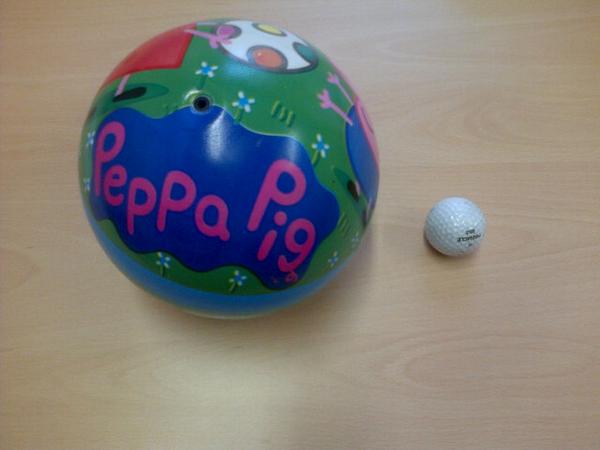
Visitors to the office of the Head of the School of Mathematical and Physical Sciences at the University of Sussex often remark upon the presence of these two objects and inquire as to their purpose:

Supernova

Since I don’t play golf and am a bit long in the tooth to be a fan of Peppa Pig, most assume that it must be for some strange astrophysical reason. I tried asking on Twitter what people think I use them for, and the most common answer was to demonstrate the relative size of the Earth and Moon. As Roy Walker would have said, “That’s a good answer, but it’s wrong”.

In fact I use the objects concerned to demonstrate what goes on when a star goes supernova.

The point is that a supernova explosion begins with gravitational collapse of the progenitor star, so why does that manifest itself as an explosion? The point is that the outer layers are blown off while the core collapses into a compact object such as a neutron star or, perhaps, a black hole.

The way to demonstrate this is first to balance the golf ball (representing the outer layers) on top of the beach ball; the air hole in the latter is a useful place to do this. You then lift the conjoined objects to a reasonable height and drop them onto the table or bench provided for such a purpose in a lecture theatre. The objects fall together under gravity until the beach ball hits the surface. You will find that the beach ball (representing the core) stops still while the golf ball (representing the outer shells) shoots upwards as most of the kinetic energy of the system is transferred to it during the bounce.

I think this is quite an effective demonstration, but I’d encourage inexperienced lecturers to note that there is a Health and Safety Issue, so it is necessary to carry out a risk assessment before attempting it. When I first did this during a lecture many years ago, I used a ball bearing rather than a golf ball and a fully-inflated and much larger beach ball instead of the more manageable (and slightly deflated) Peppa Pig one I now use. I told the students in the audience to watch carefully what happened and then dropped them as described above…

What happened in that case was that the ball bearing rocketed up so fast that it reached the ceiling and smashed into the lights above the lecturer’s bench, whereupon there was a very loud bang and I was showered with broken glass and other debris. I have to say that got the loudest round of applause I’ve ever had while lecturing, but it wasn’t exactly the effect I’d been hoping for.

But the real reason for posting today is to wish a very happy 65th birthday to supernova expert extraordinaire and occasional reader of this blog, Robert Kirshner of Harvard University, who has celebrating along with a number of my astro-chums at a conference in Australia.

Many happy returns, Bob!

Advice for Mathematics, Physics and Astronomy Students on Clearing!

Posted in Education with tags , , , , on August 14, 2014 by telescoper

Got your A-level results? Not made your first-choice University? My advice is:

1-dont-panic

We still some have places in the School of Mathematical & Physical Sciences at the University of Sussex. Whether you’re interested in Physics, Astrophysics, Astronomy or Mathematics (or even a combination of those subjects), why not just take a look at the University’s Clearing Page and give us a ring?

As a matter of fact, I’ll be around myself from 8am this morning to talk to interested students!

Click the relevant link for more information on our courses in Physics & Astronomy or for Mathematics!

Mathematics at Sussex: the videos!

Posted in Education on August 13, 2014 by telescoper

I recently posted a couple of videos illustrating some aspects of our undergraduate teaching in the Department of Physics & Astronomy here at the University of Sussex. Since I’m Head of the School of Mathematical and Physical Sciences, which encompasses Mathematics and Statistics as well as Physics & Astronomy, I thought I’d redress the balance with a couple of similar clips featuring mathematicians to give an idea of what students in the Department of Mathematics get up to.

First up is George Simpson, who graduated from Sussex this year with a (4-year) MMath and who is going to start a PhD here at the end of the summer:

And this is Hayley Wragg, a current MMath student, who is talking about her work as a Junior Research Associate in Mathematics:

Incidentally there is a vibrant and active Mathematics Society at Sussex, the University of Sussex Mathematics Society (SUMS). I’m not sure what the acronym is for Brighton University Mathematics Society…

Higher Education Funding: A Modest Proposal

Posted in Education, Finance, Politics with tags , , , , , on August 8, 2014 by telescoper

With next year’s general election already looming there are signs that the higher education funding system is likely to be a hot topic. The Conservatives, for example, are reportedly considering removing the cap on tuition fees (currently set at £9K per annum) while Labour is talking about reducing the figure to £6K. Labour’s idea is likely to prove popular among potential students, it will result in a reduction of fee income to English universities of a third, potentially leading to wholesale redundancies and closures unless it is offset by an increased contribution from the taxpayer to offset this cut. Responsibility for higher education funding in Wales, Scotland and Northern Ireland is devolved, so Westminster policy does not apply directly there although the knock-on effect of changes in England would be considerable given the number of students who choose to study away from home.

The backdrop to these suggested policy changes is the obvious fact that the current system is unsustainable. Although there has not been a marked reduction in numbers of students applying to university since the introduction of tuition fees, it has become increasingly clear that the system of loans and deferred fees is actually costing the Exchequer more in terms of short-term borrowing than the old system. Moreover, there is a growing realization that the fraction of this cost that will actually be recouped in future is going to be much smaller than its advocates would like to admit. Recent estimates, likely to be revised upwards, suggest that 45% of student loans will never be repaid.

On top of this there is the problem that the so-called “elite” universities have not succeeded in “widening participation” (as the phrase goes). Oxford and Cambridge both continue to take about 40% of their pupils from private schools; many other institutions. My own institution, the University of Sussex, takes about 86% of its intake from state schools, which is about the average across the sector.

Although only a small fraction of pupils (about 7%) attend (private) independent schools, about 65% of those go on to University; only 24% from the state sector do. In my opinion, not all universities take widening participation seriously but even if they do (like we do at Sussex) it is difficult for higher education institutions to repair the divisions that arise much earlier in the education system.

The average fee per term for a day pupil at a private school in the UK is about £3400; this rises to about £7800 per term for boarding schools. Since there are three school terms per year this means that the average cost per year for day pupils is £10,200, well above the £9000 per year maximum fee for university tuition. That says a lot for how poorly funded UK universities really are, even with increased tuition fees, especially in STEM subjects which require expensive laboratories and other facilities. Moreover, private school fees are payable upfront while tuition fees for students in higher education are funded by heavily subsidized loans which do not need to be repaid until the student is earning more than a certain minimum salary (currently £21K pa).

When funding is tight it is particularly important that it should be targetted where it is needed most. For me that means to encourage more students from state schools to go to university. The principle I’d adopt here (and indeed in many other contexts) is encapsulated in the phrase “to each according to their need, from each according to their ability”.

Parents who have decided to send their offspring to private schools have, in my view, already demonstrated that they can afford to contribute to their education at a level considerably higher than the current tuition fee for university students. In such cases there is no need for a means test to determine whether they need support from the taxpayer; they have already done that calculation for themselves.

My proposal, therefore, is that students whose parents have decided to take their children out of the state school system should be deemed to be ineligible for state support for higher education. They should therefore pay the full fees upfront. I think there’s a case even for making such students pay for the full cost of their education which is not the £9K fee payable by Home/EU but the much higher fee charged to students from outside the EU, which is currently £17K at the University of Sussex. The money saved in this way should be used to provide better fee waivers and and maintenance grants for students from the state school system (on a means-tested basis). This could be accomplished by, e.g., a system of vouchers available to students from state schools in England; the rest of the UK could adopt a similar system if they wish. This would also be a step towards reducing the incentive for families to increase social divisions by taking their children out of the state system.

As well as driving greater equality and stimulating social mobility, my suggestion would also correct a number of anomalies in the existing system. One is that students attending English universities who went to Schools elsewhere in Europe (including Wales, Scotland and Northern Ireland) are entitled to the same financial support as English students. However, most students from outside the UK will return home after graduation and there is no effective means of making them pay back their fees and loans because these are currently recovered through the UK tax system. In effect, therefore, the taxpayer is providing free higher education for these students and it is one of the reason why the default rate on student loans is likely to be very high. In my proposal this loophole would be sealed; unless a student went to an English state school they would not have the means to access HEFCE support.

I have heard it said that this idea would remove choice. I don’t agree. Parents will still have the choice of sending their sons and daughters to private school if they wish. What it will do is remove part of the incentive for them to do that.

Across the UK over 80% of university students are from state schools, so the measure I suggest will not on its own solve the University funding crisis. On the other hand, I think it would at least be fairer than the current system. On the other hand, I’m not sure fairness counts for very much these days…

Combining Research and Teaching in Physics & Astronomy

Posted in Education, The Universe and Stuff with tags , , , , , on August 7, 2014 by telescoper

Among the distinctive things we do here in the School of Mathematical and Physical Sciences at the University of Sussex are our degree programmes that involve a Research Placement (RP). Students on these courses take the normal lectures, laboratory classes and workshops during the academic year, but they spend the summer vacation doing (paid) work with research groups in the School to get an experience of what the world of research is really like. Various combinations of Physics and Astronomy with a Research Placement have been around for some time. These courses have been so popular and successful that we’ve extended the idea to Mathematics for 2015 entry. We have also started extending the RP scheme to include placements in laboratories elsewhere, either in industry or in a university abroad; we even have two students currently doing their placements in China.

Here are a couple of videos we’ve made featuring two RP students who have been working in the Department of Physics & Astronomy this summer.

This is Ross Callaghan:

And this is Nathaniel Wiesendanger Shaw:

Both these students are in between their 2nd and 3rd years of a 4-year MPhys programme. As it happens, both survived the experience of being in my Theoretical Physics class last term too!

It’s an ongoing frustration of mine that so many influential people think that teaching and research are separate functions of a university and should not be mixed. I believe that the two go hand-in-hand and that you can’t really claim to be getting a real university education if it’s not informed by the latest developments in research. Moreover, some also imply that research-led teaching only happens in the Russell Group, which is not the case at all. In fact, I think we provide a much better environment for this in Sussex than either of the Russell Group universities in which I’ve previously worked.

Many Departments talk about how important it is that their teaching is based on state-of-the-art research, but here at Sussex we don’t just talk about research to undergraduates – we let them do it!

End of Term Report: David Willetts

Posted in Education, Politics, Science Politics with tags , , , , on July 15, 2014 by telescoper

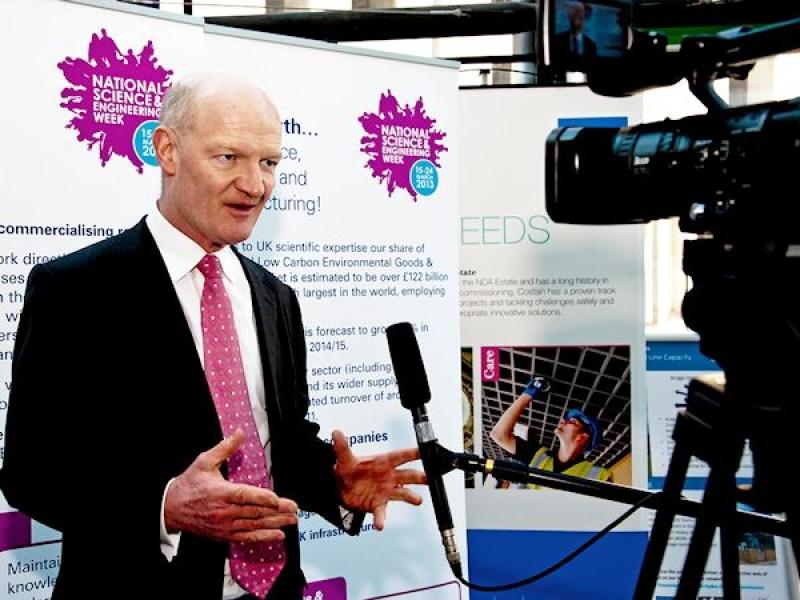
News broke yesterday that the Minister responsible for Universities and Science within the Department of Business, Innovation and Skills, David Willetts, had stepped down from his role and would be leaving Parliament at the next election.

Willetts’ departure isn’t particularly surprising in itself, but its announcement came along with a host of other sackings and resignations in a pre-Election cabinet reshuffle that was much wider in its scope than most expected. It seems to me that Prime Minster David Cameron has decided to play to the gallery again. After almost four years in which his Cabinet has been dominated by white males, most of them nondescript timeserving political hacks without beards, he has culled some of them at random to try to pretend that he does after all care about equality and diversity. Actually, I don’t think David Cameron cares for very much at all apart from his own political future and this is just a cynical attempt to win back some votes before the next Polling Day, presumably in May 2015. Rumour has it that one of the new Cabinet ministers may even have facial hair. Such progress.

Willets

David Willetts was planning to step down at the next General Election anyway so his departure now was pretty much inevitable. I never agreed with his politics, but have to admit that he was a Minister who at least understood some things about Higher Education. In particular he knew the value of science and secured a flat cash settlement for the science budget at a time when other Whitehall budgets were suffering drastic cuts. He was by no means all bad. He even had the good taste – so I’m told – to read this blog from time to time….

The campaigning organization Science is Vital has expressed its sadness at his departure:

We’re sorry to see David Willetts moved from the Science Minister role. He listened, in person, to our arguments for increasing public funding for science, and we appreciated the support he showed for science within the government.

We look forward to renewed dialogue with his successor, in order to continue to press the case that science is vital for the UK.

Now that he has gone, my main worry is that the commitments he gave to ring-fence the science budget will go with him. I don’t know anything about his replacement, Greg Clark, though I hope he follows his predecessor at least in this regard.

Other aspects of Willetts’ tenure of the Higher Education office are much less positive. He has provided over an ideologically-driven rush to force the University sector into an era of chaos and instability, driven by a rigged quasi-market propelled by an unsustainable system of tuition fees funded by student loans, a large fraction of which will never be repaid.

Another of Willetts’ notable failures relates to Open Access. Although apparently grasping the argument and make all the right noises about breaking the stranglehold exerted on academia by outmoded forms of publication, he sadly allowed the agenda to be hijacked by vested interests in the academic publishing lobby. Fortunately, there’s still a very strong chance that academics can take this particular issue into their own hands instead of relying on the politicians who time and time again prove themselves to be in the pockets of big business.

My biggest fear for Higher Education at the moment is that the new Minister will turn out to be far worse and that if the Conservatives win the next election (which is far from unlikely), Science is Vital will have to return to Whitehall to protest against the inevitable cuts. If that happens, it may well be that David Willetts is remembered not as the man who saved British science, but the man who gave it a stay of execution.

Awards Day at West Dean College

Posted in Art, Biographical, Education with tags , , , , , , on July 13, 2014 by telescoper

Last week was a very busy week at the University of Sussex (including the Graduation Ceremony for students in the School of Mathematical and Physical Sciences), and yesterday (Saturday) saw me attending another event on quasi-official business, this time at West Dean College, which is situated in West Sussex, a few miles North of Chichester.

The occasion for my visit there was Awards Day at the college, and I got the chance to go because one of our Pro-Vice Chancellors was unable to attend so I volunteered to go in her place. I didn’t know much about the College before yesterday, except that it is one of several institutions whose degree programmes are validated by the University of Sussex.

In fact, the College provides MA degrees, diplomas and short courses for students of all abilities, from the beginner to the advanced professional practitioner across a wide range of creative arts, design and conservation (including rare and old books, furniture, and clocks).  The various degree certificates, diplomas and other prizes were handed out to students of all ages, which was great to see. Before I go on I just like to congratulate them all again on their wonderful achievements, especially those creative arts students whose work we were able to view after the ceremony including prize-winning sculptures by Lotti V Closs. I even made a discreet inquiry about whether it was possible to buy some of the pieces…

Anyway, West Dean College is based in West Dean House, part of an ancient estate that was eventually inherited by the poet Edward James, a notable patron of the arts particularly famous for his support of the surrealist movement. The house was extensively modified during the late around about the turn of the twentieth century which presumably accounts for the distinctive arts-and-crafts look of some of the exterior.

SAMSUNG DIGITAL CAMERA

The house is surrounded by an estate of 6000 acres in beautiful countryside. Ownership of the house, the estate and the art collection housed therein was transferred to the Edward James Foundation, a charitable educational trust, in 1964.

Many sheep were in attendance, although they didn’t come to the actual ceremony. To be honest, it was a much grander setting than I’d imagined it would be. In fact I think the last time I saw a place like West Dean House it was the site of a Country House Murder during an episode of Midsomer Murders or some such. The awards ceremony was held held in a Marquee on the lawns which, in the muggy weather, was a little uncomfortable though the programmes came in very useful as fans. Fortunately it all passed off peacefully without any murders although I did see a large group of crows in the fields, if that counts.

SAMSUNG DIGITAL CAMERA

The manner of my arrival was much less grand than the location seemed to require. I took the train from Brighton to Chichester and then got a bus to West Dean. Being about half an hour early for the kickoff, I had time to walk around the grounds of the house. There’s a beautiful walled garden with many lovely flowers.

SAMSUNG DIGITAL CAMERA

I recognized  Crocosmia Lucifer and Phlox among the following..

SAMSUNG DIGITAL CAMERASAMSUNG DIGITAL CAMERASAMSUNG DIGITAL CAMERASAMSUNG DIGITAL CAMERASAMSUNG DIGITAL CAMERA

These curious but beautiful lantern-shaped flowers evidently belong to some type of lily, but I don’t know what kind. Any offers? (UPDATE: I am reliably informed that these are examples of Erythronium Pagoda
..)

SAMSUNG DIGITAL CAMERA

The walled garden is just one small part of the estate, which also comprises workshops and studios used by the students, a very nice dining room and bar area plus rooms for meetings and conferences. I enjoyed a quick tour of the facilities after the Awards Ceremony, but must go back some other time to have a proper look. The other gardens are fine too:

SAMSUNG DIGITAL CAMERA

And this pergola would put most garden varieties to shame!

SAMSUNG DIGITAL CAMERA

Anyway, since one of the Prizes presented yesterday was for blogging about conservation, I couldn’t resist advertising the West Dean College blogs. They have two, in fact, one for Conservation (here) and one for Visual Arts (here). These are both hosted on wordpress platforms, so if you’re following this blog on WordPress why not give them a follow too?

Come to the Edge

Posted in Education, Poetry with tags , , on July 12, 2014 by telescoper

Just back home after a very pleasant trip to West Sussex, about which I’ll blog tomorrow. During the course of the afternoon, however, I heard the following short but very effective poem which seems apt to dedicate to all the recent graduates of the School of Mathematical and Physical Sciences at the University of Sussex.

Come to the edge.
We might fall.
Come to the edge.
It’s too high!
COME TO THE EDGE!
And they came,
And we pushed,
And they flew.

by Christopher Logue (1926-2011)

Honoris Causa, Dr Chryssa Kouveliotou

Posted in Education, The Universe and Stuff with tags , , , , , on July 10, 2014 by telescoper

This morning I had the privilege of participating in a graduation ceremony at the University of Sussex. It was great to get to shake the hands of all the successful graduates as they crossed the stage to receive their degrees. I hope I’ll be able to collect a few pictures of the occasion and post them in due course.


Kouveliotou

I also had the privilege of being able to present an extremely distinguished honorary graduand, Dr Chryssa Kouveliotou. Here the oration I delivered, which I’m posting simply to record her amazing achievements and to underline that she is one of many people who have done the MSc in Astronomy at Sussex University and gone on to do great things…


Vice-Chancellor,

It is both a pleasure and an honour to present for the award of the degree of Doctor of Science, Dr Chryssa Kouveliotou.

Inspired by watching Neil Armstrong take his first step on the moon, Dr Kouveliotou always wanted to be an astronaut but, with no such opportunities apparently on offer in her native, she instead chose a career in astronomy. However, when she completed college Greece her astronomy professor (who shall remain nameless) advised her that there was no future for her in astrophysics. She has never known whether he really thought it was a poor choice or whether it was because she was a woman. Determined to follow her own path, she disregarded him completely and, even though her open-minded parents’ preference was for her to settle down and stay in her home country, she left to study for her Master’s degree in Astronomy at the University of Sussex; the topic of her dissertation was “The Sodium emission cloud around Io: mapping and correlation with Jupiter’s magnetic field”. She received the MSc in Astronomy in 1977. Although the topic of her subsequent research was rather different, the connection with magnetic fields remained strong.

Dr Kouveliotou then moved to Germany to do postgraduate research on the-then very new topic of gamma-ray bursts. Indeed, she may well have been the very first person to complete a thesis on this, which remains to this day an extremely active and exciting field of research. Gamma-ray bursts are considered to be the most powerful explosions in the universe, second only to the Big Bang itself.

After completing her PhD, Dr Kouveliotou returned to Greece to teach Physics and Astronomy at the University of Athens. All the while she knew that she really wanted to do research so spent her free time pursuing this goal. Every vacation and on her one-year sabbatical she went to the USA to undertake research at the National Aeronautics and Space Administration (NASA). Her work was on solar flares but she moonlighted during evenings, nights and weekends researching her ‘first love’ gamma-ray bursts. Because of the research she undertook outside her “day job”, she found a series of bursts which all came from the same part of the sky and, as a result, became part of the discovery team for a brand new phenomenon called a soft gamma-ray repeater.

By observing gamma rays produced in space, her team discovered an example of a new class of exotic astronomical object called a magnetar, an object which has a magnetic field trillions of times stronger than that of the Earth. A magnetar is now known to be a type of neutron star, a burnt-out relic resulting from the death of an ordinary star in a supernova explosion.

Dr Kouveliotou has always loved to ask big questions, to look at the universe and ask how nature expresses itself. By overcoming obstacles in her path she really has reached the stars. In January 2013 Dr Chryssa Kouveliotou was named the Senior Scientist for High Energy Astrophysics, Science and Research Office at NASA’s Marshall Space Flight Center in Hunstville, Alabama.

She has received many awards for her work, including the Dannie Heineman Prize for Astrophysics and the NASA Exceptional Service Medal in 2012 and the NASA Space Act Award in 2005. She was also named amongst Time Magazine’s 25 Most Influential People in Space in 2012. In 2003 she was honoured with the annual Rossi Prize by the High Energy Astrophysics division of the American Astronomical Society for a significant contribution to high-energy astrophysics. In 2002 she received the Descartes Prize which recognises scientific breakthroughs from European collaborative research in any scientific field. In the awards bestowed upon her she has also been recognised for her effectiveness at creating the sort of large collaboration needed to make effective use of multi-wavelength astronomical observations.

Dr Kouveliotou has published almost 400 papers in refereed scientific journals and has been amongst the top 10 most-cited space science researchers in the academic literature across the world. She has been elected chair of the Division of Astrophysics of the American Physical Society and is a member of the Council of the American Astronomical Society, of which she chairs the High Energy Astrophysics Division.

Vice-Chancellor, I present to you for the degree of Doctor of Science, honoris causa, Dr Chryssa Kouveliotou.


Talking About Undergraduate Physics Research…

Posted in Education, The Universe and Stuff with tags , , , , , , , on July 2, 2014 by telescoper

One of the courses we offer in the School of Physics & Astronomy here at the University of Sussex is the integrated Masters in Physics with a Research Placement. Aimed at high-flying students with ambitions to become research physicists, this programme includes a paid research placement as a Junior Research Associate each summer vacation for the duration of the course; that means between Years 1 & 2, Years 2 & 3 and Years 3 & 4 . This course has proved extremely attractive to a large number of very talented students and it exemplifies the way the Department of Physics & Astronomy integrates world-class research with its teaching in a uniquely successful and imaginative way.

Some time ago I blogged about  some very good news about one of our undergraduate researchers, Talitha Bromwich, who is about to graduate from her MPhys degree, after which she will be heading to Oxford to start her PhD DPhil; she is pictured below with her supervisor Dr Simon Peeters:

Talitha Bromwich with her JRA supervisor Dr Simon Peeters at 'Posters in Parliament' event 25 Feb 14

Talitha spent last summer working on the DEAP3600 dark-matter detector after being selected for the University’s Junior Research Associate scheme. Her project won first prize at the University’s JRA poster exhibition last October, and she was then chosen to present her findings – alongside undergraduate researchers from 22 other universities – in Westminster yesterday as part of the annual Posters in Parliament exhibition, organized under the auspices of the British Conference of Undergraduate Research (BCUR).

A judging panel – consisting of Ben Wallace MP, Conservative MP for Wyre and Preston North; Sean Coughlan, Education Correspondent for the BBC; and Professor Julio Rivera, President of the US Council of Undergraduate Research; and Katherine Harrington of the Higher Education Academy – decided to award Talitha’s project First Prize in this extremely prestigious competition.

We held a small drinks party in the School of Mathematical and Physical Sciences to congratulate Talitha on her success. Here are a couple of pictures of that occasion:

3479.item

From left to right you see Simon Peeters, myself, Talitha and Prof. Michael Farthing (the Vice Chancellor of the University of Sussex); the winning poster is in the background. Here’s me presenting a little gift:

3478.item

More recently still, the MPS Elves have made a little video featuring Talitha talking about her research placement:

We take undergraduate research very seriously here at the University of Sussex, and are now extending the Research Placement scheme to Mathematics. Many Departments talk about how important it is that their teaching is based on state-of-the-art research, but here at Sussex we don’t just talk about research to undergraduates – we let them do it!