Archive for the Education Category

A Clean Sweep For Team MPS

Posted in Education, Sport with tags , , on June 19, 2014 by telescoper

It is with great pleasure that I announce another outstanding result for the School of Mathematical and Physical Sciences (MPS). While minor unexciting sporting contests go on elsewhere in the world, all true sports fans have had their eyes literally glued on events on Falmer campus. Sussex University’s annual Fit to Get Committed Commit to Get Fit reached its final stages yesterday with the audience literally electrified by a thrilling Rounders competition. Team MPS didn’t win that event; although playing very well they were just a bit short of clichés, especially in the final third.

I wasn’t able to attend today’s lunchtime prize-giving event owing to a prior commitment. In fact I was on a course learning how to make legally fair disciplinary decisions. Fortunately this turned out to be an unnecessary precaution, as the MPS Commit to Get Fit team won all the awards!

20140619_134731 (2)

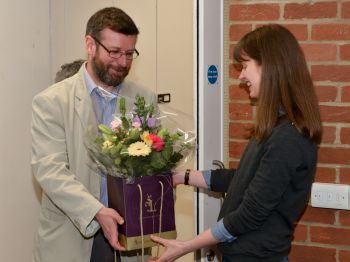
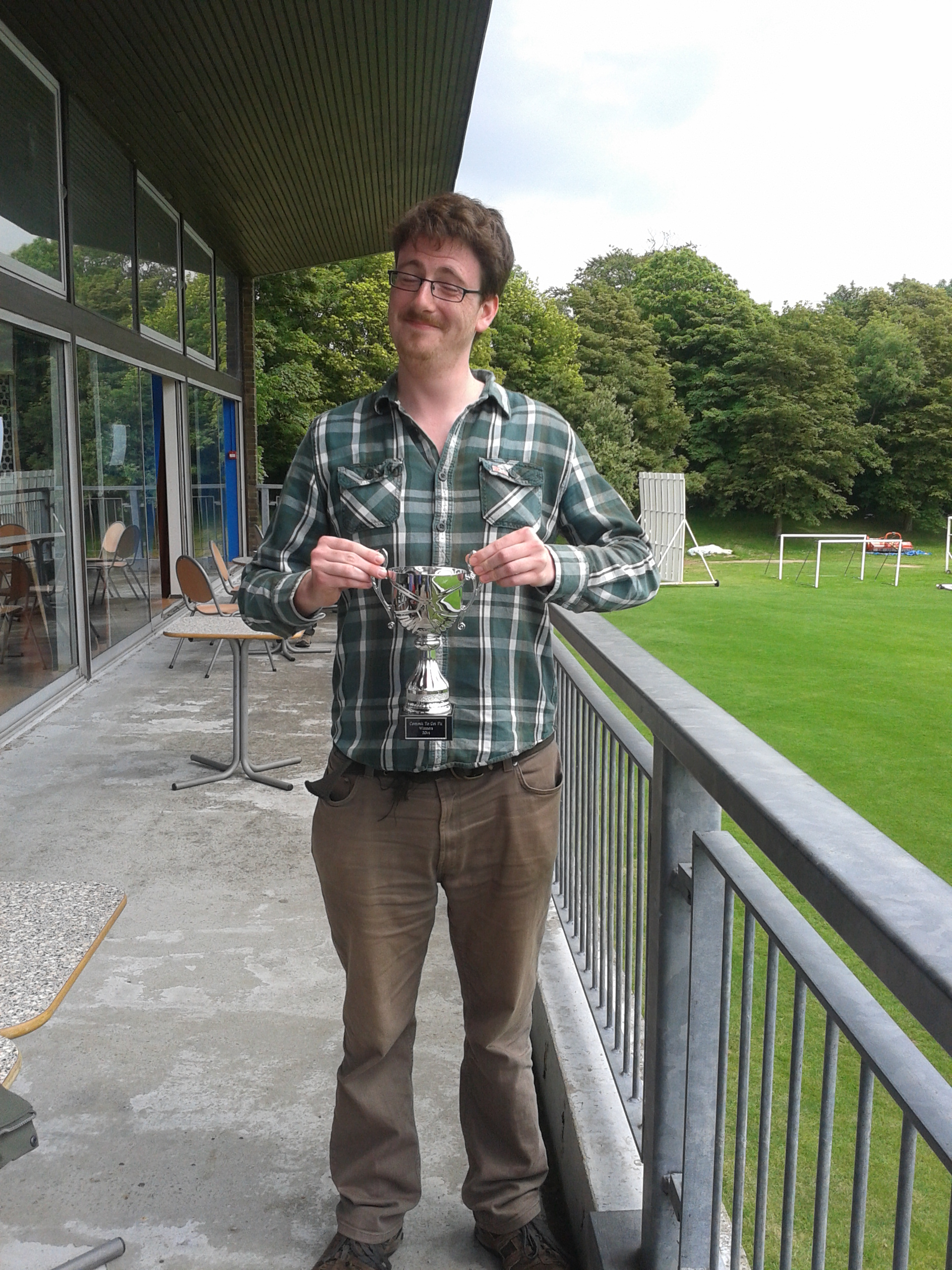
Well done to Matt for winning Best Blog by an Individual and to Naomi who was presented with a Special Individual Achievement award for her dedication as Team Captain, her personal achievements and fundraising activities where she dressed up as a musketeer for the day, together with Matt, to raise money for the Rocking Horse Foundation. Together they managed to raise a whopping £210!

20140619_134649 (2)

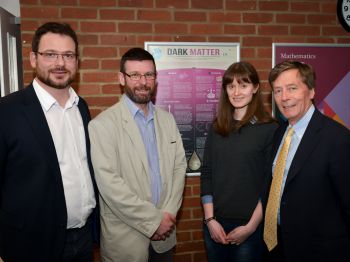
Last but not least, Team MPS scooped the top award with a trophy for Most Inspiring Team.

20140619_134505 (2)

So once again the School of Mathematical and Physical Sciences sweeps the board. Literally.


Pass List Party

Posted in Biographical, Education with tags , , on June 13, 2014 by telescoper

Well, as I mentioned yesterday the pass lists for students in the School of Mathematical and Physical Sciences at the University of Sussex went up at noon. Students and staff started to gather a bit in advance and we also made a few preparations for the celebration ..

Pass list prep

When the results were wheeled out there was an immediate scrum accompanied by plentiful popping of Prosecco corks.

Pass list party

I’d just like to congratulate all our students on their success. The results were truly excellent this year. Enjoy the moment and be proud of their achievement. I suspect that many will have been enjoying the day out in the sunshine perhaps even with a small intake of alcoholic refreshment. I on the other hand have been at Senate all afternoon. But I’m not bitter…

The Busyness of Examination Time

Posted in Biographical, Education with tags , , , , , on June 12, 2014 by telescoper

Just time this evening for the briefest of brief posts. This is probably the busiest week of the year at the University of Sussex, and it’s not over yet. The main reason for this busyness is the business of examinations, assessment and degree classification.

This morning we had our meeting of the School Progression and Award Board for Years 3 and 4 at which, among other things, we sorted out the classification for honours of our graduating students. This involves distilling the marks gained over several years of assessments down to a final “Grand Mean”. It’s not a trivial process but I’m glad to say it went off very smoothly.

The pass lists have now gone to be officially signed off by the University administration. They will be posted tomorrow at noon, at which time we’ll have a celebratory drink or several ready for those getting their results.

One of my duties as Head of School is to chair this meeting, but I don’t take credit for the successful running of the meeting because all the hard work of preparation was done by our excellent office staff, especially Oonagh and Chrystelle.

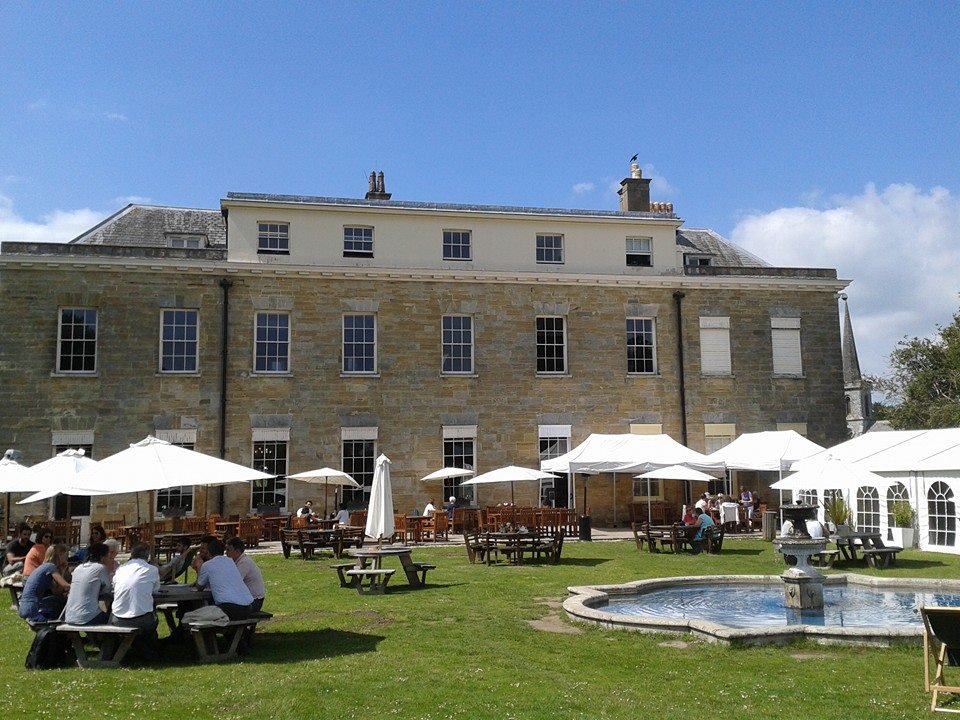
That done there was time for a quick sandwich lunch before heading off to Stanmer House for a teaching “away afternoon” for the Department of Physics & Astronomy, at which we discussed ideas for improvements to the way we teach and assess students.

Stanmer

I’m actually in the group sitting under the parasol in the left foreground.

Stanmer House is set in beautiful parkland just a short walk from Sussex University. I took the more strenuous route over the hill, but am glad I did so because the view was so nice in the glorious sunshine and it made be realise I don’t make as much of the opportunity for walking around the campus as I should.

Tomorrow is going to be another busy day but, if you’ll excuse me, I’m now going to have a glass of chilled white wine and a bite to eat.

Mathematics and Meningococcal Meningitis

Posted in Education, Science Politics with tags , , , , on June 9, 2014 by telescoper

Last week I attended a very enjoyable and informative event entitled Excellence with Impact that showcased some of the research that the University of Sussex submitted to the 2014 Research Excellence Framework. One of the case studies came from the Department of Mathematics which is part of the School of Mathematical and Physical Sciences (of which I am Head) so I thought I would showcase it here too:

The description from Youtube reads

Meningococcal meningitis is a debilitating and deadly disease, causing an estimated 10,000 deaths annually in endemic areas of sub-Saharan Africa. A novel mathematical model developed by Sussex researcher Dr Konstantin Blyuss and colleagues has helped explain the patterns of the dynamics of meningococcal meningitis in endemic areas. This model is now being used by epidemiologists and clinical scientists to design and deliver efficient public-health policies to combat this devastating disease.

You can find out more by following this link.

The Day in Pictures

Posted in Biographical, Education on June 3, 2014 by telescoper

Just back home from Milan after a pretty long day, the story of which is told in the three photographs.

First of all, congratulations to Dr Eleonora Villa, who successfully defended her thesis this afternoon! The intriguing cover picture on the glossy copy shown is of course by Wassily Kandinsky

Then there’s my old apartment at No. 19 Via Beato Angelico which I successfully located after getting lost only twice. It is on the right of the building, on the second floor, with the balcony. The graffiti weren’t there when I was resident in 1994 but otherwise the area hasn’t changed much.


And finally there’s the shambolic overcrowding in the UKBA section of Heathrow Terminal 5 that delayed my return home by about an hour…

Via Beato Angelico

Posted in Biographical, Education with tags , , , , , on June 2, 2014 by telescoper

So here I am, then, in Milan(o). I’m just here for a short visit in order to participate in a PhD examination tomorrow at the Universita Degli Studi di Milano. I’m looking forward to it, actually, as I’ve never done such an examination in the Italian system before. It will also give me the chance to meet up with a couple of old friends I haven’t seen for a while before flying back to London tomorrow night.

I don’t know if I’ve mentioned this before on this blog but I was a fairly long-term resident in Milan some years ago. In fact I’ve just checked the dates and it was in 1994, i.e. twenty years ago. Time flies indeed. All those years ago I was here as a Professore a Contratto, which means I gave some lectures and did a small research project. The invitation for this came via Silvio Bonometto. I didn’t get paid a huge amount for this visit, but as part of the deal I did get use of an apartment organized by the University. It was on the Via Beato Angelico and this photograph, which I have just ripped off from my own facebook page, shows the view from the balcony:

Via Beato Angelico

It was a nice enough flat and in a good location just around the corner from the University. The one thing I remember well is that one of the main tram lines ran along the street below; their sound has stuck with me through the years, as they often woke me up very early in the morning. I think there was an ice cream place over the road too.

During my stay here I was accompanied by a friend, Anna, whom I invited to come when they told me I was going to have use of an apartment. Anna wanted to try to find a job in Italy so it seemed a great chance to spend three months or so looking around while I worked. The place was easily big enough for two and I was grateful for the company in the evenings. We had a lot of fun doing the tourist things, visiting night clubs, and the rest. Most people thought we were an item, I suppose, but we weren’t. Her long red hair gave her the nickname Anna Dai Cappelli Rossi, after the cartoon character. Here is a picture of Anna I took on the roof of the Duomo:

Anna

Anyway, when it was time for me to return to England, Anna stayed in Milan because she had found a job (and a man). She did return to England though and now lives in the Midlands in a place called Liverpool.

I’m mentioning all this because the hotel I’m now staying in, the Hotel Dieci, is just a short walk from that old place. I’ll probably have enough time in the morning to take a walk past and see if I can find it. I wonder how much the area around here has changed in the last twenty years? I’ll have time to find out tomorrow but for tonight I had better read the thesis again!

Examination Times

Posted in Biographical, Education with tags , , , , , on May 19, 2014 by telescoper

After a gloriously sunny weekend, it’s now a gloriously sunny Monday. There always seems to be good weather when students are revising for, or actually taking, their examinations. It’s Mother Nature’s special torture. The bus I was on this morning went past a large crowd of students waiting outside the Sports Hall in the bright sunshine for some examination or other.  The sight did remind me that I usually post something about examinations at this time of year, so here’s a lazy rehash of my previous offerings on the subject.

My feelings about examinations agree pretty much with those of  William Wordsworth, who studied at the same University as me, as expressed in this quotation from The Prelude:

Of College labours, of the Lecturer’s room
All studded round, as thick as chairs could stand,
With loyal students, faithful to their books,
Half-and-half idlers, hardy recusants,
And honest dunces–of important days,
Examinations, when the man was weighed
As in a balance! of excessive hopes,
Tremblings withal and commendable fears,
Small jealousies, and triumphs good or bad–
Let others that know more speak as they know.
Such glory was but little sought by me,
And little won.

It seems to me a great a pity that our system of education – both at School and University – places such a great emphasis on examination and assessment to the detriment of real learning. On previous occasions, before I moved to the University of Sussex, I’ve bemoaned the role that modularisation has played in this process, especially in my own discipline of physics.

Don’t get me wrong. I’m not opposed to modularisation in principle. I just think the way modules are used in many British universities fails to develop any understanding of the interconnection between different aspects of the subject. That’s an educational disaster because what is most exciting and compelling about physics is its essential unity. Splitting it into little boxes, taught on their own with no relationship to the other boxes, provides us with no scope to nurture the kind of lateral thinking that is key to the way physicists attempt to solve problems. The small size of many module makes the syllabus very “bitty” and fragmented. No sooner have you started to explore something at a proper level than the module is over. More advanced modules, following perhaps the following year, have to recap a large fraction of the earlier modules so there isn’t time to go as deep as one would like even over the whole curriculum.

In most UK universities (including Sussex), tudents take 120 “credits” in a year, split into two semesters. In many institutions, these are split into 10-credit modules with an examination at the end of each semester; there are two semesters per year. Laboratories, projects, and other continuously-assessed work do not involve a written examination, so the system means that a typical  student will have 5 written examination papers in January and another 5 in May. Each paper is usually of two hours’ duration.

Such an arrangement means a heavy ratio of assessment to education, one that has risen sharply over the last decades,  with the undeniable result that academic standards in physics have fallen across the sector. The system encourages students to think of modules as little bit-sized bits of education to be consumed and then forgotten. Instead of learning to rely on their brains to solve problems, students tend to approach learning by memorising chunks of their notes and regurgitating them in the exam. I find it very sad when students ask me what derivations they should memorize to prepare for examinations. A brain is so much more than a memory device. What we should be doing is giving students the confidence to think for themselves and use their intellect to its full potential rather than encouraging rote learning.

You can contrast this diet of examinations with the regime when I was an undergraduate. My entire degree result was based on six three-hour written examinations taken at the end of my final year, rather than something like 30 examinations taken over 3 years. Moreover, my finals were all in a three-day period. Morning and afternoon exams for three consecutive days is an ordeal I wouldn’t wish on anyone so I’m not saying the old days were better, but I do think we’ve gone far too far to the opposite extreme. The one good thing about the system I went through was that there was no possibility of passing examinations on memory alone. Since they were so close together there was no way of mugging up anything in between them. I only got through  by figuring things out in the exam room.

I think the system we have here at the University of Sussex is much better than I’ve experienced elsewhere. For a start the basic module size is 15 credits. This means that students are usually only doing four things in parallel, and they consequently have fewer examinations, especially since they also take laboratory classes and other modules which don’t have a set examination at the end. There’s also a sizeable continuously assessed component (30%) for most modules so it doesn’t all rest on one paper. Unusually compared with the rest of the University, Physics students don’t have many examinations in the January mid-year examination period either. Although there’s still in my view too much emphasis on assessment and too little on the joy of finding things out, it’s much less pronounced than elsewhere. Maybe that’s one of the reasons why the Department of Physics & Astronomy does so consistently well in the National Student Survey?

We also have modules called Skills in Physics which focus on developing the problem-solving skills I mentioned above; these are taught through a mixture of lectures and small-group tutorials. I don’t know what the students think of these sessions, but I always enjoy them because the problems set for each session are generally a bit wacky, some of them being very testing. In fact I’d say that I’m very impressed at the technical level of the modules in the Department of Physics & Astronomy generally. I’ve been teaching Green’s Functions, Conformal Transformations and the Calculus of Variations to second-year students this semester. Those topics weren’t on the syllabus at all in my previous institution!

Anyway, my Theoretical Physics paper is next week (on 28th May) so I’ll find out if the students managed to learn anything despite having such a lousy lecturer. Which reminds me, I must get the rest of their revision notes onto the Study Direct website…

Your Chance to Influence UK Government Investment in Science

Posted in Education, Finance, Politics, Science Politics with tags , , , , on May 4, 2014 by telescoper

A recent piece of bloggery by esteemed Professor Jon Butterworth 0f the Grauniad reminded me that an important government consultation has just opened. In fact it opened on 25th April, but I neglected to post about it then as I was on my Easter break. I’m now passing it on to you via this blog, by way of a sort of community service.

Anyway, the consultation, which is being adminstered through the Department of Business Innovation and Skills, can be found here; there’s a large (110 page) document as well as information on how to respond. Basically about £5.8 billion in capital expenditure has been set aside for science research, and the government is asking how it should be divvied up. Such funds could be used to build big ticket items such as new telescopes, particle accelerators, lasers or other infrastructure including new laboratory buildings. It has to be capital, though, which means it can’t be used on staffing for such facilities that are funded. You might argue that this is a weakness (because ultimately science is done by people not by facilities) but, on the other hand if the government stumps up additional money for capital that might free up funds for more people to be employed.

Anyway, do read the consultation document and submit your responses. You could do a lot worse than reading Jon Butterworth’s commentary on it too. The deadline is some way off, July 4th to be exact, but this is very important so you should all get your thinking caps on right away.

One thing I’ll be including in my response concerns funding for university laboratories. The funding body responsible for English universities, the Higher Education Funding Council for England (HEFCE), is currently underfunding STEM subjects across the country. I’ve blogged about this before so I won’t repeat the argument in detail, but severe reductions in the unit of resource applied to laboratory-based subjects have meant that the new tuition fee regime does not provide anything like sufficient income to cover the costs of, say, physics undergraduate teaching. All students pay a flat-rate fee of £9K across all disciplines (including arts, humanities and science subjects) but science subjects only get £1.4K per student on top of this. The withdrawal of capital allowances has also made it very difficult for universities to invest in teaching laboratory space.

The cost of educating a physics student is actually about twice that of educating a student of, say, English, so this differential acts as a deterrent for universities to expand  STEM disciplines. Shortage of teaching laboratory space is a major factor limiting the intake of students in these areas, whereas other disciplines are able to grow without restriction.

So my vote will go for a sizeable chunk of the £5.8 billion capital  to be allocated to improving, refurbishing, expanding and building new teaching laboratories across all STEM disciplines to train the next generation of scientists and engineers that will be vital to sustain the UK’s economic recovery.

I’d be interested in people’s views about other aspects of the consultation (e.g. what big new facilities should be prioritized). Please therefore feel free to use the comment box, but not as a substitute for participating in the actual consultation.

Over to you!


Promoting Women in Physics at Sussex

Posted in Education, The Universe and Stuff with tags , , , , , on April 28, 2014 by telescoper

At the end of a very busy day of meetings I suddenly remembered that I forgot to pass on a nice bit of news about the Department of Physics & Astronomy at the University of Sussex.

It doesn’t seem very long ago at all that I announced the promotion of its first ever female Professor of Physics in the Department, Prof. Antonella de Santo. In fact it was in July last year. Well, just before the Easter break I was delighted at the promotion panel’s decision  to appoint the second female Professor in the Department. The successful candidate this time was Clauda Eberlein, who has been promoted to a Chair in Theoretical Physics with immediate effect.

I’ve already posted about how the proportion of female undergraduates studying physics as been stuck at around the 20% mark for a decade despite strenuous efforts to widen participation. A recent (2012) study by the Institute of Physics contains a wealth of statistical information about staff in Physics departments, which I encourage people to read if they’re interested in the overall issue with equality and diversity in physics. Here I’ll just pull out the figure (based on a 2010 survey) that out of a total of 650 Professors of Physics (and/or Astronomy) in the UK, just 5.5% were female. At that date about 20 physics departments had no female professors at all; that would have included Sussex, of course.

The first ever female Professor of Physics in the United Kingdom was Daphne Jackson, a nuclear physicist, who took up her Chair at the University of Surrey way back in 1971. It’s interesting to note that when Daphne Jackson studied physics as an undergraduate at Imperial College she was one of only two women among the 88 undergraduates in her year.

Congratulations to Claudia on her promotion, but the news doesn’t end there. Claudia will actually be taking over as Head of the Department of Physics & Astronomy in January 2015. She is currently Director of Teaching and Learning for the School of Mathematical and Physical Sciences and will take up her new role when the current Head of Physics & Astronomy, Philip Harris, stands down, having served his term in admirable fashion. Anyway, when Claudia takes up her post as Head of Department she will join an elite band of female physicists to have been appointed to such a role. Does anyone out there know how many other women have headed a Physics department?


Why Graduate Teaching Assistantships Should Be Scrapped

Posted in Education with tags , , , , , , on April 24, 2014 by telescoper

There’s an interesting piece in today’s Times Higher about the variability in pay and working conditions for Graduate Teaching Assistants across the UK Higher Education sector. For those of you not up with the lingo, Graduate Teaching Assistants (GTAs) are (usually) PhD students who fund their doctoral studies by doing some teaching for the department in which they are studying. As the piece makes clear, the use of GTAs varies widely between one university and another across the country and indeed between one department and another within the same university. The use of such positions is higher in arts and humanities departments than in science and engineering, because the latter general have more opportunity to fund scholarships for PhD students, either from one of the Research Councils or elsewhere. Such scholarships pay a stipend (tax-free) as well as the fee for studying as a PhD student.

When I arrived at the University of Sussex last year I found that the School of Mathematical and Physical Sciences operated a GTA scheme in parallel with Research Council bursaries. Students funded by a research council scholarship received a stipend paid at a national rate of about £13,600 per annum, but were able to top this up by undertaking a limited amount of teaching in the School (e.g. marking coursework, helping with workshops, or demonstrating in the teaching laboratories). Externally funded students did teaching on a voluntary basis. The GTAs on the other hand were required to undertake a fixed amount of teaching without remuneration in order to cover their fees.

I found this two-tier system unfair and divisive, with students funded as GTAs clearly treated as second-class citizens. One of the first major decisions I made as Head of School was to phase out the GTA scheme and replace it with bursaries on exactly the same terms as externally-funded ones with the same opportunity to top up the stipend with some teaching income. I announced this at a School meeting recently and it was met with broad approval, the only reservation being that it would be difficult if too few students opted to do extra teaching to cover the demand. I think that’s unlikely, actually, because although the stipend is not taxable so is equivalent to a somewhat higher amount in salary terms, Brighton is quite an expensive part of the country and most students would opt for a bit of extra dosh. Also, it is actually very good for a PhD student to have teaching experience on their CV when it comes to looking for a job.

Existing GTA schemes make it too easy for departments engage in exploitative behaviour, by dumping a huge amount of their teaching duties on underpaid and unqualified PhD students. It’s also unfair for the undergraduate students, nowadays paying enormously high fees, to be fobbed off onto PhD students instead of being taught by full-time, experienced and properly trained staff. Of course the system I’m advocating will be difficult to implement in departments that lack external funding for PhD students. Having to pay a full-stipend for each student will be more expensive and will consequently lead to a reduction in the number of PhD students that can be funded, but that’s not necessarily a bad thing. Indeed, the whole structure of undergraduate teaching will have to change in many departments. From what I’ve seen in the National Student Survey, that isn’t necessarily a bad thing either…

As I’ve argued a number of times on this blog, the current system drastically overproduces PhD students. The argument, a matter of simple arithmetic, is that on average in a steady state each potential PhD supervisor in the university system will, over their entire career, produce just one PhD student who will get a job in academia. In many fields the vast majority of PhDs have absolutely no chance of getting a permanent job in academia. Some know this, of course, and take their skills elsewhere when they’ve completed, which is absolutely fine. But I get the strong feeling that many bright students are lured into GTAs by the prospect that an illustrious career as an academic awaits them when really they’re just being hired as cheap labour. The result is a growing pool of disillusioned and disaffected people with PhDs who feel they’ve been duped by the system.

The British system of postgraduate research study is that it basically takes three years to do a degree. In the United States it usually takes much longer, so the employment of students as GTAs has less of an impact on their ability to complete their thesis on schedule. Although there are faults with the UK’s fast-track system, there is also much to recommend it. Not, however, if the student is encumbered with a heavy teaching load for the duration. The GTA scheme (which incidentally didn’t exist when I did my PhD nearly thirty years ago) is a damaging American import. In much of continental Europe there are far fewer PhD students and in many countries, especially in Scandinavia, PhD students are actually paid a decent wage. I think that’s the way we should go.