Archive for the Education Category

A Note to the Physics REF Panel

Posted in Education, Finance, Science Politics with tags , , , on April 23, 2014 by telescoper

I’ve just been skimming through an interesting report about the strength of UK physics research. One of the conclusions of said document is that UK physics research is the best in the world in terms of quality.

I couldn’t resist a brief post to point this out to any members of the Physics panel involved in the 2014 Research Excellence Framework. My motivation for doing this is that the Physics panel of the 2008 Research Assessment Exercise evidently came to the conclusion that UK physics research wasn’t very good at all, awarding a very much lower fraction of 4* (world-leading) grades than many other disciplines, including chemistry. I’ve never understood why the Panel arrived at such a low opinion of its own discipline, but there you go..

Physics departments across the country have fought very hard to recover from the financial and reputational damage inflicted by the 2008 RAE panel’s judgement. Let’s just hope there isn’t another unwarranted slap in the face in store when the 2014 results are announced later this year…


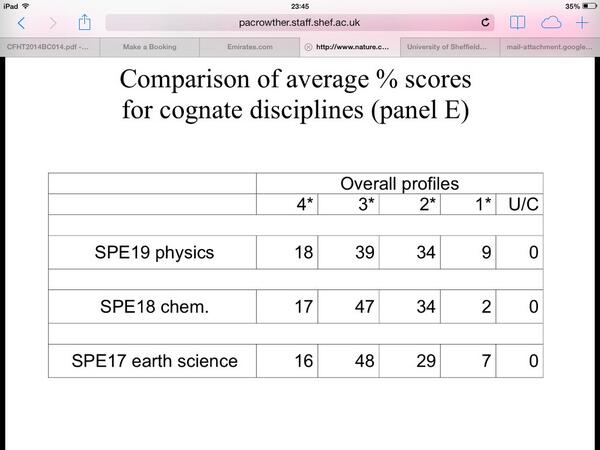
UPDATE: I’m grateful to Paul Crowther for pointing out a surprising fact based on a talk given by the Chairman of the Physics RAE Panel in 2008, Sir John Pendry. Here are the slides in full, but the pertinent fact is the distribution of 4*, 3* and 2* grades across disciplines shown in this table:

Bl8OKv0CYAE6EMq

You can see that they are in fact broadly, similar across disciplines. However, what is clear is that the highest scoring departments in Chemistry did much better than the highest-scoring in Physics; for example top of the table for Physics was Lancaster with 25% of its outputs graded 4* while top in Chemistry was Cambridge with 40%. Is it really justifiable that the top physics departments were so much worse than the top chemistry departments? Suspicion remains that the Physics scores were downgraded systematically to produce the uncannily similar profiles shown in the table. Since all the RAE documents have been shredded, we’ll never know whether that happened or not…

The Stifling Effect of REF Impact

Posted in Education, Politics with tags , , , on April 22, 2014 by telescoper

Well, I’m back to civilization (more or less) and with my plan to watch a day of cricket at Sophia Gardens thwarted by the rain I decided to pop into an internet café and do a quick post about one of the rants that has been simmering on the back burner while I’ve been taking a break.

Just before the Easter vacation I had lunch with some colleagues from the Department of Physics & Astronomy at the University of Sussex. One of the things that came up was the changing fortunes of the department. After years of under-investment from the University administration,  it was at one time at such a low ebb  that it was in real danger of being closed down (despite its undoubted strengths in research and teaching).  Fortunately help came in the form of SEPnet, which provided funds to support new initiatives in Physics not only in Sussex but across the South East. Moreover, the University administration had belatedly realized that a huge part of the institutional standing in tables of international research rankings was being generated by the Department of Physics & Astronomy. In the nick of time, the necessary resources were invested and the tide was turned and there has been steady growth in staff and student numbers since.

As Head of the School of Mathematical and Physical Sciences I have had to deal with the budget for the Department of Physics & Astronomy. Just a decade ago very few physics departments in the UK were  financially solvent and most had to rely on generous subsidies from University funds to stay open. Those that did not receive such support were closed down, a fate which Sussex narrowly avoided but which befell, for example, the physics departments at Reading and Newcastle.

As I blogged about previously, the renaissance of Sussex physics seems not to be unique. Admissions to physics departments across the country are growing at a healthy rate, to the extent that new departments are being formed at, e.g. Lincoln and Portsmouth. None of this could have been imagined just ten years ago.

So will this new-found optimism be reflected in the founding of even more new physics departments? One would hope so, as I think it’s a scandal that there are only around 40 UK universities with physics departments. Call me old-fashioned but I think a university without a physics department is not a university at all. Thinking about this over the weekend however I realized that any new physics department is going to have grave problems under the system of allocating research funding known as the Research Excellence Framework.

A large slice (20%) of the funding allocated by the 2014 REF will be based on “Impact” which, roughly speaking, means the effect the research can be demonstrated to have had outside the world of academic research. This isn’t the largest component – 65% is allocated on the basic of the quality of “Outputs” (research papers etc) – but is a big chunk and will probably be very important in determining league table positions. It is probably going to be even larger in future versions of the REF.

Now here’s the rub. When an academic changes institution (as I have recently done, for example) he/she can take his/her outputs to the new institution. Thus, papers I wrote while at Cardiff could be submitted to the REF from Sussex. This is not the case with “impact”. The official guidance on submissions states:

Impact: The sub-panels will assess the ‘reach and significance’ of impacts on the economy, society and/or culture that were underpinned by excellent research conducted in the submitted unit, as well as the submitted unit’s approach to enabling impact from its research. This element will carry a weighting of 20 per cent.

The emphasis is mine.

The period during which the underpinning research must have been published is quite generous in length: 1 January 1993 to 31 December 2013. This is clearly intended to recognize the fact that some research take a long time to generate measurable impact. The problem is that the underpinning research must have been done within the submitting unit; it can’t be brought in from elsewhere. If the unit is new and did not exist for most of this period,then it is much harder to generate impact no matter how brilliant the staff it recruits. Any new departments in physics, or any other subject for that matter, will have to focus on research that can generate impact very rapidly indeed if it is to compete in the next REF, expected in 2018 or thereabouts. That is a powerful disincentive for universities to invest in research that may take many years to come to fruition. Five years is a particularly short time in experimental physics.


Magnetic River

Posted in Education, The Universe and Stuff with tags , , on April 15, 2014 by telescoper

I stumbled across this yesterday as a result of an email from a friend who shall remain nameless (i.e. Anton). I remember seeing Prof. Eric Laithwaite on the television quite a few times when I was a kid. What I found so interesting about watching this so many years later is that it’s still so watchable and compelling. No frills, no gimmicks, just very clear explanation and demonstrations, reinforced by an aura of authoritativeness that makes you want to listen to him. If only more modern science communication were as direct as this.  I suppose part of the appeal is that he speaks with an immediately identifiable no-nonsense accent, from the part of the Midlands known as Lancashire….


Awards and Rewards

Posted in Beards, Biographical, Education, The Universe and Stuff with tags , , on April 14, 2014 by telescoper

A surge in the polls for footballer John Brayford of Sheffield United (in the Midlands) has left my dreams of the coveted title of Beard of Spring in ruins. I’m still in second place, but with the leader on 83.7% I think I’ll shortly be writing my concession speech…

Fortunately, however my disappointment at fading into oblivion in one competition has been more than adequately offset by joy at being awarded a Prize by students from the Department of Physics & Astronomy at the University of Sussex. You could have knocked me down with a feather (had I not been seated) when they announced my name as winner of the award for Best Expressed Research. Here’s the trophy:

award

I’m assuming that it’s solid gold, although it’s surprisingly light to carry. I’m not sure where I should store it until next year when presumably it will be handed onto someone else. It did occur to me to send it up to Newcastle United. At least that way they will have something to put in their trophy cabinet…

DSCN1446

Anyway, I’d like to thank everyone who voted for me, although I’m still not at all sure what “Best Expressed Research” actually means nor do I know what I did in particular to deserve the award. Not that any of that really matters. It’s honour enough to be working in a Department that’s part of a School where there’s such a wonderful friendly and cooperative atmosphere between staff and students. I’ve worked in some good physics departments in my time, but the Department of Sussex is completely unique both for the level of support it offers students and the fact that so many of the undergraduates are so highly motivated. Maybe that’s at least partly because there is such a close link between our teaching and research across the Department. Some people think – and some universities would have them think – that research-led teaching only happens in Russell Group institutions. In reality there’s plenty of evidence that, at least in Physics, Sussex does research-led teaching better than any of the Russell group.

Amid all the administrative jobs I have to do these days the opportunity to do a bit of teaching every now and then is the only chance I have of staying even approximately sane. I’m not sure how many other Heads of School at Sussex University do teaching – I’m told my predecessor in the School of Mathematical and Physical Sciences didn’t do any – but the day I have to stop teaching is the day I’ll retire. Teaching students who want to learn is much more than mere waged labour – it’s one of the most rewarding ways there is of spending your time.

Odds, Ends and Admissions

Posted in Biographical, Education on April 12, 2014 by telescoper

Term has ended at last. These 12-week teaching terms we have at Sussex are quite exhausting, but we got there in the end. In fact, I much prefer doing all the teaching in one block like that instead of having to split it in order to accommodate the Easter holiday which happens when Easter is earlier in the year. It’s tiring, but worth it.

Teaching actually finished yesterday, but today we had yet another UCAS Applicant Visit Day on the Sussex University campus, with both Departments in my School (i.e. Mathematics and Physics & Astronomy) in action.  It’s been quite a nice day actually, which is no doubt part of the reason why today has been very busy. There’s only one more such visit day left – at the very end of April – and then we can sit back and wait until August, when the A-level results come out, to find out how many students we will be welcoming into the first year next year.

I’ve had other reasons for being especially tired over the last couple of days. On Thursday night we had the Sussex University Mathematics Society Annual staff-student ball, a very pleasant affair held in the splendid Hilton Metropole Hotel on Brighton’s seafront. I had planned to leave at a respectable hour as I had to work on Friday (yesterday), but ended up getting home well after 2am.

On Friday afternoon I went up to London for the regular Monthly Open Meeting of the Royal Astronomical Society followed by dinner with the RAS Club, which was very pleasant but I didn’t get back to Brighton until after eleven. I was quite pleased that a bus arrived at the Station almost as soon as I reached the stop. About half-way home a lady got on the bus who was clearly in a tired and emotional state. As often seems to happen this person sat next to me. She proceeded to ask me if I’d like her to sing. I politely declined but she started anyway so I had an unwanted “musical” accompaniment for the rest of my journey. I wouldn’t have minded so much, but she had a terrible voice.

Then this morning I had to get up pretty early to get up to campus for our Applicant Visit Day – not that it was much of a chore to do so because I always enjoy these occasions and it was a lovely morning anyway.

It’s not quite over, though, because tonight is the Annual Physics & Astronomy Ball. It is quite disconcerting to have two Balls squeezed together in such close proximity, but when I took over as Head of School last year I decided that I should either go to both Balls, or neither. Naturally I chose the first option. It’s a tough job but somebody has to do it. I think I’ll need to give my liver a rest for a few days afterwards, though.

Now the plan is to have an afternoon nap before tonight’s event. There’s a football match kicking off at the Amex stadium at 3pm, though, so traffic is likely to be heavy until then so I’m killing time writing this meandering blog post until getting the bus back to my flat.

I’ve just got a few more days at work until I take a break for ~10 days. I haven’t decided yet, but I think I might take a break from blogging then too. But I’ll be back tomorrow on campus to try to make sure I finish all the things I’m supposed to do before I take my holiday.


Equations in Physics

Posted in Education with tags , , on April 10, 2014 by telescoper

Just so you know that our education system is safe in the hands of Michael Gove I thought I would pass on a couple of examples from the latest official guidance on subject content for GCSE Combined Science. These are both from Appendix 1, entitled Equations in Physics.

Example one:

kinetic energy = 0.5 x mass x (acceleration)2

Example two:

(final velocity)– (initial velocity)= 2 x acceleration x time

Neither of these is even dimensionally correct!

Such sloppiness from the Department of Education is really unforgivable. Has anyone else spotted any similar howlers elsewhere in the document?  If so please let me know via the comments box…

UPDATE: Monday 14th April. Apparently these errors in the document have now been corrected, but still…


Day Trip to Harwell

Posted in Education, Science Politics with tags , , , on April 1, 2014 by telescoper

Only time for a quick post as I’ve just got back from a visit to the Rutherford Appleton Laboratory which is located at Harwell (in the heart of the Midlands).

I was there to find out about the Science and Technology Facilities Council‘s Apprenticeship scheme, as we are planning to introduce a similar scheme at the University of Sussex and needed some advice about how to set it up. I hope to write more about that in due course.

Anyway, it was a very informative and useful visit with the added bonus that we also got an impromptu guided tour of the Diamond Light Source (and its associated workshops where some of the current STFC apprentices are employed). The Diamond Light Source is actually shut down at the moment so various upgrades can be performed, and we were therefore allowed up close to where the beam lines are. That was very interesting indeed, especially when I saw that special devices are apparently deployed to counteract the effects of Cold Dark Matter..

Tuition Fees, Ponzi Schemes and University Funding

Posted in Education, Finance, Politics with tags , , on March 30, 2014 by telescoper

Last week the Higher Education Funding Council for England (HEFCE) finally released information on allocations for 2014/15. As expected, there are large cuts in recurrent grants pretty much across the board (a full table can be found here).  These cuts reflect the fact that government funding for teaching in many subjects is being progressively replaced by tuition fee income in most disciplines, the prominent exception being STEM subjects, which continue to attract a (small) element of grant support in addition to the £9K fees.  Grants for research are largely unchanged for the time being; the big upheaval there will happen when the outcome of the Research Excellence Framework is applied, from 2015/16 onwards.

If you look at the table you will see that some big research universities have relatively small cuts, especially if they focus on STEM disciplines; the obviously example is Imperial College which has a cut of only 3%. Typical Russell Group universities seem to be getting cuts of around 15%. My own institution, the University of Sussex, has been handed a cut of 24%, which reflects the fact that a large majority (greater than 75%) of students here are doing non-science subjects. Universities with less research income and a higher concentration on Arts & Humanities subjects are having to bear cuts of up to 60%.  These reductions are larger than anticipated as a result of the government’s decision to increase the total number of places by about 30,000 this year.

These numbers look alarming, but in most cases, including Sussex, the net income (FEES+GRANT) will actually go up next year, as long as the institution manages to recruit a sufficient number of students. The ability of a university to generate sufficient income to cover its costs has always depended on its ability to attract students, but this has previously been managed using a student number control, effectively applying a cap on recruitment to institutions that might otherwise corner the market.   This year some institutions who failed to recruit strongly have had their cap lowered, but worse is in store from 2015/16 as the cap will be lifted entirely, so that there will effectively be a free market in student recruitment. I sure I’m not the only person who thinks the likely outcome of this change will be a period of chaos during which a relatively small number of institutions will experience a bonanza while many others will struggle to survive.

As if this weren’t bad enough, there is also the growing consensus that the current fee regime is unsustainable. Revised estimates now suggest that about 45% of graduates will never pay back their tuition fees anyway. If this percentage grows to about 50% – and I am very confident that it will – then the new tuition fee system will end up costing the Treasury (i.e. the taxpayer) even more than the old regime, while also saddling generations of graduates with huge debts and also effectively removing the sector from public control.

Apparently, the response of the government to the level of default on repayments is to consider increasing fees to a level even higher than the current £9K per annum. It seems to me that the likely consequence of this would simply be to increase the default rate still further, largely by driving UK graduates abroad to avoid liability for paying back their loans, and thus drive the system into runaway instability.

The more one looks at the fees and loans debacle the more it resembles  a Ponzi scheme that’s destined to unravel with potentially catastrophic consequences for England’s universities; note that Wales, Northern Ireland and Scotland are not covered by HEFCE arrangements.

So what can be done?

I’ll assume at the outset that the only really sensible plan – taking the entire system back under public control – is, by the very nature of the British political system, unthinkable.

My first suggestion reflects the fact that I am a scientist and that I think  science education and research properly should be a very high priority for any system of university funding. Whatever is done therefore must address the point I made a post about the threat to STEM subjects presented by HEFCE’s policies the essence of which is that the £9K flat-rate fee across all disciplines does not reflect the true difference in cost of teaching between, say, English and Physics. Differential fees would have a disastrous effect on recruitment into science subjects while the current system underfunds STEM disciplines so severely that it offers a perverse incentive for universities to focus on non-science areas. Under the current system, fees from Arts disciplines are effectively subsidizing science subjects rather than providing education to those paying the fees; in other words, Arts students are being ripped off.

Second, if the taxpayer is going to foot a significant part of the bill for higher education then HEFCE (or whatever organization replaces it in future) must have sufficient clout to manage the sector for the public interest, rather than allow it to be pulled apart by the unfettered application of market forces.

Third, any new system must be designed to reduce the level of graduate debt which, as I’ve mentioned already, simply encourages our brightest graduates to emigrate once they’ve obtained their degree.

I’ve actually never really been opposed to the principle that students who can afford to should contribute at some level to the cost of their education; I have, on the other hand, always been opposed to fees being set at the level of £9K per year. The Labour Party’s suggestion that fees should be cut to £6K would go some of the way to satisfying the third requirement, but would be disastrous unless the cut were offset by increased state funding through recurrent grants. I think a better suggestion would be to cut fees by a greater amount than that if possible, but to have a much bigger differentiation in the unit of resource paid to different subjects. I’d say that the net income per student should be about £15K per annum in STEM subjects, whereas for Arts and Social Sciences £6K probably covers the full cost of tuition.  So if the fee is set at £X across the board, STEM disciplines should receive £(15-X) from HEFCE while Arts subjects get a subsidy of £(6-X).


Lincoln – Green Shoots for Maths and Physics?

Posted in Education with tags , , , , on March 3, 2014 by telescoper

I noticed over the weekend that there’s a job being advertised at the University of Lincoln designated Founding Head of the School of Mathematics and Physics. It seems the powers that be at Lincoln University (which is in the Midlands) have decided to set up an entire new activity in Mathematics and Physics. I’m pointing this out not because of any personal connection with the position, but because it’s refreshing to see a new(ish) Higher Education Institute apparently willing to take the plunge and invest in a new venture, particularly because it includes Physics. It wasn’t at all long ago that UK Physics departments were being closed down – the University of Reading being a prominent example, in 2006. I think Reading is thinking of starting up Physics again, in fact. Perhaps these are the green shoots that presage a new spring for Physics in this country? I do hope so.

It won’t be an easy task to start up a new department from scratch in Lincoln: grant funding is tight and the competition for students among established institutions is already so intense that it will be very difficult for a brand new outfit to break through. Nevertheless, I think it’s a praiseworthy initiative and I wish it well.

Athena Swan Cake Day

Posted in Biographical, Education with tags on March 2, 2014 by telescoper

I had such a busy day on Friday (28th February) that I didn’t get time to post about our monthly MPS afternoon cake event. This month’s extravaganza was in honour of Athena Swan, the Bronze Award of which the Department of Physics and Astronomy hopes to earn later this year.

The eleven “special” cakes shown in the picture, each of which is in the shape of a swan, represent the eleven female members of academic staff in the School of Mathematical and Physical Sciences (out of about 60 total), and were consumed by them too! There were plenty of other cakes for the rest of us, but since they all involved chocolate I didn’t eat any…