Archive for the Education Category

Tuition Fee Caps

Posted in Education, Finance, Politics with tags , , , , , , , on May 27, 2013 by telescoper

I know it’s a Bank Holiday, but I’ve been thinking…

About a week ago I posted an item arguing that the current system of higher education funding is detrimental to the health of STEM disciplines (i.e. Science, Technology, Engineering and Mathematics). The main reason for this is that present funding arrangements fail to address the real difference in cost of degree courses in various disciplines: the income to a University for a student doing Physics is about £10.5K whereas for a student doing, say, English it is £9K. I would  estimate the extra cost for the former corresponds to at least a factor two and probably more. That’s partly because Physics requires laboratory space and equipment (and related technical support) that English does not, but also because Physics students receive many more contact hours with academic staff.  The issue is just as much about arts students being ripped off (as they undoubtedly are being) as it is a strategic failure to protect the sciences.

The problem is that the Council responsible for distributing funding (HEFCE) is strapped for cash, so is unable to fund STEM disciplines at the higher level of resource that it used to.  Since the government has decided, in its  (finite) wisdom, to transfer most of the cost of higher education to the students, HEFCE can now exert very little influence on how universities plan their portfolio of courses. Since it is a lot cheaper and easier to expand capacity in Arts & Social Sciences faculties than in the more expensive STEM disciplines, this is an incentive for Universities to turn away from the Sciences. Given our economic predicament this policy is simply perverse. We need more scientists and engineers, not fewer.

This morning I read an article in the Times Higher about the present £9K tuition fee cap. Not surprisingly the Russell Group of self-styled “elite” Universities wants it lifted, presumably so its Vice-Chancellors can receive even bigger pay rises. But that’s not the point. The article made me think of a cunning (or perhaps daft) plan, which I’m floating here with the prediction that people will shoot it down through the comments box.

Now before I go on, I just want to make it clear that I’m not – and never have been – in favour of the present funding system. I don’t object to the principle that students who can afford to should contribute to the cost of higher education, but the arrangements we’re stuck with are indefensible and I don’t think they will last long into the next Parliament. It’s telling that, only a decade after introducing tuition fees, Germany is now scrapping them. I’d prefer a hybdrid system in which the taxpayer funds scholarships for STEM disciplines and other strategically important areas, while leaving universities to charge fees for other disciplines.

However, since we’ve been lumbered with a silly system, it’s worth exploring what might be achieved by working within it. There doesn’t seem to be much creative thinking going on in the coalition, and the Labour Party just says it would reduce the fee cap to £6K which would squeeze all academic disciplines equally, without doing anything about the anomalies mentioned above.

My  idea is quite simple. I propose that universities be entitled to lift their fee levels for STEM subjects by an amount X, provide that they reduce the fees for Arts and Social Sciences students by the same amount. The current fee level is £9K for all disciplines, so an example might be for STEM subjects to charge £12K while A&SS (if you pardon the abbreviation) get £6K. That would achieve the factor of two differential I mentioned above.

The advantages of this proposal are that it gives an incentive for universities to promote STEM disciplines and more properly reflects the difference in cost of the different subjects, without increasing the cost to the Treasury. In fact only about 25% of students study in STEM disciplines, at least for the moment, so the cost of fee loans will actually go down

The biggest potential flaw is  that increasing the cost to STEM students would put them off. There’s simply no data on which to base an argument as to whether this would be the case or not. I suspect however that a difference in price would be perceived by many as a difference in value.

Anyway, it’s just an idea. That’s what blogs are for. Thinking out loud as it were. Feel free to object..

The Threat to STEM from HEFCE’s Funding Policies

Posted in Education, Finance with tags , , , , , on May 19, 2013 by telescoper

In my job here as Head of the School of Mathematical and Physical Sciences (MPS)  at the University of Sussex, I’ve been been spending a lot of time recently on trying to understand the way the School’s budget works, sorting out what remains to be done for this financial year, and planning the budget for next year. In the course of doing all that it has become clear to me that the current funding arrangements from the Higher Education Funding Council for England (HEFCE) are extremely worrying for Science, Technology, Engineering and Mathematics (STEM) disciplines.

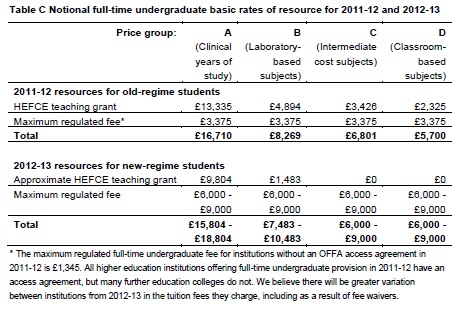
Before the introduction  of the £9K tuition fees this academic year (i.e. in the `old regime’), a University would receive income from tuition fees of up to £3375 per student and from a `unit of resource’ or `teaching grant’ that depends on the subject. As shown in the upper part of Table C below which is taken from a HEFCE document:

Budgets

In the old regime, the  maximum income per student in Physics was thus £8,269 whereas for a typical Arts/Humanities student the maximum was £5,700. That means there was a 45% difference in funding between these two types of subject. The reason for this difference is that subjects such as physics are much more expensive to teach. Not only do disciplines like physics require expensive laboratory facilities (and associated support staff), they also involve many more contact hours between students and academic staff than in, e.g. an Arts subject.  However, the differential is not as large as you might think: there’s only a factor two difference in teaching grant between the lowest band (D, including Sociology, Economics, Business Studies, Law and Education) and the STEM band B (including my own subject, Physics). The real difference in cost is much larger than that, and not just because science subjects need laboratories and the like.

To give an example, I was talking recently to a student from a Humanities department at a leading University (not my employer). Each week she gets 3 lectures and one two-hour seminar, the latter  usually run by a research student. That’s it for her contact with the department. That meagre level of contact is by no means unusual, and some universities offer even less tuition than that.

In my School, MPS, a typical student can expect around 20 contact hours per week including lectures, exercise classes, laboratory sessions, and a tutorial (usually in a group of four). The vast majority of these sessions are done by full-time academic staff, not PDRAs or PhD students, although we do employ such folks in laboratory sessions and for a very small number of lectures. It doesn’t take Albert Einstein to work out that 20 hours of staff time costs a lot more than 3, and that’s even before you include the cost of the laboratories and equipment needed to teach physics.

Now look at what happens in the `new regime’, as displayed in the lower table in the figure. In the current system, students still pay the same fee for STEM and non-STEM subjects (£9K in most HEIs) but the teaching grant is now £1483 for Physics and nothing at all for Bands C and D. The difference in income is thus just £1,483 or in percentage terms, a difference of just 16.4. Worse than this, there’s no requirement that this extra resource be spent on the disciplines with which it is associated anyway. In most universities, all the tuition income goes into central coffers and is dispersed to Schools and Departments according to the whims of the University Management.

Of course the new fee levels have led to an increase in income to Universities across all disciplines, which is welcome because it should allow institutions to improve the quality of their teaching bu purchasing better equipment, etc. But the current arrangements as a powerful disincentive for a university to invest in expensive subjects, such as Physics, relative to Arts & Humanities subjects such as English or History. It also rips off  staff and students in those disciplines, the students because they are given very little teaching in return for their fee, and the staff because we have to work far harder than our colleagues in other disciplines, who  fob off  most of what little teaching their supposed to do onto PhD students badged as Teaching Assistants. It is fortunate for this country that scientists working in its universities show such immense dedication to teaching as well as research that they’re prepared to carry on working in a University environment that is so clearly biased against STEM disciplines.

To get another angle on this argument, consider the comments made by senior members of the legal profession who are concerned about the drastic overproduction of law graduates. Only about half those doing the Bar Professional Training Course after a law degree stand any chance of getting a job as a lawyer in the UK. Contrast this with the situation in science subjects, where we don’t even produce enough graduates to ensure that schools have an adequate supply of science teachers. The system is completely out of balance. Here at Sussex, only about a quarter of students take courses in STEM subjects; nationally the figure is even lower, around 20%…

I don’t see anything on the horizon that will alter this ridiculous situation. STEM subjects will continue to be stifled as universities  follow the incentive to invest in cheaper subjects and will continue to overproduce graduates in other areas. The present Chief Executive of HEFCE is stepping down. Will whoever takes over from him have the guts to do anything about this anti-STEM bias?

I doubt the free-market ideologues in Westminster would even think of intervening either, because the only two possible changes are: (i) to increase the fee for STEM subjects relative to others; and (ii) to increase the teaching grant. Option (i) would lead to a collapse in demand for the very subjects it was intended to save and option (ii) would involve increasing public expenditure, which is anathema to the government even if it is an investment in the UK’s future. Or maybe it’s making a complete botch of the situation deliberately, as part of a cunning plan to encourage universities to go private?

General Paper

Posted in Education with tags on May 5, 2013 by telescoper

Rummaging through my drawers just now I found the General Paper I took in 1981 to get into Cambridge. I haven’t copied Section A, which involves writing a precis of a rather lengthy article about voting systems, but Sections B and C involve different forms of writing challenge.

I don’t remember which questions I answered, but most of the topics are still interesting and/or controversial enough to be topics for a blog post, at least. Which would you have chosen?

Incidentally, the whole paper was of 3 hours duration and all sections were equally weighted so you would be expected to spend about an hour on each question.

I think we should do much more to encourage science students to develop their writing skills nowadays. I think most present-day physics would find these exercises very difficult, simply because they don’t get enough practice at putting pen to paper (or even fingers to keyboard).

If you are feeling keen, and have an hour to spare, feel free to submit a piece through the comments box!

Time starts now…

Should the passive voice be avoided?

Posted in Education with tags , , , , , on May 1, 2013 by telescoper

It’s another very busy day (as well as another lovely one) so I thought instead of sitting indoors this lunchtime writing a typically verbose blog item I’d just pick something out of my back catalogue and give it another airing because it deals with something that’s come up a couple of times recently.

This is the time of year when final-year students are drafting their project reports. Yesterday I was back in Cardiff giving feedback on two such articles.  I usually quite enjoy reading these things, in fact. They’re not too long and I’m usually pretty impressed with how the students have set about the (sometimes quite tricky) things I’ve asked them to do for their project work. I think the project report is quite a challenge for UK physics students because they generally haven’t had much practice in putting together a lengthy piece of writing before or during their university course, so haven’t developed a style that they feel comfortable with and are often unfamiliar with various conventions (such as reference style, punctuation of equations, etc). Some of these are explained in quite a lot of detail in the instructions the students are given, of course, but we all know that only girls read instructions….

The thing that strikes me most forcibly about the strange way students write project reports is that they are nearly always phrased entirely in the passive voice, e.g.

The experiment was calibrated using a phlogiston normalisation widget….

I accept that people disagree about whether the passive voice is good style or not. Some journals actively encourage the passive voice while others go the opposite way entirely . I’m not completely opposed to it, in fact, but I think it’s only useful either when the recipient of the action described in the sentence is more important than the agent, or when the agent is unknown or irrelevant. There’s nothing wrong with “My car has been stolen” (passive voice) since you would not be expected to know who stole it. On the other hand “My Hamster has been eaten by Freddy Starr” would not make a very good headline.

The point is that the construction of a statement in the passive voice in English is essentially periphrastic, in that it almost inevitably involves some form of circumlocution – either using more words than necessary to express the meaning or being deliberately evasive by introducing ambiguity. Both of these failings should be avoided in scientific writing.

Apparently, laboratory instructors generally tell students to write their reports in the passive voice as a matter of course. I think this is just wrong. In a laboratory report the student should describe what he or she did. Saying what “was done” often leaves the statement open to the interpretation that somebody else did it. The whole point of a laboratory report is surely for the students to describe their own actions. “We calibrated the experiment..”  or “I calibrated the experiment…” are definitely to be preferred to the form I gave above.

That brings me to the choice of pronoun in the active voice. One danger is that it can appear very bombastic, but that’s not necessarily the case. I don’t find anything particularly wrong in saying, e.g.

We improve upon the technique of Jones et al. (1848) by introducing a variable doofer in the MacGuffin control, thereby removing gremlins from the thingummy process.

But the main issue is whether to use the singular or plural form. It can be irritating to keep encountering “I did this..” and “I did that..” all the way through a journal paper, and I certainly  would feel uncomfortable writing a piece like that in the first person singular. I think it feels less egotistical to use “we”, even if there is only one author (which is increasingly rare in any case). If it’s good enough for the Queen it’s good enough for me! However, I just looked “we” up in Chambers dictionary and found

..used when speaking patronizingly, esp to children, to mean `you’.

which wasn’t at all what I had in mind!

However in the case of a student project that I’m assessing I actually want to know what the particular student  writing the report did, not what was done by person or persons unspecified or by a group of uncertain composition. So I encourage my students to put, e.g.,

I wrote a computer program in 6502 Assembly Language to solve the Humdinger equation using the Dingbat-Schnitzelgruber algorithm.

I also (sometimes) like “we” when there’s, e.g., a complicated mathematical derivation.  Going  line by line through a lengthy piece or difficult technical argument seems friendlier if you imagine that the reader is trying to do the calculation along with you as you write it:

if we differentiate the right hand side of equation (8), use the expression for x obtained in equation (97), expand y in a power-series and take away the number we first thought of we find…

The “we” isn’t necessarily an  author with delusions of grandeur (or schizophrenia), but instead denotes a joint operation between author and reader.

Anyway, to resume the thread, it seems to me that sometimes it is appropriate to use the passive voice because it is the correct grammatical construction in the circumstances. Sometimes also the text just seems to work better that way too. But having to read an entire document written in the passive voice drives me to distraction. It’s clumsy and dull.

In scientific papers, things are a little bit different but I still think using the active voice makes them easier to read and less likely to be ambiguous. In the introduction to a journal paper it’s quite acceptable to discuss the background to your work in the passive voice, e.g. “it is now generally accepted that…” but when describing what you and your co-authors have done it’s much better to use the active voice. “We observed ABC1234 using the Unfeasibly Large Telescope..” is, to my mind, much better than “Observations of ABC1234 were made using..”.

Reading back over this post I notice that I have jumped fairly freely between active and passive voice, thus demonstrating that I don’t have a dogmatic objection to its use. What I’m arguing is that it shouldn’t be the default, that’s all.

My guess is that a majority of experimental scientists won’t agree with this opinion, but a majority of astronomers and theoreticians will.

This guess will now be tested by reactivating an old poll..

Technical Support

Posted in Education with tags , , , on April 18, 2013 by telescoper

We’re approaching the end of term here at the University of Sussex and there are lots of things that need to get finished before then, so it’s a very busy day. Just time for a quick post to pass on some great news and a comment.

One of my colleagues when I worked in the School of Physics & Astronomy at Cardiff University, Steven Baker, has won an award for being the best STEM Technician in the category of Physical Sciences in the whole country! This is an new award set up by the Higher Education Academy, so Steven is the inaugural winner of it.  Although I suspect he won’t enjoy being the centre of attenti0n very much I’m very pleased that he won this award. Among many other things he was central in setting up the  gear that enabled current 4th-year Cardiff MPhys students to have a much wider selection of modules, by accessing lectures from Swansea University by video link.

I’m also delighted that this award has been set up generally because I feel very strongly that the contribution made by support staff in university departments.  No Physics department can run with out a dedicated crew of technicians who apply their expertise in both teaching and research laboratories, but there are many more people – clerical staff, computer officers, etc – without whom many of our activities would grind to a halt. None of these support staff gets the recognition they deserve; they are often poorly paid and lack an appropriate career structure that reflects the importance of the work they do.

So Steven’s award is an occasion not just for him to celebrate, but also to remind us academics that we couldn’t do what we do without people like him doing all the difficult stuff!

Why participation isn’t widening

Posted in Education with tags , on March 23, 2013 by telescoper

Frustrated at my ongoing indisposition – I had to miss today’s Admissions Day at Sussex University, which has put me in a very bad mood – I’ve decided to deliver a short rant about widening participation. WP is the name given to schemes to open up access to higher education to students from less advantaged backgrounds. An excellent idea, of course.

The problem is that, despite pressure from the relevant quango (OFFA) most self-styled leading universities, especially those in the Russell Group, have consistently failed to widen participation to any significant extent. Why is this?

The easy answer is that universities have to take students who are adequately prepared for undergraduate studies, which means selecting on the basis of A-level grades, which means students from private schools have an advantage.

The problem with this argument is that, at least in Physics and Mathematics, I don’t think A-levels are a reliable indicator of aptitude for undergraduate study at all. If I had my way we wouldn’t use A-levels at all.

Unfortunately we’re stuck with the current, unfair, system because any “leading” university that takes a large number of students with weak A-levels (possibly through a Foundation Programme) will be penalised in the league tables for not being selective enough. Moreover, the Government’s decision to lift the cap on places for students with AAB or better, means that recruiting students with top A-level grades is potentially the most lucrative strategy.

That the system doesn’t work the way it is supposed to is obvious. If you don’t agree, then ask yourself why it’s not the case that virtually all Oxbridge students get first class degrees, when they admit only A*/A students?

Things won’t improve until we abandon the obsession with A-level tariff points and find a way of assessing intrinsic ability.

Alma Mater

Posted in Biographical, Education with tags , on March 22, 2013 by telescoper

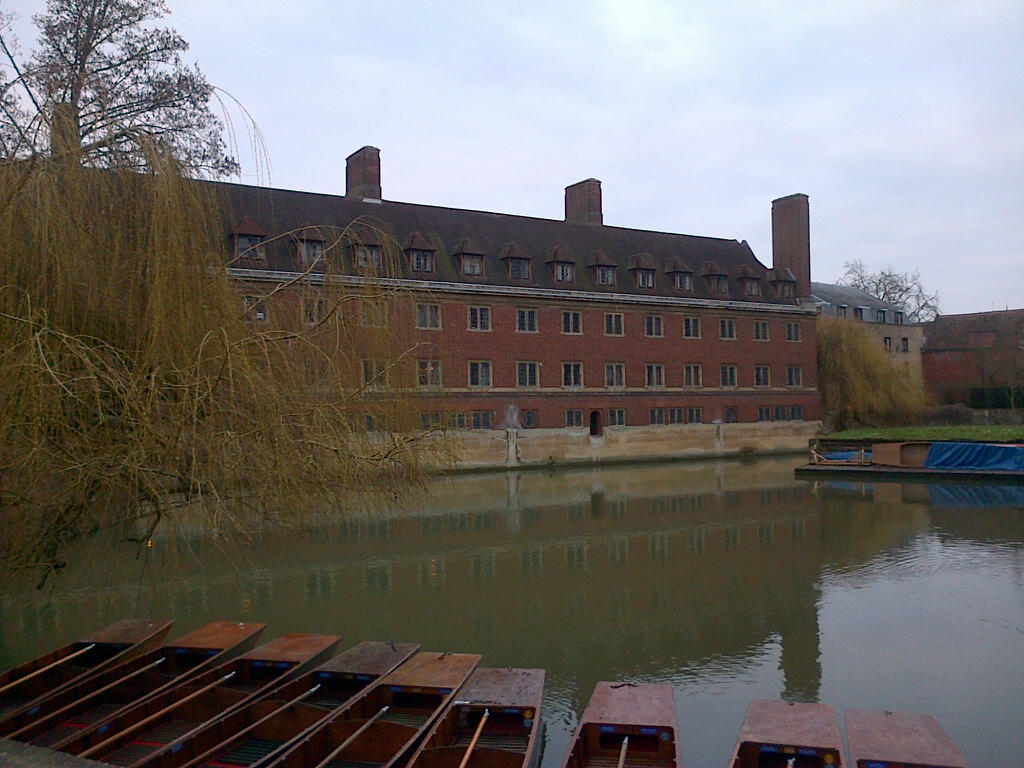
During my short visit to Cambridge on Wednesday I happened to pass through Magdalene College (on my way to a couple of pints in The Pickerel). I couldn’t resist taking a pic of the Lutyens Building, where I lived in the first year (1982/3). My room was second from the far end, on the first floor. I wonder who’s in there now?

Your PhD Questions Answered (?)

Posted in Education, The Universe and Stuff with tags , , , , , , on March 10, 2013 by telescoper

As I mentioned last week, one of the main items on the agenda at the moment is recruitment of new PhD students. As usual, this finds me having to operate on both sides of the fence,  playing a role in selecting students whilst also trying to advise students on how to target their applications, prepare for interview, and choose between offers (for those who manage to get a place).

In my field (astrophysics), the primary route for funding a PhD comes through the Science and Technology Facilities Council (STFC) which operates a national deadline (31st March) before which candidates can not be required to make a decision. This deadline sets the timescale for departments to decide too, as we clearly want to make sure all our first choice applicants get their offers before the cutoff date.

The national deadline prevents students from being pressured into making decisions before they have heard back from all the institutions to which they have applied, so in that sense it’s a good idea. On the other hand, it does mean that there’s often frantic activity on deadline day as offers are accepted or declined. Reserves have to be contacted quickly when a favoured candidate withdraws to go somewhere else and not all of them may still be available. A student who has been waiting anxiously without a first-choice offer may suddenly receive a lifeline on deadline day.

Getting offers is one thing, but deciding between them is quite another. There are many things to take into account, and the criteria are by no means clear. I’m not the only person to have been thinking about this. There are personal matters, of course. Is it a nice place? Are the people friendly? Do you think you can get on with your potential supervisor? That sort of thing. But there’s also the actual research. Is the project really what you want to do? Is is likely to open up a future career in research, or just be a dead end? Is the mixture of theory and experiment (or observation) what you would like?

One of the issues that often arises when I discuss research with potential PhD students is how structured the project  is. Some projects are  mapped out by the supervisor in great detail, with specific things to be done in a specific order with well-defined milestones against which progress can be measured. Others, especially but not exclusively theoretical ones, are much more of the nature of “here’s an interesting idea – let’s study it and see where it leads”. Most PhDs are somewhere between these two extremes, but it’s probably true that experimental PhDs are more like the former, whereas theoretical ones are more like the latter. Mine, in theoretical astrophysics, ended up evolving quite considerably from its starting point.

I’ve always been grateful to my supervisor for allowing me the freedom to follow my own curiosity. But I think it was essential to be given an initial focus, in the form of a specific project to cut my teeth on. Getting a calculation finished, written up and published gave me the confidence to start out on my own, but I did need a lot of guidance during that initial phase. We a;ll need to learn how to walk before we can run.

Another aspect of this is what the final thesis should look like. Should it be a monolithic work, focussed on one very specific topic, or can it be an anthology of contributions across a wider area?  Again, it’s a question of balance. I think that a PhD thesis should be seen as a kind of brochure advertising the skills and knowledge of the student that produced it. Versatility is a good quality, so if you can do lots of different things then your thesis should represent that. On the other hand, you also need to demonstrate the ability to carry out a sustained and coherent piece of research. Someone who flits around knocking out lots of cutesy “ideas papers” may get a reputation for being a bit of a dabbler who is unable or unwilling to tackle problems in depth. The opposite extreme would be a person who is incapable of generating new ideas, but excellent once pointed in a specific direction. The best scientists, in my opinion, have creative imagination as well as technical skill and stamina.  It’s a matter of balance, and some scientists are more balanced than others. There are some (scary) individuals who are brilliant at everything, of course., but us mere mortals have to make the most of our limited potential.

The postdoc market that lies beyond your PhD is extremely tough. To survive you need to maximize the chances of getting a job, and that means being able to demonstrate a suitability for as many opportunities as possible that come up. So if you want to do theory, make sure that you know at least something about observations and data analysis. Even if you prefer analytic work, don’t be too proud to use a computer occasionally. Research problems often require  you to learn new things before you can tackle them. Get into the habit of doing that while you’re a student, and you’re set to continue for the rest of your career. But you have to do all this without spreading yourself too thin, so don’t shy away from the chunky calculations that keep you at your desk for days on end. It’s the hard yards that win you the match.

When it comes to choosing supervisors, my advice would be to look for one who has a reputation for supporting their students, but avoid those who want to exert excessive control. I think it’s a supervisor’s duty to ensure that PhD student becomes as independent as possible as quickly as possible, but to be there with help and advice if things go wrong. Sadly there are some who treat PhD students simply as assistants, and give little thought to their career development.

But if all this sounds a bit scary, I’ll add just one thing. A PhD offers a unique challenge. It’s hard work, but stimulating and highly rewarding. If you find a project that appeals to you, go for it. You won’t regret it.

Sussex, a month in…

Posted in Biographical, Education, The Universe and Stuff with tags , , on March 2, 2013 by telescoper

Well, although it seems like no time at all it appears I’ve now been in Brighton and working at the University of Sussex for a whole month! Here’s a picture of the street I live in in the Kemptown area of Brighton, taken this afternoon. That’s the English Channel at the end of the road, in case you don’t know where Brighton is; it’s definitely not in the Midlands.

IMG-20130302-00069

I’m currently on campus again, although I made a major miscalculation in that Brighton and Hove Albion are playing at home again today. Since the Amex Stadium is just over the road from the University, that means I’ll either have to go back before the final whistle blows or wait until the crowds have dispersed before returning to base.

It has been unbelievably hectic. Although I knew it was going to be hard work taking over as Head of School halfway through the academic year, several unforeseen things have come up that have made me even busier than I’d anticipated. Some of these were pleasant surprises and some weren’t, but that’s all I’m going to say for now!

Since I arrived a large part of my time has been spent on matters relating to new staff appointments, arising from a mixture of replacements and new investment across the whole School of Mathematical and Physical Sciences. That has included new staff in Applied Mathematics, Theoretical Particle Physics, Experimental Particle Physics, Atomic, Molecular and Optical Physics and of course Astronomy. There are more to come over the next few weeks, including a new group in the area of Probability and Statistics. It’s pleasant work, of course, especially when it goes well (which it definitely is) but I have to admit that the schedule of presentations and interviews is rather exhausting.

Apart from that the other principle preoccupation has been strategic planning for the next five years. On Thursday morning I had a crunch meeting with members of the University’s management team to discuss the plans for MPS, which were actually drafted before I took up my post but have since been modified quite a bit. I was more nervous before that meeting than I’ve been for many years, primarily because I did not know what to expect. It turned out to be quite pleasant, actually, and I left the meeting not only relieved but relaxed.

In the afternoon it was back to interviewing, but this time for postgraduate students. That’s also a pleasant duty, because it involves giving excellent young scientists their first step on the ladder towards a research career. I’m sure it’s not so pleasant for the candidates though. Nerves sometimes get the better of the students in these interviews, but experienced interviewers can calibrate for that. And if you’re nervous, it means that you care…

Anyone reading this who is nervous about doing a PhD interview (or has experienced nerves in one they’ve already had) might reflect on my experience when I was called to interview for a PhD place in Astronomy at the University of Manchester way back in 1985. I was very nervous before that, and arrived very early for my grilling. I was told to wait in a sort of ante-room as the previous interview had only just started. I started to read a textbook I had brought with me. About five minutes later, the door of the interview room opened and the interviewers, Franz Kahn and John Dyson, carried out the unconscious body of the previous candidate. It turned out that, after a couple of friendly preliminary questions, the two Professors had handed the candidate a piece of chalk and told him to go to the blackboard  to work something out, at which point said candidate had fainted. When it was my turn to be handed the chalk I toyed with the idea of staging a mock swoon, but resisted the temptation.

The question, in case you’re interested, was to estimate the angle through which light  is deflected by the Sun’s gravity. I hadn’t done any general relativity in my undergraduate degree, so just did it by dimensional analysis. That seemed to go down well and they offered me a place … which I turned down in favour of Sussex.

Omnibus Edition

Posted in Biographical, Education with tags , , , , on February 27, 2013 by telescoper

One of the things I’ve had to get used to about working at a University based on an out-of-town campus is that it’s no longer feasible to walk to work every morning. Fortunately there is an excellent bus service from central Brighton to Falmer, so this isn’t too much of a hardship. I’ve now invested in one of those new-fangled smart cards that makes it very economical not only for getting to work, but also for hopping on and off while pottering about town doing shopping and whatnot.

I have noticed that if I get the No. 25 bus from Old Steine before 8am it only takes about fifteen minutes to get to the University of Sussex. If I’m a bit late starting out, however, and don’t get to the bus stop until after eight in the morning, the trip can take about forty minutes. The problem is that roadworks on the A27 Lewes Road have reduced it to a single lane in each direction; there’s a critical point when the traffic builds up to rush hour levels and then solidifies. Still, I don’t mind getting in before 9am as that gives me useful time before the roll of meetings commences, so I found it quite easy to adapt to the early start.

Anyway sitting on the bus this morning I had a kind of flashback to my schooldays. The school I went to was on the opposite side of Newcastle to where I lived, so I had to take the bus every morning. I did much the same thing in those days as I am doing now, in fact – getting the bus at 7.30 to avoid the heaviest traffic, and often doing the previous night’s homework before lessons started in the morning.

The one thing that was very different in those days (and we’re talking about the Seventies now) was that the “School Run” didn’t really exist. Even the posh kids took the bus or train to School rather than being ferried back and forth by doting parents. I think it did me a lot of good travelling on the bus along with all kinds of other people rather than being transported in the hermetically sealed cocoon of a family car. The famous friendliness of Tyneside folk undoubtedly contributed to the omnibus experience and left me with a lifelong preference for public over private transport. I’ve never owned a car and have no intention of ever doing so.

Anyway, this all reminds me of the (probably apocryphal) quote from Margaret Thatcher:

A man who, beyond the age of 26, finds himself on a bus can count himself as a failure.

Whilst I’d by no means be ashamed to be counted a failure according to a Thatcherite criterion, I did once get a bit riled by a version of it when I was conducting a UCAS Admissions Day at another institution (also a campus university). A (male) parent of one of the candidates asked me why there was so little car parking space for students on the campus. I replied that undergraduates were basically not allowed to park on the campus, otherwise it would be overrun with motor vehicles and wouldn’t be so nice and spacious and green. However, I said, that’s not a problem because there was an excellent bus service that could take students to the University from town and vice versa in just a few minutes. The indignant father bristled and announced in a very loud and angry voice “No son of mine is going to get on a bus”. That was the nearest I’ve ever come to losing my temper with a parent on a university admissions day. Fortunately nothing like it has happened since.

It never would have occurred to my parents to come with me when I visited universities for interview and I would have been horrified if they had insisted on doing so. Nowadays, however, prospective students are invariably accompanied by parents, who generally ask at least as many questions as their offspring do. Is this just an extension of the School Run, or is because parents now have to foot the bill (when in my day there were maintenance grants and no tuition fees). Either way, times have definitely changed.

Anyway, I’m about to get the bus home. Tomorrow we are interviewing prospective postgraduate (PhD) students. I don’t think any will bring their parents along. And quite a few may even come on the bus.