Archive for the Education Category

How to segregate your lecture

Posted in Education, Politics with tags , on November 26, 2013 by telescoper

Following the announcement that UniversitiesUK has decided that it is acceptable for audiences at events held at UK universities to be segregated by gender, I thought I’d would explain how such segregation should be achieved for speakers who require it.

To start with the lecture theatre chosen for the event should be equipped with suitable man-sized box trunk or cabinet into which the guest speaker is to be placed. An illustrative example of the type of container required is shown here:

_DSC2585-black-upload

Care must of course be taken to ensure that the box is of sufficiently large dimensions that it is capable of containing the speaker without causing undue discomfort.

Before the audience is admitted to the event, the speaker should be placed inside the box whereupon it should be locked.

The audience can then enter the lecture theatre, sit down wherever they like and make themselves comfortable, being confident that the appropriate level of segregation has been enforced.

An additional advantage of this scheme is that a suitably chosen box will make it impossible for the audience to hear the stream of misogynistic drivel produced by the invited guest, thus ensuring that the event runs smoothly and without disruption.

I hope this clarifies the situation.

Six (very) bad things about the REF

Posted in Education, Science Politics with tags , , , , on November 22, 2013 by telescoper

I see that Jon Butterworth has written a piece on the Grauniad website, entitled Six good things about the REF, the REF in question not being a black-clad figure of questionable parentage and visual acuity responsible for supervising a game of association football, but the Research Excellence Framework.

I agree with some of Jon’s comments and do believe that past Research Assessment Exercises have generally raised the quality of research in UK universities. I do however think that there are some very bad things about the way the REF is being implemented, and that these far outweigh the positives Jon mentions. In the interest of balance, therefore, I thought I’d respond with a list of six (very) bad things about the REF, and particularly how it applies to physics. I’ll keep them brief because I’ve blogged about most of them before:

  1. The rules positively encouraged universities to play games with selectivity. This is absurd. All academic staff on teaching and research contracts should be submitted if a true indication of research quality is to be obtained.
  2. The criteria for what constitutes 3* or 4* publications are vague and subjective, leaving everything in the hands of the panels. Worse, all paperwork will be shredded after the panel’s deliberations leaving no possibility for appeal. This absolutely stinks.
  3. How QR funding will be allocated on the basis of the REF is not made clear in advance of the submission. Nobody knows how heavily the funding will be skewed towards 4* and 3* submissions. Having encouraged departments to play games, therefore, the REF refuses to disclose the rules. It’s not even clear there will be any QR funding.
  4. The panels will be unable to perform a detailed peer review of submissions simply because there will be too many papers. Each panel will be expected to make decisions on many hundreds of papers, leaving time only for a cursory reading of each.
  5. Limiting the physics submission to 4 papers per person is ridiculous. This corresponds to a tiny fraction of the outputs of a typical physics researcher. If someone has written ten 4* publications in the REF period, why should these not be counted?
  6. Impact counts for a sizable fraction (20%) of the funding, but the rules governing what counts as “impact” are absurdly restrictive and clearly encourage short-term commercially-oriented boilerplate stuff at the expense of genuine long-term “blue skies” research.


Well, I got to six in just a few minutes and could easily get to sixty, but that will do for now. Perhaps you’d like to contribute your own bad things through the comments box?

The Grand MPS School Away(half)day

Posted in Education with tags , , , on October 30, 2013 by telescoper

Very late posting a blog today because I’ve been busy all day, preparing for and then hosting an “Awayday” in the School of Mathematical and Physical Sciences (MPS) at the University of Sussex. Actually, it was only half a day, and it didn’t really going that far away either, but I hope we won’t be prosecuted under the Trades Description Act..

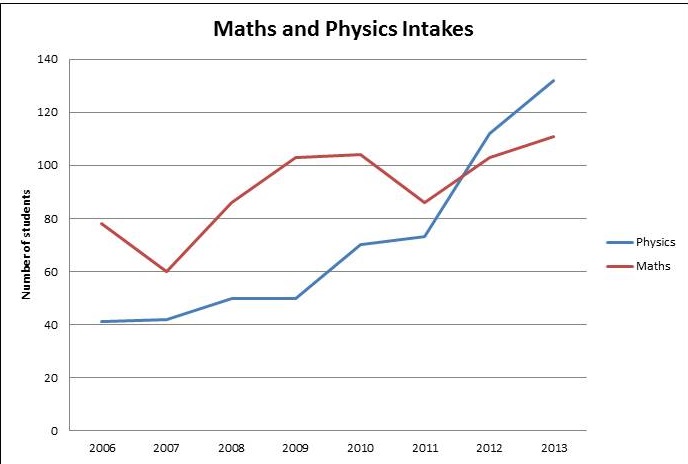
This event is something I started thinking about just as soon as I arrived in Sussex in February this year, and we’ve been preparing for it actively for quite a long time. The background to it is that the School has expanded dramatically over the last few years, especially in the Department of Physics & Astronomy. The Department of Mathematics has grown too, but at a more modest rate. Here, for example, is the annual intake of undergraduate students for our two departments over the last few years:

slide

To cope with this growth in student numbers our complement of academic staff has increased by about 50%, from around 40 just a year ago to a present number of 60. We have also increased our research income considerably over the same period. I hasten to add that none of this is my doing – it’s all down to the hard work of staff who were doing their stuff brilliantly long before I arrived.

Of course it’s great to be Head of a School that is doing so well, but I am very conscious that we need to ensure we continue to provide a good experience for students during this period of growth and also to make sure that has we get bigger, all staff and students feel that they still have a voice in how the School is run. To that end we set up an event in which most members of the staff were invited – academics, administrative and technical support included – as well as our student reps. Kelly McBride, President of the Students Union, also came along. In all, over eighty people attended; there would have been more had we not scheduled it during the local schools’ half-term, which was the only available slot.

The event, held in the spacious Conference Centre in Bramber House, was mainly focussed on teaching and a large part of it involved staff forming groups to discuss various themes: lectures, small group teaching, assessment, feedback, and so on. Before that there were presentations from myself (giving some background, including information about the School’s budget and how our finances work as well as how we measure up in the dreaded League Tables), from our School Administrator talking about issues relating to our admirable office staff, and our Technical Services Supervisor giving a perspective on the challenges facing our technical support staff. Each group comprised a cross-section of the School and each was given a theme to discuss. We then reconvened en masse to share the results of each discussion.

I was a bit nervous beforehand as to how it would all work, especially as there has never been an event of this sort in MPS. I was more nervous before this event than I have been about anything for ages, actually. I wondered how engaged staff would feel and whether the event would turn out to be as inclusive as I’d intended, i.e. whether everyone would feel able to contribute on equal terms. In the end I think it worked out pretty well. In fact we ran over by about an hour, primarily because the discussion was so extensive.

It’s not for me to say whether the day was a success or not, but although there were some things that didn’t work so well overall I was quite satisfied. In particular I was impressed with the number of good practical suggestions that came forward in the final session. We’re going to be working hard to synthesize these comments into a form we can work into our plans for the future.

Most of the comments I heard from people who participated in this event after it finished were positive too. If anyone present happens to read this blog I’d be interested to hear their views through the comments.

Without anticpating the feedback too much, I’m pretty sure that, with a few tweaks (mainly to focus things a bit better with fewer “themes” for discussion), this will become a regular fixture in the MPS calendar. As we get used to such events we’ll probably get even more out of them. I also hope that other Schools of the University of Sussex might find this event a useful model for similar activities they could hold themselves.

I’d like to end with a public “thank you” to everyone who took part and made it so enjoyable and stimulating, to Oonagh and Steve for their input, to Catering and Conference Services for all their help (and yummy food) and above all to the inestimable Miss Lemon for the huge amount of work she put in to the preparations (especially the monopoly theme for the groups, which was inspired..).

Now, however, I am completely knackered and will be going home to have a glass bottle of wine to recover. Busy day tomorrow too. Toodle-pip!

Introduction to the PhD for Physics or Astronomy students

Posted in Education with tags , , , , , , on October 22, 2013 by telescoper

It’s the time of year when final-year students start to think about the possibility of doing a PhD after they have graduated, so I I thought I’d jot down here a few general remarks that might be useful to people who are thinking of taking the plunge. I’ve posted on such matters before, but this is something that comes around every year so I hope you’ll excuse the repeat. I’m aiming this primarily at UK students applying for places in the UK; special considerations apply for students wanting to do graduate research abroad.

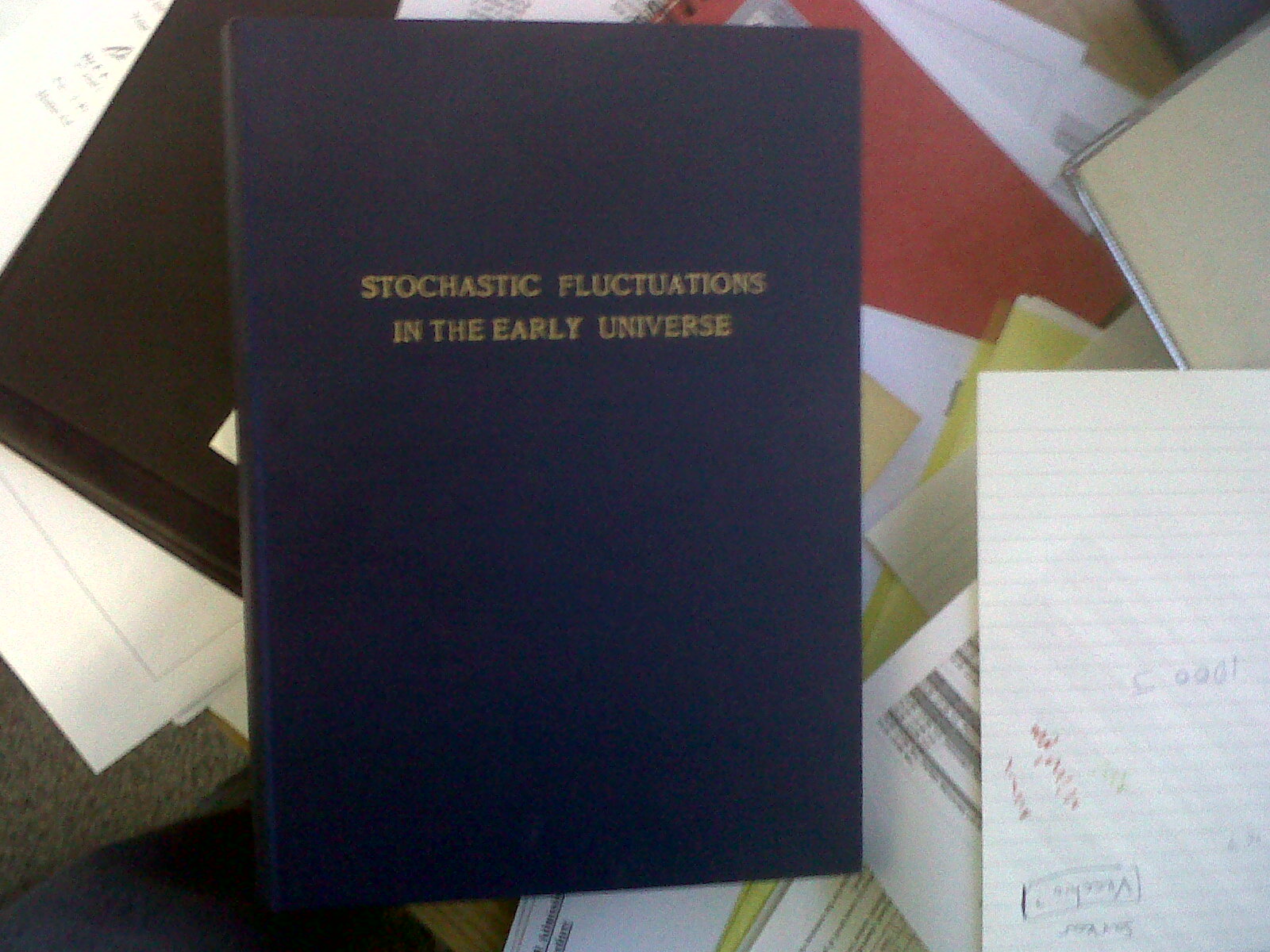
What is a PhD? The answer to that is relatively easy; it’s a postgraduate research degree. In order to obtain a PhD you have to present a thesis like that shown on the left (which happens to be mine, vintage 1988), typically in the range 100-250  pages long. A thesis has to satisfy two conditions for the award of the degree: it should contain original research, which is publishable in an academic journal; and it should present a coherent discussion of that original work within the context of ongoing work in the area of study. In Physics & Astronomy, the PhD is pretty much a prerequisite for any career in academic research, and it usually takes between 3 and 4 years to complete. After submission of the thesis you will have to undergo a viva voce examination conducted by two examiners, one internal and one external. This is quite a tough test, which  can last anywhere between about 2 and about 6 hours, during which you can be asked  detailed questions about your research and wide-ranging questions about the general area.

The Money Side. In the UK most PhDs are supported financially by the research councils, either EPSRC (most physics) or STFC (nuclear & particle physics, astronomy). These generally award quotas of studentships to departments who distribute them to students they admit. A studentship will cover your fees and pay a stipend, currently £13590 pa. That doesn’t sound like a lot, but you should at least remember that it is a stipend rather than a wage; it is therefore not taxed and there is no national insurance payable.

How do I choose a PhD? During the course of a postgraduate degree you are expected to become an expert in the area in which you specialize. In particular you should reach the point where you know more about that specific topic than your supervisor does. You will therefore have to work quite a lot on your own, which means you need determination, stamina and enthusiasm. In my view the most important criterion in your choice of PhD is not the institution where you might study but the project. You need to be genuinely excited by the topic in order to drive yourself to keep through the frustrations (of which there will be many). So, find an area that interests you and find the departments that do active research in that area by looking on the web. Check out the recent publications by staff in each department, to ensure that they are active and to have something to talk about at interview!

Qualifications. Most universities have a formal requirement that candidates for admission to the PhD should have a “good honours degree”, which basically means at least an Upper Second Class Honours degree. Some areas are more competitive than others, however, and in many disciplines you will find you are competing with a great many applicants with First Class degrees.

How to apply successfully. The application procedure at most universities is quite simple and can be done online. You will need to say something about the area in which you wish to do research (e.g. experiment/theory, and particular field, e.g. cosmology or star formation). You’ll also need a CV and a couple of references. Given the competition, it’s essential that you prepare. Give your curriculum vitae some attention, and get other people (e.g. your personal tutor) to help you improve it. It’s worth emphasizing particular skills (e.g. computing). If you get the chance, make use of your summer vacations by taking on an internship or other opportunity to get a taste of research; things like that will undoubtedly give your CV an edge.

The Interview. Good applicants will be invited for an interview, which is primarily to assess whether you have the necessary skills and determination, but also to match applicants to projects and supervisors. Prepare for your interview! You will almost certainly be asked to talk about your final-year project, so it will come across very badly if you’re not ready when they ask you. Most importantly, mug up about your chosen field. You will look really silly if you haven’t the vaguest idea of what’s going on in the area you claimed to be interested in when you wrote your  application!

Don’t be shy! There’s nothing at all wrong with being pro-active about this process. Contact academic staff at other universities by email and ask them about research, PhD opportunities. That will make a good impression. Also, don’t be afraid to ask for advice. Although we’re all keen to recruit good PhD students for our own departments, we academics are  conscious that it is also our job to give impartial advice. Ask your tutor’s opinion.

How many places should I apply for? Some research areas are more fashionable than others so the level of competition varies with field. As a general rule I would advise applying for about half-a-dozen places, chosen because they offer research in the right area. Apply to fewer than that and you might lose out to the competition. Apply to many more and you might not have time to attend the interviews.

What’s the timetable?  Most applications come in early in the new year for entry to the PhD in the following October. The Christmas break is therefore a pretty good time to get your applications sorted out. Interviews are normally held in February or March, and decisions made by late March. STFC runs a deadline system whereby departments can not force students to accept or decline offers before the end of March, so there should be ample time to visit all your prospective departments before having to make any decisions.

Here are some of the slides I used for a talk on such matters a year or so ago, which you might find useful.

That’s all I can think of for now. I hope at least some of these comments are useful to undergraduates anywhere in the UK thinking of applying for a PhD. If there are any further questions, please feel free to ask through the comments box. Likewise if I’ve missed anything important, please feel free to suggest additions in the same manner…

Did I Miss Anything?

Posted in Education, Poetry with tags , , , on October 17, 2013 by telescoper

Question frequently asked by
students after missing a class

Nothing. When we realized you weren’t here
we sat with our hands folded on our desks
in silence, for the full two hours

Everything. I gave an exam worth
40 per cent of the grade for this term
and assigned some reading due today
on which I’m about to hand out a quiz
worth 50 per cent

Nothing. None of the content of this course
has value or meaning
Take as many days off as you like:
any activities we undertake as a class
I assure you will not matter either to you or me
and are without purpose

Everything. A few minutes after we began last time
a shaft of light descended and an angel
or other heavenly being appeared
and revealed to us what each woman or man must do
to attain divine wisdom in this life and
the hereafter
This is the last time the class will meet
before we disperse to bring this good news to all people on earth

Nothing. When you are not present
how could something significant occur?

Everything. Contained in this classroom
is a microcosm of human existence
assembled for you to query and examine and ponder
This is not the only place such an opportunity has been gathered

but it was one place

And you weren’t here

by Tom Wayman (b. 1945)

Better learning means less assessment and more feedback

Posted in Education with tags , , on September 28, 2013 by telescoper

Yesterday I took part in a meeting that discussed, among other things, how to improve the feedback on student assessments in order to help them learn better. It was an interesting meeting, involving academics, administrative staff and a representative of the Students Union, that generated quite a few ideas which I hope will be implemented pretty soon.

Positive though the discussion was, it didn’t do anything to dissuade me from a long-held view that the entire education system holds back the students’ ability to learn by assessing them far too much. The combination of the introduction of modular programmes and the increase of continuously assessed coursework has led to a cycle of partial digestion and regurgitation that involves little in the way of real learning.

I’m not going to argue for turning the clock back entirely, but for the record my undergraduate degree involved no continuous assessment at all (apart from a theory project I opted for in my final year. Having my entire degree result based on the results of six three-hour unseen examinations in the space of three days is not an arrangement I can defend, but note that despite the lack of continuous assessment I still spent less time in the examination hall than present-day students.

That’s not to say I didn’t have coursework. I did, but it was formative rather than summative; in other words it was for the student to learn about the subject, rather for the staff to learn about the student. I handed in my stuff every week, it was marked and annotated by a supervisor, then returned and discussed at a supervision.

People often tell me that if a piece of coursework “doesn’t count” then the students won’t do it. There is an element of truth in that, of course. But I had it drummed into me that the only way really to learn my subject (Physics) was by doing it. I did all the coursework I was given because I wanted to learn and I knew that was the only way to do it.

The very fact that coursework didn’t count for assessment made the feedback written on it all the more useful when it came back because if I’d done badly I could learn from my mistakes without losing marks. This also encouraged me to experiment a little, such as using a method different from that suggested in the question. That’s a dangerous strategy nowadays, but surely we should be encouraging students to exercise their creativity rather than simply follow the instructions? The other side of this is that more challenging assignments can be set, without worrying about what the average mark will be or what specific learning outcome they address.

I suppose what I’m saying is that the idea of Learning for Learning’s Sake, which is what in my view defines what a university should strive for, is getting lost in a wilderness of modules, metrics, percentages and degree classifications. We’re focussing too much on those few aspects of the educational experience that can be measured, ignoring the immeasurable benefit (and pleasure) that exists for all humans in exploring new ways to think about the world around us.

Another Equinox

Posted in Biographical, Education on September 22, 2013 by telescoper

Well, that’s the end of Freshers Week at the University of Sussex. Hopefully new and returning students are settling into their courses now. Today is also the Autumnal Equinox, which gives me the excuse to post an edited and updated version of an item from the corresponding day five years ago. Although I’ve since moved from Cardiff to Brighton, not much has changed except me being five years older. Even the weather is similar:

The weather is unsettling. It’s warm, but somehow the warmth doesn’t quite fill the air; somewhere inside it there’s a chill that reminds you that autumn is not far away.

I find this kind of weather a bit spooky because it always takes me back to the time when I left home to go to University, as thousands of fledgling students are about to do this year in their turn. I did it 31 years ago, getting on a train at Newcastle Central station with my bags of books and clothes. I said goodbye to my parents there. There was never any question of them taking me in the car all the way to Cambridge. It wasn’t practical and I wouldn’t have wanted them to do it anyway. After changing from the Inter City at Peterborough onto a local train, we trundled through the flatness of East Anglia until it reached Cambridge. The weather, at least in my memory, was exactly like today.

I don’t remember much about the actual journey, but I must have felt a mixture of fear and excitement. Nobody in my family had ever been to University before, let alone to Cambridge. Come to think of it, nobody from my family has done so since either.

I was a bit worried about whether the course I would take in Natural Sciences would turn out to be difficult, but I think my main concern was how I would fit in generally.

I had been working between leaving school and starting my undergraduate course, so I had some money in the bank and I was also to receive a full grant. I wasn’t really worried about cash. But I hadn’t come from a posh family and didn’t really know the form. I didn’t have much experience of life outside the North East either. I’d been to London only once before going to Cambridge, and had never been abroad.

I didn’t have any posh clothes, a deficiency I thought would mark me as an outsider. I had always been grateful for having to wear a school uniform (which was bought with vouchers from the Council) because it meant that I dressed the same as the other kids at School, most of whom came from much wealthier families. But this turned out not to matter at all. Regardless of their family background, students were generally a mixture of shabby and fashionable, like they are today. Physics students in particular didn’t even bother with the fashionable bit. Although I didn’t have a proper dinner jacket for the Matriculation Dinner, held for all the new undergraduates, nobody said anything about my dark suit which I was told would be acceptable as long as it was a “lounge suit”. Whatever that is.

Taking a taxi from the station, I finally arrived at Magdalene College. I waited outside, a bundle of nerves, before entering the Porter’s Lodge and starting my life as a student. My name was found and ticked off and a key issued for my room in the Lutyen’s building. It turned out to be a large room, with a kind of screen that could be pulled across to divide the room into two, although I never actually used this contraption. There was a single bed and a kind of cupboard containing a sink and a mirror in the bit that could be hidden by the screen. The rest of the room contained a sofa, a table, a desk, and various chairs, all of them quite old but solidly made. Outside my  room, on the landing, was the gyp room, a kind of small kitchen, where I was to make countless cups of tea over the following months, although I never actually cooked anything there.

I struggled in with my bags and sat on the bed. It wasn’t at all like I had imagined. I realised that no amount of imagining would ever really have prepared me for what was going to happen at University.

I  stared at my luggage. I suddenly felt like I had landed on a strange island where I didn’t know anyone, and couldn’t remember why I had gone there or what I was supposed to be doing.

After 31 years you get used to that feeling.

A New Theory of Electromagnetism?

Posted in Cute Problems, Education, The Universe and Stuff with tags , , on September 19, 2013 by telescoper

I was delighted to see an article by Alok Jha in the Observer on Sunday discussing Maxwell’s Equations, but my rapture was rapidly modified when I saw the image that accompanied the piece:

Maxwell's Equations

Since our new students are just settling into their courses in the Department of Physics & Astronomy here at the University of Sussex, I thought it would be fun to post this here and invite my readers (some of whom are students) to spot the deliberate mistake(s). More amusingly, how about offering suggestions as to what the Universe would be like if electromagnetism did indeed behave the way described by the alternative theory outlined in the Observer article.

Answers through the comment box please!

Welcome to Astronomy (unless you’re female)

Posted in Biographical, Education with tags , , , , , on September 14, 2013 by telescoper

I’m here on campus preparing to attend a series of receptions at the start of Freshers’ Week to welcome new students to the University of Sussex. Over the next few days I’m going to be involved in a lot of events aimed at helping all our new undergraduate students settle in, before teaching starts properly. There’ll also be events for our new postgraduates, at both Masters and Doctoral levels.

Every year the Science and Technology Facilities Council (STFC) funds an Introductory Summer School for new postgraduate research students in Astronomy. It’s held at a different university each year and is a long-running tradition. I attended such a School at Durham University way back in 1985, long before STFC was invented! We organized and ran one at Nottingham while I was there and last year the corresponding fixture was held at Sussex University, though that was before my time here and I wasn’t involved in it at all. This year, the Introductory Summer School was held at Queen Mary, University of London (often abbreviated to QMUL).

I spent eight happy years at Queen Mary (from 1990-98) so it pains me to have to criticize my friends and former colleagues there, but I really feel that I have to. Look at the programme for the Summer School. You will see that 18 (eighteen) lecturers were involved, covering virtually all areas of current research interest in the field. There is not a single female lecturer among them.

Yesterday I blogged about the invisibility of LGBT astrophysicists, but this is a glaring example of the problems facing female scientists embarking on a career in the same discipline. What message does a male-only programme send to aspiring female astronomers and astrophysicists? The lack of female speakers probably wasn’t deliberate, but was clearly thoughtless. Discrimination by omission is real and damaging. I mean no disrespect at all to the lecturers chosen, but looking through the topics covered I could easily have picked a female alternative who would have done just as good a job, if not better.

I think this is a scandal. I’ll be writing a letter of complaint to STFC myself, and I encourage you to do likewise if you agree. It’s too late to do anything about this year’s School, of course, but STFC must make sure that nothing like this happens again.

Widening Participation – Outreach versus Bursaries

Posted in Biographical, Education, Finance with tags , , , , , on September 5, 2013 by telescoper

This morning I came across a University of Sussex News Item which explains that Sussex has made the shortlist, published today (Thursday 5 September), for Widening Participation or Outreach Initiative of the Year in the Times Higher Education Awards 2013.  This piece reminded me of a discussion I had a while ago about the whole approach to widening participation in University education, an issue made all the more serious by the introduction of £9K a year tuition fees. In particular

The University has increased spending on widening participation activities to £8.1 million a year, with over half of this spent on the innovative First Generation Scholars scheme, which supports students who are from low-income backgrounds or who are the first in their family to go to university.

Before commenting on this in any detail I should put my cards on the table. When I went to University in 1982 I was the first in my family ever to go to university. I’m also, at least as far as my immediate family goes, the last. However, in those days there was no need for a First Generation Scholars scheme: there were no tuition fees and, because I don’t come from a wealthy background, I qualified for a full maintenance grant. Life (in Cambridge) as an undergraduate student was fairly comfortable.

Times have changed a lot. Many more people go to university nowadays, but the price is that support for those who don’t have access to family funds is now spread very thinly.  There are no full maintenance grants, and the fees are very high. Looking back, though, I don’t think it would have been the tuition fees that might have deterred me from going to university. After all, they don’t have to be paid back until after graduation, and when one’s income exceeds a certain level. What would have made a difference would have been the withdrawal of maintenance. Without the grant, I simply wouldn’t have been able to study without getting a job. Apart from the amount of work involved in doing my degree, the recession of the early 1980s meant that jobs were very hard to come by.

To get back to the news item I mentioned earlier, I have always thought there is a tricky calculation to be made when it comes to designing programmes intended to encourage students from as wide a range of backgrounds as possible to come to university, whether that be to do with socio-economic considerations, gender, ethnicity, age or anything else. The question is whether pumping money into bursaries is actually effective. I can imagine that a large bursary, perhaps equivalent in money terms to the old maintenance grant, would genuinely influence the decision of a prospective student, but if the pot is shared out among very many people the resulting bursaries are fairly modest. How much does a bursary have to be to make a difference? Answers on a postcard.

The other side of the debate is what the balance should be between bursaries and outreach. In a subject like Physics one of the principal obstacles faced by pupils from the state sector is the dire shortage of physics teachers as well as the lack of laboratory facilities in schools. Here in the Department of Physics & Astronomy at Sussex we have a very large (and growing) outreach programme which includes giving kids from local schools the chance to come into our building and do specially designed experiments in a laboratory set aside for the purpose.  This kind of activity is intended to get those of school age thinking about doing Physics or Astronomy, which they might not otherwise do.

I don’t see bursaries and outreach as mutually exclusive approaches to  the goal of widening participation. It’s more a question of the balance. How do we decide how to allocate resources? Is there research on the effectiveness of different programmes?

As always, comments are welcome via the box below!