Archive for the Education Category

REF moves the goalposts (again)

Posted in Bad Statistics, Education, Science Politics with tags , , , on January 18, 2013 by telescoper

The topic of the dreaded 2014 Research Excellence Framework came up quite a few times in quite a few different contexts over the last few days, which reminded me that I should comment on a news item that appeared a week or so ago.

As you may or may not be aware, the REF is meant to assess the excellence of university departments in various disciplines and distribute its “QR” research funding accordingly.  Institutions complete submissions which include details of relevant publications etc and then a panel sits in judgement. I’ve already blogged of all this: the panels clearly won’t have time to read every paper submitted in any detail at all, so the outcome is likely to be highly subjective. Moreover, HEFCE’s insane policy to award the bulk of its research funds to only the very highest grade (4* – “internationally excellent”) means that small variations in judged quality will turn into enormous discrepancies in the level of research funding. The whole thing is madness, but there seems no way to inject sanity into the process as the deadline for submissions remorselessly approaches.

Now another wrinkle has appeared on the already furrowed brows of those preparing REF submissions. The system allows departments to select staff to be entered; it’s not necessary for everyone to go in. Indeed if only the very best researchers are entered then the typical score for the department will be high, so it will appear  higher up  in the league tables, and since the cash goes primarily to the top dogs then this might produce almost as much money as including a few less highly rated researchers.

On the other hand, this is a slightly dangerous strategy because it presupposes that one can predict which researchers and what research will be awarded the highest grade. A department will come a cropper if all its high fliers are deemed by the REF panels to be turkeys.

In Wales there’s something that makes this whole system even more absurd, which is that it’s almost certain that there will be no QR funding at all. Welsh universities are spending millions preparing for the REF despite the fact that they’ll get no money even if they do stunningly well. The incentive in Wales is therefore even stronger than it is in England to submit only the high-fliers, as it’s only the position in the league tables that will count.

The problem with a department adopting the strategy of being very selective is that it could have a very  negative effect on the career development of younger researchers if they are not included in their departments REF submission. As well as taking the risk that people who manage to convince their Head of School that they are bound to get four stars in the REF may not have the same success with the various grey eminences who make the decision that really matters.

Previous incarnations of the REF (namely the Research Assessment Exercises of 2008 and 2001) did not publish explicit information about exactly how many eligible staff were omitted from the submissions, largely because departments were extremely creative in finding ways of hiding staff they didn’t want to include.

Now however it appears there are plans that the Higher Education Statistics Agency (HESA) will publish its own figures on how many staff it thinks are eligible for inclusion in each department. I’m not sure how accurate these figures will be but they will change the game, in that they will allow compilers of league tables to draw up lists of the departments that prefer playing games to   just allowing the REF panels to  judge the quality of their research.

I wonder how many universities are hastily revising their submission plans in the light of this new twist?

Examination Period

Posted in Biographical, Education with tags , , on January 14, 2013 by telescoper

Up early this morning as I have to chair my final meeting of the Board of Studies in the School of Physics and Astronomy at Cardiff University before heading off to the Sussex-by-the-Sea for a three days of lectureship interviews and related matters. I’ll therefore probably only have time for brief posts over the next week or so.

Today is also the start of our mid-year examination period which goes on for a fortnight at Cardiff University. It’s therefore a good opportunity to send a hearty “good luck” message to all students about to take examinations, whether in Cardiff or elsewhere, especially those who are further on in their courses and for whom these papers have greater importance.

I’m a bit too busy for anything new so I thought I’d just post a rehash of a rehash of an excerpt from something I posted a while ago on the subject of examinations.

My feelings about examinations agree pretty much with William Wordsworth, who studied at the same University as me, as expressed in this quotation from The Prelude:

Of College labours, of the Lecturer’s room
All studded round, as thick as chairs could stand,
With loyal students, faithful to their books,
Half-and-half idlers, hardy recusants,
And honest dunces–of important days,
Examinations, when the man was weighed
As in a balance! of excessive hopes,
Tremblings withal and commendable fears,
Small jealousies, and triumphs good or bad–
Let others that know more speak as they know.
Such glory was but little sought by me,
And little won.

It seems to me a great a pity that our system of education – both at School and University – places such a great emphasis on examination and assessment to the detriment of real learning. The biggest bane of physics education is the way modular degrees have been implemented in this respect…

Don’t get me wrong. I’m not opposed to modularisation in principle. I just think the way we teach modules in British universities fails to develop any understanding of the interconnection between different aspects of the subject. That’s an educational disaster because what is most exciting and compelling about physics is its essential unity. Splitting it into little boxes, taught on their own with no relationship to the other boxes, provides us with no scope to nurture the kind of lateral thinking that is key to the way physicists attempt to solve problems. The small size of each module makes the syllabus very “bitty” and fragmented. No sooner have you started to explore something at a proper level than the module is over. More advanced modules, following perhaps the following year, have to recap a large fraction of the earlier modules so there isn’t time to go as deep as one would like even over the whole curriculum.

Our students take 120 “credits” in a year, split into two semesters. These are usually split into 10-credit modules with an examination at the end of each semester. Laboratories, projects, and other continuously-assessed work do not involve a written examination, but the system means that a typical  student will have 5 written examination papers in January and another 5 in May. Each paper is usually of two hours’ duration.

This means that the ratio of assessment to education has risen sharply over the last decades with the undeniable result that academic standards have fallen in physics. The system encourages students to think of modules as little bit-sized bits of education to be consumed and then forgotten. Instead of learning to rely on their brains to solve problems, students tend to approach learning by memorising chunks of their notes and regurgitating them in the exam. I find it very sad when students ask me what derivations they should memorize to prepare for examinations. A brain is so much more than a memory device. What we should be doing is giving students the confidence to think for themselves and use their intellect to its full potential rather than encouraging rote learning.

You can contrast this diet of examinations with the regime when I was an undergraduate. My entire degree result was based on six three-hour written examinations taken at the end of my final year, rather than something like 30 examinations taken over 3 years. Moreover, my finals were all in a three-day period. Morning and afternoon exams for three consecutive days is an ordeal I wouldn’t wish on anyone so I’m not saying the old days were better, but I do think we’ve gone far too far to the opposite extreme. The one good thing about the system I went through was that there was no possibility of passing examinations on memory alone. Since they were so close together there was no way of mugging up anything in between them. I only got through  by figuring things out in the exam room.

I don’t want to denigrate the achievements of students who are successful under the current system.  What I’m saying is that I don’t think the education we provide does justice to their talents. That’s our fault, not theirs…

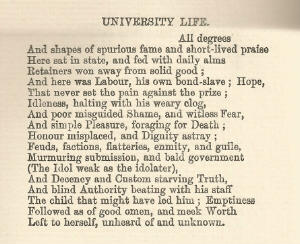
University Life

Posted in Education, Poetry on January 12, 2013 by telescoper

I came across this bit of poetry by William Wordsworth and thought I’d post here because quite a few of the readers of this blog might share his low opinion of University Life!

Dress Codes

Posted in Biographical, Education with tags , , , , , , , on January 11, 2013 by telescoper

Just time for a very quick one before I scoot off to London for this month’s Royal Astronomical Society meeting (and subsequent Club dinner).

Today is the last day of “Revision Week” so I had a two-hour revision class this morning. I gave my final proper lecture at Cardiff University before Christmas, in fact, but this morning was the last teaching of any sort I’ll be doing here before I move to Sussex at the end of the month. If any of the students taking The Physics of Fields and Flows happens to read this, then I wish them the best of luck in next week’s examination!

I won’t be able to mark the scripts (and thus find out how well they’ve all done) until I return from a trip to Brighton next week to carry out interviews for three lectureships in astronomy at Sussex recently advertised. I’m looking forward to that, but I think the three days will be just as gruelling for the panel as for the candidates.

There were some sarcastic comments at the start of today’s class about the fact that I was wearing a suit and tie. It reminded me of an old joke: “Q: What do you call a ‹insert name of institution> graduate who’s wearing a suit? A: The Accused.” I think I can guess which institution most Cardiff students would pick as the butt of that one.

In fact the reason I’m wearing a suit today is that there’s a dress code for the RAS Club, which dines at the Athenaeum. It’s not very strict, actually, just jacket-and-tie, but I usually dust off one of my suits for the occasion as I don’t mind dressing up now and again. The only other clubs I’ve been to that operate a dress code have been very different, but I’ll draw a hasty veil over that.

The RAS Club isn’t particularly posh, actually, nor is it as stuffy as people seem to think. This evening is the Parish Dinner at which the Club elects new members. It’s nice to see quite a few youngsters among the candidates, but the election procedure is so dotty it’s impossible to predict who will get in!

Coincidentally, I got an email about the dress code for next week’s interviews. “Smart casual”, apparently. Since I don’t really know what that means I think I’ll wear a suit, which presumably most of the male candidates will too.

It always seems to me rather peculiar, this thing of dressing up for interviews. The default style of dress for academics is “scruffy”, so it’s a bit odd that we all seem to pretend that it’s otherwise for interviews. I suppose it’s just to emphasize that it’s a formal occasion from the point of view of the interview panel, and to show that the candidates are taking it seriously. I don’t really pay much attention to what interviewees wear, other than that if they look like they’ve just been dragged through a hedge one might infer that they’re  a bit too disorganized even to be a member of the academic staff at a University or that they’re not really putting enough effort into the whole thing.

On the other hand, some people feel so uncomfortable in anything other than jeans and a T-shirt that putting on a suit would either be an unbearable ordeal for them or conflict with their self-image in some fundamental way. Neither of these are intended, so if that’s going to be the case for you, just dress as you normally do (but preferably with something reasonably clean).

This is the time of year that many undergraduate students are putting in their applications for PhD places too. I sometimes get asked (and did yesterday, in fact) whether a (male) candidate for a PhD place should wear a suit and tie for the interview. Having conducted interview days for many years at a number of different institutions, my experience is that a small proportion dress formally for PhD interviews than for job interviews. My advice to students asking about this is just to say that they should try to look reasonably presentable, but suit–and-tie are definitely not compulsory. It’s unlikely the staff interviewing you will dress formally, actually…

Anyway, my views may well differ from those of  my readers so here’s a poll.

I realise this post is written from a male perspective, as women’s clothes are a mystery to me. I hope someone can explain through the comments box what the equivalent categories are for female persons?  At least women are spared the choice of whether or not to wear a tie. Is there an equivalent quandary?

What’s Your Lecture Face?

Posted in Biographical, Education with tags , , , on December 19, 2012 by telescoper

I was thinking the other day – it doesn’t happen that often so I try to make the most of it when it does – about what a strange situation it is when someone stands up in front of a bunch of students and lectures at them for an hour. In the course module I’ve just finished teaching I’ve had the best part of a 100 people watching, and occasionally listening to, me drone on about something or other. What’s strange is that all those people see basically the same thing, whereas the lecturer gets to see all those different facial expressions. I wonder if the students are even aware that each one has a characteristic lecture face?

I’m one of those people who finds it very difficult to give a lecture without looking at the audience. It’s partly to try to establish some kind of rapport with them, notably in order to encourage them to answer when I ask a question or to offer questions of their own, but also to try to figure out whether anyone at all is following what I’m saying. Not all students are helpful in this regard, but some have very responsive mannerisms, nodding when they understand and frowning when they don’t. When I’m teaching a class for the first time I usually look around a lot in an attempt to identify those students who are likely to help me gauge how well things are going. Usually,  there are only a few barometers like this but I would be lost without them. Fortunately most students seem to sit in the same place in the theatre for each lecture so you can usually locate the useful ones fairly easily, with a discreet look around before you  start.

Most other students seem to have a default lecture face.  The expressions range from a perpetual scowl to a vacant smile (each of which is in its own way a bit scary). There’s the “wish I wasn’t here” face of pure boredom,  not to mention those who are fast asleep; I don’t mind them as long as they don’t snore. There’s the Bookface of someone who’s not listening but messing around on Facebook, and the inscrutable ones whose faces are masks yielding no clues as to what, if anything, is going on behind. The brightest students often seem to belong to the last group, although I haven’t done a statistical study of this so that must be taken as purely anecdotal.

Anyway, I feel a Christmas Poll coming on. Please participate if you can be bothered. If you don’t know what your own lecture face is, then you could always ask….

My Last Cardiff Lecture

Posted in Biographical, Education, The Universe and Stuff with tags , , on December 7, 2012 by telescoper

Hey ho.

This morning, as usual for a Friday, the alarm went off at 6am and I started the slow process of getting my brain in gear for a two-hour 9am lecture. As usual, by the start of the lecture I was still trying to wake up, but I at least managed to get through the performance  making only  finite number of errors.

The topic for day was Fourier series, and especially how to use them to solve interesting partial differential equations. The one I chose to illustrate the general method of separation of variables was the heat conduction equation, appropriately enough because Joseph Fourier, the man himself, developed the idea of using   trigonometric functions to represent other functions in order to solve that equation; he presented the method in his book Théorie analytique de la chaleur way back in 1822.

During the lecture I also had to distribute another bunch of questionnaires to the students to allow them to give constructive feedback vent their spleen at my incompetence and lack of organization. We already had one set of questionnaires halfway through the term, so I’m not sure why we need another one. Perhaps the students gave the wrong answers to the questions last time, so this is like a resit?

When it was all over, and I returned to my office to recover,  I suddenly realised that it was my last Cardiff lecture ever. (There is in fact another week remaining before the Christmas break, but I’m away next week and a colleague will fill in for me. ) In fact, it might have been my last undergraduate lecture ever, as I’m not sure how much time I’ll get for actual teaching when I move to my new job in the New Year. I think I’ll miss it, actually, but I’m not sure the students will!

Still, at least I get to set my alarm to a more sensible time from now on.

Open Day and Subject Fair

Posted in Education with tags , , , , , on November 28, 2012 by telescoper

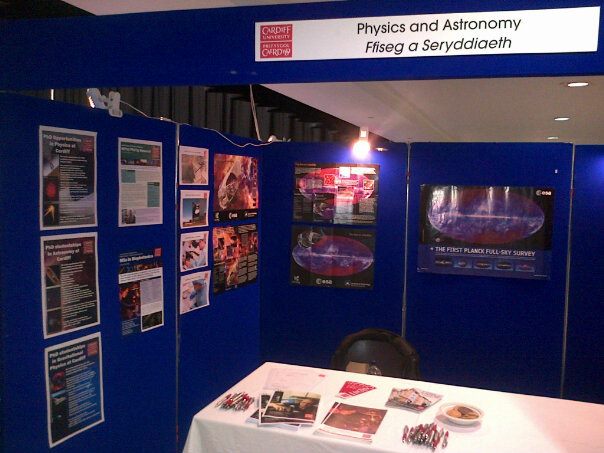
Today was the Postgraduate Open Day for Cardiff University, so I trooped off at lunchtime to man person the School of Physics & Astronomy stand in the Great Hall of the Students in the Students’ Union for the Subject Fair. It’s the first time I’ve ever been in the Great Hall, in fact, for no other reason than it’s for the students not the staff. Anyway, I have to say it didn’t look all that great, although at least it was warm. There’s no heating in my office right now, you see. And they provided coffee and biscuits.

Other than that it was just me, some leaflets and an uncountable infinity of Herschel Space Observatory souvenir pens sitting there for two hours. And there was lousy mobile coverage so I couldn’t even tweet. I got a bit bored, actually. I wish I’d taken my knitting. I did take a picture though…

It has to be said that a general Postgraduate Open Day like this isn’t a very effective method of recruiting postgraduate students, not in Physics and Astronomy at least. Most potential applicants come to apply by looking at web pages and/or listening to advice from people in the department where they are doing or did their first degree. People have already decided between Physics and, say, Astronomy and certainly between either of those and Sociology, so the idea of stalls competing for custom is a bit absurd.

Still, as Director of Postgraduate Studies I decided that it was good for Physics and Astronomy to show willing by maintaining a presence at such events, and if as a bonus we recruit even one promising PhD student then it’s probably worth the investment in time. The additional complication with this now is that I’m soon leaving to go to Sussex University, so I was tempted to tell visitors about opportunities there. I didn’t though. Mainly because I hardly spoke to anyone all afternoon…

The moral of this tale – if there is one – is that recruitment in different subjects is very different, so the “one size fits all” centralised approach isn’t always the right way to proceed. Schools and departments know their market better than anyone, so they need to be allowed to do their own thing at least part of the time.

I suspect this is an argument I’ll shortly be making elsewhere.

Physics and other things that make life worth living…

Posted in Biographical, Education, Jazz, Music, The Universe and Stuff with tags , , , , , on November 24, 2012 by telescoper

Yesterday we hosted a seminar by João Magueijo from Imperial College. It was a really interesting talk but the visit also a number of staff and students, including myself, the chance to chat to João about various things. In my case that primarily meant catching up on one another’s news, since we haven’t talked since early summer and a lot has happened since then. Then we had drinks, more drinks, dinner, drinks and then cocktails, finishing about 2am. A fairly standard night out with João, actually.

Among the topics discussed in the course of an increasingly drunken conversation was the fact that physicist Stephon Alexander had recently moved to Dartmouth College, a prestigious Ivy League institution in New Hampshire. I don’t know Stephon very well at all as I don’t really work in the same area as him. In fact, we’ve only ever met once – at a Cosmology School in Morocco (in 1996 or thereabouts); he was a graduate student and I was giving some lectures. On the left you can see a snap of him I took at that time. Can that really have been so long ago?

Anyway, I’ll resist the temptation to bemoan the passage of time and all that and get back to the point which is the connection that formed in my head between Stephon, yesterday’s post about the trials and tribulations facing prospective PhD students, and an older post of mine about  the importance of not forgetting to live a life while you do a PhD.

The point is that although there are many things that may deter or prevent an undergraduate from taking the plunge into graduate studies, one thing shouldn’t put you off and that is the belief that doing a PhD is like joining a monastery in that it requires you to give up a lot of other things and retreat from the outside world. Frankly, that’s bollocks. If I’m permitted to quote myself:

I had plenty of outside interests (including music, sport and nightlife)  and took time out regularly to indulge them. I didn’t – and still don’t – feel any guilt about doing that. I’m not a robot. And neither are you.

In other words, doing a PhD does not require you to give up the things that make life worth living. Actually, if you’re doing a physics PhD then physics itself should be one of the things that make life worth living for you, so I should rephrase that as “giving up any of the other things that make life worth living”.

Having a wide range of experiences and interests to draw on can even help with your research:

In fact, I can think of many times during my graduate studies when I was completely stuck on a problem – to the extent that it was seriously bothering me. On such occasions I learned to take a break. I often found that going for a walk, doing a crossword, or just trying to think about something else for a while, allowed me to return to the problem fresher and with new ideas. I think the brain gets into a rut if you try to make it work in one mode all the time.

I’d say that to be a good research student by no means requires you to be a monomaniac. And this is where Stephon comes in. As well as being a Professor of Theoretical Physics, Stephon is an extremely talented Jazz musician. He’s even had saxophone lessons from the great Ornette Coleman. I have to admit he has a few technical problems with his instrument in this clip, but I’m using him as an example here because I also love Jazz and, although I have a negligible amount of talent as a musician, have rudimentary knowledge of how to play the saxophone. In fact, I remember chatting to him in a bar in Casablanca way back in ’96 and music was the sole topic of conversation.

Anyway, in the following clip Stephon talks about how music actually helped him solve a research problem. It’s basically an extended riff on the opening notes of the John Coltrane classic Giant Steps which, incidentally, I posted about here.

Generational Guilt

Posted in Biographical, Education, Politics with tags , , , , , , on November 23, 2012 by telescoper

Exhausted near the end of an exceptionally busy week, I found myself taking a short break after a two-hour lecturing session when a student knocked at my door to ask for some advice about applying for PhDs. I was happy to oblige, of course, but after he’d gone it struck me how much tougher things are for today’s generation, compared with how easy it was for me.

I got a scholarship to the local grammar school (The Royal Grammar School in Newcastle upon Tyne) by passing the 11+ examination back in 1974. I got a good education that most pupils at the School had to pay for (or at least their parents did). I got good 0 and A levels, and then passed the post A-level examination to get me into Cambridge. Through contacts at school I got a job for nine months working for a British Gas research station in Cramlington, during which time I earned a nice wage. I went to Cambridge with a healthy bank balance on top of which I received a full maintenance grant. There were no tuition fees then either. When I graduated I was solvent and debt-free.

When I applied for PhDs I did so with no real idea about what research I might do. I wasn’t an outstanding undergraduate student and my personal statement was vagueness personified, but I got a place nonetheless. The stipend was modest, but one could live on it. I never had money worries as a PhD. Nor have I since. It all seems so simple, looking back.

Today’s students have no such luck. The Direct Grant system that paid my school fees was discontinued shortly after I benefited from it. I’m sure I wouldn’t have got into University had I gone to the local comprehensive. Then maintenance grants were discontinued and fees introduced (then rapidly increased from £1000 to first £3000 and then £9000). Graduates now are usually burdened with huge debts. Moreover, when students apply for postgraduate study are nowadays often expected to not only to know precisely what they’re going to do but also be outstandingly good

The pressure we put on graduates now is out of all proportion to what I experienced. The reason? There are more of them overall, so there are more with first-class degrees chasing PhD funding. Many students who are much better than I was at the same stage of my career won’t make it just because of the arithmetic. Many will be discouraged by the finances too. It’s tragic that talented young people should be denied the chance to fulfil their ambitions by not having wealthy parents.

I’m often impressed (and even inspired) by those students who show a determination to pursue academic ambitions despite all the difficulties, but at the same time I feel guilty that it was so much easier in my day. Mine is the generation that decided to transfer the cost of higher education onto students and their families. Mine is also the generation that wrecked the economy by living beyond our means for too long.

To all those young people whose ambitions are thwarted by circumstances beyond their control all I can say is I’m sorry we oldies stole your future.

Flying Visit

Posted in Biographical, Education, Politics, The Universe and Stuff with tags , , on November 15, 2012 by telescoper

I’m still at home at 10am on a weekday, which is unusual, but that’s because I’m soon going to be doing the familiar schlepp to Heathrow airport in order to get a flight to Copenhagen. The purpose of this little trip is to participate in a PhD examination at the Niels Bohr Institute. I’ve never taken part in a Thesis Defence in the Danish system before, although I’ve done many equivalent examinations elsewhere, so I’m quite looking forward to finding out how it works. Will it be much different from the system we have in the UK? Probably, as it is a much more public occasion. Will that necessarily make it better? I don’t know. I was reading the thesis last night, actually, and it’s very interesting which is another reason to look forward to the occasion. I might even get time for some shopping too.

Anyway, before going to the airport I am going to pop along to the local polling station. Today is the day for the Election of the Police and Crime Commissioner for the South Wales Police Area. I’m going to the polling station not because I have a burning desire to vote – the list of candidates is extremely uninspiring – but because I feel I should register a protest at this farcical waste of public money at what is supposed to be a time of austerity. The political class in this country has never been held in lower esteem than at present and the last thing we need is more politicians, helping themselves to six-figure salaries at taxpayers’ expense.  More politicians does not mean more democracy. We already have local council elections, Welsh Assembly elections, General (Parliamentary) Elections and European Parliament Elections. We don’t need any more! This Election is a complete waste of time and money.

I intend, therefore, to visit the polling station and, instead of putting a cross in a box, write a strongly (but politely) worded message voicing my opinion on the matter thus spoiling my ballot paper. It will be the first time I’ve ever done such a thing, but this is the first time we’ve had such a stupid election.