Following on from yesterday’s post about the “first light” images from the European Space Agency’s Euclid mission, here is a little video highlighting the brilliant work done by the instrument teams over the last month .
P.S. You can find some Irish press coverage of the first light images here.
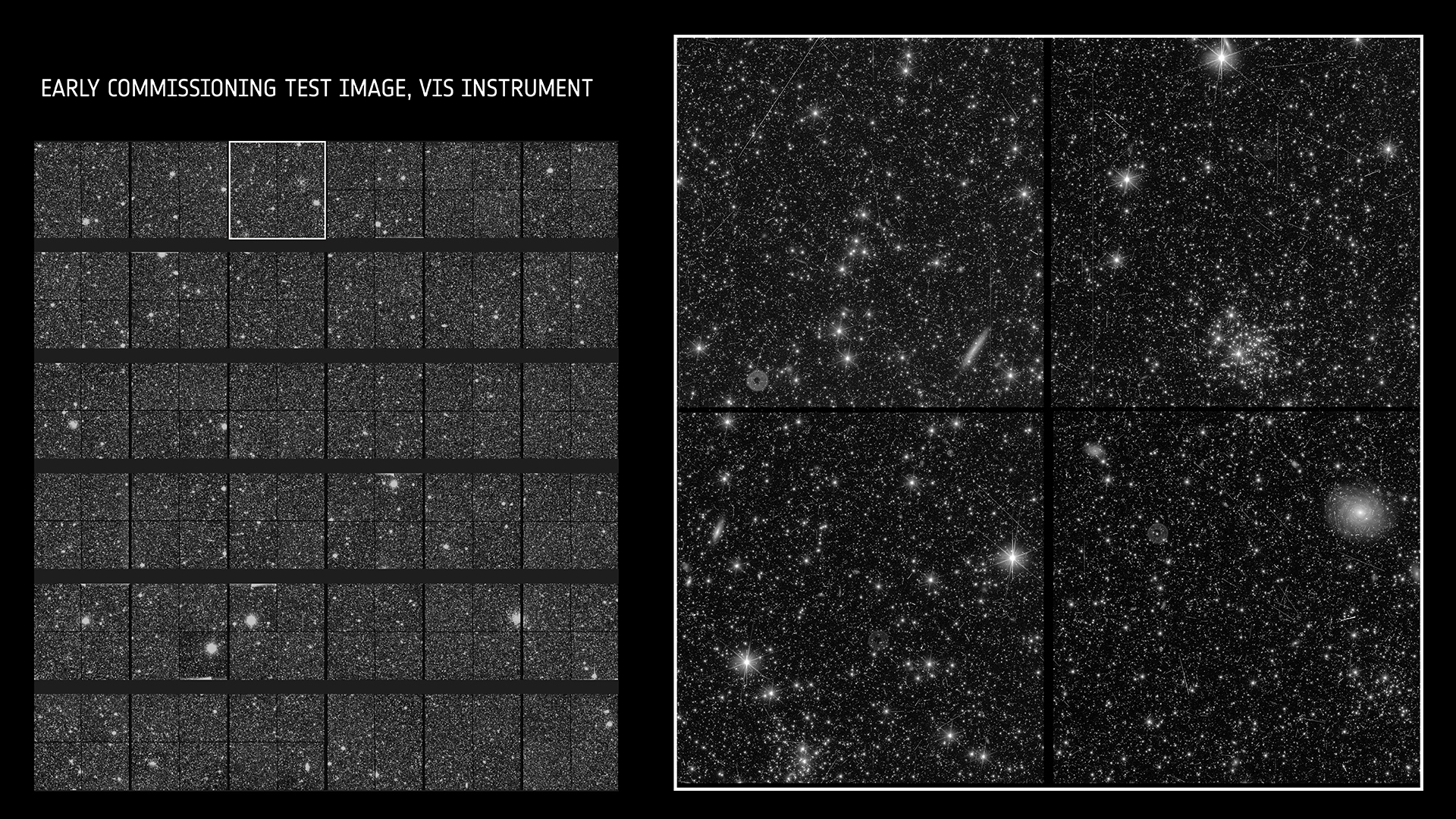
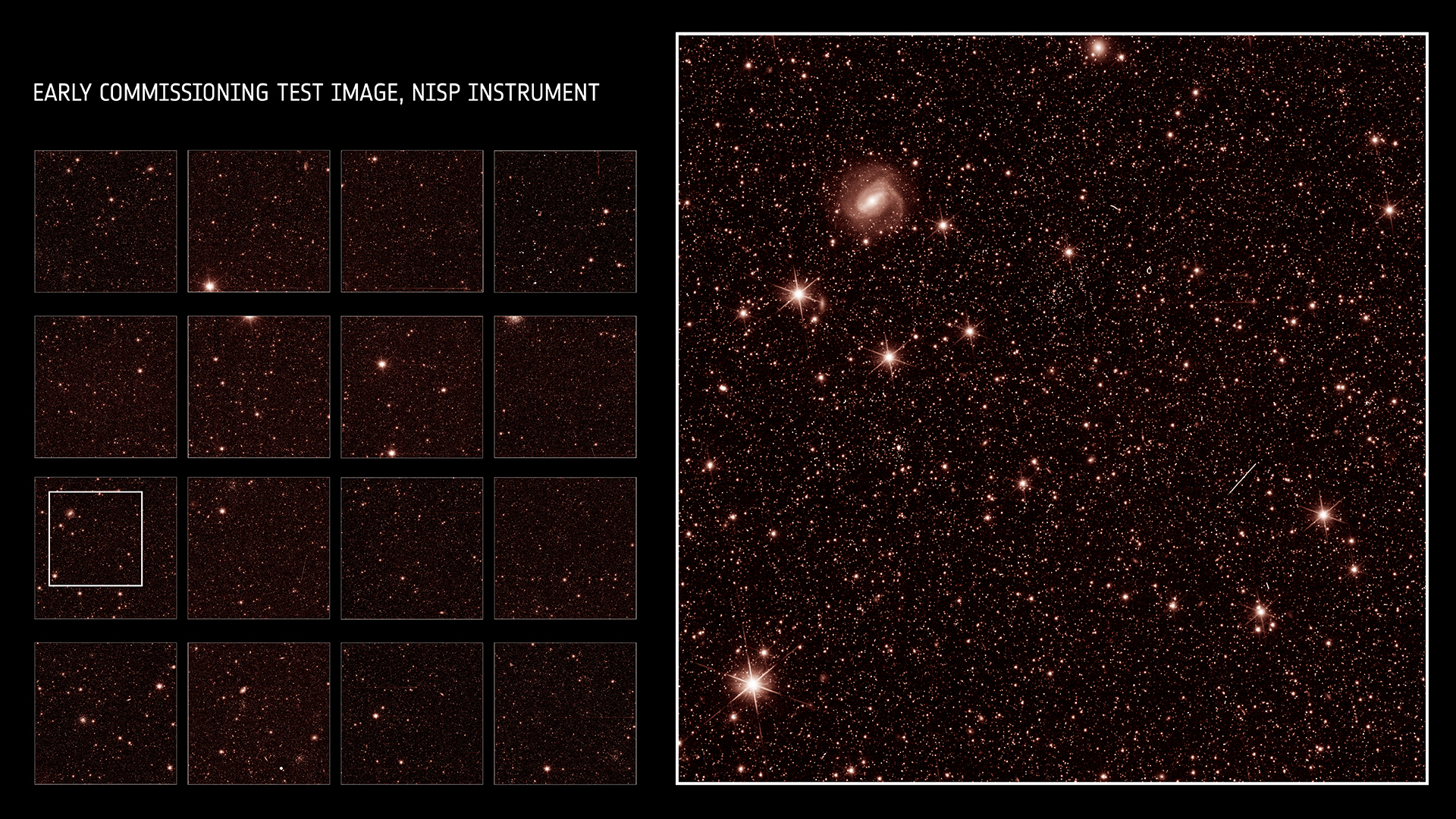
As I promised a couple of days ago, the “first light” images from the European Space Agency’s Euclid mission have now been released. You can find all the details here, but a summary is that these are “engineering” images, rather than part of the full survey to be undertaken by Euclid, and the commissioning of the instruments is not quite finished, but the telescope is now in focus and both instruments (the visual instrument, VIS, and the Near-Infrared Spectrometer & Photometer, NISP) are working well enough to show some preliminary results.
Anyway, here are the pictures released today, first from VIS:
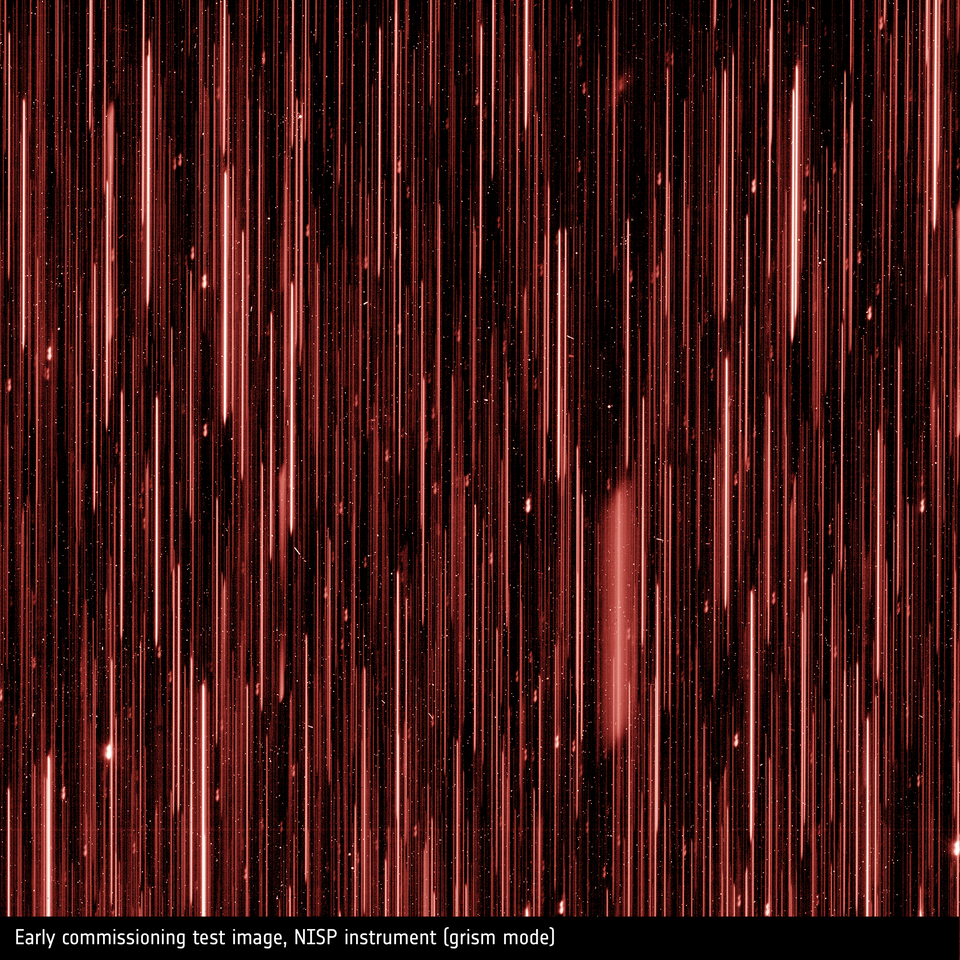
This final one, also from NISP, shows it working in grism mode, which allows the light from sources to be dispersed into a spectrum, enabling us to get much more information about the sources galaxies than a straightforward image would. The resulting images look a bit strange to the untrained eye – as the light from a point is spread out into a streak – but the result is wonderfully rich in information:
For more information – and some higher-resolution images – see the official Euclid press release here.
For myself, I’d just say these images are absolutely amazing given that they were taken during the commissioning phase and the instruments aren’t fully tweaked yet. Over the next few weeks, there will be a performance verification phase which will tell us how good Euclid will be at meeting its science goals. But so far it’s all looking very good indeed. I’ve only ever seen simulations of what would come out and it’s very exciting to see what the real thing looks like!
Hats off to the brilliant instrumentation experts who not only designed and built the kit but who have been working so hard on the commissioning. They’ve done so much in the month that has passed since the launch!
P.S. You can find here a nice explainer of some of the instrumental artefacts you might have spotted in the images above.
Here’s a little video update to accompany the news that, as of yesterday (28th July), the European Space Agency’s Euclid spacecraft has reached its orbit around L2, the second Lagrange Point of the Earth-Sun system:
More news is on the way. Commissioning of the instruments is now complete and the telescope is in focus. On Monday 31st July, ESA will release the first actual images from the Euclid telescope!
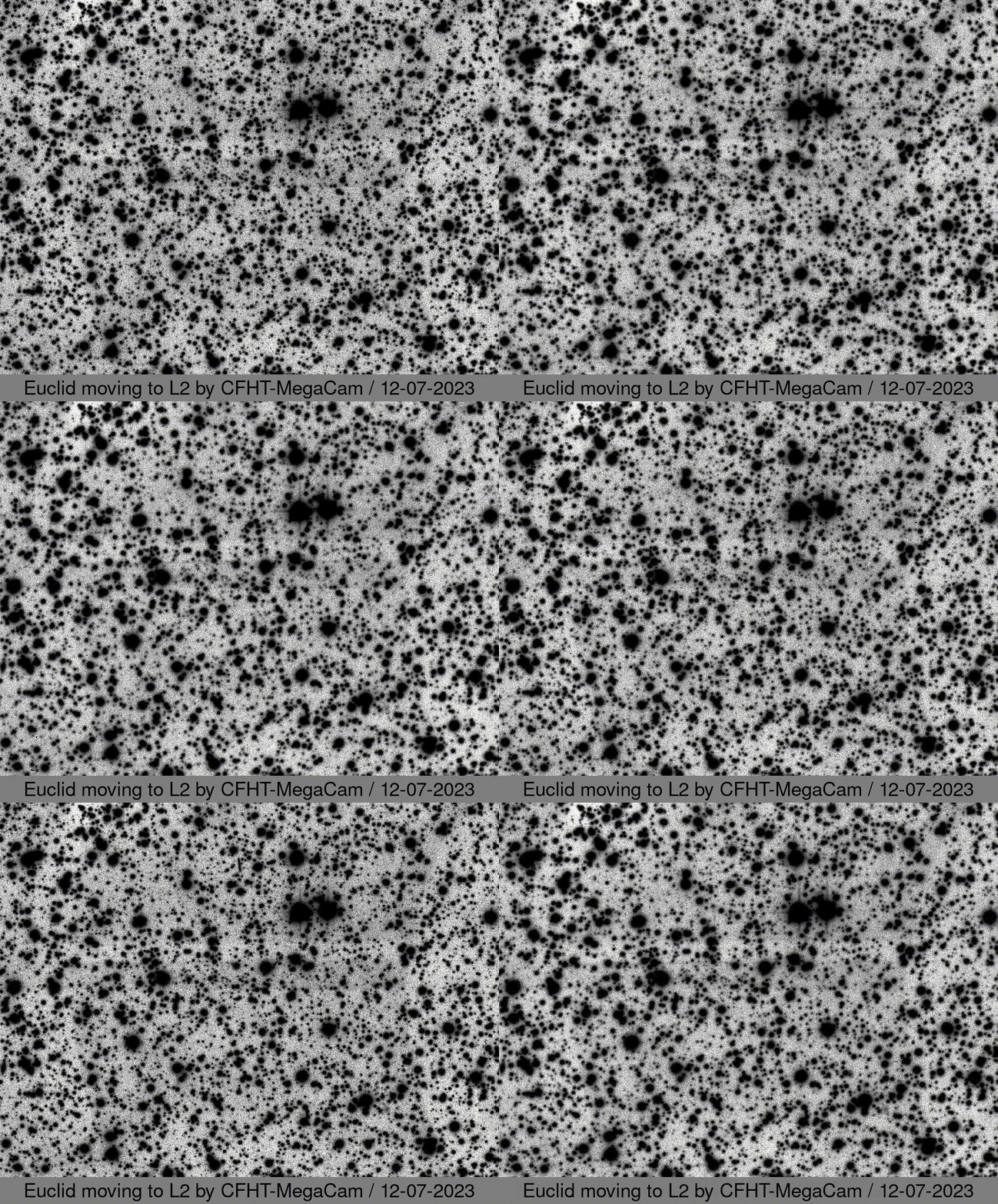
I saw this little movie on the ESA Update page for Euclid and couldn’t resist sharing it here. It’s a montage of images from the Canada-France Hawaii Telescope (CFHT); the object you see moving upwards in the centre of the frame is none other than the Euclid spacecraft, hurtling towards its destination at the 2nd Lagrange Point. You will see other moving objects. I’m not sure what they are but the field is in the ecliptic plane so they’re likely to be small solar system objects, probably asteroids.
Incidentally, people keep asking me for updates about Euclid. Although I am privy to the regular updates available to members of the Euclid Consortium, I am not allowed to publish anything on here that’s not already in the public domain nor would I want to, lest anyone think I would presume to speak on behalf of either ESA or the Euclid Consortium via the medium of a personal blog. You can follow the official updates here from people who actually understand everything that is going on!
I will just say that all the key steps so far – a critical orbit manoeuvre needed to get into the correct trajectory for L2, a temporary rotation of the spacecraft to allow it to heat up and to allow residual gas to evaporate, deployment of the high-gain antenna (essential to send data back to Earth), and the switching on of the two instruments (NISP and VIS) – have taken place in good order. There is however a long way to go before everything is tested, verified, calibrated and ready for action. It’s a very busy time for the engineers and instrumentalists; we just need to give them the time they need to work their technical magic!
I’ve been meaning to post about for some time about the use of telescopes all around the world that reside in observatories on lands previously and/or presently occupied by indigenous peoples. The creation of these astronomical facilities has been accompanied by neglect (and sometimes violent displacement) of tribal communities native to the land on which they now stand. Though we exploit native lands for science, the astronomical community makes little reference to the people who are directly impacted by the advancement of astronomy through colonialism of this sort.
I know I’m not alone in thinking that, at the very least as a community we should do much more to acknowledge our use of astronomical facilities built on land that in many cases was basically “stolen” by colonial settlers. There was a talk about this issue at the recent Euclid Consortium Meeting in Copenhagen, and it came up at the National Astronomy Meeting in Cardiff in the context of the broad issue of the decolonization of astronomy.
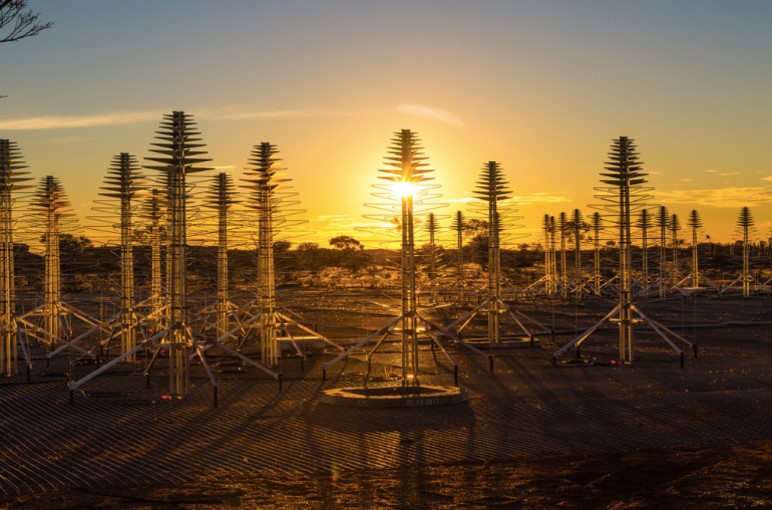
Anyway, just for a start I have included here a small gallery of images of modern astronomical observatories of various kinds, with captions giving the names not of the observatory, but of the indigenous peoples upon whose land it is built:
Maynooth University plugged these items in on the “Maynooth in the News” feed on its main webpage, along with many other items that show the University in a good light.
Conspicuous by its absence from that feed, however, is the biggest story surrounding Maynooth University in recent days, namely the appalling decision by the President to scrap elections to the Governing Authority of the University in favour of having representatives chosen only by the President. This is just one example of the increasingly intransigent and authoritarian management of the University. Can anyone justify the complete disenfranchisement of the staff of the University from the Governance of the university? Or that an Executive body should select the Board to which it is supposed to be accountable?
I know I’m not the only person employed by this University who thinks this decision is a terrible one – my Union, IFUT is strongly opposed- but it has been already been imposed and now we have no say. At least you can read about, e.g. here in the Times Higher.
One story you can’t read about however concerns the outcomes of Maynooth University’s “Staff Climate and Culture Survey” which was carried out in 2022 with the promise made to participants that results would be published in early 2023. No such results were ever communicated to staff and all mention of this survey has been wiped off the University’s web pages. I don’t know why this happened, but I venture to suggest that if the results had been good the Maynooth publicity team would not have hesitated to publish them.
Since the Management of Maynooth University has chosen to close off any internal channels by which academic and other staff can communicate their views, it seems that the only means of communication open to us is via the external media. Perhaps the Times Higher will run a story on the Curious Case of the Missing Staff Survey?
The Euclid spacecraft launched over a week ago so so here’s a short video explaining its trajectory and what it will do over the next weeks and months.
Euclid being launched on a Falcon 9 rocket on 1st July 2023
The media activity surrounding the launch of Euclid on Saturday continues. Yesterday a piece by yours truly appeared on RTÉ Brainstorm with the title All you need to know about Euclid’s six year space mission. It subsequently got picked up by the main RTÉ News website on their News Lens panel, although it’s in second place after a story about a hot-dog eating competition:
P.S. There is also piece in siliconrepublic based on an interview with me here.
Today’s the day! Weather permitting, of course, all eyes will be on Cape Canaveral for the launch of the Euclid satellite later this afternoon (as reckoned in Ireland). You can watch the launch on YouTube via the following stream (but it won’t start until 15.30 Irish Time; 16.30 CEST):
The Key Events to look for in local time are:
16:12 Euclid launch on SpaceX Falcon 9 16:53 Separation of Euclid from Falcon 9 16:57 Earliest expected time to establish communication with Euclid
After that, the mission is handed over to the ESA Space Operations Centre in Darmstadt, Germany as it sets out for the Sun-Earth Lagrange point L2. Approximately four weeks after launch, Euclid will enter in orbit around this point, which is located at 1.5 million km from Earth, in the opposite direction from the Sun. Once in orbit, mission operators will start verifying all the functions of the telescope. During this, residual water is outgassed, after which Euclid’s instruments will be turned on. Between one and three months after launch, Euclid will go through several calibrations and scientific performance tests and get ready for science. The telescope begins its early phase of the survey of the Universe three months after launch. There will be a preliminary release of a small amount of data in December 2024, but the first full data release – DR1 – will take about two years.
UPDATE: All critical stages of the launch passed satisfactorily, and contact has been established with the ground control. Euclid is now on its way to L2. Bon Voyage, Euclid!
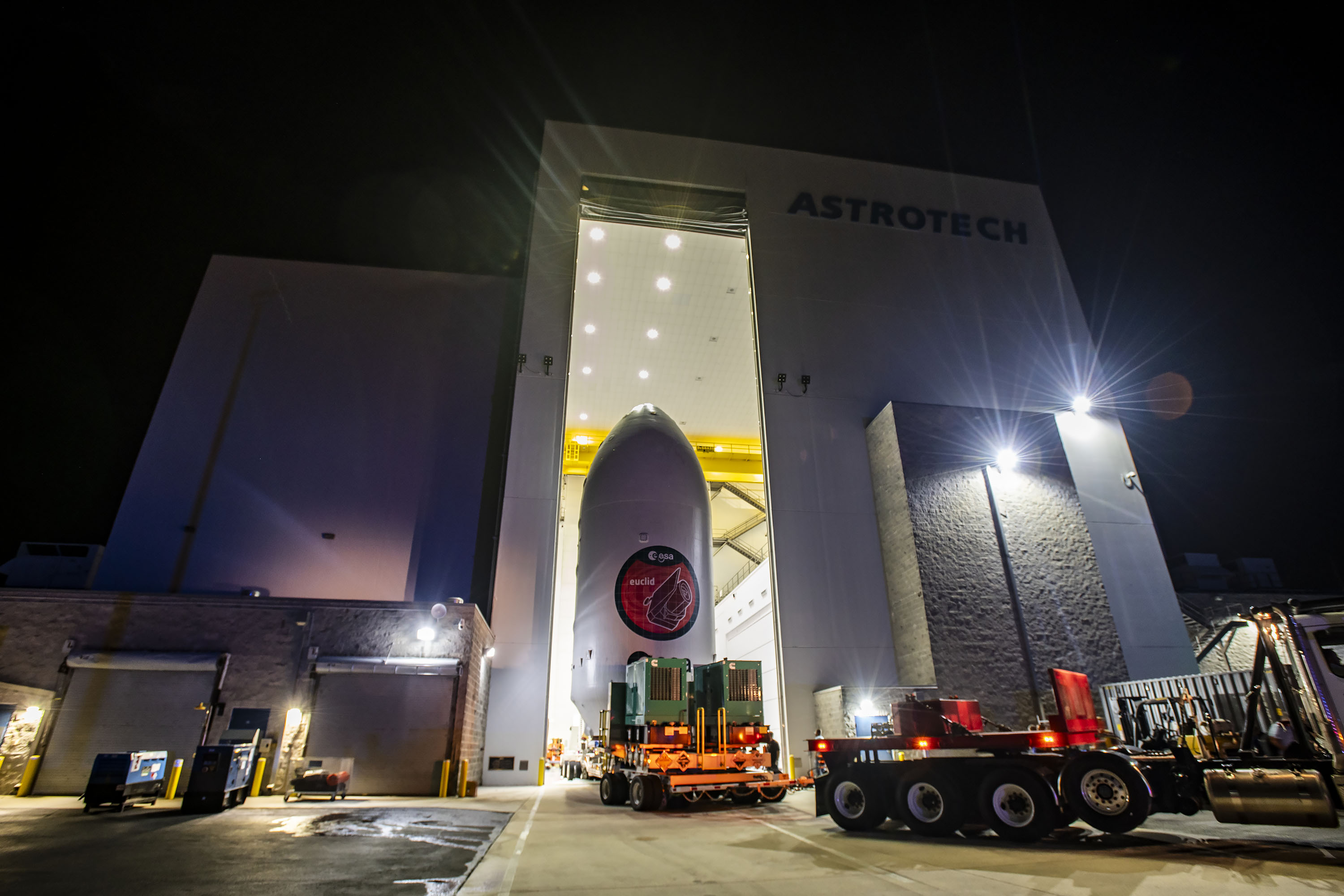
I’ve spent a sizeable chunk of the last two days answering press enquiries concerning the Euclid mission, due to be launch about 24 hours from now. Here is a picture of Euclid in the Falcon 9 fairing, getting ready to be moved to the launch facility. It’s all getting very real!
After talking with their researcher yesterday, this morning I did a short interview on Morning Ireland, which is on RTÉ Radio 1. It was shorter than I imagined because the previous item – about the ongoing ructions at RTÉ over various financial scandals – understandably overran quite a bit. The presenter, Rachel English, was very nice though and I think it went fairly well. I did another short interview on Newstalk Radio on a programme called Hard Shoulder, which took place at 5.48pm. I also spoke to a journalist from the Sunday Times Irish Edition, who I think will run a story on Sunday.
Anyway, the purpose of this media stuff is not to try to grab headlines – my involvement in Euclid is very small, really – but to generate some interest in the hope that Ireland takes a more active role in future space missions. I don’t know whether it will work, but I hope it does, and I feel obliged to try although it has made for a very busy day indeed!
The views presented here are personal and not necessarily those of my employer (or anyone else for that matter).
Feel free to comment on any of the posts on this blog but comments may be moderated; anonymous comments and any considered by me to be vexatious and/or abusive and/or defamatory will not be accepted. I do not necessarily endorse, support, sanction, encourage, verify or agree with the opinions or statements of any information or other content in the comments on this site and do not in any way guarantee their accuracy or reliability.