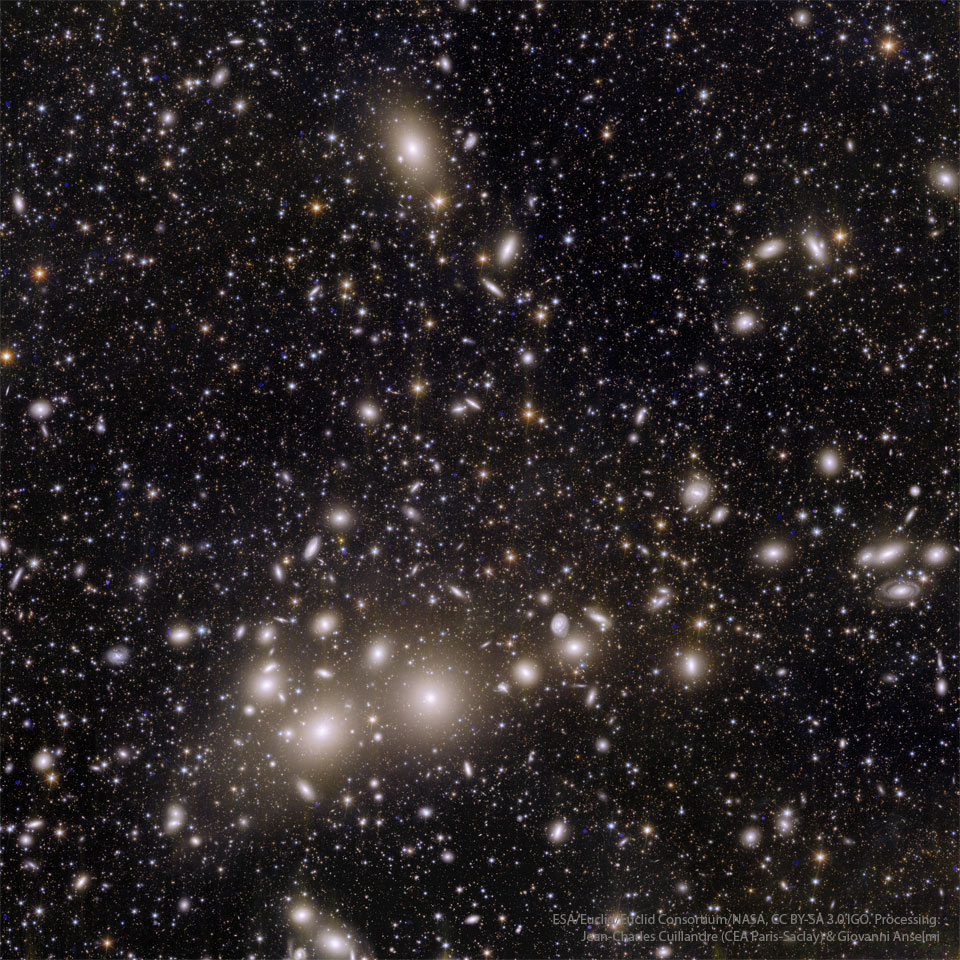
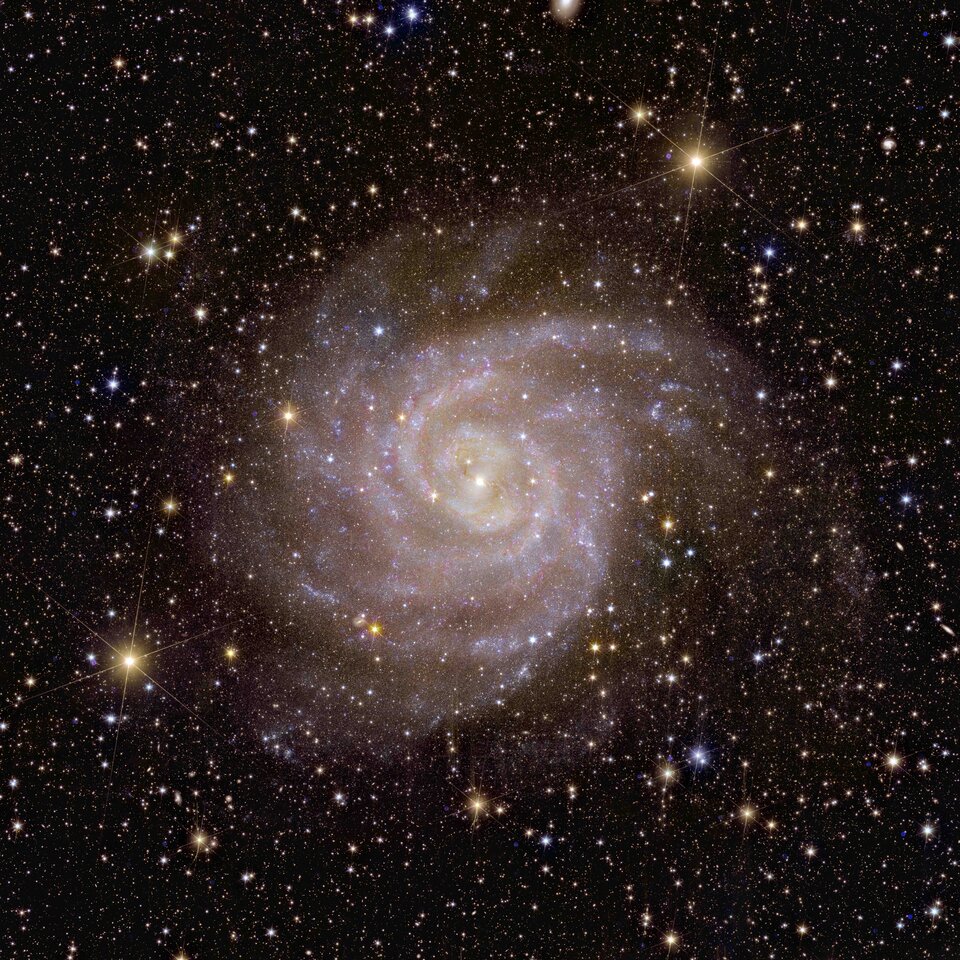
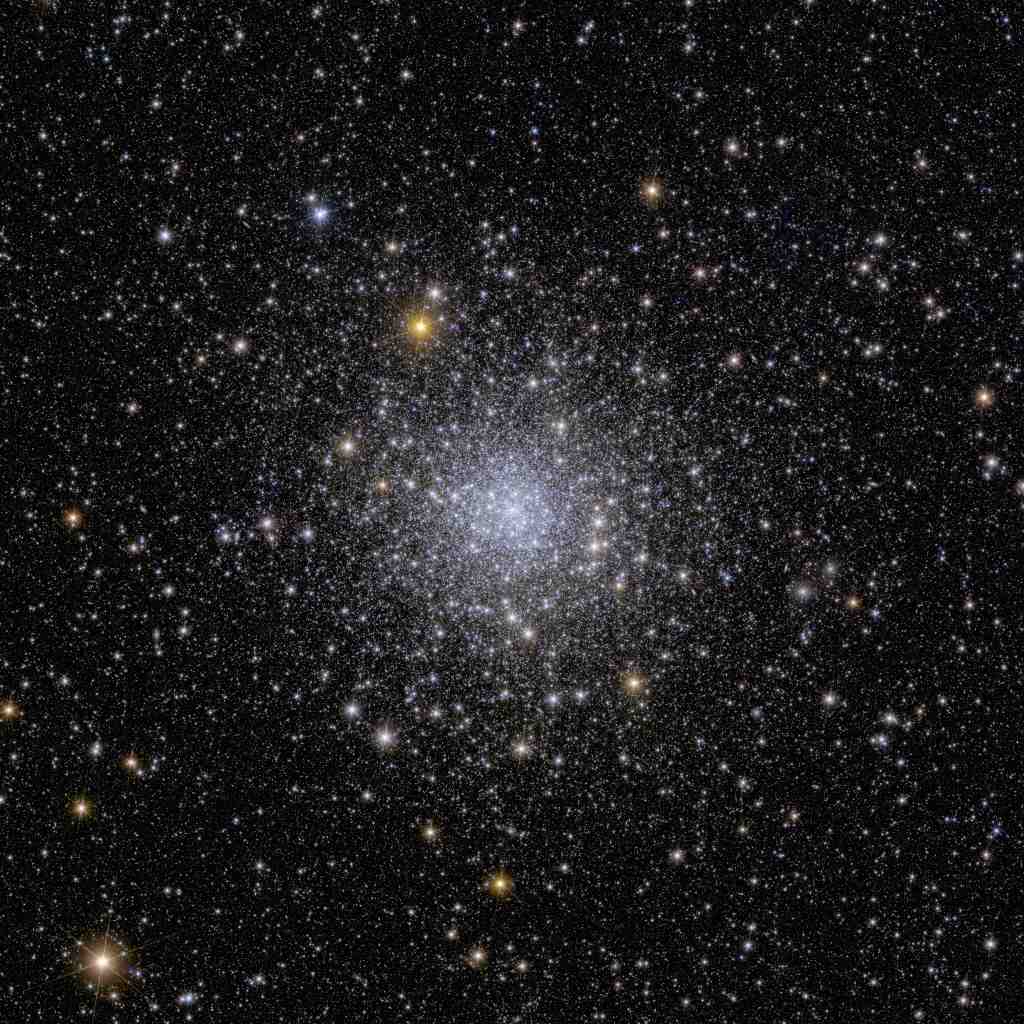
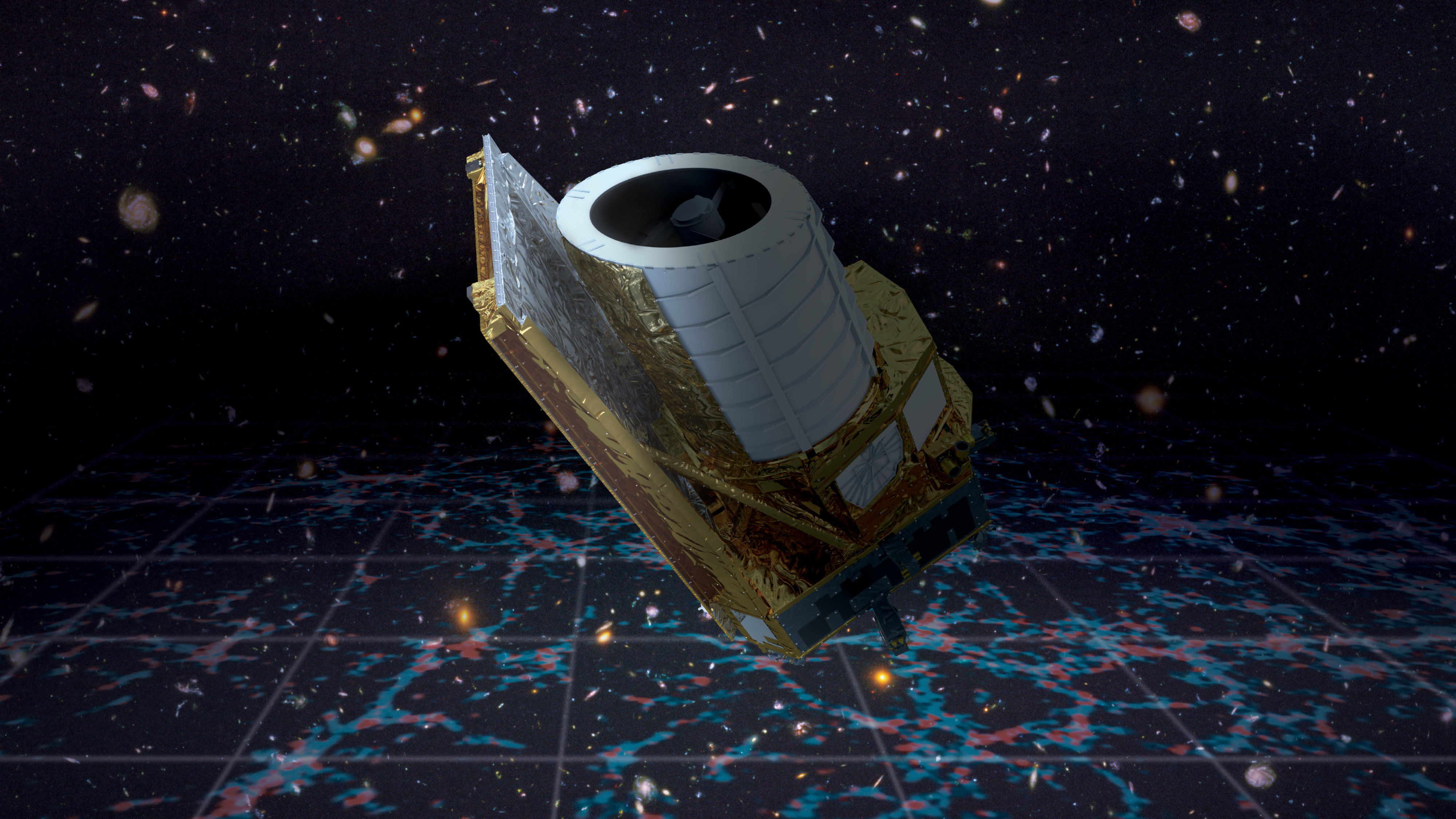
Another quick update about the release of the Early Release Observations (EROs) from Euclid, due to take place next Tuesday 7th November. For one thing, here is a little taster video.
Five images will be released on Tuesday. I know what the Early Release Observations are but you will have to wait until Tuesday to find out. If I told you now I’d have to kill you…
Just a quick post to give advanced notice that, gremlins in the pointing system having been dispelled, the first actual science images from European Space Agency’s Euclid mission will be released on Tuesday 7th November at 14.00 Central European (not Summer) Time, CET. These are called the Early Release Observations (EROs) – they won’t be part of the full survey, but are just to demonstrate the performance of the telescope and detectors.
You can watch the press conference on the new ESA Web TV channel. I’ll post more about the EROs after they become public, but not before.
Having settled in to my new apartment on the Gran Via I’ve got time for a another quick update on the European Space Agency’s Euclid mission. For full details about what follows you can see here. Everything I mention here is already in the public domain, so I am not disclosing any secrets!
The last update I posted contained some frustrating and potentially worrisome news: the Performance Verification (PV) phase of the mission had to be put on hold in order to troubleshoot an intermittent problem with the Fine Guidance Sensor (FGS), which is supposed to help to maintain correct pointing of the telescope. This wasn’t working correctly as demonstrated vividly by the following image:
Obviously the survey couldn’t proceed without accurate control of the pointing of the telescope so it was urgently necessary to find out what was going wrong and fix it. It turns out that the software was getting confused by the flashes caused by cosmic ray protons hitting the detectors, think they were the gude stars it was supposed to be steering by. After identifying the problem, new software was written and uploaded to the spacecraft.
I wasn’t sure how this had gone until I saw via an internal communication that the PV phase had restarted. That announcement would not have been made had the upgrade not worked and sure enough it has now been made public that all is well. Congratulations to the instrumentation and software teams for this success. They’ve been working phenomenally hard on this.
There was an additional problem with stray light in the telescope that I have also mentioned before. That was only an issue for specific orientations of the telescope and has been dealt with by simply redesigning the survey a little to minimize the occurrence of the effect.
So the gremlins have been dispelled, and we go on into the PV phase after a delay of about a month. The survey is due to last 6 year so this hiccup is not a big deal really. We can in fact anticipate some early science results from this phase in a month or so, although they will not be part of the full survey which will start after the PV phase is complete, after a few months.
Time for a quick update on the European Space Agency’s Euclid mission. For full details about what follows you can see here. Everything I mention here is already in the public domain, so I am not disclosing any secrets!
The last update I posted mentioned that Euclid had moved into what is called the Performance Verification phase of its mission. That has now been put on hold in order to troubleshoot an intermittent problem with the Fine Guidance Sensor (FGS) which helps to maintain correct pointing of the telescope. This issue can probably be fixed by software updates, but these will have to be tested, hence the pause. This is rather irksome, but the instrument teams are confident they can find a solution soon.
Anyway, while we’re waiting, here is a video from Launch Pad Astronomy explaining about the mission. It was actually released about six days ago but I didn’t have time to post it until now. About 15 minutes long, it’s a big longer than previous official Euclid videos I’ve posted, but I think it’s very informative:
Oh, I almost forgot to mention that I’ll be talking a little bit about Euclid among other things at this event on 6th September.
ESA/Euclid/Euclid Consortium/NASA. Background galaxies: NASA, ESA, and S. Beckwith (STScI) and the HUDF Team.
Since I’ve been working today on stuff related to ESA’s Euclid mission, I thought I would post a brief update on the mission status before I go home. The official channel to which I refer you for full updates is here.
A message was sent out on Saturday to member of the Euclid Consortium indicating that the commissioning phase of the Euclid satellite was essentially completed, although with some issues still to be fixed. In particular, as has previously been reported, there is an issue with stray light in the VIS instrument, which will have to be coped with. To prevent stray sunlight getting onto VIS detectors, Euclid will be configured to operate at a range of specific angles with respect to the Sun. This means that the survey strategy will have to be adapted in order to be as optimal as possible with this new constraint.
The next phase after the commissioning phase is called performance verification, for which control switches over to the science ground segment. The operations team will then operate the spacecraft in the same way as required for the full survey in order to assess the performance of the instruments and obtain calibration data ahead of the start of the full survey.
Time for another nice little video explainer about Euclid. This one is largely about the role of large computer simulations (particularly the Flagship simulation) in preparing for (and in future in analyzing) the Euclid survey.
The full blurb accompanying the video is appended here:
ESA’s Euclid mission will create a 3D-map of the Universe that scientists will use to measure the properties of dark energy and dark matter and uncover the nature of these mysterious components. The map will contain a vast amount of data, it will cover more than a third of the sky and its third dimension will represent time spanning 10 billion years of cosmic history.
But dealing with the huge and detailed set of novel data that Euclid observations will produce is not an easy task. To prepare for this, scientists in the Euclid Consortium have developed one of the most accurate and comprehensive computer simulations of the large-scale structure of the Universe ever produced. They named this the Euclid Flagship simulation.
Running on large banks of advanced processors, computer simulations provide a unique laboratory to model the formation and evolution of large-scale structures in the Universe, such as galaxies, galaxy clusters, and the filamentary cosmic web they form. These state-of-the-art computational techniques allow astrophysicists to trace the motion and behavior of an extremely large number of dark-matter particles over cosmological volumes under the influence of their own gravitational pull. They replicate how and where galaxies form and grow, and are used to predict their distribution across the celestial sphere.
Explore the Euclid Flagship simulation in this video and get a sneak preview of the structure of the dark Universe, as we currently model it. New insights will be brought to you by the Euclid mission in the coming years.
Following on from yesterday’s post about the “first light” images from the European Space Agency’s Euclid mission, here is a little video highlighting the brilliant work done by the instrument teams over the last month .
P.S. You can find some Irish press coverage of the first light images here.
As I promised a couple of days ago, the “first light” images from the European Space Agency’s Euclid mission have now been released. You can find all the details here, but a summary is that these are “engineering” images, rather than part of the full survey to be undertaken by Euclid, and the commissioning of the instruments is not quite finished, but the telescope is now in focus and both instruments (the visual instrument, VIS, and the Near-Infrared Spectrometer & Photometer, NISP) are working well enough to show some preliminary results.
Anyway, here are the pictures released today, first from VIS:
This final one, also from NISP, shows it working in grism mode, which allows the light from sources to be dispersed into a spectrum, enabling us to get much more information about the sources galaxies than a straightforward image would. The resulting images look a bit strange to the untrained eye – as the light from a point is spread out into a streak – but the result is wonderfully rich in information:
For more information – and some higher-resolution images – see the official Euclid press release here.
For myself, I’d just say these images are absolutely amazing given that they were taken during the commissioning phase and the instruments aren’t fully tweaked yet. Over the next few weeks, there will be a performance verification phase which will tell us how good Euclid will be at meeting its science goals. But so far it’s all looking very good indeed. I’ve only ever seen simulations of what would come out and it’s very exciting to see what the real thing looks like!
Hats off to the brilliant instrumentation experts who not only designed and built the kit but who have been working so hard on the commissioning. They’ve done so much in the month that has passed since the launch!
P.S. You can find here a nice explainer of some of the instrumental artefacts you might have spotted in the images above.
Here’s a little video update to accompany the news that, as of yesterday (28th July), the European Space Agency’s Euclid spacecraft has reached its orbit around L2, the second Lagrange Point of the Earth-Sun system:
More news is on the way. Commissioning of the instruments is now complete and the telescope is in focus. On Monday 31st July, ESA will release the first actual images from the Euclid telescope!
I saw this little movie on the ESA Update page for Euclid and couldn’t resist sharing it here. It’s a montage of images from the Canada-France Hawaii Telescope (CFHT); the object you see moving upwards in the centre of the frame is none other than the Euclid spacecraft, hurtling towards its destination at the 2nd Lagrange Point. You will see other moving objects. I’m not sure what they are but the field is in the ecliptic plane so they’re likely to be small solar system objects, probably asteroids.
Incidentally, people keep asking me for updates about Euclid. Although I am privy to the regular updates available to members of the Euclid Consortium, I am not allowed to publish anything on here that’s not already in the public domain nor would I want to, lest anyone think I would presume to speak on behalf of either ESA or the Euclid Consortium via the medium of a personal blog. You can follow the official updates here from people who actually understand everything that is going on!
I will just say that all the key steps so far – a critical orbit manoeuvre needed to get into the correct trajectory for L2, a temporary rotation of the spacecraft to allow it to heat up and to allow residual gas to evaporate, deployment of the high-gain antenna (essential to send data back to Earth), and the switching on of the two instruments (NISP and VIS) – have taken place in good order. There is however a long way to go before everything is tested, verified, calibrated and ready for action. It’s a very busy time for the engineers and instrumentalists; we just need to give them the time they need to work their technical magic!
The views presented here are personal and not necessarily those of my employer (or anyone else for that matter).
Feel free to comment on any of the posts on this blog but comments may be moderated; anonymous comments and any considered by me to be vexatious and/or abusive and/or defamatory will not be accepted. I do not necessarily endorse, support, sanction, encourage, verify or agree with the opinions or statements of any information or other content in the comments on this site and do not in any way guarantee their accuracy or reliability.