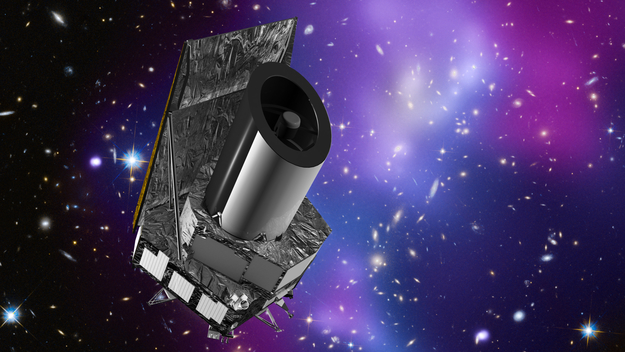
With just three days to go before the scheduled launch of the Euclid spacecraft on Saturday 1st July 2023, at 1612 Irish Time (GMT+1), the Education and Public Outreach (EPO) team have been continuing to ramp up its social media activity and the second YouTube video has now “dropped” (as you young people say).
This was filmed at Thales Alenia Space in Cannes, France, as members of the Euclid consortium from around the world gathered in anticipation to see the fully-assembled Euclid telescope for the first time as it underwent final tests before its journey to the launch site in Florida.
With the scheduled launch of ESA’s Euclid mission coming up this weekend, it is perhaps topical to share the document written almost 12 years ago that outlines the design concepts and describes the detailed scientific case. It’s a compendious piece, running to well over 100 pages but, as with virtually everything in astrophysics, the full Euclid Definition Study Report can be found on arXiv.
Here is the abstract:
Euclid is a space-based survey mission from the European Space Agency designed to understand the origin of the Universe’s accelerating expansion. It will use cosmological probes to investigate the nature of dark energy, dark matter and gravity by tracking their observational signatures on the geometry of the universe and on the cosmic history of structure formation. The mission is optimised for two independent primary cosmological probes: Weak gravitational Lensing (WL) and Baryonic Acoustic Oscillations (BAO). The Euclid payload consists of a 1.2 m Korsch telescope designed to provide a large field of view. It carries two instruments with a common field-of-view of ~0.54 deg2: the visual imager (VIS) and the near infrared instrument (NISP) which contains a slitless spectrometer and a three bands photometer. The Euclid wide survey will cover 15,000 deg2 of the extragalactic sky and is complemented by two 20 deg2 deep fields. For WL, Euclid measures the shapes of 30-40 resolved galaxies per arcmin2 in one broad visible R+I+Z band (550-920 nm). The photometric redshifts for these galaxies reach a precision of dz/(1+z) < 0.05. They are derived from three additional Euclid NIR bands (Y, J, H in the range 0.92-2.0 micron), complemented by ground based photometry in visible bands derived from public data or through engaged collaborations. The BAO are determined from a spectroscopic survey with a redshift accuracy dz/(1+z) =0.001. The slitless spectrometer, with spectral resolution ~250, predominantly detects Ha emission line galaxies. Euclid is a Medium Class mission of the ESA Cosmic Vision 2015-2025 programme, with a foreseen launch date in 2019. This report (also known as the Euclid Red Book) describes the outcome of the Phase A study.
arXiv:1110.3193
Euclid was formally adopted as an ESA M Class mission in June 2012. I’ve added the emphasis to the penultimate sentence to draw your attention to the fact that the launch of Euclid is about four years late.
With less than a week to go before the scheduled launch of the Euclid spacecraft on Saturday 1st July 2023, at 1612 Irish Time (GMT+1), the Education and Public Outreach (EPO) team has been ramping up its social media activity. They’ve even got a blog! Anyway here is a nice video featuring many members of the Euclid Consortium – some of whom gave presentations at last week’s conference – talking about Euclid. The sense of enthusiasm shines through, I think. I will be sharing further videos when they appear.
So here I am then, back in Maynooth. I had a relatively stress-free trip back, although my plane was a bit late and I had to run through Dublin Airport to catch the Hopper Bus I was booked on. Made it though.
The first thing I want to do is to thank the organizers for what was a wonderful event. I wasn’t able to attend the Euclid Consortium meeting in Oslo last year, largely because it was earlier in the year, in April (i.e. term-time) and I had teaching responsibilities. I gather it was a rather gloomy occasion because there was no concrete plan for the launch of Euclid thanks to the Russian war against Ukraine. I guess few would have predicted then that the 2023 meeting would be just a week or so before a launch on SpaceX!
I have to say the atmosphere was also helped by the excellent weather and very fine catering. The conference dinner was held in the Banqueting Hall, on the first floor of the Hans Christian Anderson Castle which stands at one of the entrances to the famous Tivoli Gardens, a few minutes from the conference venue.
Finally, one other memory that will stay with me for a while. It turned out that the week of the conference coincided with high-school graduation celebrations in Copenhagen, so every day we encountered lots of exuberant and largely inebriated teenagers around wearing funny hats and generally going a bit berserk. They made quite a lot of noise in the evenings, but it was all harmless. You’re only young once!
Having not been at an in-person conference for over four years, it was great to see some new faces and catch up with some people I haven’t seen for a long time. It was especially nice to talk to a couple of members of the Editorial Board of the Open Journal of Astrophysics. It was also nice to talk to some authors. Talking of which, here is Nicolas Tessore delivering a plenary presentation featuring work from one of the papers he has published with OJAp:
Anyway, I was up a stupid o’clock to catch my flight this morning so I think I’ll have a bit of rest and hope for the rain to stop so I can do some shopping.
It was officially announced at the Euclid Consortium Meeting in Copenhagen this morning that I have been appointed to the role of Chair of the Euclid Consortium Diversity Committee (ECDC). This has been in the pipeline for a while, but I have refrained from saying anything publicly until the appointment was endorsed by the Euclid Consortium Lead (ECL) and Euclid Consortium Board (ECB) which has now happened.
The previous Chair, Prof. Mathilde Jauzac, is stepping down because her term on the ECDC has come to an end. I’ve been a member of the ECDC for three years during which time Mathilde has done a brilliant job as Chair and she’ll be a very difficult act to follow in this role. There was a standing ovation in the room this morning when Mathilde finished delivering her final ECDC report. It will be down to me to deliver next year’s report, at the 2024 Euclid Consortium Meeting, which will be in Rome.
Instead of trying to describe the role and activities of the ECDC generally, I will direct you to the information given on the brand new Euclid Consortium website which is a one-stop shop for everything to do with Euclid. You can find specific information about Equity, Diversity and Conduct there and/or on the ECDC’s own public website here from which I’ve taken a screengrab of the nice banner:
Just for information, the Euclid Consortium has about 2700 members so it really is a very large organization, and it is the aim of the ECDC to encourage a positive and inclusive environment within it for the benefit of everyone in it.
I’m looking forward to this role for the next year. I have only one year left of my term left on the ECDC so I will almost certainly be Chair for one year only. As regular readers of this blog – both of them – will know, I am on sabbatical next year which means I should have time to take on this responsibility, which I wouldn’t be able to do if I had my full teaching and admin load.
Quick update from the Euclid Consortium confirming that the launch will take place on Saturday 1st July 2023, at 1612 Irish Time (GMT+1):
If for some reason (such as weather) the launch cannot take place at 11.12 precisely it will be delayed for 24 hours and then launched the next day, 2nd July, at the same time. I’m told that thunderstorms are quite common at Cape Canaveral at this time of year so there may well be such a delay.
P.S. When the Euclid mission was accepted by ESA, over a decade ago, the launch date was envisaged to be in 2020, so it is about three years late.
I made it to the conference venue (CPH Conference) for this year’s Euclid Consortium Meeting, which is 5 minutes walk from my hotel.
One thing that confused me when I looked at the programme last night was that all the rooms in the conference centre are named after locations in and around the city, e.g. Kastrup, Amager, Vesterbro, etc. For a while I thought the delegates would be running around Copenhagen to find their parallel sessions! Then I realized these were just names of meeting rooms…
The full programme doesn’t start until tomorrow but today I attended a couple of sessions aimed at early career researchers, not because I identify myself as such but because I wanted to listen to questions they asked and the advice given to them, much of which was very sound.
I’m looking forward to tomorrow, especially the plenaries, but first: dinner.
With the launch of the Euclid spacecraft due next month, and the last Euclid Consortium meeting before the launch coming up in just over a week, I thought I’d share another one of the nice little taster videos prepared by the European Space Agency:
The Euclid Mission has long been “sold” as a mission to probe the nature of Dark Energy in much the same way that the Large Hardon Collider was often portrayed as an experiment designed to find the Higgs boson. But as this video makes clear, testing theories of dark energy is just one of the tasks Euclid will undertake, and it may well be the case that in years to come the mission is remembered for something other than dark energy. On the other hand, big science like this needs big money, and making the specific case for a single big ticket item is an easier way to persuade funding agencies to cough up the dosh than for a general “let’s do a lot of things we’re sure we’ll fin something” approach. These thoughts triggered a memory of an old post of mine about Alfred Hitchcock so, with apologies for repeating something I have blogged about before, here’s an updated version.
Unpick the plot of any thriller or suspense movie and the chances are that somewhere within it you will find lurking at least one MacGuffin. This might be a tangible thing, such the eponymous sculpture of a Falcon in the archetypal noir classic The Maltese Falcon or it may be rather nebulous, like the “top secret plans” in Hitchcock’s The Thirty Nine Steps. Its true character may be never fully revealed, such as in the case of the glowing contents of the briefcase in Pulp Fiction, which is a classic example of the “undisclosed object” type of MacGuffin, or it may be scarily obvious, like a doomsday machine or some other “Big Dumb Object” you might find in a science fiction thriller. It may even not be a real thing at all. It could be an event or an idea or even something that doesn’t exist in any real sense at all, such the fictitious decoy character George Kaplan in North by Northwest. In fact North by North West is an example of a movie with more than one MacGuffin. Its convoluted plot involves espionage and the smuggling of what is only cursorily described as “government secrets”. These are the main MacGuffin; George Kaplan is a sort of sub-MacGuffin. But although this is behind the whole story, it is the emerging romance, accidental betrayal and frantic rescue involving the lead characters played by Cary Grant and Eve Marie Saint that really engages the characters and the audience as the film gathers pace. The MacGuffin is a trigger, but it soon fades into the background as other factors take over.
Whatever it is real or is not, the MacGuffin is the thing responsible for kick-starting the plot. It makes the characters embark upon the course of action they take as the tale begins to unfold. This plot device was particularly beloved by Alfred Hitchcock (who was responsible for introducing the word to the film industry). Hitchcock was however always at pains to ensure that the MacGuffin never played as an important a role in the mind of the audience as it did for the protagonists. As the plot twists and turns – as it usually does in such films – and its own momentum carries the story forward, the importance of the MacGuffin tends to fade, and by the end we have usually often forgotten all about it. Hitchcock’s movies rarely bother to explain their MacGuffin(s) in much detail and they often confuse the issue even further by mixing genuine MacGuffins with mere red herrings.
Here is the man himself explaining the concept at the beginning of this clip. (The rest of the interview is also enjoyable, convering such diverse topics as laxatives, ravens and nudity..)
There’s nothing particular new about the idea of a MacGuffin. I suppose the ultimate example is the Holy Grail in the tales of King Arthur and the Knights of the Round Table and, much more recently, the Da Vinci Code. The original Grail itself is basically a peg on which to hang a series of otherwise disconnected stories. It is barely mentioned once each individual story has started and, of course, is never found.
Physicists are fond of describing things as “The Holy Grail” of their subject, such as the Higgs Boson or gravitational waves. This always seemed to me to be an unfortunate description, as the Grail quest consumed a huge amount of resources in a predictably fruitless hunt for something whose significance could be seen to be dubious at the outset. The MacGuffin Effect nevertheless continues to reveal itself in science, although in different forms to those found in Hollywood.
The Large Hadron Collider (LHC), switched on to the accompaniment of great fanfares a few years ago, provides a nice example of how the MacGuffin actually works pretty much backwards in the world of Big Science. To the public, the LHC was built to detect the Higgs Boson, a hypothetical beastie introduced to account for the masses of other particles. If it exists the high-energy collisions engineered by LHC should (and did) reveal its presence. The Higgs Boson is thus the LHC’s own MacGuffin. Or at least it would be if it were really the reason why LHC has been built. In fact there are dozens of experiments at CERN and many of them have very different motivations from the quest for the Higgs, such as evidence for supersymmetry.
Particle physicists are not daft, however, and they realized that the public and, perhaps more importantly, government funding agencies need to have a really big hook to hang such a big bag of money on. Hence the emergence of the Higgs as a sort of master MacGuffin, concocted specifically for public consumption, which is much more effective politically than the plethora of mini-MacGuffins which, to be honest, would be a fairer description of the real state of affairs.
While particle physicists might pretend to be doing cosmology, we astrophysicists have to contend with MacGuffins of our own. One of the most important discoveries we have made about the Universe in the last decade is that its expansion seems to be accelerating. Since gravity usually tugs on things and makes them slow down, the only explanation that we’ve thought of for this perverse situation is that there is something out there in empty space that pushes rather than pulls. This has various possible names, but Dark Energy is probably the most popular, adding an appropriately noirish edge to this particular MacGuffin. It has even taken over in prominence from its much older relative, Dark Matter, although that one is still very much around.
We have very little idea what Dark Energy is, where it comes from, or how it relates to other forms of energy with which we are more familiar, so observational astronomers have jumped in with various grandiose strategies to find out more about it. This has spawned a booming industry in surveys of the distant Universe, all aimed ostensibly at unravelling the mystery of the Dark Energy. It seems that to get any funding at all for cosmology these days you have to sprinkle the phrase “Dark Energy” liberally throughout your grant applications.
The old-fashioned “observational” way of doing astronomy – by looking at things hard enough and long enough until something exciting appears (which it does with surprising regularity) – has been replaced by a more “experimental” approach, more like that of the LHC. We can no longer do deep surveys of galaxies to find out what’s out there. We have to do it “to constrain models of Dark Energy”. This is just one example of the (not entirely positive) influence that particle physics has had on astronomy in recent times.
Whatever the motivation for doing these projects now, they will undoubtedly lead to many new discoveries, so I’m not for one minute arguing that the case for, e.g, the Euclid mission is misguided. I’m just saying that in my opinion there will never be a real solution of the Dark Energy problem until it is understood much better at a conceptual level, and that will probably mean major revisions of our theories of both gravity and matter. I venture to speculate that in twenty years or so people will look back on the obsession with Dark Energy with some amusement, as our theoretical language will have moved on sufficiently to make it seem irrelevant. That’s how it goes with MacGuffins. In the end, even the Maltese Falcon turned out to be a fake, but what an adventure it was along the way!
As the launch of the European Space Agency’s Euclid mission approaches, though we don’t know official launch date yet, the associated publicity machines are ramping up for the big occasion. The latest bit of merch is the Euclid Launch Kit.
Sadly, this does not allow you to build your own Falcon 9 launcher which is what I inferred from the name. What it is is an interactive PDF file that allows you to navigate around and learn things about the satellite, its orbit, its instruments and the science case. I think it’s pretty good. You can download it here. It’s over 100 MB though, so beware if you have a very slow connection.
To whet your appetite, here some graphics extracted from the launch kit. You can click on the tiles to make them bigger.
I just saw the announcement of this competition and thought I’d share it here to encourage people to enter:
The winner gets a trip to European Space Operations Centre (ESOC) in Darmstadt which will be Mission Control for Euclid, which will be launched from Florida in July.
You can find out more about the competition, including the rules and instructions on how to enter, here.
Here are some suggestions:
You could choose to bake a cake, cross stitch, design a fabric, paint, draw, dance or anything else that comes to mind that symbolizes these proportions 5-25-70 and helps others understand just how much of the Universe we know and don’t know.
Once you have created your creation you have to put an image or a video of it on social media. For more ideas see here.
P.S. The Universe’s vital statistics of 5-25-70 would seem to present quite a challenge if someone were to design an outfit!
The views presented here are personal and not necessarily those of my employer (or anyone else for that matter).
Feel free to comment on any of the posts on this blog but comments may be moderated; anonymous comments and any considered by me to be vexatious and/or abusive and/or defamatory will not be accepted. I do not necessarily endorse, support, sanction, encourage, verify or agree with the opinions or statements of any information or other content in the comments on this site and do not in any way guarantee their accuracy or reliability.