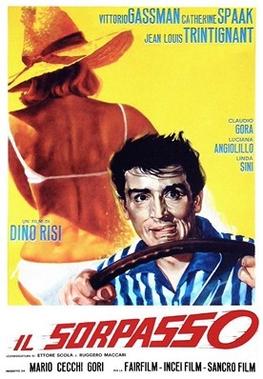
Just a quick note to say that yesterday we published the 120th article in Volume 8 (2025) of the Open Journal of Astrophysics. This means that we have so far in 2025 published as many papers we published in the whole of 2024. At the end of August we will be about 2/3 of the way through the year so I expect we will publish more than 180 articles this year. It may be more than that because we have a group of articles in the pipeline that will be published simultaneously in a special issue, which may be completed this year. We might in this case reach 200 altogther for 2025, but if not the special issue will appear in 2026.
The relevance of all this to the 1962 Italian comedy film Il Sorpasso is entirely negligible, except that I like the movie.
Since I seem to be having a weekend dominated by feelings of nostalgia, I thought I would comment on a nice article I read yesterday about The Rocky Horror Picture Show, a cult film which got its first cinematic release fifty years ago in 1975. You can find the article here.
Here is a the original theatrical trailer:
The Rocky Horror Picture Show is redolent with nostalgia for my days in Brighton in the Eighties. For a time I lived in a shared house not far from the Duke of York’s Picture House which had fairly frequent late-night showings of Rocky Horror, but it wasn’t just a question of going to see the film. It was obligatory to dress up like the characters, join in the dancing, squirt water pistols to recreate the rain, throw rice during the wedding scene, etc.
The first time I went it took me ages to find an outfit resembling that of Dr. Frank-N-Furter, the mad scientist played by Tim Curry in the film. I eventually found suitable lingerie items in shops but failed when it came to the shoes. I couldn’t find stilettos in a size 11 anywhere. That’s probably just as well as I don’t think I’d have been able to walk in them anyway. I settled for a pair of Doctor Martens boots. I had longer hair in those days so a bit of gel did the trick for that, and a friend did the make-up for me. I had to shave my legs to wear the fishnet stockings too. I rather enjoyed dressing up, going to the show and, especially, the after-party…
I never got into the habit of cross-dressing, and haven’t got the figure for it now, but I am not at all ashamed to admit that I think some guys look very hot in lipstick and lingerie.
Last night I stayed up long past my usual bedtime to watch the film Poltergeist. This film, about the haunting of a family house by malevolent spirits, was a huge hit when it came out in cinemas back 1982, and I was interested to see how well it has endured. I think it stans up pretty well actually. The special effects could be done better nowadays, but it is still credibly scary.
The idea of a poltergeist is not new, but the film cleverly combines the old legends with new technology, in the way that the first manifestation of an evil presence is through a TV set. It is the youngest child of the house in question, Carol Anne, who is able to detect the ghosts when all we can see on the screen is static. The implication is that the young are the most receptive to paranormal phenomena.
Most of the static produced in a TV set when it is not tuned to a broadcast frequency is produced by thermal noise in the receiver, but around 1% of it comes from the cosmic microwave background (CMB). I’ve used static on a TV screen as a gimmick in public lectures on several occasions, with the joke that it may only be 1% but the birth of the Universe is far more interesting than most things you can see on TV!
The CMB is a ghost of the Big Bang. Watching Poltergeist last night, it occurred to me that when cosmologists study this relic radiation, we are all a bit like Carol Anne, trying to make sense of an eery presence that is always with us, but is barely perceptible. Such studies involve extensive use of spectral analysis.
This line of thinking led me to my new theory of the Universe. Perhaps it was built on the remains of an earlier, deceased Universe which is now trying to make contact this one in order to wreak revenge for the violation of its grave…
Now that the Christmas dinner and follow-up leftovers are done, I thought I’d just mention a very beautiful film I watched on the TV late on Christmas Day – An Cailín Ciúin (in English: The Quiet Girl). I was quite surprised to see it scheduled then, but TG4 is known for bold and imaginative programming.
It’s (mostly) in the Irish language, but don’t let that put you off; there are subtitles. It’s gentle, poignant and wonderfully observed. A little gem, in fact. I’d encourage you to see it if you can. It’s a fine film all round, but I can’t resist pointing out Catherine Clinch in the central role of Cáit, the quiet girl herself. She had never acted in front of a camera before this film, which makes her subtly expressiven performance all the more remarkable.
I heard yesterday of the death at the age of 89 of the great Maggie Smith. Tributes have been appearing around the world at the loss of such a great talent and wonderful personality. I can’t add anything to these except to say that I adored her.
I guess many people will be most familiar her through the work she did in later life, such as the Harry Potter franchise and Downtown Abbey but as an oldie I will always think of her as the eponymous Edinburgh schoolteacher in the 1969 film The Prime of Miss Jean Brodie, based on the Muriel Spark novel of the same name, for which she deservedly won an Oscar as Best Actress for her portrayal of Jean Brodie, an over-zealous teacher with a soft spot for Mussolini’s Fascisti. Here’s the original trailer.
I do hope this film gets shown again soon as a tribute, as it is really superb.
Maggie Smith as Lady Constance Trentham in Gosford Park (2001)
Other roles I particularly remember Maggie Smith for are in are California Suite (for which she also won an Oscar, as Best Supporting Actress). She was absolutely hilarious in Murder by Death, her perfect sense of comic timing generating numerous laugh-out-loud moments in that film.
Maggie Smith with David Niven in Murder by Death (1976)
Maggie Smith was also memorable as the splendidly rude Lady Constance in Gosford Park, a role you might think of as a sort of prelude to her part in Downton Abbey. There are countless other performances I could mention too, on TV, on Film and in the Theatre. She was tremendously versatile and talented, as well as extremely funny. She admitted having learnt a great deal about comedy from Kenneth Williams, with whom she was great friends for a long time.
Rest in peace, Maggie Smith. You’ll be missed so much.
I have seen many comments on social media to the effect that the 2024 Paris Olympics have gone “woke”. I agree. Many sports are now mere shadows of what they were a few decades ago let alone the original Greek ideals. Gymnastics for example, the name of which is derived from the Greek gymnós meaning “naked”, nowadays involves competitors with their naughty bits covered up. How woke is that? And the boxers even wear gloves! They’ve all gone soft!
Another example is the fencing. I’m not an expert on this but I did watch quite a lot when I was younger – admittedly not on live TV, but in the form of film recordings. The modern Olympic version of fencing is boring compared with how it used to be. Here are two photographs that illustrate how fencing has gone woke.
WOKENOT WOKE
For a start, just look at all the protective gear worn by the namby-pamby competitors on the left! And they don’t even use proper swords! It’s health and safety gone mad!
Also, where are the fancy costumes, the stone staircases to run up and down, the chandeliers to swing from, the elaborate hanging tapestries to climb, or the long banqueting tables covered in expensive items there to be trashed? Pathetic!
(P.S. Basil Rathbone (in the still on the right) was actually a seriously good fencer, twice British Army champion in fact, unlike his opponent in the picture Errol Flynn who was so useless that he was a danger to other members of the cast, including Rathbone.)
I was saddened to hear of the death at the age of 98 of prolific film producer and director Roger Corman. He is best known, at least to me, as the director of a string of cult low-budget B-movies. They were of variable quality in terms of acting – Corman couldn’t often afford to pay for top-quality actors – but some of the films were outstanding. Roger Corman’s death gives me an excuse to rehash an old post about one of his films.
The first film I remember seeing that really terrified me was House of Usher starring the great Vincent Price, a regular in a series of films by Roger Corman inspired by Edgar Allan Poe, who gives most of his performance in a creepy stage whisper, a film based Poe’s short story The Fall of the House of Usher. When I was around 8 or 9 I was once left home alone on a Friday night by my parents. In those days the BBC used to show horror films late at night on Fridays and, against parental guidance, I decided to watch this one. It scared me witless and when my parents got home they found me a gibbering wreck. I don’t really know why I found it so scary – younger people reared on a diet of slasher movies probably find it very tame, as you don’t actually see anything particularly shocking – but the whole atmosphere of it really got to me. Here’s an example clip.
I almost forgot that today is the Ides of March , but I’ve remembered now and it’s not too late a priceless bit of cultural history relevant to such this fateful day. This is from the First Folio Edition of Carry On Cleo, and stars the sublime Kenneth Williams as Julius Caesar delivering one of the funniest lines in the whole Carry On series. The joke may be nearly as old as me, but it’s still a cracker…
And if one old joke isn’t enough for you, here is a Caesar Salad:
On Saturday I watched the 2017 film Dunkirk for the first time. I don’t often watch films on TV but I saw this one in the listings and since it got some very positive reviews I thought I’d watch it. Here’s the trailer.
So what did I think?
First, the positives. There is some wonderful cinematography in this movie, and some realistic action sequences that manage to be disturbing without degenerating into a gorefest. It’s also quite interesting that we don’t really see the enemy at all at any point during the film. In summary, I found the first forty minutes or so very gripping, despite (or perhaps because of) the almost complete lack of dialogue.
After that, though, my interest began to wane. The main negative is that I found it hard to engage with any of the characters. In particular, the film did not convey the stress the troops must have been under. The editing was a bit of a mess too. It’s far too repetitive and I found some of the scenes rather contrived.
(I gather some people found the sound in the cinema version rather oppressively loud, but I watched it on telly at home so just turned down the volume…)
Overall, I found Dunkirk worth watching, but I’ve seen it described as one of the greatest war films of all time and it’s not that.
Three historical points.
First, I think there’s a key ingredient missing from this – and some other – tellings of the Dunkirk story, and that is the crucial role of the rearguard that valiantly defended the perimeter of the town and won enough time for evacuation to proceed. The different units of the rearguard (both French and British) depended entirely on the units either side of them to stand. Had the perimeter been broken anywhere, the defence would have failed. The men involved must have thought that they had no chance of making it back to Britain, but they held their ground and by doing so ensured that many thousands did get home. In fact, it was such a well-organized operation that much of the British rearguard was actually evacuated after a controlled retreat to the beach.
A second point is that most of the over 800 small boats that eventually proved crucial in Operation Dynamo were crewed by naval personnel, rather than their owners. The few exceptions were fishing boats, like the one shown in the film. Many of the smaller ships with a shallow draft were used to ferry men from the beach to destroyers rather than taking them all the way back to England.
Incidentally, the trip from Ramsgate – where the little boats were assembled – to Dunkirk is about 50 miles of open water. That’s quite a journey for a pleasure boat or paddle steamer.
Finally, the film reminded me that Winston Churchill’s famous speech in response to the “miracle” of Dunkirk, with its peroration “We shall fight them on the beaches, etc” was given to the House of Commons. It includes this:
We must be very careful not to assign to this deliverance the attributes of a victory. Wars are not won by evacuations. But there was a victory inside this deliverance, which should be noted.
Hansard, 4th June 1940
Churchill made that speech on 4th June 1940. I was born on the same day in the same month, a mere 23 years later.
I’ve been writing far too many R.I.P. posts recently, but I had to say something to mark the passing of Glenda Jackson who has died at the age of 87. Glenda Jackson had an illustrious acting career during which she won many awards (including two Oscars) and then turned her hand to politics; she was a Labour Member of Parliament from 1992 to 2015.
Glenda Jackson in Stevie (1978)
The role in which I remember Glenda Jackson best was in the film Stevie (1978) in which she played the poet Stevie Smith, whose poetry I have admired greatly for its dark yet whimsical tone since I was introduced to it while at school. The originality of her voice is the reason I’ve posted some of her poems on this blog from time to time.
Stevie Smith, who died in 1971, made a number of radio broadcasts and, without really trying to impersonate her, I think Glenda Jackson captured perfectly her quirky mixture of wit and melancholia. It was a marvelous performance in what I think is a neglected film masterpiece.
The views presented here are personal and not necessarily those of my employer (or anyone else for that matter).
Feel free to comment on any of the posts on this blog but comments may be moderated; anonymous comments and any considered by me to be vexatious and/or abusive and/or defamatory will not be accepted. I do not necessarily endorse, support, sanction, encourage, verify or agree with the opinions or statements of any information or other content in the comments on this site and do not in any way guarantee their accuracy or reliability.