I have seen many comments on social media to the effect that the 2024 Paris Olympics have gone “woke”. I agree. Many sports are now mere shadows of what they were a few decades ago let alone the original Greek ideals. Gymnastics for example, the name of which is derived from the Greek gymnós meaning “naked”, nowadays involves competitors with their naughty bits covered up. How woke is that? And the boxers even wear gloves! They’ve all gone soft!
Another example is the fencing. I’m not an expert on this but I did watch quite a lot when I was younger – admittedly not on live TV, but in the form of film recordings. The modern Olympic version of fencing is boring compared with how it used to be. Here are two photographs that illustrate how fencing has gone woke.
WOKENOT WOKE
For a start, just look at all the protective gear worn by the namby-pamby competitors on the left! And they don’t even use proper swords! It’s health and safety gone mad!
Also, where are the fancy costumes, the stone staircases to run up and down, the chandeliers to swing from, the elaborate hanging tapestries to climb, or the long banqueting tables covered in expensive items there to be trashed? Pathetic!
(P.S. Basil Rathbone (in the still on the right) was actually a seriously good fencer, twice British Army champion in fact, unlike his opponent in the picture Errol Flynn who was so useless that he was a danger to other members of the cast, including Rathbone.)
I was saddened to hear of the death at the age of 98 of prolific film producer and director Roger Corman. He is best known, at least to me, as the director of a string of cult low-budget B-movies. They were of variable quality in terms of acting – Corman couldn’t often afford to pay for top-quality actors – but some of the films were outstanding. Roger Corman’s death gives me an excuse to rehash an old post about one of his films.
The first film I remember seeing that really terrified me was House of Usher starring the great Vincent Price, a regular in a series of films by Roger Corman inspired by Edgar Allan Poe, who gives most of his performance in a creepy stage whisper, a film based Poe’s short story The Fall of the House of Usher. When I was around 8 or 9 I was once left home alone on a Friday night by my parents. In those days the BBC used to show horror films late at night on Fridays and, against parental guidance, I decided to watch this one. It scared me witless and when my parents got home they found me a gibbering wreck. I don’t really know why I found it so scary – younger people reared on a diet of slasher movies probably find it very tame, as you don’t actually see anything particularly shocking – but the whole atmosphere of it really got to me. Here’s an example clip.
I almost forgot that today is the Ides of March , but I’ve remembered now and it’s not too late a priceless bit of cultural history relevant to such this fateful day. This is from the First Folio Edition of Carry On Cleo, and stars the sublime Kenneth Williams as Julius Caesar delivering one of the funniest lines in the whole Carry On series. The joke may be nearly as old as me, but it’s still a cracker…
And if one old joke isn’t enough for you, here is a Caesar Salad:
On Saturday I watched the 2017 film Dunkirk for the first time. I don’t often watch films on TV but I saw this one in the listings and since it got some very positive reviews I thought I’d watch it. Here’s the trailer.
So what did I think?
First, the positives. There is some wonderful cinematography in this movie, and some realistic action sequences that manage to be disturbing without degenerating into a gorefest. It’s also quite interesting that we don’t really see the enemy at all at any point during the film. In summary, I found the first forty minutes or so very gripping, despite (or perhaps because of) the almost complete lack of dialogue.
After that, though, my interest began to wane. The main negative is that I found it hard to engage with any of the characters. In particular, the film did not convey the stress the troops must have been under. The editing was a bit of a mess too. It’s far too repetitive and I found some of the scenes rather contrived.
(I gather some people found the sound in the cinema version rather oppressively loud, but I watched it on telly at home so just turned down the volume…)
Overall, I found Dunkirk worth watching, but I’ve seen it described as one of the greatest war films of all time and it’s not that.
Three historical points.
First, I think there’s a key ingredient missing from this – and some other – tellings of the Dunkirk story, and that is the crucial role of the rearguard that valiantly defended the perimeter of the town and won enough time for evacuation to proceed. The different units of the rearguard (both French and British) depended entirely on the units either side of them to stand. Had the perimeter been broken anywhere, the defence would have failed. The men involved must have thought that they had no chance of making it back to Britain, but they held their ground and by doing so ensured that many thousands did get home. In fact, it was such a well-organized operation that much of the British rearguard was actually evacuated after a controlled retreat to the beach.
A second point is that most of the over 800 small boats that eventually proved crucial in Operation Dynamo were crewed by naval personnel, rather than their owners. The few exceptions were fishing boats, like the one shown in the film. Many of the smaller ships with a shallow draft were used to ferry men from the beach to destroyers rather than taking them all the way back to England.
Incidentally, the trip from Ramsgate – where the little boats were assembled – to Dunkirk is about 50 miles of open water. That’s quite a journey for a pleasure boat or paddle steamer.
Finally, the film reminded me that Winston Churchill’s famous speech in response to the “miracle” of Dunkirk, with its peroration “We shall fight them on the beaches, etc” was given to the House of Commons. It includes this:
We must be very careful not to assign to this deliverance the attributes of a victory. Wars are not won by evacuations. But there was a victory inside this deliverance, which should be noted.
Hansard, 4th June 1940
Churchill made that speech on 4th June 1940. I was born on the same day in the same month, a mere 23 years later.
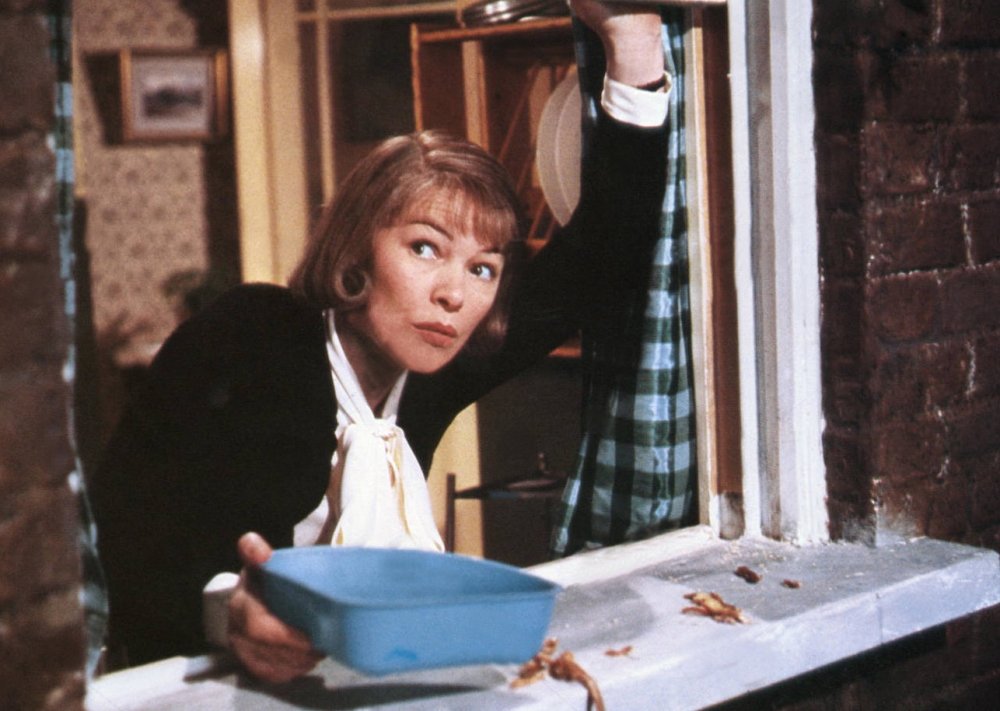
I’ve been writing far too many R.I.P. posts recently, but I had to say something to mark the passing of Glenda Jackson who has died at the age of 87. Glenda Jackson had an illustrious acting career during which she won many awards (including two Oscars) and then turned her hand to politics; she was a Labour Member of Parliament from 1992 to 2015.
Glenda Jackson in Stevie (1978)
The role in which I remember Glenda Jackson best was in the film Stevie (1978) in which she played the poet Stevie Smith, whose poetry I have admired greatly for its dark yet whimsical tone since I was introduced to it while at school. The originality of her voice is the reason I’ve posted some of her poems on this blog from time to time.
Stevie Smith, who died in 1971, made a number of radio broadcasts and, without really trying to impersonate her, I think Glenda Jackson captured perfectly her quirky mixture of wit and melancholia. It was a marvelous performance in what I think is a neglected film masterpiece.
With the launch of the Euclid spacecraft due next month, and the last Euclid Consortium meeting before the launch coming up in just over a week, I thought I’d share another one of the nice little taster videos prepared by the European Space Agency:
The Euclid Mission has long been “sold” as a mission to probe the nature of Dark Energy in much the same way that the Large Hardon Collider was often portrayed as an experiment designed to find the Higgs boson. But as this video makes clear, testing theories of dark energy is just one of the tasks Euclid will undertake, and it may well be the case that in years to come the mission is remembered for something other than dark energy. On the other hand, big science like this needs big money, and making the specific case for a single big ticket item is an easier way to persuade funding agencies to cough up the dosh than for a general “let’s do a lot of things we’re sure we’ll fin something” approach. These thoughts triggered a memory of an old post of mine about Alfred Hitchcock so, with apologies for repeating something I have blogged about before, here’s an updated version.
Unpick the plot of any thriller or suspense movie and the chances are that somewhere within it you will find lurking at least one MacGuffin. This might be a tangible thing, such the eponymous sculpture of a Falcon in the archetypal noir classic The Maltese Falcon or it may be rather nebulous, like the “top secret plans” in Hitchcock’s The Thirty Nine Steps. Its true character may be never fully revealed, such as in the case of the glowing contents of the briefcase in Pulp Fiction, which is a classic example of the “undisclosed object” type of MacGuffin, or it may be scarily obvious, like a doomsday machine or some other “Big Dumb Object” you might find in a science fiction thriller. It may even not be a real thing at all. It could be an event or an idea or even something that doesn’t exist in any real sense at all, such the fictitious decoy character George Kaplan in North by Northwest. In fact North by North West is an example of a movie with more than one MacGuffin. Its convoluted plot involves espionage and the smuggling of what is only cursorily described as “government secrets”. These are the main MacGuffin; George Kaplan is a sort of sub-MacGuffin. But although this is behind the whole story, it is the emerging romance, accidental betrayal and frantic rescue involving the lead characters played by Cary Grant and Eve Marie Saint that really engages the characters and the audience as the film gathers pace. The MacGuffin is a trigger, but it soon fades into the background as other factors take over.
Whatever it is real or is not, the MacGuffin is the thing responsible for kick-starting the plot. It makes the characters embark upon the course of action they take as the tale begins to unfold. This plot device was particularly beloved by Alfred Hitchcock (who was responsible for introducing the word to the film industry). Hitchcock was however always at pains to ensure that the MacGuffin never played as an important a role in the mind of the audience as it did for the protagonists. As the plot twists and turns – as it usually does in such films – and its own momentum carries the story forward, the importance of the MacGuffin tends to fade, and by the end we have usually often forgotten all about it. Hitchcock’s movies rarely bother to explain their MacGuffin(s) in much detail and they often confuse the issue even further by mixing genuine MacGuffins with mere red herrings.
Here is the man himself explaining the concept at the beginning of this clip. (The rest of the interview is also enjoyable, convering such diverse topics as laxatives, ravens and nudity..)
There’s nothing particular new about the idea of a MacGuffin. I suppose the ultimate example is the Holy Grail in the tales of King Arthur and the Knights of the Round Table and, much more recently, the Da Vinci Code. The original Grail itself is basically a peg on which to hang a series of otherwise disconnected stories. It is barely mentioned once each individual story has started and, of course, is never found.
Physicists are fond of describing things as “The Holy Grail” of their subject, such as the Higgs Boson or gravitational waves. This always seemed to me to be an unfortunate description, as the Grail quest consumed a huge amount of resources in a predictably fruitless hunt for something whose significance could be seen to be dubious at the outset. The MacGuffin Effect nevertheless continues to reveal itself in science, although in different forms to those found in Hollywood.
The Large Hadron Collider (LHC), switched on to the accompaniment of great fanfares a few years ago, provides a nice example of how the MacGuffin actually works pretty much backwards in the world of Big Science. To the public, the LHC was built to detect the Higgs Boson, a hypothetical beastie introduced to account for the masses of other particles. If it exists the high-energy collisions engineered by LHC should (and did) reveal its presence. The Higgs Boson is thus the LHC’s own MacGuffin. Or at least it would be if it were really the reason why LHC has been built. In fact there are dozens of experiments at CERN and many of them have very different motivations from the quest for the Higgs, such as evidence for supersymmetry.
Particle physicists are not daft, however, and they realized that the public and, perhaps more importantly, government funding agencies need to have a really big hook to hang such a big bag of money on. Hence the emergence of the Higgs as a sort of master MacGuffin, concocted specifically for public consumption, which is much more effective politically than the plethora of mini-MacGuffins which, to be honest, would be a fairer description of the real state of affairs.
While particle physicists might pretend to be doing cosmology, we astrophysicists have to contend with MacGuffins of our own. One of the most important discoveries we have made about the Universe in the last decade is that its expansion seems to be accelerating. Since gravity usually tugs on things and makes them slow down, the only explanation that we’ve thought of for this perverse situation is that there is something out there in empty space that pushes rather than pulls. This has various possible names, but Dark Energy is probably the most popular, adding an appropriately noirish edge to this particular MacGuffin. It has even taken over in prominence from its much older relative, Dark Matter, although that one is still very much around.
We have very little idea what Dark Energy is, where it comes from, or how it relates to other forms of energy with which we are more familiar, so observational astronomers have jumped in with various grandiose strategies to find out more about it. This has spawned a booming industry in surveys of the distant Universe, all aimed ostensibly at unravelling the mystery of the Dark Energy. It seems that to get any funding at all for cosmology these days you have to sprinkle the phrase “Dark Energy” liberally throughout your grant applications.
The old-fashioned “observational” way of doing astronomy – by looking at things hard enough and long enough until something exciting appears (which it does with surprising regularity) – has been replaced by a more “experimental” approach, more like that of the LHC. We can no longer do deep surveys of galaxies to find out what’s out there. We have to do it “to constrain models of Dark Energy”. This is just one example of the (not entirely positive) influence that particle physics has had on astronomy in recent times.
Whatever the motivation for doing these projects now, they will undoubtedly lead to many new discoveries, so I’m not for one minute arguing that the case for, e.g, the Euclid mission is misguided. I’m just saying that in my opinion there will never be a real solution of the Dark Energy problem until it is understood much better at a conceptual level, and that will probably mean major revisions of our theories of both gravity and matter. I venture to speculate that in twenty years or so people will look back on the obsession with Dark Energy with some amusement, as our theoretical language will have moved on sufficiently to make it seem irrelevant. That’s how it goes with MacGuffins. In the end, even the Maltese Falcon turned out to be a fake, but what an adventure it was along the way!
I just read the sad news of the death, on Monday 5th June at the age of 83, of legendary Brazilian Bossa Nova and Samba singer Astrud Gilberto.
There was a time in the 1960s when the Bossa Nova seemed to be everywhere, and the reason for that was a collaboration between singer, guitarist and composer João Gilberto and tenor saxophonist Stan Getz that resulted in the award-winning album Getz/Gilberto that made the Bossa Nova go global, penetrating not only the world of jazz but the much wider cultural sphere including pop and film music. It also made a star of João Gilberto’s then wife, Astrud, who had never recorded before but sang on some of the tracks, the most famous example being The Girl From Ipanema. The popularity of this track resulted in a shorter version being released as a single which was a smash hit around the globe in 1964. Whether or not it’s true, the story goes that she was not under contract at the time the recording was made so never received any royalties for it, although the single made millions. It is said that it was Stan Getz – a wonderful musician but a notoriously horrible man – was responsible for swindling her.
Although an inexperienced singer at the time of this famous session, Astrud Gilberto had a direct, uncomplicated style and an aura of cool detachment that proved very appealing to audiences around the world, earning her a Grammy Award and turning her into a star almost overnight. Her relationship with her husband did not survive this transformation, however, and they divorced a few years later.
There was a lot more to Astrud Gilberto than that hit record, however. She started writing her own songs and her singing style matured. As a matter of fact I was lucky enough to see her perform live in London in the mid-1990s – at the Jazz Cafe in Camden, if I remember correctly – and she sang a very interesting mixture of music. I liked that later style more than the Getz/Gilberto recordings actually.
Anyway, here is a video of Astrud Gilberto singing The Girl From Ipanema in 1964 in what looks like it must be a clip from the film Get Yourself A College Girl – though I stand to be corrected if wrong! – and the music is exactly the same as the hit single so the band and the singer were obviously miming…
Today is the Ides of March so I thought I’d keep post this priceless bit of British cultural history relevant to such a fateful day.
This is from the First Folio Edition of Carry On Cleo, and stars the sublime Kenneth Williams as Julius Caesar delivering one of the funniest lines in the whole Carry On series. The joke may be nearly as old as me, but it’s still a cracker…
And if one old joke isn’t enough for you, here is a Caesar Salad:
I know it’s a bit late for Hallowe’en but have you noticed the similarity between the physical manifestation of the apocalyptic Sumerian deity Gozer as seen in the film Ghostbusters (left) and the pattern of dark coronal holes recently observed by NASA in the Sun’s atmosphere (right)? I wonder if, by any chance, they might be related?
So we have arrived at October 31st, Hallowe’en or, in pagan terms, Samhain. This, a cross-quarter day – roughly halfway between the Autumnal Equinox and the Winter Solstice – represents the start of winter (“the dark half of the year“) in the Celtic calendar. As it turns out I didn’t get any trick-or-treaters this evening. I think the torrential rain put the dampeners on any such adventures, and I could scarcely hear the fireworks for the sound of the rain stotting down on my roof.
Despite my own reservations about Hallowe’en, I’ve decided to resurrect the following little video which seems to be appropriate for the occasion. It’s made of bits of old horror B-movies but the music – by Bobby “Boris” Pickett and the Crypt-kickers is actually the second 7″ single I ever bought, way back in 1973…
The views presented here are personal and not necessarily those of my employer (or anyone else for that matter).
Feel free to comment on any of the posts on this blog but comments may be moderated; anonymous comments and any considered by me to be vexatious and/or abusive and/or defamatory will not be accepted. I do not necessarily endorse, support, sanction, encourage, verify or agree with the opinions or statements of any information or other content in the comments on this site and do not in any way guarantee their accuracy or reliability.