Archive for the History Category

R.I.P. Margaret Burbidge (1919-2020)

Posted in History, The Universe and Stuff with tags , , , , , on April 6, 2020 by telescoper

I just heard via Twitter that Margaret Burbidge has passed away at the age of 100. I send my condolences to her friends, colleagues and family.

Margaret Burbidge will perhaps be best remembered as the first author anniversary of the classic work of Burbidge, Burbidge, Fowler and Hoyle in 1957 (a paper usually referred to as B2FH after the initials of its authors). It’s such an important contribution, in fact, that it has its own wikipedia page.

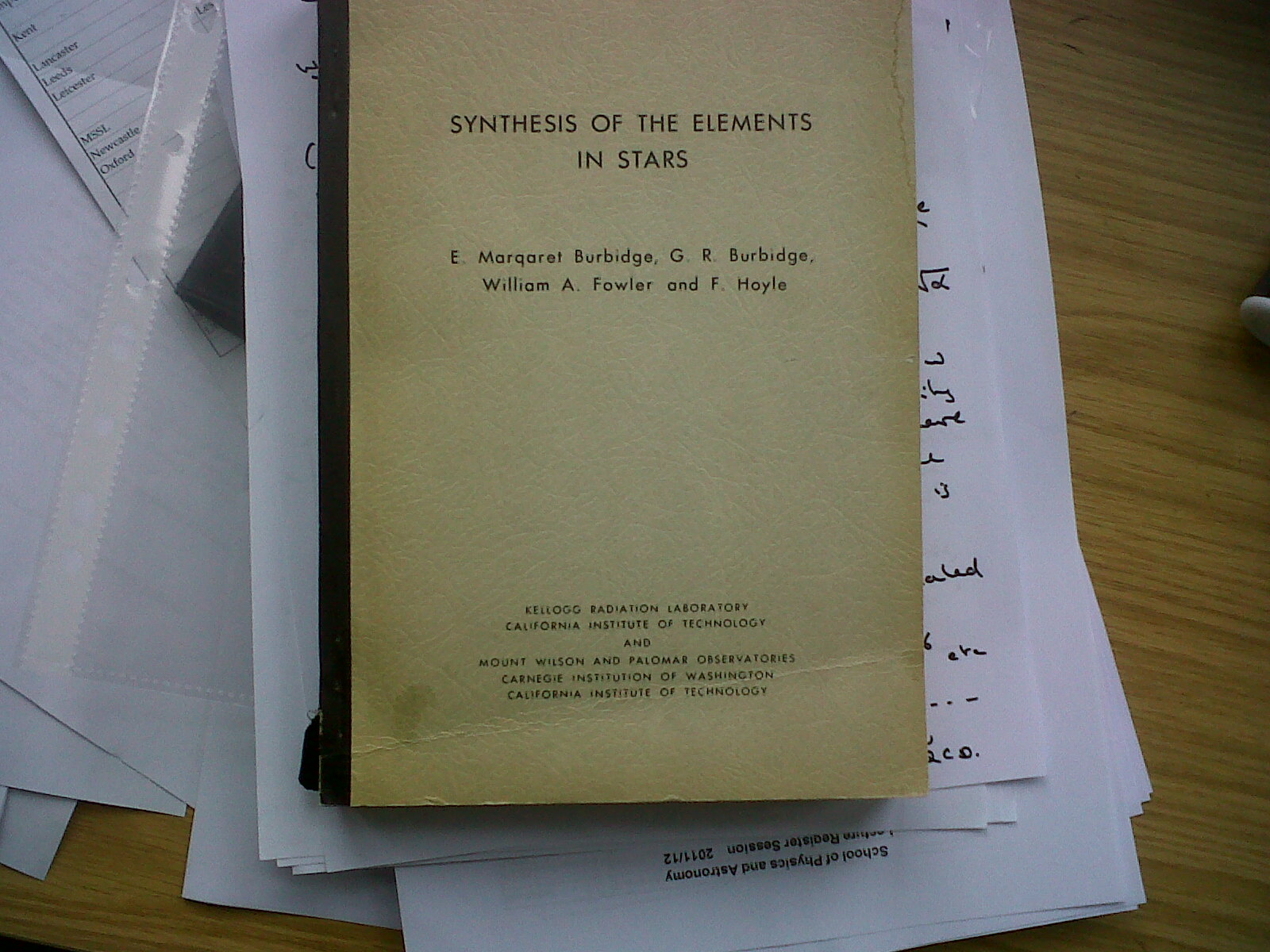
One of the interesting astronomical things I’ve acquired over the years is a preprint of the B2FH paper. Younger readers will probably not realize that preprints were not always produced in the electronic form they are today. We all used to make large numbers of these and post them at great expense to (potentially) interested colleagues before publication in order to get comments. In the age of the internet people don’t really bother to make hard copies of preprints for distribution any more.

Anyway, here’s a snap of it.

Sadly all of the authors have now passed away Margaret Burbidge did much more than that paper, of course. She made important contributions over a wide range of topics in astrophysics and will be greatly missed.

Rest in peace, Margaret Burbidge (1919-2020)

The Slouch Hat Question

Posted in History with tags , , , on March 29, 2020 by telescoper

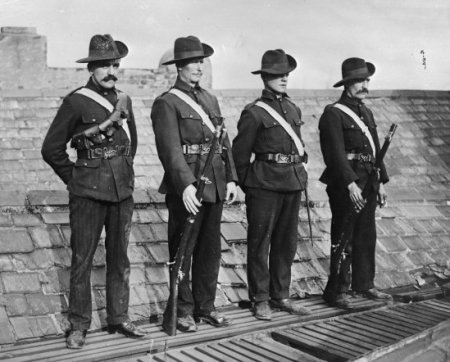
Yesterday I was reading a book about Irish history – I’m reading quite a lot these days – and was intrigued by the headgear worn by members of the Citizens Army during the 1916 Easter Rising:

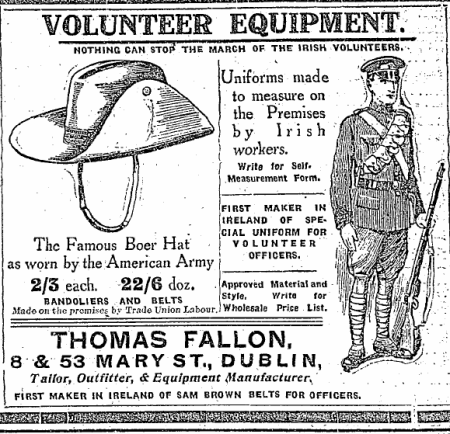
This type of broad-brimmed hat seems to have been quite thing among volunteers of the time:

Described as a ‘Boer Hat as worn by the American Army’ (?) this is usually called a ‘Slouch Hat’ and is also associated with the Australian Army and other Commonwealth forces.

I can understand the utility of the broad brim in hotter climes though not perhaps in Ireland…

The main question that struck me, though, is why it is so often worn with the brim folded up on one side?

See if you can guess. I reveal the answer below.

Continue reading

An Eye for Bumfodder

Posted in History, Literature with tags , , on March 23, 2020 by telescoper

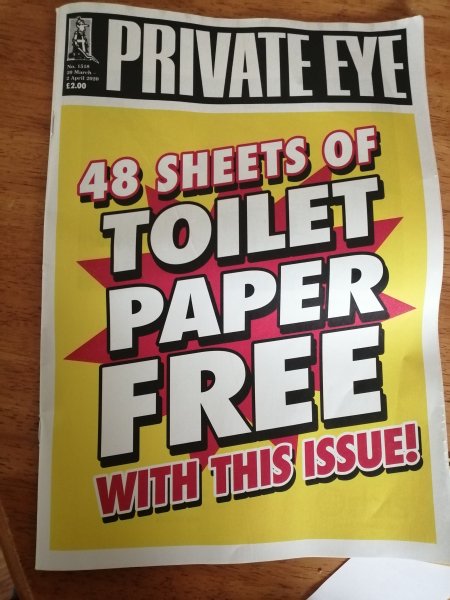
Deliveries of my subscription copy of Private Eye have been a bit unpredictable recently but the latest edition arrived today, with the following hilarious cover:

That reminded me of a thing I wrote recently on the issue of toilet tissue. As far as I am aware, paper in a form specifically designed for the use of wiping one’s bits clean after defecation wasn’t introduced until the middle of the 19th century, but waste paper was commonly used for that purpose much earlier. In the 18th century it was apparently commonplace to tear pages out of cheap books to use as lavatory tissue, and it appears some people would buy books both to read when on the job and for cleaning up afterwards.

This practice gave rise to the word bumfodder, which the Oxford English Dictionary defines as:

  1. Toilet paper. Also occasionally: a piece of this.

  2. attributive and allusively. Worthless or inferior literature; any written or printed material that is perceived as useless, tedious, or unnecessary.

In case you didn’t know, this is also the origin of the word bumf, which the OED gives as

  1. slang (originally in British public schools). Paper (of any kind). Now rare.

  2. Toilet paper. Now somewhat archaic.

  3. orig. Military slang. Written or printed material that is perceived as useless, tedious, or unnecessary, as bureaucratic paperwork, advertising, etc. Also occasionally: worthless or inferior literature.

I have to admit I’ve used the word `bumf’ in the third sense on a number of occasions without realizing quite how indelicate is its origin.

The first instances of `bumfodder’ quoted in the OED date from the mid-17th Century, which surprises me a little because I was under the impression that paper was an expensive commodity then. By the 18th century, however, it was obviously much cheaper, presumably because of mass production, and so consequently books and newspapers were much less expensive. Waste paper was then used quite frequently not only as toilet paper but also for wrapping groceries and other goods. I should mention, however, that paper was used at toilet tissue in China as far back as the 6th Century AD, so Europe was obviously a bit behind on the matter.

Anyone who has read any 18th Century literature – the humour in which is often rather coarse – will not be surprised by the number of scatalogical jokes about bumfodder going around. Obviously I couldn’t repeat any here.

P.S. Now wash your hands please.

The Vernal Equinox 2020

Posted in History, Maynooth with tags , , , , on March 20, 2020 by telescoper

With everything else going on I quite forgot that the Vernal Equinox or Spring Equinox (in the Northern hemisphere) took place today (Friday 20th March) at 3.49am (Irish Time). This is in fact the earliest Spring Equinox for 124 years, the fact that 2020 is a leap year moving it a day earlier in our calendar. It’s a lovely day in Maynooth too!

People sometimes ask me how one can define the `equinox’ so precisely when surely it just refers to a day on which day and night are of equal length, implying that it’s a day not a specific time?

The answer is that the equinox is defined by a specific event, the event in question being when the plane defined by Earth’s equator passes through the centre of the Sun’s disk (or, if you prefer, when the centre of the Sun passes through the plane defined by Earth’s equator). Day and night are not necessarily exactly equal on the equinox, but they’re the closest they get. From now until the Autumnal Equinox days in the Northern hemisphere will be longer than nights, and they’ll get longer until the Summer Solstice before beginning to shorten again.

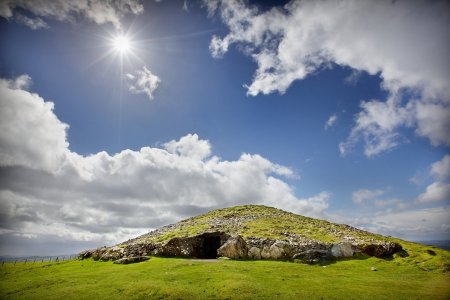
Loughcrew (County Meath), near Newgrange, an ancient burial site and a traditional place to observe the sunrise at the Equinox

Here in Ireland we celebrated Saint Patrick’s day on March 17th, the reputed date of his death in 461 AD. Nobody really knows where St Patrick was born, though, so it would be surprising if the when were any better known.

In any case, it wasn’t until the 17th Century that Saint Patrick’s feast day was placed on the universal liturgical calendar in the Catholic Church. In the thousand years that passed any memory of the actual date was probably lost, so the Equinox was perhaps rebranded for the purpose.

The early Christian church in Ireland incorporated many pre-Christian traditions that survived until roughly the 12th century, including the ancient festival of Ēostre (or Ostara), the goddess of spring associated with the spring equinox after whom Easter is named. During this festival, eggs were used a symbol of rebirth and the beginning of new life and a hare or rabbit was the symbol of the goddess and fertility. In turn the Celtic people of Ireland probably adapted their own beliefs to absorb much older influences dating back to the stone age.

St Patrick’s Day and Easter therefore probably both have their roots in prehistoric traditions around the Spring Equinox, although the direct connection has long been lost.

An Astronomical Anniversary

Posted in Biographical, History, The Universe and Stuff with tags , , on March 10, 2020 by telescoper

I was reminded via Twitter that today is the 200th anniversary of the first formal meeting of the Astronomical Society of London which took place on 10th March 1820. This society turned into the Royal Astronomical Society when it was given a Royal Charter in 1831. Here is the first page of the the Minutes of that first meeting:

Those of you who have been paying attention will recall that the decision to form the Society was taken at a dinner in January 1820 and the bicentenary of this event was celebrated in January by the RAS Dining Club (of which I am a member).

Club Dinners usually take place after the Open Meetings of the Royal Astronomical Society on the second Friday of the month. Sadly, however, there won’t be a Club Dinner this Friday as it has been cancelled owing to the Coronavirus emergency. I’ll have to make do with beans on toast again then.

Incidentally, I thought I’d share this list of the first 200(ish) members of the Royal Astronomical Society (PDF) kindly sent to me by former Cardiff colleague Mike Edmunds. There are some illustrious names among the early members, including Laplace and Bessel, as well as some oddities, such as His Excellency Alexis Greig (Vice Admiral of the Imperial Russian Navy) and Edward Riddle, Esq. (First Mathematical Master, the Royal Naval Asylum).


Clifford’s `Space-Theory of Matter’

Posted in Beards, History, mathematics, The Universe and Stuff with tags , , , on February 26, 2020 by telescoper

Well, here’s another thing I didn’t know until I was informed by Twitter.

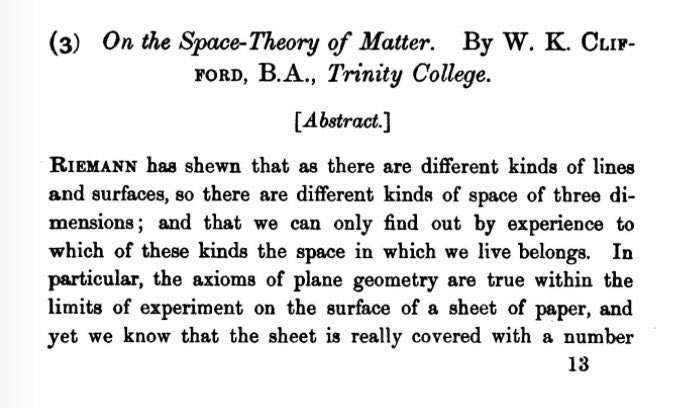
Way back in 1876 –  forty years before Einstein presented his Theory of General Relativity – the mathematician W.K. Clifford (who is most famous nowadays for the Clifford Algebra) presented a short paper in the Proceedings of the Cambridge Philosophical Society in which he speculated that space might be described by Riemannian rather than Euclidean Geometry.

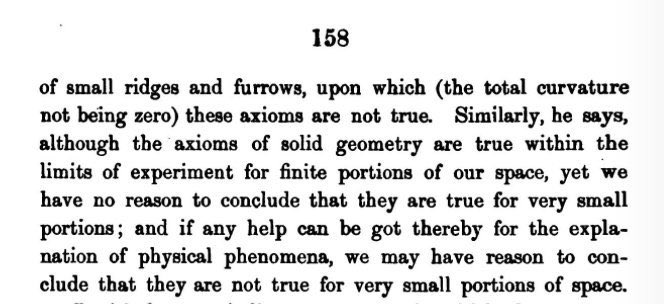
Here are a couple of excerpts:

and

The paper does not contain any actual equations, and his concentration on small scales rather than large was misguided, but it is quite remarkable that he was thinking about such matters such a long time ago!

Unfortunately Clifford died very young, in 1879, at the age of 33, tuberculosis. Had he lived longer he might have been able to develop these ideas a bit further.

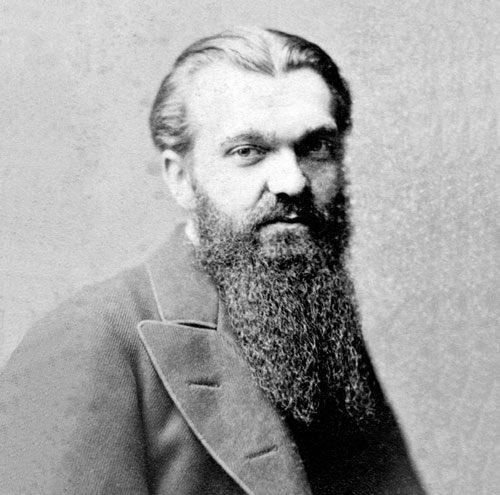
As a postscript I should mention that Clifford had an impressive beard.

It’s all a question of angles.

Posted in History, mathematics on February 14, 2020 by telescoper

I couldn’t resist reblogging this fascinating post on the origins of trigonometry by the inestimable Thony Christie..

thonyc's avatarThe Renaissance Mathematicus

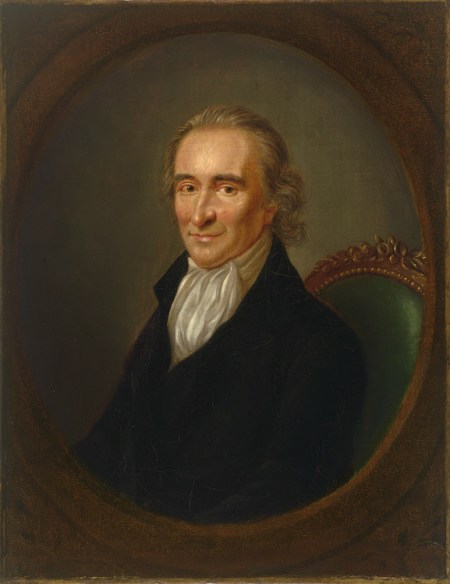
Thomas Paine (1736–1809) was an eighteenth-century political radical famous, or perhaps that should be infamous, for two political pamphlets, Common Sense (1776) and Rights of Man (1791) (he also wrote many others) and for being hounded out of England for his political views and taking part in both the French and American Revolutions.

Portrait_of_Thomas_Paine Thomas Paine portrait of Laurent Dabos c. 1792 Source: Wikimedia Commons

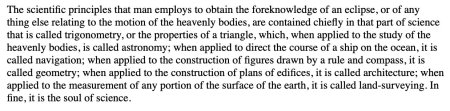
So I was more than somewhat surprised when Michael Brooks, author of the excellent The Quantum Astrologer’s Handbook, posted the following excerpt from Paine’s The Age of Reason, praising trigonometry as the soul of science:

EO_QsU2WkAIDGol

My first reaction to this beautiful quote was that he could be describing this blog, as the activities he names, astronomy, navigation, geometry, land surveying make up the core of the writings on here. This is not surprising as Ivor Grattan-Guinness in his single volume survey of the history…

View original post 1,567 more words

The Journal of Military History and Defence Studies

Posted in History, Maynooth, Open Access with tags , , , on February 13, 2020 by telescoper

I’ve been a bit busy with Computational Physics lectures and labs today so I couldn’t make it to the launch event of a new online Open Access Journal by Maynooth Academic Publishing, who also publish the Open Journal of Astrophysics. The new publication is the Journal of Military History and Defence Studies and its website is here.

Here is the description of the journal:

The Journal of Military History and Defence Studies is a bi-annual peer-reviewed open access online journal that publishers original research and contributions in military history and defence studies. In addition to publishing work by established authors and scholars, the journal has the particular aim of making available to a wide audience the best work completed by postgraduate students studying within these fields at Maynooth University, the Irish Military College and other similar institutions. The journal also aims to publish special editions that make available original research presented at conferences, research seminars etc. As the title suggests, the journal focuses on military history and defence studies, taking a broad view of these subject areas to include the history of war and of militaries, and also of the impact of these on wider society, in addition to the study of war, strategy, security and military organisation today and into the future.

You will see from the website that, as well as catering for a different discipline, this one has a look and feel that is quite different from that of the Open Journal of Astrophysics , but the ultimate aim of both journals is the same, to make high quality research available free of charge to the largest possible audience.

A Day of Results

Posted in History, Politics with tags , , , on February 10, 2020 by telescoper

The results of Saturday’s election are not all in yet, but it is clear that Sinn Féin have come top of the popular vote, with 24.5% of first preferences. As I write this they have 36 TDs compared to 22 altogether in the last Dáil Éireann. They are unlikely to win more than 2-3 more so won’t be the biggest party in terms of seats, but the chances are they will be part of the next Government.

In my own constituency of Kildare North, Sinn Féin’s Réada Cronin won a seat, dislodging one of the Fianna Fáil incumbents, Frank O’Rourke:

As news came in yesterday evening of the strong showing by Sinn Féin, quite a few old friends from the UK emailed me to ask about my opinion. Some for some reason were under the impression that this result is something to do with Brexit. It simply isn’t. The campaign was totally dominated by domestic issues, especially housing and health, on both of which the existing coalition has clearly failed. The so-called `Irexit’ party (funded and promoted by Nigel Farage stooges) flopped in spectacular, as did sundry other far-right parties who tried to whip up anti-immigrant sentiment.

Others asked whether the success of Sinn Féin makes a United Ireland more likely in the short term. Although I would love to see that outcome achieved by democratic means, I’m not sure that this election result automatically brings it closer. For one thing, the Border Poll that would be needed to achieve unification is not in the gift of the Dublin Government, whatever its complexion. For another. a successful vote for Irish unity would require a majority in favour on both sides of the border. The hard-line unionists in the North would not vote `yes’ under any circumstances so a majority would require a significant number of more moderate or more pragmatic unionists to swing towards unity. That may well happen as the negative effects of Brexit begin to bite on Northern Ireland, but it’s also possible that Sinn Féin’s past association with violence may scare some of them off. We’ll have to wait and see. A lot will depend on what happens in the next few months.

There are also some here in the Republic who regard Sinn Féin as pretty toxic, but I see the fact that it is now a major mainstream political party as a very positive development for Ireland’s democracy. For one thing, they offer a radical alternative to the two `establishment’ centre-right parties that have run Ireland for decades. These parties, Fine Gael and Fianna Fáil, came into existence as a result of the Irish Civil War, the latter party splitting from Sinn Féin on the issue of abstentionism. After the Civil War it was not until 1997 that the first Sinn Fein TD actually took a seat in the Dáil. Way back in 1919, however, the First Dail was essentially created by Sinn Féin. It seems to me only right that this party that played such a key role in Irish history should return from the wilderness. In some sense this General Election could mark the end of the beginning of Ireland as an independent nation.

Update: here is a summary of the final results.

The Reverend Professor Callan

Posted in Biographical, History, Maynooth, The Universe and Stuff with tags , , , , , on February 5, 2020 by telescoper

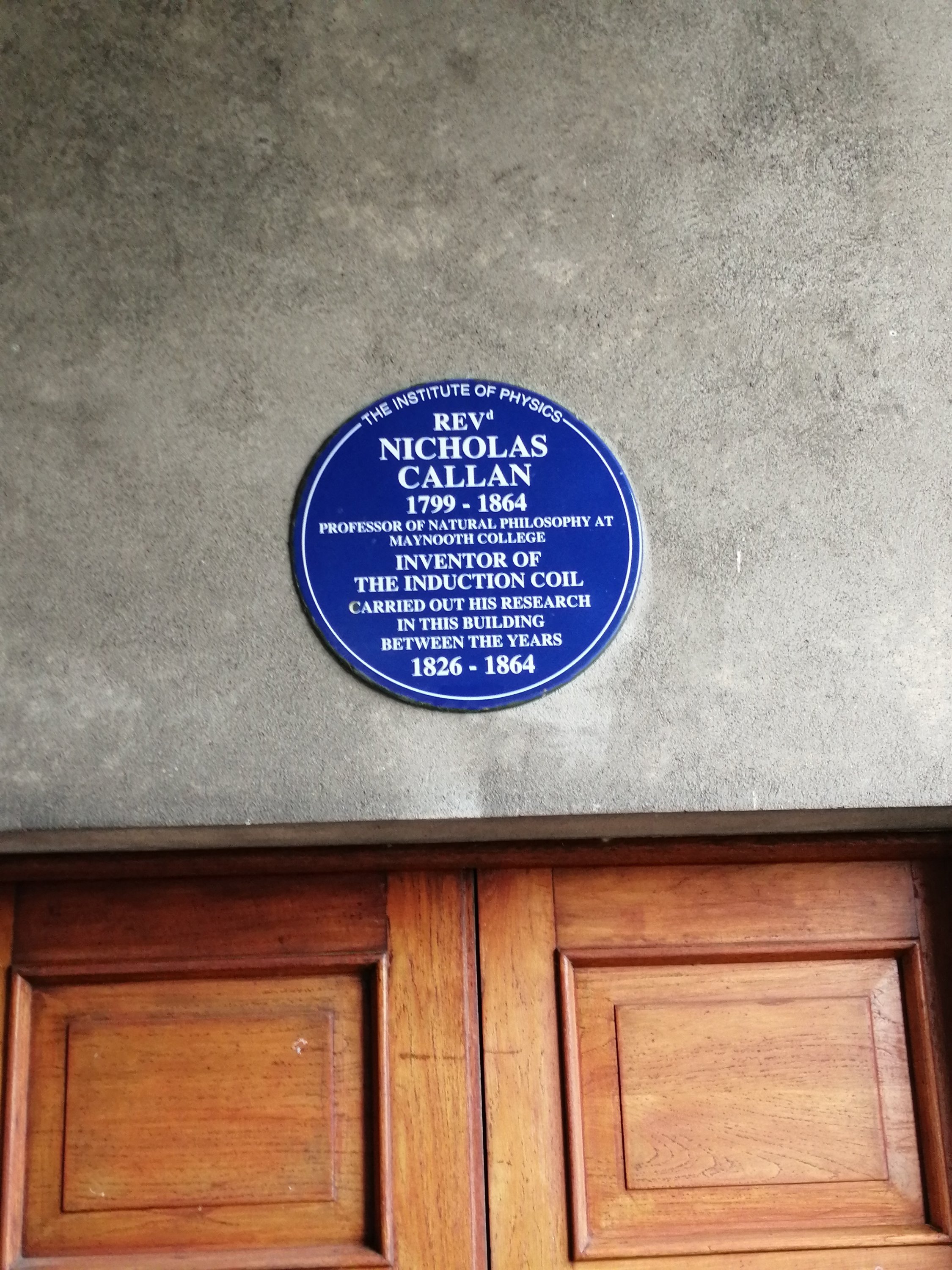
I’ve had a busy day doing various things that took me to various places on the Maynooth University campus, culminating in my first visit to the Department of Mathematics and Statistics (which is based in Logic House) to give a colloquium. On my travels I passed this sign, which I hadn’t noticed before:

Since I’ve been too busy to write a post today I thought I’d rehash an old one about the person named in the plaque, which is above Callan Hall (on the South Campus)

Father Nicholas Callan (or, more formally, The Reverend Professor Nicholas Joseph Callan) was born in County Louth in 1799 went to the seminary of St Patrick’s College, Maynooth, in 1816 to train as a priest. During his time as a seminarian Callan studied ‘Natural Philosophy’ and became interested in experiments involving electricity. In 1823 Callan was ordained as a priest, and went to Rome in 1826 to obtain his doctorate in Divinity. At the time Italy was a centre for research into electricity and here Callan became familiar with the work of the Italian physicist Alessandro Volta who had developed the world’s first battery. Callan returned to Maynooth where he was made chair of Natural Philosophy, a post he would hold until his death in 1864.

Callan is most famous for inventing the induction coil (in 1836). By connecting two copper wire coils to a battery and electromagnet and then interrupting the current he was able to generate much larger voltages than could be obtained from batteries alone. His 1837 version that used a clock mechanism to interrupt the current 20 times a second is estimated to have produced 60,000 volts – the largest artificially generated charge at that time. It is said that his induction coil could produce sparks 15″ long, which must have been fun to watch.

Callan’s biggest induction coil, unfinished at the time of his death, can be found in the National Science Museum of Ireland (which is in Maynooth). This was one of the largest in the world at the time. The iron core is 109 cm long. The secondary windings are 53 cm in diameter and consist of about 50 km of iron wire insulated with beeswax. They were made in three separate rings separated by air gaps, so wires carrying large voltage differences would not lie adjacent to each other, reducing the risk of the insulation breaking down. At the left end is a vibrating mercury ‘contact breaker’ in the primary circuit, actuated by the magnetic field in the primary, which interrupted the primary current to generate potentials of over 200,000 volts.

Sadly Callan’s work was forgotten for quite a period after his death – experimental electromagnetism was not a priority for St Patrick’s College at this time – for which reason the invention of the induction coil has often been attributed to Heinrich Ruhmkorff who made his first device (independently) about 15 years after Callan. More recently, however, Callan’s achievements have been more widely recognized and in 2000 the Irish government issued a stamp in his honour.
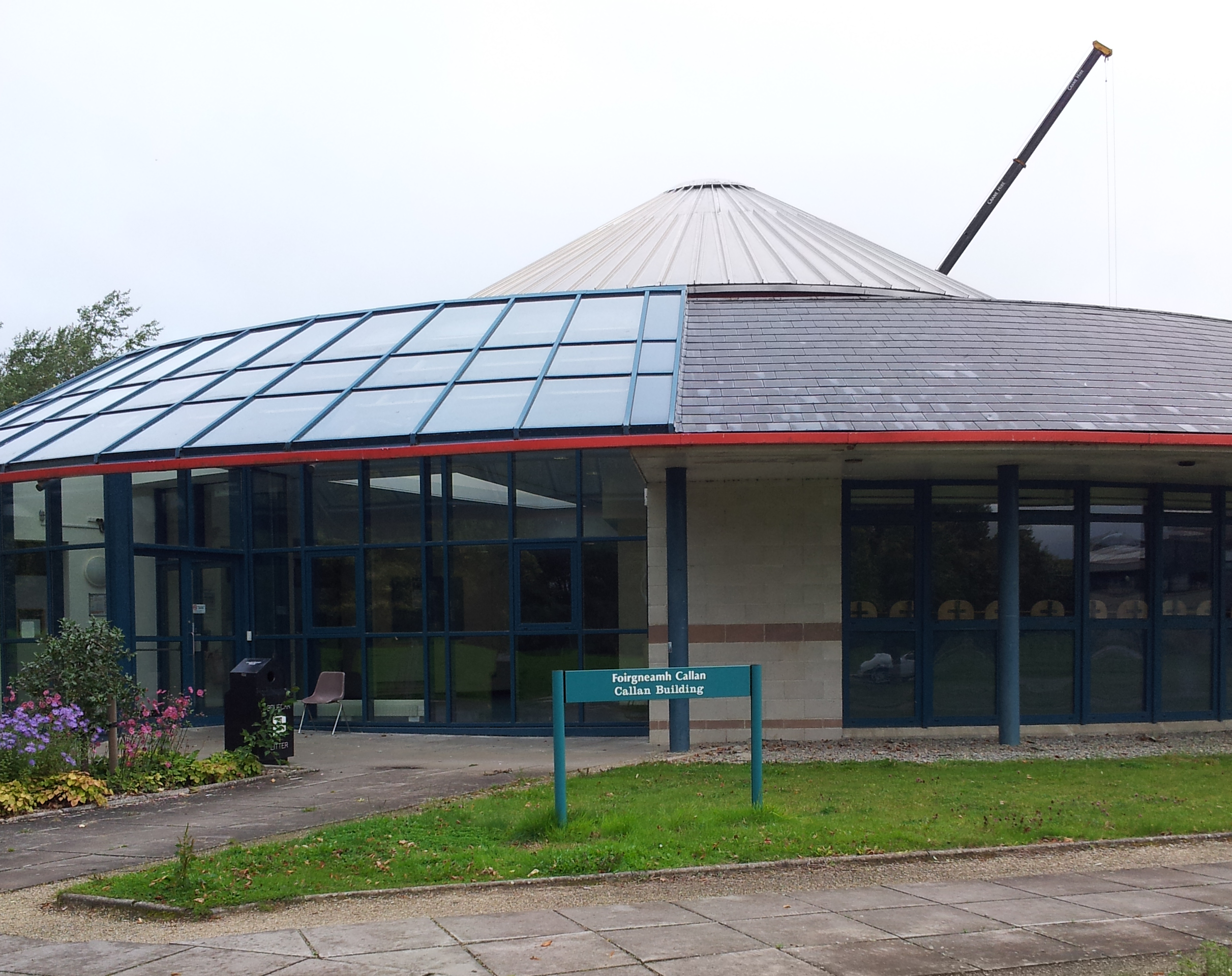
The Callan Building

Nicholas Callan was laid to rest in the College Cemetery at Maynooth in 1864. The Callan Building (above) on the North Campus of the present-day Maynooth University is named in his honour, as of course is Callan Hall which I mentioned at the start.