Archive for the History Category

The Necessity for De-Anglicising Irish Universities

Posted in Education, History with tags , , , , on November 17, 2019 by telescoper

Way back in 1892 Douglas Ross Hyde (who later became the First President of Ireland) delivered a famous speech to the Irish National Literary Society in Dublin on the subject of The Necessity for De-Anglicising Ireland. You can find the text of the speech here, and it’s well worth reading because much of what Hyde says is still relevant to the state of independent Ireland. It’s by no means a xenophobic anti-English rant, by the way, if that’s what you are tempted to infer it is based on the title.

I was struck by a theme which comes up repeatedly in Hyde’s speech. Here, for example:

It has always been very curious to me how Irish sentiment sticks in this half-way house –how it continues to apparently hate the English, and at the same time continues to imitate them; how it continues to clamour for recognition as a distinct nationality, and at the same time throws away with both hands what would make it so.

Having moved to Ireland to take up a position in an Irish university relatively recently I have been particularly struck by the tendency of those in charge of higher education in Ireland to copy slavishly the actions of the English government. I say `English’ specifically because higher education is devolved within the UK and there are different policies in Wales, Scotland and Northern Ireland. While it is true that we haven’t got a REF or a TEF yet or ridiculously high tuition fees, but that is probably just because of inertia. I wouldn’t be at all surprised if any or all of these were introduced before too long.

(As things stand students at Irish universities do not have to pay tuition fees as such but they do have to pay a `student contribution’ of up to €3000, which is a fee in all but name. There is more state help for disadvantaged students in Ireland than in England too. In most respects the situation here is similar to the regime that held in England prior to 2012, when £9000 year fees were brought in following the Browne Review. The question is whether England will cut university fees before Ireland gets round to increasing them. )

The current Irish government – which is of neoliberal hue – is presiding over a worsening situation in Irish universities, with funding for Irish undergraduate students failing to keep up with increasing numbers. It is hard to resist the feeling that starving the system of state funding is a precursor to increasing student fees to levels seen in England. At the moment English universities have the highest tuition fees in Europe. After Brexit it will be Ireland that takes that dubious honour within the EU.

The situation is even worse at postgraduate level, about which there seems to have been no thought whatsoever at government levels. In contrast to most European countries there is very little state funding for Masters courses in Ireland, so those wanting to do postgraduate degrees generally have to fund their own fees (over €6K per annum in physics) and living expenses. When final-year undergraduate students ask for advice about doing a Masters one is morally obliged to point out to them that they can do a high-quality course in, e.g., Germany or The Netherlands essentially for free, and that’s what many very able students do. Some might return, and bring their skills and knowledge back to Ireland but many won’t. The landscape of higher-education in Ireland does not encourage them to come back.

So what’s the answer to these woes? Well, it won’t solve everything, but a good start would be to stop looking at England for a way to run higher education and look instead at continental models. In this respect Brexit could prove to be an excellent opportunity for Ireland to reinvent itself as a fully European country. Over the years, largely driven by its membership of the European Union, Ireland has steadily reduced its economic dependency on trade with the United Kingdom and increased its connections with mainland Europe. Brexit will probably accelerate that trend.

I think that Ireland now needs to re-examine other sectors and stop the slavish copying of the idiotic policies of English politicians. It could do worse than to start with higher education.

Searching for Synge

Posted in History, mathematics, Television with tags , , on November 14, 2019 by telescoper

John Lighton Synge (above; 1897-1995), who was an expert on geometrical approaches to general relativity, was regarded by many as the most eminent Irish mathematician and physicist since Sir William Rowan Hamilton. Synge (whose uncle was the famous playwright John Millington Synge) was born in Dublin and had spells at Trinity College Dublin, the University of Toronto and various universities in the USA before taking up a position as Senior Professor at Dublin Institute for Advanced Studies (DIAS) in 1948 from which he retired in 1972.

I have been asked by a friend to find out if there are any video recordings of Synge talking or lecturing. A quick google search turns up nothing, so I thought I would put this request out into the blogosphere to see if anyone is aware of anything.

Given the dates it seems likely that any recordings of him would be originally on film (or perhaps television) which would have to be transferred to digital format. Perhaps there is archive material at Trinity College or DIAS that could be suitable?

Upcoming conference in Ireland on the history of physics

Posted in History, The Universe and Stuff on November 13, 2019 by telescoper

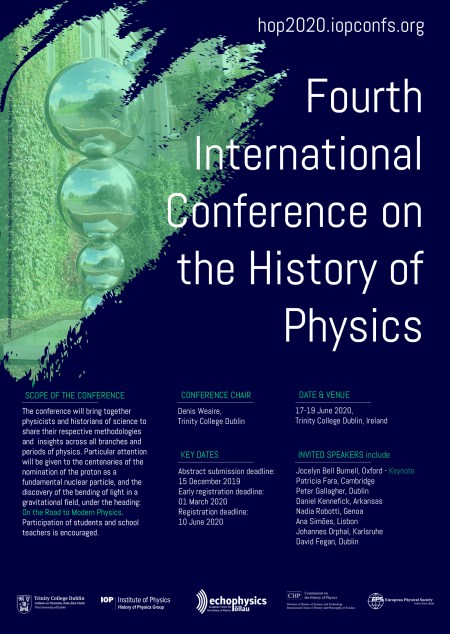
Much as I dislike the word “upcoming”, it is my pleasure to reblog this announcement about a conference to be held at Trinity College next summer (June 17th to 19th). In particular the deadline for abstracts is only a month away (December 15th) so if you would like to contribute a talk you have until then to submit an abstract!

cormac's avatarAntimatter

Just a quick post to highlight the fact that December 15th marks the deadline for submission of abstracts for the 4th International Conference on the History of Physics. The conference marks the fourth in a biennial series of meetings supported by the UK Institute of Physics and the European Physical Society that aim to bring together historians of science and physicists with an interest in the history of their subject and will take place at Trinity College Dublin on June 17th-19th. The website for the conference is here and previous iterations of the conference can be found here.

fiop-poster05112019

I have attended all three of the previous meetings of this conference series and they were most interesting. As the conference takes place in Ireland this time around, I have been heavily involved in the preparations, from chairing the scientific programming committee to attending regular meetings of the organizing committee…

View original post 79 more words

Newton’s Laws in Translation

Posted in History, Maynooth, The Universe and Stuff with tags , , on November 13, 2019 by telescoper

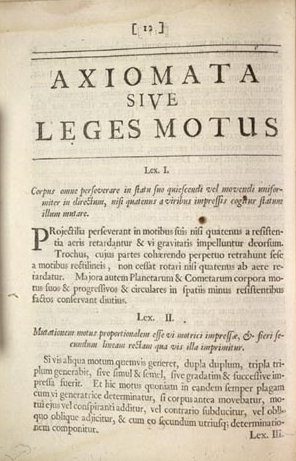
I’m about to do some lectures about Newton’s Laws of Motion to my first-year Mathematical Physics class so I thought I’d put up a quick post about how these laws have been expressed through the years. The original versions in the Principia (frontispiece above, first published in 1687) are of course in Latin. I did five years of Latin at school, but found most of the Principia impenetrable when I tried to read it in the original


The laws of motion are however fairly clear, perhaps because they are familiar in English:

Lex I: Corpus omne perseverare in statu suo quiescendi vel movendi uniformiter in directum, nisi quatenus illud a viribus impressis cogitur statum suum mutare.

Lex II: Mutationem motus proportionalem esse vi motrici impressæ, & fieri secundum lineam rectam qua vis illa imprimitur.

Lex III: Actioni contrariam semper & æqualem esse reactionem: sive corporum duorum actiones in se mutuo semper esse æqualeset in partes contrarias dirigi.

As I am teaching in a room in the old college here in Maynooth (which was founded in 1795), I looked for a contemporary English translation. This is from 1792:

Law I: Every body perseveres in a state of being at rest or of moving uniformly straight forward except insofar as it is compelled to change its state by forces impressed.

Law II: The alteration of motion is ever proportional to the motive force impressed; and is made in the direction of the right line in which that force is impressed.

Law III: To every action there is always opposed an equal reaction: or the mutual action of two bodies upon each other are always equal, and directed to contrary parts.

And finally here’s the modern version I was taught at School:

First Law: Every body continues in a state of rest or uniform motion in a straight line unless it is acted upon by an external (unbalanced) force.

Second Law: The rate of change of momentum of a body is proportional to the impressed force, and is in the direction in which this force acts.

Third Law: To every action there is always an equal and opposite reaction,

an alternative form of the Third Law being:

Third Law: If Body A exerts a force on Body B then Body B exerts a force on Body A which is equal in magnitude and opposite in direction.

Going back to the 1792 English translation, the exposition of the second law continues:

If a force generates a motion, a double force will generate double the motion, a triple force triple the motion, whether that force be impressed altogether and at once, or gradually and successively. And this motion (being always directed the same way with the generating force), if the body moved before, is added to or subtracted from the former motion, according as they directly conspire with or are directly contrary to each other; or obliquely joined, when they are oblique, so as to produce a new motion compounded from the determination of both.

If only Newton had known vector notation!


No More Poppies

Posted in Biographical, History, Politics with tags , , , , on November 9, 2019 by telescoper

Over the years I have written quite a few pieces on this blog, around the time of Remembrance Sunday, about the wearing of a poppy, the last being in 2016. I have worn a poppy at this time of year for most of my adult life, but in 2017 I decided to stop.

For one thing, there is no pressure to wear a poppy here in Ireland. Indeed, many Irish people see the poppy mainly as a symbol of British militarism and colonial oppression. At a concert to mark the Armistice last year I saw only a few audience members wearing a poppy, and most of them were the shamrock version commemorating the sacrifice of Irish soldiers during the Great War.

But I don’t think I’ve ever really been that susceptible to peer pressure, so that’s not the main reason for my not wearing a poppy. The main reason is that over the past couple of years the poppy has been appropriated by the likes of racist thug, career criminal and founder-member of the EDL, Stephen Yaxley-Lennon (also known as Tommy Robinson):

I simply cannot bring myself to wear the same badge as this horrible racist gobshite, nor can I stand the hypocrisy of those politicians who make a show of wearing it while happily encouraging the rise of nationalism that caused all the suffering just a century ago. The message of the poppy is supposed to be `Lest We Forget’. I’m afraid far too many have already forgotten.

I have a lecture on Monday 11th November at 11am, when the traditional two minutes’ silence to mark the 1918 armistice is observed. Fortunately, lectures at Maynooth run from five past the hour until five to, so I will be able to observe this on my own before I start the lecture. But I won’t be wearing a poppy.

Is it disrespectful to the war dead to refuse to wear a poppy? No, of course it isn’t. What is disrespectful to them is to seek to reoeat the mistakes that led to wars in the first place.

The Royal Society really needs to work on its history of the telescope

Posted in History, The Universe and Stuff with tags , , , on October 30, 2019 by telescoper

An important corrective to frequently repeated fallacies about the history of telescopes in astronomy. The Royal Society really shouldn’t be making mistakes like this!

thonyc's avatarThe Renaissance Mathematicus

One would think that the Royal Society being one of the eldest, but not the eldest as they like to claim, scientific societies in Europe when presenting themselves as purveyors of the history of science, would take the trouble to get their facts right. If, however, one thought this, one would be wrong. Last week on the Internet the Royal Society was pushing a slide show, under their own name, on Google Arts and Culture on the history of the telescope in astronomy that in terms of historical accuracy is less than one, as a historian of science, nay of the telescope, might hope or indeed wish for.

The slide show in question is titled, Silent Harmony: astronomy at the Royal Society: Discover how innovation in telescopes and other optical instruments changed the way we see the universe. Following the title slide we have another general blurb slide…

View original post 835 more words

Happy Birthday, Quaternions!

Posted in History, mathematics with tags , , , , on October 16, 2019 by telescoper

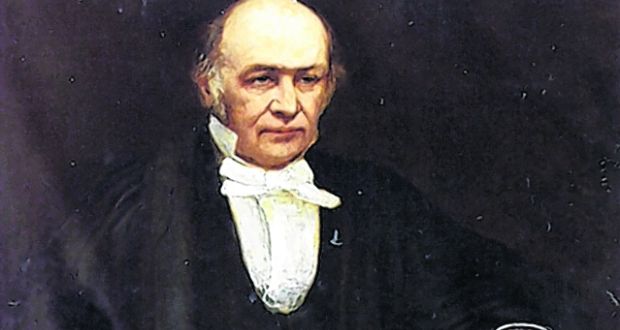
Sir William Rowan Hamilton (1805-1865)

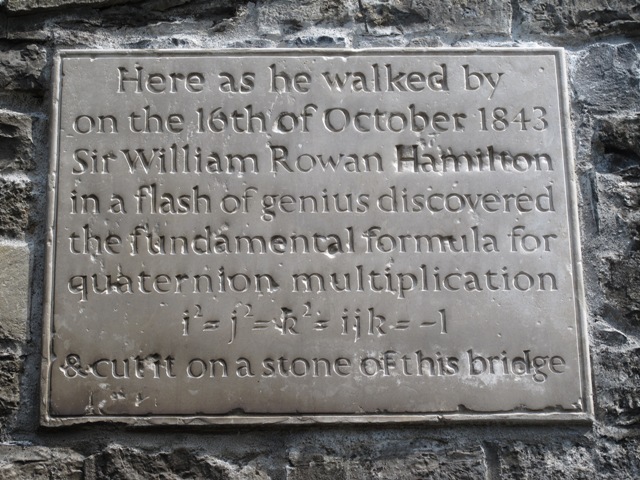
Today, October 16th, is Hamilton day! It was on this day 176 years ago, in 1843, that  William Rowan Hamilton first wrote down the fundamental result of quaternions. Apparently he was walking from his residence at Dunsink Observatory into Dublin when he had a sudden flash of inspiration  and wrote the result down on the spot, now marked by a plaque:


Picture Credit: Brian Dolan

This episode  is commemorated by an annual Hamilton Walk. Sadly,  Broombridge (Droichead Broome) is near the bridge (Broom Bridge) where Hamilton had his Eureka moment and it is on the main commuter line from Maynooth into Dublin. This is ironic because Quaternion algebra does not commute. (Geddit?)

Although it is quite easy to reach Broombridge from Maynooth, I sadly can’t attend the walk this year because I’m teaching this afternoon.

P.S. Maynooth is also home to the Hamilton Institute which promotes and facilitates research links between mathematics and other fields.

Dinner with Wagner

Posted in History, Opera with tags , , , on October 13, 2019 by telescoper

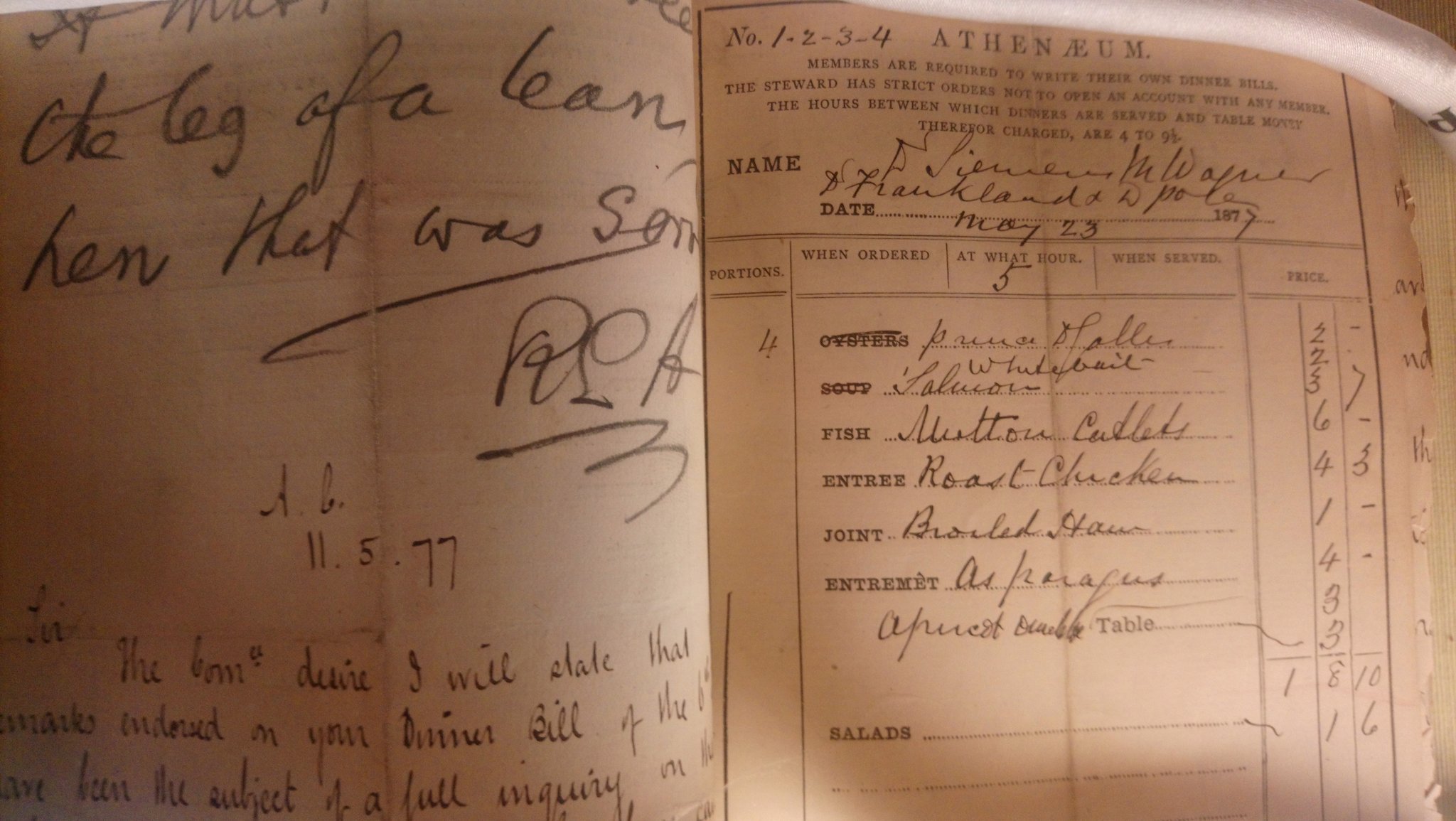
Before dinner with the RAS Club on Friday evening I was looking through the display cabinets at the Athenaeum and saw this, the record of a dinner involving a member and guests on 23rd May 1877. The member was electrical engineer, businessman and Fellow of the Royal Society Carl Wilhelm Siemens and among is guests was Richard Wagner:

Dinner started early and was evidently a lengthy affair, much like Wagner’s operas!

That reminds me of a famous review of one of Wagner’s operas by a critic who clearly wasn’t a fan.

Parsifal is an Opera by Richard Wagner that starts at half past five. Three hours later, you look at your watch and it’s quarter to six.

P.S. There is a photograph taken of Wagner (whose 64th birthday was on 22nd May) during his visit to London in 1877:

Culture Night (and Afternoon)

Posted in Art, Biographical, History, Maynooth, Music with tags , , , , , , , , , , , on September 21, 2019 by telescoper

I thought I’d do a quick round-up of my little trip around cultural and historic Dublin yesterday after being stood down from duty at the Higher Options fair at the Royal Dublin Society (RDS). I have to say it was wonderful to see so many people out and about in the City’s beautiful parks and public spaces enjoying the September sunshine as I walked around.

The RDS is in the Ballsbridge area in of Dublin, to the East of the City. My route into town from there took me along Northumberland Road, where I took this picture outside Number 25:

A little further along I went across Mount Street Bridge, passing this memorial.

If you want to know more about the significance of these memorials to the events of the Easter Rising in 1916, see my post here.

My main intention during my afternoon off was to visit the National Gallery of Ireland which is situated on one side of Merrion Square. I have to say that this was even better than I’d expected, and I’m sure to visit again many times in the future. The ground floor is dominated by the work of Irish artists from about 1660 to 1965, together with European Art from 1835 to 1965. You will find works by Monet and Picasso in this section, which has much to savour. Among the Irish artists represented in this show is Jack B. Yeats (brother of poet W.B. Yeats), an extremely interesting artist in his own right.

The highlights for me, however, were found on the 3rd floor which displays examples of European Art from the early Renaissance (c. 1300) to the Enlightenment. One of the interesting things about this collection is that it is arranged thematically rather than by artist (or nationality thereof). There is, for example, an entire room of paintings inspired and influenced by Caravaggio, all of them with an intensely dramatic use of light and shadow. The gallery is worth it just for that room, but there are also fascinating juxtapositions of religious paintings from the renaissance with icons and altarpieces from the Byzantine and Russian orthodox traditions from the same period.

Elsewhere in the collection there are notable works by Vermeer, Rembrandt and Perugino as well as a number of British works by, for example, Gainsborough and Reynolds.

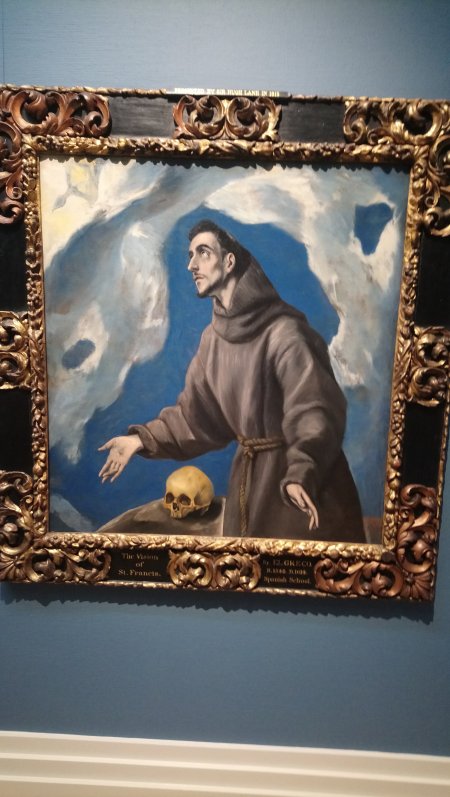
The work that really stopped me in my tracks, however, was this:

This is St Francis Receiving The Stigmata by El Greco. I knew about this painting but had no idea it was in Dublin. Seeing it close up is a revelation: the swirling brushstrokes give it an extraordinary texture that makes it hard to bring the image completely into focus. The hypnotic feel that results is a brilliant depiction of a man undergoing a kind of ecstatic vision. This work has an unbelievably powerful effect on the viewer (or at least on this one).

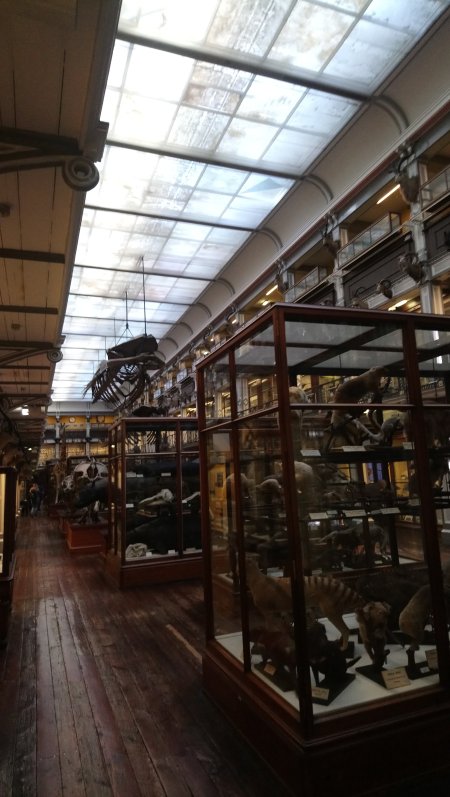
After a break for a sit down and a cup of coffee I visited the Natural History Museum (which is practically next door to the National Gallery). This is a surprisingly old-fashioned affair, with hundreds of stuffed animals and birds crammed into two large rooms:

It reminded me a lot of visits to the Hancock Museum in Newcastle when I was a kid. It’s interesting, but more than a little creepy and would make an excellent setting for a horror story!

After adjourning to a pub for a pint of Guinness the final stop of the day was the National Concert Hall for yesterday’s Culture Night concert. On the way there I saw a big queue of people trying to get into one of the many free events around Dublin. It turns out this Culture Night was the grand opening of the Museum of Literature Ireland, which is situated in Newman House on the South Side of St Stephen’s Green. There’s another one to put on my list of places to visit.

The Culture Night concert was by the RTÉ National Symphony Orchestra conducted by Leonard Slatkin. The opening piece, Kinah, was a composition by the conductor himself and is a sort of memorial to his parents, both of whom were classical musicians, one a violinist and the other a cellist, and together they formed half of the famous Hollywood String Quartet. It was a new piece for me, and I found it very moving indeed. After that there was a bit of reorganization on stage to make way for the Steinway on which the brilliant Xiayin Wang played the Piano Concerto by Samuel Barber, which consists of two fast and furious movements either side of a beautifully lyrical slower movement. This must be a ferociously difficult piece to play – especially the last movement which is at a breakneck pace in 5/8 time – requiring not only dexterity but physical strength. It was a wonderful performance by Xiayin Wang, who rounded off the first half with an encore in the form of a transcription of George Gershwin’s song The Man I Love.

After the wine break interval came the main course in the form of the Symphony No. 4 in E Minor by Johannes Brahms. This is of course a much more familiar work than the previous two, but I really like concerts that mix unfamiliar material with the standard concert repertoire. It also gave me the chance to persevere with Brahms as my friends keep telling me to. It’s not that I don’t like Brahms, it’s just that I don’t find that he moves me as much as many other composers and so many people rave about him that I think I must be missing something. The 4th Symphony is a very fine work, and was performed beautifully last night under the direction of Leonard Slatkin (conducting, incidentally, without a score), but I couldn’t stop myself thinking how much like Beethoven it sounds. That’s not meant to be derogatory, by the way.

But you don’t need to take my word for it. You can listen to (and watch) the whole concert here:

Anyway, after the applause had died down I headed out towards Pearse Station for the train back to Maynooth. I was a bit tired after a very full day and wanted to get the 10.08 train so I didn’t stop to watch any of the numerous musical and artistic events I passed on the way, including an intriguing installation involving images projected onto one of the buildings to the side of St Stephen’s Green. I made it to the station with 5 minutes to spare and discovered that, because it was Culture Night, the train home was free!

Operation Market Garden – 75 Years On

Posted in History with tags , , , on September 17, 2019 by telescoper

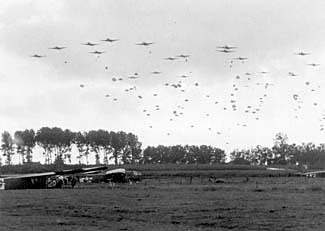
Seventy-five years ago today, on 17th September 1944, the largest airborne operation in military history began. Operation Market Garden (as it was called) saw about 35,000 Allied troops dropped by parachute or landed in gliders behind German lines in Holland, with the aim of seizing key bridges in order to allow infantry and armoured divisions to advance, eventually into Germany. Of more immediate tactical importance was that capture of the Northernmost bridges over the Rhine at Arnhem would prevent German reinforcements from moving South to confront the advancing troops, tanks and armoured vehicles of XXX Corps whose job was to punch a hole in the German defences and link up with the airborne troops.

Operation_MARKET-GARDEN_-_82.Airborne_near_Grave

Motivated by the belief that German armies in the West were exhausted and on the brink of collapse as well as the desire if possible to finish the war before Christmas, Operation Market Garden was daring and imaginative, but began to unravel right from the outset and ended as a disastrous failure, with the loss of many lives.

I’m not a military historian, so am not competent to add anything significant to the huge amount that has been written about what went wrong, but I will add a personal note. A cousin of my Grandfather flew to Arnhem with the 1st British Airborne division whose job was to take and hold the bridges over the Rhine that would open the door to an invasion of Germany. Sadly, he was one of those many troops who never even made it to their objective. In fact he was dead before he even hit the ground; his unit was dropped virtually on top of heavily armed German forces and had no chance of defending themselves. I had always been told that he had been dropped by parachute, but the records at the cemetery revealed that was wrong; he was on a glider which was badly shot up during its approach and crash-landed with no survivors.

The action at Arnhem actually involved two bridges, one a railway bridge at Oosterbeek, and the other a road bridge in Arnhem itself. British paratroopers did manage to capture one end of the road bridge, but never succeeded in securing both ends of the structure. Cut off from the much larger force pinned down near their landing zones they were eventually forced to surrender simply because they had run out of ammunition. The other units that landed near Arnhem never made their objectives and had to dig in and hope for reinforcements that never came. They fought a brave but desperate defensive action until 25th September when some were successfully evacuated across the Rhine. The original battle orders had specified they were to hold their ground for 48 hours until relieved by armour and infantry advancing rapidly from the South, but 30 Corps was heavily delayed by fighting, poor tactical decisions and congestion on the single road.

Some years ago, after attending a conference in Leiden, I took time out to visit Oosterbeek cemetery, where  1437 soldiers lie buried. Such was the chaos at Arnhem that bodies of fallen soldiers are still being discovered in gardens and woods; as there were so many dead that there was only time to bury them in shallow graves where they had fallen. As remains are discovered they are removed and reburied in Oosterbeek. When I visited the cemetery about 25 years ago, there were several brand new graves.

At the time of Market Garden the local people looked on in horror as their potential liberators were cut down. It must have been deeply traumatizing for them. I think it is telling that when, in 1969, the British Army proposed bringing to an end the annual ceremonies in commemoration of these events, local Dutch civilians insisted that they continue.

As I stood by the grave I couldn’t help thinking of how lucky members of my generation are that we have not been called on to make such a sacrifice. Now I fear deeply that the rise of nationalism and xenophobia, not least in Britain, threatens to the peace in Europe that has held for almost 75 years.

The failure of Operation Market Garden had other terrible consequences. The winter of 1944/45 was a terrible time one for Dutch civilians in the part of their country that had not been liberated, with many thousands dying from hunger and the bitter cold.

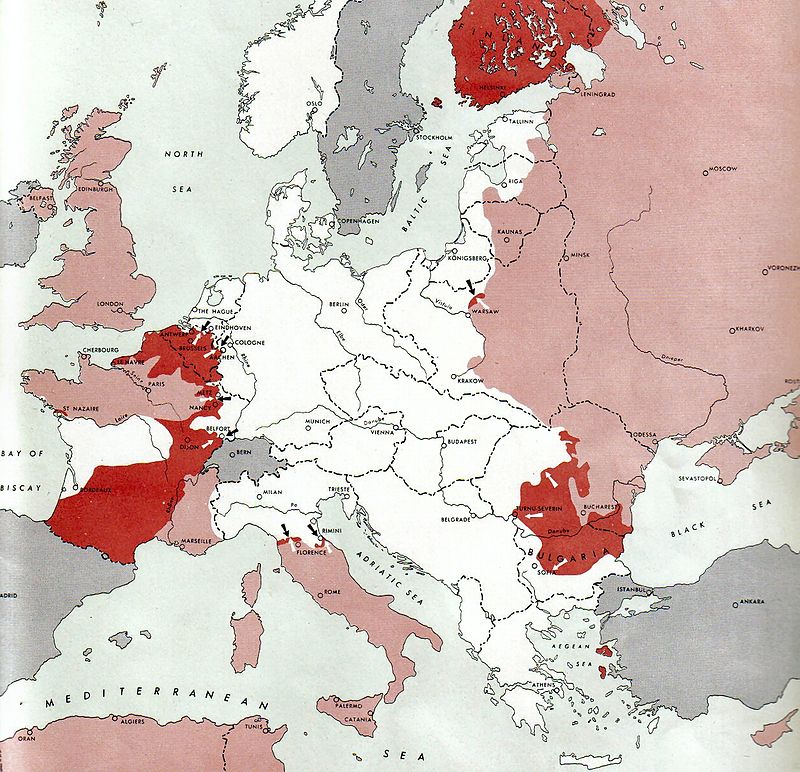
And of course had the Allies succeeded in penetrating into Germany in 1944, the post-war map of Europe would probably have been very different. This is how the front lines were drawn in mid-September 1944, with the Western Front and Eastern Front roughly equidistant from Berlin.

(By Army Map Service – Document “Atlas of the World Battle Fronts in Semimonthly Phases to August 15th 1945: Supplement to The Biennial report of the Chief of Staff of the United States Army July 1, 1943 to June 30 1945 To the Secretary of War”, Public Domain, Link.)

Had Market Garden been successful would there have been 45 years of Cold War?