Archive for the History Category

Collapse at Sophia Gardens

Posted in Cardiff, History with tags , , on January 10, 2017 by telescoper

If the title of this post attracted the attention of cricket fans then I apologize, because it’s not about goings-on at the SWALEC Stadium in Cardiff but at the Sophia Gardens Pavilion which no longer exists (for reasons which will become obvious) but was an entertainment and exhibition venue built in 1951 as part of the Festival of Britain celebrations. You can see a (rather hilarious) Pathé News item about a fashion show held there in 1952 here.  It was also the venue in 1958 for the Empire and Commonwealth Games, held between July 18 and 26th, for boxing and wrestling matches. Owing to post-war austerity, the supply of building materials was heavily controlled so it was necessary to adapt a war surplus aeroplane hangar to provide the framework for the Pavilion. The hangar was obtained from Stormy Down aerodrome near Pyle, Bridgend in late 1949. The cost of dismantling and transporting it was £3,400 and rebuilding it in Sophia Gardens was estimated to cost £40,000. The Pavilion when completed seated approximately 2,500 people, and the final cost of construction was £80,000. It was opened officially on Friday 27th April 1951.

I was about to leave the office just now when I was reminded – by Derek The Weather – that at this time of year in 1982 (i.e. 35 years ago) Cardiff was in the grip of exceptionally severe weather. In fact it started snowing heavily on 7th January and carried on for 48 hours without a pause. It snowed so heavily, in fact, that the weight of snow caused the roof of the Sophia Gardens Pavilion to collapse:
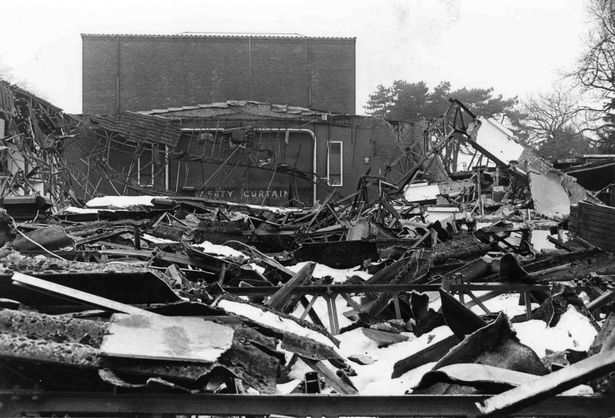
cardiff-sophia-gdns

Fortunately no-one was inside. After the roof collapsed the Pavilion was demolished and the land it stood on is now a car park (a little way South of the cricket ground). I don’t know precisely when this event occurred, but it had happened by 13th January 1982. I know this because he collapse of the building led to the cancellation of a concert due to take place there on 13th January 1982 by Black Sabbath, which is apparently a popular beat combo of some sort.

Anyway, it looks like we’re due for some snow in the UK over the next few days although perhaps not in Cardiff and perhaps not heavy as 1982. Strangely, I have no memory of 1982 being a particularly severe winter. I was living in Newcastle at the time, but the weather maps suggest the severe conditions covered most of the country.

The “Pont” in Pontcanna

Posted in Cardiff, History with tags , on January 10, 2017 by telescoper

Regular readers of this blog (Sid and Doris Bonkers) will know that I currently reside in an area of Cardiff known as Pontcanna, which is part of the administrative district of the city known as Riverside.  Although Pontcanna does have a distinct identity as a community, there’s no precise definition that I can find of exactly where it is. Even Cardiff City Council doesn’t really recognize its existence: all my official mail has  “Riverside” in the address. Although I tell everyone I live in Pontcanna, I don’t have any official evidence that I do!

I’ve also often wondered about the origin of the name, as it definitely suggests a bridge of some sort (Pont is Welsh for bridge, cf  the French) and there are no bridges in the area. The name Canna is generally taken to refer to Saint Canna, whose name  is also associated with Canton, an area of modern Cardiff adjacent to Riverside but until the 19th Century a village in its own right. Since this is a very old name it’s logical to infer that the bridge is no more. However, the thing that always puzzled me is that the area of Pontcanna is actually quite small, and actually not all that close to the River Taff (the main river through Cardiff), which is even further from Canton, so there’s no obvious site for a bridge to have been, even if the bridge itself is long gone.

A chance conversation in a pub the other day however led me to a website that offers a solution to this conundrum., namely that the “Pont” in Pontcanna does not relate to a bridge over the River Taff, but over a small brook that used to run through the area shown on old maps and known (in English)  as the “White House Brook”.  This interpretation also casts doubt on the idea that “Canna” has anything to do with Saint Canna: it is possible that it derives instead from an old Welsh verb meaning “to whiten” although I’m by no means confident in that.

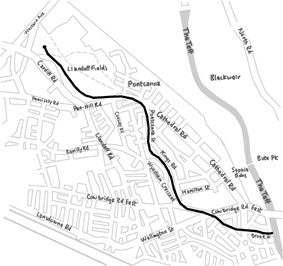
Here, according to my source, is the route of this brook:

cannamap

I’m sorry it’s low resolution, but it’s basically an annotated scan of a historical map. You can compare that with a modern map of the area around my house:

pontcanna

The River Taff can be seen to the upper right of the modern map. The White House Brook ran down what is now Cathedral Road before turning along the route of what is now Pontcanna Street. 

Construction of the  large houses on Cathedral Road, and others on surrounding streets, began around 1896, at a time when Cardiff’s population was expanding rapidly. Prior to that this area was mainly farmland, with a few cottages here and there. It is also part of the River Taff flood plain and was criss-crossed with ditches containing small streams, of which the White House Brook was the largest.

As the area became developed, water from these streams was diverted to form the sewer system for the new buildings and the White House Brook progressively dried up. What little remains of it now runs in a culvert, which eventually empties into the Taff.

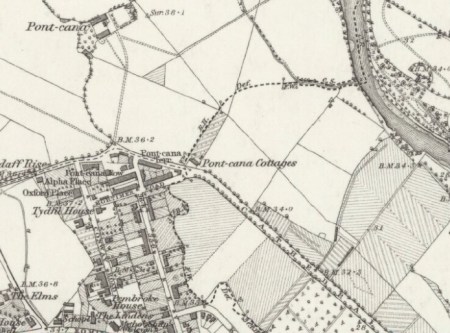
The bridge presumably disappeared at the same as the brook went underground around 1896, but the most likely candidate for it is a small bridge that stood near a row of cottages that lay between a small church (at the site of the Presbyterian Chuch on Gileston Road, marked on the modern map) and the end of what is now Teilo Street. These can be seen on this map, which  Bryn Jones directed me to (see comment below):

pontcanna_1886

The “Pont-cana cottages” (sic) were also demolished to make way for the new houses on Cathedral road and new roads either side of it. The best guess for the site of the bridge is close to the junction between Teilo Street and Cathedral Road. Note that in the first  map, Pontcanna is marked to the River Taff side of Cathedral road which is probably where the bridge was situated, very close to the end of my street. I feel more justified than ever in saying that I live in Pontcanna!

P.S. This map also shows another location marked “Pont-cana” to the North, on what are now called Llandaff Fields. I think refers to Pontcanna Farm, presumably named after the bridge. Perhaps the Pontcanna cottages may have been homes for farm workers?

P.P.S. Incidentally, I learned from this site that until 1858, Cathedral Road was only accessible by paying a toll at a booth on Cowbridge Road! Even in the old days, Pontcanna was an exlusive area!

The Trumpet Shall Sound

Posted in History with tags , , , , , , , on December 15, 2016 by telescoper

Following on from yesterday’s post about Handel’s Messiah I thought I’d include this very nice performance of The Trumpet Shall Sound, featuring the excellent bass voice of Alastair Miles with Crispian Steele-Perkins playing the solo trumpet part. One of the reasons for posting it – other than the obvious one (that it’s great) – is that I was thinking about it after Tuesday’s  concert.  The trumpet part at the performance I went to was played (superbly) by Dean Wright on a modern (valved) trumpet, but that wasn’t invented until many years after Handel’s time.

The historical development of the trumpet is a fascinating story but the most interesting technical developments actually happened long after Handel wrote Messiah (which was in 1741).  The keyed trumpet – a forerunner of the modern valved variety – wasn’t invented until the late 18th Century. In fact Joseph Haydn wrote his Trumpet Concerto specifically to demonstrate the capabilities of this instrument; that piece wasn’t first performed until 1800. The modern valved trumpet didn’t begin to appear until about 1818. Before that orchestras used the natural trumpet, which has no valves or other means of controlling the flow of air through the instrument and is therefore only really capable of playing harmonics (rather like a bugle).  Other notes can be generated, but only with some difficulty, using the lip. This kind trumpet is the sort of instrument that would have been played in Handel’s time. The so-called baroque trumpet  is actually a 20th century invention created for musicians who want the “period sound” of  a natural trumpet but with the additional flexibility that comes from having “vents” in the tube that can be covered with the fingers. This is the kind of instrument that Crispian Steele-Perkins is playing in the video. It is valveless but has two finger holes which the trumpeter can close and open with the thumb and little finger of the right hand for fine pitch control.


The Great Rewrite: Secularism and Nineteenth-Century Wales

Posted in History, Politics on November 27, 2016 by telescoper

Lengthy but fascinating piece about the rise of secularism in Wales. I’m a member of the National Secular Society, by the way.

Campaigners pay tribute to Fidel Castro, ‘most iconic post-1945 beard wearer’

Posted in History on November 26, 2016 by telescoper

R.I.P. Fidel Castro. He had his faults, but there’s no denying the cultural significance of his beard..

kmflett's avatarKmflett's Blog

Beard Liberation Front

Media Release

26TH November

Keith Flett 07803 167266

Campaigners pay tribute to Fidel Castro, ‘most iconic post-1945 beard wearer’

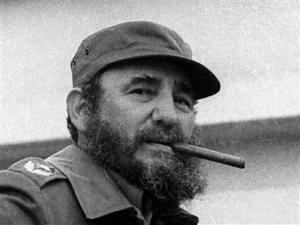
castro2

The Beard Liberation Front, the informal network of beard wearers, has paid tribute to Fidel Castro, who has died at 90, as the most iconic post-1945 beard wearer.

Castro, like Che Guevara, did not always have facial hair but grew a beard as his politics moved to the left in the 1950s.

Subsequently his beard came to be seen as a symbol, worldwide, of opposition to US foreign policies in the 1960s

A 1975 US Senate Intelligence Committee heard that in the 1960s the CIA believed that if Castro’s beard fell out this would undermine his standing with the Cuban people. Plots were hatched to put thallium salt in Castro’s cigar or his shoes which would have caused his beard hairs to fall out.

The plots were…

View original post 45 more words

November 18th 1916: The End of the Somme Offensive

Posted in History with tags , , , on November 18, 2016 by telescoper

If you think a lot has happened between this summer and now, it is perhaps worth reflecting on the fact that the Battle of the Somme, which started on July 1st 1916, only came to an end on November 18th 1916, i.e. one hundred years ago today. The last phase of the Somme Offensive was the Battle of the Ancre which lasted from November 13th until November 18th. Though the key objective (of eliminating a German salient) was not met, and casualties were heavy, this battle is considered a qualified success for the British Army, who secured the key position of Beaumont Hamel, though the village itself was almost completely destroyed during the fighting:


beaumont-hamel

The battlefield at Beaumont-Hamel, taken in November 1916

Incidentally, Beaumont-Hamel had seen fighting since the very first day of the Battle of the Somme. On July 1st 1916, 700 men of the Newfoundland Regiment gave their lives there as they went “over the top” and were promptly mown down by machine guns. There is an important memorial to their sacrifice there.

The statistics of the Somme Offensive are truly horrific. In total well over a million men were killed or seriously wounded during the 141 day campaign. By the time it finished the British, French and Commonwealth armies had advanced a maximum of about 6 miles. Most historians describe the outcome as “inconclusive”, largely on the grounds equal numbers of soldiers were slaughtered on each side.  It was a stalemate, but the price paid in blood was appalling.

The carnage didn’t end with the Somme. As the “Great War” stumbled on, battle after battle degenerated into bloody fiasco. Just a year later the Third Battle of Ypres saw another 310,000 dead on the British side as another major assault on the German defences faltered in the mud of Passchendaele. By the end of the War on 11th November 1918, losses on both sides were counted in millions.


A Question of Morality

Posted in History, Politics with tags , , on November 14, 2016 by telescoper

I floated the following hypothetical question on Twitter yesterday and was quite surprised at the response, so I thought I’d repeat it here and see what the reaction is.

Please make your choice before reading my opinion below the line.

Continue reading

The Last Post – Cardiff University Remembers

Posted in History with tags , , , , on November 11, 2016 by telescoper


If you think a lot has happened since July 1st this year, pause a moment to reflect on the fact that 100 years ago today the Battle of the Somme was still raging.


Lest we forget.

Morbid Symptoms and the Optimism of the Will

Posted in History, Politics with tags , on November 9, 2016 by telescoper

trump

So there we are then. It will soon be President Trump and I won my compensation bet, though to be honest I would have preferred to lose it. I have quite a number of friends and colleagues from the USA and all were distraught when it became clear that Trump was going to win. Perhaps not surprisingly, I don’t know any Trump supporters, either from the USA or elsewhere.

I’m not going to try to offer consoling platitudes. It must be an even scarier time for them than it is for the rest of us Citizens of the World. In the absence of anything better, all I can do is say that I’m so very sorry for the pain they’re feeling now.

I’m not going to attempt any sort of analysis of what led to Trump’s victory either. There’s a lot of twaddle already filling up the internet, much of which isn’t at all illuminating despite being written with the benefit of hindsight.

I will say, however, that the quote that sprang into my head when I checked the news on waking up this morning was the following, from Antonio Gramsci (from The Prison Notebooks, c1930):

The crisis consists precisely in the fact that the old is dying and the new cannot be born; in this interregnum a great variety of morbid symptoms appear.

Or if you prefer the original Italian:

La crisi consiste appunto nel fatto che il vecchio muore e il nuovo non può nascere: in questo interregno si verificano i fenomeni morbosi piú svariati.”

It seems to me that the old order – in the form of a broad consensus that has held in Western democracies since the end of World War 2 – is collapsing. Events like the election of Donald Trump and BrExit vote in the UK do not, however, represent the construction of a new order but are merely the death-bed convulsions of the old.

What the new world order will look like depends on what new political alignments and forms of governance can be established and whether this transformation takes place by peaceful and democratic means. I think there will be considerable social and economic upheaval in the next few years, and this will be a dangerous time if factions attempt to impose their will by violent means. It seems to me that what is vital is for people to be offered a positive vision for the future, something which today’s politicians – especially those on the left – seem unable or unwilling to do. Some of political parties may not survive, but then if they have outlived their usefulness or relevance then there’s no reason for them to.  What happens will depend entirely on who grasps the opportunities that this period of uncertainty will undoubtedly create. Clinging in despair to the wreckage of the past will put us in no position to grasp anything.

So I’ll end with another quote from Gramsci:

I’m a pessimist because of intelligence, but an optimist because of will.


Why I’m wearing a poppy again

Posted in Biographical, History with tags , , on November 2, 2016 by telescoper

Once again we’re coming up to Remembrance Sunday, an occasion to remember those who have given their lives in conflicts past and present. This is always held on the second Sunday in November in the United Kingdom, which means that this year it is on 13th November, so that it is close to the date of anniversary of the armistice that formally ended the First World War, which happened on 11th November 1918. Another way to commemorate this  is the observance of two minutes’ silence at 11am on 11th November itself. I plan to do that, next Friday  (which is the 11th November). I’ve kept my calendar free at 11 am precisely for that purpose.

Then there  is the wearing of a poppy. The poppy appeal raises money for veterans and their families, but the wearing of these little red paper flowers is something that not everyone feels comfortable with. Some people think that to wear a poppy is to celebrate militarism or even Britain’s imperialist past. I don’t see it that way at all. In fact, if someone asked me to wear a badge to support Britain’s participation in the invasion of Iraq, I’d certainly refuse.

I wrote about my reaction to the horror and futility of war some time ago, so I’ll try not to repeat myself except to say that, to me, the poppy is not about celebrating war or military prowess or imperialism, it’s simply about remembering those who died. In fact, one of the main reasons the paraphernalia of  Remembrance Day observances (the Poppy, the Cenotaph, the Tomb of the Unknown Soldier, etc) were set up in the first place was to remind not just people but also governments of the devastation caused by World War One. That’s why the Remembrance Day ceremonial laying of wreaths takes place in Whitehall, right at the heart of government. The ritual  was specifically intended to be a warning to the politicians who had brought the conflict about not to allow it to happen again.

As a young lefty student I grappled with the implications of the poppy appeal. The Peace Pledge Union produces white poppies, as an overtly anti-war symbol of remembrance. For a time I wore a white poppy but, although I am against war, I don’t think a policy of non-violence would have helped much against Hitler’s Nazi regime and therefore can’t really call myself an out-and-out  pacifist. One year I wore both white and red poppies, but since then I’ve decided to stick with a red one.

Of course many in the Establishment would like the poppy to turn into a symbol of obedience, a kind of alternative national flag. Some people choose not to wear it precisely because it has that implication. The sight of some hypocritical warmongers wearing the poppy at the Cenotaph on these occasions sickens me, but their betrayal does not make me want to stop wearing it myself. Neither does the fact that so many seem to be so contemptuous of the great strides that have been made over the past decades to try to construct a Europe defined by peaceful cooperation rather than by narrow-minded nationalism and conflict. The parallels between Britain in 2016 and Germany in 1933 seem to me to be frighteningly real,  and I fear very much for the future if we carry on in the direction we seem to be taking. All I can say is that I’m glad I’m not young.

People have  a wide range of views about the poppy and its meaning. There is no “right” answer – every person’s attitude is shaped by a number of factors, not least by whether or not they have lost a loved one in any form of armed conflict.  Some of us wear wear a poppy, some don’t. It’s a matter of choice. The fact that we have a choice is important in itself. I would probably refuse to wear a poppy myself if someone tried to make it compulsory.

Some poppy sellers use the slogan  Wear Your Poppy With Pride, but the original meaning  is much better expressed by the original, Lest We Forget. I’m not sure I wear mine with pride at all, in fact. What I feel is really more like shame, at the wastefulness and stupidity of armed conflict. I count myself incredibly lucky that I have never had to live through anything like that, not only because I’ve had a relatively peaceful and comfortable life, but also because I have never been tested in the way previous generations were. I wear the poppy to acknowledge their bravery and to recognize my own good fortune.  When I stand for the two minutes silence I remember those all who fell fighting on all sides of all wars, and  fallen civilians too.

When the newsreader Jon Snow decided not to wear a poppy on TV, there were angry complaints. I’m sure he didn’t mean disrespect to the cause but disliked the pressure being put on him to conform. I can see his point. It has to be voluntary if it is to mean anything at all.  But in the end I agree with Euan Ferguson’s piece in the Observer a few years ago:

I don’t like pressure being put on people to conform. Orthodoxy and fear are always to be regretted and today’s society is over-condemnatory, swift to its manufactured outrage. But this change seems to have come from below, not been ordered by bullies: the daily reports of life and death in the forces, of the danger other 20-year-olds daily find themselves facing. And is the symbolism of the poppy being degraded as it is customised? No. You can’t do much to the fabulous simplicity of this symbol. And the poppy doesn’t preach: it’s not about “right” or “wrong” wars, but about brave dead soldiers. And the message was, never, Remember in the way we tell you to remember. It is, simply, Lest We Forget.

So, yes. I am wearing a poppy again this year. You can decide to wear one if you wish. You can also decide not to.  It’s entirely up to you.  That’s the whole point really. It’s called Freedom.

Lest we forget.