Archive for the History Category

Jacob van Artevelde

Posted in History with tags , , , on July 17, 2016 by telescoper

image

This statue stands in the Vrijdagsmarkt (“Friday Market”) in Ghent just round the corner from the hotel I stayed in last week. It is of
Jacob van Artevelde , a merchant turned statesman who brokered an alliance with Edward III during the early stages of the Hundred Years War. Flanders had close commercial ties with England at the time and Artevelde thought it would be very bad for business to be on the wrong side of the conflict.

The statue is supposed to show Artevelde pointing in the direction of England, but it isn’t aligned correctly.

Artevelde was very close to the Plantagenet royal family. His son, Philip, being the godson of the Queen, Philippa of Hainault, and named in her honour.

Incidentally, among the actual sons of Philippa of Hainault was John,  who happened to be born in Ghent, which for some reason was rendered in the English of the time as “Gaunt”. John of Gaunt was the first Duke of Lancaster, and founded the House of Lancaster, which gave us Henry IV to Henry VI (inclusive).  In fact (or at least in Shakespeare) it was the eldest son of John of Gaunt, Bolingbroke, who deposed Edward III’s successor Richard II and thus became Henry IV..

Last Day of MaxEnt2016

Posted in Biographical, History, The Universe and Stuff with tags , , on July 15, 2016 by telescoper

This week has gone very quickly. It is already the last day of MaxEnt2016. Tomorrow I’m returning by train to the UK. Last night was a very nice conference dinner at a place called Parnassus (which is actually a deconsecrated church). That was after a very enjoyable afternoon of sightseeing through two guided tours, one on foot and the other by boat.

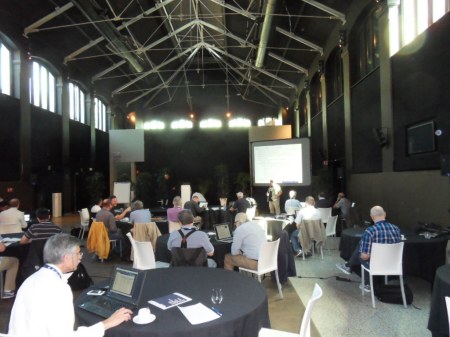
This morning is the last session in the conference venue Oude Vismijn. Here is a snap taken in between talks this morning:

SAMSUNG DIGITAL CAMERA

MaxEnt2016

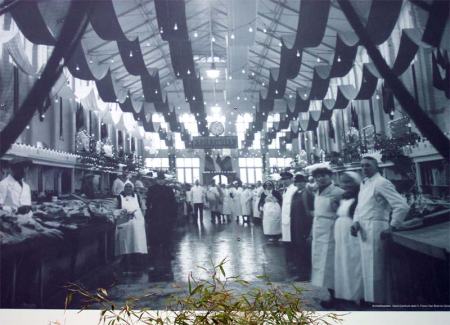
In olden days this hall looked more like this:

vismijn3

Given the location it’s a pity I didn’t think to put a joke in my talk about the Poisson distribution. Geddit?

Over the last few days the City of Ghent has been preparing for the annual Ghent Festival (Gentse Feesten) which has involved the construction of dozens of temporary structures including stages for the bands to play on, and many tents of various sizes for beer consumption). The Festival goes on for 10 days and the first night is tonight. I’m told it’s very noisy in the city centre, which is where my hotel is, so I’m not sure I’ll get much sleep tonight as the festivities go on round the clock!


Emily Dickinson’s Desk

Posted in History, Poetry with tags , on July 15, 2016 by telescoper

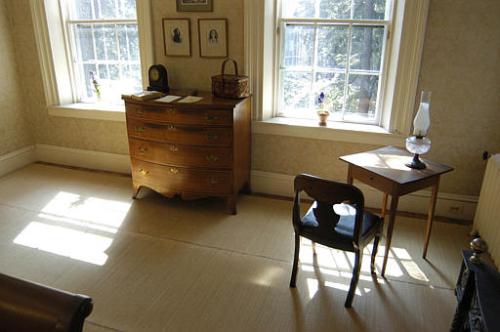
Here’s a fascinating post about the poet Emily Dickinson. Apparently she wrote all her poems sitting at that little square table!

malcolmguite's avatarMalcolm Guite

Emily's desk Emily’s Desk

Whilst I was speaking at a CS Lewis conference in Amherst I had the opportunity to visit Emily Dickinson’s house, now beautifully preserved as the Emily Dickinson Museum. And so I came to stand in that ‘mighty room’ where all the poems were written, and there, plain and simple and strangely, paradoxically, small was her little desk: a small square writing table.  I was filled with wonder at how much had flowed from so small a space, but then I thought about Dickinson’s characteristically concentrated and terse verse forms; those compact and concentrated little quatrains with the emphatic dashes linking and yet binding in the energy of her phrases, and it seemed to me the smallness of the desk was itself part of the form of the poetry, part of her gift.

Anyway the whole experience stirred me on to this: (as always you can hear…

View original post 88 more words

Egmont

Posted in History, Music with tags , , , on July 12, 2016 by telescoper

It was just brought to my attention that one of the historical landmarks of Ghent, the location of the conference I am currently at, is the home of Lamoral, Count of Egmont whose execution in 1568 sparked an uprising against Spanish occupation that eventually led to the independence of the Netherlands. The house itself is extremely old, being built in 1200 from roman bricks.

Egmont was also the inspiration behind Beethoven’s  famous overture played here in suitably dramatic style by the Berlin Philharmonic under the direction of Herbert von Karajan.


Chilcot Reactions

Posted in History, Politics with tags , , , on July 6, 2016 by telescoper

At long last, the Chilcot Report on the UK’s involvement in the 2003 Iraq War has now been published. It’s a mammoth document which can obtain in full here. Even the Executive Summary is 150 pages long.

I’m going to put my cards on the table straight away. I opposed the invasion of Iraq in 2003 and have never wavered from that opposition. I would feel vindicated were I not so saddened by the agony the invasion unleashed.

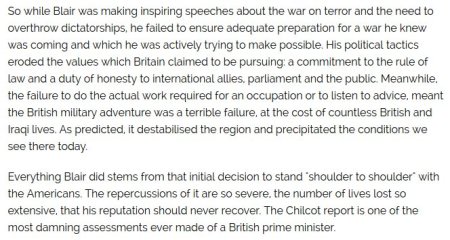
I’m not going to pretend to have read the whole document, or even all of the Executive Summary, but all the reaction I’ve seen suggest that it is unequivocal in its condemnation of the (then) Prime Minister, Tony Blair. Here is an example:

Chilcot

I sincerely hope that Blair’s reputation will not recover, and indeed hope that some form of legal redress can be sought against him. Attention in this country is focussing on the 179 service personnel who lost their lives in Iraq either during, or as a direct result of, the invasion of Iraq. However, let’s not lose sight of the fact that it was the Iraqi people who suffered most – over 150,000 are thought to have been killed, though such is the chaos of a country ruined by invasion and its aftermath that the true figure will never be known.

A few days ago we remembered the thousands who died on the Somme with the words “Lest we forget”. We shouldn’t forget Blair either…


The Day Sussex Died

Posted in History with tags , , , on June 30, 2016 by telescoper

In advance of tomorrow’s sombre commemorations of the centenary of the start of the Battle of the Somme, I thought I’d write a short preliminary piece about a related centenary to be marked today, 30th June 2016.

On this day in 1916 there took place the Battle of the Boar’s Head, the name given to a German salient near Richebourg-l’Avoué in the Pas de Calais region. This battle is remembered locally here in Brighton as The Day Sussex Died. The following brief account is based on the wikipedia article.

The attack on the Boar’s Head was launched on 30 June 1916, as an attempt to divert German attention from the Battle of the Somme which was to begin on the following day, 1 July. The attack was conducted by the 11th, 12th and 13th (Southdowns) Battalions of the Royal Sussex Regiment, part of the 116th Southdowns Brigade of the 39th Division.

A preliminary bombardment and wire-cutting by the artillery commenced on the afternoon of 29 June and was reported to be very effective. The final bombardment commenced shortly before 3:00 a.m. and the 12th and 13th battalions went over the top (most for the first time) shortly afterwards, the 11th Battalion providing carrying parties. The guns lifted their fire off the German front trench and put down an intense barrage in support. The infantry reached the German trenches, bombing and bayoneting their way into the German front line trench and held it for about four hours.

The second trench was captured and held for only half an hour, during which several counter-attacks were repulsed and then the raiders withdrew, because of a shortage of ammunition and mounting casualties. The German support position was not reached by the infantry, because the German defensive tactics included shelling trenches where the British had gained a foothold.

In fewer than five hours the three Southdowns Battalions of the Royal Sussex lost 17 officers and 349 men killed, including 12 sets of brothers, three from one family. A further 1,000 men were wounded or taken prisoner.

The corps commander looked upon the attack as a raid and considered it to be successful.

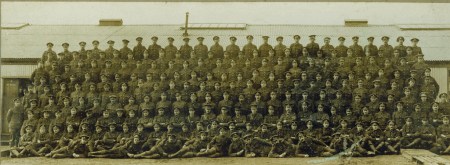
Here is a photograph of A Company of the 13th Battalion of the Royal Sussex Regiment, taken shortly before the battle; by its end, over 80% of these men were dead.

BoarsHead

The losses at the Boar’s Head were shortly to be dwarfed by the horrendous scale of the slaughter on the Somme, but their impact  on families and indeed whole villages in rural Sussex was devastating.  Those who lost their lives in armed conflict should never been forgotten, nor should their sacrifices be appropriated for political ends.

Lest we forget.


Why I think the United Kingdom should remain in the European Union

Posted in Biographical, History, Politics on June 19, 2016 by telescoper

These last few weeks have been absurdly busy, and even without Thursday’s referendum, next week promises to be even busier. I will, however, definitely make time to vote and I urge you to do the same, whichever way you feel inclined to cast your ballot.

A number of my friends and colleagues have been posting on social media about why they plan to vote for one side or the other, or in some cases already have voted ( by postal ballot), so I thought I’d do the same today. I don’t suppose my ramblings will change anyone’s mind, and that’s not the reason for posting this anyway. It’s just a personal opinion, that’s all. It’s fine if yours is different. I have friends who disagree strongly with what I’m going to say, but we’re still friends. There’s no reason to think that will change whichever way the vote goes, although I am deeply worried about what damage the campaign has done to British political culture (which was deeply flawed before it started).

Let me start with a bit of biography that might explain why I see things the way I do. I was born in Wallsend on Tyneside in 1963. My parents were both born just before World War 2 started also in the area where I was born. Of my four grandparents, one was born in England, one in Northern Ireland, one in Scotland, and one in Wales. I always smile when I get to right my nationality on a form, because I put “United Kingdom”. Of course being born in England makes me English too, but I find that less defining than “UK” or even “Geordie”. To be honest, my ancestry means that  I generally find the whole concept of nationality fundamentally silly. I find nationalism silly too, except for those occasions – regrettably frequent – when nationalism takes on the guise of xenophobia.  Then it is much more sinister. That is happening now in the United Kingdom, a point I will return to later.

I don’t come from a wealthy background. Holidays abroad were an unaffordable luxury when I was a kid. In fact, the only members of my immediately family ever to venture abroad before I did for the first time (in 1986) were my grandfather’s brother (who died at Arnhem in 1944), his cousin (who died at the Salerno landings in 1943), and my uncle Richard who crossed the Rhine with the British Army in 1945 and was stationed in the devastated city of Hamburg for the duration of his National Service; he at least survived the War.

I had the good fortune to be born during a time of peace and relative prosperity, and have experienced immense good fortune in my life. I got a scholarship to go to a very good school and thence won a place at Cambridge University, where I did well enough to go onto a PhD here at the University of Sussex. Thirty years ago last summer, when I was 23, I went abroad for the very first time – to a cosmology conference in Cargèse, in Corsica. Since then I’ve had the opportunity to travel widely in Europe and beyond, meeting and working with some wonderful people. What little sense of nationality I started with has diminished steadily with time, and I now have no difficulty at all in adding another label to my identity: European. I’m British and I’m European. And proud to be  both. That statement alone has led to me being called a “traitor”, such are the depths to which this wretched referendum campaign has sunk. Fortunately I an nowhere near sufficiently important or prominent for anyone to assassinate.

The United Kingdom joined the European Economic Community (as it was then called) in 1973, when I was ten years old. The EEC morphed into the EU in 1993, but in some form or another it has been a fact for all of my adult life. There is no question in my mind that Britain’s membership has been has been very good for Britain and for the other member states. We pay a subscription to the modern EU that amounts to around 0.5% of our public spending and for that we get preferential access to a free market that gives us around ten times as much back in trade and inward investment.

My career in science gives a perspective on this too. The UK is a member of the European Southern Observatory (ESO), the European Organization for Nuclear Research (CERN) and the European Space Agency (ESA), all of which have been stunningly successful. None of these are actually European Union organizations. ESO and CERN were founded in the 1950s and ESA in the 1970s, all before the EU formally came into existence. But they do serve as models for why the EU is such a good thing in a wider sense than the science that they do. Members of ESO, CERN and ESA pay a subscription which amounts to a pooling of resources into a pot far bigger than any individual country could manage. Each organization is run by a council that makes collective decisions on where and what to invest. The UK has a strong influence on those decisions. By being a member it has a seat at the table and a voice in the discussions. The net result is that each of these organizations is much more than the sum of its parts.

fat cut

That model that works so well for ESO, CERN and ESA is basically the model for the European Union. Even when they’re not lying about the cost of membership as the official Vote Leave campaign consistently does, people tend to talk in a very short-sighted way about the amount we pay and how much we get back. That’s the wrong way to look at it. The point is that, just as with scientific organizations,  the EU is more than the sum of its parts. Pooling some resources and doing things collectively does, for certain things, give a value way beyond the relatively small amount we invest. But remember that we only pool 0.5% of our public funds in this way. It’s an astonishingly good deal. And, what’s more, it’s mutually beneficial. The UK benefits and the other EU member states benefit too. It’s not “us” versus “them”, it’s “we”.

Now I know that BrExit advocates will say. “You profit from EU grants! You’ve been bought off by the EU! You’ve a vested interest!” I’ve been attacked on social media repeatedly for having the temerity to argue that EU membership is as good for science as it is for everything else. But the fact of the matter is that the accusation is completely false. My own research is wholly funded from UK sources. I don’t have any EU funding at all. Even if I had I’d still have a right to express my opinion, but I don’t. I haven’t been “bought off” by anyone. I’ve thought about the issues and come to my own conclusion. You can do that in a free country.

The EU is by no means perfect. I think it could be made more accountable, more democratic. I understand those concerns, but I do feel that they’re hard to justify coming from one of the least democratic countries in Europe. We have an entirely unelected House of Lords, and a House of Commons that has delivered an overall majority to a party with a minority share of the popular vote. Pot calling the kettle black?

I think the economic, educational, cultural and societal benefits of EU membership have been discussed widely in the referendum campaign so I won’t repeat them here. I’ll just say that I think the benefits are immense, and the risk to this country if they are lost is huge.

But there is one reason over and above all this why I shall be voting to Remain in the EU. For this I will quote note other than Boris Johnson, who wrote just two years ago in his biography of Winston Churchill:

It was his (Churchill’s) idea to bring those countries together, to bind them together so indissolubly that they could never go to war again – and who can deny, today, that this idea has been a spectacular success? Together with Nato the European Community, now Union, has helped to deliver a period of peace and prosperity for its people as long as any since the days of the Antonine emperors.

I won’t comment on why Boris Johnson has changed his mind, but I agree with that statement. It brings me back to the bit of personal family history with which I started this post. I have been lucky enough to live in the period of “peace and prosperity” described in that quote. I am sorry my grandfathers’ generation was not so lucky. I don’t have any children of my own, but  I categorically refuse to take any step that would risk any future generation having to endure the same horrors.

And then there’s this.
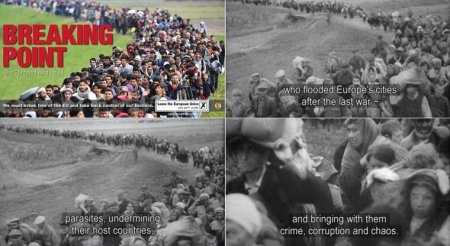
Nazi_UKIP

The top left image shows  a poster produced by the UK Independence Party. The other three are taken from a Nazi propaganda film of the 1930s. The historical parallels are obvious and not accidental. This is indeed “Breaking Point” indeed. It’s the point the BrExit campaign descended into the gutter.

Of course I’m not saying that all those who want the UK to Leave the EU are fascists. Far from it. Many – indeed the majority – are reasonable, civilised people. But like it or not, if you vote Leave you’re voting the way the far right want you to vote. I for one will not take a single step in that direction. Fascism only needs a foot in the door. I fear that the domestic political consequences of BrExit will give it far more than that. Once they get hold of it, we’ll never get our country back.

One final point. On Thursday I will definitely vote for the United Kingdom to remain in the EU. However, Article 50 of the Lisbon Treaty allows any member state to leave the European Union, and sets a protocol for how this can be achieved. This demonstrates that the UK has sovereignty over its own affairs, thus defeating one of the central arguments of the Leave campaign.

 

Flaming June Again

Posted in Art, Biographical, Bute Park, History with tags , , , , on June 10, 2016 by telescoper

Since we’re in the middle of a modest heatwave I thought “Flaming June” would be a good title for a blog post. Until a few years ago I always thought that “Flaming June” was some sort of folk expression or quotation from a poem, but it is instead the title of this Pre-Raphaelite painting by Frederic Leighton of a lady wearing what looks like a dress made out of old curtains. Apparently the oleander branch seen in the upper right symbolizes the fragile link between sleep and death. It looks to me like she must be attending a lecture…

But I’m rambling. This has been an exhausting week, probably because I a few days off last week and have come back to one of the busiest periods of the academic year. The examination period is over so there are scripts to mark,  examiners’ meetings, class lists and the like, all parts of the arcane business of academic life. In fact I’ll be spending the first three days of next week in Cambridge where I’m External Examiner for Physics, and I have a lot to do here before I go.

In between all the meetings I had to attend yesterday I noticed that it was the 9th of June, a date of enormous cultural significance for those of us born on Tyneside, as Geordie Ridley’s famous music hall song The Blaydon Races begins “I went to Blaydon Races, ’twas on the 9th of June… The original Blaydon Races were horse races and site of the course is long since gone, but the name has recently been resurrected as a road race involving people on foot rather than on horseback. Incidentally, the usual “Whit Week” holiday in late May or early June is still referred to on Tyneside as “Race Week”.

All this reminded me of the occasion – over twenty years ago – when I entered the Great North Run for the first time. Nowadays this race – the biggest mass participation half-marathon race in the world, with 50,000 competitors – is run in September, but in those days it was held in June. As it happened, there was also a heatwave the first time I did it. I remember lining up at 9.30 on a Sunday morning on the start grid (I was number eleven thousand and something) while the stewards went round pleading with all the participants to take plenty of water as they went around as it was going to be very hot indeed and they didn’t want people suffering from dehydration.

In those days I was quite a keen long-distance runner and was fairly fit. I wasn’t that concerned about the heat but took the advice to heart and determined to stop at all the water stations on the way from Newcastle to South Shields. When we started I also took care not to go off too fast over the first mile or so, which is basically all downhill from the Town Moor to the Tyne Bridge. Not that you could go fast anyway, as the track was so crowded with runners.

I remember the wonderful feeling as we emerged onto the Tyne Bridge and took in the splendid view of the bridges along the river. When we got to Gateshead the crowds were out in large numbers cheering everyone on and I felt completely elated. The first water station was near Gateshead athletics stadium, and I took a drink there as I did at the next, and the next. After Gateshead the route heads towards the Felling bypass at about 4-5 miles and then the runners can see a long climb in front of them. A large thermometer showed the temperature on the road to be about 45 Celsius. Fortunately the people living in houses either side of the road were out in their front gardens offering encouragement and sometimes had their hoses out to shower people as they went past. At one point there was a fire engine that had made an impromptu fountain by the side of the road too.

Unfortunately, as I near the ten mile mark I started to feel a bit strange. I had never actually taken on water while I was running before this race; I never felt the need for it when on training runs. My stomach wasn’t used to the water sloshing around while I was running. I felt quite sick by the time we got to the top of the climb but when I saw the sea and felt its breath on my face I cheered up and descended the steep downward slope towards the seafront near Marsden Rock.

There’s a good mile and a half along the seafront to the finish, however, and I was definitely struggling really badly by then. I could see the finish line but it felt like it wasn’t getting any closer. I slowed to a crawl but kept going, finally reaching the grandstand where a large crowd shouted encouragement. I must have looked dreadful because I heard several people shouting out my number along with “keep going, son”  and “you’re nearly there”.

Eventually I got to the finish line but the feeder lanes were quite busy then – I was finishing at about the peak  time of about 1hr 50 – so I was forced to slow right down because of the people in front of me.

As I crossed the line, I stopped running and was immediately overcome with nausea. I bent over, hands on my knees and emptied the contents of my stomach – mainly water – all over the grass. I felt absolutely dreadful but, after a quick check from the St John Ambulance crew who were on hand, I recovered and found my folks who were nearby. After we got home and I had a shower I felt fine.

About a week later, when I had returned to my flat in London a letter arrived for me. I opened it up and found a small passport-sized photograph, with the caption “YOUR MOMENT OF TRIUMPH”. It turns out there was an automatic camera near the finishing line that snapped everyone crossing it along with a shot of the digital clock showing their finishing time. The idea is that you could order a blow-up of the picture for £25 to put on your wall.

In my case, though, the picture showed not a moment of splendid athletic achievement, but a bedraggled creature puking uncontrollably while those around him looked on in disgust. I didn’t order the blow-up of my throw-up.

Over the years I did the Great North Run a number of times – six or seven, I don’t remember exactly – and a few marathons too, but the strain of running on the roads around London gradually told on my knees and I had to stop because of recurrent pain and swelling. Eventually, a few years ago I surrendered to the inevitable and had arthroscopic surgery to sort out the damage to my knee joints. That seems to have fixed the problem, but my running days are over.


Too windy for Zeppelins

Posted in History on May 31, 2016 by telescoper

Fascinating recreation of the weather pattern at the Battle of Jutland

Philip's avatarOld Weather Blog

100 years ago today – 31st May 1916, saw the start of a major fleet action between the British and German navies: The battle of Jutland.

This is right in the middle of the period covered by the original oldWeather project, so you’d think we had all the logbooks and observations, at least from the British half of the battle, but alas, it’s not so. The Grand Fleet sounds impressive, and with as many as 40 major warships surely was impressive, but it didn’t travel much: The doctrine of ‘Fleet in being’ means that all those battleships stayed in port as a threatening influence rather than travelling to distant locations, and that puts them right at the bottom of our priority list for transcription, and we’ve never looked at them.

So we don’t have the Grand Fleet, but we can still reconstruct the weather of the battle, and…

View original post 276 more words

The Battle of Jutland

Posted in History with tags , , , on May 30, 2016 by telescoper

I’m going to be away for the rest of the week so I thought I’d mark the centenary of the Battle of Jutland a little early. In fact this battle, by far the largest naval engagement of the First World War, started  on 31st May 1916 and carried on into the early hours of the morning of 1st June when the German fleet, under Vice Admiral Reinhard Scheer, retreated. It took place in the North Sea off the western coast of the Jutland peninsula, and is referred to in Germany as the Battle of the Skagerrak, the strait that separates Jutland from southern Norway.

At the time of the battle are that Germany was under a naval blockade imposed by the Royal Navy, the main parts of which were organised into a “rapid response” fleet of cruisers and battle-cruisers (led by Admiral Sir David Beatty) and a “Grand Fleet” of larger but slower battleships (under Admiral Sir John Jellicoe). Knowing that his combined forces were much smaller than those of the British, so he couldn’t afford to take them on head to head, Scheer’s plan was to draw out and destroy as much as possible  of the lighter British fleet before the heavier ships could react. The problem was that the British had deciphered German communications that revealed a major operation was under way, so in fact the Grand Fleet left its base in Scapa Flow on May 30th, 100 years ago today.

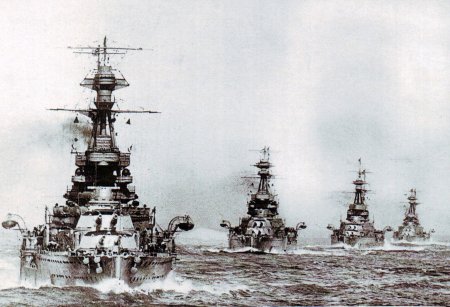
Jutland_grand_fleet

HMS Barham Valiant Malaya & Warspite heading to the Battle of Jutland on May 31st 1916

The first engagement, which turned out to be a preliminary skirmish, went very much in Germany’s favour, and two of Beatty’s battlecruisers were sunk. However, he then used his fleet to lure the German ships towards Jellicoe’s forces and battle was joined between the two main fleets. The outcome of this battle in terms of lost men and material was clearly in Germany’s favour. They exploited numerous technical deficiencies in the British ships  as well as tactical errors by their commanding officers, and ended up sinking 3 battlecruisers, 3 armoured cruisers, and  8 destroyers for the loss of 1 battlecruiser, 1 pre-dreadnought, 4 light cruisers and 5 torpedo-boats. In terms of casualties it was even clearer: over 6,000 were killed on the British side compared to just over 2,500 on the German side.

One other thing is clear, the cautious Jellicoe missed at least two opportunities to secure a decisive victory. The first came when  Scheer’s fleet first encountered the British Grand Fleet. Staggered to see the massed battleships of Jellicoe’s force precisely where it shouldn’t have been, Scheer turned his entire flight around  to the West. Jellicoe didn’t follow it, but instead turned to the East. He could have sprung the trap but didn’t. Later on he compunded this decision by allowing the German ships to slip through his formation under the cover of darkness, back towards their base, after the battle proper had ended.

The strategic outcome of the Battle of Jutland is a bit harder to judge. Some have argued that although it was a tactical defeat it was a strategic victory. The naval blockade indeed remained in place until 1918 and it undoubtedly contributed to the eventual defeat of Germany. Seen in that light, Jellicoe’s decision not to take risks to secure an outright victory is quite understandable. He didn’t need an outright victory, he just needed to keep the German flight bottled up. A draw was fine. To others, Jellicoe had simply messed up. Winston Churchill described Jellicoe as “the only man on either side who could lose the war in an afternoon”.

Jutland became a PR disaster when the British government failed to inform the public what had happened and allowed the Germans to gain a huge propaganda victory. It got worse when battered ships laden with dead and badly wounded sailors arrived at their home ports. Jellicoe was soon removed from his position as commander of the Grand Fleet and given a desk job as First Sea Lord. Beatty replaced him.

Anyway, that was all 100 years ago. It’s not such a long time by historical standards, but at least now another war between Britain and Germany is unthinkable, and has been for over 70 years. Let’s keep it that way.