Archive for the History Category

Peterloo 16th August 1819: why it is important to remember

Posted in History on August 16, 2015 by telescoper

A perspective on the Peterloo Massacre, which took place on this day in 1819.

P.S. For those of you unfamiliar with the location of the Peterloo Massacre, it was at St Peters Fields, Manchester (iin the Midlands).

kmflett's avatarKmflett's Blog

Peterloo 16th August 1819- why it is important to remember

____________________________________________________________________________-

16th August marks the 196th anniversary of the Peterloo Massacre at St Peters Field in Manchester.

peterloo

As EP Thompson noted in the Making of the English Working Class Peterloo, even in an age when the internet, mobiles and social media had never been thought of, was an event of national significance.

The numbers of dead and injured when the Manchester Yeomanry rode into a peaceful crowd protesting for the vote has never been finally substantiated, but aside from those killed it ran into hundreds in terms of those who received injuries from sabres or horses hooves.

Peterloo had several lasting impacts. One was the 1832 Reform Act. Another was the Manchester Guardian. The founder of the paper, Taylor, was a persistent critic of the Magistrates actions at Peterloo.

The detail of what took place on St…

View original post 488 more words

Astronomy: One of the Seven Liberal Arts

Posted in Art, Education, History, The Universe and Stuff with tags , , , on July 20, 2015 by telescoper

This morning I came across this picture (via @hist_astro on Twitter):

Seven Liberal ArtsIt is by Giovanni dal Ponte and was painted in or around 1435; the original is in the Museo Nacional del Prado in Madrid. It depicts the Seven Liberal Arts which, in antiquity were considered the essential elements of the education system. The Arts concerned are: Grammar, Rhetoric, Dialectic, Astronomy, Arithmetic, Geometry and Music. Appropriately enough, Astronomy is in the middle.

I suspect some of you may have noticed that there are more than seven figures in the painting. That’s because each of the Liberal Arts is itself represented by a (female) figure, presumably a Goddess, and also a famous character associated with the particular discipline. Second from the right, for example, you can see Arithmetic accompanied by Pythagoras, who seems to be trying to copy from her notebook. Astronomy. In the centre, kneeling at the feet of Urania (the muse of Astronomy) is Ptolemy..

It’s quite interesting to look at the structure of a Liberal Arts education as it would be in classical antiquity. The first three subjects (Grammar, Rhetoric and Dialectics) formed the Trivium (from which we get the English word “trivial”). “Grammar” means the science of the correct usage of language, knowledge and understanding of which helps a person to speak and write correctly; “Dialectic” basically means “logic”, the science of rational thinking as a means of arriving at the truth; and “Rhetoric” the science of expression, especially persuasion, which includes ways of organizing and presenting an argument so that people will understand and hopefully believe it. These may have been considered trivial in ancient times, but I can’t help thinking that we could do with a lot more emphasis on such fundamental skills in the modern curriculum.

After the Trivium came the Quadrivium: Arithmetic, Geometry, Astronomy and Music all of which were considered to be disciplines connected with Mathematics. Presumably these are the non-trivial subjects. We might nowadays consider Astronomy to be a mathematical subject – indeed in the United Kingdom astronomy was until relatively recently generally taught in mathematics departments, even after the rise of astrophysics in the 19th Century. On the other hand, fewer would nowadays would recognize music as being essentially mathematical in nature. Historically, however the connections between music, mathematics and natural philosophy were many and profound.

Of course there are now many other disciplines and it would be impossible for any education to encompass all fields of study, but I do think that it’s a shame that modern education systems are so lacking in breadth, as they tend to emphasize the differences between subjects rather than what they all have in common.

Pluto and the Pavilion

Posted in Biographical, Football, History with tags , , , , , on July 14, 2015 by telescoper

This is a busy week in many ways and for many reasons, but the main activity revolves around Graduation at the University of Sussex; the ceremony for graduates from my School (Mathematical and Physical Sciences) takes place on Thursday which gives me a couple of days to practice the pronunciation of the names I have to read out!

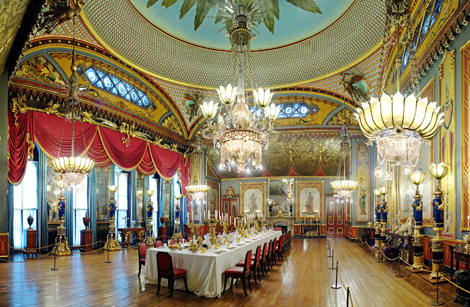
Anyway, last night there was a very Commemoration Dinner in the Dining Room of Brighton Pavilion:

Brighton_Pavilion_Dining_room

The decor is a little understated for my tastes, and in any case I was among a group of about 40 guests who were seated elsewhere owing to the popularity of the event. In fact I was in the Red Drawing Room, which as its name suggests is, er, red:

5_royal_pavilion_red_drawing_room

Anyway, the dinner itself was splendid with particularly fine wine to boot. One of the topics of conversation was the forthcoming flypast of Pluto by the NASA New Horizons spacecraft. As the token astrophysicist on my table I tried my best to answer questions about this event. In fact the closest approach to Pluto takes place about 12.50 pm today (BST) but it will take some time for the images to be downloaded and processed; data transmission rates from the outer edge of the Solar System are rather limited! After passing Pluto, the spacecraft will carry on out of the Solar System into interstellar space. One thing I didn’t know until this morning was that the discoverer of Pluto, Clyde Tombaugh, expressed a wish that when he died his ashes should be sent into space. In fact, they are on New Horizons,  being carried past the planet object he found just 85 years ago. I find that very moving, but it’s also so inspiring that such a short time after Pluto was discovered a spacecraft is arriving there to study it. We humans can do great things if we put our minds to them. Science provides us with constant reminders of this inspirational fact. Unfortunately, politics tends to do the opposite…

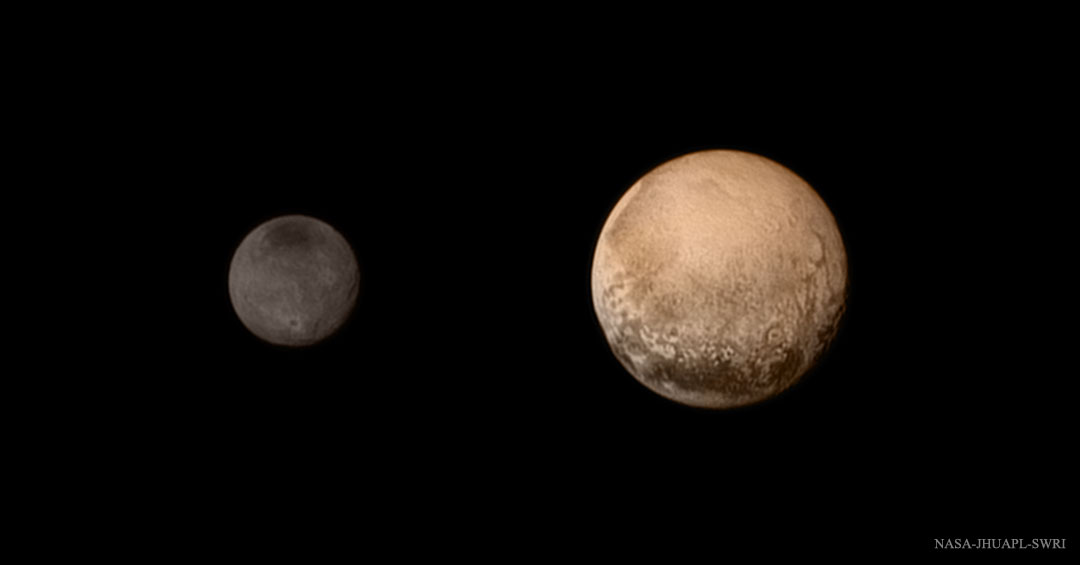
I hope to provide a few updates with images from New Horizons if I get time. Here to whet your appetite is today’s stunning Astronomy Picture of the Day, showing Pluto and its largest moon, Charon, in the same frame:

PlutoCharon01_NewHorizons_1080

Here’s a close-up of Pluto from yesterday:

Pluto_yesterday

And if that isn’t enough, click here for a simulation of the detail we expect to see when New Horizons reaches its closest approach to Pluto.

Stonewall and After – in Praise of Drag Queens

Posted in Biographical, History, LGBTQ+ with tags , , , , on June 28, 2015 by telescoper

Despite not being able to go to the big event in London yesterday, it’s been a very memorable Pride Weekend, preceded as it was by the ruling of the Supreme Court of the United States of America that the right for same sex couples to get married was protected under the constitution. The White House responded to the judgement in appropriate style:

white-house-rainbow-3

I’m tempted to quote Genesis 9:16, but I won’t.

My facebook and twitter feeds have been filled with rainbows all weekend, as is my wordpress editor page as I write this piece. It’s been great to see so many people, straight and gay, celebrating diversity and equality. Even a Dalek joined in.

Gay Dalek

I’m a bit more cynical about the number of businesses that have tried to cash in on  Pride but even that is acceptance of a sort. It’s all very different from the first Pride March I went on, way back in 1986. That was a much smaller scale event than yesterday’s, and politicians were – with very few exceptions – notable by their absence.

In fact today is the anniversary of the event commemorated by Pride. It was in the early hours of the morning of Saturday June 28th 1969 that the Stonewall Riots took place in the Greenwich Village area of New York City. There are few photographs and no film footage of what happened which, together with some conflicting eyewitness accounts, has contrbuted to the almost mythical status of these demonstations, which were centred on the Stonewall Inn (which, incidentally, still exists).  What is, I think, clear is that they were the spontaneous manifestation of the anger of a community that had simply had enough of the way it was being treated by the police. Although it wasn’t the first such protest in the USA, I still think it is also the case that Stonewall was a defining moment in the history of the movement for LGBT equality.

One of the myths that has grown up around Stonewall is that the Stonewall Inn was a place primarily frequented by drag queens and it was the drag queens who began the fight back against intolerable  police harassment. That was the standard version, but the truth is much more complicated and uncertain that that. Nevertheless, it is clear that it was the attempted arrest of four people – three male (cross-dressers) and one female – that ignited the protest. Whether they led it or not, there’s no doubt that drag queens played a major role in the birth of the gay liberation movement. Indeed, to this day, it remains the case that the “T” part of the LGBT spectrum (which I interpret to include Transgender and Transvestite) is often neglected by the rest of the rainbow.

I have my own reasons for being grateful for drag queens. When I was a youngster (still at School) I occasionally visited a gay bar in Newcastle called the Courtyard. I was under age for drinking alcohol let alone anything else – the age of consent was 21 in those days – but I got a kick out of the attention I received and flirted outrageously without ever taking things any further. I never had to buy my own drinks, let’s put it that way.

Anyway, one evening I left the pub to get the bus home – the bus station was adjacent to the pub – but was immediately confronted by a young bloke who grabbed hold of me and asked if I was a “poof”. Before I could answer, a figure loomed up behind him and shouted “Leave him alone!”. My assailant let go of me and turned round to face my guardian angel, or rather guardian drag queen. No ordinary drag queen either. This one, at least in my memory, was enormous: about six foot six and built like a docker, but looking even taller because of the big hair and high heels. The yob laughed sneeringly whereupon he received the immediate response of a powerful right jab to the point of the chin, like something out of boxing manual. His head snapped back and hit the glass wall of a bus shelter. Blood spurted from his mouth as he slumped to the ground.

I honestly thought he was dead, and so apparently did my rescuer who told me in no uncertain terms to get the hell away. Apart from everything else, the pub would have got into trouble if they’d known I had even been in there. I ran to the next stop where I got a bus straightaway. I was frightened there would be something on the news about a violent death in the town centre, but that never happened. It turns out the “gentleman” concerned had bitten his tongue when the back of his head hit the bus shelter. Must have been painful, but not life-threatening. My sympathy remains limited.

I think there’s a moral to this story, but I’ll leave it up to you to decide what it is.

(Almost) Fifty Years of Astronomy at Sussex

Posted in Education, History with tags , on June 19, 2015 by telescoper

I came across this booklet earlier this morning, whereupon I realised that Thirty is about to turn into Fifty…

Astronomy_30

The date on the front of the booklet is November 1996, but inside it explains that the content is based on a seminar given at Sussex about a year earlier. In fact the first MSc students in Astronomy started in October 1965. However, they were all part-time students (they were all staff at the Royal Greenwich Observatory which at that time was in Herstmonceux, Sussex) and none graduated until 1967. The 40th anniversary of that graduation was recognized with an event in 2007. The first full-time staff astronomer arrived in 1966, along with the first full-time MSc students. The first MSc students to graduate did so in 1967.

In fact I joined the Astronomy Centre at Sussex as a DPhil student in October 1985, 20 years after the arrival of the first cohort.

It’s interesting to note that originally astronomy existed at Sussex only as a postgraduate course. The attitude in most Universities in those days was that students should learn all the necessary physics before applying it to astronomy. Over the years this has changed, and most departments offer some astronomy right from Year 1. I think this change has been for the better because I think the astronomical setting provides a very exciting context to learn physics. If you want to understand, say, the structure of the Sun you have to include atomic physics, nuclear physics, gravity, thermodynamics, radiative transfer and hydrostatics all at the same time. This sort of thing makes astrophysics a good subject for developing synthetic skills while more traditional physics teaching focusses almost exclusively on analytical skills.

Anyway, I’m now left with a quandary. Should Fifty Years of Astronomy at Sussex be celebrated in 2015, 2016 or 2017?

Answers on a postcard please….

The Meaning of Magna Carta

Posted in History, Television with tags , , on June 15, 2015 by telescoper

Today (15th June 2015) is the 800th anniversary of the signing of Magna Carta. To mark the occasion here is a short educational video explaining the meaning and significance of this important historical event:

Cricket Quiz

Posted in Cricket, History on June 13, 2015 by telescoper

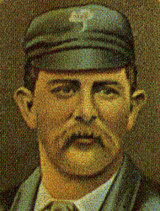
Too lazy to do a proper post today, I though I would try a little cricket quiz. This legendary cricketer featured in today’s Independent Prize Cryptic. Can you put a name to the face?

image

Answers through the comments box please!

Phlogiston, Dark Energy and Modified Levity

Posted in History, The Universe and Stuff with tags , , on May 21, 2015 by telescoper

What happens when something burns?

Had you aslked a seventeenth-century scientist that question and the chances are the answer would  have involved the word phlogiston, a name derived from the Greek  φλογιστόν, meaning “burning up”. This “fiery principle” or “element” was supposed to be present in all combustible materials and the idea was that it was released into air whenever any such stuff was ignited. The act of burning was thought to separate the phlogiston from the dephlogisticated “true” form of the material, also known as calx.

The phlogiston theory held sway until  the late 18th Century, when Antoine Lavoisier demonstrated that combustion results in an increase in weight of the material being burned. This poses a serious problem if burning also involves the loss of phlogiston unless phlogiston has negative weight. However, many serious scientists of the 18th Century, such as Georg Ernst Stahl, had already suggested that phlogiston might have negative weight or, as he put it, “levity”. Nowadays we would probably say “anti-gravity”.

Eventually, Joseph Priestley discovered what actually combines with materials during combustion:  oxygen. Instead of becoming dephlogisticated, things become oxidised by fixing oxygen from air, which is why their weight increases. It’s worth mentioning, though, the name that Priestley used for oxygen was in fact “dephlogisticated air” (because it was capable of combining more extensively with phlogiston than ordinary air). He  remained a phlogistonian longer after making the discovery that should have killed the theory.

So why am I rambling on about a scientific theory that has been defunct for more than two centuries?

Well,   there just might be a lesson from history about the state of modern cosmology. Not long ago I gave a talk in the fine city of Bath on the topic of Dark Energy and its Discontents. For the cosmologically uninitiated, the standard cosmological model involves the hypothesis that about 75% of the energy budget of the Universe is in the form of this “dark energy”.

Dark energy is needed to reconcile three basic measurements: (i) the brightness distant supernovae that seem to indicate the Universe is accelerating (which is where the anti-gravity comes in); (ii) the cosmic microwave background that suggests the Universe has flat spatial sections; and (iii) the direct estimates of the mass associated with galaxy clusters that accounts for about 25% of the mass needed to close the Universe. A universe without dark energy appears not to be able to account for these three observations simultaneously within our current understanding of gravity as obtained from Einstein’s theory of general relativity.

We don’t know much about what this dark energy is, except that in order to make our current understanding work out it has to produce an effect something like anti-gravity, vaguely reminiscent of the “negative weight” hypothesis mentioned above. In most theories, the dark energy component does this by violating the strong energy condition of general relativity. Alternatively, it might also be accounted for by modifying our theory of gravity in such a way that accounts for anti-gravity in some other way. In the light of the discussion above maybe what we need is a new theory of levity? In other words, maybe we’re taking gravity too seriously?

Anyway, I don’t mind admitting how uncomfortable this dark energy makes me feel. It makes me even more uncomfortable that such an enormous  industry has grown up around it and that its existence is accepted unquestioningly by so many modern cosmologists. Isn’t there a chance that, with the benefit of hindsight, future generations will look back on dark energy in the same way that we now see the phlogiston theory?

Or maybe the dark energy really is phlogiston. That’s got to be worth a paper!

A scientific paper with 5000 authors is absurd, but does science need “papers” at all?

Posted in History, Open Access, Science Politics, The Universe and Stuff with tags , , , , , , , , , on May 17, 2015 by telescoper

Nature News has reported on what appears to be the paper with the longest author list on record. This article has so many authors – 5,154 altogether – that 24 pages (out of a total of 33 in the paper) are devoted just to listing them, and only 9 to the actual science. Not, surprisingly the field concerned is experimental particle physics and the paper emanates from the Large Hadron Collider; it involves combining data from the CMS and ATLAS detectors to estimate the mass of the Higgs Boson. In my own fields of astronomy and cosmology, large consortia such as the Planck collaboration are becoming the rule rather than exception for observational work. Large ollaborations  have achieved great things not only in physics and astronomy but also in other fields. A for  paper in genomics with over a thousand authors has recently been published and the trend for ever-increasing size of collaboration seems set to continue.

I’ve got nothing at all against large collaborative projects. Quite the opposite, in fact. They’re enormously valuable not only because frontier research can often only be done that way, but also because of the wider message they send out about the benefits of international cooperation.

Having said that, one thing these large collaborations do is expose the absurdity of the current system of scientific publishing. The existence of a paper with 5000 authors is a reductio ad absurdum proof  that the system is broken. Papers simply do not have 5000  “authors”. In fact, I would bet that no more than a handful of the “authors” listed on the record-breaking paper have even read the article, never mind written any of it. Despite this, scientists continue insisting that constributions to scientific research can only be measured by co-authorship of  a paper. The LHC collaboration that kicked off this piece includes all kinds of scientists: technicians, engineers, physicists, programmers at all kinds of levels, from PhD students to full Professors. Why should we insist that the huge range of contributions can only be recognized by shoe-horning the individuals concerned into the author list? The idea of a 100-author paper is palpably absurd, never mind one with fifty times that number.

So how can we assign credit to individuals who belong to large teams of researchers working in collaboration?

For the time being let us assume that we are stuck with authorship as the means of indicating a contribution to the project. Significant issues then arise about how to apportion credit in bibliometric analyses, e.g. through citations. Here is an example of one of the difficulties: (i) if paper A is cited 100 times and has 100 authors should each author get the same credit? and (ii) if paper B is also cited 100 times but only has one author, should this author get the same credit as each of the authors of paper A?

An interesting suggestion over on the e-astronomer a while ago addressed the first question by suggesting that authors be assigned weights depending on their position in the author list. If there are N authors the lead author gets weight N, the next N-1, and so on to the last author who gets a weight 1. If there are 4 authors, the lead gets 4 times as much weight as the last one.

This proposal has some merit but it does not take account of the possibility that the author list is merely alphabetical which actually was the case in all the Planck publications, for example. Still, it’s less draconian than another suggestion I have heard which is that the first author gets all the credit and the rest get nothing. At the other extreme there’s the suggestion of using normalized citations, i.e. just dividing the citations equally among the authors and giving them a fraction 1/N each. I think I prefer this last one, in fact, as it seems more democratic and also more rational. I don’t have many publications with large numbers of authors so it doesn’t make that much difference to me which you measure happen to pick. I come out as mediocre on all of them.

No suggestion is ever going to be perfect, however, because the attempt to compress all information about the different contributions and roles within a large collaboration into a single number, which clearly can’t be done algorithmically. For example, the way things work in astronomy is that instrument builders – essential to all observational work and all work based on analysing observations – usually get appended onto the author lists even if they play no role in analysing the final data. This is one of the reasons the resulting papers have such long author lists and why the bibliometric issues are so complex in the first place.

Having thousands of authors who didn’t write a single word of the paper seems absurd, but it’s the only way our current system can acknowledge the contributions made by instrumentalists, technical assistants and all the rest. Without doing this, what can such people have on their CV that shows the value of the work they have done?

What is really needed is a system of credits more like that used in the television or film. Writer credits are assigned quite separately from those given to the “director” (of the project, who may or may not have written the final papers), as are those to the people who got the funding together and helped with the logistics (production credits). Sundry smaller but still vital technical roles could also be credited, such as special effects (i.e. simulations) or lighting (photometic calibration). There might even be a best boy. Many theoretical papers would be classified as “shorts” so they would often be written and directed by one person and with no technical credits.

The point I’m trying to make is that we seem to want to use citations to measure everything all at once but often we want different things. If you want to use citations to judge the suitability of an applicant for a position as a research leader you want someone with lots of directorial credits. If you want a good postdoc you want someone with a proven track-record of technical credits. But I don’t think it makes sense to appoint a research leader on the grounds that they reduced the data for umpteen large surveys. Imagine what would happen if you made someone director of a Hollywood blockbuster on the grounds that they had made the crew’s tea for over a hundred other films.

Another question I’d like to raise is one that has been bothering me for some time. When did it happen that everyone participating in an observational programme expected to be an author of a paper? It certainly hasn’t always been like that.

For example, go back about 90 years to one of the most famous astronomical studies of all time, Eddington‘s measurement of the bending of light by the gravitational field of the Sun. The paper that came out from this was this one

A Determination of the Deflection of Light by the Sun’s Gravitational Field, from Observations made at the Total Eclipse of May 29, 1919.

Sir F.W. Dyson, F.R.S, Astronomer Royal, Prof. A.S. Eddington, F.R.S., and Mr C. Davidson.

Philosophical Transactions of the Royal Society of London, Series A., Volume 220, pp. 291-333, 1920.

This particular result didn’t involve a collaboration on the same scale as many of today’s but it did entail two expeditions (one to Sobral, in Brazil, and another to the Island of Principe, off the West African coast). Over a dozen people took part in the planning,  in the preparation of of calibration plates, taking the eclipse measurements themselves, and so on.  And that’s not counting all the people who helped locally in Sobral and Principe.

But notice that the final paper – one of the most important scientific papers of all time – has only 3 authors: Dyson did a great deal of background work getting the funds and organizing the show, but didn’t go on either expedition; Eddington led the Principe expedition and was central to much of the analysis;  Davidson was one of the observers at Sobral. Andrew Crommelin, something of an eclipse expert who played a big part in the Sobral measurements received no credit and neither did Eddington’s main assistant at Principe.

I don’t know if there was a lot of conflict behind the scenes at arriving at this authorship policy but, as far as I know, it was normal policy at the time to do things this way. It’s an interesting socio-historical question why and when it changed.

I’ve rambled off a bit so I’ll return to the point that I was trying to get to, which is that in my view the real problem is not so much the question of authorship but the idea of the paper itself. It seems quite clear to me that the academic journal is an anachronism. Digital technology enables us to communicate ideas far more rapidly than in the past and allows much greater levels of interaction between researchers. I agree with Daniel Shanahan that the future for many fields will be defined not in terms of “papers” which purport to represent “final” research outcomes, but by living documents continuously updated in response to open scrutiny by the community of researchers. I’ve long argued that the modern academic publishing industry is not facilitating but hindering the communication of research. The arXiv has already made academic journals virtually redundant in many of branches of  physics and astronomy; other disciplines will inevitably follow. The age of the academic journal is drawing to a close. Now to rethink the concept of “the paper”…

Benjamin Appl and James Baillieu

Posted in History, Music, Poetry with tags , , , , , , , , , on May 16, 2015 by telescoper

Yesterday evening I crossed the border from Brighton into the Labour stronghold of Hove (actually), All Saints Church to be precise. The purpose of my mission was to attend a recital of songs by German baritone Benjamin Appl accompanied at the piano by James Baillieu. This was my fourth Brighton Festival event in as many days, but the shows I have attended have been very different so I have no regrets about booking this particular sequence.

This recital was performed in the nave of All Saints Church in a sideways configuration so the musicians were on one side rather than at the end towards the altar. I have never been to this venue before but it’s quite a regular one for musical events. I suppose they use this arrangement for the more intimate kind of music-making, such as the singing of Lieder, so the performers can be as close as possible to the audience.

The programme consisted of songs either from or inspired by Eastern Europe. The concert began with three fairly well known songs by Franz Liszt based on poems by Heinrich Heine but then continued with six Heine settings by Anton Rubinstein (his Op. 32) which I’d never heard before. These songs are direct and uncluttered and I found them rather charming. The first half closed with The Biblical Songs by Antonín Dvořák, his Opus 99. Based on extracts from the Book of Psalms these very touching works were written when the composer heard his father was gravely ill.

After a short interval and a quick glass of overpriced Pinot Grigio, we continued with Six Songs Op. 90 by Robert Schumann, who also provided the finale with his intensely moving Requiem which was written later but subsequently added to the Opus 90 collection. In between these works by Schumann we heard a selection of songs from Terezin (German name Theresienstadt) the site of a concentration camp. These pieces are much lighter than the art songs surrounding them in the programme, but are invested with a deep sense of tragedy by the circumstances in which they were composed and also performed. The song Wiegala, for example, is a lullabye written by Ilse Weber, a Jewish lady who worked for some time as a nurse in Terezin. She sang it for countless children destined for the gas chambers, and when the time came for her and her son to be murdered she sang it for him too as they walked together to their deaths.

As an aside here I thought I would plug a CD of music from Terezin I bought a while ago that features Anne Sofie von Otter singing some of the heartbreaking songs written by the inhabitants of Terezin. It’s highly recommended, though I have to admit I find it hard to listen to it without bursting into tears.

What struck me most about this recital is that the greatest Lieder are often very simple and often very brief. Some of the greatest songs by, for example, Schubert areas simple that only a genius could have written them
I think it’s the focus that gives each its power and the variety within each collection means there’s always something to hold the listener even in a long programme. Yesterday I complained about the limitations of a programme featuring only one voice, yet this one also featured only one voice but was an unqualified success. The difference, I think, is that these songs were meant to be performed the way we heard them last night…

I really enjoyed this concert. Benjamin Appl has a wonderful baritone voice, and very few vocal mannerisms or affectations. He just lets the music do its stuff. It was an amazingly mature performance for such a young man.I shouldn’t forget the flawless accompaniment provided by James Baillieu either.

Apparently Benjamin Appl was the last private pupil of the late Dietrich Fischer-Dieskau. That provides me with an excuse to include this version of the song Morgen! (Tomorrow!) Opus 27(4) by Richard Strauss, which was performed last night as an upbeat encore to an evening of intensely emotional music.

Und morgen wird die Sonne wieder scheinen
und auf dem Wege, den ich gehen werde,
wird uns, die Glücklichen sie wieder einen
inmitten dieser sonnenatmenden Erde…
und zu dem Strand, dem weiten, wogenblauen,
werden wir still und langsam niedersteigen,
stumm werden wir uns in die Augen schauen,
und auf uns sinkt des Glückes stumme Schweigen..

The first line translates as “And tomorrow the Sun will shine again…” Here is Dietrich Fischer-Dieskau singing it: