Archive for the History Category

Astronomy and Forensic Science – The Herschel Connection

Posted in History, The Universe and Stuff with tags , , , , , , on April 27, 2015 by telescoper

When I was in Bath on Friday evening I made a point of visiting the Herschel Museum, which is located in the house in which Sir William Herschel lived for a time, before moving to Slough.
image

Unfortunately I got there too late to go inside. It did remind me however of an interesting connection between astronomy and forensic science, through a certain William Herschel..

When I give popular talks about Cosmology,  I sometimes look for appropriate analogies or metaphors in detective fiction or television programmes about forensic science. I think cosmology is methodologically similar to forensic science because it is generally necessary in both these fields to proceed by observation and inference, rather than experiment and deduction: cosmologists have only one Universe;  forensic scientists have only one scene of the crime. They can collect trace evidence, look for fingerprints, establish or falsify alibis, and so on. But they can’t do what a laboratory physicist or chemist would typically try to do: perform a series of similar experimental crimes under slightly different physical conditions. What we have to do in cosmology is the same as what detectives do when pursuing an investigation: make inferences and deductions within the framework of a hypothesis that we continually subject to empirical test. This process carries on until reasonable doubt is exhausted, if that ever happens.

Of course there is much more pressure on detectives to prove guilt than there is on cosmologists to establish the truth about our Cosmos. That’s just as well, because there is still a very great deal we do not know about how the Universe works. I have a feeling that I’ve stretched this analogy to breaking point but at least it provides some kind of excuse for mentioning the Herschel connection.

In fact the Herschel connection comes through William James Herschel, the grandson of William Herschel and the eldest son of John Herschel, both of whom were eminent astronomers. William James Herschel was not an astronomer, but an important figure in the colonial establishment in India. In the context relevant to this post, however, his claim to fame is that he is credited with being the first European to have recognized the importance of fingerprints for the purposes of identifying individuals. William James Herschel started using fingerprints in this way in India in 1858; some examples are shown below (taken from the wikipedia page).
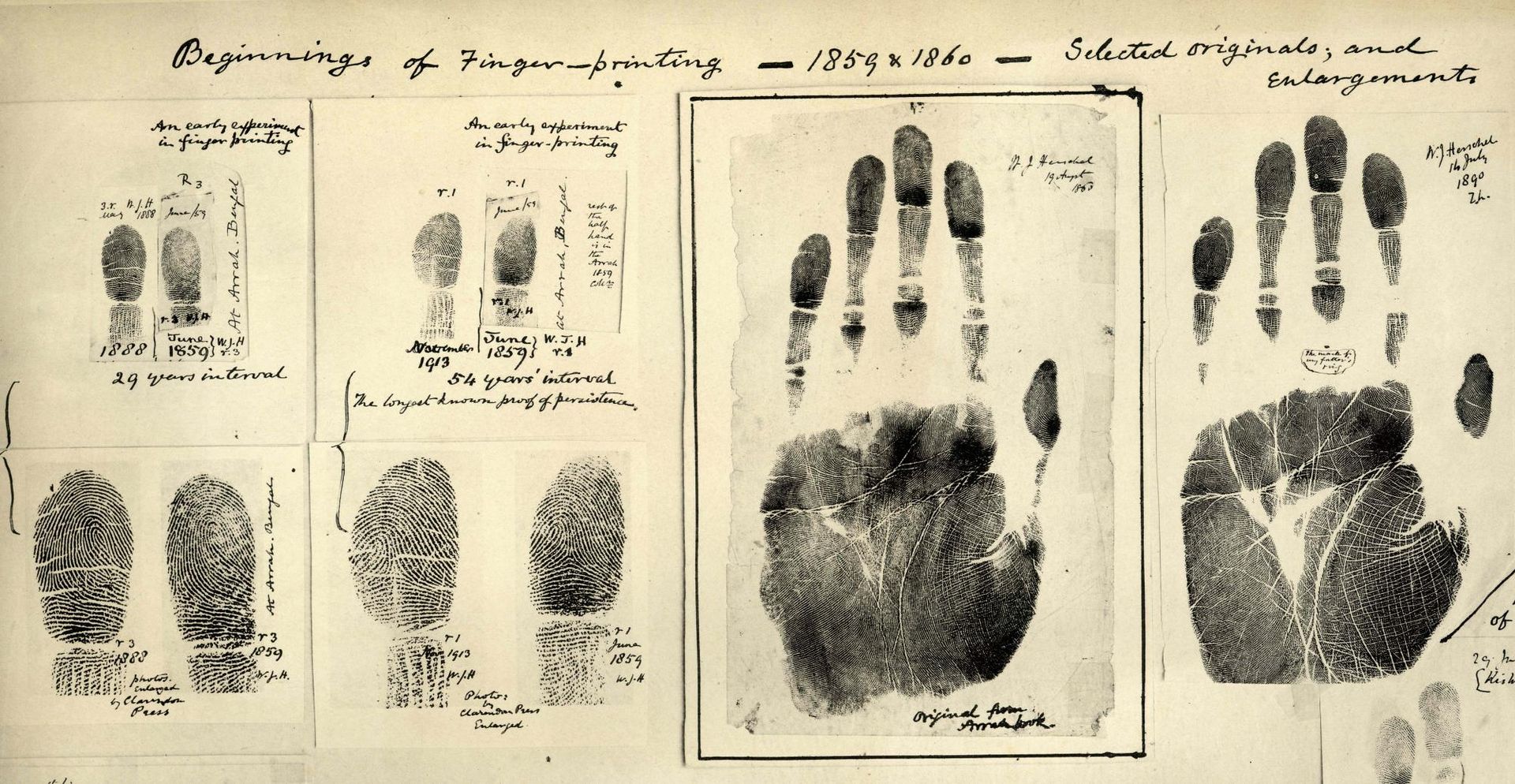
Fingerprints_taken_by_William_James_Herschel_1859-1860

Later,  in 1877 at Hooghly (near Calcutta) he instituted the use of fingerprints on contracts and deeds to prevent the then-rampant repudiation of signatures and he registered government pensioners’ fingerprints to prevent the collection of money by relatives after a pensioner’s death. Herschel also fingerprinted prisoners upon sentencing to prevent various frauds that were attempted in order to avoid serving a prison sentence.

The use of fingerprints in solving crimes was to come much later, but there’s no doubt that Herschel’s work on this was an important step.

Reasons to be committed: mental illness in the 19th century

Posted in History, Mental Health with tags , , on April 11, 2015 by telescoper

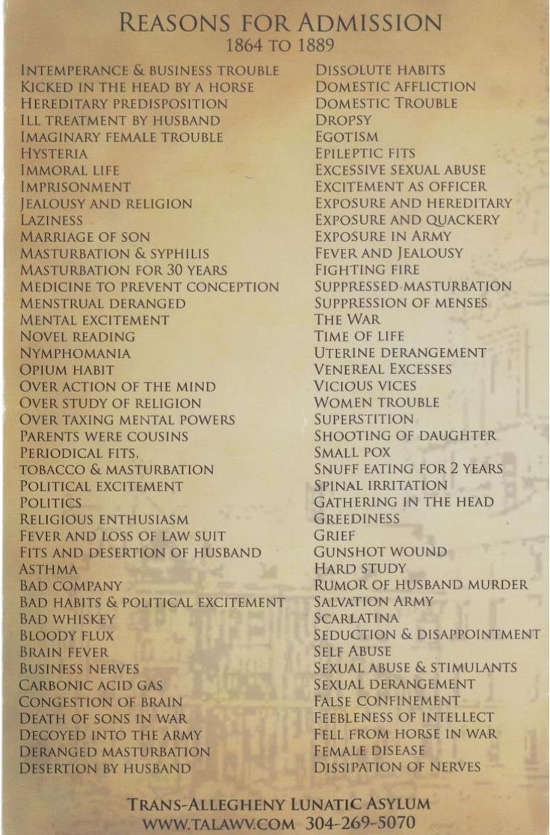
I came across this on Twitter yesterday as I travelled back to Brighton from the RAS Club. It’s an official record of the reasons stated for patients being admitted to the Trans-Allegheny Lunatic Asylum located in Weston, West Virginia in the USA. Formerly known as the Weston State Hospital, this facility was constructed between 1858 and 1881. The first phase of the original hospital, designed to house 250 people, was opened to patients in 1864 but its population expanded to a peak in the 1950s with about 2400 patients in overcrowded and generally poor conditions. It was closed as a hospital in 1994 but remains open as a kind of museum. Like most such institutions it was founded with good intentions and was designed with long rambling wings arranged in a staggered formation, assuring that the patients received an abundance of sunlight and fresh air. Just as was the case with similar institutions in the United Kingdom, however, the lack of effective treatment for the mentally ill led to it becoming more a place of incarceration than therapy and no doubt many troublesome individuals were committed there simply to keep them out of the way.

Anyway, here is the list:

Lunatic Asylum

When I first saw this I didn’t know whether to laugh or cry. The mind boggles, for example, at a diagnosis of “masturbation and tobacco”, or was that the treatment? Among the baffling entries, however, you can see a clear thread of misogyny and considerable evidence of the traumatising effect of the American Civil War, not only on combatants but also on grief-stricken relatives of the fallen. It was on April 9th 1865, almost exactly 150 years ago, that Robert E. Lee surrendered the 28,000 troops of the Confederate Army to Ulysses S. Grant, thereby ending the American Civil War so it is not surprising so many entries refer to “The War”.

Psychiatric hospitals are no longer called “lunatic asylums”, and the approach to the mentally ill is no longer simply to lock them away out of sight, but despite the progress that has been made they remain far from happy places even if you’re only there voluntarily and for a short time. You can take my word for that.

Operation Varsity

Posted in History with tags , , , , on March 24, 2015 by telescoper

Today provides me with an occasion for a short post in a very irregular series marking the momentous events that unfolded seventy years ago.

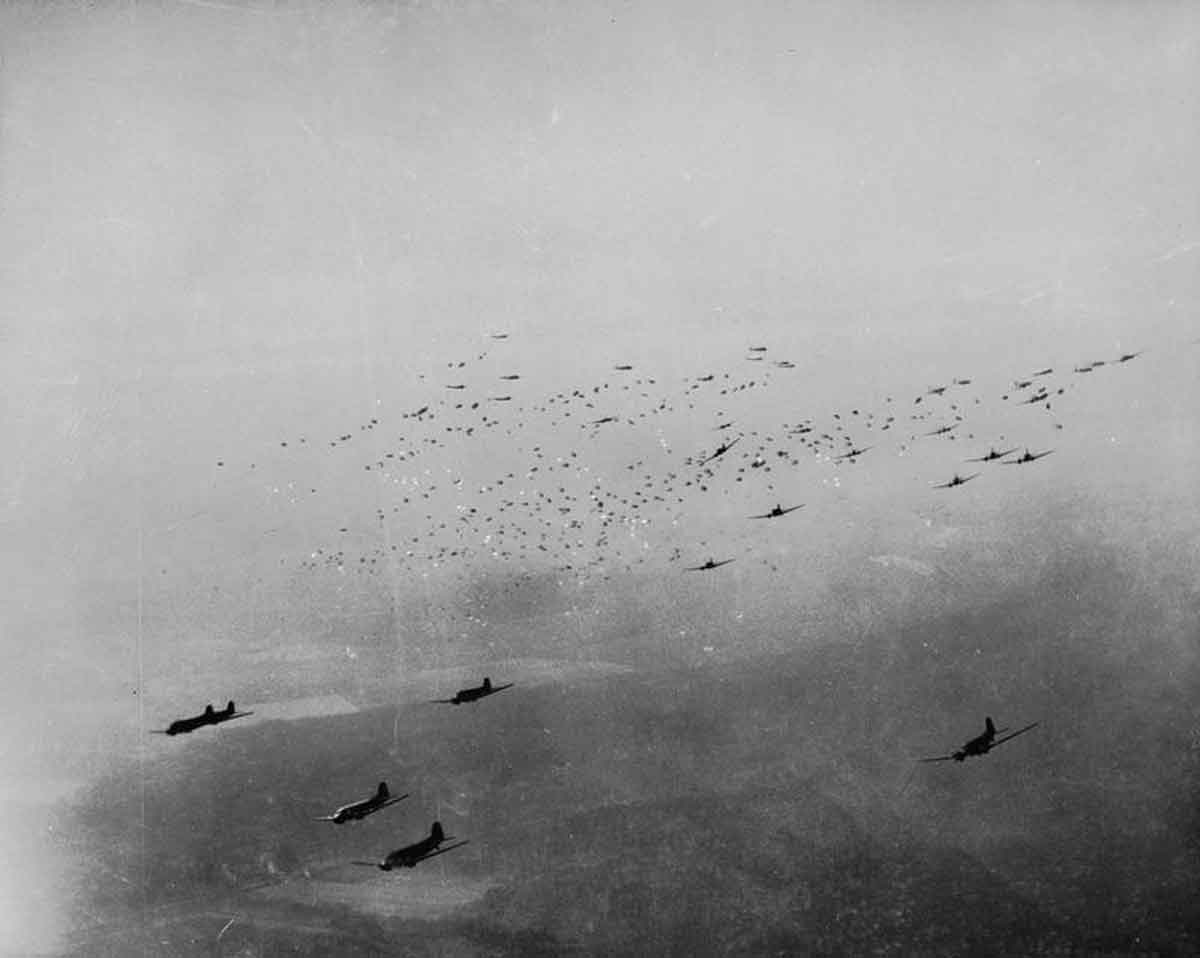
At 1000 hours on 24th March 1945, nine battalions of the 6th British Airborne Division together with six from 17th US Airborne Division began landing on the German (east) side of the River Rhine, near Wesel. This was the last mass parachute and glider assault of the Second World War, and was designed to pierce the final great physical barrier to a ground advance into Nazi Germany. It was codenamed Operation Varsity.

airborne-rhine

The airborne troops were given the task of seizing and holding high ground overlooking a stretch of the Rhine which was to be crossed by elements of the British 21st Army Group, which included the British Second Army. The airborneassault involved 540 aircraft towing 1300 gliders into heavy anti-aircraft fire, so casualties during the first phase of the operation were heavy. However, within six hours of the commencement of the operation, all objectives were taken and the airborne troops subsequently linked up with ground forces who had crossed the river in assault boats in what was known as Operation Plunder.

This was all a part of a coordinated series of airborne and amphibious attacks by British, Canadian and American forces that began overnight on 23rd March 1945 and went on during the morning of 24th March 1945. The Applied troops, crossing the River Rhine in large numbers and beginning a rapid advance into Germany. By 27 March, they had established a bridgehead 35 miles (56 km) wide and 20 miles (32 km) deep.

Following the link-up with the ground troops, the 6th Airborne led  a 300 mile advance through Germany, marching approximately 11 miles per day until they managed to capture enough enemy transport. Second Army reached the Weser on 4 April, the Elbe on 19 April, the shore of the Baltic Sea at Lübeck on 2 May. On 3 May, Hamburg capitulated. By 7 May the Soviet Army had met up with the British forces at the Baltic port of Wismar.

I mention this because one of the troops that crossed the Rhine the British Second Army that day was a new recruit, a young man by the name of Richard Shaw, my mother’s brother. He took part in the subsequent advance through Germany and spent most of the year after the end of the Second World War stationed in Hamburg. He died just a few years ago, after a fall in his home, at the age of 85.

Lest we forget.

Brighton Seafront in Wartime

Posted in Brighton, History with tags , , , on February 15, 2015 by telescoper

Yesterday I stumbled across a collection of old photographs of Brighton seafront. Most of the pictures are charming images of everyday life Brighton, made all the more fascinating by the fact that the city has changed relatively little and all the locations are immediately recognizable. However, in the middle of a sequence of such photographs I saw this:

Brighton_lawns_east

The view is from the Hove side of the city, with Hove lawns to the left and the West Pier in the distance. Notice that there’s a gap in the Pier. All piers along the south coast of England were cut during the Second World War to prevent them being used as landing  jetties by the enemy. I didn’t know that until I saw the gap in this picture and found out more.

There’s no date on the original, so I initially guessed that it must have been taken in 1940 when the threat of invasion during World War 2 was at its height. However, as Bryn Jones pointed out to me on Twitter, the presence of the white star on the vehicle in the foreground marks it out belonging to the US military. I did a little bit of research (via Google) and discovered that the plain white cross was only used by US troops exercising in Britain in 1942. The symbol was subsequently replaced by a white cross surrounded by a white circle, which is the marking used on all US vehicles in Normandy from 1944 onwards. The photograph must therefore have been taken some time in 1942, although the static defences were presumably put in place much earlier in the war. At a guess I’d say that it seems quite likely that US troops stationed in this area may well have used Brighton beach to train for the eventual Normandy landings

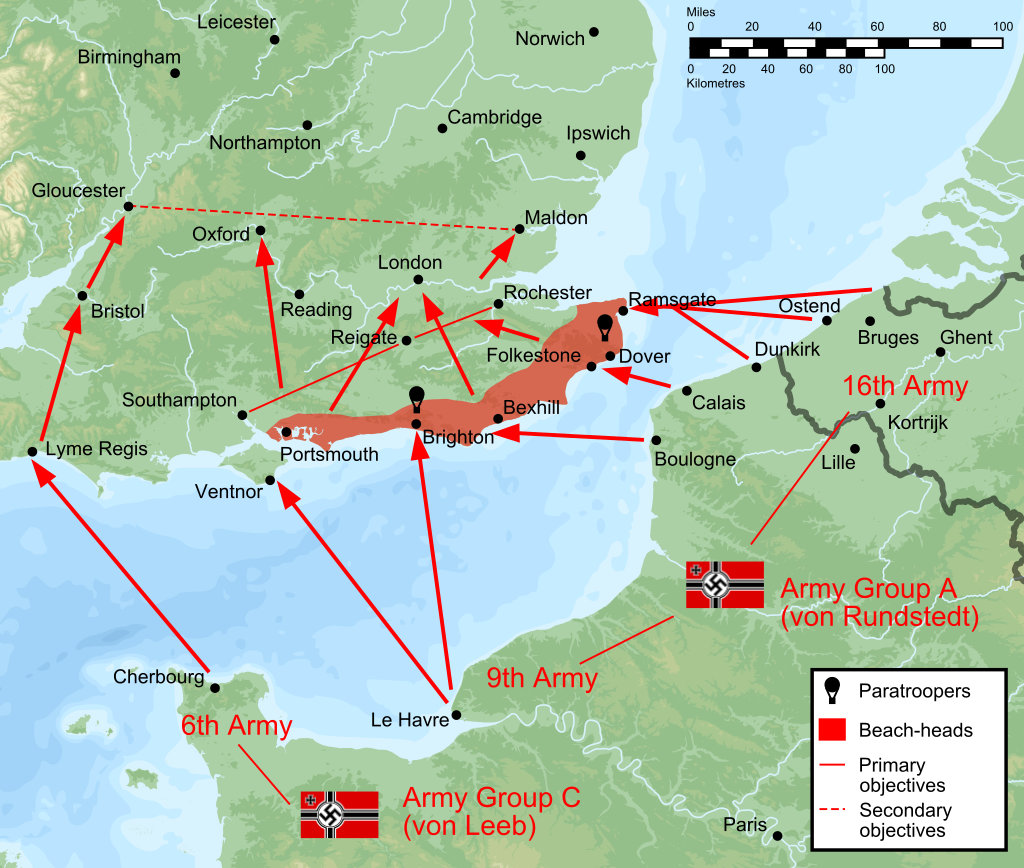
As it turns out, Brighton would have been in the front line had the Germans tried to invade England, as the following plan of Operation Sealion makes clear:

1024px-OperationSealion.svg

The shore defences in the photograph look pretty fierce, but the planned amphibious assault would have been preceded by parachute landings, so they  may have been seized and rendered ineffective by the time the landings began.

Here is a picture of the same general area looking to the West with Hove Lawns on the right:

Brighton_lawns_west

The beaches were out of bounds to the general public for most of the war, primarily because they were covered in mines, but in any case they would have been pretty inaccessible through all the barbed wire and other obstacles.

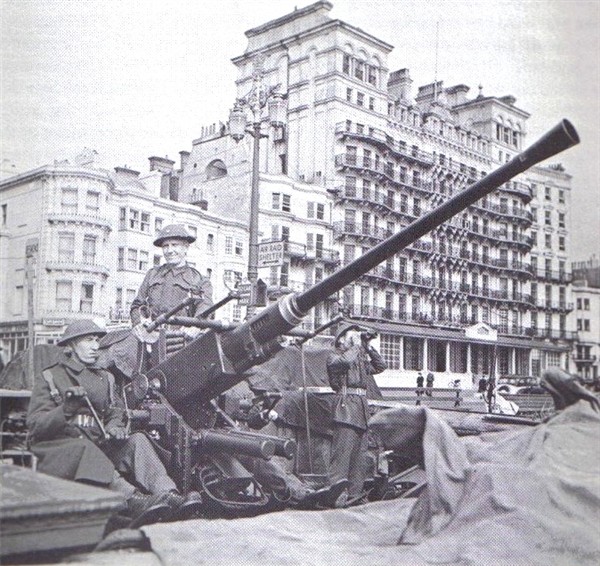
Although the immediate threat of invasion had receded by 1942, Brighton remained on high alert. Here is a picture I found elsewhere on the net, taken in 1943, showing a 40mm Bofors anti-aircraft gun stationed on the seafront not far from the Grand Hotel seen clearly in the background:

Brighton_bofors

The juxtaposition of the comfortingly familiar with the shockingly unfamiliar gives these images tremendous power. It’s hard to imagine what life must have been like under the constant threat of invasion and air raids, but these pictures at least give an idea of how grim it must have been to those of us who are fortunate enough to have never been forced to experience anything like it.


The Map is not the Territory

Posted in History, The Universe and Stuff with tags , , , , , , , , on January 27, 2015 by telescoper

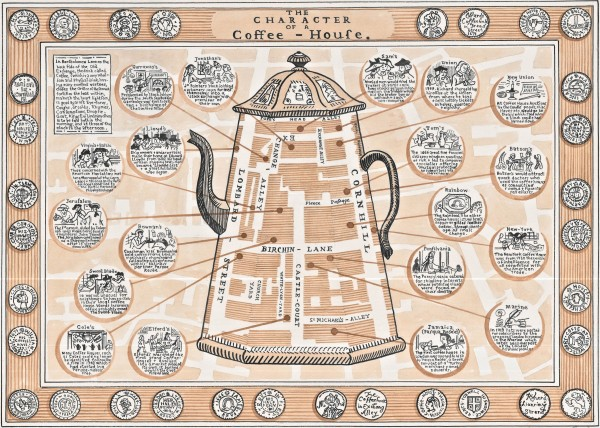
I came across this charming historical map while following one of my favourite Twitter feeds “@Libroantiguo” which publishes fascinating material about books of all kinds, especially old ones. It shows the location of London coffee houses and is itself constructed in the shape of a coffee pot:

Coffee
Although this one is obviously just a bit of fun, maps like this are quite fascinating, not only as practical guides to navigating a transport system but also because they often stand up very well as works of art. It’s also interesting how they evolve with time  because of changes to the network and also changing ideas about stylistic matters.

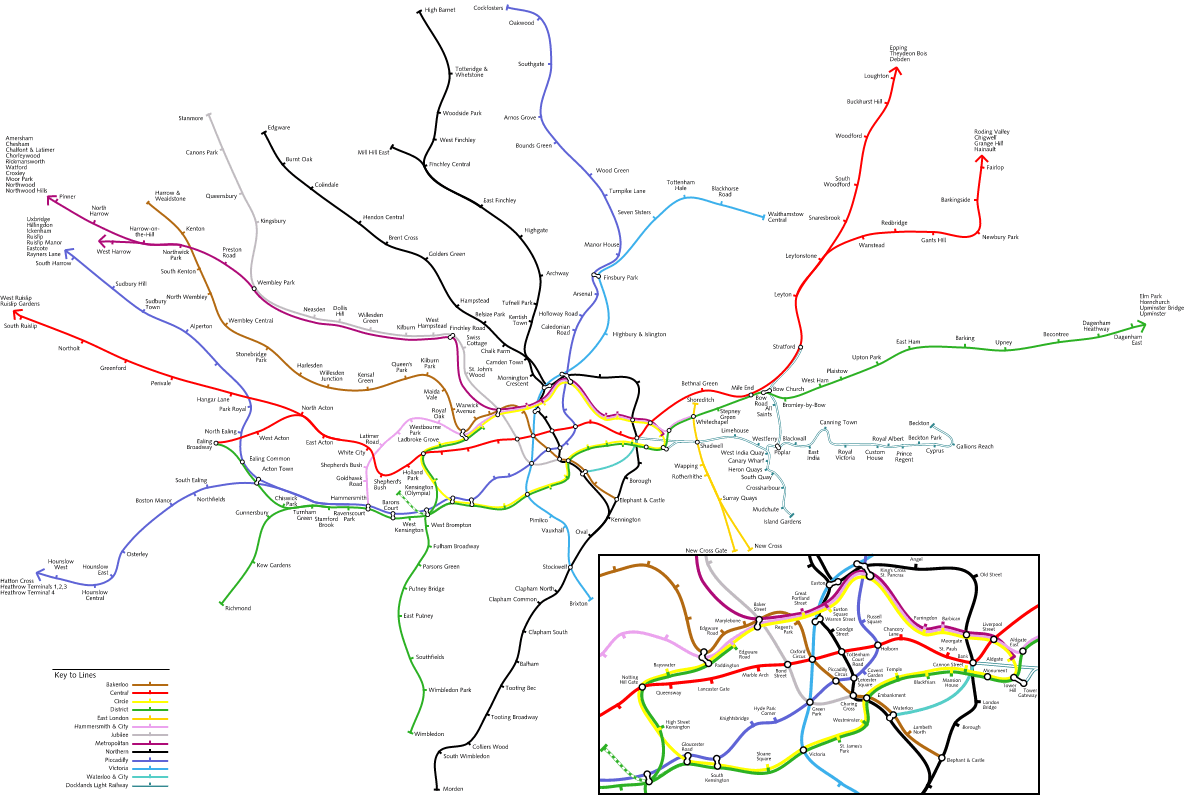
A familiar example is the London Underground or Tube map. There is a fascinating website depicting the evolutionary history of this famous piece of graphic design. Early versions simply portrayed the railway lines inset into a normal geographical map which made them rather complicated, as the real layout of the lines is far from regular. A geographically accurate depiction of the modern tube network is shown here which makes the point:

tubegeo

A revolution occurred in 1933 when Harry Beck compiled the first “modern” version of the map. His great idea was to simplify the representation of the network around a single unifying feature. To this end he turned the Central Line (in red) into a straight line travelling left to right across the centre of the page, only changing direction at the extremities. All other lines were also distorted to run basically either North-South or East-West and produce a regular pattern, abandoning any attempt to represent the “real” geometry of the system but preserving its topology (i.e. its connectivity).  Here is an early version of his beautiful construction:

Note that although this a “modern” map in terms of how it represents the layout, it does look rather dated in terms of other design elements such as the border and typefaces used. We tend not to notice how much we surround the essential things, which tend to last, with embellishments that date very quickly.

More modern versions of this map that you can get at tube stations and the like rather spoil the idea by introducing a kink in the central line to accommodate the complexity of the interchange between Bank and Monument stations as well as generally buggering about with the predominantly  rectilinear arrangement of the previous design:

I quite often use this map when I’m giving popular talks about physics. I think it illustrates quite nicely some of the philosophical issues related with theoretical representations of nature. I think of theories as being like maps, i.e. as attempts to make a useful representation of some  aspects of external reality. By useful, I mean the things we can use to make tests. However, there is a persistent tendency for some scientists to confuse the theory and the reality it is supposed to describe, especially a tendency to assert there is a one-to-one relationship between all elements of reality and the corresponding elements in the theoretical picture. This confusion was stated most succintly by the Polish scientist Alfred Korzybski in his memorable aphorism :

The map is not the territory.

I see this problem written particularly large with those physicists who persistently identify the landscape of string-theoretical possibilities with a multiverse of physically existing domains in which all these are realised. Of course, the Universe might be like that but it’s by no means clear to me that it has to be. I think we just don’t know what we’re doing well enough to know as much as we like to think we do.

A theory is also surrounded by a penumbra of non-testable elements, including those concepts that we use to translate the mathematical language of physics into everday words. We shouldn’t forget that many equations of physics have survived for a long time, but their interpretation has changed radically over the years.

The inevitable gap that lies between theory and reality does not mean that physics is a useless waste of time, it just means that its scope is limited. The Tube  map is not complete or accurate in all respects, but it’s excellent for what it was made for. Physics goes down the tubes when it loses sight of its key requirement: to be testable.

In any case, an attempt to make a grand unified theory of the London Underground system would no doubt produce a monstrous thing that would be so unwieldly that it would be useless in practice. I think there’s a lesson there for string theorists too…

Now, anyone for a game of Mornington Crescent?


Mathematics, Astronomy and the National Secular Society

Posted in Biographical, History, Politics with tags , , , , on January 17, 2015 by telescoper

I imagine that a  great many people have been thinking hard recently about democracy, free speech and religious belief in the wake of the Charlie Hebdo murders in Paris. There’s also been a great deal of stuff in the print media covering these issues. I just want to mention one thing that I have decided to do, namely to join the National Secular Society an organization that campaigns against religious privilege.

Let me reproduce a statement from their webpage here:

The National Secular Society works towards a society in which all citizens, regardless of religious belief, or lack of religious belief, can live together fairly and cohesively. We campaign for a secular democracy with a separation of religion and state, where everyone’s Human Rights are respected equally.

We work in the UK and Europe to challenge the disproportionate influence of religion on governments and in public life. We provide a secular voice in the media, defending freedom and equality as a counterbalance to the powerful religious lobby and some of the more destructive religious impulses that can threaten human rights worldwide.

The National Secular Society is a non-party-political organisation with members from across the social and political spectrum. Our Honorary Associates include MPs and peers, as well as leading figures from politics, journalism, law and the arts.

The NSS is a democratic and independent non-profit organisation which receives no funding from government or other public bodies. Our campaigning is wholly supported by our members and supporters, people like you who share our belief in the urgent need to keep religion and politics separate.

One of the National Secular Society’s very active current campaings is against the egregious Local Government (Religious etc Observances) Bill, which includes a provision that would require local councillors to attend sessions that involve prayers. This bill is wholly unacceptable to me, as it is perfectly possible for councillors of a religious persuasion to pray whenever they like, either before during or after a meeting, without requiring non-believers to be present.

I respect the right of others to whatever religious belief they choose and would not interrupt or disrupt an act of religious observance, but imposing such actions on others is simply unacceptable. I don’t think religious services should be imposed in schools and colleges, and I don’t see why this is any different.

Anyway, the general point is that I firmly believe that the only way we will ever develop a society that allows people of all cultures and beliefs to live in peace with each other and in atmosphere of mutual respect is to remove any reference to religion from our political and legal establishment. It’s a ridiculous anachronism that Bishops of the Church of England sit in the House of Lords, for example.

You’ll all no doubt be glad to know that I’m not going to “preach” about this at length here, although I may from time to time post on matters related to the National Secular Society (NSS), though hopefully in such a way as it doesn’t get confused with that other NSS the National Student Survey. I will however include a little story as a kind of postscript.

When I tweeted about the National Secular Society recently a friend of mine pointed out a curious connection between it, astronomy, and my former employer, Cardiff University. The first ever Professor of Mathematics and Astronomy at the University College of South Wales and Monmouthsire (which eventually became Cardiff University) was a distinguished chap by the name of Henry William Lloyd Tanner, who was appointed to his position in 1883. In November 1883 there was a vigorous campaign by religious types to have him removed because of his connections with the National Secular Society (which was founded way back in 1866); you can read about it here. The campagign did not succeed, and H.W. Lloyd Tanner remained in post until 1909.

We have at least made some progress since 1883, in that nowadays a Professor would not be threatened with the sack on the basis of his religious beliefs or lack of them, but there’s a long way to go before our nation is a truly secular society.

Hubble Images With Music By Herschel

Posted in History, Music, The Universe and Stuff with tags , , on November 20, 2014 by telescoper

Too busy for a full post today, so here’s a little stocking filler. The, perhaps familiar, pictures are taken by the Hubble Space Telescope but the music is by noted astronomer (geddit?) Sir William Herschel – the Second Movement of his Chamber Symphony In F Major, marked Adagio e Cantabile. Although best known as an astronomer Herschel was a capable musician and composer with a style very obviously influenced by his near contemporary Georg Frideric Handel. Although music of this era puts me on a High Harpsichord Alert, I thought I’d share this example of music for those of you unfamiliar with his work…

Marginal Notes – Are You For Or Against?

Posted in Books, History with tags , , , , on November 19, 2014 by telescoper

At the weekend I was listening to a programme on Radio 3 part of which was about the rise of the foreign language phrasebook over the last three or four centuries. It was a fascinating discussion, not least because it reminded me of an old Victorian English-Hindi phrasebook I found in a bookship in Pune (India). The book was intended for the use of well-to-do British ladies  and the phrases presumably chosen to reflect their likely needs as they travelled about India. I opened the book at random and found a translation of “Doctor, please help me. I am suffering from severe constipation”. In my experience as a Westerner travelling in India, constipation was the least of my worries…

Anyway, the real point of posting about this is that some of the old phrasebooks which were used to illustrate the programme had been heavily annotated by their owners. That reminded me of an discussion I’ve had with a number of people about whether they like to scribble in the margins of their books, or whether they believe this practice to be a form of sacrilege.

I’ll put my cards on the table  straightaway. I like to annotate my books – especially the technical ones – and some of them have extensive commentaries written in them. I also like to mark up poems that I read; that helps me greatly to understand the structure. I don’t have a problem with scribbling in margins because I think that’s what margins are for.Why else would they be there?

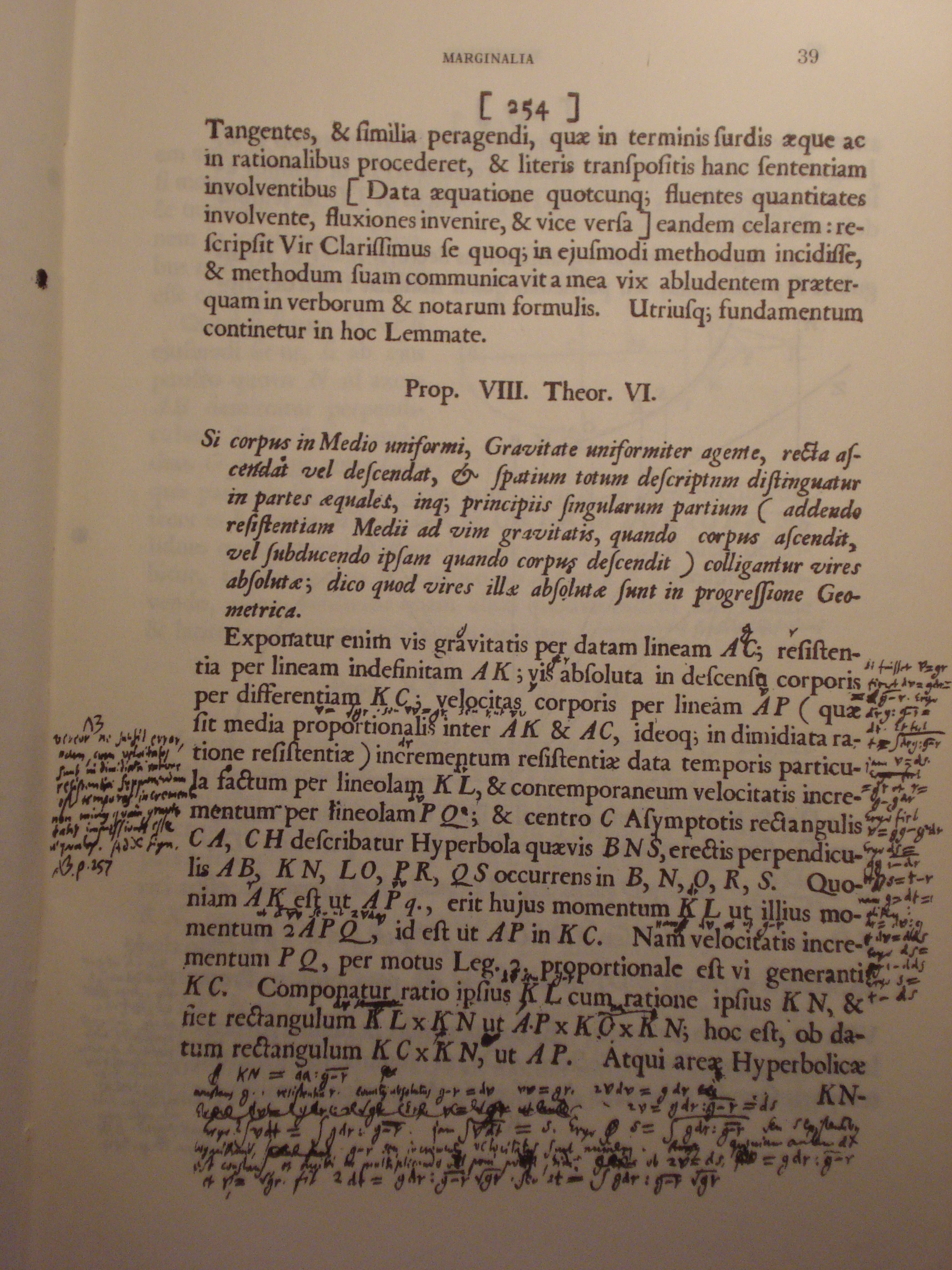
This is a famous example – a page from Newton’s Principia, annotated by Leibniz:

dsc00469

Some of my fellow academics, however, regard such actions as scandalous and seem to think books should be venerated in their pristine state.  Others probably find little use for printed books given the plethora of digitial resources now available online or via Kindles etc so this is not an issue..

I’m interested to see what the divergence of opinions is in with regard to the practice of writing in books, so here’s a poll for you to express your opinion:

200 Years of Sax – Anniversary Poll

Posted in History, Music with tags , , , on November 6, 2014 by telescoper

Today is the 200th anniversary of the birth of famous Belgian Adolphe Sax, inventor of the saxophone. To mark this occasion I thought I’d undertake a bit of audience participation and get you out there in internet land to vote on the greatest proponent of said instrument. I’ve populated the list with people I consider to be likely contenders, but feel free to add your own if your favourite is missing!

Thought for the Day

Posted in History, Literature with tags on October 25, 2014 by telescoper

A good world needs knowledge, kindliness, and courage; it does not need a regretful hankering after the past, or a fettering of the free intelligence by the words uttered long ago by ignorant men.

Bertrand Russell (1927)