Today (15th June 2015) is the 800th anniversary of the signing of Magna Carta. To mark the occasion here is a short educational video explaining the meaning and significance of this important historical event:
Follow @telescoperArchive for the History Category
The Meaning of Magna Carta
Posted in History, Television with tags Magna Carta, Tony Hancock, Twelve Angry Men on June 15, 2015 by telescoperCricket Quiz
Posted in Cricket, History on June 13, 2015 by telescoperToo lazy to do a proper post today, I though I would try a little cricket quiz. This legendary cricketer featured in today’s Independent Prize Cryptic. Can you put a name to the face?
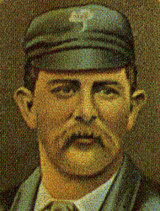
Answers through the comments box please!
Follow @telescoperPhlogiston, Dark Energy and Modified Levity
Posted in History, The Universe and Stuff with tags Cosmology, Dark Energy, Phlogiston on May 21, 2015 by telescoperWhat happens when something burns?
Had you aslked a seventeenth-century scientist that question and the chances are the answer would have involved the word phlogiston, a name derived from the Greek φλογιστόν, meaning “burning up”. This “fiery principle” or “element” was supposed to be present in all combustible materials and the idea was that it was released into air whenever any such stuff was ignited. The act of burning was thought to separate the phlogiston from the dephlogisticated “true” form of the material, also known as calx.
The phlogiston theory held sway until the late 18th Century, when Antoine Lavoisier demonstrated that combustion results in an increase in weight of the material being burned. This poses a serious problem if burning also involves the loss of phlogiston unless phlogiston has negative weight. However, many serious scientists of the 18th Century, such as Georg Ernst Stahl, had already suggested that phlogiston might have negative weight or, as he put it, “levity”. Nowadays we would probably say “anti-gravity”.
Eventually, Joseph Priestley discovered what actually combines with materials during combustion: oxygen. Instead of becoming dephlogisticated, things become oxidised by fixing oxygen from air, which is why their weight increases. It’s worth mentioning, though, the name that Priestley used for oxygen was in fact “dephlogisticated air” (because it was capable of combining more extensively with phlogiston than ordinary air). He remained a phlogistonian longer after making the discovery that should have killed the theory.
So why am I rambling on about a scientific theory that has been defunct for more than two centuries?
Well, there just might be a lesson from history about the state of modern cosmology. Not long ago I gave a talk in the fine city of Bath on the topic of Dark Energy and its Discontents. For the cosmologically uninitiated, the standard cosmological model involves the hypothesis that about 75% of the energy budget of the Universe is in the form of this “dark energy”.
Dark energy is needed to reconcile three basic measurements: (i) the brightness distant supernovae that seem to indicate the Universe is accelerating (which is where the anti-gravity comes in); (ii) the cosmic microwave background that suggests the Universe has flat spatial sections; and (iii) the direct estimates of the mass associated with galaxy clusters that accounts for about 25% of the mass needed to close the Universe. A universe without dark energy appears not to be able to account for these three observations simultaneously within our current understanding of gravity as obtained from Einstein’s theory of general relativity.
We don’t know much about what this dark energy is, except that in order to make our current understanding work out it has to produce an effect something like anti-gravity, vaguely reminiscent of the “negative weight” hypothesis mentioned above. In most theories, the dark energy component does this by violating the strong energy condition of general relativity. Alternatively, it might also be accounted for by modifying our theory of gravity in such a way that accounts for anti-gravity in some other way. In the light of the discussion above maybe what we need is a new theory of levity? In other words, maybe we’re taking gravity too seriously?
Anyway, I don’t mind admitting how uncomfortable this dark energy makes me feel. It makes me even more uncomfortable that such an enormous industry has grown up around it and that its existence is accepted unquestioningly by so many modern cosmologists. Isn’t there a chance that, with the benefit of hindsight, future generations will look back on dark energy in the same way that we now see the phlogiston theory?
Or maybe the dark energy really is phlogiston. That’s got to be worth a paper!
Follow @telescoperA scientific paper with 5000 authors is absurd, but does science need “papers” at all?
Posted in History, Open Access, Science Politics, The Universe and Stuff with tags academic publishing, astronomy, citations, Crommelin, Daniel Shanahan, Dyson, Eddington, Large Hadron Collider, paper, research on May 17, 2015 by telescoperNature News has reported on what appears to be the paper with the longest author list on record. This article has so many authors – 5,154 altogether – that 24 pages (out of a total of 33 in the paper) are devoted just to listing them, and only 9 to the actual science. Not, surprisingly the field concerned is experimental particle physics and the paper emanates from the Large Hadron Collider; it involves combining data from the CMS and ATLAS detectors to estimate the mass of the Higgs Boson. In my own fields of astronomy and cosmology, large consortia such as the Planck collaboration are becoming the rule rather than exception for observational work. Large ollaborations have achieved great things not only in physics and astronomy but also in other fields. A for paper in genomics with over a thousand authors has recently been published and the trend for ever-increasing size of collaboration seems set to continue.
I’ve got nothing at all against large collaborative projects. Quite the opposite, in fact. They’re enormously valuable not only because frontier research can often only be done that way, but also because of the wider message they send out about the benefits of international cooperation.
Having said that, one thing these large collaborations do is expose the absurdity of the current system of scientific publishing. The existence of a paper with 5000 authors is a reductio ad absurdum proof that the system is broken. Papers simply do not have 5000 “authors”. In fact, I would bet that no more than a handful of the “authors” listed on the record-breaking paper have even read the article, never mind written any of it. Despite this, scientists continue insisting that constributions to scientific research can only be measured by co-authorship of a paper. The LHC collaboration that kicked off this piece includes all kinds of scientists: technicians, engineers, physicists, programmers at all kinds of levels, from PhD students to full Professors. Why should we insist that the huge range of contributions can only be recognized by shoe-horning the individuals concerned into the author list? The idea of a 100-author paper is palpably absurd, never mind one with fifty times that number.
So how can we assign credit to individuals who belong to large teams of researchers working in collaboration?
For the time being let us assume that we are stuck with authorship as the means of indicating a contribution to the project. Significant issues then arise about how to apportion credit in bibliometric analyses, e.g. through citations. Here is an example of one of the difficulties: (i) if paper A is cited 100 times and has 100 authors should each author get the same credit? and (ii) if paper B is also cited 100 times but only has one author, should this author get the same credit as each of the authors of paper A?
An interesting suggestion over on the e-astronomer a while ago addressed the first question by suggesting that authors be assigned weights depending on their position in the author list. If there are N authors the lead author gets weight N, the next N-1, and so on to the last author who gets a weight 1. If there are 4 authors, the lead gets 4 times as much weight as the last one.
This proposal has some merit but it does not take account of the possibility that the author list is merely alphabetical which actually was the case in all the Planck publications, for example. Still, it’s less draconian than another suggestion I have heard which is that the first author gets all the credit and the rest get nothing. At the other extreme there’s the suggestion of using normalized citations, i.e. just dividing the citations equally among the authors and giving them a fraction 1/N each. I think I prefer this last one, in fact, as it seems more democratic and also more rational. I don’t have many publications with large numbers of authors so it doesn’t make that much difference to me which you measure happen to pick. I come out as mediocre on all of them.
No suggestion is ever going to be perfect, however, because the attempt to compress all information about the different contributions and roles within a large collaboration into a single number, which clearly can’t be done algorithmically. For example, the way things work in astronomy is that instrument builders – essential to all observational work and all work based on analysing observations – usually get appended onto the author lists even if they play no role in analysing the final data. This is one of the reasons the resulting papers have such long author lists and why the bibliometric issues are so complex in the first place.
Having thousands of authors who didn’t write a single word of the paper seems absurd, but it’s the only way our current system can acknowledge the contributions made by instrumentalists, technical assistants and all the rest. Without doing this, what can such people have on their CV that shows the value of the work they have done?
What is really needed is a system of credits more like that used in the television or film. Writer credits are assigned quite separately from those given to the “director” (of the project, who may or may not have written the final papers), as are those to the people who got the funding together and helped with the logistics (production credits). Sundry smaller but still vital technical roles could also be credited, such as special effects (i.e. simulations) or lighting (photometic calibration). There might even be a best boy. Many theoretical papers would be classified as “shorts” so they would often be written and directed by one person and with no technical credits.
The point I’m trying to make is that we seem to want to use citations to measure everything all at once but often we want different things. If you want to use citations to judge the suitability of an applicant for a position as a research leader you want someone with lots of directorial credits. If you want a good postdoc you want someone with a proven track-record of technical credits. But I don’t think it makes sense to appoint a research leader on the grounds that they reduced the data for umpteen large surveys. Imagine what would happen if you made someone director of a Hollywood blockbuster on the grounds that they had made the crew’s tea for over a hundred other films.
Another question I’d like to raise is one that has been bothering me for some time. When did it happen that everyone participating in an observational programme expected to be an author of a paper? It certainly hasn’t always been like that.
For example, go back about 90 years to one of the most famous astronomical studies of all time, Eddington‘s measurement of the bending of light by the gravitational field of the Sun. The paper that came out from this was this one
A Determination of the Deflection of Light by the Sun’s Gravitational Field, from Observations made at the Total Eclipse of May 29, 1919.
Sir F.W. Dyson, F.R.S, Astronomer Royal, Prof. A.S. Eddington, F.R.S., and Mr C. Davidson.
Philosophical Transactions of the Royal Society of London, Series A., Volume 220, pp. 291-333, 1920.
This particular result didn’t involve a collaboration on the same scale as many of today’s but it did entail two expeditions (one to Sobral, in Brazil, and another to the Island of Principe, off the West African coast). Over a dozen people took part in the planning, in the preparation of of calibration plates, taking the eclipse measurements themselves, and so on. And that’s not counting all the people who helped locally in Sobral and Principe.
But notice that the final paper – one of the most important scientific papers of all time – has only 3 authors: Dyson did a great deal of background work getting the funds and organizing the show, but didn’t go on either expedition; Eddington led the Principe expedition and was central to much of the analysis; Davidson was one of the observers at Sobral. Andrew Crommelin, something of an eclipse expert who played a big part in the Sobral measurements received no credit and neither did Eddington’s main assistant at Principe.
I don’t know if there was a lot of conflict behind the scenes at arriving at this authorship policy but, as far as I know, it was normal policy at the time to do things this way. It’s an interesting socio-historical question why and when it changed.
I’ve rambled off a bit so I’ll return to the point that I was trying to get to, which is that in my view the real problem is not so much the question of authorship but the idea of the paper itself. It seems quite clear to me that the academic journal is an anachronism. Digital technology enables us to communicate ideas far more rapidly than in the past and allows much greater levels of interaction between researchers. I agree with Daniel Shanahan that the future for many fields will be defined not in terms of “papers” which purport to represent “final” research outcomes, but by living documents continuously updated in response to open scrutiny by the community of researchers. I’ve long argued that the modern academic publishing industry is not facilitating but hindering the communication of research. The arXiv has already made academic journals virtually redundant in many of branches of physics and astronomy; other disciplines will inevitably follow. The age of the academic journal is drawing to a close. Now to rethink the concept of “the paper”…
Follow @telescoperBenjamin Appl and James Baillieu
Posted in History, Music, Poetry with tags Anton Rubinstein, Antonin Dvorak, Benjamin Appl, Brighton Festival, Franz Liszt, Heinrich Heine, Ilse Weber, James Baillieu, Lieder, Terezin on May 16, 2015 by telescoperYesterday evening I crossed the border from Brighton into the Labour stronghold of Hove (actually), All Saints Church to be precise. The purpose of my mission was to attend a recital of songs by German baritone Benjamin Appl accompanied at the piano by James Baillieu. This was my fourth Brighton Festival event in as many days, but the shows I have attended have been very different so I have no regrets about booking this particular sequence.
This recital was performed in the nave of All Saints Church in a sideways configuration so the musicians were on one side rather than at the end towards the altar. I have never been to this venue before but it’s quite a regular one for musical events. I suppose they use this arrangement for the more intimate kind of music-making, such as the singing of Lieder, so the performers can be as close as possible to the audience.
The programme consisted of songs either from or inspired by Eastern Europe. The concert began with three fairly well known songs by Franz Liszt based on poems by Heinrich Heine but then continued with six Heine settings by Anton Rubinstein (his Op. 32) which I’d never heard before. These songs are direct and uncluttered and I found them rather charming. The first half closed with The Biblical Songs by Antonín Dvořák, his Opus 99. Based on extracts from the Book of Psalms these very touching works were written when the composer heard his father was gravely ill.
After a short interval and a quick glass of overpriced Pinot Grigio, we continued with Six Songs Op. 90 by Robert Schumann, who also provided the finale with his intensely moving Requiem which was written later but subsequently added to the Opus 90 collection. In between these works by Schumann we heard a selection of songs from Terezin (German name Theresienstadt) the site of a concentration camp. These pieces are much lighter than the art songs surrounding them in the programme, but are invested with a deep sense of tragedy by the circumstances in which they were composed and also performed. The song Wiegala, for example, is a lullabye written by Ilse Weber, a Jewish lady who worked for some time as a nurse in Terezin. She sang it for countless children destined for the gas chambers, and when the time came for her and her son to be murdered she sang it for him too as they walked together to their deaths.
As an aside here I thought I would plug a CD of music from Terezin I bought a while ago that features Anne Sofie von Otter singing some of the heartbreaking songs written by the inhabitants of Terezin. It’s highly recommended, though I have to admit I find it hard to listen to it without bursting into tears.
What struck me most about this recital is that the greatest Lieder are often very simple and often very brief. Some of the greatest songs by, for example, Schubert areas simple that only a genius could have written them
I think it’s the focus that gives each its power and the variety within each collection means there’s always something to hold the listener even in a long programme. Yesterday I complained about the limitations of a programme featuring only one voice, yet this one also featured only one voice but was an unqualified success. The difference, I think, is that these songs were meant to be performed the way we heard them last night…
I really enjoyed this concert. Benjamin Appl has a wonderful baritone voice, and very few vocal mannerisms or affectations. He just lets the music do its stuff. It was an amazingly mature performance for such a young man.I shouldn’t forget the flawless accompaniment provided by James Baillieu either.
Apparently Benjamin Appl was the last private pupil of the late Dietrich Fischer-Dieskau. That provides me with an excuse to include this version of the song Morgen! (Tomorrow!) Opus 27(4) by Richard Strauss, which was performed last night as an upbeat encore to an evening of intensely emotional music.
Und morgen wird die Sonne wieder scheinen
und auf dem Wege, den ich gehen werde,
wird uns, die Glücklichen sie wieder einen
inmitten dieser sonnenatmenden Erde…
und zu dem Strand, dem weiten, wogenblauen,
werden wir still und langsam niedersteigen,
stumm werden wir uns in die Augen schauen,
und auf uns sinkt des Glückes stumme Schweigen..
The first line translates as “And tomorrow the Sun will shine again…” Here is Dietrich Fischer-Dieskau singing it:
Follow @telescoper
Astronomy and Forensic Science – The Herschel Connection
Posted in History, The Universe and Stuff with tags astronomy, Bath, Fingerprints, Forensic Science, John Herschel, William Herschel, William James Herschel on April 27, 2015 by telescoperWhen I was in Bath on Friday evening I made a point of visiting the Herschel Museum, which is located in the house in which Sir William Herschel lived for a time, before moving to Slough.

Unfortunately I got there too late to go inside. It did remind me however of an interesting connection between astronomy and forensic science, through a certain William Herschel..
When I give popular talks about Cosmology, I sometimes look for appropriate analogies or metaphors in detective fiction or television programmes about forensic science. I think cosmology is methodologically similar to forensic science because it is generally necessary in both these fields to proceed by observation and inference, rather than experiment and deduction: cosmologists have only one Universe; forensic scientists have only one scene of the crime. They can collect trace evidence, look for fingerprints, establish or falsify alibis, and so on. But they can’t do what a laboratory physicist or chemist would typically try to do: perform a series of similar experimental crimes under slightly different physical conditions. What we have to do in cosmology is the same as what detectives do when pursuing an investigation: make inferences and deductions within the framework of a hypothesis that we continually subject to empirical test. This process carries on until reasonable doubt is exhausted, if that ever happens.
Of course there is much more pressure on detectives to prove guilt than there is on cosmologists to establish the truth about our Cosmos. That’s just as well, because there is still a very great deal we do not know about how the Universe works. I have a feeling that I’ve stretched this analogy to breaking point but at least it provides some kind of excuse for mentioning the Herschel connection.
In fact the Herschel connection comes through William James Herschel, the grandson of William Herschel and the eldest son of John Herschel, both of whom were eminent astronomers. William James Herschel was not an astronomer, but an important figure in the colonial establishment in India. In the context relevant to this post, however, his claim to fame is that he is credited with being the first European to have recognized the importance of fingerprints for the purposes of identifying individuals. William James Herschel started using fingerprints in this way in India in 1858; some examples are shown below (taken from the wikipedia page).
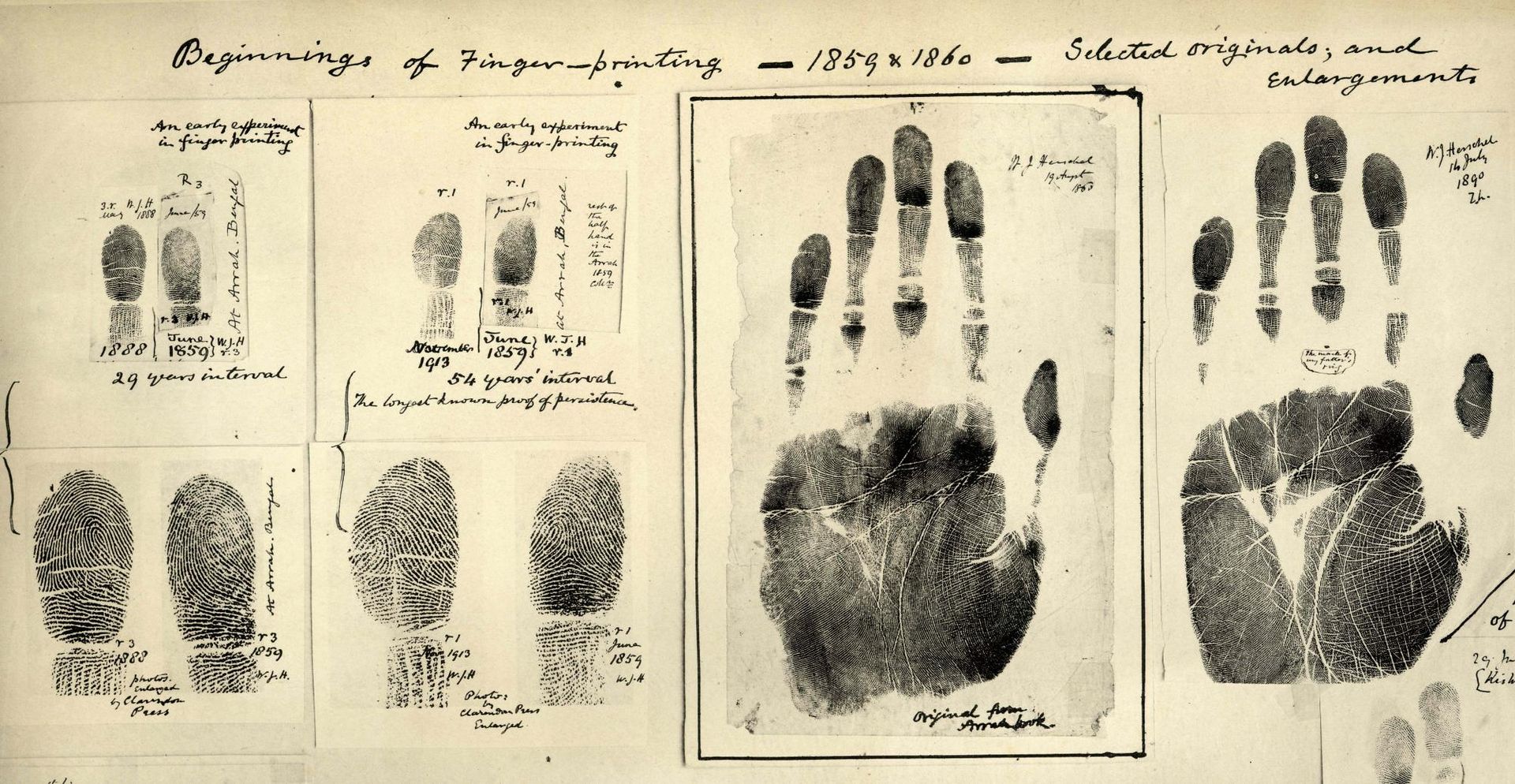
Later, in 1877 at Hooghly (near Calcutta) he instituted the use of fingerprints on contracts and deeds to prevent the then-rampant repudiation of signatures and he registered government pensioners’ fingerprints to prevent the collection of money by relatives after a pensioner’s death. Herschel also fingerprinted prisoners upon sentencing to prevent various frauds that were attempted in order to avoid serving a prison sentence.
The use of fingerprints in solving crimes was to come much later, but there’s no doubt that Herschel’s work on this was an important step.
Follow @telescoperReasons to be committed: mental illness in the 19th century
Posted in History, Mental Health with tags American Civil War, Mental Health, Trans-Allegheny Lunatic Asylum on April 11, 2015 by telescoperI came across this on Twitter yesterday as I travelled back to Brighton from the RAS Club. It’s an official record of the reasons stated for patients being admitted to the Trans-Allegheny Lunatic Asylum located in Weston, West Virginia in the USA. Formerly known as the Weston State Hospital, this facility was constructed between 1858 and 1881. The first phase of the original hospital, designed to house 250 people, was opened to patients in 1864 but its population expanded to a peak in the 1950s with about 2400 patients in overcrowded and generally poor conditions. It was closed as a hospital in 1994 but remains open as a kind of museum. Like most such institutions it was founded with good intentions and was designed with long rambling wings arranged in a staggered formation, assuring that the patients received an abundance of sunlight and fresh air. Just as was the case with similar institutions in the United Kingdom, however, the lack of effective treatment for the mentally ill led to it becoming more a place of incarceration than therapy and no doubt many troublesome individuals were committed there simply to keep them out of the way.
Anyway, here is the list:
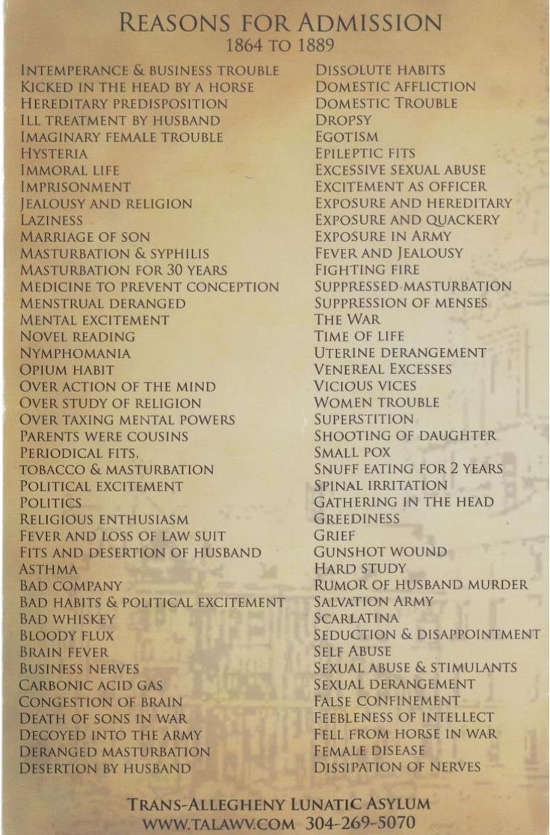
When I first saw this I didn’t know whether to laugh or cry. The mind boggles, for example, at a diagnosis of “masturbation and tobacco”, or was that the treatment? Among the baffling entries, however, you can see a clear thread of misogyny and considerable evidence of the traumatising effect of the American Civil War, not only on combatants but also on grief-stricken relatives of the fallen. It was on April 9th 1865, almost exactly 150 years ago, that Robert E. Lee surrendered the 28,000 troops of the Confederate Army to Ulysses S. Grant, thereby ending the American Civil War so it is not surprising so many entries refer to “The War”.
Psychiatric hospitals are no longer called “lunatic asylums”, and the approach to the mentally ill is no longer simply to lock them away out of sight, but despite the progress that has been made they remain far from happy places even if you’re only there voluntarily and for a short time. You can take my word for that.
Follow @telescoperOperation Varsity
Posted in History with tags History, operation plunder, operation varsity, rhine crossing, second world war on March 24, 2015 by telescoperToday provides me with an occasion for a short post in a very irregular series marking the momentous events that unfolded seventy years ago.
At 1000 hours on 24th March 1945, nine battalions of the 6th British Airborne Division together with six from 17th US Airborne Division began landing on the German (east) side of the River Rhine, near Wesel. This was the last mass parachute and glider assault of the Second World War, and was designed to pierce the final great physical barrier to a ground advance into Nazi Germany. It was codenamed Operation Varsity.
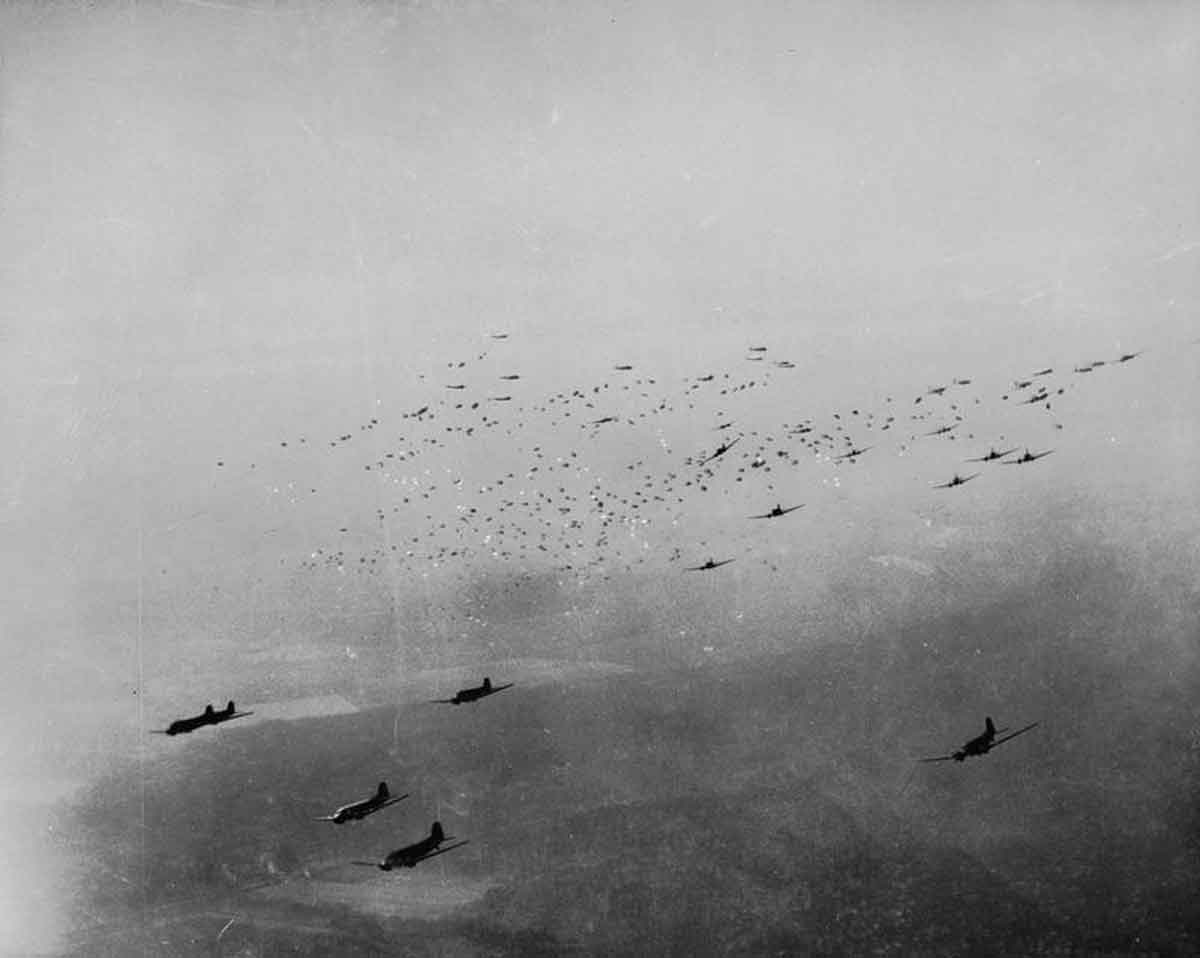
The airborne troops were given the task of seizing and holding high ground overlooking a stretch of the Rhine which was to be crossed by elements of the British 21st Army Group, which included the British Second Army. The airborneassault involved 540 aircraft towing 1300 gliders into heavy anti-aircraft fire, so casualties during the first phase of the operation were heavy. However, within six hours of the commencement of the operation, all objectives were taken and the airborne troops subsequently linked up with ground forces who had crossed the river in assault boats in what was known as Operation Plunder.
This was all a part of a coordinated series of airborne and amphibious attacks by British, Canadian and American forces that began overnight on 23rd March 1945 and went on during the morning of 24th March 1945. The Applied troops, crossing the River Rhine in large numbers and beginning a rapid advance into Germany. By 27 March, they had established a bridgehead 35 miles (56 km) wide and 20 miles (32 km) deep.
Following the link-up with the ground troops, the 6th Airborne led a 300 mile advance through Germany, marching approximately 11 miles per day until they managed to capture enough enemy transport. Second Army reached the Weser on 4 April, the Elbe on 19 April, the shore of the Baltic Sea at Lübeck on 2 May. On 3 May, Hamburg capitulated. By 7 May the Soviet Army had met up with the British forces at the Baltic port of Wismar.
I mention this because one of the troops that crossed the Rhine the British Second Army that day was a new recruit, a young man by the name of Richard Shaw, my mother’s brother. He took part in the subsequent advance through Germany and spent most of the year after the end of the Second World War stationed in Hamburg. He died just a few years ago, after a fall in his home, at the age of 85.
Lest we forget.
Follow @telescoperBrighton Seafront in Wartime
Posted in Brighton, History with tags Brighton, Hove, Operation Sealion, World War 2 on February 15, 2015 by telescoperYesterday I stumbled across a collection of old photographs of Brighton seafront. Most of the pictures are charming images of everyday life Brighton, made all the more fascinating by the fact that the city has changed relatively little and all the locations are immediately recognizable. However, in the middle of a sequence of such photographs I saw this:

The view is from the Hove side of the city, with Hove lawns to the left and the West Pier in the distance. Notice that there’s a gap in the Pier. All piers along the south coast of England were cut during the Second World War to prevent them being used as landing jetties by the enemy. I didn’t know that until I saw the gap in this picture and found out more.
There’s no date on the original, so I initially guessed that it must have been taken in 1940 when the threat of invasion during World War 2 was at its height. However, as Bryn Jones pointed out to me on Twitter, the presence of the white star on the vehicle in the foreground marks it out belonging to the US military. I did a little bit of research (via Google) and discovered that the plain white cross was only used by US troops exercising in Britain in 1942. The symbol was subsequently replaced by a white cross surrounded by a white circle, which is the marking used on all US vehicles in Normandy from 1944 onwards. The photograph must therefore have been taken some time in 1942, although the static defences were presumably put in place much earlier in the war. At a guess I’d say that it seems quite likely that US troops stationed in this area may well have used Brighton beach to train for the eventual Normandy landings
As it turns out, Brighton would have been in the front line had the Germans tried to invade England, as the following plan of Operation Sealion makes clear:
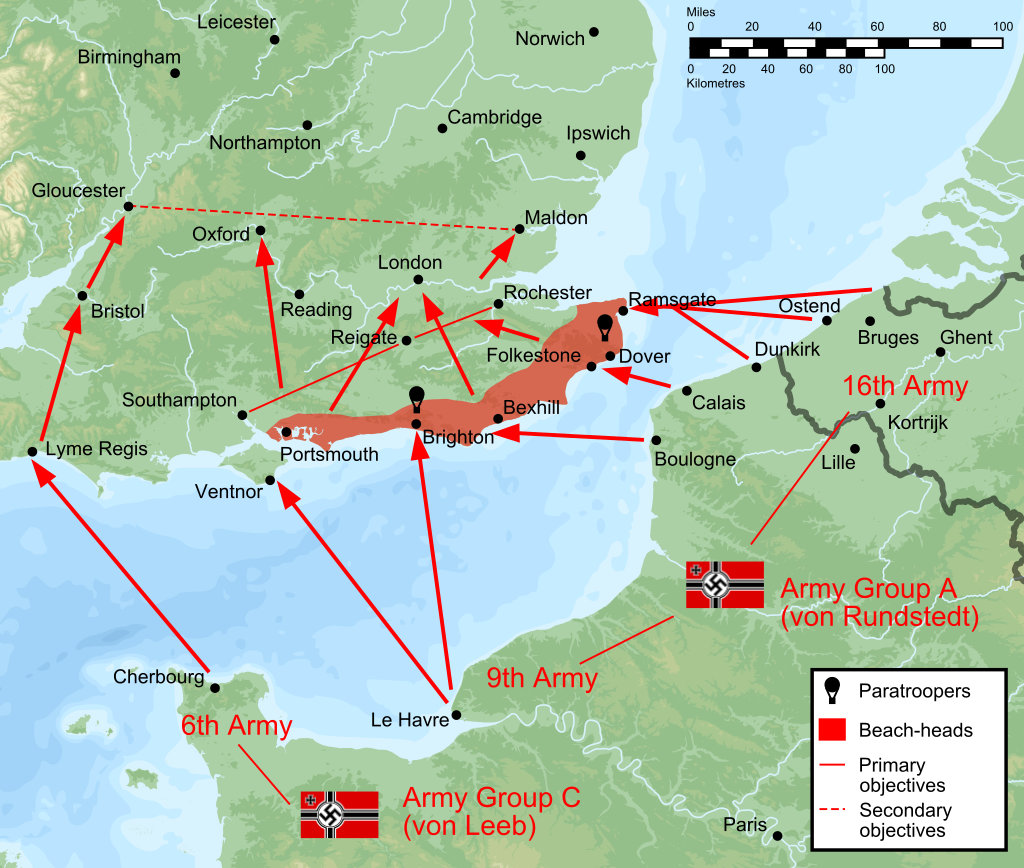
The shore defences in the photograph look pretty fierce, but the planned amphibious assault would have been preceded by parachute landings, so they may have been seized and rendered ineffective by the time the landings began.
Here is a picture of the same general area looking to the West with Hove Lawns on the right:

The beaches were out of bounds to the general public for most of the war, primarily because they were covered in mines, but in any case they would have been pretty inaccessible through all the barbed wire and other obstacles.
Although the immediate threat of invasion had receded by 1942, Brighton remained on high alert. Here is a picture I found elsewhere on the net, taken in 1943, showing a 40mm Bofors anti-aircraft gun stationed on the seafront not far from the Grand Hotel seen clearly in the background:
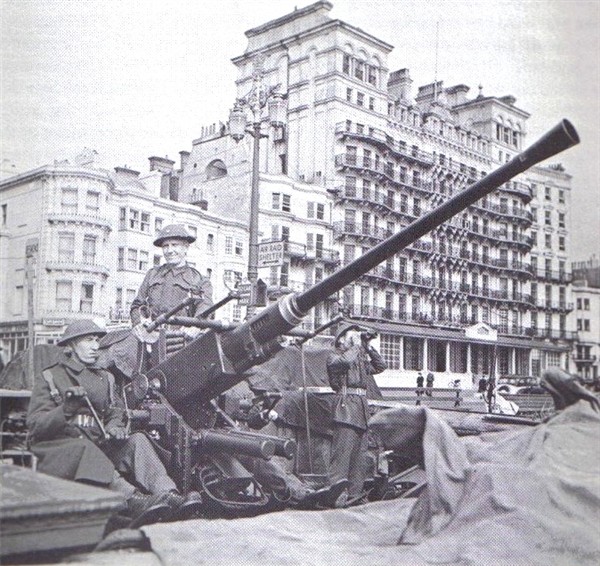
The juxtaposition of the comfortingly familiar with the shockingly unfamiliar gives these images tremendous power. It’s hard to imagine what life must have been like under the constant threat of invasion and air raids, but these pictures at least give an idea of how grim it must have been to those of us who are fortunate enough to have never been forced to experience anything like it.
Follow @telescoper
The Map is not the Territory
Posted in History, The Universe and Stuff with tags Alfred Korzybski, Harry Beck, London Underground, Mornington Crescent, multiverse, Physics, Science, String Theory, Tube Map on January 27, 2015 by telescoperI came across this charming historical map while following one of my favourite Twitter feeds “@Libroantiguo” which publishes fascinating material about books of all kinds, especially old ones. It shows the location of London coffee houses and is itself constructed in the shape of a coffee pot:
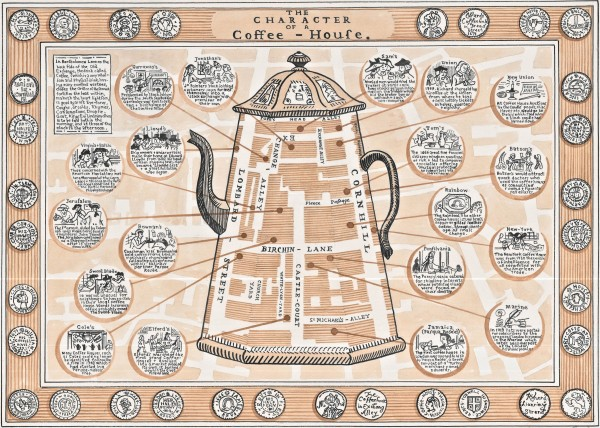
Although this one is obviously just a bit of fun, maps like this are quite fascinating, not only as practical guides to navigating a transport system but also because they often stand up very well as works of art. It’s also interesting how they evolve with time because of changes to the network and also changing ideas about stylistic matters.
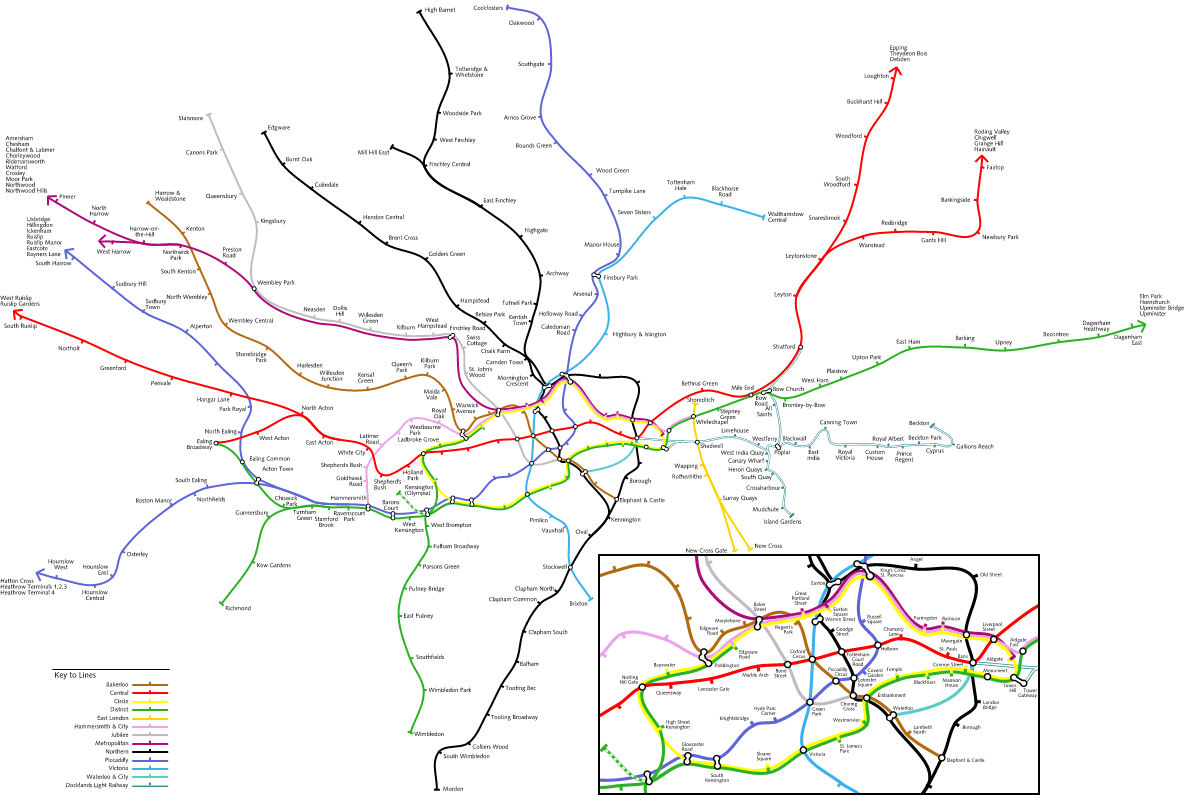
A familiar example is the London Underground or Tube map. There is a fascinating website depicting the evolutionary history of this famous piece of graphic design. Early versions simply portrayed the railway lines inset into a normal geographical map which made them rather complicated, as the real layout of the lines is far from regular. A geographically accurate depiction of the modern tube network is shown here which makes the point:
A revolution occurred in 1933 when Harry Beck compiled the first “modern” version of the map. His great idea was to simplify the representation of the network around a single unifying feature. To this end he turned the Central Line (in red) into a straight line travelling left to right across the centre of the page, only changing direction at the extremities. All other lines were also distorted to run basically either North-South or East-West and produce a regular pattern, abandoning any attempt to represent the “real” geometry of the system but preserving its topology (i.e. its connectivity). Here is an early version of his beautiful construction:

Note that although this a “modern” map in terms of how it represents the layout, it does look rather dated in terms of other design elements such as the border and typefaces used. We tend not to notice how much we surround the essential things, which tend to last, with embellishments that date very quickly.
More modern versions of this map that you can get at tube stations and the like rather spoil the idea by introducing a kink in the central line to accommodate the complexity of the interchange between Bank and Monument stations as well as generally buggering about with the predominantly rectilinear arrangement of the previous design:

I quite often use this map when I’m giving popular talks about physics. I think it illustrates quite nicely some of the philosophical issues related with theoretical representations of nature. I think of theories as being like maps, i.e. as attempts to make a useful representation of some aspects of external reality. By useful, I mean the things we can use to make tests. However, there is a persistent tendency for some scientists to confuse the theory and the reality it is supposed to describe, especially a tendency to assert there is a one-to-one relationship between all elements of reality and the corresponding elements in the theoretical picture. This confusion was stated most succintly by the Polish scientist Alfred Korzybski in his memorable aphorism :
The map is not the territory.
I see this problem written particularly large with those physicists who persistently identify the landscape of string-theoretical possibilities with a multiverse of physically existing domains in which all these are realised. Of course, the Universe might be like that but it’s by no means clear to me that it has to be. I think we just don’t know what we’re doing well enough to know as much as we like to think we do.
A theory is also surrounded by a penumbra of non-testable elements, including those concepts that we use to translate the mathematical language of physics into everday words. We shouldn’t forget that many equations of physics have survived for a long time, but their interpretation has changed radically over the years.
The inevitable gap that lies between theory and reality does not mean that physics is a useless waste of time, it just means that its scope is limited. The Tube map is not complete or accurate in all respects, but it’s excellent for what it was made for. Physics goes down the tubes when it loses sight of its key requirement: to be testable.
In any case, an attempt to make a grand unified theory of the London Underground system would no doubt produce a monstrous thing that would be so unwieldly that it would be useless in practice. I think there’s a lesson there for string theorists too…
Now, anyone for a game of Mornington Crescent?
Follow @telescoper


