When I blogged last week about English Paper 2 of the 2023 Leaving Certificate, I mentioned that one of the poets that came up was Paula Meehan. I wasn’t at all familiar with her work before then I looked around for some examples, and found some lovely poems. I’m not surprised the students were glad she came up this year. She has a very distinctive and powerful sense of imagery and a wry sense of humour, as exemplified by this witty but poignant poem, which takes an unusual perspective of the Easter Rising 2016. Inspired by the epigram which is quoted from the Irish Architectural Archive, it is a meditation on what is commemorated and what is not.
–0–
6 of our waterfowl were killed or shot, 7 of the garden seats broken and about 300 shrubs destroyed.
Park Superintendent in his report on the damage to St. Stephen’s Green, during the Easter Rising 1916
Time slides slowly down the sash window
puddling in light on oaken boards. The Green
is a great lung, exhaling like breath on the pane
the seasons’ turn, sunset and moonset, the ebb and flow
of stars. And once made mirror to smoke and fire,
a Republic’s destiny in a Countess’ stride,
the bloodprice both summons and antidote to pride.
When we’ve licked the wounds of history, wounds of war,
we’ll salute the stretcher bearer, the nurse in white,
the ones who pick up the pieces, who endure,
who live at the edge, and die there and are known
by this archival footnote read by fading light;
fragile as a breathmark on the windowpane or the gesture
of commemorating heroes in bronze and stone.
I’ve mentioned on here before that I had an English teacher at school who used to set interesting creative writing challenges, in which we would be given two apparently disconnected topics and asked to write something that connected them together. The inspiration was ‘Only Connect’, the epigraph of E.M. Forster’s novel Howard’s End. Since I’ve spent all afternoon in an Exam Board meeting I thought I’d do a little bit of connecting now.
Les sanglots longs
Des violons
De l’automne
Blessent mon coeur
D’une langueur
Monotone.
Tout suffocant Et blême, quand Sonne l’heure, Je me souviens Des jours anciens Et je pleure;
Et je m’en vais Au vent mauvais Qui m’emporte Deçà, delà, Pareil à la Feuille morte.
I posted the above poem by Paul Verlaine for two reasons. One is that lines from the poem were broadcast on the eve of the Normandy Landings. The landings themselves began in the morning of June 6th 1944 and the excerpt – the last three lines of the first verse – formed a coded message broadcast to the French resistance by Radio Londres, 5th June 1944 at 23.15 GMT, informing them that the Allied invasion of France was imminent and that sabotage operations should commence.
The other reason is that that it was just two weeks ago that I attended a concert featuring settings by Benjamin Britten of prose poems taken from Les Illuminations by Arthur Rimbaud. I didn’t know until that Verlaine and Rimbaud were lovers and that they lived for some time together in London. Their relationship was on the tempestuous side – at one point Verlaine fired a gun at Rimbaud, wounding him in the hand. Here’s a detail from a painting showing the two of them (Verlaine on the left, Rimbaud on the right).
It was said of Rimbaud that, as well as writing remarkable poetry, he was cute-looking, had a very dirty sense of humour, drank a bit too much, and liked lots and lots of rough sex. I think I would have liked him (although perhaps not enough to risk being shot by his jealous older boyfriend).
Anyway, this provides me with an excuse not only to commemorate D-Day but also Pride Month!
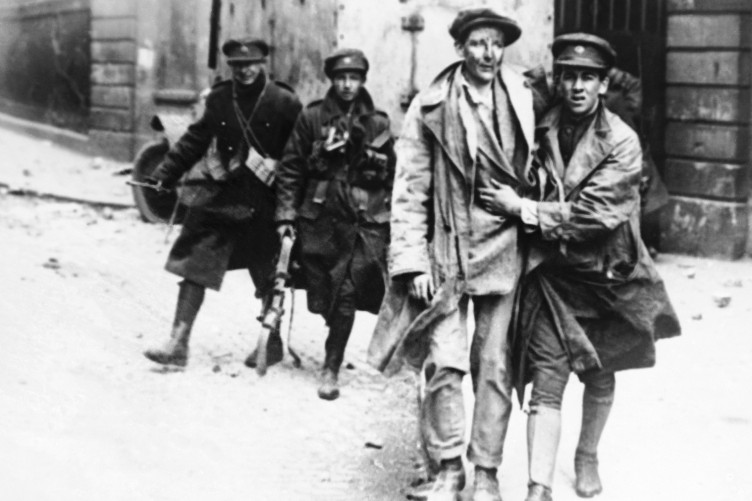
An injured Anti-Treaty soldier is supported by a fellow fighter in the Battle for Dublin that started the Irish Civil War; over 500 Anti-Treaty fighters were taken as prisoners after the battle died down in the city.
Just a very quick post to mark the fact that it was on this day a century ago, May 24th 1923, that the terrible Irish Civil War came to an end. The conflict had been stuttering to a close for some time, but the final act was a communique issued by Éamon de Valera, the political leader of the Anti-Treaty forces, which said
Soldiers of the Republic. The Republic can no longer be successfully defended by your arms. Further sacrifice on your part would now be in vain and the continuance of the struggle in arms unwise in the national interest and prejudicial to the future of our cause. Military victory must be allowed to rest for the moment with those who have destroyed the Republic. Other means must be sought to safeguard the nation’s right.
Éamon de Valera, May 24th 1923
The Irish Free State created by the Anglo-Irish Treaty lasted until 1937, when a new constitution, largely written by de Valera, was adopted. Ireland (minus the Six Counties retained by the United Kingdom in the Treaty) became a full republic in 1949.
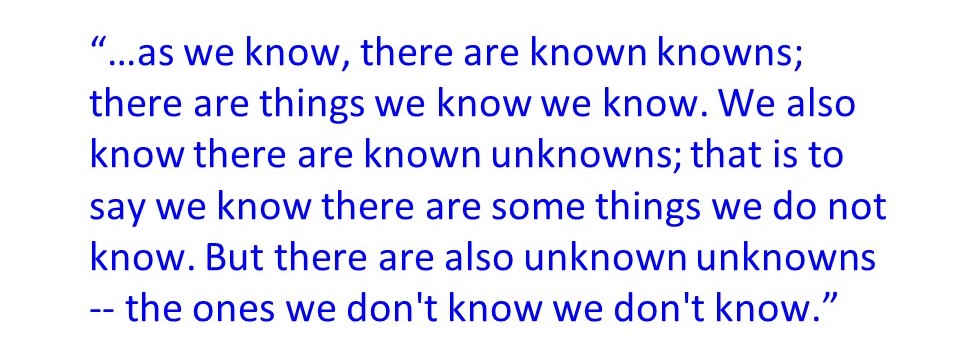
I was surprised today that some students I was talking to couldn’t identify the leading American philosopher and social scientist responsible for this pithy summation of the limits of human knowledge:
Obviously it’s from before their time. How about you? Without using Google, can you identify the origin of this clear and insightful description?
The Shelbourne Hotel, viewed through the trees at the North-East corner of St Stephen’s Green
I was a bit early arriving into Dublin for the concert on Friday so decided to take a walk around St Stephen’s Green. It was a pleasant evening, and the park was quite busy with people, some sitting on the grass and some strolling around as I was. This was 28th April 2023.
The scene must have been very different 107 years ago. The Easter Rising of 1916 started on Easter Monday (24th April of that year), and ended on Saturday 29th. St Stephen’s Green was a focus of the first day of hostilities, as I blogged about here. It is obvious why the rebel forces considered this park an important location to control as it is at the junction of several main roads. On the other hand if you actually visit the location you will see a big problem, namely that the Green itself is surrounded on all sides by very tall buildings, including the swanky Shelbourne Hotel to the North.
When a contingent of about 120 members of the Citizens Army arrived in St Stephen’s Green on Easter Monday, 24th April 1916, they immediately began erecting barricades outside, and digging trenches inside, the Park. They did not, however, have the numbers needed to seize and hold the buildings around it except for the Royal College of Surgeons building to the West.
The following morning, Tuesday 25th April, the British moved two machine guns into position, one in the Shelbourne Hotel (on the 4th floor) and the other in the United Services club, along with numerous snipers. According to eyewitness accounts, almost every window in the hotel had a sniper in it. From these vantage points British soldiers could shoot down into the Park, making it impossible for the rebels to move around safely. The position inside the Green being untenable the Rebels effected an orderly (but perilous) withdrawal to the Royal College of Surgeons which they had fortified for the purpose. And that’s where they stayed until the surrender at the end of the Rising.
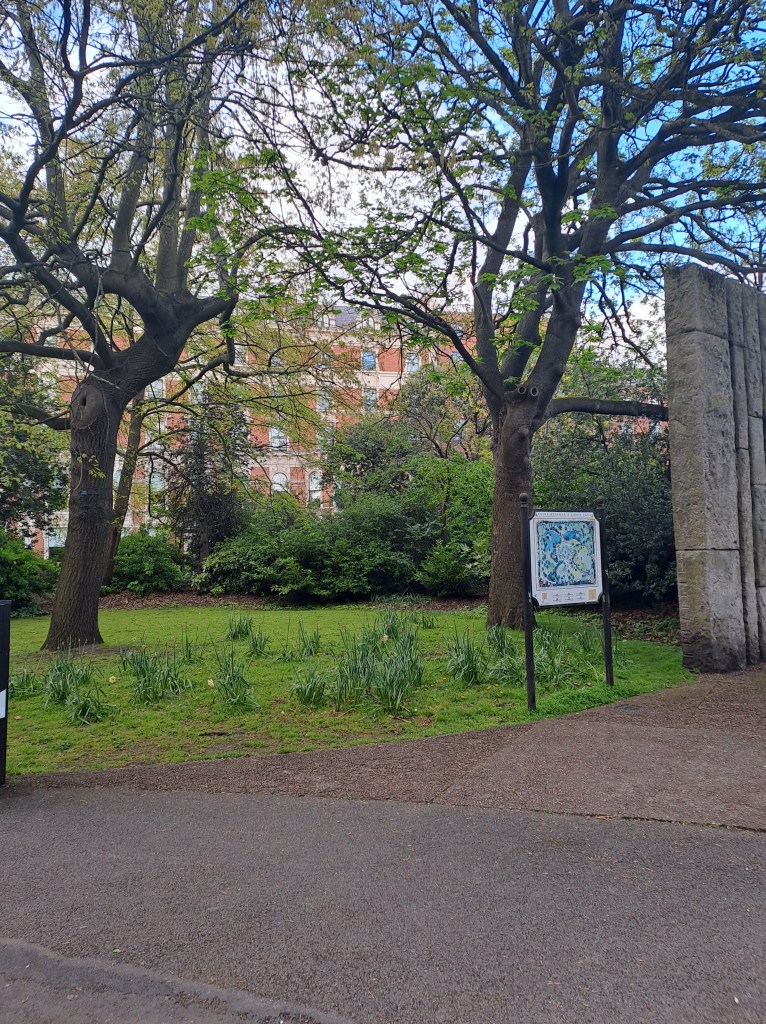
St Stephen’s Green is full of mature trees – there are about 750 at present – which would have been in full leaf at the time. Something I have occasionally wondered about is the extent to which the trees in late April might have afforded the rebels cover from the snipers and machine guns aimed into the park. It being the same time of year when I visited on Friday, and assuming the trees looked roughly the same as in 1916, I had a look around to see what protection they might have offered.
The answer, as you can see from the photo, is not very much…
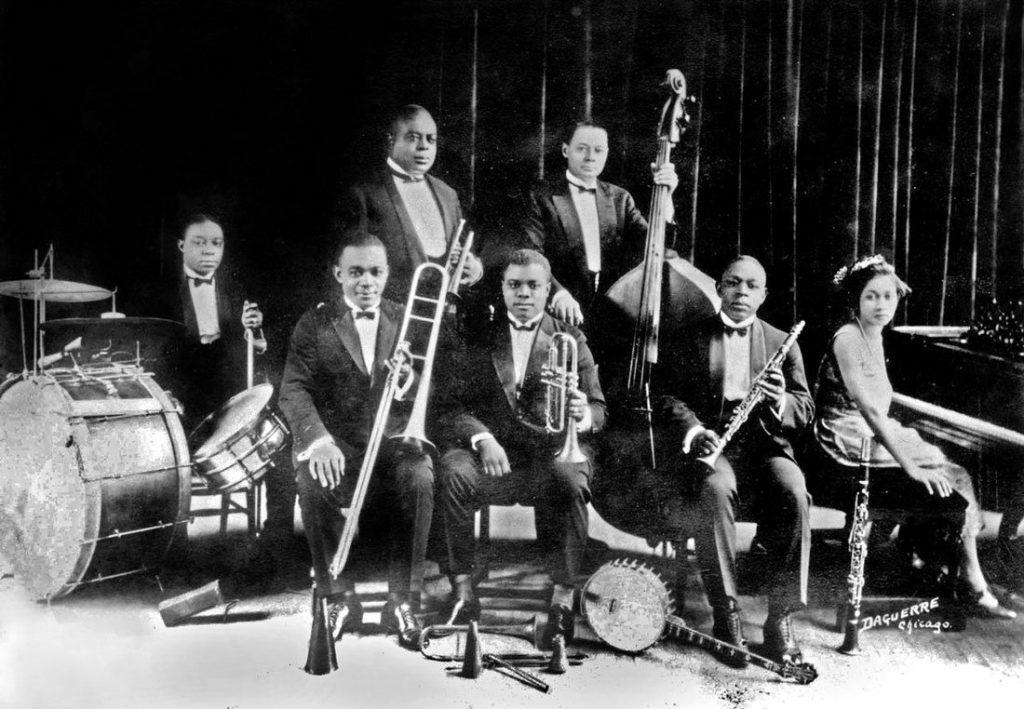
King Oliver’s Creole Jazz Band vintage 1923. From the left: Warren “Baby” Dodds (drums); Honore Dutrey (seated front, trombone); Joe “King” Oliver (standing rear, cornet); Louis Armstrong (seated front, cornet); Bill Johnson (standing rear, string bass and banjo); Johnny Dodds (seated front, clarinet); and Lil Hardin (piano)
I’ve been looking forward to this day because it marks an important jazz centenary. Or at least I think it does. There’s some contradictory evidence about whether it was April 5th 1923 or April 6th, or maybe both, when King Oliver‘s Creole Jazz Band did its first ever recording session at the Gennett studios in Richmond, Virginia. They recorded 20 sides in that session, which may well have involved two days with a break in between or working through the night.
These dates represent a remarkable occasion not only because King Oliver’s band was really the first jazz Supergroup, but also because it had been joined just a few months earlier by a young cornet player by the name of Louis Armstrong. This session therefore represent the first examples of Louis Armstrong ever heard on record.
It is somewhat surprising that this historic session happened at the Gennett studios. The band was based on Chicago, Illinois, and the studios were in Richmond, Virginia, so it required a long road trip to get there. Moreover the studio building wasn’t exactly in a prime location, as it was right next to a railroad line:
Gennett Recording Studios, Richmond Virginia (Picture Credit here)
Musicians had to time their recordings so as to avoid the noise from passing trains. Still, records only lasted about 3 minutes in those days so presumably weren’t so frequent as to make it difficult to fit in a take between two of them! Recording techniques were rather primitive in those days though, and the sound quality that emerged isn’t great.
The lineup for the band is shown in the picture at the top of this page. It’s interesting to note that four of these musicians (Armstrong, Hardin, and the Dodds brothers) were to feature regularly from 1925 onwards in the classic Hot Fives and Hot Sevens. King Oliver’s band, however, had style that was very different from these later records, with a much greater emphasis on polyphony, much more complex arrangements, and much less emphasis on solos. Also, King Oliver’s band played to live audiences on a regular basis, but the Hot Fives and Hot Seven only ever performed as such in recording studios.
As far as I understand how this band worked, King Oliver made the arrangements. I don’t think they used full written scores, but tended to play from wonderfully intricate “head arrangements” worked out beforehand, with ensemble passages, gaps for breaks and solos, and King Oliver introducing the (usually very catchy themes). Armstrong and Johnny Dodds improvised a decorative counterpoint, and Honore Dutrey added harmonic breadth to the ensemble. This must have been a great learning experience for the young Louis Armstrong, has he had to develop a great ear for what was going on around him to play like this. I gather that Louis Armstrong often tended to play very loud so he was kept well in the background in these early Gennett sessions, but such a prodigious talent was never going to play second fiddle for long and in later sessions he effectively duets with King Oliver and swapped leads with him freely and completely intuitively, producing a sound that was entirely unique. I am always astonished by how much is going on in these old records, even if you can’t hear it all very well!
I’ve mentioned before that, over time, this classic type of polyphonic Jazz – derived from its New Orleans roots – gradually morphed into musical form dominated by much simpler arrangements and a succession of virtuoso solos. This change was also reflected in the differing fortunes of Louis Armstrong and King Oliver. The former went on to become an international celebrity, while the latter lost all his savings when his bank went bust during the Wall Street Crash and ended his life working as a janitor.
As well as Gennett, this band recorded with other labels in 1923 including Okeh and Columbia. Sadly however they split up at the end of 1923 over disagreements about a possible tour in 1924. Only about 40 sides were ever recorded King Oliver’s Creole Jazz Band. Many of them are absolutely marvelous.
This is the first track recorded by the band in April 1923. It’s called Just Gone. It’s a scratchy old record, with a rather compressed acoustic, so it’s like putting your next to one end of a tunnel leading back a hundred years, but it’s a good example of the Creole Jazz Band’s style. Joe Oliver’s lead cornet clearly influenced Louis Armstrong’s later style. You have to listen hard to hear Satchmo in the background on this track, but it’s worth the effort. You’re listening to a piece of music history, and a wonderful piece at that.
I was very sad to hear this morning of the death at the age of 67 of Paul O’Grady, who was best known (to me) in the form of Lily Savage, the best of the drag acts to be found in London when I lived there years ago. I remember seeing Lily Savage many times, including one memorable night at the old Drill Hall near Tottenham Court Road, which was a hilarious occasion enjoyed by everyone there (including a smattering of celebrities in the audience). The best bit of the best drag shows is always how the performer deals with hecklers. Paul O’Grady had a ready wit and a very acerbic tongue which made Lily Savage a must-see act. I wasn’t the only one to be surprised when Lily Savage got her own mainstream television show in the 90s, as much of her material was very “blue”, and I wondered how she would fare with the inevitable toning down of the material. The transition to Telly, however, turned out to be a great success.
Paul O’Grady “retired” Lily Savage some years ago, but still appeared on TV as himself to great popular acclaim. I never knew him personally but some old friends of mine from London got to know him very well, including going on holiday with Paul and his partner Andre (whom he married in 2017). They all said Paul was a lovely and friendly person and just as funny in private as he was on stage or on television. I send my condolences to his friends and family.
Drag has of course been around for centuries. Cross-dressing in the theatre, in film, and in opera, where it plays a central role in many plots especially in comedies. Who can forget the wonderful Alastair Sim in the St Trinian’s movies? More recently, Danny La Rue (who, incidentally, was born in Cork) was a regular performer on television in my youth and was for a time Britain’s highest paid entertainer.
But Paul O’Grady was a bit different. He successfully navigated a tricky journey to bring Lily Savage from the underground world of gay bars and clubs into the realm of popular culture at a time overshadowed by Section 28 and the AIDS crisis. Paul O’Grady was a powerful advocate for LGBTQ+ rights. His visibility and humour made the world a better place for many of us. His was a life well lived.
It is especially sad that Paul O’Grady’s death coincides with widespread and growing hostility to drag queens from far right bigots, who are intent on attacking anyone associated in any way with the LGBTQ+ community. The banning of drag shows – which has already happened in some States of the USA- is just part of this agenda; transphobia is another, as is the anti-migrant movement. It’s all about manufacturing hostility to distract attention away from the real problems of society. The list of targets is growing. Before long, any lifestyle perceived to be unconventional in any way will come under attack. The wave of bigotry sweeping across the world is intended to sweep diversity aside and leave in its wake a bleak landscape of dreary uniformity.
The career of Ireland’s own Rory O’Neill (aka Panti Bliss), who was a popular contestant on Dancing with the Stars, mirrors that of Paul O’Grady. I recently went to an event featuring Rory O’Neill. He had left Panti at home for the occasion but it was extremely interesting and enjoyable – and a bit sweary! – to hear him talk about his life and experiences, especially why he became an activist and how he started out as a drag performer. I have the same sort of admiration for Rory as I had for Paul. We need more like them.
I also have personal reasons for being grateful for drag queens. When I was a youngster (still at School) I occasionally visited a gay bar in Newcastle called the Courtyard. I was under age for drinking alcohol let alone anything else – the age of consent was 21 in those days – but I got a kick out of the attention I received and flirted outrageously with the much older clientele. I never took things further but never had to buy my own drinks, let’s put it that way.
Anyway, one evening I left the pub to get the bus home – the bus station was adjacent to the pub – but was immediately confronted by a young bloke who grabbed hold of me and asked if I was a “poof”. Before I could answer, a figure loomed up behind him and shouted “Leave him alone!”. My assailant let go of me and turned round to face my guardian angel, or rather guardian drag queen. No ordinary drag queen either. This one, at least in my memory, was enormous: about six foot six and built like a docker, but looking even taller because of the big hair and high heels. The yob laughed sneeringly, whereupon he received the immediate and very muscular response of a powerful right jab to the point of the chin, like something out of a boxing manual. His head snapped back and hit the glass wall of a bus shelter. Blood spurted from his mouth as he slumped to the ground.
I honestly thought he was dead, and so apparently did my rescuer who told me in no uncertain terms to get the hell away. Apart from everything else, the pub would have got into trouble if they’d known I had even been in there. Instead of waiting around in Marlborough Crescent, I ran to the next stop where I got a bus after a short wait.
When I got home I was frightened there would be something on the news about a violent death in the town centre, but that never happened. It turns out the “gentleman” concerned had bitten his tongue when the back of his head hit the bus shelter. It must have been painful, but not life-threatening. My sympathy remains limited. I stayed away from the pub after that.
I think there’s a moral to this story, but I’ll leave it up to you to decide what it is.
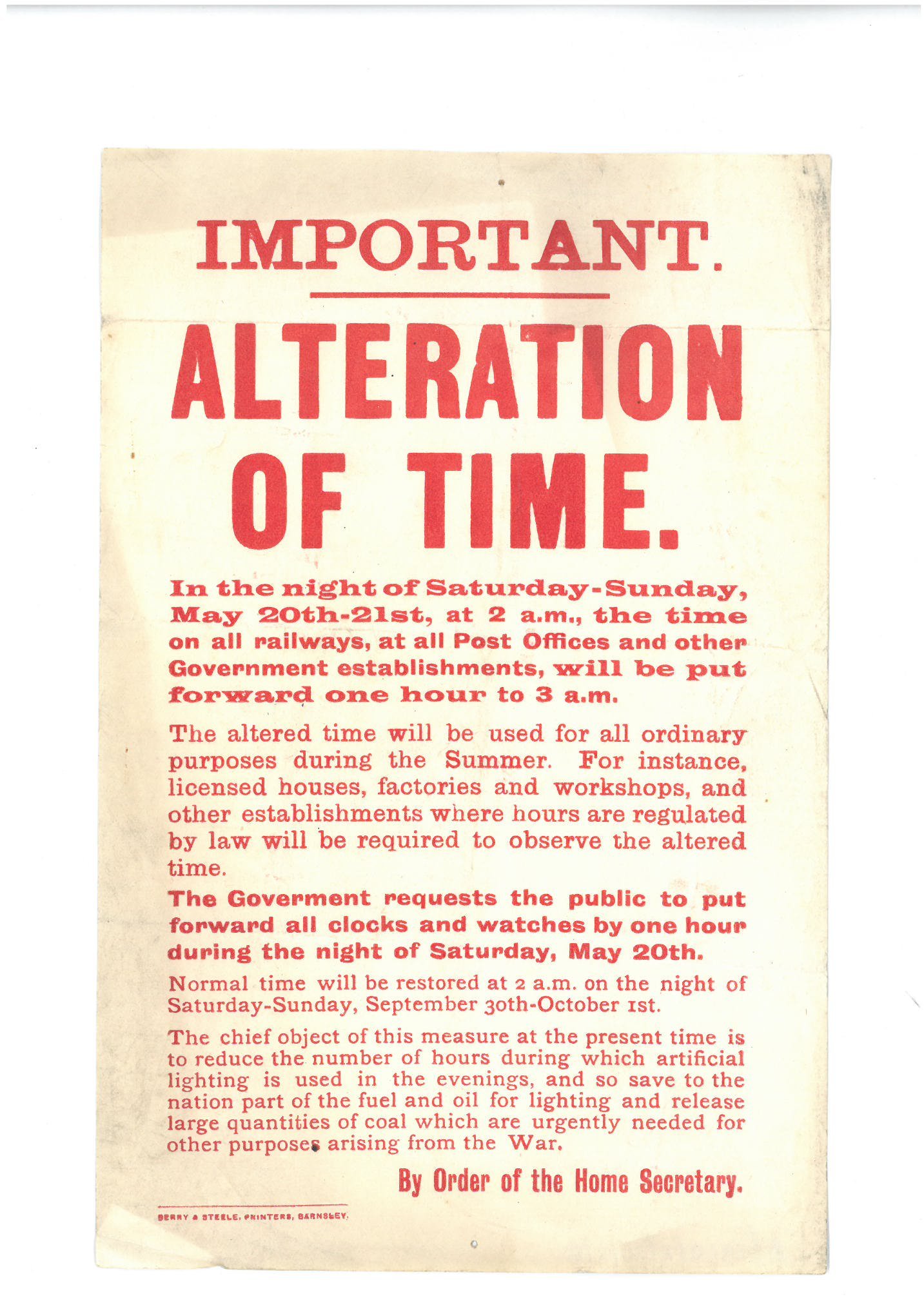
It’s that time of year again. The clocks went forward at 1am on 26th March, when I was in bed. I scheduled this post for exactly that time to see what would happen. By the time I get up tomorrow morning I’ll be on Irish Summer Time and it will probably take me most of the day to work out how to change the clock on my oven again. Still, at least there will be a slight reduction in the amount of confusion over the timing of next week’s batch of telecons.
Among the many sensible decisions made recently by the European Parliament was to approve a directive that will abolish `Daylight Saving Time’. I’ve long felt that the annual ritual of putting the clocks forward in the Spring and back again in the Autumn was a waste of time effort, so I’ll be glad when this silly practice is terminated. It would be better in my view to stick with a single Mean Time throughout the year. This was supposed to happen in 2021 but has been delayed and I gather there are no plans to make it happen in the foreseeable future.
The splendid poster above is from 1916, when British Summer Time was introduced. You might be surprised to learn that the practice of changing clocks backwards and forwards is only about a hundred years old, in the United Kingdom. To be honest I’m also surprised that the practice persists to this day, as I can’t see any real advantage in it. Any institution or organization that really wants to change its working hours in summer can easily do so, but the world of work is far more flexible nowadays than it was a hundred years ago and I think few would feel the need.
Anyway, while I am on about Mean Time, here is a another poster from 1916.
Until October 1916, clocks in Ireland were set to Dublin Mean Time, as defined at Dunsink Observatory, rather than Mean Time as defined at Greenwich. The adoption of GMT in Ireland was driven largely by the fact that the British authorities found that the time difference between Dublin and London had confused telegraphic communications during the Easter Rising earlier in 1916. Its imposition was therefore, at least in part, intended to bring Ireland under closer control of Britain. Needless to say, this did not go down well with Irish nationalists.
Ireland had not moved to Summer Time with Britain in May 1916 because of the Easter Rising. Dublin Mean Time was 25 minutes 21 seconds behind GMT but the change was introduced at the same time as BST ended in the UK, hence the alteration by one hour minus 25 minutes 21 seconds, i.e. 34 minutes and 39 seconds as in the poster.
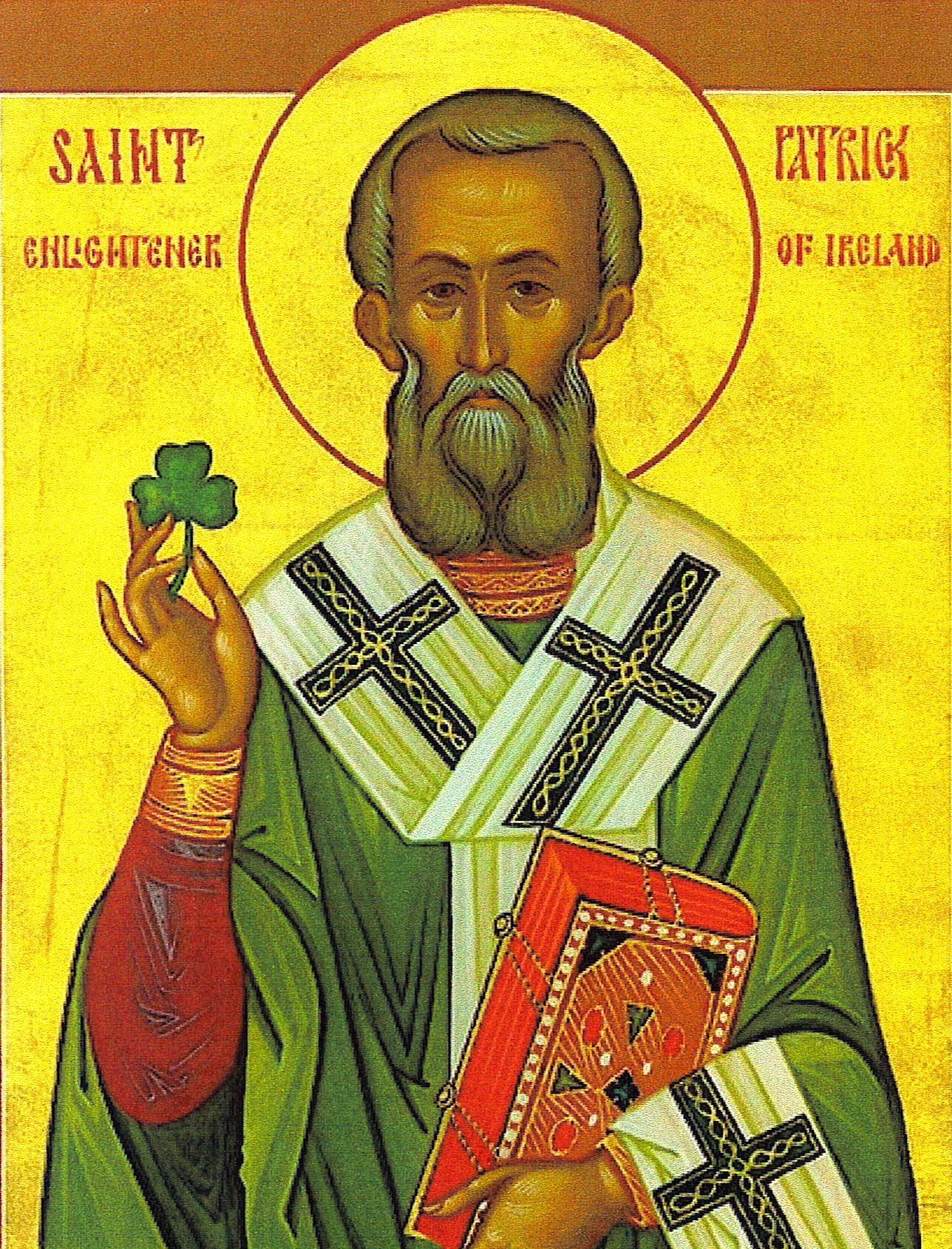
So it’s St Patrick’s Day, a bank holiday here in Ireland. I shall probably observe the festivities in Maynooth later on, though it is pouring down at the moment and very likely to rain on the parade, which starts at 11am. That would be disappointing, as it hardly ever rains in Ireland.
I came second in the Beard of Ireland poll, by the way. Thanks to everyone who voted for me and congratulations to the winner, Aodhan Connolly. A few people have asked for an up-to-date picture of me and my beard, so here goes:
Not many facts are known about the life of St Patrick, but it seems he was born in Britain, probably in the late 4th Century AD, probably somewhere around the Severn Estuary and probably in Wales and according to virtually all artistic depictions of him he had a fine beard. It also appears that he didn’t know any Latin. When a young man, it seems he was captured by Celtic marauders coming up the River Severn and taken as a slave to Ireland. He eventually escaped back to Britain, but returned to Ireland as a missionary and succeeded somehow in converting the Irish people to Christianity.
Ireland was the first country to be converted to Christianity that had never been part of the Roman Empire. That made a big difference to the form of the early Irish Church. The local Celtic culture was very loose and decentralized. There were no cities, large buildings, roads or other infrastructure. Life revolved around small settlements and farms. When wars were fought they were generally over livestock or grazing land. The early Irish Church that grew in this environment was quite different from that of continental Europe. It was not centralized, revolved around small churches and monasteries, and lacked the hierarchical structure of the Roman Church. Despite these differences, Ireland was quite well connected with the rest of the Christian world.
Irish monks – and the wonderful illuminated manuscripts they created – spread across the continent, starting with Scotland and Britain. Thanks to the attentions of the Vikings few of these works survive but the wonderful Lindisfarne Gospels, dating from somewhere in the 8th Century were almost certainly created by Irish monks. The Book of Kells was probably created in Scotland by Irish Monks.
Saint Patrick’s Day is celebrated on March 17th, the reputed date of his death in 461 AD. Nobody really knows where St Patrick was born, though, so it would be surprising if the when were any better known.
In any case, it wasn’t until the 17th Century that Saint Patrick’s feast day was placed on the universal liturgical calendar in the Catholic Church. Indeed, St Patrick has never been formally canonized. In the thousand years that passed any memory of the actual date of his birth was probably lost, so the choice of date was probably influenced by other factors, specifically the proximity of the Spring Equinox (which is this year on Monday, March 20th).
The early Christian church in Ireland incorporated many pre-Christian traditions that survived until roughly the 12th century, including the ancient festival of Ēostre (or Ostara), the goddess of spring associated with the spring equinox after whom Easter is named. During this festival, eggs were used a symbol of rebirth and the beginning of new life and a hare or rabbit was the symbol of the goddess and fertility. In turn the Celtic people of Ireland probably adapted their own beliefs to absorb much older influences dating back to the stone age. St Patrick’s Day and Easter therefore probably both have their roots in prehistoric traditions around the Spring Equinox, although the direct connection has long been lost.
Lá Fhéile Pádraig sona daoibh go léir!
Update. I waited until it stopped raining before leaving the house, which meant that I missed the start of the Maynooth parade but there seemed to be a very good turnout. Here are some snaps of the bit I saw:
Today is the Ides of March so I thought I’d keep post this priceless bit of British cultural history relevant to such a fateful day.
This is from the First Folio Edition of Carry On Cleo, and stars the sublime Kenneth Williams as Julius Caesar delivering one of the funniest lines in the whole Carry On series. The joke may be nearly as old as me, but it’s still a cracker…
And if one old joke isn’t enough for you, here is a Caesar Salad:
The views presented here are personal and not necessarily those of my employer (or anyone else for that matter).
Feel free to comment on any of the posts on this blog but comments may be moderated; anonymous comments and any considered by me to be vexatious and/or abusive and/or defamatory will not be accepted. I do not necessarily endorse, support, sanction, encourage, verify or agree with the opinions or statements of any information or other content in the comments on this site and do not in any way guarantee their accuracy or reliability.










 In the Dark