Archive for the mathematics Category

Generative AI in Physics?

Posted in Artificial Intelligence, Education, mathematics, Maynooth with tags , , , , , , , , , on August 11, 2025 by telescoper

As a new academic year approaches we are thinking about updating our rules for the use of Generative AI by physics students. The use of GenAI for writing essays, etc, has been a preoccupation for many academic teachers. Of course in Physics we ask our students to write reports and dissertations, but my interest in what we should do about the more mathematical and/or computational types of work. A few years ago I looked at how well ChatGPT could do our coursework assignments, especially Computational Physics, and it was hopeless. Now it’s much better, though still by no means flawless, and now there are also many other variants on the table.

The basic issue here relates to something that I have mentioned many times on this blog, which is the fact that modern universities place too much emphasis on assessment and not enough on genuine learning. Students may use GenAI to pass assessments, but if they do so they don’t learn as much as they would had they done the working out for themselves. In the jargon, the assessments are meant to be formative rather than purely summative.

There is a school of thought that has the opinion that formative assessments should not gain credit at all in the era of GenAI since “cheating” is likely to be widespread. The only secure method of assessment is through invigilated written examinations. Students will be up in arms if we cancel all the continuous assessment (CA), but a system based on 100% written examinations is one with which those of us of a certain age are very familiar.

Currently, most of our modules in theoretical physics in Maynooth involve 20% coursework and 80% unseen written examination. That is enough credit to ensure most students actually do the assignments, but the real purpose is that the students learn how to solve the sort of problems that might come up in the examination. A student who gets ChatGPT to do their coursework for them might get 20%, but they won’t know enough to pass the examination. More importantly they won’t have learnt anything. The learning is in the doing. It is the same for mathematical work as it is in a writing task; the student is supposed to think about the subject not just produce an essay.

Another set of issues arises with computational and numerical work. I’m currently teaching Computational Physics, so am particularly interested in what rules we might adopt for that subject. A default position favoured by some is that students should not use GenAI at all. I think that would be silly. Graduates will definitely be using CoPilot or equivalent if they write code in the world outside university so we should teach them how to use it properly and effectively.

In particular, such methods usually produce a plausible answer, but how can a student be sure it is correct? It seems to me that we should place an emphasis on what steps a student has taken to check an answer, which of course they should do whether they used GenAI or did it themselves. If it’s a piece of code to do a numerical integration of a differential equation, for example, the student should test it using known analytic solutions to check it gets them right. If it’s the answer to a mathematical problem, one can check whether it does indeed solve the original equation (with the appropriate boundary conditions).

Anyway, my reason for writing this piece is to see if anyone out there reading this blog has any advice to share, or even a link to their own Department’s policy on the use of GenAI in physics for me to copy adapt for use in Maynooth! My backup plan is to ask ChatGPT to generate an appropriate policy…

Lá Saoire i mí Lúnasa

Posted in Biographical, Education, mathematics, Maynooth with tags , , , , on August 4, 2025 by telescoper

Today, Monday 4th August 2024, being the first Monday in August, is a Bank Holiday in Ireland. This holiday was created by the Bank Holiday Act of 1871 when Ireland was under British rule. While the August Bank holiday was subsequently moved to the end of August in England and Wales, it has remained at the start of August in Ireland.

We have had some proper Bank Holiday weather, in the form of Storm Floris. Although the worst of this passed to the West of Maynooth, the winds were powerful enough to blow one of my wheelie bins over.

As I mentioned last week, the first day of August marks the old pagan festival of Lughnasadh, named after the God Lugh, on which is celebrated the beginning of the harvest season. This coincides with the English Lammas Day, one of many Christian festivals with pagan origins. Traditionally this is the start of the harvest season and is celebrated accordingly, with rites involving the first fruit and bread baked from flour obtained from the first corn. It is also one of the cross-quarter days, lying roughly half-way between the Summer Solstice and the Autumnal Equinox (in the Northern Hemisphere).

I’m reminded that this time last year I was still on sabbatical. That seems like ages ago. When I resumed teaching last September I had to teach two modules I’d never taught before: a fourth-year Mathematical physics course on Differential Equations and Complex Analysis and a second-year Engineering Mathematics course. This time should be a bit easier as I get to do both of these again. Over the year I also had a final-year undergraduate project student and an MSc student. Both have been a pleasure to work with. The Masters course lasts a calendar year so that one isn’t quite finished, but the deadline for handing in their dissertation is close, next Monday (11th) in fact.

After I return to work tomorrow the next big item on the agenda is the repeat examination period, which starts on Wednesday August 6th. The fates have conspired to require me to be “on call” for four papers next Saturday (two of my own and two covering for a colleague): three of these are scheduled at 12.30 and the other one at 15.30 so I’l have to be by the phone all afternoon in case any matters arise. I also have three others scattered through the approximately ten days of the examination period.

After the repeat examinations are done, the marks uploaded, and the Examination Board has done its work, the next job will be to prepare for the new intake of students. This year’s Leaving Certificate results will be announced on Friday 22nd August, at which point we’ll see how many students (if any) we have studying Physics next academic year which, if all goes to plan, will be my antepenultimate…

Lehrer and Lobachevsky

Posted in mathematics, Music with tags , , , , , on July 28, 2025 by telescoper

I couldn’t resist adding a little anecdote by way of a postscript to yesterday’s item about the the late Tom Lehrer. I didn’t know anything about this story until yesterday when I saw it as a thread on Bluesky (credit to @opalescentopal). The whole thread can be read here, so I’ll just give you a short summary and add a bit of context.

Tom Lehrer’s debut album, Songs by Tom Lehrer, released in 1953, contained a number called Lobachevsky. At concerts he would introduce this song with the words “some of you may have had occasion to run into mathematicians and to wonder therefore how they got that way”. If you don’t know the song then you can listen to it, for example, here. This song contains this verse:

I am never forget the day
I am given first original paper to write
It was on "Analytic and Algebraic Topology
Of Locally Euclidean Metrizations
Of Infinitely Differentiable Riemannian Manifolds"
Bozhe moi!

That’s relevant to what follows.

In 1957, while he was still working as a mathematician, Lehrer co-wrote a paper for the U.S. National Security Agency, with R.E. Fagan, under the title Gambler’s Ruin With Soft-Hearted Adversary, the full text of which can be found here. For those of you unaware, the Gambler’s Ruin is an important problem in the theory of probability. The paper was an internal document but was unclassified. It was later published, in 1958, with some modifications under the title Random Walks with Restraining Barrier as Applied to the Biased Binary Counter.

The 1957 paper was filed away, attracting little attention until 2016 when the person who wrote the Bluesky thread looked at it and noticed something strange. The reference list contains six papers, indexed numerically. References [1], [2] and [4] are cited early on in the paper, and references [5] and [6] somewhat later. But nowhere in the text is there any mention of reference [3]. So what is reference [3]? Here it is:

(It’s a pity about the spelling mistake, but there you go.) Although the song Lobachevsky had been written a few years before the Gambler’s Ruin paper, and had proved very popular, nobody had spotted the prank until 2016. This is episode is testament to Lehrer’s mischievous sense of humour, and to his patience. He made a joke and then kept quiet about it for almost 60 years, waiting for the payoff!

P.S. The Lobachevsky reference was omitted from the modified paper published in 1958.

Happy Retirement, James Hirschfeld!

Posted in mathematics with tags , , on July 22, 2025 by telescoper

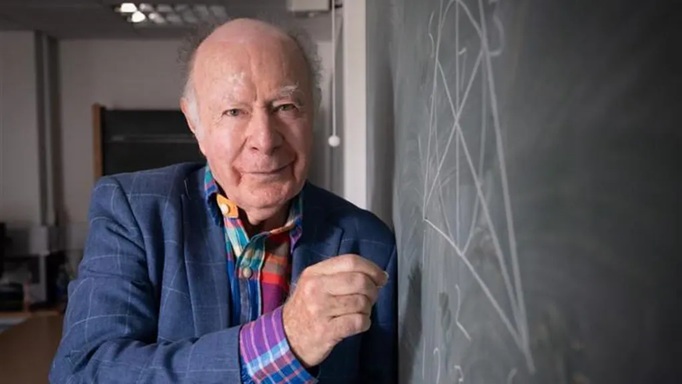
I’m indebted to my erstwhile colleague from Sussex days, Dorothy Lamb, for passing on the news that another former colleague from Sussex days, mathematician Professor James Hirschfeld, has finally retired at the age of 84. He formally retired some years ago, but remained in employment as a Tutorial Fellow. He was very popular with students and staff alike.

Prof. James Hirschfeld, picture credit: University of Sussex

James started as a lecturer at Sussex University in 1966, soon after the opening of the University, and remained working there for almost 60 years. I remember him well from both my stints here: from 1985-990 when I was a research student and then postdoc in the Astronomy Centre, and then from 2013 to 2016 when I was Head of the School of Mathematical and Physical Sciences, of which the Department of Mathematics was a part. He was an excellent colleague who knew the workings of the University inside out and provided valuable advice on many occasions.

James’s retirement was marked by an event at Sussex University. I’m sure I speak for many present and past colleagues and students in wishing him a long and happy retirement.

The 2025 Leaving Certificate Mathematics Papers

Posted in Education, mathematics with tags , , on June 7, 2025 by telescoper

As I mentioned a few days ago, examinations for the 2025 school Leaving Certificate are under way. One of the interesting things about the Irish system is that the examination papers are put up online immediately after the examinations. Students took their first paper in Mathematics (either Ordinary or Higher level) on Friday (yesterday), and there has been some reaction.

Anyway, I thought I’d share the papers here so you can see what you think. Paper 2 is on Monday 9th June, so I’ll add those papers then.

They look reasonable to me. The thing that strikes me about them is that they are much more structured than the A-level mathematics examinations I took way back in 1981.

Comments are welcome through the box below.

Update: As promised here are the Papers 2:

Reaction to Paper 2 of Higher Mathematics is that it was more challenging than Paper 1.

The Leaving

Posted in Biographical, Education, mathematics, Maynooth with tags , , , , , on June 4, 2025 by telescoper

Today is not only a significant date for me (in more ways than one), but it’s important for many young people in Ireland because the Junior Certificate and Leaving Certificate examinations both start today, so the first thing I need to do is wish everyone starting their examinations the very best of luck!

Among other things, the results of the leaving certificate examinations are important for September’s university admissions. This year the grade inflation that occurred during the pandemic years will be reduced, though it is not yet clear how. Whatever happens is likely to have a big impact on student recruitment to third-level institutions.

In the system operating in England and Wales the standard qualification for entry is the GCE A-level. Most students take A-levels in three subjects, which gives them a relatively narrow focus although the range of subjects to choose from is rather large. In Ireland the standard qualification is the Leaving Certificate, which comprises a minimum of six subjects, with many students taking more than this. This gives students a broader range of knowledge at the sacrifice (perhaps) of a certain amount of depth; it has been decreed for entry into this system that an Irish Leaving Certificate subject counts as about 2/3 of an A-level subject for admissions purposes, so Irish students do the equivalent of at least four A-levels, and many do more than this. It’s also worth noting that all students have to take Mathematics at Leaving Certificate level.

One can choose to do Leaving Certificate subjects at Ordinary or Higher level and there’s quite a big difference between the two, especially in Mathematics (of which more below).

Overall I prefer the Leaving Certificate over the UK system of A-levels, as the former gives the students a broader range of subjects than the latter (as does the International Baccalaureate). I would have liked to have been allowed to take at least one arts subject past O-level, for example.

For University admissions points are awarded for each paper according to the marks obtained and then aggregated into a total CAO points, CAO being the Central Applications Office, the equivalent of the UK’s UCAS. This means, for example, that our main Science pathway at Maynooth allows students to study Physics without having done it at Leaving Certificate level. This obviously means that the first year has to be taught at a fairly elementary level, but it has the enormous benefit of allowing us to recruit students whose schools do not offer Physics.

There is however a big problem with Mathematics. It was decided some years ago that students would get 25 extra CAO points if they got a mark of at least 40% in Higher Mathematics. This has led to more students taking the subject, which is good, but there are signs that this may have led to a decline in standards. If, for example, the marking is such that a fixed proportion of students get the top grade but more weaker students take the examination, that means that standards fall at the top end. For more discussion, see here.

Anyway, our Theoretical Physics & Mathematics course requires a good result in Higher Mathematics for entry. Will changes to the marking of Higher Mathematics this year make it harder for students to make the grade? We’ll just have to wait and see.

Moreover, since the pandemic struck, students have been able to choose to answer questions from a limited range of sections on the mathematics examination papers. That means that students can get very high grades despite knowing nothing about a big chunk of the syllabus. That matters most for subjects that require students to have certain skills and knowledge for entry into University, such as Physics. I taught part of our first year Mathematical Physics course in Maynooth for about 5 years. It was noticeable how the fraction that were comfortable with basic differentiation and integration was falling. Will this trend accelerate? Again, we’ll just have to wait and see…

Trump’s Tariff Tirade

Posted in Finance, mathematics, Politics with tags , , , , , , on April 3, 2025 by telescoper

I didn’t watch the speech tirade by “US President” Donald Trump* last night in which he unveiled his new tariff plan, but people have been talking about this all day so I couldn’t resist a quick comment. There’s a lot I don’t know about economics and trade policy but one thing I do know is that the trad-weighted average tariff on goods from the USA entering the EU is about 3%, not the 39% that Trump alleged. I did therefore wonder where he got this number and all his other “reciprocal tariffs” from. Fortunately a little digging around revealed the answer.

On the left you see part of the chart showing tariffs country-by-country and the second is an extract from the published methodology which would be hilarious were the consequences not so serious.

You will see that the second column on the chart is headed “Tariffs charged on the USA”, with 39% listed for the European Union. This number is calculated using the “formula” on the right which has absolutely nothing to do with tariffs charged. Moreover, the denominator contains the product εφ with the values ε=4 and φ=0.25 given in the text so εφ = 1. The expert mathematician who derived this formulae seems to have missed the fact that ε is not less than zero (first sentence) if it is equal to 4, but we’ll let that pass. In fact I can’t be bothered to point out the other errors because no matter how egregious they are, there is no chance of Trumpty Dumpty reversing his decisions anyway.

To sum up, the notional tariff in column 2 is just the difference between imports and exports (the country’s trade surplus) divided by imports. The numbers in the third column of the chart on the left are just half those in the second column (give or take rounding errors). There is also a minimum of 10%, which applies even to countries with which the USA has a trade surplus. China faces huge tariffs because it has a large trade surplus with the USA. The EU’s 20% tariff is nothing to do with the tariffs it charges but is due to the fact that it has a trade surplus with the USA; the UK has a lower tariff rate than the EU because it has a smaller trade surplus  with the USA. That’s it.

I heard a Trump-supporting numpty attempting to justify the calculation shown in the chart on the grounds that it is really an “unfairness index”, it apparently being unfair and worthy of punishment if a country sells more to the USA than the USA sells to it. Following this line of reasoning, I have decided that all shops are unfair because I always buy more from them than they buy from me.

P.S. I was thinking that in future retaliation I should boycott goods from the USA but this would be an empty gesture because I don’t really buy any anyway. Looking up top imports from the USA to Ireland I find, for example, Bourbon (which I never buy because it is undrinkable) and confectionery (which I don’t buy because I don’t have a sweet tooth). Then I found peanuts, which I do buy occasionally, and will not buy in future. However in the grand scheme of world trade, peanuts are small potatoes.

*I apologize for forgetting to mention that Donald Trump is a convicted felon.

Crossword Solution and Problem

Posted in Crosswords, mathematics with tags , , , , on March 22, 2025 by telescoper

I got an email last week pointing out that I had won another prize in the Times Literary Supplement crossword competition 1565. They have modernised at the TLS, so instead of sending a cheque for the winnings, they pay by bank transfer and wanted to check whether my details had changed since last time. You can submit by email nowadays too, which saves a bit in postage.

Anyway, I checked this week’s online edition and found this for proof:

I checked when I last won this competition, which I enter just about every week, and found that it was number 1514, almost exactly a year ago. There are 50 competitions per year rather than 52, because there are double issues at Christmas and in August, so it’s actually just over a year (51 puzzles) since I last won. I’ve won the crossword prize quite a few times but haven’t been very careful at keeping track of the dates. I think it’s been about once a year since I started entering.

All this suggested to me a little problem I devised when I was teaching probability and statistics many years ago:

Let’s assume that  the same number of correct entries, N, is submitted for each competition. The winner each time is drawn randomly from among these N. If there are 50 competitions in a year and I submit a correct answer each time, winning once in these 50 submissions, then what can I infer about N?

Answers on a postcard, via email, or, preferably, via the Comments!

If Oscar Wilde were a Torus

Posted in mathematics with tags , , , , on March 3, 2025 by telescoper

Beautiful Equations

Posted in Biographical, mathematics, The Universe and Stuff with tags , , , , on February 25, 2025 by telescoper

I did a lecture today about the Dirac Equation (which is almost 100 years old, having been first presented in 1928). You might think this is a difficult topic to lecture on, but it’s really a piece of cake:

This reminds me that a a while ago I posted about an interesting article on the BBC website that discussed the way mathematicians’ brains appear to perceive “beauty”. A (slightly) more technical version of the story can be found here. According to functional magnetic resonance imaging studies, it seems that beautiful equations excite the same sort of brain activity as beautiful music or art.

The question of why we think equations are beautiful is one that has come up a number of times on this blog. I suspect the answer is a slightly different one for theoretical physicists compared with pure mathematicians. Anyway, I thought it might be fun to invite people offer suggestions through the comments box as to the most beautiful equation along with a brief description of why.

I should set the ball rolling myself, and I will do so with the Dirac Equation:

dirac_equation

This equation is certainly the most beautiful thing I’ve ever come across in theoretical physics, though I don’t find it easy to articulate precisely why. I think it’s partly because it is such a wonderfully compact fusion of two historic achievements in physics – special relativity and quantum mechanics – but also partly because of the great leaps of the imagination that were needed along the journey to derive it and my consequent admiration for the intellectual struggle involved. I feel it is therefore as much an emotional response to the achievement of another human being – such as one feels when hearing great music or looking at great art – as it is a rational response to the mathematical structure involved. But it’s not just that, of course. The Dirac Equation paved the way to many further developments in particle physics. It seems to encapsulate so much about the behaviour of elementary particles in so few symbols. Some of its beauty derives from its compactness- it uses up less chalk in a mathematical physics lecture.

Anyway, feel free to suggest formulae or equations, preferably with a brief explanation of why you think they’re so beautiful.

P.S. Paul Dirac was my (academic) great-grandfather.