Just got back from the St Patrick’s parade in Maynooth to find that I won the Beard of Ireland poll!
Thanks to everyone who voted for me! I’m going to celebrate this evening with a traditional Irish dinner of bacon and cabbage, with a parsley sauce.
Just got back from the St Patrick’s parade in Maynooth to find that I won the Beard of Ireland poll!
Thanks to everyone who voted for me! I’m going to celebrate this evening with a traditional Irish dinner of bacon and cabbage, with a parsley sauce.
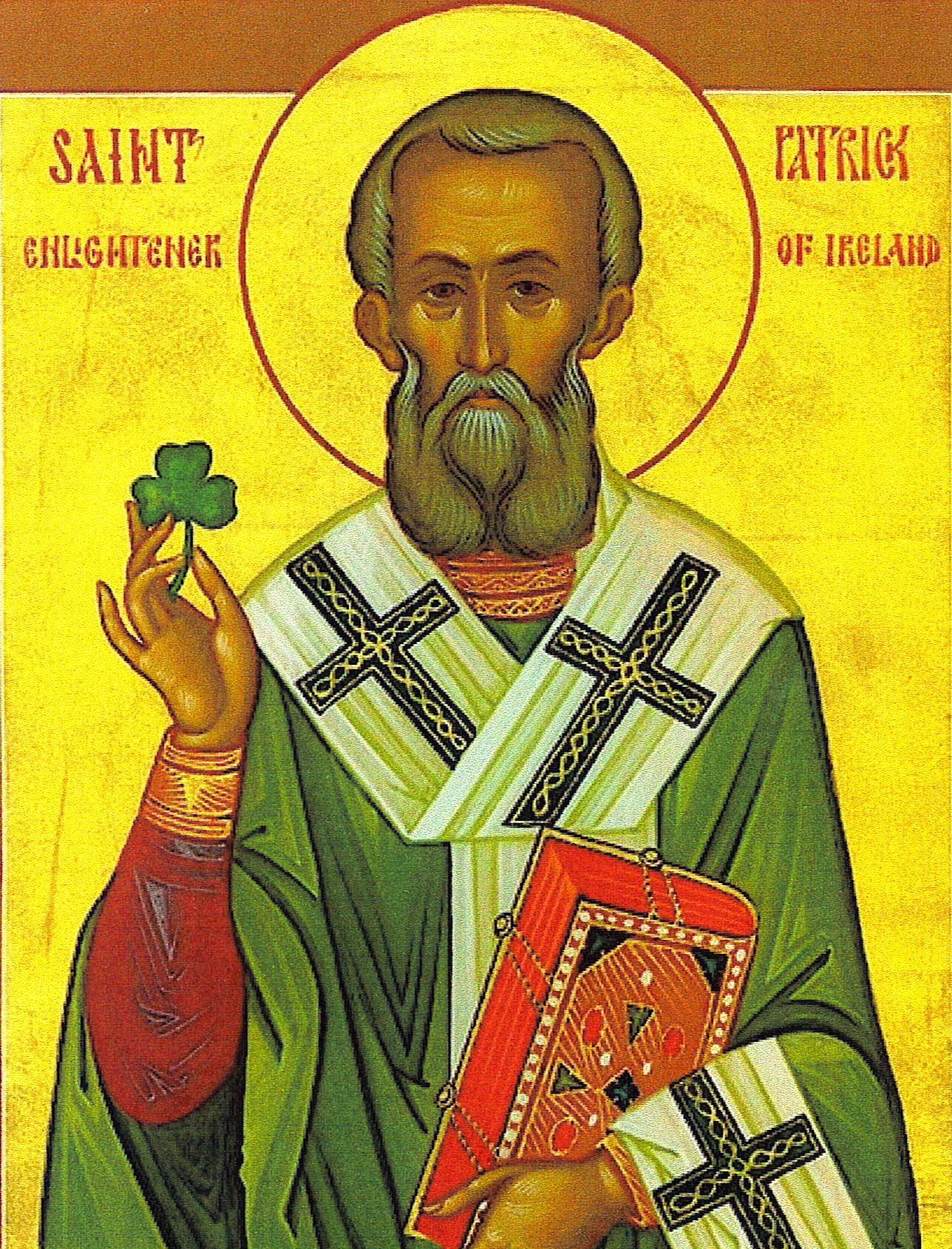
Well, it’s St Patrick’s Day, which means I’m on holiday. I’ll soon be toddling off to watch the parade in Maynooth, which passes quite close to my house. In accord with tradition, it’s very cold today – and not a little windy – but at least it’s not raining.
Not many facts are known about the life of St Patrick, but it seems he was born in Britain, probably in the late 4th Century AD, probably somewhere around the Severn Estuary and possibly in Wales. It also appears that he didn’t know any Latin. When a young man, it seems he was captured by Celtic marauders coming up the River Severn and taken as a slave to Ireland. He eventually escaped back to Britain, but returned to Ireland as a missionary and succeeded somehow in converting the Irish people to Christianity.
Or did he? This interesting piece suggests his role was of lesser importance than many think. On the other hand, if even a fraction of what is said about him is true, then he must have been a very remarkable man.
However it happened, Ireland was the first country to be converted to Christianity that had never been part of the Roman Empire. That made a big difference to the form of the early Irish Church. The local Celtic culture was very loose and decentralized. There were no cities, large buildings, roads or other infrastructure. Life revolved around small settlements and farms. When wars were fought they were generally over livestock or grazing land. The church that grew in this environment was quite different from that of continental Europe. It was not centralized, revolved around small churches and monasteries, and lacked the hierarchical structure of the Roman Church. Despite these differences, Ireland was well connected with the rest of the Christian world.
Irish monks – and the wonderful illuminated manuscripts they created – spread across the continent, starting with Scotland and Britain. Thanks to the attentions of the Vikings few of these works survive but the wonderful Lindisfarne Gospels, dating from somewhere in the 8th Century were almost certainly created by Irish monks. The Book of Kells was probably created in Scotland by Irish Monks.
The traffic wasn’t entirely one-way however. A while ago I saw a fascinating documentary about the Fadden More Psalter. This is a leather-bound book of Psalms found in a peat bog in 2006, which is of similar age to the Lindisfarne Gospels. It took years of painstaking restoration work to recover at least part of the text (much of which was badly degraded), but the leather binding turned out to hold a particularly fascinating secret: it was lined with papyrus. The only other books from the same period with the same structure that are known are from the Coptic Church in Egypt. That doesn’t mean that whoever owned the Fadden More Psalter had actually been to Egypt, of course. It is much more this book made its way to Ireland via a sort of relay race. On the other hand, it does demonstrate that international connections were probably more extensive than you might have thought.
Anyway, back to St Patrick’s Day.
Saint Patrick’s Day is celebrated on March 17th, the reputed date of his death in 461 AD. Nobody really knows where St Patrick was born,, and the when of his birth isn’t known either.
In any case, it wasn’t until the 17th Century that Saint Patrick’s feast day was placed on the universal liturgical calendar in the Catholic Church. Indeed, St Patrick has never been formally canonized. In the thousand years that passed any memory of the actual date of his birth was probably lost, so the choice of date was probably influenced by other factors, specifically the proximity of the Spring Equinox (which is this year on Saturday March 20th).
The early Christian church in Ireland incorporated many pre-Christian traditions that survived until roughly the 12th century, including the ancient festival of Ēostre (or Ostara), the goddess of spring associated with the spring equinox after whom Easter is named. During this festival, eggs were used a symbol of rebirth and the beginning of new life and a hare or rabbit was the symbol of the goddess and fertility. In turn the Celtic people of Ireland probably adapted their own beliefs to absorb much older influences dating back to the stone age. St Patrick’s Day and Easter therefore probably both have their roots in prehistoric traditions around the Spring Equinox, although the direct connection has long been lost.
Lá Fhéile Pádraig sona daoibh go léir!
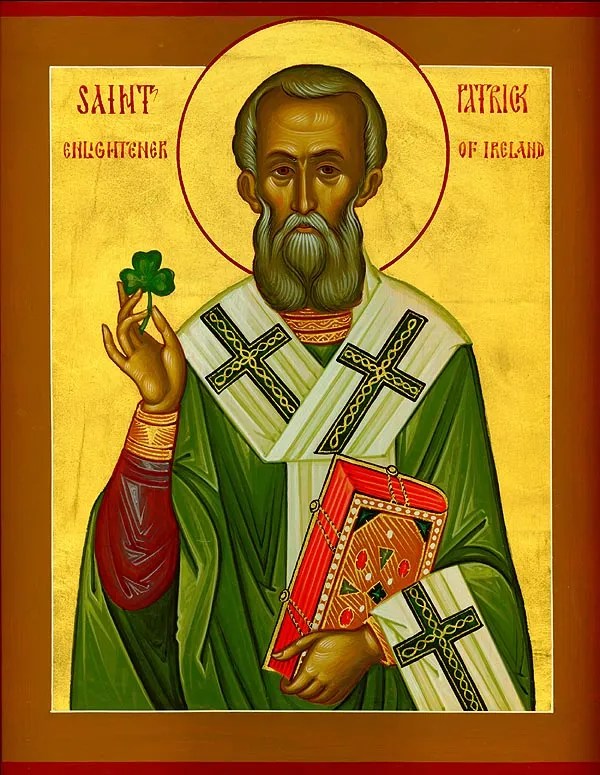
One of the things I learnt during my sabbatical in Barcelona a couple of years ago is that un Puente (a Bridge) is a term used to describe a day in between a weekend and a public holiday. In Spain, it is quite normal to take such a day off work so as to create a long weekend. A sequence of such days is called un Aqueducte, the ideal version of which involves public holidays on Tuesday and Thursday leading to a whole week off!
Tomorrow being St Patrick’s Day (Tuesday 17th March), it is a public holiday in Ireland so I have decided to adopt Spanish practices and declared today La Puente de San Patricio. I am not going to campus (though I will be doing some work, including participating in a Euclid telecon). Officially this week is a Study Break, not a holiday (apart from tomorrow), but there are no lectures or labs or tutorials.
This reminds me to mention that I have made it to the final round of the annual St Patrick’s Day Beard of Ireland competition, which I actually won way back in 2020. The poll has been conducted mainly on Xitter in recent years, and I’ve hardly registered because I have had no presence there since 2023. This year, however, voting is possible via Bluesky (though I don’t think you have to be registered on Bluesky to vote). Last time I looked I was in the lead, but that’s by no means guaranteed to last. Here is a picture of me and my beard:

Anyway, if you feel like voting for me (or indeed any of the other candidates) you can do so here.
Today (Friday 13th March 2026) is 40 years to the day since the Giotto spacecraft started to send back images of Halley’s comet;it reached its closest approach on 14th March 1986. This guest post by my colleague in the Department of Physics at Maynooth, Dr Emma Whelan, was written to mark this anniversary and the connection with the eminent Irish astrophysicist Susan McKenna-Lawlor.
–o–
This week, as I mull over the importance of International Women’s Day, I am also thinking about the significance to Irish women scientists of the 40th anniversary of the historic flyby of Halley’s Comet by the European Space Agency’s first deep space mission Giotto. On 14 March 1986, Giotto passed within about 600 km of the nucleus of Halley’s comet at a relative speed of roughly 68 km/s. Despite being bombarded by dust particles in the comet’s coma, the spacecraft successfully returned unprecedented data. Maynooth University space scientist and former Head of the Department of Experimental Physics, Prof. Susan McKenna-Lawlor, made a key contribution to this mission and was the Principal Investigator for Giotto’s instrument, the Energetic Particle Analyser otherwise known as EPONA. EPONA was designed to measure high-energy charged particles in the vicinity of Halley’s comet. By analysing the flux and energy of these particles, the experiment helped scientists understand the interaction between the solar wind and a comet.

Giotto represents not only a major milestone in the history of ESA, but also an important moment in the history of the contribution of Irish Women to the field of Astrophysics and the involvement of Maynooth University women scientists, in Space Science. The Department of Physics now has a thriving Physics with Astrophysics degree (MH204) with many women (students, technicians, administrators and academics) making important contributions to the success of this programme. Prof. McKenna-Lawlor’s leadership in developing and operating the instrument represented one of Ireland’s earliest direct contributions to an international space mission. Her work helped establish Ireland’s reputation in space science and encouraged future Irish participation in European and international space research, especially by young women who were inspired by seeing an Irish woman succeeding in a field where women were very rarely visible.
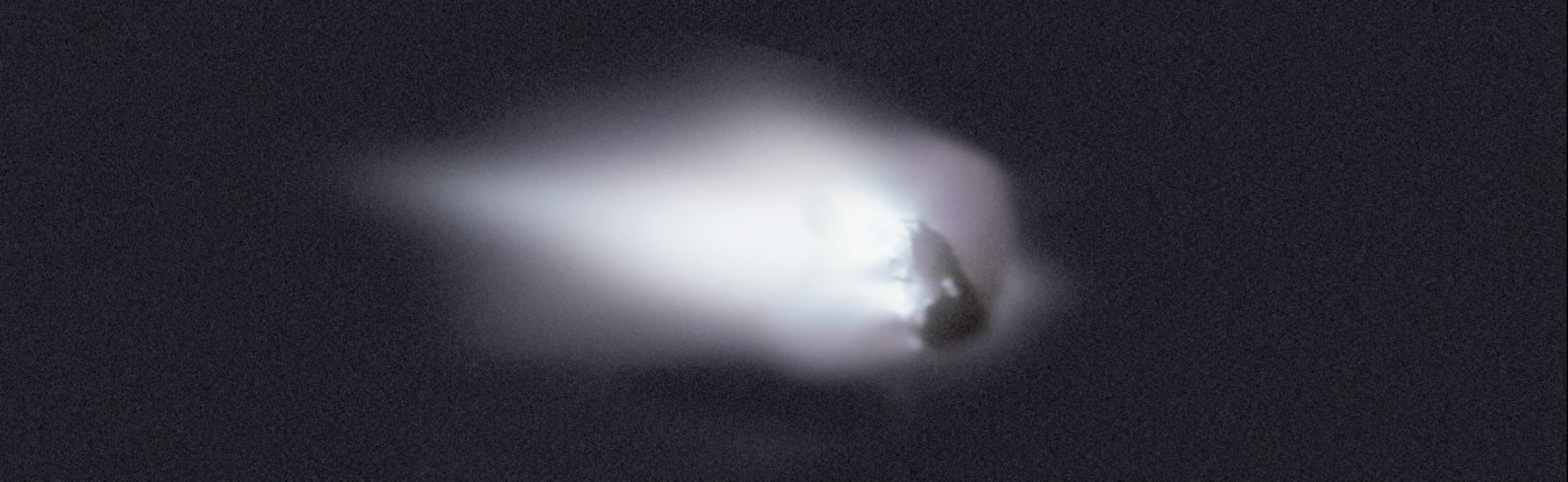
Launched in July 1985, Giotto’s primary objective was to encounter and study Halley’s Comet during its 1986 return to the inner Solar System. ESA have compiled a movie of its encounter which can be viewed here. At the time, Halley’s Comet was the most famous comet known, having been observed for centuries, yet very little was understood about comets and in particular the detailed structure of their nuclei and the physical processes occurring as they approach the Sun. Giotto provided the first close-up measurements of a comet and fundamentally changed scientific understanding of these Solar System bodies. One of Giotto’s most significant results was the first direct image of a comet’s nucleus. The images revealed that Halley’s nucleus is a dark, irregular object roughly 15 km long, far darker than expected, reflecting only a small fraction of sunlight. This confirmed the long-standing “dirty snowball” model proposed by astronomer Fred Whipple, in which a comet consists of volatile ices mixed with dust and rocky material. Giotto’s observations also showed jets of gas and dust erupting from localised regions on the nucleus, demonstrating that cometary activity is driven by sunlight heating specific surface areas rather than uniformly across the surface.
In addition to imaging, Giotto carried instruments designed to study the plasma, dust, and the energetic particle environment around the comet. These measurements revealed the complex interaction between the comet’s expanding atmosphere and the solar wind. Scientists were able to observe the formation of structures such as bow shocks and ion tails, helping to explain how cometary material becomes ionised and carried away through space. These results provided critical insights into the physics of cometary comae and their interaction with the heliosphere. The results from EPONA were crucial in identifying regions where energetic particles were produced by the interaction between the solar wind and the cometary plasma. These measurements contributed to the understanding of shock waves and particle acceleration processes occurring near the comet.

Prof. McKenna-Lawlor (pictured above, in 2017) was born in Dublin in 1935 and received a BSc, MSc and PhD from University College Dublin. She was a research assistant at The Dublin Institute for Advanced Studies and became a lecturer at the Department of Experimental Physics in Maynooth in the early 1970s. She has received numerous awards including the Russian Tsiokovsky Gold Medal for “Outstanding Contributions to Cosmonautics” in 1988. She has written several books on the history of Irish Astronomy including “Whatever Shines Should be Observed” that documents the pioneering contributions of five 19th-century Irish women to astronomy, photography, and science. The title is derived from the motto of the Royal Astronomical Society. In more recent times she was involved with ESA’s Rosetta mission which landed its Philae probe on comet 67P/Churyumov-Gerasimenko on November 12, 2014.
It’s been a while since I posted any Euclid-related news so I’m taking this opportunity to share a press-release related to this image:
The Press Release follows:
–o–
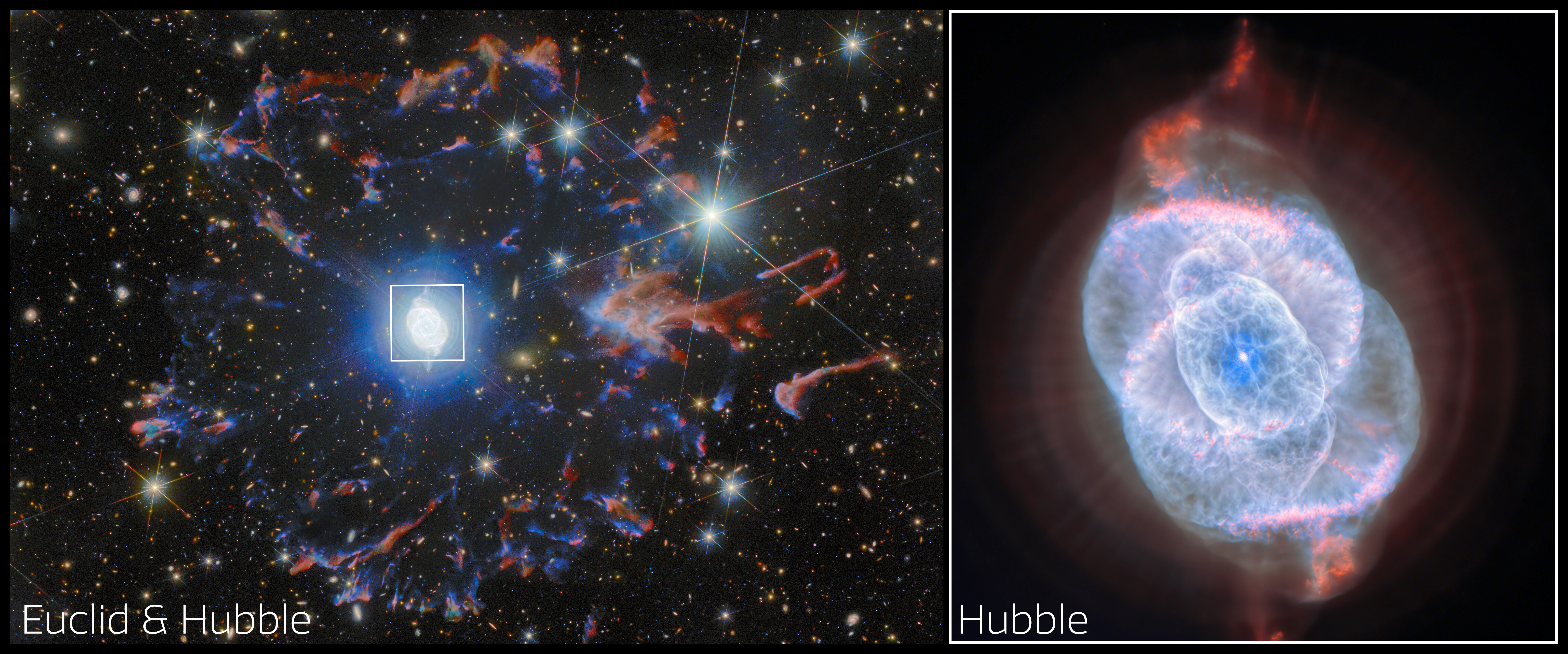
For this ESA/Hubble Picture of the Month, Hubble is joined by ESA’s Euclid to create a new view of the most visually intricate remnants of a dying star: the Cat’s Eye Nebula, also known as NGC 6543.
This extraordinary planetary nebula in the constellation Draco has captivated astronomers for decades with its elaborate and multilayered structure. Observations with ESA’s Gaia mission place the nebula at a distance of about 4300 light-years.
Planetary nebulae, so-called because of their round shape when viewed through early telescopes, are in fact expanding gas thrown off by stars in their final stages of evolution. It was the Cat’s Eye Nebula itself where this fact was first discovered in 1864 – examining the spectrum of its light reveals the emission from individual molecules that’s characteristic of a gas, distinguishing planetary nebulae from stars and galaxies.
Here, the nebula is showcased through the combined eyes of the NASA/ESA Hubble Space Telescope and ESA’s Euclid, highlighting the remarkable complexity of stellar death.
Though primarily designed to map the distant Universe, Euclid captures the Cat’s Eye Nebula as part of its deep imaging surveys. In Euclid’s wide, near-infrared and visible light view, the arcs and filaments of the nebula’s bright central region are situated within a halo of colourful fragments of gas zooming away from the star.
This ring was ejected from the star at an earlier stage, before the main nebula at the centre formed. The whole nebula stands out against a backdrop teeming with distant galaxies, demonstrating how local astrophysical beauty and the farthest reaches of the cosmos can be seen together in modern astronomical surveys.
Within this broad view of the nebula and its surroundings, Hubble captures the very core of the billowing gas with high-resolution visible-light images, adding extra detail in the centre of this image. The data reveal a tapestry of concentric shells, jets of high-speed gas and dense knots sculpted by shock interactions, features that appear almost surreal in their intricacy. These structures are believed to record episodic mass loss from the dying star at the nebula’s centre, creating a kind of cosmic “fossil record” of its final evolutionary stages.
Combining the focused view of Hubble with Euclid’s deep field observations not only highlights the nebula’s exquisite structure but also places it within the broader context of the Universe that both space telescopes explore. Together, these missions provide a rich and complementary view of NGC 6543 – revealing the delicate interplay between stellar end-of-life processes and the vast surrounding space.
–o–
For more information, see here. There’s also this video which shows the Nebula in context in Euclid’s extraordinarily impressive wide field capability and Hubble’s superb resolution in the optical band:
P.S. I put the following on my office door in Maynooth University to demonstrate the true scale (!) of my own involvement in Euclid.
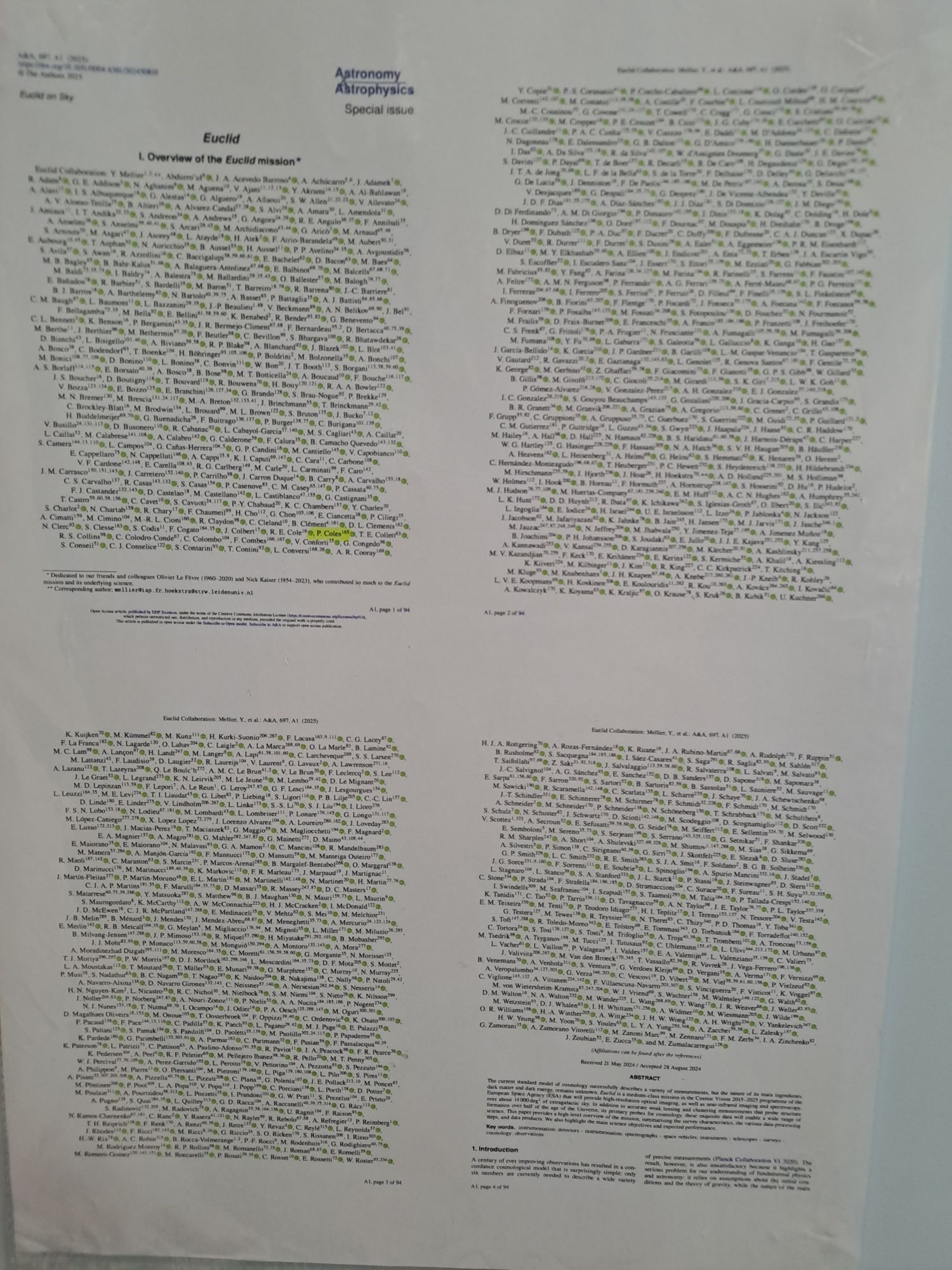
At least I’m on the first page!
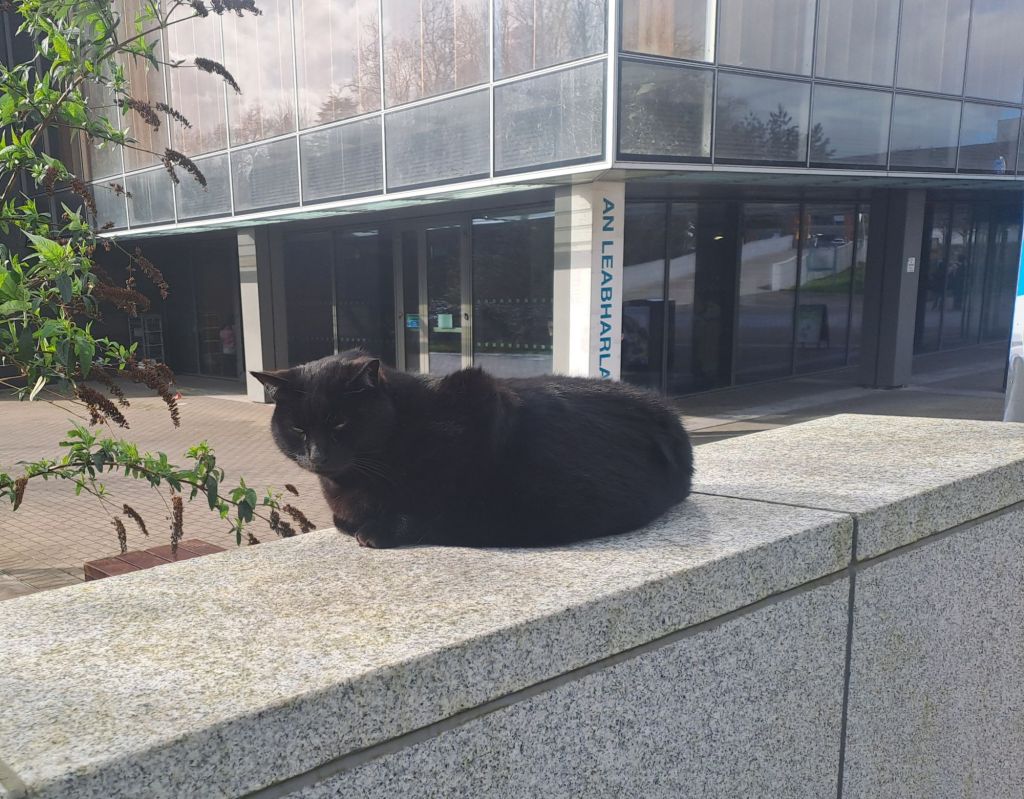
It being a spring-like day, Maynooth University Library Cat took the opportunity to choose a spot away from his usual post so he could loaf in the sunshine.
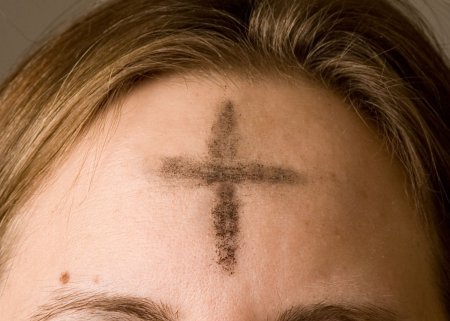
Yesterday was Ash Wednesday. I remember this time eight years ago when I was very much a newcomer to Maynooth being quite surprised to see some folk wearing a cross marked in ash on their forehead as in the picture above. I think this practice is a tradition within the Roman Catholic Church, with which Maynooth has long historical associations, so it’s not really surprising to see it here. Having been brought up in Protestant England I had never seen this before moving to Ireland, but it doesn’t surprise me any more to see people with crosses on their foreheads. That said, I noticed very few around the place yesterday. The numbers observing this ritual seem to be declining every year. Perhaps if they want to increase its popularity they could zhuzh it up a bit: how about some glitter in the ash? Just a thought.
Apparently the tradition used to be for ashes to be sprinkled on the top of the head of a male worshipper but a cross to be made on the forehead of a woman because she would be expected to be wearing a hat. Based on a small sample of those I have observed it seems both genders wear the cross on the forehead nowadays.
Anyway, although I’m not a Christian myself, respect to all those observing the season of Lent (Quadragesima), whether that means fasting, devotional prayer, or just giving up luxuries, such as reading this blog perhaps.
P.S. I’m told that the normal rule for Lent is `One meal and two collations’. The word collation, in the sense of ‘light meal,’ comes from the title of John Cassian‘s early fifth-century work Collationes patrum in scetica eremo (Conferences with the Egyptian hermits), which was read in Benedictine communities before a light meal. I haven’t heard that English word for a while, but it has the same origin as the Italian colazione, used in prima colazione (breakfast).
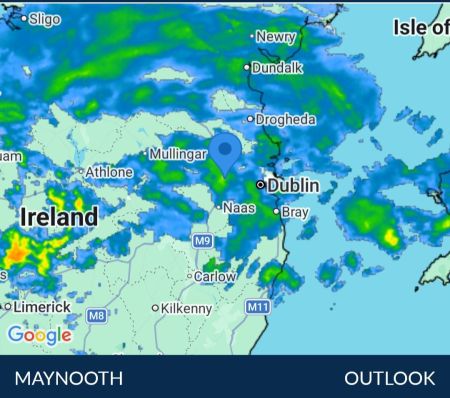
There’s been a lot of rain recently, combined with an unusual easterly wind; the usual prevailing wind in Ireland is from a westerly direction. I’ve managed to avoid the worst of the wet until today. On the way home from work this evening I got absolutely drenched. A lot of water had pooled on the paths and pavements on campus too; I hadn’t put sufficiently sturdy footwear on so my feet got wet too. It seems set to be similar weather tomorrow, so I’ll make sure I’m better prepared. Was it Billy Connolly who said that there’s not really such a thing as bad weather, just the wrong clothes?
We are approaching the end of Week 2 of Semester 2 at Maynooth. I’ve been busy with the usual start-of-term things as well as some other jobs of the sort that crop up from time to time. I started teaching Computational Physics again last week for the first time in a different computer lab, and there were numerous problems with logins, etc, which caused quite a lot of stress. The second cycle of labs started today and everything went much better. I hope this continues. My lecture course on Particle Physics seems to be going reasonably well too, although it’s early days. Hopefully things will settle down and I won’t feel so exhausted for the rest of term. Thursdays are busy for me this term, with a 9am lecture as well as a lab and, today, several other things in between. Combined with the drenching on the way home I feel in need of refreshment, so I think I’ll have a hot bath followed by a glass of brandy and an early night…
P.S. Anniversaries often give me ideas for blog posts but I forgot one yesterday, which was ten years to the day since the announcement of the discovery of gravitational waves. Here’s the blog I did on that day. Was it really a decade ago?
The visit of my former PhD student Mateja Gosenca to Maynooth last year reminded me that she was co-author of the very first paper published by the Open Journal of Astrophysics. The date of publication for that paper was 8th February 2016, i.e. excactly10 years ago today.
Here is the overlay:
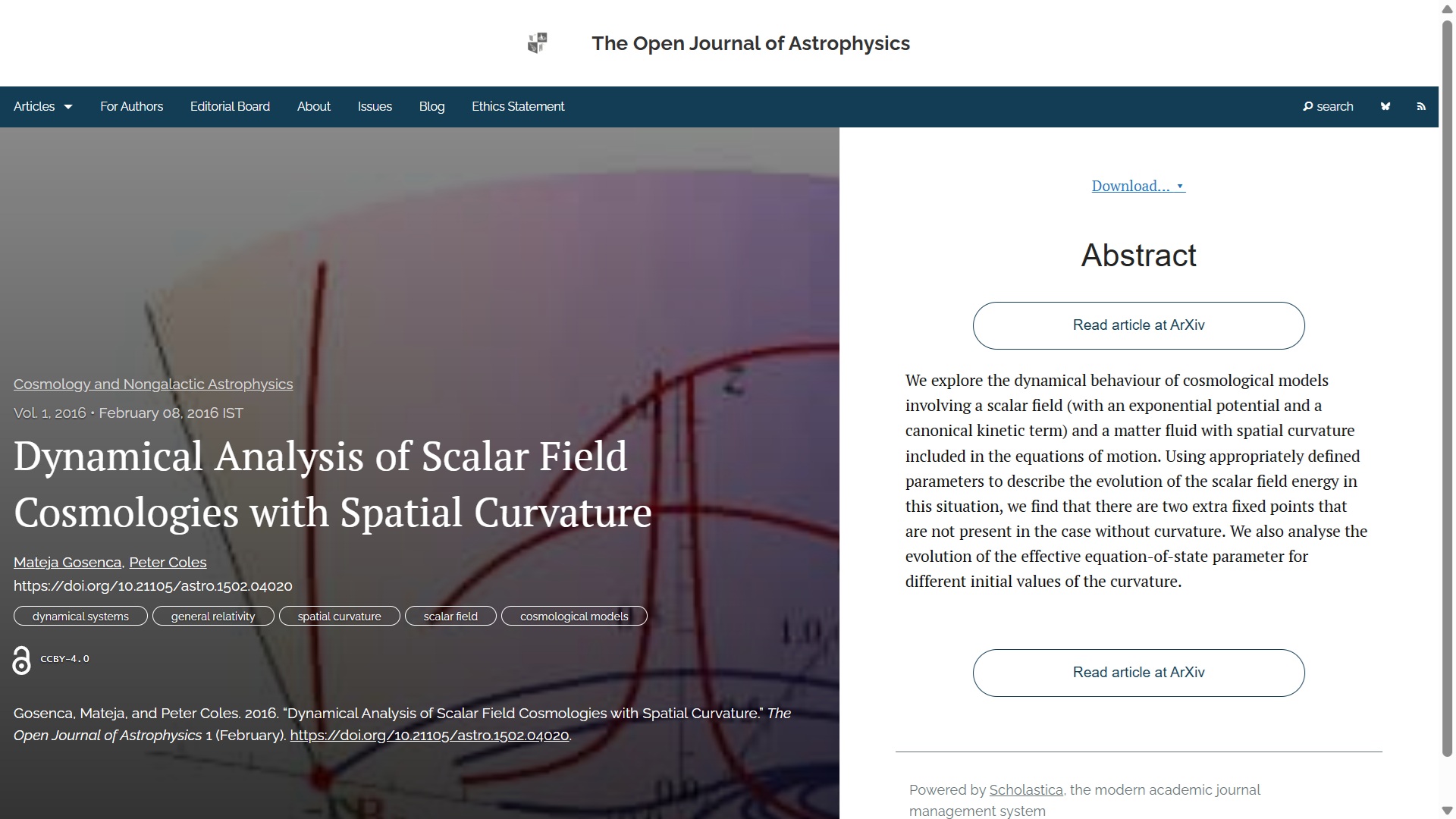
In those days OJAp was very much an experiment, and we used a protoptype platform which I had paid a developer to set up but it never really progressed beyond a “beta” version owing to stability and other issues. I was a Head of School at Sussex then and had very little time to work on the project and it stalled. I came to Maynooth in late 2017 and discussed the idea of OJAp with staff at the Library who were enthusiastic about it. We abandoned the prototype and switched to the Scholastica platform, imported the papers we had previously published into the new site and restarted. It was slow going at first and then we had the Covid-19 lockdown tand I had to conted with a workload that went through the roof. Several times I thought it was never going to take off and wondered about closing it to new submissions. With a bit of pig-headed obstinacy and a refusal to look facts in the face, however, we carried on.
The journal has grown steadily since the end of the pandemuic: from just 17 papers in 2022, 50 in 2023, 120 in 2024, to 213 last year (including our first Supplement). I expect we’ll publish over 250 this year. I think a large part of the growth has been due to the decision of the Royal Astronomical Society to adopt a pay-to-publish model. I expected it to take a while to establish a reputation, but perhaps not as long as it did. We’re still quite small compared to other journals, but I’m pleased with the progress. I think in the long run the slow start helped, as it gave us more time to iron out various issues and recruit more editors.
This brings me to the fact that I will be retiring in a couple of years, if not sooner, and someone else will have to take over as Editor-in-Chief when that happens. At present, OJAp is published by Maynooth Academic Publishing and it’s not obvious that arrangement can continue when I am no longer employed at Maynooth. It would not be technically difficult to transfer everything to a new owner, but the handover would have to be planned to avoid disruption.
P.S. As I mentioned last month, we are always on the lookout for new Editors. Please contact me if you’re interesed!

 In the Dark